Categories
Perspective

Destruction and Reemergence: Tracey Emin’s Renaissance of Self

By Verity Browne

Content warning: This article discusses grief, trauma, mental and physical health problems, suicidal feelings, sexual abuse and abortion.

My first encounter with Dame Tracey Emin’s work was at the Tate Modern this summer, at her exhibition A Second Life. A confessional, iconoclastic, and introspective showcase of sculpture, painting, photography, installation, film, writing, and textiles, Emin traverses media and, in doing so, encapsulates the female experience. It was from here that I was hooked on her story, which she details so poignantly throughout her evocative oeuvre. In viewing her exhibition, I picked up on themes of trauma and grief, and in her most recent works, physical illness, as Emin creates art reflecting upon her battle with bladder cancer. In earlier works, this idea of using bodily vulnerability and physical trauma as a subject is also present, as Emin’s two medically complicated and mentally challenging abortions in the early 1990s play a large role in shaping the narrative of her works – as well as triggering an artistic and personal reinvention.

As can be proven by her first-class degree from Maidstone College of Art, before her attendance at the Royal College of Art in 1987, Emin possesses a breadth of technical ability and prowess. In her school years, she favoured printmaking and woodcuts with a German Expressionist feel, without exploring too much the abstract; her subjects were often either dark landscapes inspired by her hometown of Margate, or representations of her turbulent relationship with Billy Childish. Her rarely seen 1980s watercolour paintings depict seascapes from her home in Kent, and interpretations of cityscapes as she explored her familial heritage in Turkey, for example, Istanbul (1989). However, while there are some differences in medium and colour scheme, Tracey’s rendering of people remains, throughout her oeuvre, Munch-like, with distorted or simplified faces, as can be seen in Disposition of Christ (1990).

Around 1990, after her abortions, Tracey Emin experienced what she refers to as an ‘emotional suicide’. Severely depressed and battling intense physical and psychological trauma, she burned all of the paintings which she had previously produced, in a vehemently driven attempt to rid herself of a part of her life which she believed no longer purposefully served her, or positively benefitted her. At her Tate exhibition this summer, I noted a wall decorated with small photographs, ordered in rows, of all of these destroyed works. To me, this arrangement seemed almost cemeterial and struck me in its emotional weight, while I simultaneously could appreciate there was an eerie beauty in such an homage, in Emin’s recognition of the brutality of her past. It can be difficult to comprehend the sheer significance which art has in her life, in order that the eradication of her artworks might be likened to a suicide of part of her soul, and that a material act of destruction can mirror an entirely individual and intimate mental one. In many ways this was the beginning of Emin’s effort to fracture the norms of how art is perceived: not only in the way that it is created and appears, but in the way that it resonates with all who encounter it. She meant to, and means to, challenge what art is and what it can signify – in her case, her art is a part of her very being.

A hiatus from art and creation ensued after her ‘emotional suicide’, until a return in 1993 at White Cube, with her first solo exhibition – My Major Retrospective, in which she debuted a tender assemblage of memorabilia, text, and paintings. Already, a drastic shift in style was apparent, Tracey adopted a more diaristic, honest tone, while also beginning to favour raw imagery of the female body in her paintings and sculptures, and the painting of rageful canvases inspired by her history as a victim of sexual abuse. She was experiencing an emotional rebirth, and this had encouraged an artistic switch from expressionism to a philosophical, and culturally critical, postmodern exploration.            
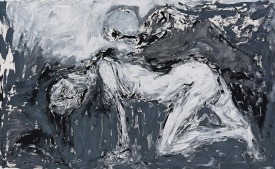
Like the Moon, You Rolled Across My Back, 2022, monoprint

In 1998, Emin created her seminal installation My Bed, and we are thus provided with another example of how reimagination is so vital in her art and in her life. At the time, My Bed divided public opinion and shocked critics. As pictured below, the installation featured a precise replica of her room after a four-day depressive episode, in all of its uncensored and intimate reality. Despite intense initial backlash to Emin’s confrontation of taboo topics, from depression to sexual liberation, it was nominated for the Turner Prize and had immense commercial success, being sold at Christie’s London in 2014 for over £2.5 million.
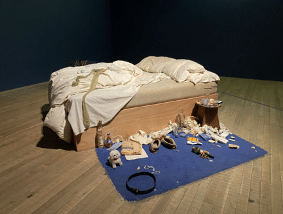
My Bed, 1998, at the Tate Modern 2026

My Bed pushed what art could be to the very precipice, and is now accepted and celebrated for having done so. In Artist Talk: Tracey Emin (2025) by The Yale Center for British Art, Emin confesses that this installation saved her and opened up doors for her. There is something remarkable about the fact that a recreation of one of the most pernicious times in her life could have been reclaimed in a positive way. Moreover, in this interview, she explains her process of installing My Bed each time it is exhibited and how she subtly changes certain elements – it is constantly being adapted and reinterpreted depending on her memory and perception of the site of her depressive episode back in the late 1990s. Thus, My Bed is subject to physical alteration as well as alteration of what it means to its creator; every aspect of the installation is always morphing, and from destruction, Emin produced something insightful and resonant.
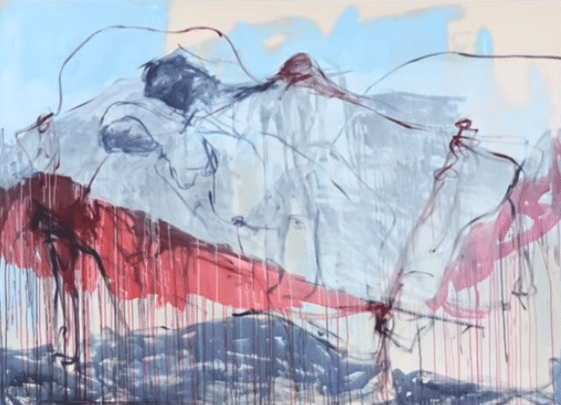
The Saddest Tomb, 2024                  
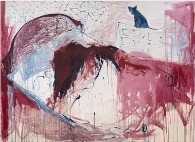
The End of Love, 2024        

(Beds became a motif in Emin’s later works.)                            

In both her personal and artistic life, Tracey Emin has undergone a metamorphosis; from mental and physical turmoil, she takes inspiration and is constantly developing her style and improving upon herself. She has reclaimed her trauma by making it into beautiful, emotive artworks which evoke pathos and convey feminine rage, while remaining sharp and socially conscious.

Interview: Artist Talk: Tracy Emin (2025), YaleBritishArt

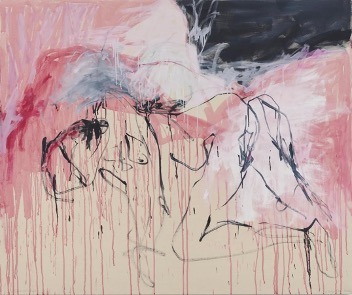
Featured image: Like a Cloud of Blood, 2022

Categories
Travel

Nearby North East

Venturing to different countries or travelling 1000 miles has seemed to become the defining action of what ‘travelling’ is. The Collins definition of the verb is ‘to go from one place to another, often a place that is far away’. Within this definition, I am interested in the use of ‘often’ instead of ‘always’. The placement of ‘often’ allows for the exploration of places within close proximity to also be defined as travel. This prompts the question: do you recognise such ‘travelling’ opportunities in front of you? 

Returning to university life, with the academic term fast approaching, has a certain monotonous undertone. Especially when your life consists of Elvet Riverside, Maiden Castle, and The Viaduct on rotation. The importance of recognising the potential of your surroundings instead of yearning to be abroad discloses an alternative secret world. 

By wandering around these areas, you notice many spots are unfrequented. The secluded nature of these places gives you the ability to escape within your own ecosystem. The dynamic of a place accessible to so many, yet filled by only you, brings a deep sense of reward. The fact that anyone could be here, but aren’t, lends you an illusion of superiority; you’re in on a secret and no one else is. Possessing this exclusive knowledge gifts you with a higher sense of awareness. That’s why articles have the word ‘hidden’ in their title, to entice you. It’s what I’m attempting to do now. 

Belmont Railway

Situated north-east of Durham, the Belmont Railway Viaduct towers over the River Wear, festooned with weeds and vines. Only accessible by a path hugging the roaring flow of the Wear, it is unsurprisingly accompanied by a sense of isolation. Completed in 1856 and closed in 1964, its cloudy grey stone and brickwork are a testament to Victorian engineering and the design of Thomas Elliot Harrison. A significant piece of history, which simultaneously acts as a standing reminder of the ‘Railway Mania’, which took place in the 19th century. Three hours will enable you to do a loop from the centre of Durham and return from visiting this structure. 

Crook Hall Garden 

A surprisingly unknown pearl situated opposite the Business School. With sections dating back to the first half of the 14th Century, it is natural to understand why the likes of William and Dorothy Wordsworth visited. The medieval structure is surrounded by complementary gardens filled with a medley of flowers and a moat pool. With a maze, café, and a second-hand bookshop, it is no wonder the Hall and garden are rated as one of the top Gardens in the North East. Owned by the National Trust, there is a price upon entry, however £8 setting you back is a bargain for the experience. After visiting in May, they were handing out free cyanotype photos, so you never know what might be behind the gate!

Lake District 

Maintaining a connection to the Wordsworth siblings, although not on the door step, a 90 minute drive away is Penrith. Hiking around the multiple lakes and through the inspiring landscapes, the literary creativity produced by the scenery is no coincidence. From gingerbread to Jemima Puddle Duck, you could build cathedrals (of which there is a lack of in the lakes) with the opportunities available. Often passing other hikers, you join a unique fellowship of strangers who stop to converse. When visiting earlier this week, slumped in a chair, arched back with head in hands, sat a 76-year-old man with his wife. His name was Ian, a retired police officer who worked for 30 years. After bumping into him twice on the trail from Grasmere to Ambleside, his passion for drawing and his son training to be a primary school teacher were revealed. Fleeting conversations is a distinctive feature of the Lakes, making it a tonic for the soul. By splitting petrol and scouting Airbnb, a night away can be as little as £25. 

Ushaw

Located 10 minutes West of Durham down Broom Lane is where the historic House and Chapels of Ushaw sit. Opening to the public in 2014, Ushaw has a rich Catholic History, originally being used as a religious community for training priests. When Ushaw opened in 1808, there was anxiety surrounding a potential anti-catholic reaction. This led to the construction of the Georgian Period Country House, which served as a disguise to shroud the true purpose of Ushaw. These vast collections of spectacular structures host events throughout the year, including music functions and floristry workshops. ‘Discovering the Big Library’ is held every month until December too, allowing you to see rare first editions such as Charles Darwin’s On the Origin of Species. 

There are plenty of places situated close by just longing to be explored. When looking at Pausanias, the Greek Historian and author of the earliest surviving guide to Greece, travel has always had connotations of a vibrant, foreign culture. However, this vibrant foreign culture can be overlooked when so close. So make sure to look outside!

Categories
Perspective

‘The Past We Inherit, The Future We Build’: The Continued Importance of Durham Miners Gala

By Cadance Whawell


Durham’s mining history, despite its importance in shaping the cultural identity of the North East, often is unfamiliar to the city’s term-time inhabitants. Unknown to many students is the swarm of people, who flood Durham for one day every summer. Colourful banners, brass bands, and a proud community, alien to Durham’s term-time self, transform the city into a day of remembrance, celebration, and solidarity. 

It’s the 11th July 2026, and it is clear this is no ordinary day. As I approach the Gilesgate Roundabout, there is a noticeably shorter wait to cross the usually busy road. It’s only 9am, yet families are already making their way into the city centre, whilst a whisper of music crawls up Claypath. By the time I reach Market Place, the few families have turned into dense crowds, and that distant sound has amplified into the distinctive blast of marching bands. From the Market Place, to Saddler Street, to Elvet Bridge, Durham has been transformed by parades of bands, crowds, and emblematic banners. The Big Meeting has begun.

After weaving through the crowds, and dodging the banners of mining collieries and trade unions, I find the perfect spot. Elvet Bridge in front of me, and the County Hotel directly behind me, I keep hold on my ‘barriers spot’ and wait impatiently for the procession to begin. 

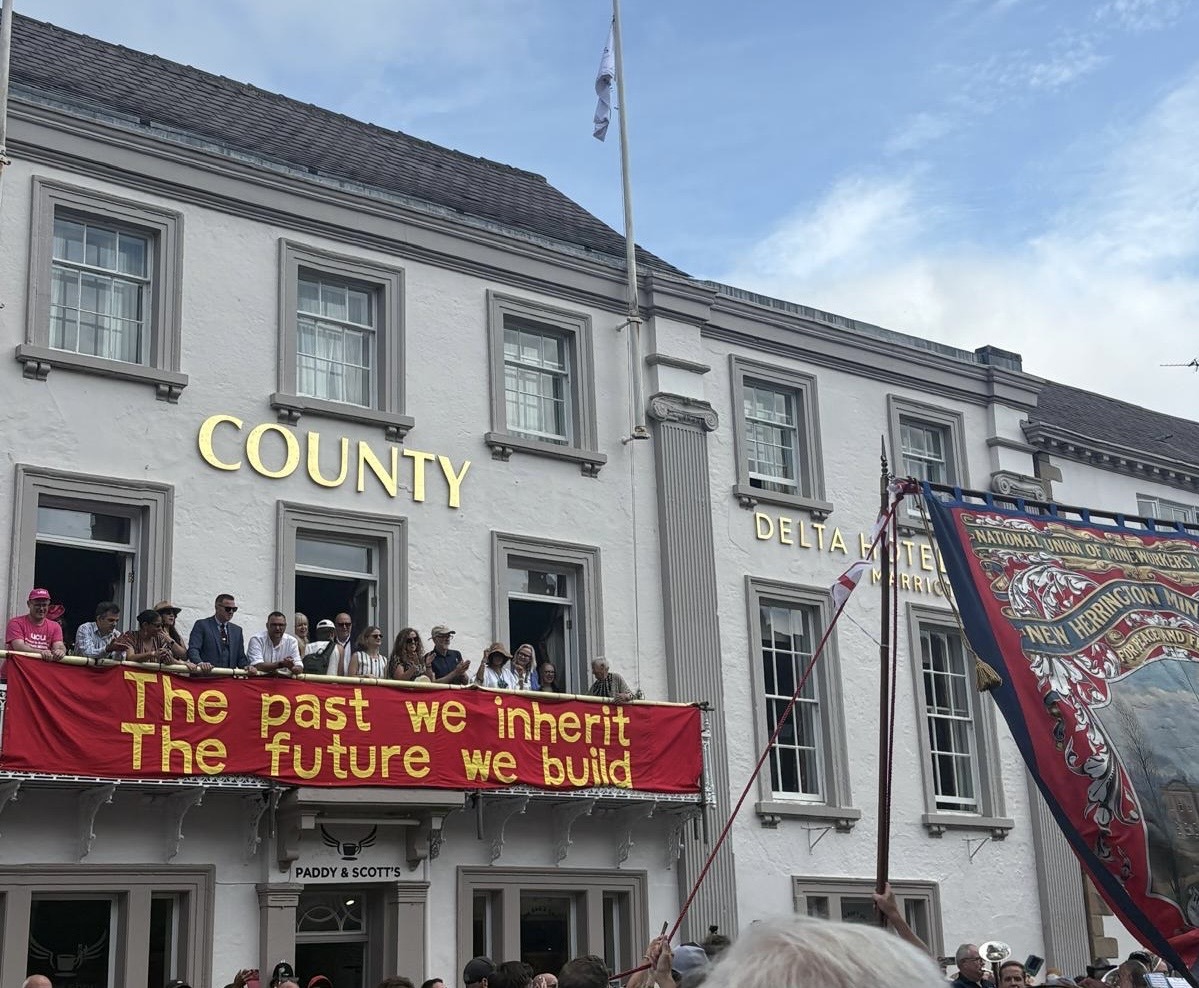
Signalled in groups towards Old Elvet, processions converge from New Elvet and Elvet Bridge before advancing towards the Racecourse. Mining lodges, trade unions, community and political organisations pass by me carrying their distinctive banners, accompanied by the sound of brass bands and bagpipes.  Many of the marchers stopped outside the County Hotel, where bands electrified the crowds and onlookers from the hotel’s balcony with renditions of contemporary hits such as Freed from Desire and Sweet Caroline. The juxtaposition of modern music and traditional instruments and symbolic banners poignantly captures this year’s 140th anniversary theme, ‘The past we inherit, The future we build,’ emblazoned across the balcony. A reminder to all that this is not only a celebration of the past, but hope and solidarity as we move towards the future.

After two hours of observing the parade, word of food and festivities at The Racecourse inspired a change of location. Following the procession down Old Elvet, we arrived at The Racecourse, except this wasn’t the familiar picnic spot many students enjoy during Easter term. The green field was concealed beneath a sea of people, lined with the gala’s historic banners, and alive with stalls, food trucks and a main stage. Transformed into a festival celebrating North East and working class culture, The Racecourse was certainly not a quiet cricket pitch today.

This festival ground offered the perfect opportunity to admire the Gala’s emblematic banners. Their symbolism, craftmanship, and detail gave the day an artistic dimension. Like wandering through an open-air gallery, each banner told a different story, reflecting both the histories and the present-day identities of the communities it represents. From mining lodges and miners’ families, to trade unionist, and campaign groups, the curation of banners created a unique representation of solidarity and community spirit.

In the midst of the activity of the day, it became impossible to see Durham only through the sheltered lens of its university prestige. The Big Meeting offers a glimpse into the region’s history, yet football chants ahead of England World Cup match that evening and brass-band rendition of Three Lions revealed how tradition and modernity coexist, allowing heritage to continue evolving. Durham Miners’ Gala is a reminder that the North East’s heritage is not simply something confined to the past. Contemporary culture slips naturally into the event through its songs and festivities, allowing tradition to evolve and be alive in the present, without losing its historic roots. Whilst the Gala preserves and celebrates working-class history, its message of solidarity continues to resonate today. Its socialist foundations continue to adapt to contemporary causes, bringing over 200,000 people to Durham each year from across the country.

Although Durham is best known for its historic landscapes, defined by its cobbled streets, cathedral and architecture, it is the annual Big Meeting that brings the city’s history to life, showing how heritage continues to live within communities today. 

Categories
Perspective

Where Did It All Go Wrong?

By Robertha Green Gonzalez

I was feeling rather nostalgic and decided to revisit the classic romcoms I grew up loving: Two Weeks Notice, Miss Congeniality, Jerry Maguire, Pretty Woman, Notting Hill, and 10 Things I Hate About You. The films that convinced an entire generation that love was funny, complicated and, above all, inevitable. Before I continue, I should make one thing clear: I’m no cynic. Quite the opposite. But as the credits rolled on each of these films, all I could think was…

Where did it all go wrong?

And not to sound like Carrie Bradshaw at the start of every Sex and the City episode, but how on earth did we let these films shape our idea of the perfect relationship? How did manipulation become persistence, jealousy become passion and grand gestures become the ultimate proof of love? More importantly, when did romcoms convince us that poor communication was chemistry and emotional chaos was destiny? That if someone hurts you, lies to you or disappears, they’ll eventually realise what they’ve lost, turn up at your door in the pouring rain and deliver a speech so moving that everything that came before simply doesn’t matter. Perhaps that’s the biggest fantasy of all. Not that love conquers everything, but that love excuses everything. Watching these films back, I realised that almost every one of these iconic love stories would raise more than a few eyebrows in 2026, and yet we still use them as examples in casual conversation of what we want in our own relationships.

Take Two Weeks Notice. For years, we were encouraged to cheer when George races after Lucy, finally realising he can’t live without her. It’s framed as the ultimate romantic revelation. Yet watching it now, it’s hard not to notice that he only seems to recognise her value once she’s prepared to leave. We’re taught this is love. In reality, it often looks more like someone taking a person for granted until they establish boundaries.

Then there’s Miss Congeniality. Eric spends much of the film teasing, challenging and undermining Gracie, and somehow we’re meant to interpret this as chemistry. The message is clear: if a man irritates you enough, it’s probably because he secretly likes you. That lesson has been thoroughly tried and tested, and I think we can all agree it’s aged really, really poorly.

Another one: Jerry Maguire may be responsible for one of the most famous romantic lines in cinema history: “You complete me.” At the time, it felt profound. Now it feels like an awful lot of pressure to place on another human being. The idea that one person should complete us suggests we’re somehow unfinished on our own, waiting for someone else to provide the missing pieces. And the worst part? My heart absolutely breaks for Dorothy, who has clearly been pining after Jerry the entire film. “You had me at hello”? More like, “I had my standards on the floor. You took me for granted, and now you’ve decided to give me the credit I deserved all along, which somehow excuses all of your previous behaviour.”

Pretty Woman? Edward climbing the fire escape to rescue Vivian is iconic. We all wanted the fairy tale. We all wanted the grand gesture. Yet beneath the fantasy sits an idea that appears again and again throughout romantic cinema: that happiness arrives when somebody comes to save you.

Even Notting Hill, and this one I hate to critique. I really do, especially because it’s one of my favourite films of all time. I firmly believe Anna Scott’s line that love is “a violin-playing goat” is exactly right. But even Notting Hill isn’t immune. Anna’s declaration “I’m just a girl, standing in front of a boy, asking him to love her”  is beautiful. It remains beautiful. But vulnerability alone doesn’t automatically make a relationship healthy. Throughout the film, Anna drifts in and out of William’s life whenever circumstances allow, she even cheats on her existing partner with him and yet we’re encouraged to overlook the instability and the relentless red flags because the speech is just so good and Julia Roberts… well Julia Roberts is Julia Roberts and how could you not forgive her.

Then there’s 10 Things I Hate About You, are we forgetting the central romance begins with outright deception. Patrick is literally paid to date Kat. Of course, he eventually develops genuine feelings, but the foundation of their relationship is built on a lie. Somehow, because Heath Ledger sings on the bleachers, we collectively agreed to ignore that part.

The more I watched, the more I realised they all sell a similar fantasy. Not that love should be kind, communicative or dependable, but that love should be dramatic. That the right person can behave terribly for most of the story, provided they deliver a sufficiently moving speech before the credits roll. What’s worse is that none of this occurred to me the first time around. I believed every airport dash, every last-minute confession and every grand declaration that somehow made years of emotional chaos worth it. And that’s because romcoms sold us a very particular version of love. Love doesn’t require accountability because, if two people are meant to be together, they’ll forgive each other anyway.

I found myself needing to be reminded that healthy relationships don’t make particularly good cinema, and the problem is that we started believing those obstacles belonged in real life too.

Featured Image: Disney

Categories
Culture

Violeta Parra: Singing for More Than Supper

By Cara Crofts

“Sometimes, while I am making a tapestry, a melody comes to my head. Then I stop, grab the guitar, and the melody flows with the same ease as if… I was preparing soup!” – Violeta Parra.

Chilean folksinger and artist Violeta Parra dismisses any struggle in her relationship with song – tunes seemingly arrived to her on the breeze amidst the day to day dreariness of stock pots and weaving. Her life could not be characterised by the same soup-making, lyric-writing ease. Financial hardship following the death of their father sent a 13-year-old Parra and her siblings to the streets, playing music for spare change or food in the midst of Chile’s Great Depression of the early 30s. It was through singing for supper that her lifelong need for lyricism began to grow; she came to find – and to crave – solace in the storytelling capacity of music. Songwriting became an addictive antidote for her ensuing bouts of depression. In her poetic autobiography Parra prescribes writing as a remedy which “calms the torments of the soul” but, although her soul might have found some lightness in outpourings of words and melodies, a deep-rooted melancholy tugs on many of her verses.

Parra’s haunting “Gracias a la Vida” is a bittersweet thank you to life, released on her final album Las últimas composiciones in 1966 before her suicide in 1967. Some of its mournful tone is stripped away by the more upbeat tempo of Joan Baez’s famous 1974 anti-war cover. For Baez, recording a home performance in 2020 during the Covid lockdown, “Gracias a la Vida” has the potential – as it always did – to be an anthem which can “help to raise our spirit in difficult times”.

Gracias a la vida que me ha dado tanto
Me ha dado la risa y me ha dado el llanto
Así yo distingo dicha de quebranto
Los dos materiales que forman mi canto

Thanks to life that has given me so much

It has given me laughter and it has given me tears

Thus I distinguish joy from sorrow

The two materials that make up my song

This image, popularised by Khalil Gibran’s 1923 poem “On Joy and Sorrow”, of being “suspended like scales between your sorrow and your joy” is certainly not an original one, but Parra’s tender rendition rescues her lyrics from being trite. Somehow this gentle ode to life was penned by the same self-proclaimed fiery spirit who smashed 48 guitars over people’s heads. In her creations, too, Parra is anything but predictable. Even Las últimas composiciones mixes sorrowful tracks with the playful riffs and satire of “Mazúrquica modérnica” and “El Albertío”. It is an album which wraps us in the highs and lows of life; it cannot decide between heartbroken laments and poking fun at society, but swoops easily between the two. It was a back and forth Parra relished: “I feel happy to be able to wander between my soul, very old, and this life of today”.

It wasn’t until the 50s that Parra became a folklorista. A conversation in 1953 with her brother Nicanor revealed that Chilean folk culture, following its decline during the 40s,  was being put under the academic microscope by university students as though it was a thing of the past. “Tradition is already almost a corpse”, lamented Parra at the time, so she began crossing the country to learn the traditional folk music of the Chilean countryside. She would help rural families in the fields or with the household in exchange for being taught to sing. An elderly farmer taught her to play the 25-string Chilean guitarrón, an instrument normally only for men. Not knowing musical notation did not deter Parra – she invented her own. The stories and skills she collected fuelled the songs which Parra started to write and release, and the national reception of these albums popularised a culture that had been on the verge of extinction; her Dylan-like breathing of new life into traditional folk music was a radio success. Across the Atlantic over a century earlier, 19-year-old Edward Bunting began a 47 year-long project recording and preserving music of the last Irish harpers. The titular poem of Moya Cannon’s brilliant collection Bunting’s Honey (2025) pays tribute to him with words that ring true of Parra’s preservation of her country’s music: “for what do a musician’s hands ever hold / but the hammered treasure of the human soul?”

During Chile’s 50s folk revival, photographer Sergio Larraín accompanied Parra to a working class boliche (pub) in a disadvantaged neighbourhood of Santiago. She began drumming the table, singing until the crowned joined in. “They sang beautiful songs,” recalled Larraín, “they were guys who seemed very dejected, but that’s where the music was.” Shared hardship continued to inspire Parra’s musical output with her pioneering of the Chilean nueva canción (new song) musical and political movement in the 1960s. The nueva canción did not stay confined within Chile’s bordering Andes mountain ranges; it spread across Latin America and brought social consciousness and protest to the core of the continent’s music.

Photographs of Parra depict her curled over an acoustic guitar, or a 25-string Chilean guitarrón, but she had a polymath career as a composer, singer, writer, poet, painter, textile artist, ceramicist and sculptor. In 1959, she contracted hepatitis, and the following bedridden months spurred on her main burst of production of visual art, which continued until 1965. Chile’s elitist art scene during the early 60s favoured traditional oil on canvas, so Parra’s arpilleras (embroidered burlap tapestries) or papier-mâché sculptures were not well received. 1960’s Europe, brimming with experimentation and New Realism’s ‘poetic recycling’, took more kindly to Parra’s abstract style and creative use of materials. She was the first Latin American artist to have a solo exhibit at the Louvre in Paris in 1964, turning her space in the gallery into a traditional Chilean ramada by playing guitar and serving Chilean food. Few items beat empanadas for uniting groups of people, but the floors of the Louvre did not erupt into cueca dancing in the way Parra might have hoped.

Alongside scenes of rural campesino culture, Parra advocated for peace through much of her art. Her tapestry Contra la Guerra denounces the harsh political oppression in Chile during the years leading up to Pinochet’s dictatorship.

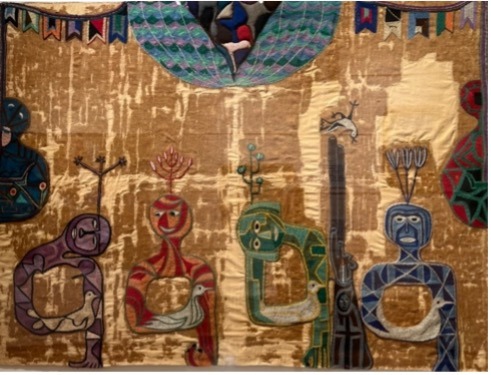
Contra la guerra (Against War), 1962, embroidery on fabric.

“This [political unrest] I don’t like at all,” Parra bluntly stated in a 1965 interview , “so my way of protesting is through painting.”  She explains the four embroidered figures in Contra la Guerra: herself and three Latin American friends, united by their desire for peace, each holding a dove. Unambiguous symbols are at play; a dove is shot in mid-flight by a rifle – those in power do not listen to their people. The flowers sprouting from the heads of the friends suggest continued resistance. Parra is unpretentious with her protest art; the pacifist messages are consistently clear and striking, much like her songs.

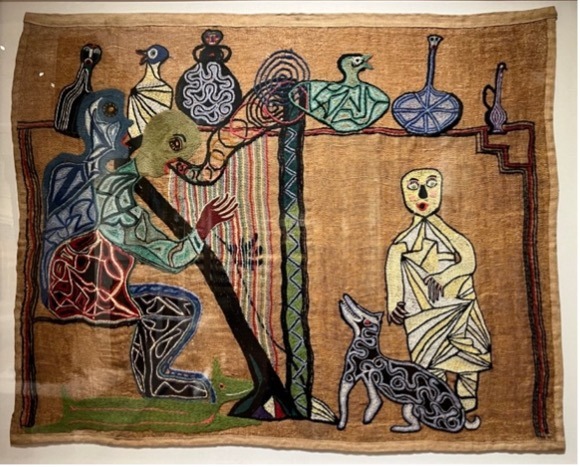
La cantante calva (The Bald Soprano), 1960, yute embroidered with wool.

With embroidering and painting Parra found an alternative to singing during her period suffering from hepatitis, but in her artwork sound still manages to explode out of the visual. La cantante calva evokes Parra’s frustration with her temporary inability to sing; the bird-shaped vases seem to be attempting to squawk a tune, but the swirling cords of wool are bottled up in their stomachs, unable to escape from the beaks in song form. Simultaneously, sound appears to be gushing out of the harpist’s mouth. The ascending circles serve a double function as the harp’s curvature and an outpouring of speech bubbles from the harpist’s perfectly aligned lips. The onlooking yellow figure adds to the imagined soundscape with a mouth curled into a neat ‘O’, perhaps whistling along.

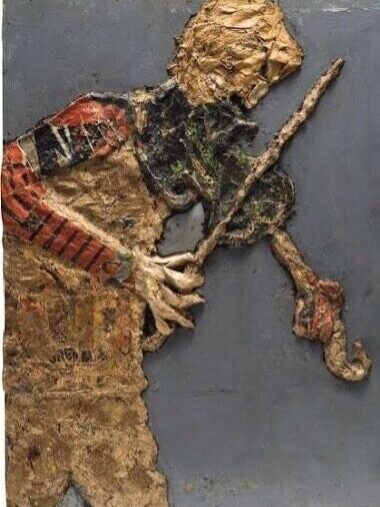
As in La cantante calva, the neck of the player in Parra’s papier-mâché Violinista bends to meet the instrument.

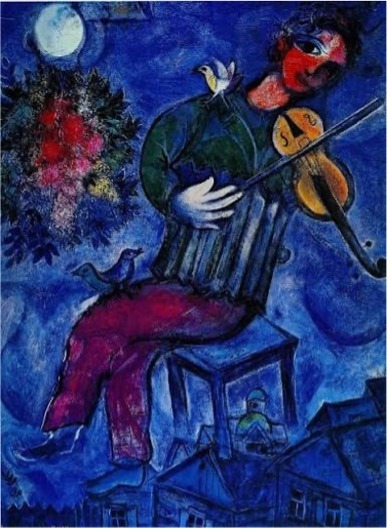
Violeta Parra, Violinista (Violinist), 1964-1965, papier-mâché (left); Marc Chagall, Le Violiniste Bleu (The Blue Violinist), 1947, oil on canvas (right).

It is difficult to tell where the violin ends and the musician begins; in the three-dimensional crumpled fusion of paint and paper the instrument and its player appear inseparable. The figure’s tilting stature and colour tones are reminiscent of Chagall’s The Blue Violinist (1947). In both, a hand glows white as though reflecting moonlight, the fingers splayed widely around the violin’s bow. The hand takes centre stage and seems detached from the violinist’s body, playing of its own accord while the newspaper man’s face tilts towards us expectantly, willing us to hear some musicality.

Parra’s own expression captures her artwork perfectly – her arpilleras are “songs that paint themselves”. It is impossible to imagine Parra at a blank canvas. She sought out the fabric of her country and was a whisperer of the threads of people’s stories; as if under her spell they wove together into words, tapestries and song. Her hunger for stories never died. To hear and see Parra’s art and music is not to be bowled over by perfection, but to encounter people. When asked to choose between song, painting or embroidery as the only form of artistic expression, she replied simply: “I would keep people.” The response of a true folklorista. What Violeta Parra craved more than creating was to connect with and connect the folk behind the lore.

Featured image: Thiago de Mello, 1960-1961, Museo Violeta Parra

Categories
Culture

‘The Story of Us’: Frances Ha at the Edge of Adulthood

By Saoirse Pira

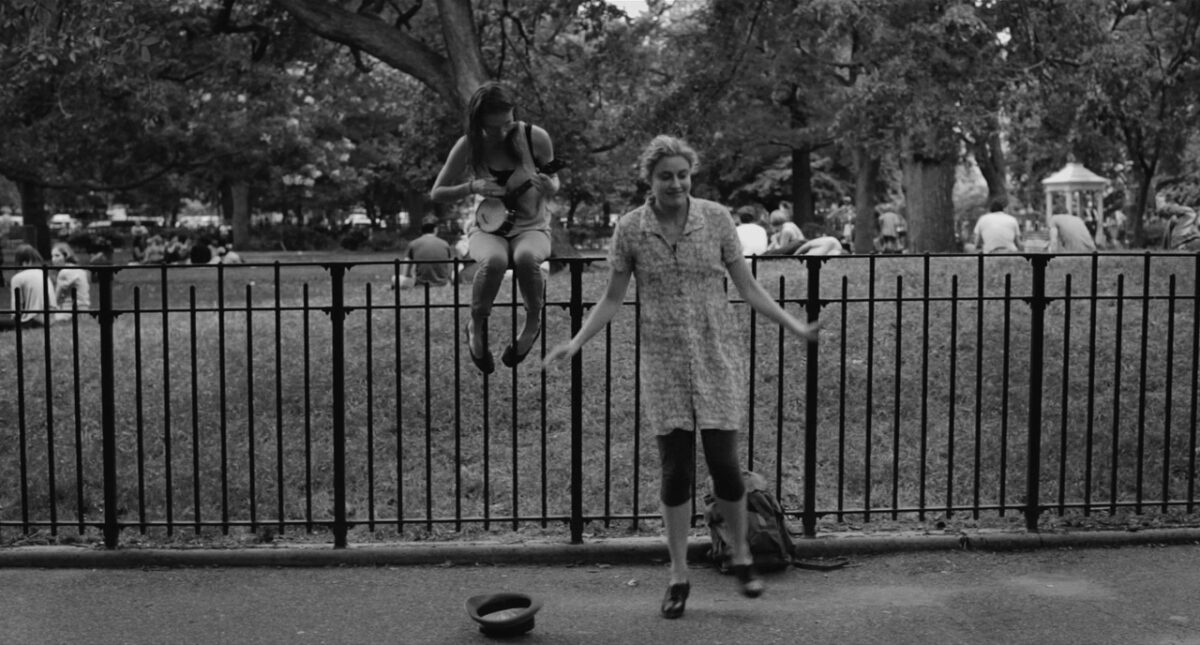
Around two-thirds of the way through Frances Ha (2012), Frances Halladay sits on the terrace at a dinner party she doesn’t quite belong to, drinking wine she can’t really afford, and delivers a monologue about what she wants from love. It’s what she wants out of a relationship, but it’s something altogether grander than that – “a secret world that no one else knows about, that exists right there in public unnoticed – sort of like how they say other dimensions exist all around us but we don’t have the ability to perceive them.” She’s drunk, but articulate, and it’s a clarity withheld from any of her romantic scenes. It’s not about romance, not really. It’s about her best friend; it’s about Sophie. It has always been about Sophie, about friendship, that foundational love. It’s recollection dressed up as longing; not wishing for some abstract love somewhere in the future, but reaching back through memory to the love that has, as of yet, defined her adult life. 

Frances, played by Greta Gerwig with a sort of kinetic awkwardness, is overcome with the particular humiliations of growing up and being outgrown. It’s not that she is opposed to adulthood, she just hasn’t quite found a version of it that feels authentic to her. Over the course of the film, we watch Frances, a twenty-seven year old dancer in New York, attempt to construct a life out of a series of increasingly unconvincing arrangements. She moves between apartments, between jobs, between friendships, between versions of herself. She is not quite successful enough to be successful, not quite unsuccessful enough to admit defeat, and not quite young enough to pretend that there is no urgency about her life. She is a dancer without a company, a woman without a permanent home, without a stable romantic relationship and, for much of the film, whose idea of the future still contains her best friend, at almost every point. 

The film opens with a montage, backed by the delightfully twee “Camille” by Georges Delerue (from Le Mépris), of the two women moving through life with pure and simple joy. They play-fight in public, fall asleep, head-to-shoulder on the subway, read and knit, cook, do laundry, smoke cigarettes out of two adjacent windows in their apartment. It’s all wrapped up in love. Later, after Frances breaks up with her boyfriend unceremoniously (he wants her to move in with him, she wants to stay with Sophie), the pair find themselves back in their apartment. Frances jokes that they are like a lesbian couple that don’t have sex anymore, they laugh about Sophie’s boyfriend, lie together in Sophie’s bed. Frances asks Sophie to tell her “the story of us,” and it’s a kind of dance they do together, rehearsed and metabolised. It’s a story that is a dream of the future, in which they are together, ever-inseparable. Their friendship is the beating heart of the film, and in this vision of the future, Frances and Sophie are upheld less as separate souls, and more as each other’s other half. They’re “the same person with different hair,” only Sophie is the version who might succeed at the ordinary business of adulthood. The problem isn’t that the two women have become dangerously entangled, but that the entanglement was the best thing either of them had, and that eventually, something would have to give – someone would have to grow up. 

Which is, of course, exactly what Sophie goes on to do. The centre cannot hold, and the story of us is interrupted by the ordinary attrition of adult life, in a series of small defections  that accumulate into one swelling ache of abandonment. Sophie is offered a better apartment in Tribeca, one Frances can’t afford to join her in, gets serious with her boyfriend Patch, moves to Japan with him, gets engaged. There’s a title card, a new address, a new chapter in the story of them. Sophie doesn’t wrong Frances explicitly; there is no instance of her telling Frances that she is leaving her behind, because that is not, technically, what she is doing, what she means to do. Sophie is simply doing what twenty-seven year olds with functioning careers and relationships do. It’s all perfectly reasonable, and that’s precisely what makes Frances’ grief so hard to name, let alone justify to anyone else. The tragedy belongs solely to Frances, who is left to grieve a friendship that has not ended, only outpaced her, and for which there is no accepted vocabulary of loss. Nobody sends flowers when your best friend’s life goes well without you.

Baumbach and Gerwig get at something about coming-of-age here – an understanding that growing up is rarely, if ever, a single threshold deliberately crossed. Rather, more often it’s an ache inferred over time, from the fact that someone you grew up with, built your identity alongside, has started living a different kind of life that is not predicated on you.

I first watched Frances Ha at eighteen, and I’ve watched it more than ten times since – it’s my favourite film, which is not a claim I make lightly or revise often. Somewhere along the way, it also became a kind of accidental litmus test; I’ve made most everyone in my life sit through it with me, and I don’t mean for it to function as a test of character, but there is always something telling, something pointed, in the way a person responds to the film, to Frances. I should not take it as a personal attack, of course, when a friend tells me they found Frances annoying, embarrassing, pretentious – but I can’t help it, really. I can’t shake the feeling that the embarrassment is the point: it is so incredibly humiliating to be shaking off your adolescence, to be suddenly so publicly behind schedule. 

Back home in Sacramento for Christmas, Frances is submerged in the bathtub at her parents’ house. It’s a close up of her face, she’s catching water in her mouth. Her mother is at the door, she wants to come in. Exasperated, she asks Frances, “How much longer?” It’s a short scene, all of fifteen seconds. There’s no grand swell of music, there’s no music at all. It’s quiet and intimate, it’s absolute urgency. She’s in the bathroom, taking up space – she’s underwater, and it’s on purpose. How much longer will she be? How much longer can she remain, submerged and arrested, grieving an abstract loss, suspended between adulthood she can’t quite claim and adolescence she can no longer justify? That’s the thing about growing up, in the end. There is no definitive moment at which somebody tells you that you have to become an adult, one at which you oblige. Eventually, you are simply expected to get out of the bath.

In “the story of us”, Frances and Sophie dreamed in tandem. They would co-own a vacation apartment in Paris, have lovers and no children, speak at college graduations, and receive honorary degrees. Then, later, on a credit card and a whim, Frances does actually go to Paris, alone, for a weekend. It is a place she had imagined as part of the shared mythology of their friendship, but it’s one she wanders through alone, jetlagged, sleeping through the day. She has flown halfway across the world to do precious little, trying to conjure a dream into reality with only half the parts. While Frances tries to bring about some sense of the future they had imagined, Sophie is doing the opposite. She has changed the score – she is living a life, building a future, and it’s not the one they had dreamed of together. It’s a life that has begun to make sense to other people.

But what becomes clear is precisely how little either woman actually gets from moving forward alone. Frances returns from Paris, having spent money she doesn’t have to visit a city that means nothing without Sophie in it. It’s not long after this that Sophie, too, spins out. Drunk and adrift in her own way, she comes to Frances in the middle of the night, needs her in a way that both recalls their old way and subverts it slightly. She tells Frances that she always felt competitive with her, and it’s an aspect of their dynamic we, nor Frances, had ever realised. There’s a sort of clarity there, an admission of fallibility, the quiet part is finally said out loud. 

Sophie goes on to marry Patch, and Frances goes on, too, to build something of her own. She takes a desk job at the dance company, she makes herself useful in a way that is less glamorous, though considerably more stable than anything we had seen her hold down previously. She choreographs her own piece, her own show. It’s gorgeous and decidedly Frances. Sophie comes to the show, and it happens: across a crowded room, Frances and Sophie catch each other’s eye. They look at each other, each kind of laughing, and they’re two bodies made up purely of love. Colleen, Frances’ boss, asks her who she is making eyes at, and of course it’s Sophie, it’s her best friend. It’s the moment Frances had always wanted, the pair of them in that secret world, finally, again.

We leave Frances as she moves into an apartment of her own; it’s far from the sort of place that would have made it into her and Sophie’s story, but it’s nice, and it’s hers. She writes her name on a piece of paper to slide into her mail box. She tries it, it doesn’t quite fit – she has to fold it slightly to get it in. Once in, it simply reads: FRANCES HA. It lands somewhere between punchline and good closure. It isn’t the life she and Sophie had dreamed of together in youth, it’s not Paris and lovers and honorary degrees. It’s smaller, it’s compromised, and it fits. She has made a life that fits.

Featured Image: IFC Films