By Bel Kelly
Midge had not been in the church for longer than five minutes when she felt that familiar hot slickness between her thighs. Immediate relief, then panic. She checked the date: yes, it really was that time of the month, how could she have forgotten? Of course, there were no tampons at the bottom of the tiny purse she had brought with her, and no time to go buy some. She looked around at the other attendees for someone to ask, but most were strangers, and Midge was still the kind of person, at twenty-five, to be ashamed to admit she was free-bleeding.
Shuffling out of the pew, she stumbled to the bathroom at the back of the church, her heels on the cobbled stone floor making it an embarrassingly loud journey. As she found her way into the boxy stall, vaguely traumatic memories of periods past came to her. She was a young teenager again, on a school trip or a first date. Stuffing her underwear with toilet paper, she remembered the horoscope she had read that morning on her astrology app: “Your body is conditioned unconsciously over a lifetime.” It really, really is. Yet, God, what an awful time for this to happen. Looking in the discoloured mirror, she checked her front and back. In the clear. Even if the next hours would be uncomfortable, she at least wouldn’t have red ruining her blue dress. Count your blessings.
Midge hurried back to her seat in the front row, on the end, next to Emily’s mother Irene Maitland, a gentle yet fretful woman who was all pearls and perfume. The two had tussled in the past: to this day, Midge remained quite unsure of if Irene had ever truly forgiven her for the time she spilled a glass of cranberry juice on their white sofa at the age of seven.
“Where’s our favourite lady gone?” Midge asked.
“She’s outside, trying to calm the baby.” She paused, and added, “You look well put-together, Miriam. Thank you for making an effort. The photographs are sure to come out very nicely.”
Midge felt a jolt, unsure of what feeling. She had known before, deep-down, that Irene did not see her fit for the role of godmother, but the comment confirmed it. Did it? Was she misreading it? There seemed to be judgement there. Shock, at least, that she could scrub up well. She suddenly wanted to tell her there was blood gushing out of her vagina like violent murder in her underwear, that she was going to haemorrhage all over her dress-skirt and stain the pew and ruin the photos too.
How crass. Was that the kind of godmother she was going to be, a godmother of messy blatant womanliness? She imagined the baby enamoured with her, an antithesis to mother Emily and Acqua di Parma grandma. Teach the kid swear words, sneak the kid treats before dinner. Midge had had an aunt like that, and what a thrill that lady had been.
A sharp cramp sent ripples of pain through her. ‘Messy blatant womanliness,’ she turned over in her mind, cringing. Go for ‘mess,’ perhaps, and leave out the rest. Irene was right to be nervous; she was a woman who polished silverware for fun, read Russian novels in the original Russian, could identify what country a bottle of wine was from with one sniff. She had raised Emily, a daughter who had excelled in everything she did: every sport, every job. And these two fantastic women were ready to leave this baby in Midge’s useless hands? Midge, who could not even keep track of her own period?
Imagine a gas leak in the family home, a hurricane on a holiday, a tragic twenty-car pile-up. Lifeless eyes, limbs everywhere. A accident so great it wiped out all the Maitlands, leaving Midge as the only one left to raise this baby. The cramp twisted and contorted in her gut. A knife with a jagged edge inside her, slashing up the lining of her uterus.
“Irene, you don’t have any painkillers on you, do you?” She didn’t clarify it was for cramps. It felt so school-trip first-date to admit a little vaginal bleeding could still incapacitate her.
Irene looked up from her phone, and nodded. Of course she did. Retrieving them from her bag, she said, “There is a water cooler by the bathroom. I’m in correspondence with Emily, the baby is really upset so we shouldn’t be starting the ceremony for a bit longer still, so you have time.”
Midge took the pills from her, popped two, dry-swallowed them, handed the box back. Irene looked at her, slightly appalled, and then turned back to her phone. The judgement was becoming irritating. When was the last time Irene had had to deal with menstruation anyway? As soon as the thought came to mind, she regretted thinking it: it felt mildly ageist, or misogynistic, or something, she wasn’t sure.
When was the last time Emily had had her period, Midge wondered. She always got it around the twelfth – that was something Midge learnt when they briefly shared an apartment at university – and was real hard work when she was on it. Crying, craving, cussing, the works. And yet those memories of managing her bleeding best friend around the twelfth in that scummy flat remained fond. Whatever made Emily cry, they would laugh about later. Stupid commercials, sad Facebook posts.
Things had changed so much since then. Midge now lived alone in a flat the size of a postage stamp, while Emily and her husband Robert were just one stop away in a cosy two-bed. Now, they saw each other for a pint every so often. As exquisite as these meet-ups were, it was clear that the days of stroking each other’s hair as they moaned about cramps were long gone. Still, with the pain in her tummy ballooning, Midge could go for some hair-stroking now.
Midge wished she had been there when Emily missed her period on the twelfth, when she tested positive. She wished she had been the one to drive her to her first doctor’s visit. Instead, she had found out about the baby like everyone else: a post on Instagram. A chalkboard inscribed with “We’re pregnant!”, blue and pink balloons. Very Pinterest, very Emily.
She had asked Emily, on one of their pub nights, why she hadn’t told her first. We wanted everyone to find out about it at the same time. There was a time when Midge wouldn’t have been a part of the everyone bracket – she would have been the one helping Emily draft the post. Looking around the church, it’s not like everyone is on Instagram anyway. Great Aunt Lily in the third row could barely hit ‘call’ on an iPhone, let alone download a social media app. It felt like an excuse. But count your blessings: she still asked her to be the godmother.
Emily hadn’t needed Midge’s help in those first few weeks anyway. From the outset, she had seemed to handle pregnancy with professional flair. She was good at it: all the exercises, a squeaky-clean diet, a regimented sleep schedule. She was prettier than she had ever been. Perfect picture of femininity. Midge looked for an image of Mary for comparison, but couldn’t find one. Vaguely ironic, she felt: Shouldn’t Mary be present for a Christening? She imagined that conventional picture: A young woman with black hair in blue garb, passively smiling down at her marvellous tummy. The Virgin Mother with Emily’s lovely round face.
The painkillers had turned the sharp feeling in Midge’s tummy dull. She looked down at herself, imagined that same swelling. A couple years ago, she had been repulsed by pregnancy. No way could her body do all that. Now that she was older, she was less disturbed by it. She instead regarded it with the same curiosity and fascination with which she did abortion. It seemed rather thrilling to be able to hold life in one hand, and death in the other.
Life in one hand, death in the other. She’d said that to her mother several years ago, when they found themselves in a dinner-table debate about abortion. Midge’s mother had called her sacrilegious and inconsiderate. You don’t get to decide who lives and who dies, she’d said. Then who does? Someone has to, Midge had shot back. Looking back at that night, she felt ashamed to have spoken so lightly of it all. Her mother had been a girl, too. She had gotten periods at awkward times, and stuffed her underwear with loo roll, too. She had looked in the mirror and imagined a little girl with her own features, too. She had also sat on a toilet somewhere waiting for a pregnancy test result, shuddering with anxiety. Midge wondered what she had felt when she’d seen those two vertical lines. She wondered if she was what she had pictured, when she had looked in the mirror and imagined a daughter.
“Well, Emily is truly taking the mickey now. It’s half past,” muttered Irene, a sudden brick wall in front of her train of thought. “I ought to go talk to the priest.”
“You do that, Irene,” Midge responded, aiming for supportive and landing on somewhat condescending. Why was it so impossible to talk to this woman she had known all her life?
Irene narrowed her eyes. “You might make yourself useful, Miriam, in going to check on Emily. I’ve no idea where Robert has gotten himself to. Such an ineffectual man.”
“Such an ineffectual man,” Midge repeated with a laugh. She stood, happy to be given a task.
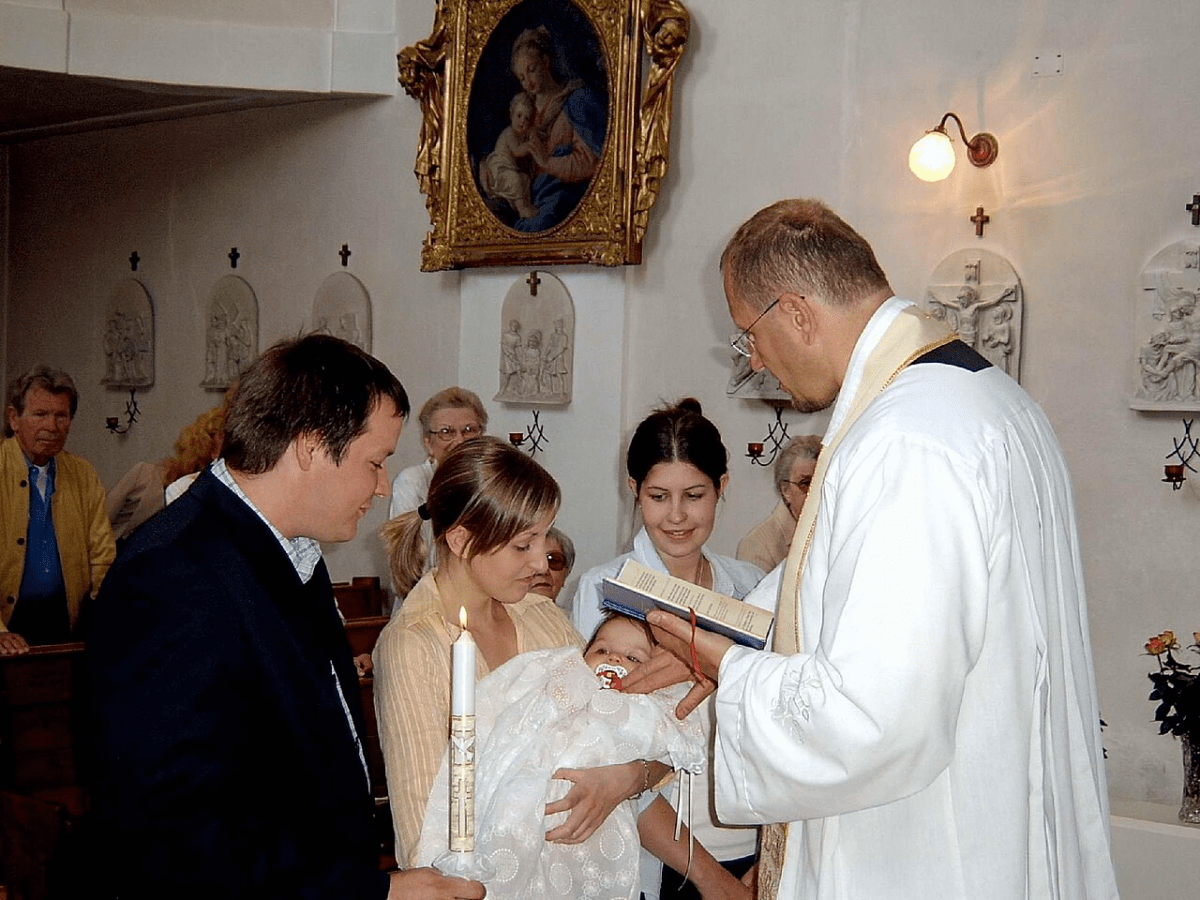
Again, she made the awkwardly loud journey to the back of the church, and stepped out into the cool October air. The church grass, peppered with golden leaves, shivered in the wind. Emily sat on the steps, in a pink tea-dress. She held the baby, cooing gently to it as it cried.
“Hey, Em, what’s going on?” Midge came to sit beside her. Emily jumped, not expecting her, and the baby cried even harder. Both mother and daughter’s faces were red and streaked.
“I can’t get her to stop crying. She just won’t stop crying. I don’t know what’s wrong, and she can’t tell me what’s wrong, and everyone’s inside waiting, and I don’t know what to do.”
Midge looked at the creature in her best friend’s arms. That was a whole human girl. That was her best friend’s daughter. How absurd, that we all start out as weepy rosy little blobs.
“Take a break. Give her to me,” Midge heard herself saying. Here was life in her hands. It didn’t feel good, but it didn’t feel bad either. The baby wriggled a little as she held her: was she doing something wrong?
“I don’t really know how to do this,” she told Emily.
“Neither do I,” Emily said with a dispirited smile, and put her head on Midge’s shoulder. “I could really go for a cigarette right now.”
Midge replied, “I passed a corner store on the way here. When this shit’s over, we’ll run by and pick up a pack. It’s on me. Christening gift.” They laughed. Midge ran her hands through Em’s hair. “I just got my period too. We’re both really having a morning, aren’t we?”
“God, I remember periods.”
“Babe, you know you still have to have them for like another couple decades, don’t you?”
Emily groaned, and they laughed again. The baby’s crying had subsided.
“I don’t think it matters if the baby’s crying, anyway. She’s going to start crying again when we dunk her in the water anyway.”
“Midge, we’re not dunking her, oh my God, it’s just a little water.” She paused. “But you’re right. We should head in. Let’s go.”
Her best friend next to her. The warm soft autumnal sunlight. The gentle swaying of the trees. Irene’s perfume. A promised cigarette. Blessings, counted. Midge looked down at the strange pink little thing in her lap, a little girl. She thought of the blood between her legs. She felt no more compelled for one of her own. But, God, this kid was beautiful. Just like her mother.
“Let’s go, Midge,” Emily repeated, without moving.
“I’m ready when you are, Emily.”
Featured Image: Wikipedia, Public Domain