Categories
Culture

Saudade: Senna vs Prost

By Robin Reinders

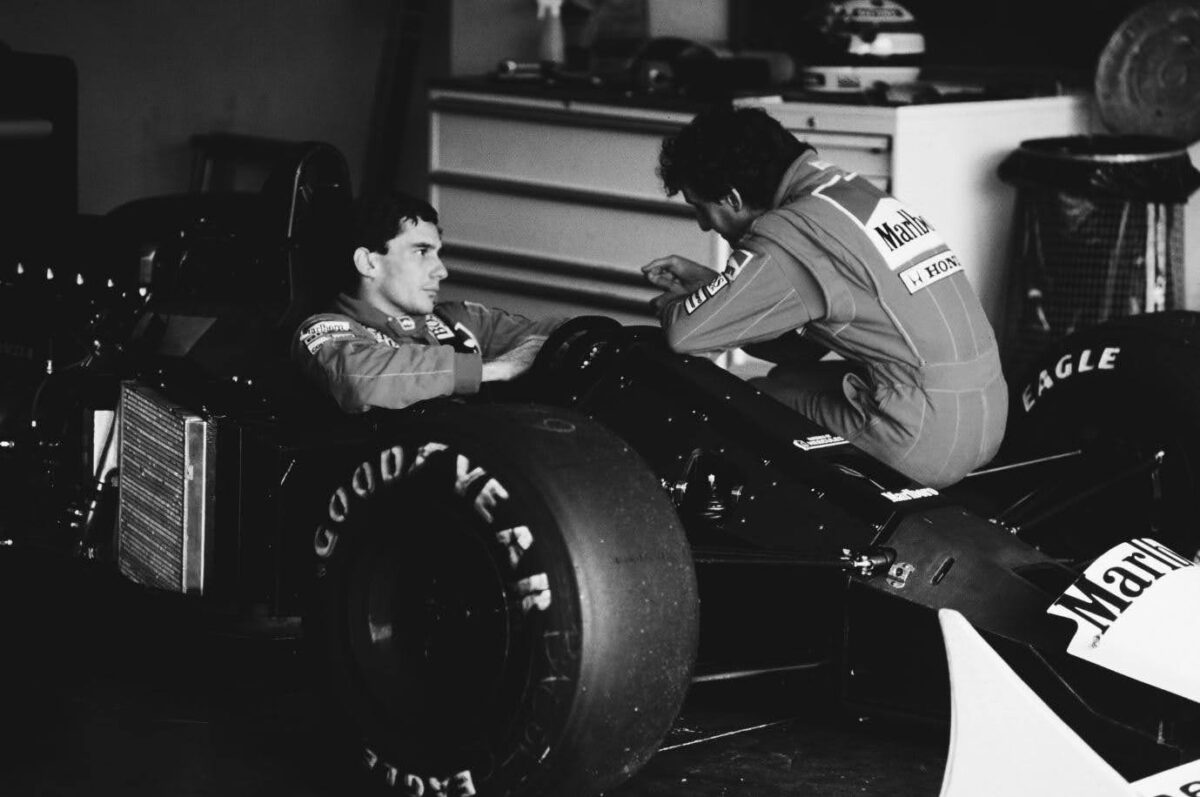
When you hear the word ‘Brazil’, what do you see? Racing driver Alain Prost correlates the country with a sequence of fond images. He remembers the sun, the sand. He remembers the smiles of the locals, their welcome, their character. He remembers the churrascarias and the beach and the grandeur of Rio de Janeiro. ‘And then’ – he speaks wistfully in an interview, mouth pulling askew – ‘there’s Ayrton.’

It is an invocation spoken like a prayer, a name that rests heavy at the base of Prost’s skull, brought forth and splayed bitterly across his face. It is both wound and salve. Match and mirror. ‘When you talk about Senna you speak about Prost and when you speak about Prost you talk about Senna.’ It is arguably the greatest rivalry in motorsport history; two near-divine beings rocketing through Formula One’s golden age, galvanising it with their animosity, their obsessive competitiveness, their tragic humanity. Near-divine. Near.

Teammates, 11 and 12 – but never partners. Theirs was a war waged in millimetres, in fractions of a second, in the mechanical exhale of a V6. Senna drove with holy devotion, God behind his ribs and beneath his palms; Prost was secular, stringent, sharp. In no world were either clean. Haniff Abdurraqib speaks on that astringent flavour of intimacy enemies share: ‘there is a tenderness in knowing what desire ties you to a person, even if you have spent your dreaming hours cutting them a casket … it is a blessing to know someone wants a funeral for you.’ Senna’s monomaniacal fixation on Prost cannot be overstated; here was a teenage karter with Renault-yellow and a charmingly crooked nose plastered on his bedroom wall, all-grown-up and starving for approval. Idolisation through a jaundiced lens: gnarled into confounded resentment, gnawing at the insatiable void of a racing driver’s volatile ego. ‘Ayrton did not think about other people’, Prost would say, ‘he just thought about me.’

Suzuka was the crucible. 1989 saw a collision on the chicane: Prost turning into Senna, sacrificing the twin McLarens on the altar of the tarmac to strategically secure his success; Senna, furious and dogged as he hauled the damaged car to the finish line – only to have his win invalidated, the championship seized. 1990 saw a reflection, a retribution: Senna hurtling into Prost, abandoning his former teammate – now driving for Ferrari – in the gravel as he snatched the championship like a malicious, mean-faced baby-brother.

When Prost retired, the fever broke: ‘We came to terms … and we stopped trying to remake each other.’ For the first time, there was laughter. Prost describes the year between 1993 and 1994 as the time he and Senna were closest. ‘Why did we put ourselves through all of that?’ he would ask. There was ease. There were breakfasts and late-night phone calls and ‘my dear friend Alain; we miss you Alain’ – spoken by Senna on the morning of the end of all things. And then Alain Prost watched Ayrton Senna die from the commentary booth at Imola. Watched as Senna torpedoed at 211 km/h into a concrete cradle. How do you cope? How do you mourn your mirror?

‘Maybe all I can say is that I was having breakfast in the morning of race day and he dropped by and sat with me. I am glad his final breakfast was with me. Even though it was short, that was still time he gave to me.’ This is how Alain speaks of his only rival, his counterpart, his almost-friend for the next thirty years, voice cloyed with saudade.

‘It was a fantastic story, don’t you think?’ he asks. His words are quiet, hopelessly reverent. 

Featured Image: LaPresse

Categories
Creative Writing

Leopold The Russian Bear

By Robertha Green Gonzalez

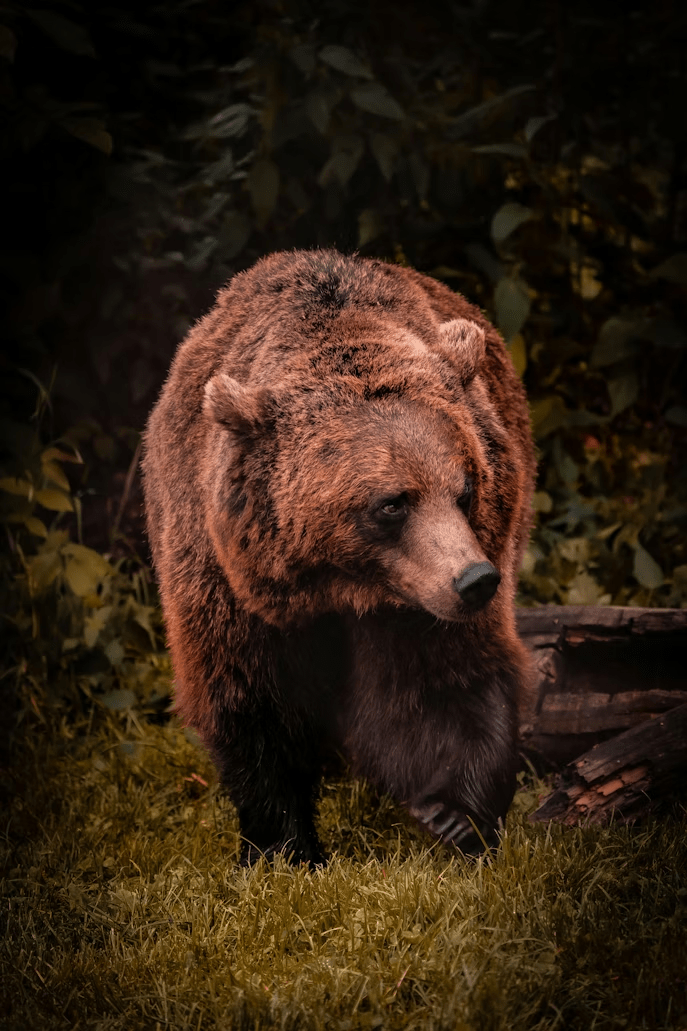
Leopold was a Russian brown bear. Precisely how he came to inhabit the welfare rooms of the Sergei Rachmaninoff Conservatory remains an enigma, one of those strange realities people come to accept not through understanding, but through quiet resignation. It was said, simply, that he was there and there wasn’t really much one could do about it.

He was not, by nature, an objectionable tenant. Leopold bore himself with a certain melancholy dignity. He did not roar, nor did he disturb. To put it frankly, he wasn’t much of an inconvenience to anyone, unless of course you needed to use the welfare facilities, in which case, to put it rather bluntly, you were stumped.

Curiously, Leopold spoke excellent French. How a bear acquired such eloquence is unclear. Rumours abounded. The most persistent of them claimed he had learned the language in the 1970s in order to woo a violinist named Arabella. She, poor soul, never saw his face. She heard only the voice, low and resonant, emanating from behind a half-closed office door. And how could she have known? Leopold

was, if anything, a hopeless romantic though hopeless more in the sense of being ill-fated, or even morally adrift. He delighted not in love itself, but in its illusion.

In stringing Arabella along the path of imagined passion, he seemed to reach the outer edge of some dimly recalled humanity. But love requires flesh, and presence, and truth and Leopold, alas, was still a bear. When Arabella graduated, she vanished

from his life. There wasn’t much Leopold could do about the matter and since, Leopold has seldom spoken French.

I think the last noted occurrence was rather tragic really, as it was used with rather malicious intent – luring a visitor, an oboist if I’m correct into the welfare room and … well truly, no one saw her again, though the sound of her oboe – of the melody Gilles Silvestrini’s Six Etudes Pittoresque is apparently often heard in the quiet of the night.

There was, however, one particular occasion that stands out. Perhaps it even explains why Leopold is still allowed to reside in the welfare rooms at all. It was to do with his fondness for jazz. 

Naturally, jazz wasn’t something regularly heard in the conservatory reality, almost improper. Yet from the room below Leopold’s, it drifted upward now and then—the work of a saxophonist, a quiet prodigy. Lived mostly in major thirds and Chopin études. But jazz, that was where his heart sat. He kept his passion for it hidden, a

secret. Only late at night, when he was certain everyone else had gone home, would he indulge. Quiet at first, then freer, more wild. It was beautiful, really.

Leopold listened. Night after night, he’d sit in the welfare room above, unmoving. He assumed, based on the playing, that it was a “he” down there. He never checked. Leopold didn’t like leaving the welfare room. What mattered was that anyone who tried to interrupt the player, anyone who thought they might barge in or critique or ask politely for the practice room, was met with a rather unpleasant surprise the

following morning. A large, unmistakable one. Left just outside their door. It was, to put it plainly, Russian brown bear shit.

It didn’t take long for word to get around. Soon, no one dared interrupt the saxophonist. And a kind of understanding formed unspoken but very real, that if the bear liked your playing, then no one else had the right to question it. In a place filled with judgement, that kind of endorsement was priceless. Leopold and the saxophonist never actually spoke. Not once. But their silence said enough. A strange sort of friendship. One that didn’t need to be acknowledged to be deeply felt. In some ways, it may have been the thing the saxophonist needed most.

The following year, he quit the conservatory. Went off to play jazz full-time. In an interview, he was asked why. He said, simply, “It was the bear.”

And that was that.

Featured Image: Daniel Diesenreither

Categories
Culture

“Heart of gold, constitution of an ox, and pants of thunder” – An Ode to the Weirdest Children’s Film Ever Made

By Charles FitzGerald

Circa 2011, I was browsing the small film section of my primary school’s library. It housed the usual suspects – Barnyard, Open Season and, bizarrely, Bridget Jones: The Edge of Reason (one for the mums, I suppose?). Even stranger was the sun-faded, garishly noughties DVD – bearing its title in big, bold Comic Sans; Thunderpants

The synopsis was weirder still: a ten-year-old boy with incredible flatulence who dreams of becoming an astronaut is recruited by NASA to assist in a life-or-death rescue mission. Upon reading the blurb, a resounding wave of ‘what the fuck?’ washed over me. I had another read before opting for Coraline

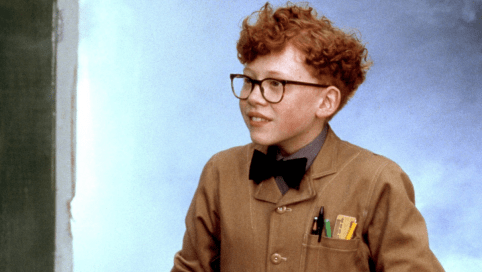
Thereafter, Thunderpants haunted a young Charles. I couldn’t shake the confusion, bordering on concern – how on Earth could they make a children’s film about something so puerile? Who would green-light such a thing? Why was a bespectacled Rupert Grint on the cover? My father claimed he’d once caught a portion of it on TV – calling it “one of those British films that’s desperate to be  American”. I asked if he’d recommend it and, with commendable economy of language, he replied, “No”. The conversation moved swiftly on. 

Morbid curiosity eventually got the better of me. I searched for Thunderpants in my father’s old Radio Times compendium, where it received a scathing one-star review from Alan Jones. In an ingeniously subtle play-on-words, Jones hailed the film “an absolute stinker”, and “excruciatingly vulgar”. That clinched it; I had better things to occupy my mind with than a 2002 family comedy about farting – such as my forthcoming Year 2 SAT exams. 

Thunderpants was co-written and directed by Peter Hewitt, whose resume is a diverse roster of light-hearted 1990s films, from Bill and Ted’s Bogus Journey to The Borrowers. The film was shot over the summer of 2001 on a modest $7 million budget, though it ultimately failed to recoup even half of that at the box office. Its production company, Pathé, must have had some faith in  Thunderpants – as the film boasts a baffling all-star cast:

Paul Giamatti of Sideways, Ned Beatty of Deliverance (responsible for the titular quote), Stephen  Fry of supposed ‘national treasuredom’, Simon Callow of Four Weddings and a Funeral, Rupert  Grint of a little-known multi-billion dollar franchise about an adolescent wizard, and a young  (uncredited) Keira Knightley. The lead, Bruce Cook, retired from acting following the film’s release in May 2002. 

My first viewing of Thunderpants came in the advent of the first national lockdown. I can’t quite remember why I sought it out – probably the urge to extinguish the spectre which burned in my psyche for the preceding ten years. Within the film’s opening five minutes, something becomes abundantly clear: the blurb on that sun-faded DVD does no justice to the debauched lunacy that is Thunderpants’ plot. 

Here’s a fun little exercise for you. Of the following, which do you reckon is a genuine Thunderpants plot point? Bear in mind, the British Board of Film Classification awarded the film a  ‘PG’ certificate – citing “some crude humour”. 

I.) A newborn baby quite literally flies out of his mother’s womb – as the doctor exclaims,      “We’ve got a flyer!” 

II.) A young boy’s flatulence becomes so unbearable, his father permanently leaves the family home – and his mother turns to chronic alcoholism. 

III.) A young boy, named ‘Patrick Smash’, accompanies an opera singer on a world tour –   producing an unattainable high note with his “unique gift”. 

IV.) A young boy is placed before a firing squad after accidentally murdering an Italian man with his flatulence. 

V.) A young boy is strapped to a methane-powered rocket thruster. The resulting flame prompts Paul Giamatti to punch the air and yell “hot dog!” for some reason. 

Your suspicion is correct; they are all, indeed, real components of Thunderpants’ plot. Like young  Charles, you are likely questioning how – and to what end – this made the journey from Hewitt’s  ‘lively’ imagination to national cinema screens. Having had fifteen years to mull this over, I feel well-equipped to answer. Despite the feeble special effects, the unsavoury green set-design, and  the off-putting inappropriateness of the whole thing, you’d be hard-pressed to call Thunderpants 

a “bad film”. 

Thunderpants treats its audience with respect – developing its juvenile premise with surprising restraint. In careless hands, Hewitt’s central, crude conceit would wear thin very quickly. And yet,  in a film about a young boy’s inability to control his flatulence, the wind-breaking becomes almost incidental – a vehicle for an earnest message of overcoming adversity and pursuing your dreams.  It’s just as schmaltzy as it sounds, but only the most cynical could fault the ambition. 

The central performances are similarly earnest, though they effectively serve their purpose. Cook plays  ‘Patrick Smash’ with a perpetually gormless gaze, as unperturbed by his school bullies as he is by appearing before a firing squad. Grint echoes Jerry Lewis’ Nutty Professor in his role as Cook’s only friend – a child prodigy who lacks a sense of smell. None of the all-star cameos phones it in either – revelling in the material’s Viz-like absurdity. 

Most striking is Thunderpants’ no-bars approach to cruelty. Under the guise of a Beano comic strip brought-to-life, the film is relentlessly bleak. The lead – a ten-year-old child, mind – is mercilessly bullied, neglected by his parents, insulted by a criminal barrister, and exploited by questionable NASA officials. Hewitt’s message – ostensibly “life is shit, so do what you can with 

what you have” – is refreshingly honest, and seldom posed in children’s media. 

Despite my modest praise, I find myself in agreement with young Charles. A children’s film with such a puerile premise should probably not exist. At risk of sounding puritanical, there’s a myriad 

of subject matter Hewitt could have used as a crux for the ‘follow your dreams’ moral. Equally, I  must concede, Thunderpants is as good a film about farting could possibly be.  

Thunderpants was met with widespread critical derision and quickly fell into DVD bargain-bin –  and school library – obscurity. It performed so poorly at the UK box office that Pathé released the film straight-to-DVD in the US, several years later. The US poster prominently features a much older  Rupert Grint, bearing little resemblance to his appearance in the film; a desperate attempt to cash in on his Harry Potter fame. 

For years, Thunderpants remained a barely-visible stain on the memories of those who saw it as children. However, recently, many have taken to TikTok and X to express their glee that  Thunderpants wasn’t just a bizarre fever dream – and defend the film as a childhood favourite.  

The cast seems similarly fond of the film. During a press junket for The Holdovers in 2023, Paul  Giamatti was visibly delighted at an interviewer’s reference to Thunderpants. He states, without a  sliver of sarcasm, “Thunderpants is one of the most remarkable movies I’ve been in… It is a  brilliant movie.”  

In a sea of AI-generated slop – functioning solely as cheap babysitting under the misnomer of  ‘children’s entertainment’ – a film as humble, unpretentious and charming as Thunderpants is well worth reevaluating.  

Categories
Poetry

Territories

By Daniel Ali

You readers trust written things too much,

honesty is not a poet’s obligation –

even unfiltered thoughts are pulsed through a poetic sieve.

Adulting is unclean–

mediocre and cynical,

like an untuned piano.

Who am I?

I’m a hoarder’s untouched basement,

artefacts of everybody I have ever met.

I occupy the space in my head too much,

resorting to memories

to find feelings.

This comes naturally to me,

divulging like this,

I wish I could talk to her so fluently.

Societies and times change

but people never do.

Stale progression, stagnant evolution.

Today’s snow is cold and

my dog will not settle.

I think my brother has the flu.

Featured Image: Toby Dossett

Categories
Perspective

A Chat with God.

By Tess May

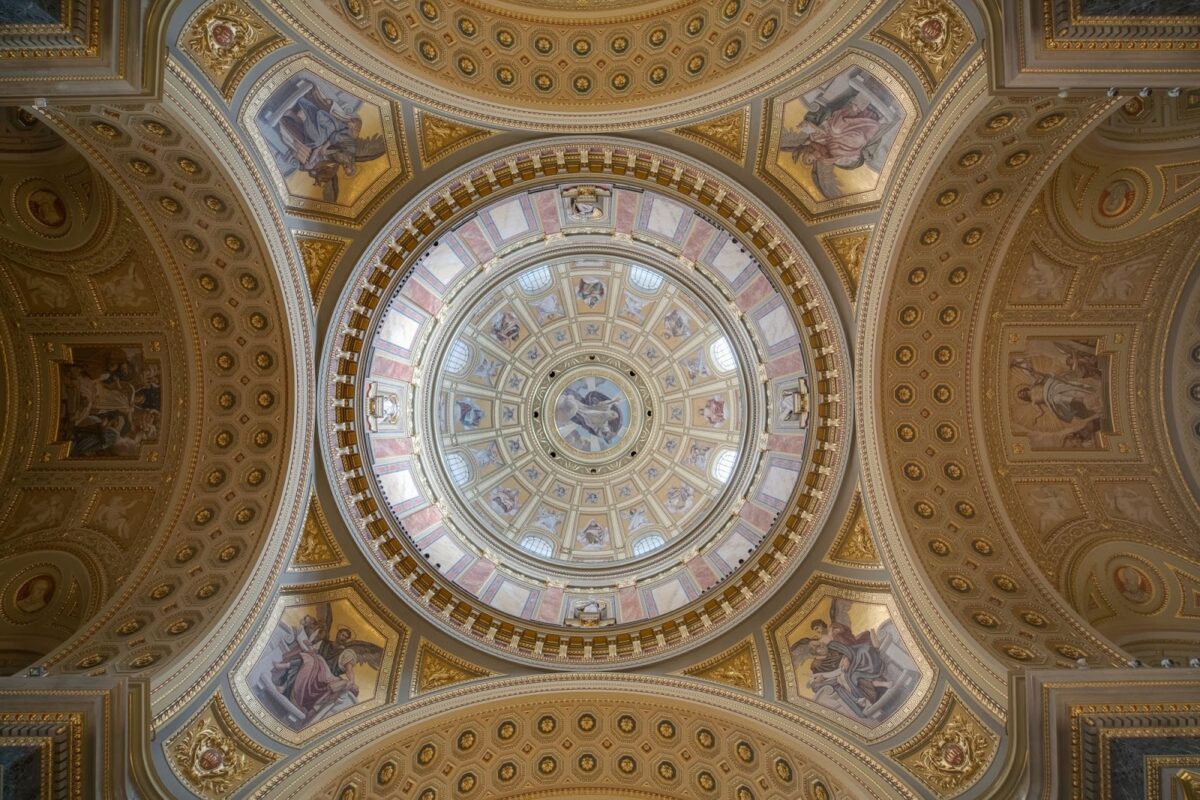
An inner monologue sitting inside St Stephen’s Basilica, Budapest, Hungary. 

“I never know how to start these. I guess it’s because I never know if you’re listening. Though I imagine if you were to listen to me anywhere, this would be the place. It is so very beautiful. 

There was a sign on the door that said ‘Dona Nobis Pacem’, which means ‘Give Us Peace’. I wonder if you will. 

I can’t get over the grandness of this church. I wonder very much if you revel in its glory, or despise the nature of it. All this gold – it cost me $19.99 to even be allowed in here. Surely the money goes to the church’s upkeep, though I can’t help but think of the ways in which the money would be better spent. I think you’d agree with me, but I suppose that’s the irony of it all. 

I wonder if that’s why I could never find true faith – no offence. The irony that is, well, you. The irony that runs so deep it is spilling out the altar in front of me. I meant what I said, I think, in that poem I wrote a few years ago –  that you are very much like a girl in your idealism and your anger (that is to say, you are so very human). You – or at least as far as I’ve been taught – created this world to be a perfect place. You created beings perfect and free from all that could be bad – created them to be like you. And yet, when they did not show you gratitude, when things did not work as you had imagined, you stripped away this perfection, and left the world with people like me: silly little people, who spend their money on beautiful places to worship you, in the hopes that you will ‘give us peace’. It must have been a terrible mirror you saw that day, right at the start of time. You set a tone for this world when it had barely begun. That, I would wager, you didn’t realise until it was far too late. Do you fault yourself for being so quick to anger? 

I also wonder if it was all truly a part of your plan, as the wise old men wearing robes seem to think. I wonder if you do truly have the power to bring us peace, or if maybe you know that peace is something we must all find for ourselves. In the same breath, I wonder how much power you really have. Because as The Creator, you have created a world that can create on its own. Is it you behind every birth, or did you create what is now a hands-off machine? I suppose that’s a sacrilegious thought, but I wonder all the same. 

I wonder why you bless some more than others. I wonder why you’ve blessed me more than most. And I know I have not had an easy life, but if you were to place me on a chart I am certainly not naïve enough to expect to be anywhere near the lower half. But I also know that I am blessed to know I’m blessed. And I wonder why you can’t give everyone that. 

I wonder about Mary. I wonder how she feels. I wonder if Jesus really was your son, or just a good guy, who believed in your goodness. I wonder if you love him because he saw things in you that you didn’t see in yourself. Maybe I’m making you too human in my head, but I think I like you better that way. 

I’m sad to not believe in you, really. I’ve always been envious of the people who know to their core that they walk in your light. You must be such a comfort to them. I hope that you don’t disappoint them one day. 

There are a few things that I know about you. Or I think that I know. I know to be kind. I know not to lie. I know to forgive. 

I wonder if you forgive, truly. I think of the women suffering in ways that I have been fortunate not to suffer, living in very different parts of the world. Do you forgive the men who oppress them, since likely they have never known to behave differently? Why couldn’t you tell them to stop? Do you bless the women in ways I can’t see or know? Can you forgive yourself for creating a world like that for them? 

I’m so full of questions, and at the same time I feel full of answers. In all my wondering, I feel quite strongly about what I suppose the answers to be. Which leaves me with one final wondering: do I know these answers because it is who I am, or because of who you are? Have you revealed yourself to me in such a way that I do know you, without knowing that I do, or are you simply everything that I am, because that is what I want you to be? 

I wonder also if you have heard any of this. I hope you have. I’d like to think you did. 

Oh, and while I’ve got you, one last thing: please look after my family on this earth. And please look after my loved ones in your kingdom, because if it does really exist, I know that is where they are. 

And thank you, God, for this life. I truly am grateful. 

Amen.”

Image Credit: St. Stephen’s Basilica, Budapest – official website

Categories
Travel

Bellême: A Week in Perche

By Toby Dossett

A week can be an awkward unit of time: too brief to claim familiarity and too indulgent to pretend it changed you. Travel writing had taught me to distrust the “short stay”, to almost apologise for it, to pad it with fact and disguise its thinness with beauty. The Perche region in Normandy, France, resisted this instinct, and I wanted simply to show the week as it was.

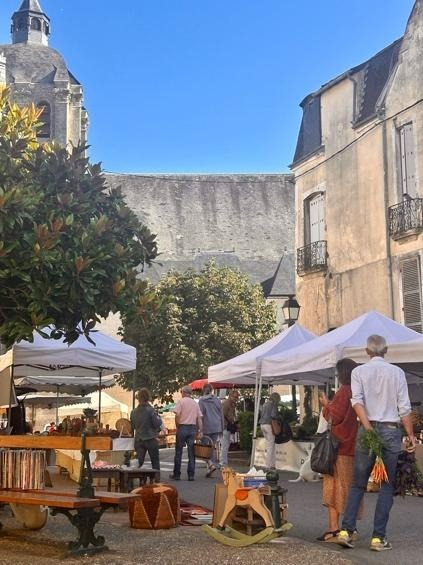
On Saturday morning, the bells of the Church of Saint-Sauveur spilled over tiled roofs into the Place de la République, drawing locals and visitors toward the weekly market. I followed the crowd through the stone archway and into the square, where garlic hung in thick, snug bundles and plump, grooved tomatoes blushed against half-timbered façades. Artichoke petals were lilac at the tips and tiny fresh radishes a deep pink. The sun was beginning to press down, and I swallowed the warm air in giant gulps. Stalls meandered across the square; at the far end, books and frames lay on the cobbles beside a pottery stall, crates of records and more antiques. My favourite piece there was a handcrafted rocking horse with a burnt-red saddle. A breeze tried to lift it into motion but only nudged it upwards so it looked permanently on the verge of rearing and bolting down the hill.

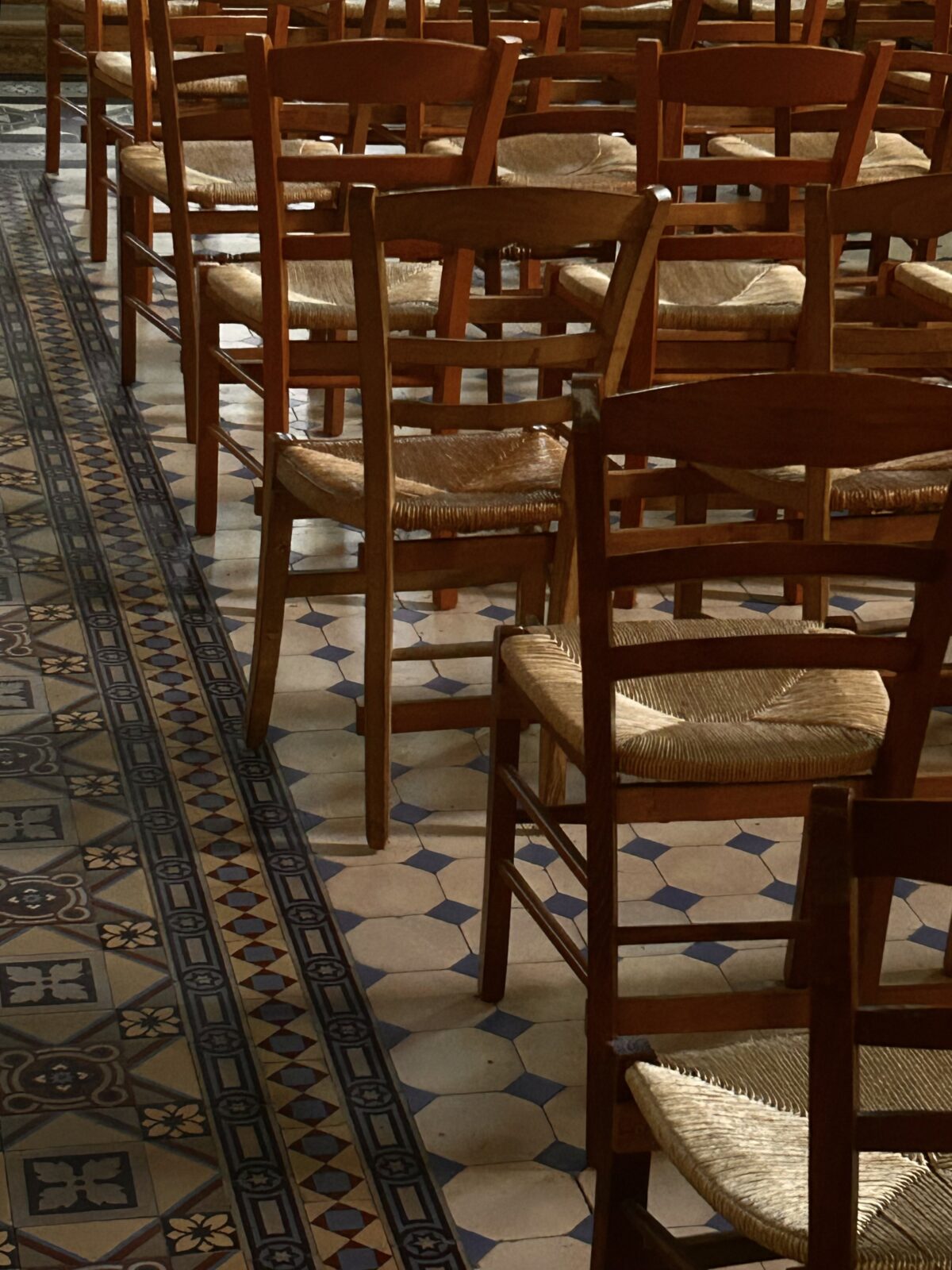
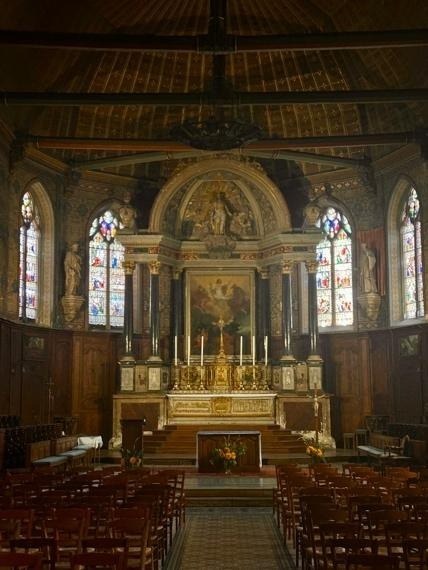
L’Église de Saint-Sauveur, a seventeenth-century reconstruction of a fifteenth-century church, sat at the town’s centre and looked down on the market’s slow churn. Inside, subdued light filtered through faded stained glass onto rows of straw-seated chairs. At the far end, the marble altar and tabernacle formed the main decorative focus, while the rest of the interior was restrained and pale. The ceiling lifted gently above the nave, its height felt more in the dark timber of the beams than in empty air, so that the proportions stayed balanced and the atmosphere calm. This calm was anchored by the mixed smell of stone, wax, incense and sudden gusts of cold air – a smell immediately recognisable to anyone who has spent time in old churches elsewhere in Europe. When I left, I stepped out through a curved doorway that felt almost like a portal in itself with the outside light already tracing its frame. On the tower, the most unusual feature was a clock placed deliberately off-centre. I wondered why, as it seemed quietly defiant, and so I was glad I’d noticed it despite the sheets of light layering down in front of it; we don’t look up enough these days.

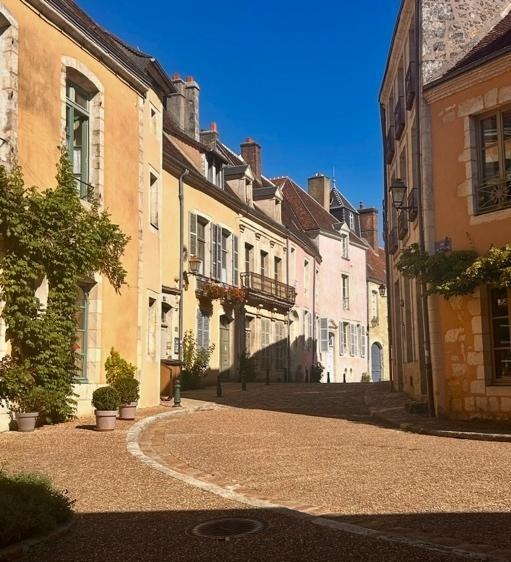
The oldest house on the square bore the date 1580 carved into its stone, and Rue Ville Close, the oldest street, was lined with half-timbered houses that leaned conspiratorially towards one another. Six antique sundials were scattered across façades in the rest of the town; it would have been easy to spend an afternoon hunting them down one by one. The buildings that held antique shops and small galleries appeared barely altered by their commercial lives. One such shop, Métamorphoses – Bois Métal Lumière – specialised in elaborate door knockers, their faces, animals and abstract whorls made it easy to imagine the elaborate doors they might one day belong to.

From the square I followed the edge of the medieval wall, still mostly intact, and stopped at a plaque explaining how Bellême had once been the seat of a powerful Norman barony. The original arched gateway, the Porche de Bellême, which I had walked through not an hour earlier, still framed the town’s entrance, while fragments of ramparts slid down towards what remained of the old moat. A single swan circled the pond, leaving an oval of ripples that continued to widen, like loops of a gaze. From the bottom of the slope, I could see the houses on the hill bending down to peer into the passing streetcar windows; the whole skyline carouselling past in separate panes of glass.

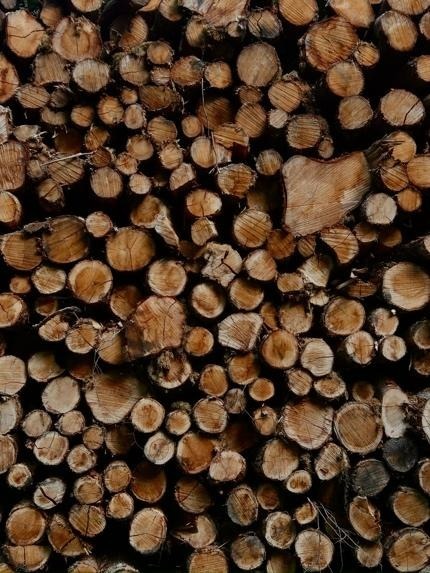
Later in the week, on Tuesday, we walked through the forest near Belforêt-en-Perche to find the Fontaine de la Herse. The site consisted of two landscaped basins ringed by six sandstone blocks; on two of them, Latin inscriptions translated as “To Aphrodite” and “Consecrated to the lower deities, to Venus, Mars and Mercury”. It was a small Gallo-Roman sanctuary in a clearing, its stones darkened by their time in the water. In the forest, rain nibbled at the leaves and the path softened underfoot. When we stopped by the side of the path, I noticed a heart-shaped patch of moss on a tree, a deer with wings on a waymarker and several stacks of cut logs waiting to be taken away. I wanted to roll the ends of those logs with ink and press them onto a large canvas, to see if I could keep their intricate rings forever if they were only going to be burnt or chomped into chippings. We ended the walk with chips and a beer, a hot, salty round off to all the green and grey.

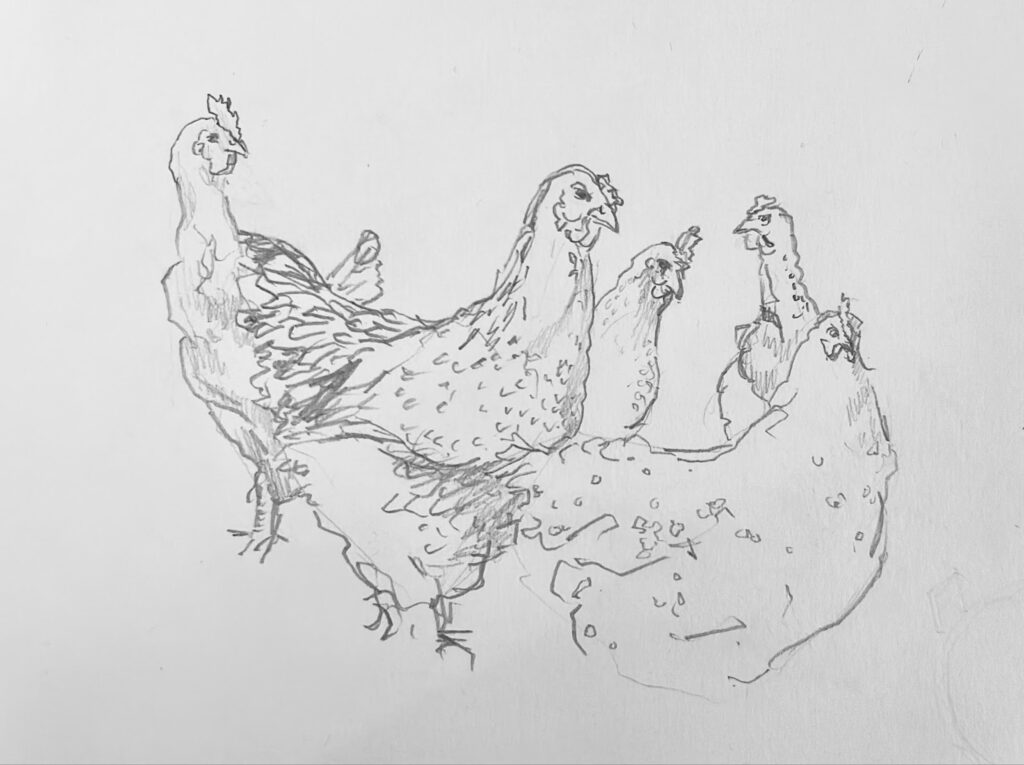
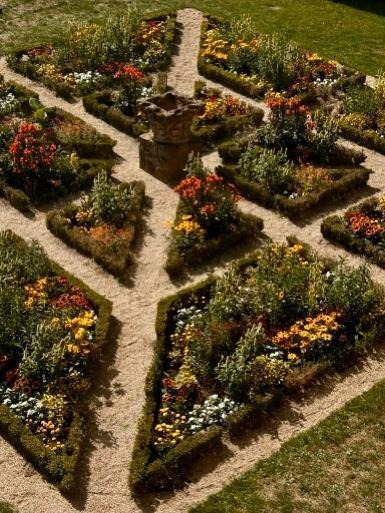
The next morning, tractors in the neighbouring field pulled us awake. We had coffee in the sun, spooning sugar from the tarnished yellow tin. Louise and I went down to see the horses, (she enjoyed feeding the smaller one green apples) and we managed to free a tiny blackbird from a wire trap. We collected eggs from the chickens, while Pop set up his easel, painting the house from different points in the garden at different times of day, tracking the light like a human sundial. The house itself had old beams and plain corniced walls, and a long, benched dining table in the kitchen that invited chopping and spreading and laying out. Lunch was crisp baguette with slabs of salted butter and a salad of roughly chopped beef tomatoes – tomatoes that tasted briefly, insistently, of having been somewhere else that morning. They were drowned in olive oil, splashed with balsamic, and finished with a generous throw of salt and purple basil snipped from the herb bed by the back door. We ate cantaloupe melon afterwards. In the evening Jérôme scattered thyme onto the fire while he cooked the meat, and we drank wine from Bourgogne while Jacques Brel and “Alexandrie, Alexandra” by Claude François triggered tipsy singing round the table. A dozen lanterns hanging from the nearby trees cast small, steady circles on the floor, encouraging the night to move on inverted wings, aloft.

Mortagne-au-Perche gathered itself around the Église Notre-Dame, with its hexagonal terracotta tiles, pale stone exterior and a square edged with cafés, estate agents and bookshops (many Parisians enjoy long weekends in the region and rent.) We took an early coffee there, watching Thursday’s shoppers move between stalls and neighbours greet one another. Sixteenth-century houses organised themselves beside modest modern buildings without fuss. In one window, model cars and bottles of cognac were lined up in rows and in another, an antique shop was so densely layered that, staring into the glass, I came to see that each item had a label from who it was donated by.

From there, we drove on to La Chapelle-Montligeon to see the Basilica of Notre-Dame de Montligeon, a muted stone structure set against open countryside. Inside, the space was high and white and full of gathered light. Nuns dressed in white moved quietly between the pews, a line of similarly dressed children followed. During our visit, a choir rehearsal filled the nave with children’s voices that rose easily into the vaulted ceiling. I didn’t understand the words, but the sound travelled along the ribs and arches of the building, and it was enough just to sit and listen.

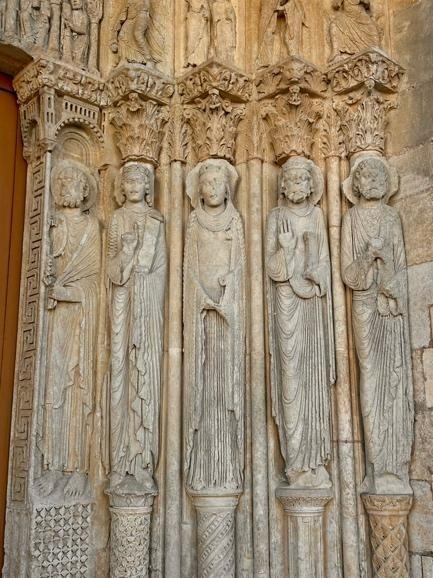
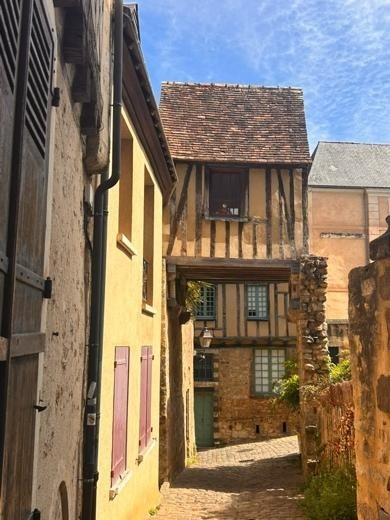
On our last day we drove an hour or so out to Le Mans and climbed up into the Plantagenet City. At the Place des Jacobins market, stalls were packed close together, selling old stamps, enamel pins, waxy paintings and hundreds of second-hand books. Watches and jewellery cases glinted on blue tables, and beautifully carved violins leaned against their cases in the sun. The town hosted a medieval festival each year, but we had just missed it, though we could sense the anticipation for banners to be raised in the following days. We crossed the square and followed the old town’s narrow, colour-beamed streets as they rose towards the cathedral.  Along the way, we spotted a carved doorway depicting Adam and Eve which stood beneath a teal-framed window, where a scruffy dog had wedged its head between the shutters and was almost dribbling down onto the cobbles below. 

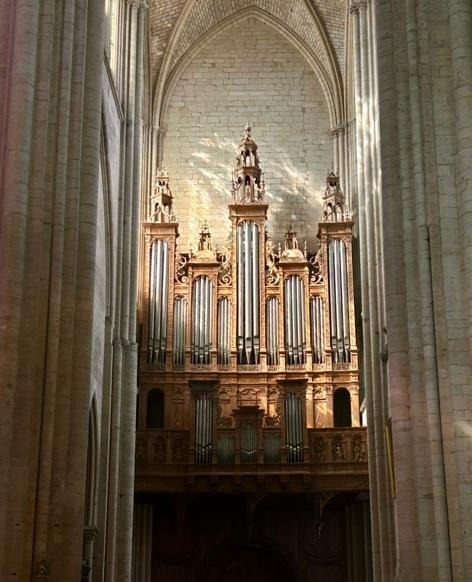
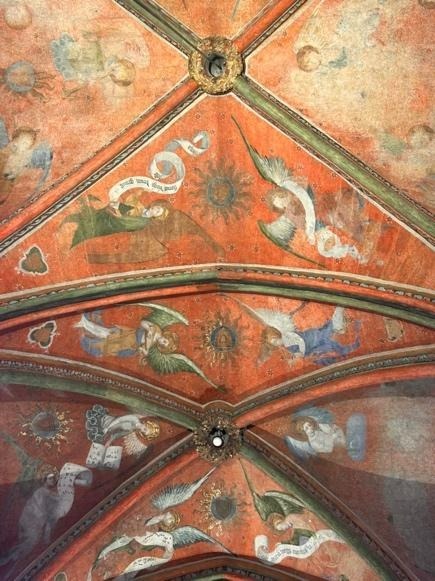
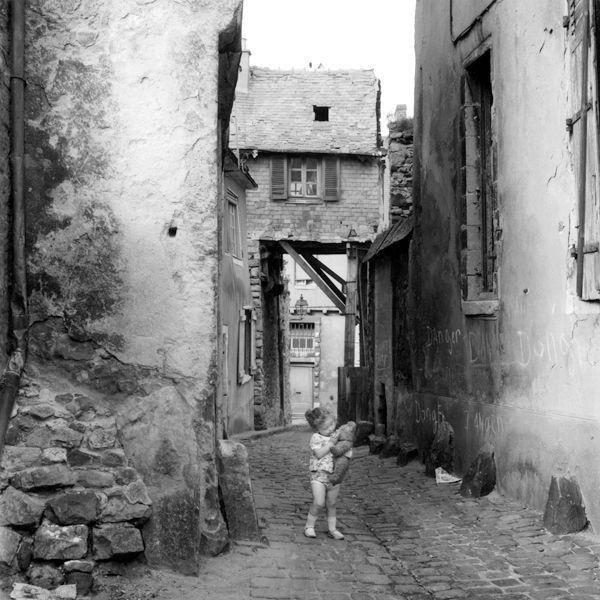
Inside Le Mans Cathedral, the great sixteenth-century organ anchored the space; light drifted in and glanced off its pipes so that it looked as though it were in a shimmer of shallow water. In one of the chapels, nine angels backed by red were painted high on the ceiling and we lit candles and thought about our loved ones: each of us held for a minute in our own small pool of light. We spent half an hour or so admiring the space until lunchtime where we ate pizza in the Place de la République. Then my dad led us through the backstreets to find Robert Doisneau’s 1962 photograph of a little girl and her teddy bear; above the arch, a toy bear in the window still stood in for the child frozen in the image. 

(Robert Doisneau’s 1962 photograph) 

We left the Perche region with the sense that we were only just beginning to get our bearings. It had been a rare kind of trip: three generations together, exploring a part of France that was new to all of us, fitting markets and forests and basilicas around shared meals, games of boule and long conversations in the sun. As we drove on towards Rouen, the week sat behind me like a sequence of modest scenes: a swan circling a moat, thyme on a fire, a heart-shaped patch of moss, a bear in a window. On their own, they didn’t seem spectacular enough to hold my attention, but linked together they felt like the start of knowing the Perché – or at least of wanting to know more.

Categories
Poetry

divinity

By Tashy Back

the moon and the stars
the sun and the earth
bound up together
brown string since birth

she is a whisper
stepping into the light
petals unfurling
Jupiter’s own might

he is desolate
far down in the earth
claimed by Saturn
the whisper goes unheard

there are two gravestones
not side by side
torn apart by the ages
Venus’s true love dies

a teardrop on Mars
anger starts our war
golden-amber-white
bodies furiously intertwined

mine is a soft sigh
breaks the silence of time
tastes like Mercury
poisonous message inside

the third and forgotten
Neptune in the deep
conquers monsters unknown
allows us to breathe

the gods and the planets
rulers of fate
Divine in their nature
for mankind they wait

Featured Image: Tashy Back

Categories
Art Poetry

The Doctor Tells Me

By Tillie-Rose Wallis

‘Doctor Tells Me’ – a poem composed in unison with the creation of the accompanying painting

The doctor tells me ‘everything is normal’
Yet I am still tested, poked and prodded
I am still consumed by pain

The words of comfort believed; based on a knowledge I myself do not possess
The doctor tells me ‘come in with a full bladder’
Gulping down water for my own bodies sake
The doctor tells me ‘change behind the curtain’
That cold, wet gel pressed onto my stomach, spread by the hand of a stranger
With sounds of beeping monitors and surging liquid
The doctor tells me ‘Just a little bit of pressure now’
Whilst greys in contrast dance across the screen
A screenshot is taken
The doctor tells me ‘over 20 growths’

The doctor tells me ‘everything is normal’
Yet I am still tested, poked and prodded
I am still consumed by pain

The doctor tells me ‘remove your shirt’
Unknown hands on my warm flesh, pushing and squeezing
Permanent marker makes shapes on my skin
That cold, wet gel pressed onto my chest, spread by the hands of a stranger
The doctor tells me ‘you’re young, under 25’
But I still feel It there, a beacon of reminder

Featured Image – Tillie-Rose Wallis

Categories
Perspective

‘Something else is alive’: Ecology and empathy in the philosophy of Arne Næss

By May Thomson

‘The last beachheads of uniqueness have been polluted if not turned into amusement parks: language, tool use, social behavior, mental events – nothing really convincingly settles the separation of human and animal.’ – Donna Haraway

Donna Haraway’s reference to the ‘last beachheads of uniqueness’ being polluted points to the collapsing myth of human exceptionalism and ‘uniqueness’ – a collapse Arne Næss takes further than most. This article will consider Næss’s theory of ‘the ecological self’, actively challenging Western individualism and human supremacy, as radically complicating the concept of human, not through mere entanglement but through philosophical expansion.[1] Whilst Haraway touches on the difficulty of separating the animal and human, Næss believes firmly in the mythic nature of this difference, seeking to dissolve the boundary entirely. Contrasting Haraway’s posthuman irony, Næss offers a serious, ethical vision of the self that redefines identity as inseparable from the nonhuman world. Where Haraway appreciates polluted boundaries, Næss’s transformative philosophy of ‘deep ecology’ erases the dividing line between human and nonhuman, redefining the self, and showing us that, indeed, ‘nothing really convincingly settles the separation of human and animal.’

Næss’s conception of the ecological self fundamentally rejects the human/animal dichotomy Haraway describes, proposing, instead, a radical redefinition of identity as inherently relational, in which the human is not a master but, like all organisms, a mere ‘knot in the biospherical net … of intrinsic relations.’ Næss, who coined the term in 1973, describes ‘deep ecology’ as a rejection of the ‘man-in-environment image in favour of the relational, total-field image’, instead emphasising ‘biospherical egalitarianism.’ Næss critiques shallow ecology (focused on ‘pollution and resource depletion’ and, by nature, undemanding and ‘shallow’ – but, Næss concedes, ‘presently rather powerful’) for almost solely emphasising the ‘health and affluence of people in the developed countries.’ Næss’s deep ecological approach goes beyond mere environmentalism. Indeed, the etymology of ‘environment’ itself encodes and perpetuates an anthropocentric, man-in-environment view, having its roots in the Old French ‘en-vironer’ – referring to the act of surrounding – and suggesting both anthropocentrism and invariable separation. The use of the image of a man-in-environment illustrates the human desire for dominion, with mankind rendered as the sole autonomous actor, with earth as his playground. This desire itself is explained away by social ecologists as a symptom of human hierarchies, with thinkers like Bookchin arguing for social revolution as a prerequisite for ecological restoration. But Næss rejects this view, arguing that, whilst exploitation of nature can be linked to intrahuman hierarchies, it is (1) irresponsible to view ecological relations as merely symptomatic, (2) downright dangerous to delay action against crises until the fall of all oppressive systems, and (3) counterintuitive to centre the human at all. This deep green philosophy is not anti-human, as some, like Eccy De Jonge who suggests the ideology contains ‘palpable misanthropy’, suggest – it is, instead, deeply post-individual. Næss’s concept of the ecological self describes a deeper, interconnected sense of self that transcends the individual ego and embraces the natural world: that is to say, one is inseparable from the ‘biospherical net’ in which they are a knot. And this brings us a new assumption: the needs of the whole biosphere must outweigh any individual species. This assumption, ‘the equal right to live and blossom,’ is one he describes as an ‘intuitively clear and obvious value axiom.’

Whilst Haraway critiques human ‘uniqueness’ through irony, hybridity, and cultural entanglement, Næss’s deep ecology dismantles the same boundary through ontological identification, offering a unifying and arguably more ethically demanding account of what it means to be a human in a shared world. Haraway’s critique is distinctly sarcastic, wrapped up in the rejection of essentialism embodied in A Manifesto for Cyborgs – a constructivist work which favours entangling and merging the machine, human, and animal in bizarre, unpredictable, chimeric ways. For Haraway, the divide between culture and nature becomes inconsequential through the ‘cyborg’, a dual figure that blends the boundary. Whilst Haraway’s comment is ironic, celebrating the blurring and complication of seemingly fixed lines, Næss is sincere, metaphysical, and insistent on our transcendence of boundaries through radical identification with the non-human. Haraway sees the line between animal and human as both corruptible and culturally produced, where Næss sees it as ontologically false. Indeed, Næss’s description of deep ecology contains an excellent synthesis of this relational ecology: he essentially argues, through the figures of ‘A’ and ‘B’, that A and B only exist as A and B because of how they relate. Entities do not pre-exist their relationships – the relationship between them makes them what they are. Whilst the objective of both thinkers is the destabilisation of these boundaries, Næss seeks to replace it with a vision of selfhood (‘“Self-realisation!” as an ultimate norm’) instead of simply playing with its erosion.

Arne Næss’s deep ecology is valuable in understanding both the human and the literature they produce. His works give us the tools and language to interrogate the representation of relations between mankind and nature in the literature we read. The poetry of Ted Hughes and Wendell Berry, for instance, seems to align with this collapse of human primacy by staging a metaphysical return and refusing symbolic domestication – offering space to stage the transcorporeality of matter. That is to say, both poets ostensibly present the animal as something raw, unknowable, and untranslatable – something to be encountered and understood as having ‘the equal right to live and blossom’, aligning with Næss’s vision of the nonhuman as an agentic equal. In ‘I Go Among Trees’, for instance, Berry takes a radical approach to describing the natural world. Refusing to name the creature his speaker encounters in the woods, Berry describes it simply through their interactions: ‘Then what is afraid of me comes / and lives a while in my sight. / What it fears in me leaves me, / and the fear of me leaves it.’ His approach, here, is one of total empathy and identification – one in which equality and mutual respect is integral. Embodied in his employment of grammatical parallelism, this is, at its core, an embodiment of Næss’s concept of the ecological self – an interaction between two beings on wholly equal footings. In ‘The Thought Fox’, likewise, Hughes notes ‘Something else is alive / Beside the clock’s loneliness’, lines which quietly expand the self to include the non-human. Hughes’s poem is a strikingly innocent and peaceful study of one animal carefully watching another. Indeed, the works of Berry and Hughes perhaps go even further in this sense: it would seem that the animal is actually not unknowable, so long as it is encountered on its own terms and not reduced to metaphor merely for the human writer’s self-indulgent self-knowledge. Through their refusal to instrumentalise the nonhuman, Hughes and Berry enact Næss’s philosophy: to truly encounter the animal is not to master it, but to identity with it as an unpretentious equal.

Ultimately, Haraway’s image of the ‘last beachheads of uniqueness’ embodies Næss’s desire to complicate the human as a concept – not through mere entanglement, but through a radical, ontological redefinition of identity. His deep green ecology and conception of an ecological self do not simply trouble the line between human and animal: Næss renders it meaningless. Where Haraway emphasises hybridity, he insists on identification – a radical ontological claim that challenges the very definition of the human. In a moment of ecological crisis, Næss calls us not simply to act differently, but to understand ourselves differently – as beings who are inextricably animal.

Featured Image: Honor Adams


[1] Quotes provided are taken from Næss’s ‘The Environmental Crisis and the Deep Ecological Movement’ and ‘The Shallow and the Deep, Long-Range Ecology Movement.’

Categories
Culture

‘Time Isn’t After Us’: Transcending Time Through Collaboration in Stop Making Sense

By Matthew Dodd

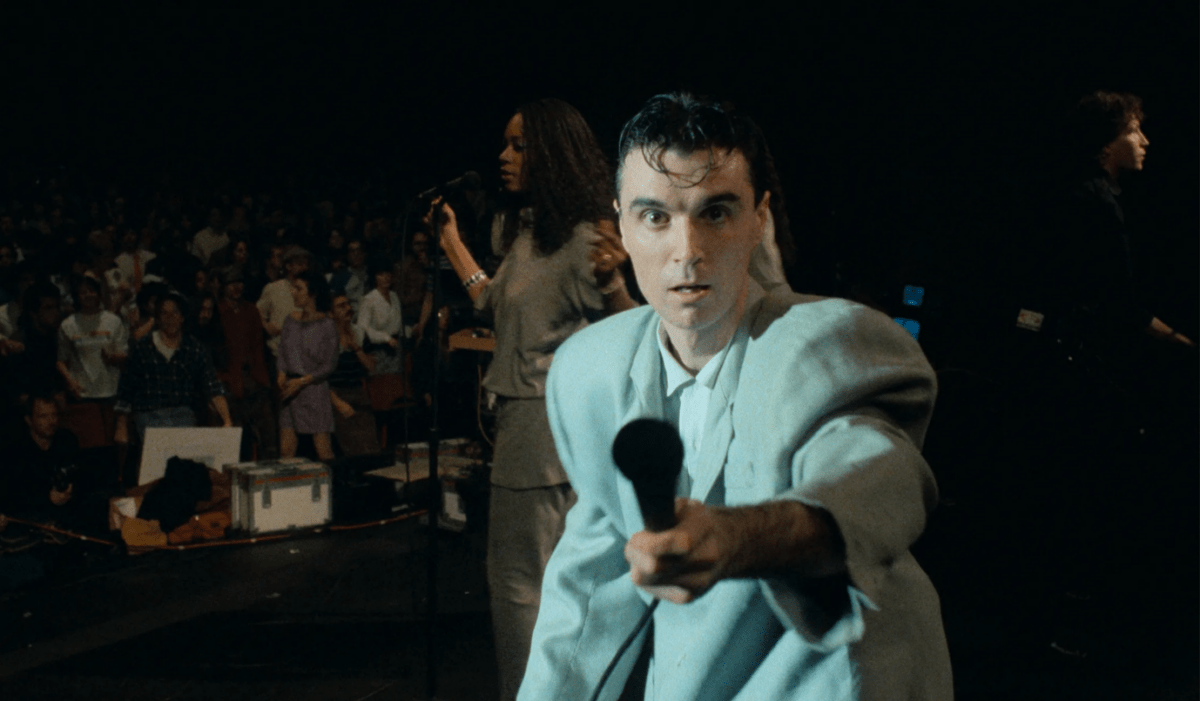
A gangly, quasi-spectral figure in a pale grey suit walks onto an empty stage. The camera clings to his feet – white plimsoles against a black floor – as he wanders purposefully into a light. He, placing a jukebox on the ground before him, proclaims quite calmly, “I’ve got a tape I want to play.” As the opening chords of Psycho Killer are violently strummed, the camera pans up to reveal our lead player, David Byrne. So begins the greatest record of human creativity ever put to screen.

In 1984, Talking Heads – the great pioneers of the 80s new wave scene – had found themselves at their commercial peak: Speaking in Tongues had produced their biggest hit, Burning Down the House, and Remain in Light had assured their place in the highest order of musical talents. With the benefit of hindsight, this was a peak to which they’d never quite return. Their next two albums, Little Creatures and True Stories, were hits but failed to reach the sonic highs of their earlier work. The tour recorded in Stop Making Sense was to be their last. As such, the resultant film feels like a lightning-in-a-bottle crystallisation of unstoppable talent, a consignment to screen of a moment in time at which these musicians were not only the best band of their generation but, probably, the greatest of all time. Fresh off his Oscar-winning  Silence of the Lambs , director Jonathan Demme approaches Stop Making Sense less as a concert film and more as an argument for the expansive possibilities of human creativity.

As Byrne is revealed to the audience in Psycho Killer, he immediately establishes himself as scene-stealing leading man. He jerks around the stage, as if attacked by his own chords, and maintains, in his steeled expression, a look somewhere between deathly shock and religious epiphany. He gambles towards the camera as though his actual audience were mere spectators to a world entirely his own. Behind him, stagehands assemble the sort of apparatus that would look more at home on a construction site than a concert stage. The deliberate exposition of this work – Demme makes no effort to shield the stagehands from view – is central to the argument that underscores the music. Art is, unavoidably, a collaboration. David Byrne is doubtlessly the central figure, but his efforts are nothing without those working around him.

At the end of Psycho Killer, bassist Tina Weymouth steps out to accompany Byrne on Heaven. Demme holds our view, for the most part, on a side-by-side of the two artists, their vocal and physical harmonies kept in gentle balance. As the song runs out, yet more stagehands crowd the two performers, assembling pedal-boards and drumkits. The camera follows Chris Frantz as he makes his way to the newly assembled drumkit, capturing a momentary glance between him and his bandmate-cum-wife, Weymouth. During a brief pause after the next song – in which David Byrne makes his second announcement to the crowd: ‘thanks!’ – Jerry Harrison arrives on stage, rounding out the quartet. By deconstructing the band – revealing the specific importance of a vocalist, bassist, drummer, and guitarist song by song – Stop Making Sense becomes a narrative thesis on the joys of communal music making. After Found a Job, the band is joined by another drummer, two more backing vocalists, another guitarist, and a keyboard player – Steve Scales, Lynn Mabry, Ednah Holt, Alex Weir, and Bernie Worrell, respectively. By this point, as the expanded group starts performing Slippery People, the performance has become an orgy of sound: ‘Lord help up, help us lose our minds’ sings Byrne. Taking their time to construct this massed ensemble, the band shows us that they could do this with one player, or two, or four, but they choose to do it with the whole troupe. It reminds us that music isn’t just some auditory phenomenon that arrives pre-constructed into our ears, it is something that people DO together, to entertain, to have fun. The stage is built, the band is built, right before our eyes to remind us that human hands made it. The little moments and looks between members of the band are just as magical as the performances. It reminds us, perhaps, that we’re all just animals, looking for a home, to share the same space for a minute or two.

For a film so delicately choreographed, it is the space it allows for spontaneous human moments which elevate it to its note of all-conquering tenderness. During Burning Down the House, Demme’s camera is distracted for some time by Alex Weir as he, evidently caught in the throes of the music, begins jumping around the stage. Immediately after, we watch as Harrison joins in an awkward shuffling dance with backup singers Mabry and Holt, eliciting a noiseless chuckle from the latter. Talking Heads, then as now, were a band renowned for their mystical inscrutability. Stop Making Sense is replete with that impenetrable charm – David Byrne wiggling through Life During Wartime; the quasi-nonsensical words that appear on screens behind the band, e.g. ‘BEFORE DINNER TIME’; the massive suit, of course – but they are buoyed throughout by the unimpeachable humanity of their performance.

The stage becomes a church; Byrne becomes a new-wave evangelist. His sermons reverberate through the audience, whose reaction Demme offers us only sparingly: ‘watch out, you might get what you’re after’. He, like any great prophet, understands that he is not the centre of the universe and briefly cedes the stage to Weymouth and Frantz’s side project Tom Tom Club for a section in which the sonic wizardry of Genius of Love is only somewhat marred by Frantz’s barrage of ad-libs, including but not limited to ‘the girls can do it to, y’all’ and ‘James Brown!’ Reclaiming the stage and, having guided his flock through the spiritual journey of Stop Making Sense, Byrne leads us to a final baptism with Take Me to the River: a sweaty, noisy, beautiful absolution. Rounding off with the frenetic Crosseyed and Painless, we are finally treated to a view of the audience in their convulsive, magical reverie. A small child holds a stuffed unicorn, two sound technicians stand arm-in-arm. Byrne waves for the stagehands to join the band on stage, providing a final tableau of massed creativity in all its myriad forms, before the concert wordlessly ends, subsumed by applause.

Talking Heads make a friend out of time’s passing, out of the knowledge that all experience is fleeting and all moments will be lost. When spent well, when spent with the right person, the dispensation of life’s transient currency is a gift gladly given: ‘You’re standing here beside me, I love the passage of time’. Such is the revelation at the heart of Stop Making Sense. A song is a few minutes, a concert is an hour and a half, this time will never return. But this is no cause for concern. We are the masters of time, and of life, because we spend it how we care to. The suburban paranoiac who narrates Once in a Lifetime feels that, in modern America, he is quite unconsciously ‘letting the days go by, letting the water hold me down.’ His life has been folded together, he has found himself unknowingly sat ‘behind the wheel of a large automobile ’ – beset with wife, job, and house, wondering, understandably, ‘how did I get here?’ His mistake is resistance. As David Byrne howls in the final chorus, his oversized suit wibbling in the darkness, ‘time isn’t holding up’. Equally, however, ‘time isn’t after us.’ Time is no predator, clawing at our lives. It will never stop, but it holds no grudges. Forty years later, the 90 minutes of Stop Making Sense remain as potent as ever, drawing crowds together in ecstatic movement as surely in the screens of London’s Prince Charles Cinema as it did in Hollywood’s Pantages Theatre. We live life as we choose and, if someone asks, this is where I’ll be.

An incidental post-script:

I first watched Stop Making Sense with one of my best friends in a packed-out BFI IMAX, a week or so before starting university. About a month later, I performed This Must Be the Place in a since-closed cocktail bar at my first open mic night with a newfound friend who would later become my housemate. One particular lyric stuck out to me in that moment, as a frightened fresher taking his first flight out of the nest, uncertain of his place here or anywhere: ‘home is where I want to be, but I guess I’m already there.’

Featured Image: A24