Categories
Culture

The End of Doctor Who and the Era of Cultural Inertia

By Matthew Dodd

‘Change my dear, and it seems not a moment too soon’

–        The Sixth Doctor, Doctor Who, 1984

‘I don’t want to go’

–        The Tenth Doctor, Doctor Who, 2010

In the most unceremonious of ways, a midweek Instagram post, a British cultural institution of more than half a century was, not for the first time, put to rest. Or rather, it was, like a wounded dog limping from showrunner to showrunner, lifeline to lifeline, finally put out of its misery in an overwhelming cloud of indifference. Doctor Who – the British science fiction show launched in 1963, cancelled in 1989, temporarily resurrected in 1996, and brought back proper in 2005 – was confirmed by the BBC to not be returning to screens this Christmas, as was previously announced. Indeed, the show will not be returning to screens at all, until such time as a new co-production partner can be found. The current showrunner and production company have left the programme, and the property is to be put out to competitive tender in the coming months. Russell T Davies, the man who has the peculiar distinction of having both resuscitated and euthanised the programme, washed his hands of the show he credits with launching his interest in television – as well as, in no small part, his career – with curious detachment: ‘and so GOODBYE from me to Doctor Who but HELLO to a big new future for the show’, he wrote in a rambling Instagram caption. In the same caption, he admitted that he never had a plan for the show going forward, and that previous assertions to the contrary were but a clever piece of theatrical misdirection.

As any fan of the longest running Sci-Fi show in history will know, Doctor Who has long been lumbering through crisis after crisis, constantly battling an existential danger far worse than any Dalek or Cyberman. The show has been haemorrhaging viewers for over a decade and hasn’t been the nationally unifying Saturday night staple it once was since Matt Smith left the TARDIS. Their own worst enemies, Doctor Who fans will endlessly debate when it was that the show went off – after David Tennant morphed into a CGI goblin, after Russell T Davies left the first time, after Matt Smith made an erection joke with his sonic screwdriver, after Chris Chibnall rewrote the show’s mythology and cast Bradley Walsh, etc., etc. – but the truth is that the show has been held hostage by its own mythology from the very beginning. For twenty years it has grown heavy under the weight of its own narrative baggage. In this way, it has become the archetype for the kind of cultural inertia experienced across our contemporary mass media: a self-reflexive world of ‘fandom’ written by and for people who already know and love the property. For a show so fundamentally about change, Doctor Who – like so much of our modern culture – is terrified of the unknown.

The great trick to Doctor Who’s longevity is both narrative and practical. In 1966, when William Hartnell, the first actor to play the titular role, was becoming an increasingly difficult and unreliable presence on set, the show’s producers came up with a novel idea to continue the show without its hero: regeneration. In regeneration – the in-universe mechanism by which The Doctor is able to heal himself from mortal injury by changing his chemical construction – had the effect of offering Doctor Who a method to continue in perpetuity. Regeneration allowed for characters to be reshuffled alongside writers, directors, and design philosophies. If the show was failing under one team, regeneration offered a mechanism to swap them out, supported by the show’s own mythology. Under such a guise have instrumental changes been made to the show’s format, soundtrack, logo, and everything in between. More than that, however, regeneration cemented the central theme of the show as one of change. When Patrick Troughton emerged as the Second Doctor, he proclaimed to his questioning companions that ‘life depends on change, and renewal’. It’s that notion of constant evolution, of the way in which we all live many lives in our one, which has guided the show for sixty years. As long as the show believed in that conviction, it could live forever. In recent years, however, change has been overtaken as the driving force of the show by its more sinister cousin, regression. So then, we might contend that the moment Doctor Who precipitated its own doom was not with any shift in writer, actor, or storyline, but rather when David Tennant’s Tenth Doctor looked towards the camera in his final outing and, with tears mounting in his eyes, proclaimed, ‘I don’t want to go’.

The moment functions well in its context. It is the tragic sight of a character, burdened by years of narrative angst, finally buckling under the weight of trauma and accepting, as we all must, our innate fear of death. A few seconds later, Matt Smith arrived on screen and the machinery of the Whoniverse began running once more, with a successful rebrand under showrunner Steven Moffat. Yet it represented a paramount concession to fan expectation and the reluctance to change. It was, perhaps, not a major incident at the time – the show would achieve wide international acclaim in the Moffat era – but nevertheless planted a seed of reactionaryism that would come to the fore years later. Tennant was, and remains, certainly the most popular of the modern iterations of The Doctor. As such, it was no surprise that his leaving the show should be worth a teary adieu. Yet, compared to the departures of previous fan favourites, his can’t help but feel egregious. When Tom Baker’s Fourth Doctor – by far and away the most popular of the original run – left the show, his final words were of hope and perseverance: ‘it’s the end, but the moment has been prepared for.’ The turn from one philosophy to the other, from the stoic farewell to the bleary-eyed plea, is a turn inward: the sign of a show rapidly becoming centred on itself.

Hayao Miyazaki, the great Japanese animator, courted controversy for his criticism of anime – a genre he helped to popularise – as being ultimately doomed in the modern day by its lack of inspiration. As a young director, he recalled being inspired by the films of Kurosawa and the writing of Ursula K. Le Guin, and how these broad multimedia influences came through and were synthesised in his animation. Now, he claims with regret, anime directors are expressly and solely influenced by other anime. As such, the genre becomes self-feeding and incapable of genuine growth. We can track the same trend in the sphere of western popular culture. In the 1980s, when Steven Spielberg and George Lucas wanted to make an homage to The Treasure of the Sierra Madre and the adventure films of their youth, they made cinematic history with Indiana Jones. In 2023, when James Mangold was tasked with making an homage to Indiana Jones, he made a sequel to Indiana Jones. In the same vein, we need only look at the most culturally ubiquitous of American cinematic exports: Star Wars.

With the first film in 1977, George Lucas was drawing on his love of Kurosawa’s The Hidden Fortress – at one time considering Toshiro Mifune for the role of Obi-Wan Kenobi – and concerns about the imperial machinery of the United States. In the franchise’s most recent outing, The Mandalorian and Grogu, the inspirational roots of the film are found nowhere deeper than those previous Star Wars films, as well as the attached apocrypha of television shows and comic books. The leads – heralded as the faces of a new era – are, in effect, stand-ins for two of the franchise’s original characters, Boba Fett and Yoda. This, concocted with a culture of ‘fandom’, has created a cultural ouroboros. As Roger Ebert observed in 2009, ‘a lot of fans are basically fans of fandom itself. It’s all about them. They have mastered the “Star Wars” or “Star Trek” universes or whatever, but their objects of veneration are useful mainly as a backdrop to their own devotion.’ It is these extreme fans who now hold the keys to our popular culture: either as the creative minds behind the latest Star Trek reboot, or else the ‘influencers’ endlessly agitating about their pet franchises. The studio system upholds this cultural stunting: why take the risk on a new property, or even a new character, when you can endlessly resuscitate an old one? In 2026, we reach a new low in this chronic resistance to the new with HBO’s Harry Potter. After J.K. Rowling’s prequel series Fantastic Beasts and Where to Find Them failed to live up to the box-office juggernaut which was its predecessor, Warner Bros have returned to the, by now, decomposing horse of the Harry Potter corpus to create a reboot which shares music, designs, plots, and even actors with the original films. There is nothing new to be extracted from this project, only subscriptions to the newly launched HBO Max streaming service. Popular culture is becoming a simulacrum of itself.

Doctor Who provides, perhaps, the clearest and largest scale example in British popular culture of this destructive self-reflexivity. The seeds of Doctor Who’s undoing have always been rooted in an over-reverencing of the show’s canon. When the show returned under Russell T Davies in 2005, it presented itself as something genuinely new. The original show, though a national institution, had become something of a laughing stock by the time of its cancellation. It was a show for strange, emotionally stunted men in anoraks, replete with over-complicated plots, flimsy sets, and saltshaker robots. With Christopher Eccleston, it became must-watch television. It was well-written, funny, and grounded. The world of the show felt genuinely relevant and rooted in the experience of 21st century British life. Rose Tyler, the Doctor’s companion across the first two series of the revived show, was a shop assistant who lived on a council estate, offered the keys to the universe. The monsters were analogues for trauma, weight loss fads, the Iraq war, and modern slavery. The stories were personal and drawn together by coherent thematic threads: escapist fairy tales that were never afraid to touch on the real. After twenty years in the wilderness, Doctor Who was a show that meant something again. Two decades later, with Russell T Davies once more at the helm, Doctor Who has never felt more out of touch.

A popular prognosis for Doctor Who’s decline has been its surrender to so called wokeism. Nigel Farage, leader of Reform UK, blamed the BBC for ruining a show he once loved with its flagrant kowtowing to the militant left (we are to assume this was an allusion to the recent introduction of Ncuti Gatwa, the first black Doctor). In their autopsy of the show, The Telegraph contended that its downfall was having become ‘mired in preachiness and identity politics’. The suggestion that Doctor Who had suddenly shifted towards social and political concerns in the last few years is both laughable and ahistorical. Genesis of the Daleks, one of the original run’s most acclaimed stories, drew direct comparisons between the creation of the villainous Daleks and the rise of fascism in Nazi Germany; in 1971’s The Claws of Axos, Jon Pertwee’s Third Doctor admonishes the nationalist Minister of Defence Mr Chinn for his cries of ‘England for the English’; the Davies written Turn Left depicts an alternate timeline where economic crisis leads the British government to intern settled immigrants, whilst the war veteran Wilf laments, ‘labour camps, that’s what they called them last time.’ Indeed, when it launched in 1963, Doctor Who was helmed by the BBC’s only female producer, Verity Lambert, and directed by the gay, Indian-born Waris Hussein. All this to say, the heart of Doctor Who has always been one of progressive social and political conviction. The issue with the contemporary show is not that it has become exceptionally left-wing, but rather that it has become painfully reactionary.

The major turn to wokery, in the popular consciousness, came about with the announcement in 2017 that Jodie Whittaker would portray the first female incarnation of The Doctor. The news was divisive: Fifth Doctor actor Peter Davison mourned ‘the loss of a role model for boys.’ Yet the show under Jodie Whittaker was not a polemic work of left-wing propaganda. Quite to the contrary, in Kerblam!, The Doctor comes face to face with a disgruntled worker at a space-age version of Amazon who turns to domestic terrorism to protest the harsh and dehumanising conditions at the company. Her response to him is one of chronic centrism: ‘the systems aren’t the problem! How people use and exploit the system, that’s the problem!’ In the same series, the Malorie Blackman penned Rosa sees The Doctor and co. have to help ensure that Rosa Parks ends up launching her bus protest – portrayed in the show as a random accident rather than a coordinated act of political disruption – and find themselves forced to sit and watch her be racially abused as, were they to leave, they would create enough space on the bus for the white man to sit down. The most egregious case, perhaps, occurs in the episode Spyfall, when The Doctor’s nemesis The Master – played by Sacha Dhawan – appears as a Nazi officer, using a perception filter to disguise his race. Having already foiled his plans, The Doctor deactivates the filter and warns that ‘now they’ll see the real you’. The rest of the episode implies that The Doctor had his archenemy sent to a Nazi concentration camp. Such episodes display a deeply noncommittal if not conservative politics, buried under the veneer of progressivism.  

With the return of Russell T Davies, the disconnect between how the show presented itself and how it operated only deepened. His first episode back in post, The Star Beast, has The Doctor berated by his old friend Donna for his inability to just let things go – ‘something a male presenting Time Lord will never understand’ – mere moments after asserting the character’s fundamentally non-binary nature. The show integrated social politics in the most oblique and clunky of ways – often fundamentally misrepresenting sensitive issues – to become a kind of self-caricature, characters operating less as psychologically grounded figures but conduits for well-intentioned but frequently malformed social critique. Beneath this dusting of progressivism persisted the undercurrent of conservatism: in The Interstellar Song Contest, The Doctor appears to take pleasure in torturing a genocide survivor for his attempt at revenge against the corporation that destroyed his home planet. What has become increasingly clear is that the issue of ‘Doctor Who gone woke’ and the issue of its self-mythologising are one and the same.

During the ‘Wilderness Years’, those between Doctor Who’s cancellation in 1989 and return in 2005, the franchise was kept on life support by a dedicated fan culture, manifest in books, comics, and Comic Relief sketches. A key element of this culture met regularly in London’s Fitzroy Tavern, where they would, over some number of pints, wax lyrical on their love for the programme, and notions of how they might write it if they were only given the chance. Amongst this crowd were Russell T Davies, Steven Moffat, Chris Chibnall, Mark Gatiss, Nicholas Briggs, and Paul Cornell – to name a few. When Davies was offered the chance to bring back Doctor Who in 2005, he brought the Fitzroy set with him. Twenty years later, they have not left. This group of upper middle class white men have controlled the show’s direction since its return, and, like any group that governs for decades, the waning of their creative insight has become ever more apparent. Instrumentally, the show has not been allowed to change. This is, of course, not entirely the fault of the writers. When Chris Chibnall left (in something of a cloud) in 2022, the rumour mill suggested that Davies returning was the only thing that would stop the BBC from pulling the plug entirely. Just as Hollywood studios favour established IP over new ideas, the BBC sought the certainty of the old guard rather than risking anything on the new. Davies brought back Doctor Who in 2005 as a bright young thing, fresh off his groundbreaking series ‘Queer as Folk’, and made it something new and exciting. Increasingly clear now is that, despite his great recent successes with shows like ‘It’s a Sin’ and ‘Years and Years’, the attitude he brings to Doctor Who, alongside his Fitzroy peers, is quite simply at odds with the freshness of his original stint and instead feels blisteringly stagnant.

As with Star Wars and Miyazaki’s anime warnings, Doctor Who has become a show that self-destructively recedes into itself. In Davies’ second run as showrunner, he has leant on the show’s back catalogue in lieu of creative advancement. When David Tennant said he didn’t want to go sixteen years ago, we could accept it as a tragic denouement for a beloved character, rather than a genuine resistance to progress. When, twelve years later, Tennant was returned to the role in a move that amounted to little more than exaggerated fan service, it became more difficult to write off. In bringing back David Tennant as the Fourteenth Doctor, Davies seemed to concede that the best ideas were behind him, and that there was nothing wrong with regression into the familiar. Across the next two series he would make similar allowances – bringing back characters largely unremembered by those of us who hadn’t pored over the 700 episodes of the show’s original run. This kind of writing does nothing to bring in any new audience members, playing purely to those already caught up on at least two decades of narrative lore. For a show like Doctor Who, at its core a family show, this is especially fatal. No child can stumble upon an episode of this new series and be drawn into its wonder, because it functions in effect as half a story, with the other half scattered across 700 previous episodes. Davies’ final blaze of glory, the image on which Doctor Who appears to be left for the foreseeable future, was Ncuti Gatwa, having killed himself to ensure that his companion remains a single mother, regenerating into none other than Billie Piper, the actor who played The Doctor’s companion Rose twenty years ago. It was, perhaps, one wink to the camera too many, and an ultimate declaration that this was a show no longer concerned with change, or indeed anything other than itself. As Davies had sinisterly declared on returning to his role, the intention was simply ‘to generate content’ by an endless retreading of the past. No more were episodes inspired by geopolitical conflicts, or philosophical debates, or even simple interpersonal dynamics. Instead, the show is governed by a principle of content creation: of which surprise reveal can get the most engagement on Twitter. Doctor Who has become a show, more than anything else, about Doctor Who. Every episode, good or bad, is an argument for or against its own existence; every success is read as a manifesto on how the show ought to be.

Aside from its position as one of the longest running television shows ever made, Doctor Who is an institution of paramount importance to our national culture. It has, across the last sixty years, become a kind of oral poetry, passed down and shared, reiterated and expanded upon. It was a triumph of collaborative creativity – a germ of an idea, rolling through the minds of other writers until it became something far bigger than any one author – and remains a testament to the possibilities of televised storytelling. In its current state, it has become, like so much of our contemporary culture, drawn into its own centre of gravity, under the pull of which it is slowly crushed. If it wants to survive, it must be about something again. It must be a show both escapist and humanist, about the broad spectrum of experience and the wonder of the universe’s infinite beauty. Whether it’s with an allegory for radicalisation or a story that preys on an innate human fear of the dark, Doctor Who must blossom out of a novel idea, not a recession into its own history. No longer can it be inward-looking, speaking only to the faithful with no care for the as-yet-unconverted. Should it be allowed to wither away, a martyr for our modern culture of inertia, it would be a colossal failure of imagination. Doctor Who has, by nature, a concept of boundless inventiveness: an open invite to a universe of possibility. To turn from that, and regress instead into known territory, is to place a limit on our self-belief. Fundamentally, Doctor Who is a show that has meant perhaps too much to too many people – this writer included – and one whose personal importance to countless self-styled whovians cannot possibly be overstated. At its best, it is a grand narrative of hope, compassion, and growth; of triumphing good and the dignity of life; of the monsters who live under the bed and the imaginary friend who will always be there to save us. Like all of us, it must be unafraid of change, of jumping into the unknown with nothing but belief and hope. To be held hostage by our pasts is an affront to the possibilities of our futures. We all regenerate throughout our lives, casting off one skin for another, and it is the readiness to change and evolve that makes a life, to coin a phrase, fantastic. Our culture is a mirror, and what hope can there be if it reflects only itself?

‘One day I shall come back. Yes, I shall come back. Until then, there must be no regrets, no tears, no anxieties. Just go forward in all your beliefs and prove to me that I am not mistaken in mine’

–        The First Doctor, Doctor Who, 1964

Featured Image: The BBC

Categories
Culture

The Strokes Get Old

By Matthew Dodd

On the second night of Indio, California’s 2026 Coachella Festival, a musical singularity event of sorts occurred. Across one day, audiences were able to watch on as the ghosts of indie rock past and present performed from opposite ends of their respective careers. This is to say, Geese and The Strokes were scheduled to play on the same day. Since their rapid ascent to the centre of the cultural zeitgeist at the end of last year, Geese have been dogged by comparisons to their New York indie forebears. Both bands were touted as heralding a revival of guitar-rock, both were products of New York private schools, and both were fronted by messianic lead singers who seemed incapable of washing their hair. Sonically, both seem guided by the same philosophy, though pursuing divergent methods. The appeal of The Strokes, 25 years ago as now, was that they were remarkable musicians who seemed broadly disinterested in the excellence they were dispensing. Julian Casablancas would lazily groan into an old-fashioned microphone, rarely deigning to move around the stage, while the rest of the band would remain focused on either their instruments or their bandmates, unbothered by the imposition of any audience. Geese seem to have carried this attitude to its logical extreme, disregarding any notions of established performance conduct: altering tempos within songs, duplicating verses to throw off any singing audience members, and randomly leaping into covers of Justin Bieber’s ‘Baby’. Chief amongst their similarities, though, is that both were thrust into the musical ecosystem as the prototypical ingenues. Both Casablancas and Geese singer Cameron Winter were 23 when they had their breakthrough; both bands were promoted as much for their music as for their status as a group of bright, young things. Coachella’s accident of scheduling is a reminder that, as The Strokes prepare to release their seventh album ‘Reality Awaits’, they are no longer the wunderkinds of the scene, but the godfathers. 

The joy of the early Strokes output, primarily their debut ‘Is This It’, had a lot to do with a self-conscious attitude towards their own youth. Indeed, theirs was an appeal conditional on their youth, and one which deliberately toyed with the melancholy of memories still being made, an actively forming nostalgia. ‘Last Nite’ is a paean to nights out nobody will ever understand; the title track is a forlorn reflection on the disappointments of the adult world. On ‘Someday’, Casablancas pines that ‘when we were young, oh man did we have fun’ – again, nobody in the band was over 23 at the time of release. The aesthetics they played with – grainy music videos of the band members hanging around in bars, concerts modelled after Elvis’ 68 comeback gig – only bolstered that image of crystalised youthful expression. To this day, ‘Is This It’ remains an unimpeachable masterpiece of 2000s indie, a flash-in-the-pan moment of musical ingenuity. It was an album that, practically overnight, made The Strokes the most important band in the world. They were as influential as The Velvet Underground, as derivative as Oasis, and as cool as The Ramones. It was their impact which shook the UK out of its post-britpop daze and launched the careers of countless awkward, jangly guitar bands. As Alex Turner of Arctic Monkeys would reflect on the opening track of ‘Tranquillity Base Hotel and Casino’, ‘I just wanted to be one of The Strokes.’  

On successive releases across the next two decades, The Strokes never really managed to return to the heights of ‘Is This It’. 2003’s ‘Room on Fire’ was well received but criticised for being little more than a continuation of their debut. The spectre of shrinking youth persists throughout this second album: ‘talk to me now I’m older’, croons Casablancas on ‘12:51’. ‘You Only Live Once’, the lead single from third album ‘First Impressions of Earth’, offers a 28-year old’s reflections on life’s lessons: ’oh men don’t notice what they’ve got, oh women think of that a lot.’ An alternate version of the track, a piano lead number entitled ‘I’ll Try Anything Once’, makes this spirit of maudlin introspection all the more obvious. Removed from the hard-rocking verve of the original track, this parallel take foregrounds the anxiety of youth with greater melancholy than on previous efforts – ‘ten decisions shape your life, you’ll be aware of five about’. Nevertheless, after their explosion as the new faces of youth rebellion and the vanguards of guitar rock, The Strokes were held hostage by that image such that they were never truly able to expand beyond it. Their next two albums, ‘Angles’ and ‘Comedown Machine’, were received lukewarmly, and the creative attentions of the bandmembers seemed turned towards other projects, such as Julian Casablancas’ electronic rock outfit The Voidz. For much of the 2010s, then, it had seemed that the great rockers of the century had failed to make it out of their early-20s excitement.

Their return in 2020 – at the height of worldwide lockdown – was nothing short of a resurrection. ‘The New Abnormal’ was a revelatory album. It was as musically brilliant as anything they’d ever done but, crucially, it was as relevant to the band as 40-somethings as ‘Is This It’ had been to them in their early 20s. The album is full of middle-age regret and gestures towards a lost past. ‘Bad Decisions’ deliberately interpolates Billy Idol’s ‘Dancing With Myself’ into a knowing reflection on the band’s evolution and the inevitability of alienating its audience. The sound of the album is a world away from the band’s garage-rock roots: a breezy mix of synth-pop and new wave that sits closer to The Psychedelic Furs than Arctic Monkeys. Opening track and TikTok megahit ‘The Adults are Talking’ is a masterful sermon from the aging rockers towards the strata of teenage rebels from which they are, by time, estranged. On the fame won so early by Casablancas and co., the message is clear: ‘don’t go there ‘cause you’ll never return’. Album closer ‘Ode to the Mets’ sets the band’s own history against that of their native New York and their home baseball team. The overarching theme is one of regret and introspection. It is an apology to their fans for ‘the silence you’re hearing’ and a dismissive creation myth for the band itself: ‘I was just bored, playin’ the guitar, learned all your tricks, wasn’t too hard.’ With the release of ‘The New Abnormal’, The Strokes had finally made a true successor to ‘Is This It’, a bookend of a record which was as inventive and essential as its ancestor. As the band had grown up, so too had their music.

Six years later, we find the Strokes once more on the verge of revival. ‘Reality Awaits’ is set to release at the end of June, with two singles put out in anticipation. It is hard not to listen to these tracks, ‘Going Shopping’ and ‘Falling Out of Love’, without a sinking of the heart. The Strokes have always been chasing a new sound, for better of for worse, to maintain an edge: a glimpse of the creative insight that burned through their initial success. On ‘Going Shopping’, The Strokes sound, for the first time, out of touch. It doesn’t sound like a new evolution, or indeed a knowing homage to the old, but a misstep into the middlebrow. The instrumental is fine – a groovy-enough synth line with a classically Strokesy guitar accompaniment. A good, if not great, song seems buried within the track. Yet, the decision of Julian Casablancas to mire his vocals in deliberately janky autotune makes the song sound like the product of a secondary school band messing around with Pro Tools for the first time, rather than one of the most important acts of the century. They feel, in a way they never have before, like an act disconnected from the zeitgeist. If ‘The New Abnormal’ was their great reflection on ageing, ‘Reality Awaits’ sounds like the album on which The Strokes get old. This, accompanied by widespread allegations of AI usage in the creation of the album’s promotional art, gives the band an aura of awkward tastelessness which can’t help reminding us that they are rapidly approaching the dominion of the Classic Rock station. 

At Coachella, The Strokes seemed to reassert their position as the great ones of indie-rock: a performance as good as any they’d given in years, coupled with a political intervention braver than any at this year’s festival. Even Cameron Winter was forced to look on in awestruck wonder. In their new music, however, none of that spirit of rebellion seems to have found creative footing. Perhaps this is solely an accident of single choice, or an elaborate prank by Julian Casblancas. We can only hope, for the sake of the 21st century’s greatest band.

Featured Image – GQ

Categories
Creative Writing

Evensong at St. Dismas’

By Matthew Dodd

Evensong at St. Dismas’ begins at 6.15pm on Mondays, Wednesdays and alternate Sundays. It did, at least, begin then between the years 1980 and 2024: the years in which Rosemary and Albert Watkins made a point of attending at least twice weekly. In her youth, Mary – Albert always called her Mary – had been a most dutiful stalwart of Lady Ann-Bennett’s school choir, earning a specially embroidered school tie for her fidelity in the lower sixth form. Albert had shown her how to do the tie countless times over the years, all to minimal lasting avail. On leaving Lady Ann’s, Rosemary’s warbling alto had done little to impress the conductor of her village choral society and so her singing fell resolutely into the domain of the kitchen, shower and – of a Friday evening – the sitting room after her weekly tipple of Sherry. Nevertheless, her love for the choral never faded. Evensong was her special treat – a biweekly recession into the divine. Cold nights beaten back by hymns and melody. Howells was her favourite – his Collegium Regale as close to paradise as she could conceive. She first took Albert with her the Christmas before Thatcher came to power. She remembered arguing with him in the snug of the Dog and Sparrow about matters of economic policy neither of them really grasped. It didn’t much matter, she loved to argue, Albert loved to indulge her.

St Dismas’ became their local parish as soon as the couple moved into Ambling Vale. As she was setting a painting of two Westies up over the mantle, Rosemary had heard the choir rehearsing from the nearby church and, leaving the dogs cockeyed, sat off at a sprint down the street towards the music. She never did get around to fixing the painting. For their third anniversary, Albert had surprised Rosemary by, through a private donation to the chaplaincy, having the choir perform a narrative of their marriage through the medium of psalmody. She’d never been more embarrassed, and held nothing back in chastising Albert for his gross corruption – no, invasion – of this most sacred event. After a week’s sulking, she forgave him – she usually did, eventually.

The Director of Music, a portly embodiment of tweed and teatime, gave Benny piano lessons as a personal favour to Rosemary for her enduring patronage. Indeed, he’d offered the choir’s services at Benny’s christening, but Rosemary was sure they needn’t go through all that trouble. Benny, for a time, sang treble in the choir – Rosemary’s great pride – but strayed from the musical as his voice broke and girls began to exist to him. Around the time Benny was sitting sixth form entrance exams, the choir got a new conductor – a brutish fellow with hair like a shoe brush and arms like cabers. As he conducted, flailing his arms in violent counterclockwise fits, Rosemary feared that the choir might get blown away. She found him detestable, and – though she’d never tell him – was somewhat pleased that Benny had stopped singing before he arrived. Nonetheless, she couldn’t deny he was a brilliant conductor, and evensong remained her solace. She would sit, arm wrapped in Albert’s, and disappear into a communion with music, faith, humanity. All was one in her revery, if only for a little under an hour. Light streamed across the quire, the mangy cobbles of St. Dismas transfigured into ebullient vessels of love. At every command to stand, sit, kneel, respond in like fashion, Rosemary felt herself ever more a part of the world’s four-part harmony.

Benny held his father’s hand – he had not done so since boyhood – in the front pew of St. Dismas’ as the Vicar read the names of those whose recently departed souls warranted especial prayer. For a moment, Albert didn’t recognise the name – unused as he was to its unabridged usage. Sandpaper fingers rose to his eye, dabbing at an errant tear. He had never before been to evensong without Rosemary, but supposed that she wouldn’t want him missing it on her account. After a moment’s silent reflection, the Vicar got up and intoned loftily, ‘now, if you’ll join the choir in singing this evening’s hymn, which can be found at number 381 in the green books.’ Albert escaped Benny’s grip and reached under the pew for his hymnal; his son matched the action. Together, the pair stood up and began to sing.

Featured Image: Joseph Hornsby

Categories
Creative Writing

Waltz for Debby

By Matthew Dodd

He’d put on a collared shirt for the occasion, knowing as he did that Debby liked him best in collared shirts. He was sorry he didn’t wear them more often but, to his great shame, he never quite mastered the art of ironing. This one was pale blue and dotted with, in the words of the charming and vaguely European shop clerk who’d sold it to him, ‘orbs like the stars at night.’ It was more expensive than he’d hoped but Willard had let him pick up an extra shift on Tuesday night, so it wasn’t too bad. Trouser-wise he was hoping Debby wouldn’t notice that these were his bowling trousers and might simply take him as the kind of a man who would naturally own and habitually sport navy chinos. They were good because of the give around the thigh; he lunged deep when he bowled, that was the secret to his success. 

The phone rang while he was plucking his monobrow. ‘Uh-huh,’ he said with a solitary hair caught between the tweezers. ‘Don’t say uh-huh like that Herb, it makes you sound like a slob.’ He tore out the hair in shock and stood up straight, as though his handset might judge him the worse otherwise. ‘Ah, sorry Deb, I didn’t know it was you.’ A grumble from the other end of the line. ‘Well, that’s just the problem, isn’t it Herb? You never do know who could be on the phone, do you? I might be Bobby Kennedy for all you know.’ The line stayed silent for some few seconds as Herb percolated this. ‘You’re not, are you?’ No response. ‘I don’t mean to be difficult, I just sorta hoped we could keep politics out of the bedroom is all.’ A crackling hiss that might’ve been laughter: that was good enough for Herb. ‘What time did you make the reservation for? Paula wants me to stick around until close tonight, I’d say no but what with Gail sick and Murph bailing on us, I can’t bear to leave her on her own.’ Herb had put the tweezers down and stood cradling the telephone like he’d seen the Virgin Mary do with the baby Jesus in some of those pictures at church. ‘You’re calling from the bakery? Say, you got any of the brioche lying around that might be unfit for consumers, if you know what I mean?’ Another grumble. ‘Sorry. The reservation is for 8, but I can call and move it if you –‘she didn’t let him finish. ‘No, that’s fine, I’ll see you at 8.’ She appreciated the drama inherent in the urgent putting down of a telephone. Herb smiled and reset the handset before returning to his tweezing. 

On the subway, Herb saw four dogs, two cats, a baby, and a saxophonist: he gave one of them a quarter, but planned not to tell Debby which. Debby worked at a bakery called Loaf at First Sight. At first, Herb was attracted to the pun moreso than the woman behind the counter, but after watching her delicately assemble a ham and cheese croissant in a little under forty seconds, his opinions became inverted. The bakery was two stops from Sal’s Own, the second-rate restaurant Herb had booked – he usually opted for third-rate establishments, so this was something of a treat. Debby got to Sal’s two minutes before Herb, but waited a few paces out of view so that she might spare his feelings by appearing, as if by some miracle, a matter of seconds after he eventually arrived. He offered her a polite kiss on the cheek, she obligingly accepted.

‘Some place, huh?’ Herb observed as they took their seats at a table by the front window with an ample view of the passing traffic and an old man asleep on a park bench. Debby agreed in her usual way, a curt nod which landed somewhere between approval and condescension. They both ordered spaghetti with marinara sauce and decided to split a bottle of the second most expensive wine. An hour or so later, as the dishes were being taken, Debby made the face Herb recognised as her important point expression. She swapped her purse between her hands a few times before speaking: ‘Herb, there’s something I’ve been meaning to talk to you about.’ This time, Herb cut her off. ‘Say, I got you something!’ He reached around for the messenger bag his dad gave him when he turned 17 and produced a 12-inch vinyl record. ‘Well, Ralph spotted me the money, but it was me who picked it out – thought that counts right?’ He passed it across the table to Debby, who examined it with a tender care: Waltz for Debby, Bill Evans Trio. ‘You get it?’ Herb began. ‘Waltz for Debby! It’s a waltz for you! I heard Willard and his buddies talking about it – intellectual jazz types y’know – and knew I had to get it for you.’ Debby smiled down at the record and, after a few moments, up at Herb. ‘Thank you, Herb,’ She started, before, ‘I’ve been offered a job in Chicago, and I’m afraid I’m leaving tomorrow.’ In his head, Herb heard the sound of an empty telephone line. 

‘Tomorrow?’ Debby nodded. ‘Chicago?’ She repeated the action. Under his breath he murmured a half-formed joke about the deep-pan style pizza he’d heard from someone at work say that they had over in Chicago, but gave up before he reached the punchline. A silence marinated between them. Herb tapped a rhythm with his knife and fork. 

‘What do you say you come back to mine and we give this Bill character a spin?’ The ends of Debby’s eyebrows sunk; her mouth folded into a half-frown. ‘I’m sorry Herb, I’ve made up my mind. I can’t stay here forever, spinning my wheels. It’s a good job, a real good job. It’s not that I don’t love it here, or that I don’t – ‘. She cut herself off. ‘It’s just that I can’t stand still any longer.’ Herb smiled. ‘Is that yes, then?’ Her frown intensified. Before she could get out an affectionately scolding ‘Herb…’ he’d interjected. ‘Look, I won’t ask you to stay. I’ve been losing you ever since I met you: that’s just the way of things. But.’ He grasped around in the air for the words. ‘Won’t you just listen to this record with me? I hear it’s really good.’ They sat for a second in silence; outside, the old man awoke and set off towards a nearby bar. ‘You don’t need to love me forever Debs, just let me have the song. Can’t you stand still one more night?’ Behind the counter, a young waiter dropped a bowl of olives and swore loudly. Head downturned, Debby’s head rocked back and forth, a negotiation between agreement and dissent. ‘Oh, Herb. Why’d you have to go and buy me a present?’ The corner of her mouth curled upward as she caught Herb’s eyes: ‘you never know, I might just give you a dance as well.’

As they got up, Debby noticed a stain of marinara sauce across Herb’s collar. He scoffed: ‘and I tried my best to look all refined.’ Debby laughed slightly. ‘Ah well’, she said, ‘it’s the thought that counts.’

They walked to the subway arm-in-arm, how Debby saw them do in the movies, and made the 8.15 train. The couple were in Herb’s sitting room by 9. Debby sat and giggled as Herb awkwardly tried to drop the needle on the exact start of the album, a fool’s errand that lasted about as long as the record itself. Once it started, he emphatically cast his hand out towards Debby and, with slightly overambitious energy, pulled her up to him. Together, they shuffled across the room with all the soaring romance of Gene Kelly and Leslie Caron, only lacking in some of the grace. In a moment of special closeness, Debby looked up at Herb with a warmth he remembered from their early days. He made a point of not looking down to meet her eyes; he didn’t want her to see him cry. After what felt like a moment but must have been some forty minutes, the record spun out and was replaced by a dry hiss of static. They remained unmoved for a moment before Herb released Debby from their embrace and, with a voice just shy of cracking told her she ought to be on her way. She didn’t want to miss her train, after all. Debby agreed and set off to move. At the door, they shared a polite kiss and a quiet goodbye. 

As she left, Debby could hear Herb reset the needle on the record and start it over. She could still hear it outside, as she looked back up at the apartment. Through the window, it looked like he was dancing.

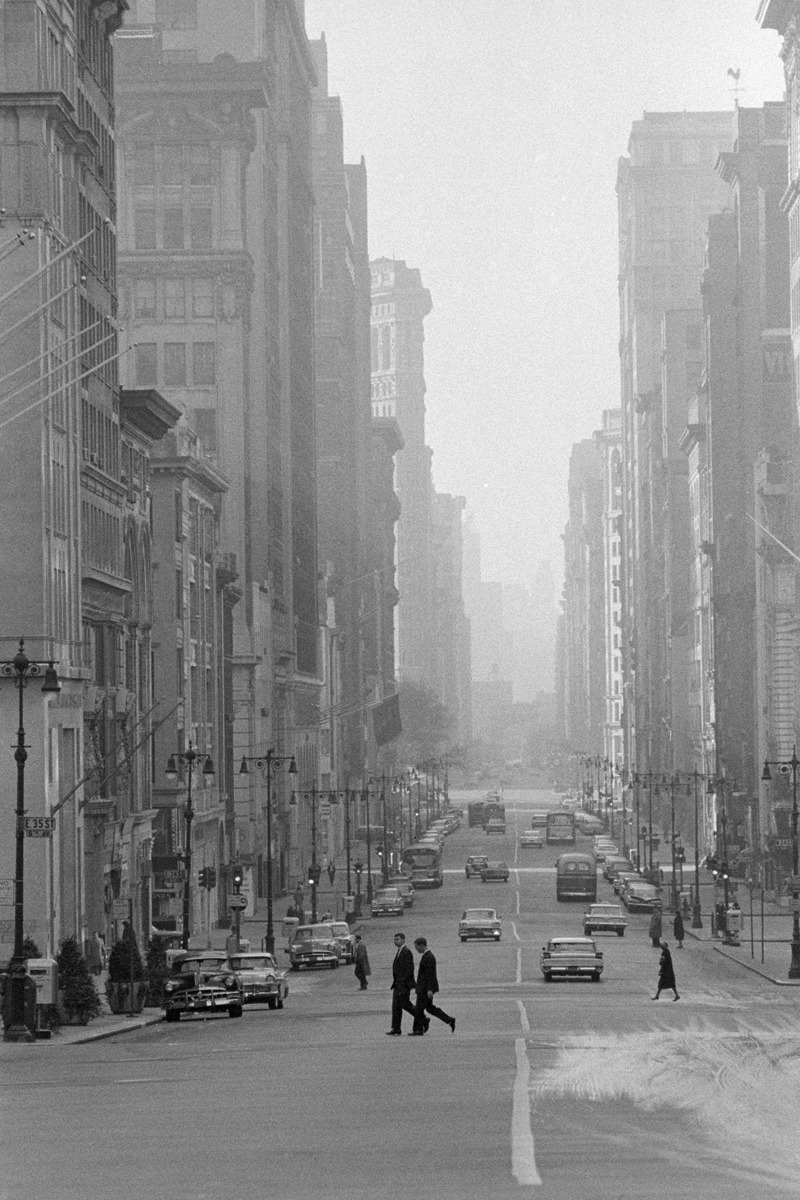
Photo Credit: Constantine Manos

Categories
Culture

‘Time Isn’t After Us’: Transcending Time Through Collaboration in Stop Making Sense

By Matthew Dodd

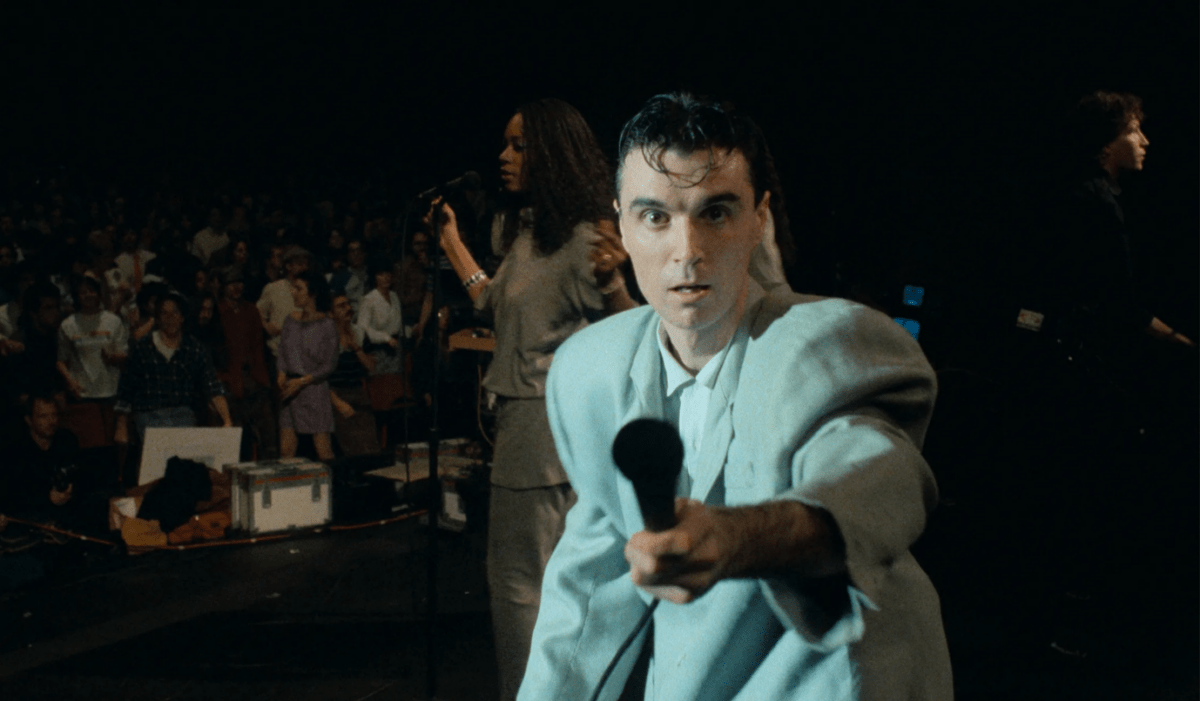
A gangly, quasi-spectral figure in a pale grey suit walks onto an empty stage. The camera clings to his feet – white plimsoles against a black floor – as he wanders purposefully into a light. He, placing a jukebox on the ground before him, proclaims quite calmly, “I’ve got a tape I want to play.” As the opening chords of Psycho Killer are violently strummed, the camera pans up to reveal our lead player, David Byrne. So begins the greatest record of human creativity ever put to screen.

In 1984, Talking Heads – the great pioneers of the 80s new wave scene – had found themselves at their commercial peak: Speaking in Tongues had produced their biggest hit, Burning Down the House, and Remain in Light had assured their place in the highest order of musical talents. With the benefit of hindsight, this was a peak to which they’d never quite return. Their next two albums, Little Creatures and True Stories, were hits but failed to reach the sonic highs of their earlier work. The tour recorded in Stop Making Sense was to be their last. As such, the resultant film feels like a lightning-in-a-bottle crystallisation of unstoppable talent, a consignment to screen of a moment in time at which these musicians were not only the best band of their generation but, probably, the greatest of all time. Fresh off his Oscar-winning  Silence of the Lambs , director Jonathan Demme approaches Stop Making Sense less as a concert film and more as an argument for the expansive possibilities of human creativity.

As Byrne is revealed to the audience in Psycho Killer, he immediately establishes himself as scene-stealing leading man. He jerks around the stage, as if attacked by his own chords, and maintains, in his steeled expression, a look somewhere between deathly shock and religious epiphany. He gambles towards the camera as though his actual audience were mere spectators to a world entirely his own. Behind him, stagehands assemble the sort of apparatus that would look more at home on a construction site than a concert stage. The deliberate exposition of this work – Demme makes no effort to shield the stagehands from view – is central to the argument that underscores the music. Art is, unavoidably, a collaboration. David Byrne is doubtlessly the central figure, but his efforts are nothing without those working around him.

At the end of Psycho Killer, bassist Tina Weymouth steps out to accompany Byrne on Heaven. Demme holds our view, for the most part, on a side-by-side of the two artists, their vocal and physical harmonies kept in gentle balance. As the song runs out, yet more stagehands crowd the two performers, assembling pedal-boards and drumkits. The camera follows Chris Frantz as he makes his way to the newly assembled drumkit, capturing a momentary glance between him and his bandmate-cum-wife, Weymouth. During a brief pause after the next song – in which David Byrne makes his second announcement to the crowd: ‘thanks!’ – Jerry Harrison arrives on stage, rounding out the quartet. By deconstructing the band – revealing the specific importance of a vocalist, bassist, drummer, and guitarist song by song – Stop Making Sense becomes a narrative thesis on the joys of communal music making. After Found a Job, the band is joined by another drummer, two more backing vocalists, another guitarist, and a keyboard player – Steve Scales, Lynn Mabry, Ednah Holt, Alex Weir, and Bernie Worrell, respectively. By this point, as the expanded group starts performing Slippery People, the performance has become an orgy of sound: ‘Lord help up, help us lose our minds’ sings Byrne. Taking their time to construct this massed ensemble, the band shows us that they could do this with one player, or two, or four, but they choose to do it with the whole troupe. It reminds us that music isn’t just some auditory phenomenon that arrives pre-constructed into our ears, it is something that people DO together, to entertain, to have fun. The stage is built, the band is built, right before our eyes to remind us that human hands made it. The little moments and looks between members of the band are just as magical as the performances. It reminds us, perhaps, that we’re all just animals, looking for a home, to share the same space for a minute or two.

For a film so delicately choreographed, it is the space it allows for spontaneous human moments which elevate it to its note of all-conquering tenderness. During Burning Down the House, Demme’s camera is distracted for some time by Alex Weir as he, evidently caught in the throes of the music, begins jumping around the stage. Immediately after, we watch as Harrison joins in an awkward shuffling dance with backup singers Mabry and Holt, eliciting a noiseless chuckle from the latter. Talking Heads, then as now, were a band renowned for their mystical inscrutability. Stop Making Sense is replete with that impenetrable charm – David Byrne wiggling through Life During Wartime; the quasi-nonsensical words that appear on screens behind the band, e.g. ‘BEFORE DINNER TIME’; the massive suit, of course – but they are buoyed throughout by the unimpeachable humanity of their performance.

The stage becomes a church; Byrne becomes a new-wave evangelist. His sermons reverberate through the audience, whose reaction Demme offers us only sparingly: ‘watch out, you might get what you’re after’. He, like any great prophet, understands that he is not the centre of the universe and briefly cedes the stage to Weymouth and Frantz’s side project Tom Tom Club for a section in which the sonic wizardry of Genius of Love is only somewhat marred by Frantz’s barrage of ad-libs, including but not limited to ‘the girls can do it to, y’all’ and ‘James Brown!’ Reclaiming the stage and, having guided his flock through the spiritual journey of Stop Making Sense, Byrne leads us to a final baptism with Take Me to the River: a sweaty, noisy, beautiful absolution. Rounding off with the frenetic Crosseyed and Painless, we are finally treated to a view of the audience in their convulsive, magical reverie. A small child holds a stuffed unicorn, two sound technicians stand arm-in-arm. Byrne waves for the stagehands to join the band on stage, providing a final tableau of massed creativity in all its myriad forms, before the concert wordlessly ends, subsumed by applause.

Talking Heads make a friend out of time’s passing, out of the knowledge that all experience is fleeting and all moments will be lost. When spent well, when spent with the right person, the dispensation of life’s transient currency is a gift gladly given: ‘You’re standing here beside me, I love the passage of time’. Such is the revelation at the heart of Stop Making Sense. A song is a few minutes, a concert is an hour and a half, this time will never return. But this is no cause for concern. We are the masters of time, and of life, because we spend it how we care to. The suburban paranoiac who narrates Once in a Lifetime feels that, in modern America, he is quite unconsciously ‘letting the days go by, letting the water hold me down.’ His life has been folded together, he has found himself unknowingly sat ‘behind the wheel of a large automobile ’ – beset with wife, job, and house, wondering, understandably, ‘how did I get here?’ His mistake is resistance. As David Byrne howls in the final chorus, his oversized suit wibbling in the darkness, ‘time isn’t holding up’. Equally, however, ‘time isn’t after us.’ Time is no predator, clawing at our lives. It will never stop, but it holds no grudges. Forty years later, the 90 minutes of Stop Making Sense remain as potent as ever, drawing crowds together in ecstatic movement as surely in the screens of London’s Prince Charles Cinema as it did in Hollywood’s Pantages Theatre. We live life as we choose and, if someone asks, this is where I’ll be.

An incidental post-script:

I first watched Stop Making Sense with one of my best friends in a packed-out BFI IMAX, a week or so before starting university. About a month later, I performed This Must Be the Place in a since-closed cocktail bar at my first open mic night with a newfound friend who would later become my housemate. One particular lyric stuck out to me in that moment, as a frightened fresher taking his first flight out of the nest, uncertain of his place here or anywhere: ‘home is where I want to be, but I guess I’m already there.’

Featured Image: A24

Categories
Culture

Leonard Cohen and the Noble Art of Perversion

By Matthew Dodd

I’d love to speak with Leonard.
He’s a sportsman and a shepherd.
He’s a lazy bastard, living in a suit.
– Leonard Cohen, ‘Going Home’

In 1994, the Canadian poet and musician Leonard Cohen escaped to the mountains outside Los Angeles to study Zen Buddhism with the monks at Mount Baldy Zen Center. He lived there five years, becoming himself an ordained Buddhist monk, drinking whisky and writing poetry, before returning to civilisation. “I wasn’t looking for a religion,” claimed Cohen, “I already had a perfectly good one of those.” The abscondment to the mountains was, to Cohen, the only logical way to escape the hard-drinking, depressive malaise into which he’d fallen during the early 90s. Failing to find answers in psychoanalysis, Cohen “bumped into someone who seemed to be at ease with himself and at ease with others” and headed for the hills. Many of the poems Cohen wrote during his time at Mount Baldy would appear in Book of Longing, his first book of poems since the 80s. The five years at Mount Baldy did not grant Cohen inner peace but nevertheless exerted a manifold influence on his post-millennium work. In 2023, eight years after Cohen’s death, his song Anthem was invoked on boygenius’ track Leonard Cohen, in which Lucy Dacus quotes his observation that “there is a crack in everything, that’s how the light gets in.” before adding her own, that “I am not an old man having an existential crisis at a Buddhist monastery writing horny poetry, but I agree.

In the years since his death, Leonard Cohen has only continued his elevation to the saintlike status that had begun being afforded him in life. The prototypical poet-singer, the image of his steeled jowls half-covered by the brim of his fedora, grimly crooning his way through one of a lifetime’s worth of sung reflections stands firm in the popular consciousness. He is, alongside friend and contemporary Bob Dylan, one of the true folk heroes of modern culture. He is synonymous with a style of confessional, dreary talk-singing; the standard bearer of a genre which would be picked up by everyone from Nick Cave to Fiona Apple to Cameron Winter. This mystique, however, has always been steeped in his reputation as one of music’s pre-eminent womanisers. Joni Mitchell, his one-time lover, recalled him as a ‘‘boudoir poet’’; his numerous attachments to various artists, musicians, and actresses remain the stuff of musical legend. It was an infamy Cohen himself disavowed: ‘‘my reputation as a ladies’ man was a joke that caused me to laugh bitterly through the ten thousand nights I spent alone’’, he would later reflect. And yet, it is Cohen’s steadfast commitment to cataloguing life’s sordid physicality which sets him apart from the bulk of his peers and embeds his influence into the firmament of popular music.

When Taylor Swift released her twelfth album, The Life of a Showgirl, much criticism was levied against the song Wood and its metaphorical allusions to the penis of Kansas City Chiefs’ tight end Travis Kelce. The song, which compares said appendage to everything from a ‘redwood tree’ to a ‘hard rock’, was described by Guardian critic Alex Petridis as one which ‘‘clambers on a table in a Wetherspoons pub with a skew-whiff bridal veil on its head and an L-plate around its neck and favours everyone in earshot with a loud paean to the size of her fiancé’s penis.’’ As Swift learnt, to write well about the realities of sexual life is no mean feat. In this arena, Leonard Cohen is an unparalleled talent. A poet before a musician,  Cohen revels in marrying off the sacred and the profane with wry aplomb. On Chelsea Hotel #2, a beautiful ode to fleeting love that recounts the author’s short-lived affair with Janis Joplin, Cohen offers music’s prettiest account of oral sex: ‘I remember you well in the Chelsea Hotel / you were talking so brave and so sweet / giving me head on the unmade bed / while the limousines wait in the street.’  Cohen finds no shame in confessing his sexual exploits. Heroic couplets and the lilting internal rhyme of ‘bed’ and ‘head’ sublimate the awkward physicality of fellatio into a scene of both aesthetic and emotional gentility. It is as proper to describe one’s lover as ‘so brave and so sweet’ as it is to describe them ‘giving me head’: for Cohen they are two clauses in the same sentence. Cohen does not parse out the beauty from romance, deeming the physical unworthy of poetic attention, but instead accepts the whole. 

The body is the central vessel of human expression, in Cohen’s world. Poetry is not the dominion of ideals, but should derive from the hands, mouths, legs and shoulders of the poet. ‘I locked you in this body / I meant it as a kind of trial / you can use it for a weapon / or to make some woman smile’ , a father – whether the connection is one of patrilineage or divine creation is unclear – tells his son on Lover, Lover, Lover. This liturgical notion of life as a ‘trial’ on how to use one’s body is essential and the album at large, New Skin for the Old Ceremony, finds Cohen at the crossroads of this crisis. Written and recorded at the onset of the Yom Kippur War, Cohen is wracked by the spectre of violence. The first verse of Lover, Lover, Lover sees Cohen implore the Father, ‘change my name / the one I’m using now it’s covered up with fear and filth and cowardice and shame.’ – his nomic allegiance to Kohenism becoming itself a summons to arms. Performing on the battlefield in Sinai, Cohen told audience members “I don’t care if their war is just or not. I know only that war is cruel, that it leaves bones, blood and ugly stains on the holy soil.” The question, then, of using one’s body as ‘a weapon’ is not mere poetic speculation. Physical love is the Other to physical violence and, by extension, the imperative. In no uncertain terms, Leonard Cohen is a lover, not a fighter. 

Deleuze wrote that “to desire is to become delirious in some way.” Few artists have been as delirious as Leonard Cohen. For him, desire is debasement, the utter annihilation of the self. Voyeurism and the painful art of yearning are as much a part of Cohen’s system of desire as sex itself. With I’m Your Man, Cohen brings to the fore the inherently animal nature of passion – ‘I’ll crawl to you baby and I’d fall at your feet / and I’d howl at your beauty like a dog in heat.’  On Paper-Thin Hotel, a jilted lover listens through the wall as the subject of his affection makes love to another – ‘the struggle mouth to mouth and limb to limb / the grunt of unity as he came in.’ This non-adultery is, to the speaker’s surprise, a relief: ‘A heavy burden lifted from my soul / I heard that love was out of my control.’ Without the bodily specificity, such a song fails in its object. It is the realities of physical love, the grunting, struggling messiness, which knock the speaker out of his poetic revery. Life moves on whilst we wax lyrical. Indeed, Cohen’s most enduringly popular love song centres on a woman with whom he never actually had a relationship. Suzanne Verdal, with whom Cohen walked Old Montreal and drank Constant Common tea, was a woman Cohen only “imagined” having sex with. The lack of physical intimacy is no hindrance, it would seem, as the bodily connection extends to a mental-spiritual one: ‘you’ve touched her perfect body with your mind.’ 

boygenius’ ironic half-dismissal of Cohen the horny poet speaks to the gross missteps of our modern musical luminaries. It seeks, with superior morality, to extract the poetry (‘there is a crack in everything / that’s how the light gets in’) whilst distancing itself from the old man who wrote it. The truth is, of course, that we can’t have one without the other. The same Cohen who wrote Bird on a Wire also wrote Don’t Go Home With Your Hard-On. More urgently than that, though, is the latent desire on the part of many artists to painfully over-correct from the hyper-sexualised misogyny of the pre-MeToo cultural sphere by sanitising life to the point of sterility. For many contemporary artists, the reality of bodily existence is a messy inconvenience, best kept at an arm’s length.  Artists like boygenius’ component parts are at their best when they front the truth of human connection in all its seediness – ‘you are sick and you’re married and you might be dying / but you’re holding me like water in your hands’ – but too often resist the grotesqueness that it is to live and love in a human body. Self-described Cohen acolyte Cameron Winter seems to understand this, mentioning feet in no less than six of the songs he’s released in the last eighteen months. Humanity is inescapably bodily, in its beauty, frailty and vulgarity. Any artist with a claim to understanding life must see the beauty in this as Leonard Cohen so effortlessly did. Bring on the perverts.

It’s like our visit to the moon or to that other star
I guess you go for nothing, if you really wanna go that far
– Leonard Cohen, ‘Death of a Ladies Man’

Featured Image: Jim Wigler

Categories
Culture

The Romance of Rail: On Cinema’s Locomotive Love Affair

By Matthew Dodd

Consider the train. There is, perhaps, no greater symbol of the industrial age, of mankind’s advancement from agrarian primitivists to mechanised modernists than the hulking mammoth of steam and steel, rattling through sceptred fields and countryside. It permeates the psyche of modern society; the great communitarian dream that we might, united by rail, draw nations and continents together as one. Even as its atomistic rival, the dreaded motorcar, threatens its position, it remains a potent image of our contemporary world, and the hope of what it might be. No wonder, then, that it has seeped so heavily into the language of visual storytelling. The train is, like the telephone booth or the six-shooter, one of those enduringly anomalous staples of the moving image. How else to tear lovers apart or prompt random meetings across a train carriage? For over a century, since cinema’s very conception, the train has been an indispensable tool of symbolic relevance, a tool too often overlooked as merely perfunctory. In considering and unwinding the manifold resonances of the train on film, we might come to a better understanding of just how spiritually relevant this marvel of invention truly is.

Britain’s cultural consciousness, to its great disadvantage, lacks the figure of the cowboy. Where American national storytelling may always fall back on the image of the brooding sheriff traipsing endless flatlands on horseback, Britain is forced to recede deep into its medieval past to find any similarly entrancing historical archetypes. Perhaps, then, we supplant the train as our own kind of cowboy. A post-industrial mammoth, stoic and unfeeling, rounding the hills and valleys with unitary purpose. 1936’s Night Mail, a documentary – perhaps the first in Britain’s cinematic history – charting the progress of the overnight postal train, accompanied by a specially commissioned W.H. Auden poem and Benjamin Britten score, certainly makes this argument. The train hurtles from London to Scotland, an egalitarian troubadour at the nation’s service: ‘letters for the rich, letters for the poor, the shop at the corner, the girl next door’. Workers tirelessly sort through envelopes, placing each on specially chalked town-specific shelves. Mailbags are yanked from hooks by purpose-built nets at passing stations with a mechanical, stolid brutality. Auden’s poem is set to the metre of the train’s passage, a relentless onslaught of brusque couplets, dispassionately toasting the broad cross-section of British life past which the engine runs – ‘letters from uncles, cousins, and aunts, letters to Scotland from the South of France’. That the film, produced by the Post Office so as to increase public perception of the service and to dissuade the challenge of privatisation, should choose to tie the figure of the postal engine into this poetic system is something of a small wonder. This is no mere advertisement, but an argument for the incontrovertible necessity of the railway to British life. Across Night Mail, the railways become veins through which the blood of the nation runs. The train is positioned as a uniquely British kind of hero: deferential, resolute. The documentary serves as a hymn to this unsung champion of modernity. There is a note of George Eliot about the whole thing, an industrial echo of Middlemarch’s closing paragraphs: that things are not so ill with you and me as they might have been is half owing to the number of locomotives which have run a hidden service from Euston to Aberdeen and rest in unvisited depots. 

The conclusion of Night Mail, the poem and the film, is a revelation about the fundamental importance of the postal network, its manifold powers of connection, and thus the train’s ultimate duty in serving the people of Britain their correspondence, ‘for who can bear to feel himself forgotten?’. Films such as Night Mail, state-funded promotions for a nationalised train network, speak to a dream of post-war British connectivity: a nation at one with itself, bridged by a selfless and noble fleet of knightly engines running, unthanked, across the country. The final such film, a sequel to Night Mail, was produced in 1988, directed by Chariots of Fire’s Hugh Hudson and scored by Vangelis, with additional stanzas added to Auden’s poem. This modern version placed emphasis on the scope of British Rail’s commuter classes, drawing together, once more, the mess of British life intertwined by the railway: ‘the teacher, the doctor, the actor in farce, the typist, the banker, the judge in first class. Reading The Times with the crossword to do, returning at night on the six forty-two’. The film, the last to be made pre-privatisation, ends on the still image of an elderly couple reuniting with their children and grandchildren at the platform’s edge, overlaid with the slogan ‘Britain’s Railway’

The train’s stoical connotations give rise, by turn, to a rich romantic resonance. In 1899, two silent films entitled The Kiss in the Tunnel were produced, the first by George Albert Smith and the second by Bamforth and Company. Neither are especially complex works of cinema, featuring nothing more than establishing shots of a train entering and leaving a tunnel, as well as an interposed scene of a couple stealing a kiss in the darkness of the carriage. Between the two films, the only major difference is that Bamforth’s – known for their salacious seaside postcards – significantly increased the passion of the couple’s kiss. By combining the couple’s scene with those of the train entering and leaving the tunnel, Smith’s film represented the arrival of narrative editing in filmmaking. In its way, this minor locomotive love affair invented the very notion of narrative cinema. For over a century, then, the intrigue of the engine – the jeopardy of the darkened train tunnel, the intimacy of the compartment – has brought forth its romantic quality to the moving image. 

In his seminal new wave classic Les Parapluies de Cherbourg, Jacques Demy mounts his camera to the moving train which tears young lovers Guy and Genevieve apart. Genevieve recedes into the horizon as the train/camera removes Guy inexorably from her. The train, for the lovers, represents the inevitable: a separation as unfeeling and unshakeable as a railway timetable. Thus, the train becomes a method of industrial timekeeping, hours measured out by the comings and goings of engines and carriages. Meetings and affairs are cut short by the necessity of catching a train, a train representative of the outside world – a marriage avoided or a life escaped. Such is the case in Brief Encounter, David Lean and Noel Coward’s masterpiece of post-war British filmmaking. When Laura, the despondent housewife, and Alec, the kind-hearted dentist, meet by chance in a picturehouse, it is the waiting room of Milford Railway Station which becomes their sanctuary: an Edenic place of stillness, free from the rigidity of that real life represented in the arrival of the train. Whilst there, in that liminal space between destinations, they have a kind of freedom, yet a freedom which is ever worn down by the movement of their respective trains towards their station. It is, once more, the train that separates them from one another, and the fear of missing a connection which robs the pair of a real goodbye. The engines represent the reality to these romantic fantasies, tying us invariably to a world which works strictly to timetables and appointments which must be met. As in Night Mail, there is something decidedly British in the character of these trains, apathetic in the annihilation of high-flown romance. The lovers, whose respective worlds are obliterated by their separation, must move on dispassionately, catch the next train, and continue their lives.

The logical counterpoint to the heartbreak of the railway connection is found in Richard Linklater’s sprawling epic of love and transport, the Before trilogy, a cycle that dwells resolutely in the space between trains, and probes the danger of disrupting the regular flow of the timetable. In Before Sunrise, the young ramblers Jesse and Celine – a wandering American 20-something and a French university student – catch eyes across a train carriage bound for Vienna. They exchange reading materials, get to talking, and decide to delay their respective commitments by a day, hop off in Vienna and spend a night together. They amble through the city, falling in a kind of condensed love – the kind of love that perhaps works best with an established time limit – before being borne away by their respective trains. They promise at the platform to meet again in the same spot, in one year’s time. Eight years later, Before Sunset picks up their narrative with the two meeting again for the first time since their lone night together. Erring slightly away from the world of the train, their reunion is marked by a real-time countdown to Jesse’s return flight to America. Surely, were a direct rail route between Paris and Los Angeles established, Linklater would’ve used it here. Nevertheless, the film goes to great lengths to accentuate that kind of rigid timekeeping interposed by a train (plane, in this case) timetable, counting out minutes under the stress of a connection to be caught. The revelatory, subversive decision made at the end of the film, when Jesse elects to lounge in Celine’s apartment at the expense of his flight becomes a transcendentally romantic disruption of the mode of industrial timekeeping. Rather than play his role as modern man, zipping to an airport gate and dashing through security, Jesse does the radical opposite: he wastes time. ‘Baby,’ Celine tells him, ‘you are gonna miss that plane.’ When Jesse, with a coy smile, looks up and says ‘I know’, it is as a man broken free from the oppression of the timetable and, by extension, the outside world. 

Consider, then, when next you race for the TransPennine express or collapse into a seat on the LNER service from Newcastle to Edinburgh, that you are engaged in a sacred communion with an industrial object riven with soaring notes of romance and melancholy. You are the mechanical cowboy, the lovesick housewife; the railways the canvas of your own story. Consider the train. 

Featured Image: O. Winston Link Museum Archives Collection

Categories
Creative Writing

Another, Before They Close?

By Matthew Dodd

It had been some years since I’d seen him. We’d last met in the early hours of the morning at opposite ends of a dining table in the house of a mutual friend neither of us knew particularly well. We didn’t talk about anything very substantial, though we must’ve been there for some few hours. We were just filling time and the air between us. I suppose, on some level, we both had a dim notion that we were unlikely to meet again, that these were the final verbs, nouns and infrequent adjectives that we’d ever share. We had, quite literally, run out of things to say to one another. These last few pleasantries were the aftershock of a friendship, eulogising a camaraderie that had meant something to us both for some years. We had nothing in common but circumstance. And yet, sat there, asking that man what his plans for the coming days were, how he was finding the weather, whether he envisioned a successful season for Arsenal, I wasn’t sure there was all that much to our little back and forth. Had I ever thought to ask what love meant to him? Or whether he had ever known grief? Or if he’d seen The Godfather? What did I really know of this man, or he of me, beyond vague likes, dislikes, phone numbers and shoe sizes? Cynically, I could conceive that this was, in fact, all there was to life, but as I left that house and nodded him farewell, I knew this couldn’t be true. There were too many songs on the radio for me to believe that life meant so little. And yet, still, I couldn’t shake the feeling that the paintings of one another which existed, and would continue to exist, in each of our memories were nothing more than pencil sketches. It was a troubling notion. He beat me to hailing a taxi, so I was able to watch as he, in the animus of an Austin FX4, receded over the horizon and out of my life. I managed to get a cab about ten minutes later and was home in bed by five-thirty.

Once, when we were in our late teens – he 17, me 16 – I remember us trying to smuggle a crate of inexpensive lager his older brother, Stephen, had bought for us into the sixth form graduation dinner. It was the end of the summer term and, though we still had a year left, we fancied joining in on the older year’s celebrations. We’d planned the whole thing between a maths and geography lesson under two pushed-together desks in Mrs. Deacon’s old classroom. We would wait about an hour, so that the teachers would assume all the students had already gone in, and then go round the back entrance to the dining hall, as though we were working the catering. Then, so he said, all we had to do was act casual and hope nobody recognised us. He kept guessing at how certain teachers would react if they caught us, doing wholly unrecognisable impressions of each of them. As he went on, the impressions became more and more outrageous, and we descended further and further into hysterics. By the end, he was doing our English teacher like Bugs Bunny and our headmaster like Popeye. I don’t know if I ever laughed as hard as I did that day, screwed up under that desk making notes on half a dozen pages torn out of a textbook. It didn’t work, of course. Mr. Amersham – who incidentally did sound a little like Popeye in the moment – found us almost immediately as we left the kitchen, threw us out and placed us in detention for the remainder of the year. It didn’t matter to us: we spent those endless hours in detention suppressing laughter at the thought of Mr. Amersham back in his office eating copious amounts of spinach and getting into fights on the seven seas with various miscellaneous sailors.

It was an uncharacteristically warm morning at Moorgate tube station when I saw him next. If memory serves, it was a little after nine o’clock, putting me vaguely in the realm of lateness for a meeting the details of which I struggle to remember. Droves of conservatively clad big-city types piled through a woefully insufficient number of ticket barriers and out into the street. For my sins, I was one of them. The cavalcade splayed in a multifarious passage towards central London’s many large buildings and unreasonably priced coffee shops. I had long since given up on keenly observing my surroundings on these sorts of commutes so had my attention firmly pointed towards nothing more than an article I’d read in the Times that morning about the surprising health benefits of artichoke hearts. As I walked, I’d been faintly aware of a head popping out of a car window and a related arm springing out of it, waving incessantly, but I hadn’t thought much of it until that head started shouting my name. Turning around in an accidentally-quite-delicate half-pirouette, I caught sight of the upper half of a man who looked strangely similar to someone I had known years before, only with thinner hair and darker eyes. He called out again and I, realising that this was someone I’d known years before, walked up to the car. My preeminent thought at the time was bewilderment that he had recognised me after all these years. I liked to think that I had changed at least somewhat but, I suppose, we weren’t all that different: I was an awkward adolescent then and an awkward adult now. He excitedly told me how wonderful it was to see me, how unlikely it was that we’d bump into each other here of all places, how terrible it was that it had been so long, how – ah sorry! – he must get to a meeting himself but that – oh – we must meet, how did Finsbury Circus at six sound? I agreed with him on all points and nodded a cheerful goodbye as his car – a sensible Volkswagen – set off in the direction of Old Street.

A day’s work passed uneventfully and, ten minutes early, I was sat on a bench in Finsbury Circus waiting for my friend. On time, he arrived. This surprised me, frankly, as the man I knew in the hinterland years of our youth was anything but punctual. Quick-witted, stubborn, smart-arse – never punctual. It wasn’t a bad thing, but it certainly was a shock. We shook hands, alleviating the tension the decade’s silence had accrued, before he brought me into a suffocatingly long embrace. After about twenty seconds, he released most of my body but kept a firm grip on my respective arms. Holding me in place, he looked me up and down, measuring his thoughts before sharing his final judgement: ‘you look really well.’ I began to reciprocate the compliment but he cut me off before I’d a chance – ‘come on, there’s this great Chinese place near here I’ve been meaning to try out.’ Dropping my arms he began walking away out of the park. Immediately and without my having to say a word, we had fallen back into old rhythms.  

The ‘great Chinese place’ in question was a Korean restaurant about ten minutes from the park, positioned unassumingly between a newsagents and an upmarket shoe repair shop. The owner, a short man whose face was bifurcated by a pair of steel-rimmed spectacles, led us to a table which, at the request of my dining-partner, was equidistant between the bar and the toilet. We took our seats and, while he went on a tangent about the colleague who’d recommended the restaurant, I had a chance to look, really look, at this man for the first time in years. It was him, certainly. And yet, there was something in his aspect which spoke to time-won wisdom, to a concerted difference in his nature. Wrinkles ran crevices along his forehead; silver hairs peppered his eyebrows at random. His earlobes sagged to nose-level – though I can’t say for sure this was a change or whether I’d simply never made a point of considering his earlobes.  

Eventually, his ramble ran out of steam and he relaxed into a placid smile. ‘It’s so great to see you mate’. I nodded and we sat with the thought. ‘So,’ he drummed the table, ‘what have you been up to?’ It’s an affronting prospect, trying to sum up one’s life and achievements within the confines of a convivial comment, but I tried my best. ‘I’m an English teacher, in the city.’ The explanation wasn’t quite finished, but this was enough to entertain him, somehow, and propel him out of his seat temporarily. ‘Do you remember Mrs Baxter in Year 10? I reckon the title of Macbeth was about all I learnt of it in two years with her.’ This made him chuckle. I remembered Mrs Baxter quite well, as it happened; she’d been a great help in directing me towards some University pre-reading. For an hour or so we proceeded in this way: I relaying some fact of my recent life and he returning with a remembrance from our far-flung history. Having got him started on the subject of sports, I managed to eat my starter of seafood Pajeon without once having to offer my opinion. Apparently, our old football team – whose scores I did not realise were publicly available – had been doing especially well that year. In those days I’d played left-wing defence and he striker. In practice, this usually meant that I stood about idly watching his frequent attempts to overdramatically punt the ball towards the boys’ changing rooms just west of the goal. Predominantly, I was just happy that he distracted any crowd of spectators – usually about seven old men none of us recognised and a handful of younger boys skiving off – from my, at that stage, severely awkward physical appearance; I hated how I looked in those shorts.

At some point, a squat waiter with a ruby tiepin came to deliver our main course. He’d gone for a cut of pork belly, rendering my kimchi somewhat dwarfed by comparison. ‘There’s a ring on your finger,’ he keenly observed, ‘who’s the lucky lady? Or is it just a statement?’ I considered the ring, an unintrusive gold band which had protected a sliver of my finger from tanning for nearly five years. ‘I don’t know if she’d call herself lucky.’ He scoffed. ‘We met on our postgrad, she – Annie – was a few doors down in halls. One night she fell into my room by accident and, in a way, I suppose she never left.’ He looked at me gormlessly as if this wasn’t a complete account. ‘We got married a few years ago.’ – and, in order to mitigate any potential awkwardness – ‘it was a small ceremony, just family’, I lied. A glass of wine by his hand had mysteriously emptied whilst I’d been talking. ‘No kids then?’, he asked. I shook my head: ‘not yet, but soon I hope.’ The squat waiter dropped a bottle of sparkling water at the adjoining table. ‘And you?’ I began, ‘kids, wife, etcetera?’ This wasn’t very tactfully put, I think in retrospect. ‘No, no.’ His eyes were fixed on my lapel. ‘I guess I never really had the time,’ he rubbed his temple roughly, ‘or the opportunity, if I’m honest.’ After our main courses were dispatched, the waiter returned to offer a dessert menu. I declined, citing a weight-loss routine I was at that point somewhat agnostically following, and he followed suit. I adjourned to the bathroom for a moment and returned to find two Old Fashioneds sat at our table. ‘I really shouldn’t’, I chuckled over-apologetically. He didn’t accept this and, invoking the same wanton vim with which I’d once watched him volley a football into the forehead of our chemistry teacher, passed the drink to me: ‘I’m sure Amy wouldn’t mind.’  Forgetful, that was another one.

While we drank – or rather, while I drank – he went into more depth on his earlier comment, explaining in gross detail the vast maze of divergent paths which had led him away from anything like a family. ‘There was a girl, I think, a few years ago. I really thought I loved her and, I guess, I think I thought she loved me too.’ There isn’t much to do but nod at times like these. ‘But I was wrong – typical me! Do you remember how everyone used to groan when I was called on to answer a question in maths? I never got any better at understanding the complicated things.’ I tried to steer us to safer shores by asking him about work and the meeting he’d had to rush off to earlier. ‘Oh,’ he paused, ‘that. Well, it pays the bills and I guess that’s all it needs to do.’ I didn’t question this, but he continued as though I had. ‘It’s not a bad life, you know, really. I drive a nice car, I eat nice meals,’ – he reached over and jostled my shoulder – ‘I see nice old pals!’ I smiled and touched his hand with a warmth I hope read as affectionate. He leant back in his chair and gripped his glass somewhat defensively – ‘not a bad life at all’, he said to the air beside him.

Our conversation had run dry, as had my glass. I ostentatiously sat it back on the table, attempting to project the image of a man about to leave a restaurant. This caught his attention. He simpered into the middle distance, laughed at something neither of us had said and turned back to me: ‘shall we have another, before they close?’ I smiled into my lap and shook my head. ‘Sorry,’ I was reaching for my wallet, ‘I really should be getting back.’ The waiter, who’d been wiping the same corner of the bar for about twenty minutes, looked up at us expectantly. He laughed once more, looked to his left twice, ran his hands through his hair and nodded, as if he didn’t really care either way. We both stood up, almost simultaneously, and produced our respective wallets. ‘No’, he said, thrusting his arm between my hand and the table, ‘let me, please’. There was a measured pause between those last two words, though I can’t say with any certainty that this meant anything. It would seem churlish to suggest I allowed him to pay for my meal, it was of course a great kindness on his part. Nevertheless, it seemed that depriving him of that little victory, that little reminder that I was still the gangly left-wing defender to his star striker, was an unnecessary cruelty. Besides, it had the added benefit of leaving me with enough cash on hand – I’d drawn just enough for my meal out of a cashpoint machine earlier that day – to treat myself to a taxi home.

He waited with me as I flapped my arm hopelessly into the street at a succession of unstopping cars. Eventually, after a hideously long wait, I attracted one’s attention. It veered alongside the pavement and I jogged, lightly, over to meet it, a definite spring present in my step. He laughed at my disproportionate joy in this minor success, ‘you never changed, did you?’ I turned back and smiled: ‘I yam what I yam!’ The weather had held firm throughout our dinner, so it was against the backdrop of a pleasantly clear sky that I saw him nod to me as my taxi joined an unceasing flow of traffic swimming upstream to Dalston. My driver was neither talkative nor the sort to make excessive use of the radio: it was a silent journey home and I was in bed by midnight.

The next I heard of him was a few years later, when news spread that, after a brief but consequential interaction with a Fiat Punto, he had shattered most every bone in his body. In time he made a full recovery. I sent some chocolates and a card to his hospital bed, I think. God, I hope I did.

Featured Image: Kenneth Josephson, Front Street, Rochester, NY 

Categories
Culture

The Neverending Britpop Summer

By Matthew Dodd

As I cowered outside Wembley Park tube station, sheepishly shielding four cans of Carling from the view of patrolling police officers, and watched in semi-intoxicated wonder as a parade of bucket hats flowed towards the stadium, it seemed self-evident that I was observing a national cultural reckoning. Oasis were back. The great bastion of 90s Britishness had returned home to their natural place, extracting millions of pounds from millions of adoring fans. All over the nation, the tidal wave of Adidas Spezials and misjudged haircuts heralded the return of a cultural phenomenon. Across their two hour set, they more than clarified their enduring excellence, the anthemic barrage of power chords and vaguely aspirational lyrics turning thousands of fans – myself, of course, included – into a drunken congregation, joined together in the great fraternity of Gallagher-ism. And yet, this tour didn’t seem to reconsecrate Oasis as the biggest band in Britain. Rather, it seemed to be a reaction to the fact that Oasis still are the biggest band in Britain. Their physical reunion is almost perfunctory; they still occupy the same place at the centre of Britain’s musical ecosystem. Their return three decades on doesn’t toss them into a foreign cultural environment, an antique guitar cable awkwardly plugged into a state-of-the-art amplifier, rather it seems like they never really left.

It’s thirty years exactly since their seminal second album (What’s The Story) Morning Glory? established Oasis firmly as the pre-eminent British band of the 90s. In the same year, The Beatles Anthology 1 was released, a sprawling multi-media project reflecting on the band’s body of work and legacy, thirty years on from their heyday. Such a project was and remains so interesting because it reacts to how The Beatles shaped the course of popular music, placing them into a totally foreign musical environment – the 1990s – and arguing for their enduring relevance. This year, The Beatles Anthology 2025 is set to be released, a further argument for their continuing influence in an even further removed world. It’s interesting, then, that when Oasis, like their Liverpudlian icons, made their own return after thirty years, it was not to a totally foreign cultural zeitgeist against which theirs was an anomalous presence, but rather to a British musical sphere more amenable to them than ever. Just a year before the reunion, Liam Gallagher had sold out a tour performing Definitely Maybe in full. This isn’t a time-won reflection on an era’s defining music, it is a direct replay of that era. In the three decades between 65 and 95, British rock and roll went from A Hard Day’s Night to Wonderwall; in the three decades since, it’s gone from Wonderwall to Wonderwall again. Bloke-core, a wave of 90s nostalgia, nichetok edits, aAdidas brand deals and the spectre of Radio X continues to propel Oasis into the cultural mainstream, decades after their time. Of course, it isn’t just Oasis at fault. Blur sold out Wembley in 2023; Pulp made headlines at Glastonbury just a few months ago; Radiohead are set to embark on their own blockbuster reunion tour this autumn. These groups persist in shaping our national music conversation. In the 90s, kids queued up for hours to see these godlike bands. In the 2020s, it is the same bands who occupy this space, the same bands kids are queuing up to see. Oasis and their contemporaries continue to dominate Britain’s musical culture in a way that veers beyond reverence and towards stagnation.

Since the end of britpop – somewhere between the release of Oasis’ Be Here Now and Pulp’s This is Hardcore – few British acts have managed to break the mainstream and capture the cultural zeitgest in the same way. The Libertines seemed primed for a time to inherit Oasis’ spot as the tabloid-courting rock n’ roll ascendants before their abrupt implosion after only two albums. Taking a purely commercial view of things, one British band stands out as undoubtedly the most successful since Oasis. That said, as much as we all might like a late-night singalong of Yellow, we can hardly point to Coldplay as the paragons of modern rock. As Super Hans famously noted, ‘people like Coldplay and voted for the Nazis, you can’t trust people.’ What, then, has happened to the Great British band?

The post-britpop indie movements of the 2000s, what we might broadly call the landfill indie era, was a far less sure thing than its 90s predecessor. Fuelled by the panoptical tabloid furore of NME and its peers, bands were thrown in and out of the spotlight at a breakneck pace. A few names survive – The Fratellis, Kaiser Chiefs, Courteneers – but a whole wave of lesser bands stand, deservedly or undeservedly, forgotten – The Hoosiers, The Paddingtons, Joe Lean & the Jing Jang Jong, etc. etc. Where the britpop era saw a centralisation of culture, a nation crowded around Oasis and Blur, the landfill period was marked the vast proliferation of upstart outfits. The band who emerged unscathed from the skip, surely the only band to get close to filling Oasis’ vacant seat, is Arctic Monkeys. From grassroots beginnings – both in Sheffield and on the nascent world wide web – and headline-grabbing romances to, most crucially, massively successful and zeitgeist-capturing music, the Monkeys fit the bill more than any band this side of the century. Like Oasis, they remain lodged in the firmament of the contemporary indie scene: you’d be hard pressed to find a teenager with Doc Martens and a superiority complex who doesn’t know A Certain Romance by heart. Unlike Oasis, however, Arctic Monkeys had the boldness to allow their music to grow up with them, to not continue singing about nights out and Smirnoff ices into their fourties. It’s that artistic bravery that has held them back from becoming the nostalgia-fuelled ouroboros Oasis risks turning into. Nevertheless, their mainstream success is indisputable, especially in comparison to their contemporaries. Over their career, every one of Oasis’ eight albums reached number one on the UK charts. Six of Arctic Monkeys’ seven – blame Taylor Swift – achieved the same feat. By contrast, The Kooks and The Wombats have two number one albums between them.

Since the Monkeys swapped guitars for keyboards in the mid 2010s, what has become now the ‘indie’ scene has failed to produce an act to the same level of popular success. In the years since, UK indie has been collapsing into itself and into a nostalgia for the scenes that once were. For many British bands post-landfill and post-britpop, the object has been less to push the genre forward and more to recreate the feeling brought about by those earlier bands. Consequently, we end up with acts like Catfish and the Bottlemen, whose songs seem custom-built to be chanted drunkenly in a field on the shoulders of your best mate from school. There is nobody in the crowd of a Catfish or Inhaler or Reytons gig who wouldn’t rather be watching Oasis in 1994 or Arctic Monkeys in 2007. For at least a decade, the British indie scene has been running on the fumes of those bands, hoping that this year’s Latitude festival might be at least something like Spike Island.

Naturally, this isn’t all the fault of the bands. There are those acts which overtly chase the high of a bygone era of UK indie – The Reytons’ refrain that ‘everybody round here’s got a cousin or a mate who’s best friends with Alex Turner’ is certainly guilty – but there are of course a whole host of those from across the British Isles which are making genuinely new and genuinely brilliant music. Wolf Alice, Black Country New Road, Sportsteam, Black Midi (R.I.P), Fontaines D.C., Stereo Tuesday, English Teacher, Wet Leg, Mary in the Junkyard, Wunderhorse – the list goes on. But in today’s post-Spotify society, music isn’t the centralised thing it once was. Gone are the days when a nation would sit around the television set and let Top of the Pops reveal who the next big thing are. Similarly, the media landscape of the 90s and 2000s does not exist anymore: no NME reporters are on the ground looking for the gossip about Grian Chatten or Ellie Rowsell. Now is the age of the algorithm, the indie zine, the subgenre, the niche. Bands like Black Country, New Road play deliberately to a niche crowd, revelling in the kind of experimentation only possible outside the mainstream. Today’s answer to Oasis or Arctic Monkeys, the kind of bands that headline festivals and sell out small arenas, are still playing to an audience a fraction of the size of their predecessors. Perhaps the biggest band coming out of the British Isles currently, Fontaines D.C. played their largest gig to date in Finsbury Park over the summer. 45,000 turned out, this punter included, to see a mesmeric line-up of new-age superstars. Between Fontaines, Kneecap and Amyl and the Sniffers, the gig felt like a festival in its own right: a statement of intent from a new generation of rock n’ rollers. And yet, whilst Fontaines reaches five million monthly listeners on Spotify, Oasis reach thirty-one million. Therein lies the central paradox: the market for British/Irish indie is apparently a shadow of what it once was, but the market that once was is still listening to Oasis. The days are past when a band of loud-mouthed Mancunians could, with nothing more than some power chords and a tambourine, sell out the largest stadiums in the country for weeks on end. And yet, that’s just what happened this summer.  

The quality of music is there, as is the appetite, yet for the most part the UK music industry is submerged under the corporate hegemony of American pop. When homegrown artists like Olivia Dean or Sam Fender do break through, it feels like an exception rather than a rule. National musical character is, now more than ever, defined by our Atlantic neighbours: what was once a back-and-forth trade – The Rolling Stones for The Beach Boys – is now decidedly one-sided. The internet has, for the most part, homogenised much of our popular music culture. As such, the once dominant British music scene – the scene that produced The Beatles, Bowie and Fleetwood Mac – has faded away, its vestigial remains reforming into the indie scene. It’s that scene which now remains paralysed between 1994 and 2007, forever replaying Live Forever and 505. The money is in surefire hits from Disney channel stars, not local bands playing back-end pubs. This summer hasn’t been a Britpop revival, it’s been a rerun of the last time British music felt truly relevant. In other words, it’s been a Britpop summer for thirty years. Until the indie scene can get out of its britpop stupor, until the music industry pays attention to the upstarts and, most decidedly, until audiences listen, our national music scene, once our great pride, risks remaining forever stuck in the past and the great British band, one of our finest national exports, risks becoming history. All is not lost, however. Just last year, Charli XCX’s Brat made pretending to be British cool again (see: The Dare) and the continued success of artists like Raye and Olivia Dean point to a revival in the UK’s pop-soul scene. Whether a phallocentric music establishment would accept the new faces of British music as female is another matter entirely. Nevertheless, we can but wait for the next great British band to arrive and tear Radio X asunder. Oasis spoke to a dispossessed post-Thatcher Britain about living forever, chasing the sun, feeling supersonic; about years falling by like rain and dreams being real. If ever there was a time for a band like Oasis, it’s now.

Featured Image: Jill Furmanovsky

Categories
Creative Writing

The Second Dante

By Matthew Dodd

Outside the Caffe Giulia, two old men barked at one another across a table gossamered by empty coffee cups. A russet awning cast a shadow, so long as to shade the pair completely, but short enough that it left Paolo, a sedentary streetcat, half-exposed to the shrinking sun of the early evening. Disjunct jazz floated across from the Via Dante Alighieri. Underscoring every few bars was the airy hum of laughter. Paolo stretched his two paws out, in one movement, and extended his body to its fullest length before compacting himself into a curled ball under the nascent twilight. One of the men reached down and scratched Paolo’s right ear, much to the cat’s evident displeasure.

Inside the caffe, the expatriate flaneur sat cross-legged against the back of his chair, squabbling over his cappuccino with the young gentleman at the counter, Dante – no relation. ‘You can’t be serious’, the expatriate squawked, ‘Donatello’s David over Michaelangelo’s?’ Dante threw his hands up defensively; ‘for me? No contest.’ The expatriate let out a scoff heavy enough to leave his saucer rattling for a matter of seconds until being silenced by his picking up the cup. Similar scenes had played out in the caffe most afternoons since the expatriate – William, a man with one-and-a-half working eyes, recently turned thirty despite his best efforts – had washed ashore in Genoa and taken temporary lodgings in the smallest town he could stumble to. After a one-sided battle with the Italian motorway network, he had slumped into a corner chair in the Caffe Giulia and, excluding irregular trips to the nearby pensione in which he had taken board, stayed largely put. On discovering the elevated tastes of this young barista, William had elected to devote much of his time to conversing with Dante on matters artistic, as though his company were a kind of spiritual patronage. In reality, Dante had been more of a patron to William, as the latter’s bar tab had, in the month since his arrival, been never more than half settled.

‘Have you been to the Uffizi, Dante?’, William asked, with no intention of waiting for an answer. ‘I went with my folks when I was a boy; I must go back; I’ve been on a total Botticelli kick as of late; it’s a real beauty.’ He considered what he had said and drummed the fingers of his right hand against the knuckles of his left. ‘So few galleries are themselves worthy of exhibition.’ He beamed noiselessly, an intermission allowing Dante a response: ‘I haven’t, signor.’ William was aghast. ‘Oh, you must! Perhaps we’ll go together.’ – this idea evidently pleased the expatriate. Dante rubbed a moistened rag against the counter, his eyes fixed away from William. ‘I must work, if I want to study. I can’t go to Florence on a whim.’ A muffled, septuagenarian growl and the sound of a hand slamming against a table reverberated through the half-shut door. Ears drawn to the noise, William noted the accelerated tempo of the music across the street. ‘Is Beatrice singing tonight?’, he asked with a coy half-smile to Dante. The counter grew ever cleaner. Dante shrugged. ‘She sings on a Saturday,’ the pace of his scrubbing quickened, ‘it is Saturday today.’ A quiet hung between them, punctured at intervals by a faint hiss from Paolo and a pronounced chuckle from the two old men. ‘Why don’t you go over there? I’m sure of so little, but I know she’d love to see you.’ No response; the counter practically squeaked. 

William stood and, under the pretence of returning his cup, strode over to the counter. ‘Look,’ he began, ‘I don’t pertain to have any great romantic insight that didn’t come from a magazine or a horoscope’ – he waited for a laugh that did not come – ‘but I think I know something or other about that ineffable intercourse between man and woman which we, colloquially, call love. Enough to know that that girl out there’ – he pointed exaggeratedly towards the street opposite – ‘is feeling something like that for you.’ Placing the cup on the counter, he sat a hand on Dante’s shoulder. ‘And I know that when you hear her sing misty, you think it’s you she’s getting misty over, and it makes you feel good. Makes you feel like someone people ought to be singing about.’ He had his eyes set on the base of Dante’s ears, where his gaze would be met should the young man feel so inclined. ‘So, what I don’t understand is why you don’t shake off this ratty old place and run over there right now!’ He kept his hand on Dante’s shoulder. The night had set in fully, denoted by the groans of the men outside as they attempted standing up to leave. Ever the pugilist, Paolo insisted on scratching at both of their oversized gabardine trouser legs before they could leave.  

Dante shrugged the hand off of him. ‘I have to work.’ He picked up the abandoned cup and began methodically working out the heavy staining around its rim. ‘I don’t work, I don’t earn. I don’t earn, I’ll never study.’ The stains were agitating him. He bore away at them like a bull at a toreador. With sudden vigour, his head snapped around towards William, who had set off back to his seat. ‘And what about you? Swanning around as though you have no cares?’ William interjected, though he knew Dante wasn’t done: ‘Swanning! I don’t swan! Gamble, perhaps.’ Dante ignored the jibe and continued. ‘When will you leave here?’ Seeing on William’s face he’d entered territory resolutely marked ‘no trespassing’, he pressed further. ‘When will you go back to your wife?’ The jazz outside had slowed to a waltz. In the street, the two old men were walking together in time. William receded into his seat. ‘She’s not my wife.’ His right leg bounced at a violent pace against the table. ‘She won’t be my wife until I go back. Hence, I am here; she is there.’ This last geographical distinction was marked by an accentuated movement of the hands: here on one side of the table, there on the other. ‘Why should I leave? Go back and take over the role of upstanding husband? Have a cup of coffee, work hard and come back home to baying housewife? Where’s the time to gamble there, where’s the time to swan? Here, you’ve got freedom.’ This point was important to him, it was clear. ‘Freedom, Dante.’ Behind the counter, he shook his head and brought out a scourer. ‘I think there are different kinds of freedom, signor.’ 

A faint smile leaked into William’s face. ‘I think you are a wise man Dante, and I think one day the world will know it.’ Standing up, he made his way to the stand in the corner. He collected a military style trench coat from the stand and flung it over his person theatrically. Paolo had come up to the door now, evidently endeared by the sound of argument. William knelt down to stroke his chin. Paolo purred and scurried back into the night. The music had picked back up. William got up, stepped towards the door, paused, spun on his heel and sighed. ‘I’ll see you there, Dante.’ Once more, the young man did not return his gaze. ‘I must work, signor.’ William shrugged and set out towards the Via Dante Alighieri, leaving the second Dante alone in the caffe. 

Dante closed up the caffe after a few hours, by which time the music had stopped, and, thirty years later, died three doors down from a bacterial infection of the stomach – having never seen either David.

Featured Image: Matthew Dodd