The Zurbarán exhibition at the National Gallery pays homage to the genius of one of Spain’s greatest master painters, Francisco de Zurbarán (1598-1664). Including works from private collections that have never before been brought into public view, the exhibition provides a comprehensive display of Zurbarán’s most prolific works as the first exhibition in the UK to be dedicated to the artist.
Zurbarán was born in 1598 in Fuente de Cantos, Extremadura, Spain and worked as an apprentice to Pedro Díaz de Villanueva in Seville from 1614 until 1617. After returning to his native region of Extremadura and setting up his first workshop in the town of Llerena, Zurbarán went back to Seville in the 1620s. The 1620s and 1630s subsequently saw Zurbarán at the zenith of his career. Primarily a painter of religious subjects, Zurbarán received his commissions from the Dominicans, Carthusians and Mercedarians. These religious orders had established themselves in Seville to benefit from the city’s prosperous position as a major hub of international trade, having been in possession of the royal monopoly on trade since 1503. The result was that Seville was a flourishing centre of artistic patronage of religious works of which Zurbarán was master.
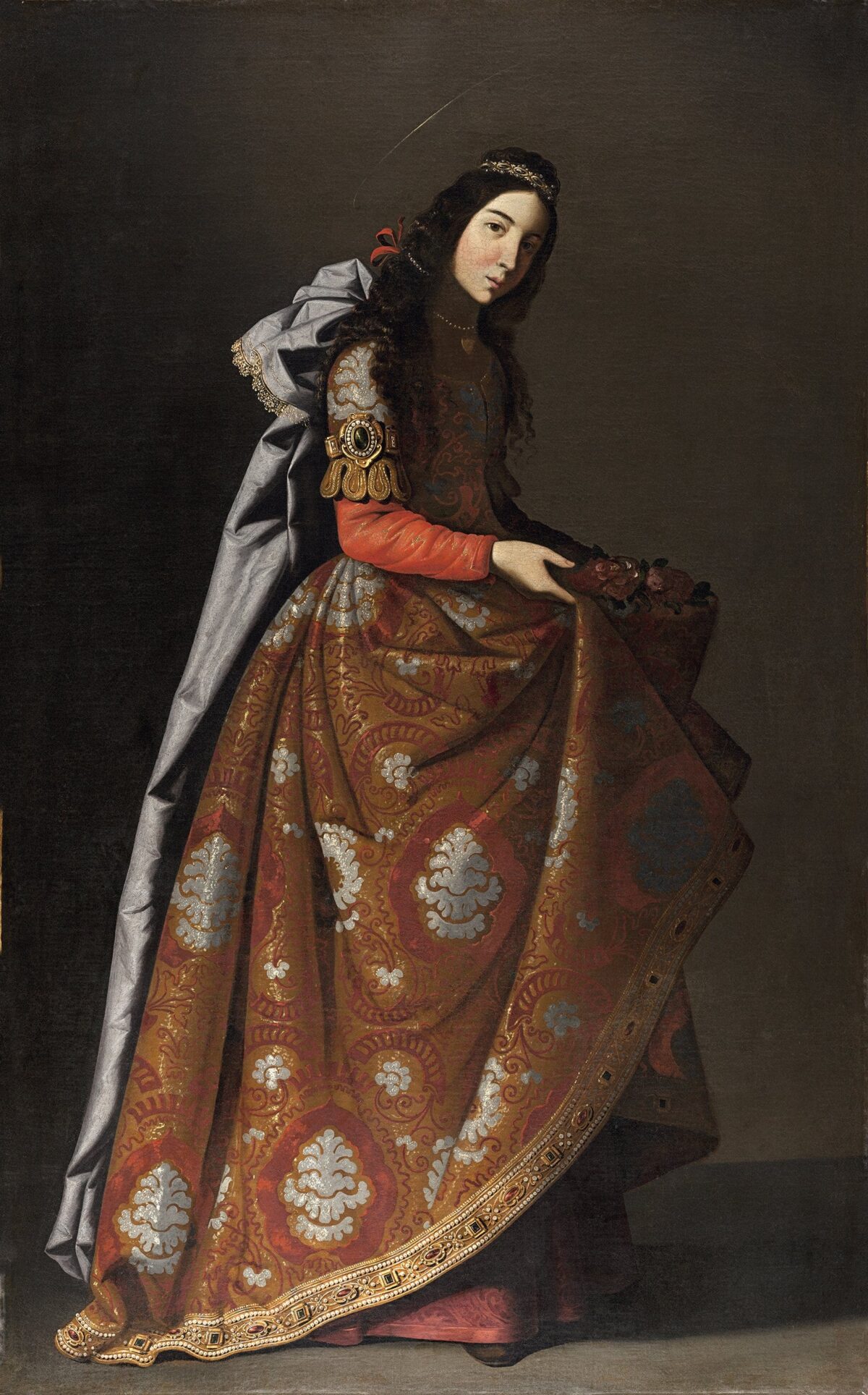
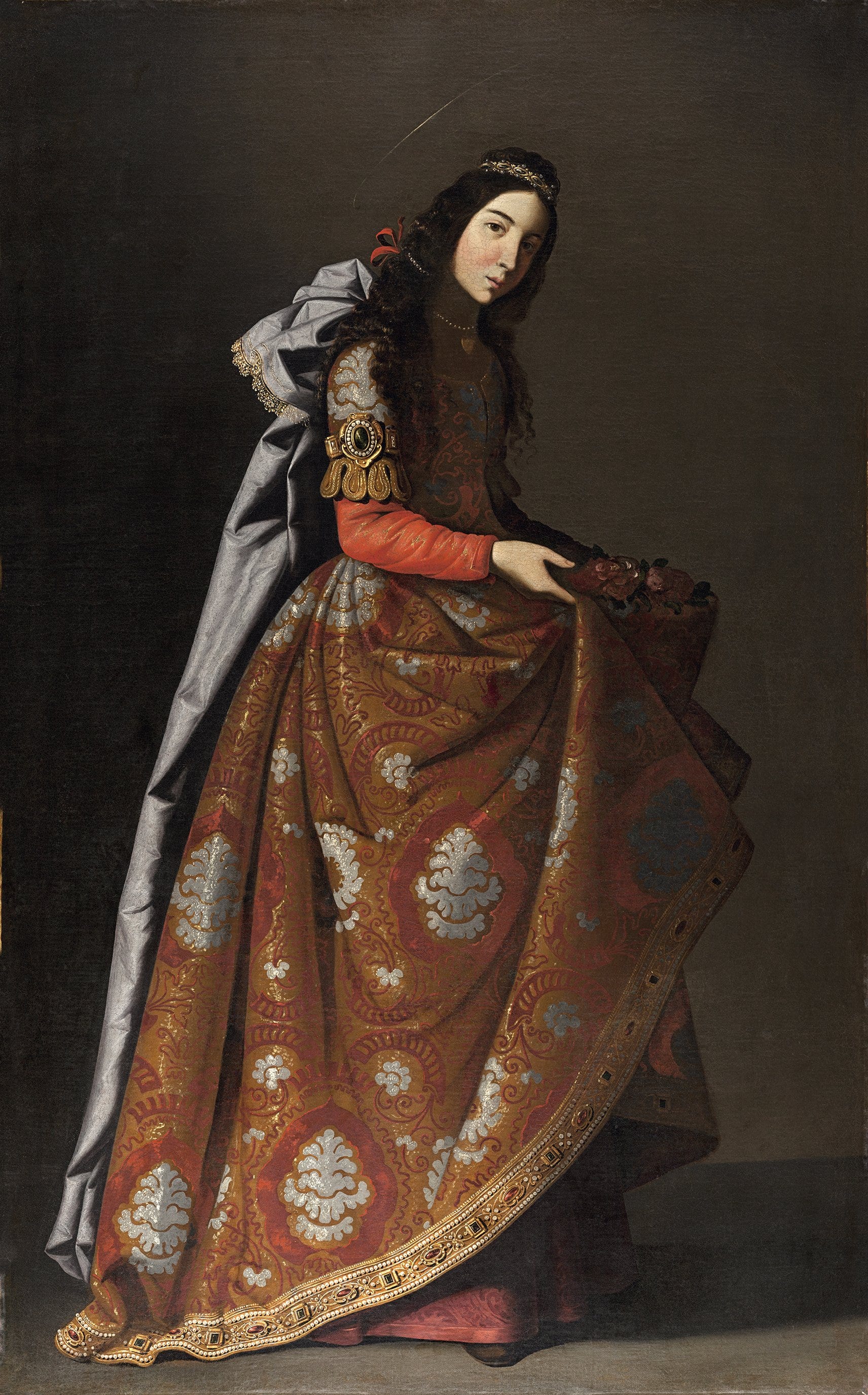
Zurbarán’s genius rests in his ability to craft seemingly tangible subjects from paint. When faced with Zurbarán’s works, one cannot help but feel overcome by the paintings’ brooding power and stirred by the emotional intensity with which the artist conveys religious themes. That is not to suggest, however, that you have to be religious to appreciate the art. Throughout the exhibition you are enveloped in the sumptuous, ornately decorated and exquisitely detailed textiles donned by Zurabarán’s sitters. Zurbarán’s unrivalled capability to depict fabric is best epitomised by Saint Casilda (c.1635), one of the most popular works of his saint series. The daughter of an Arab king, Casilda converted to Christianity and supplied her father’s Christian prisoners with bread. Upon being discovered by her father, the bread Casilda had hidden in her skirt miraculously turned into roses and she was subsequently martyred in 1087.
Francisco de Zurbarán, Saint Casilda, circa. 1635, Museo Nacional Thyssen-Bornemisza, Madrid
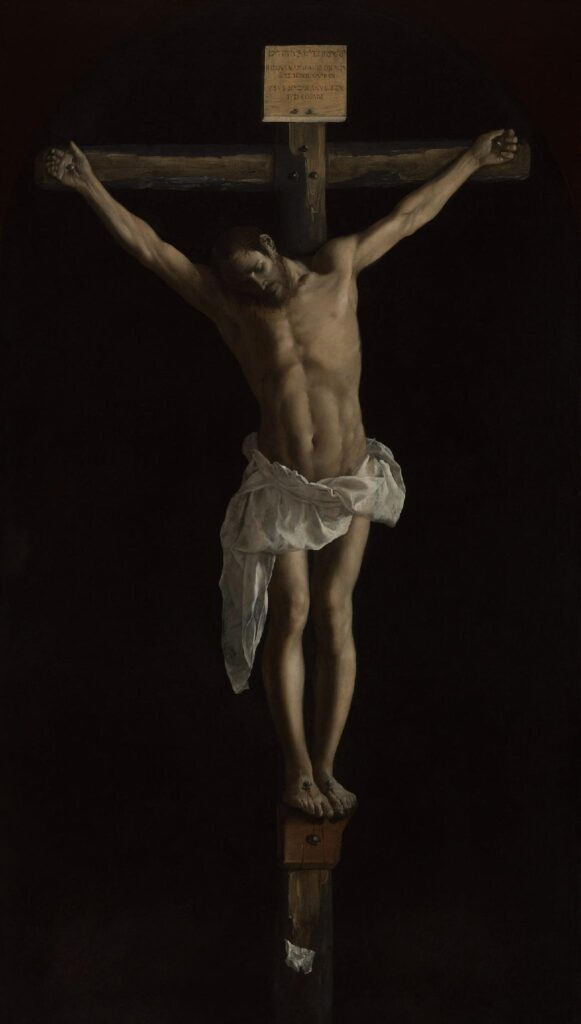
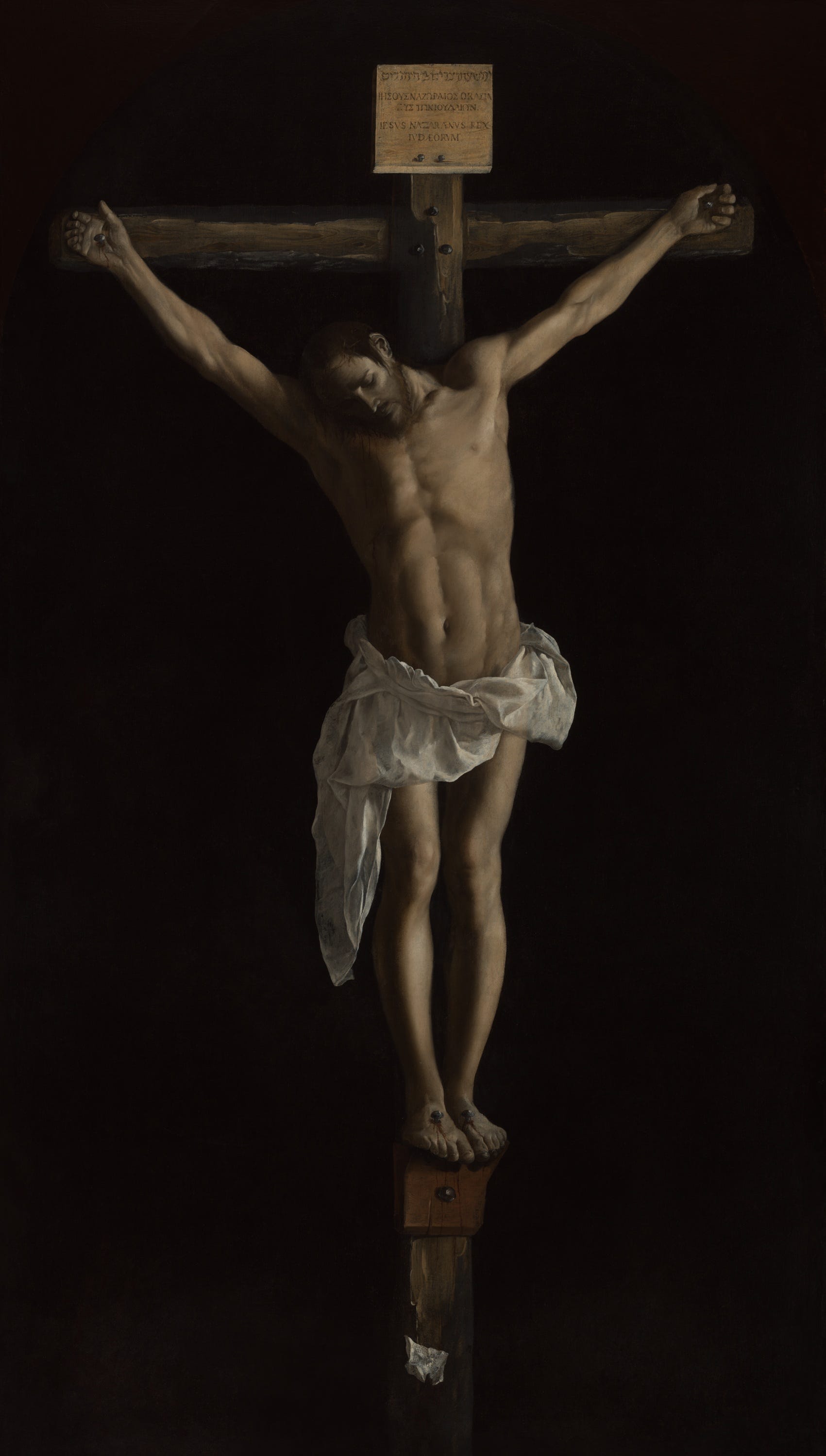
In Zurbarán’s presentation of the saint, Casilda holds her voluminous skirt, richly embroidered and trimmed with precious stones, to partially conceal the roses she is carrying. The folds in the skirt’s fabric are great and deep so that you can imagine its weight. Just in case you somehow miss it, the vivid red of her sleeve draws your eye towards her obnoxiously large armband, at the centre of which is a large, black stone – possibly an onyx symbolic of remembrance and divine strength and guidance in the bible – enclosed by a border of pearls. Nonetheless, for me the most impactful element of her attire is her cape. It appears to be constructed from stiff satin with an ornate gold trim, rendered so naturalistically you feel as if you could scrunch it up in your hands and it would hold the creases. Even in Zurbarán’s depictions of the Crucifixion, the most morbid scene of Christian iconography, Christ’s loincloth is presented as an excess of stark white fabric, with crisp folds and a haunting quality when contrasted with the black abyss of the background.
Nonetheless, the ability of Zurbarán’s paintings to exert their full power on their onlooker was hindered by the lighting of the exhibition space. Before visiting the exhibition, I anticipated the gallery space to be dimly lit to emphasise Zurbarán’s practice of chiaroscuro – the Italian term for creating three-dimensional forms through contrasting lightness and darkness. However, the exhibition space shared the same brightness and natural lighting as the rest of the gallery. Subsequently, whilst Zurbarán had meticulously and masterfully manipulated shadows and highlights to imbue his subjects with a sculptural quality, the brilliance of his execution of this technique could not be fully appreciated. Instead, I often found myself viewing the works from various angles in an attempt to escape the artificial glare.
This was apparent from the moment you entered the exhibition space when you are confronted with The Crucifixion (1627), the first of four in the exhibition and Zurbarán’s first signed and dated work. Christ is depicted with the upmost naturalism, his head hanging in a quiet but devastating solemnity. Outstretched on the cross, his elongated torso and limbs look almost as if they have been carved from marble. This sculptural quality of the work is key to understanding its power. The Crucifixion, which stands tall at 339.1cm by 212.1cm when framed, was commissioned by the Dominican Monastery of San Pablo el Real in Seville as part of a cycle of religious paintings. Of particular interest is that the work was originally placed behind a grill in the monastery so that, in the words of seventeenth-century art historian Antonio Palomino,
“Everyone who sees it, and does not know it, believes it to be sculpture”.
It therefore struck me as a bit of an oversight that the curation of the exhibition did not reflect this fundamental aspect of its original display. Why prompt people to imagine what the work would look like to contemporary observers when the effect could be very easily recreated?
Francisco de Zurbarán, The Crucifixion, 1627, Art Institute, Chicago
In contrast, the Wallace Collection’s recent exhibition of Caravaggio’s Victorious Cupid (finished in April of this year) seized the darkness. Caravaggio’s Victorious Cupid (also known as Amor Vincit Omnia, Amor Victorious amongst other names) formed the finale of the short exhibition which showed the masterpiece along with two ancient Roman sculptures, all of which historically belonged to the collection of the Marchese Vincenzo Giustinani (1564-1637) in Rome. Painted by Caravaggio in 1601-1602, the work was backdropped by paragone “comparison”, a Renaissance debate between artists and collectors which questioned whether painting or sculpture were the superior artform. Caravaggio’s cupid, in the same manner as Zurbarán’s figures, combines both; it is a painting with a sculptural quality. Set in a near-pitch black room which echoed the work’s black background, the onlooker could easily appreciate the three-dimensionality of Caravaggio’s cheeky subject in contrast to the set-up at the National Gallery.
However, the issue with the lighting cannot ‘overshadow’ what was otherwise a wonderfully curated exhibition. From smaller commissions such as the devastating Agnus Dei and still-lifes by both Zurbarán and his son, to an appreciation of scale through the partial reconstruction of a fifteen-metre altarpiece and the giant, ominous head attributed to the artist, the exhibition provides a unique and unmissable opportunity to be fully immersed in the drama and theatricality of Zurbarán’s art.
The Zurbarán exhibition is on at the National Gallery, London, until the 23rd August, 2026.
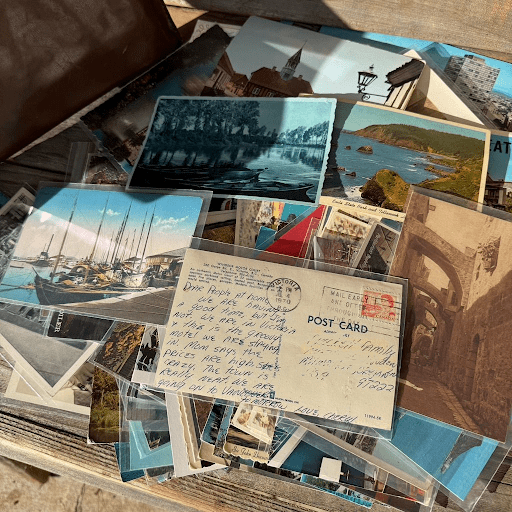
Part of the holiday ritual was always writing a postcard. Off we would set to a shop selling ice creams, beachballs, booze, and tat, to stand in front of the revolving galleries. The glossy sheen shone back at our suncreamed faces as we would choose the ones with the nicest photos of flowers or donkeys, or with the most vibrant Word Art font to attest to the fun available at the destination it read out. We always wrote them, be it to grandparents in Blighty, or school friends we had felt a particular attachment to in the school year just gone; I don’t remember a holiday without them. We spoke of the crunchyness of sandwiches with foreign bread and sand, the infinite fun a child can conjure up upon being provided with open water, all in a sprawling, phonics directed hand. Now, my handwriting is less sprawling and my excitement over water has lessened into a blissful anticipation, but my postcard writing remains. Chances are most people whose names appear on my phone’s contact list will have received a postcard from me. I still write them, and offer them as my preferred medium of communication. I never graduated past primary school postcard activities offered by my parents, the letter form never really stuck with me, but I am content with my little postcard world.
I had never given postcards much thought, attributing my attachment to them with a misquoted Virginia Woolf phrase – ‘there is no such joy like receiving post’ (which I think explains most of our Vinted habits too). These A6 tokens are dime a dozen, but they have a particular specialness to them. Something irresistible in their form keeps me coming back whenever I need to say anything. Subconsciously my habit of choosing a postcard at a young age was helping form a visual language for when words couldn’t fit. In looking for postcards with flowers and animals, I was hoping to provide the recipient with more than just the juvenile details of a holiday, but a symbol representative of my time.
Berger’s 1972 series Ways of Seeing, based on his collection of essays under the same name, scrutinises the way art has come to exist in the 20th century. Reproductions of art are everywhere. If Berger could have seen how this would evolve into being able to see Carivaggio from a tool in your pocket I wonder what he would say. As a result of all this reproduction, postcards of your favourite works are readily available at any good or bad museum across the world. ‘Pictures [are] like words rather than holy relics’ observes Berger, using the postcard epidemic as a case study. No longer contained within the sanctuary of the museums or chapels they live in, art has come to take a new meaning that is less shrouded in its uniqueness to one place. Each postcard stuck on your fridge, wall, or mantel piece, regardless of their content or the photo/reproduction on the front, helps form a ‘visual language. Used for describing or revealing experience’. The back and front work in tandem, building a vision from words and symbols that captures the moment in which you are writing, the location of where you are, the reason for your stamping the address. The postcard becomes the most ephemeral form, capturing a fleeting language of a holiday or period that necessitates the visual.
I stick the postcards I receive in return all over my walls, lodged inside my books, and wrapped in ribboned piles once the walls and books get too heavy. I can’t bear to throw them away. It would be like throwing away a little piece of the personal history of myself and the sender. ‘Wish you were here!’ is not merely just a cliched saying but an invite into the sender’s perception. The thought of you was triggered and aligned by the postcard they brought, the images on it, aspects of their perspective while abroad brought them back to you. It is very rare to see how other people actually perceive you, and is a major source of thought if you are a vain twenty-something year old (insert THAT quote from Jemima Kirk). The postcard allows us to see the visual language the sender uses for you. Pieces of art people thought I would like. Holidays people thought of me on. Designs and objects people recognised me in. While postcard writing was originally an exercise provided by my parents to ensure we wouldn’t return back to school having lost all ability to write, now the postcard becomes the relic of a moment. Its small, undaunting form can be scribbled out in the spur of the moment. Moments of thanks, longing, or simple upkeep of a relationship all compel the postcard into creation. When we write to someone while abroad, or simply just away, we are telling them through this very act, regardless of how simple or cliche the message, that we are thinking of them there in that moment. That despite the distance, our existence remains aligned with theirs, existing against these new insights and perspectives.
By writing we hope to preserve, to cross through time, and for our words to land at someone’s feet. Be it postcard form or longer form, as I am writing to you now, we hope our words capture and travel. We hope our use of language become symbols for sentimentality, symbols of a life. Laced in every postcard is the complete ephemerality of a moment and a journey. Thoughts, perspective, symbol, emotion, and weather land at your doormat, containing it all in only 105 x148 mm of space.
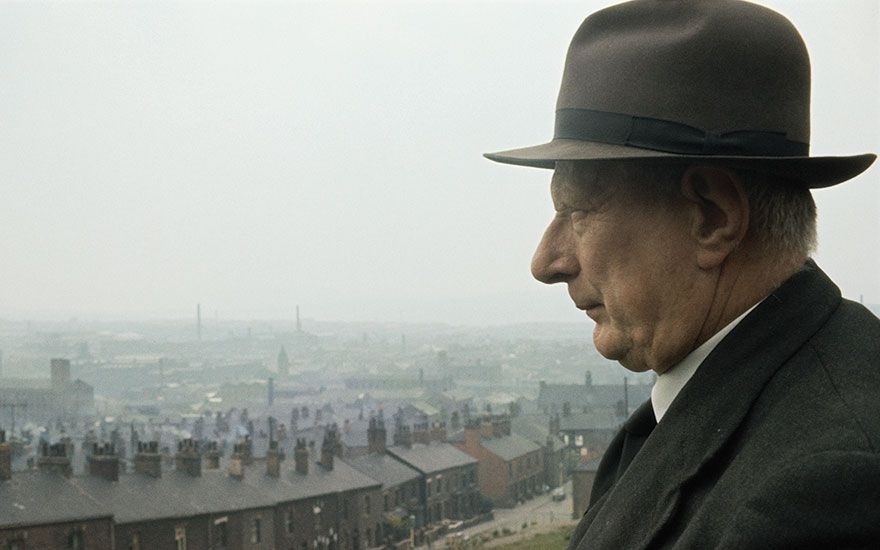
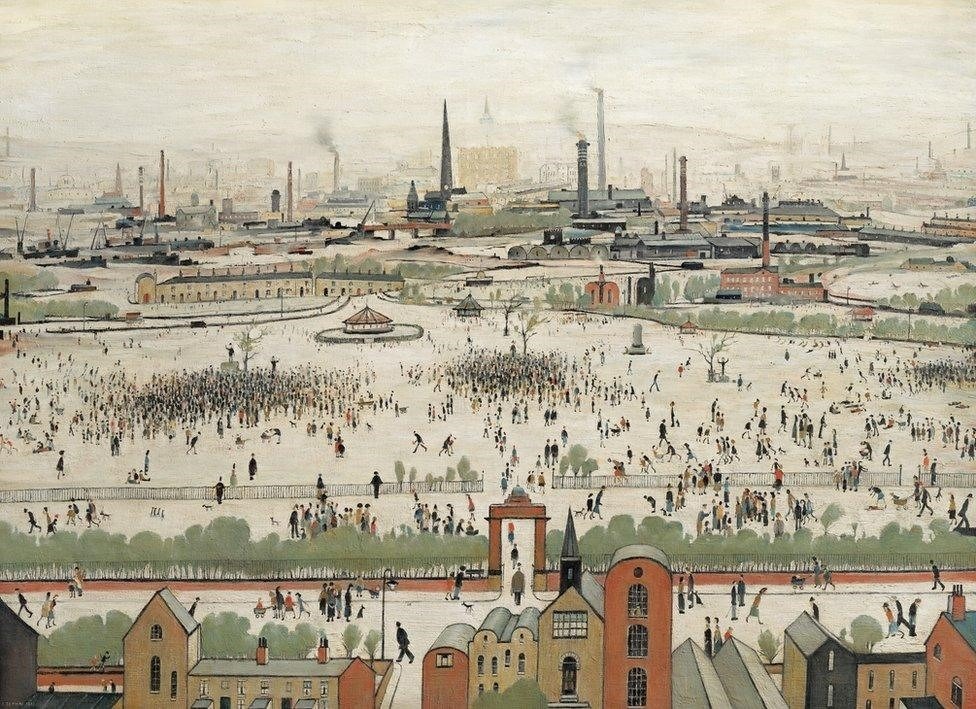
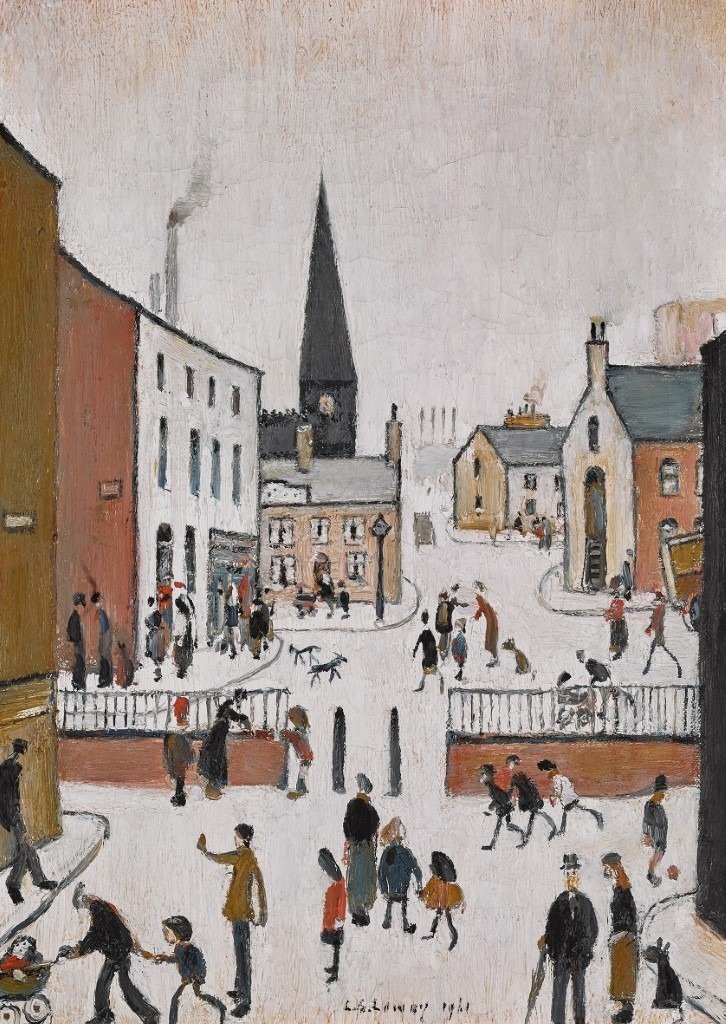
The mid-19th-century pavements of Manchester and Salford would often bear the footsteps of Karl Marx and Friedrich Engels, whose encounters with the harsh industrial conditions kindled ideas that would reverberate far beyond the city’s rauch und ruß. In the 1950s, those same pavements felt the same steady tread of L.S. Lowry, an artist who, when his paintings failed to make any profit, turned to the prosaic vocation of rent collecting – wandering the less fortunate quarters of both cities, gathering his modest income, and taking in the quiet scenes that would later find their way onto his canvases.
One cannot help but notice the irony wherein the very streets that bred The Communist Manifesto would later see an artist navigating them as rent collector, inspecting the homes of working class families and simply trying to make ends meet. Having missed his train one day in 1916, Lowry stumbled upon the loose end of a Manchester suburb with a happenstance ACME Spinning Company Mill in full churn. He would later recall, “The mill was turning out hundreds of little, pinched figures, heads bent down… I watched this scene – which I’d looked at many times without seeing – with rapture.” This view, a boilerplate skyline of brick, chimney, and chilly smoke, suddenly brimmed with a new life under the realisation that no one else was painting this. Lowry thus decided to put the industrial scene “on the map because nobody had seriously done it”, and from then on, Pendlebury’s mills, Salford’s back alleys, and Manchester’s markets became his muse.
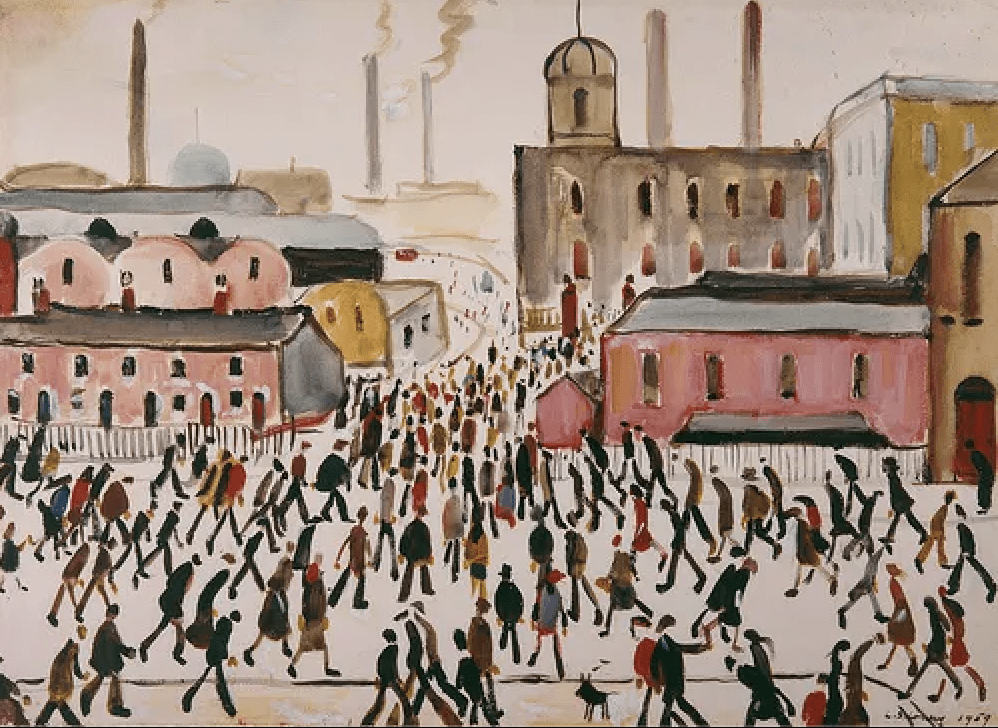
Today’s Manchester is a hive of activity, its identity manifesting in the iconography of worker-bee souvenirs and a pulsing music scene. Much the same could be said of Lowry’s Manchester, though gift shops were much less in vogue and its soundtrack not yet touched by the likes of ‘The Smiths’ and ‘Joy Division’. Nevertheless, his canvases feature a similar population of matchstick figures in dense crowds, set against red-bricked factories and rows of terraced houses.
In a 1957 BBC documentary on his life’s work, Lowry comments, “I just paint the people as I see the people in my mind’s eye,” a philosophy that creates an almost dreamlike process in which, rather than sketching soldiers or machinery from life, memories and local lore fill the scene – figures he described as “not exactly” Manchester workpeople but ghostly silhouettes that “seem to me so beautiful,” drifting through factories and streets. His speech was marked throughout by an insouciant “I don’t mind it at all,” and on the particular settings of his paintings, he observes, “I don’t mind it at all whether they’re today or yesterday or any other time.” A Christie’s curator notes that “Lowry is beloved by us for making the industrial scene his own. These works were created in his own unique way, poetic yet not sentimental, compelling… but never judgmental.” Indeed, Lowry claimed he did not paint to agitate or reform. “I was not thinking very much about the people in the way a social reformer does,” he admitted, “They are part of a private beauty that haunted me.”
After all, it is not difficult to locate his work within the mid-century backdrop of Manchester’s smoking chimneys and flat caps, all seemingly tethered to a different alien to our own. The idea that it could belong equally to today or yesterday feels, at first, like a fragment of his time rather than ours. And yet. Watching that documentary during the final stretch of a degree in English Literature at Durham University (with all the existential static that attends a completed education and its ensuing blurry prospects), I found myself looking out of my bedroom window and recognising that today and yesterday. There is something in Lowry’s figures, drifting through those industrial thoroughfares, anonymous and unhurried, that refuses to be confined to any particular moment, and, for all the years that lie between Lowry’s world and our own, you may also find yourself absorbed into the slow ebb of a crowd.
A self-proclaimed simple and lazy man, with little penchant for the “usual humdrum job,” Lowry occupies a peculiar position in the landscape of British Painters. Despite establishing an absence of ideology behind his art, it nevertheless maintains an air of its own reason. His canvases carry a certain passivity, the quality of an image recalled only in the fleeting, unfocused moments of everyday life: walking to the shops, walking through a familiar street, trying not to make eye contact with the strangers who are also simply getting on with things – reminiscent of the life my own grandma would describe to me.
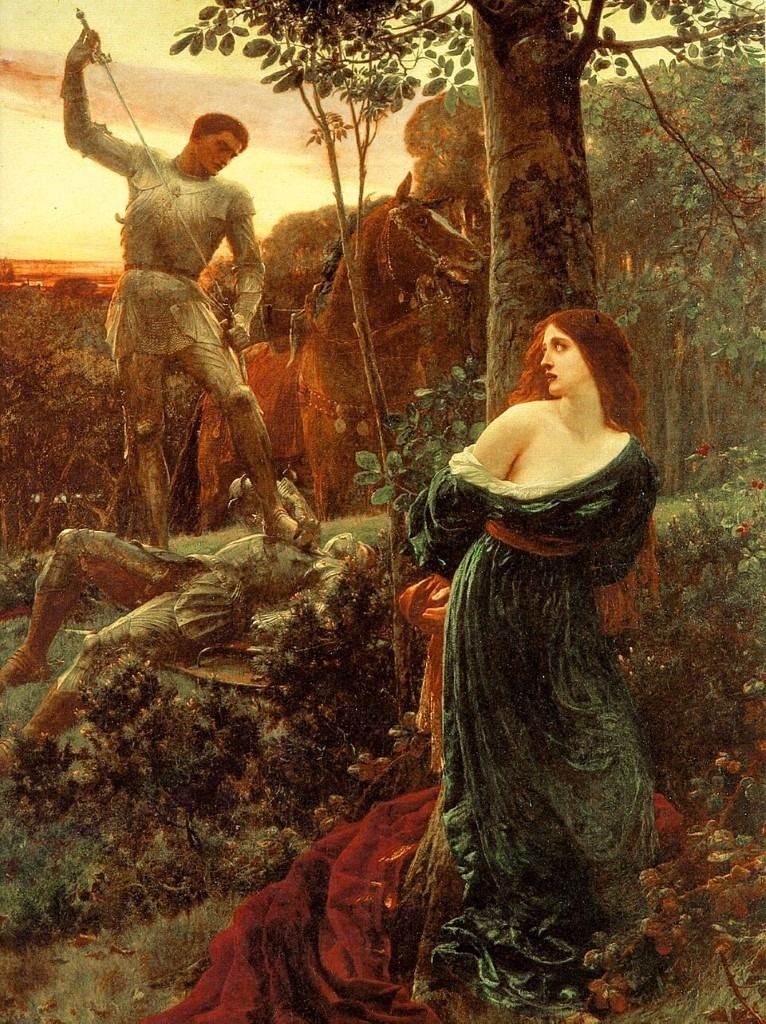
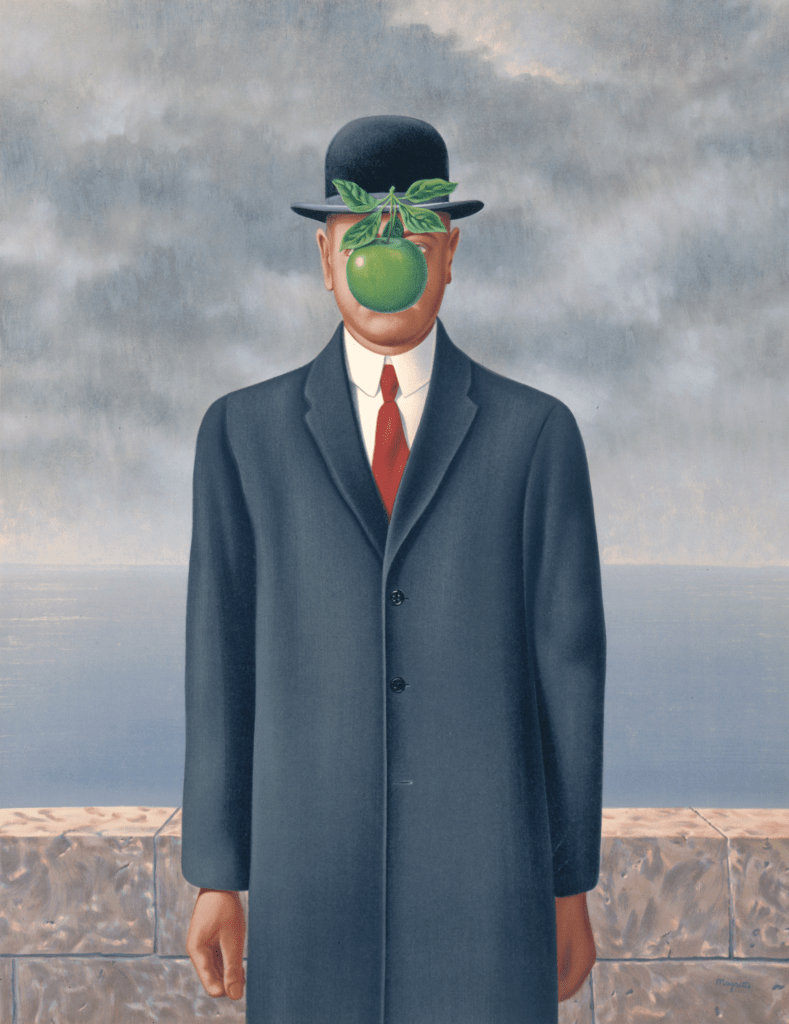
Yet. The Pre-Raphaelite Brotherhood had cast a long shadow over conservative British taste, its legacy of medieval romance and religious symbolism still colouring the expectations of what serious painting ought to look like. Within this same broad moment, artists like René Magritte were fashioning their ordinary figures within the realm of surreality, bending the everyday toward the uncanny and the subconscious.
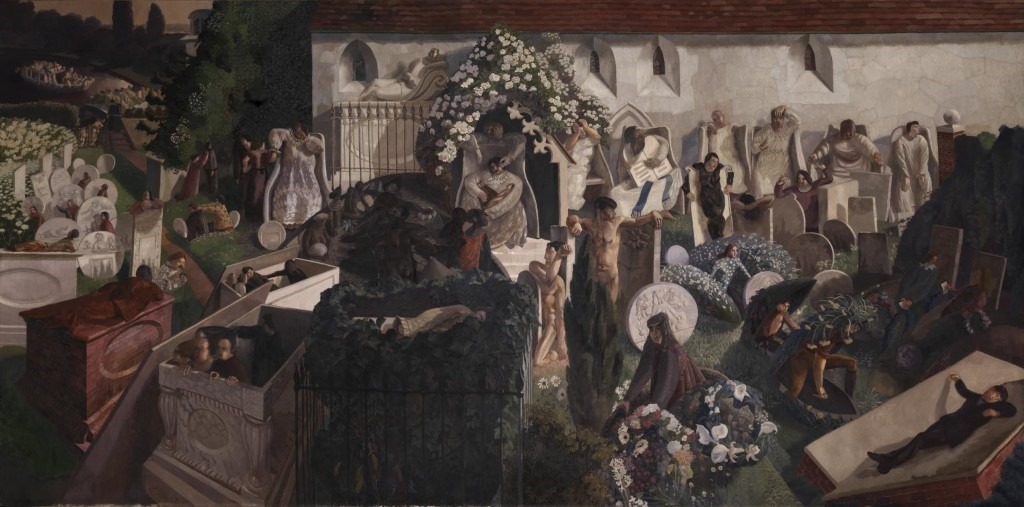
Stanley Spencer, with his quiet English churchyards and resurrected dead, transfigured the familiar into something devotional and intense. All of it, in its various ways, beckons beyond the everyday… reaching toward a distant past, an exploration of the self, or some higher plane of meaning which the visible and tangible world alone cannot contain. The Royal Academy, meanwhile, clung to its traditions of historical grandeur and mythological scene-painting, its Arthurian knights and Sunday School virgins dressed in a culture reluctant to look itself in the eye.
Lowry wanted none of it, though not out of any particular rejection so much as something closer to indifference. Where his contemporaries turned the outward world into a framing for the inward one, Lowry showed little interest in being the kind of man who made his own mind the subject. He painted what he saw, and from this, he made something that the Southron art scene never would have thought to.
As such, within this peculiar space occupied by Lowry, and in spite of his assertions otherwise, he has come to embody a politics of representation, in that, by portraying the today and yesterday of Northern England, his art performs an act of attention that the broader culture had largely refused to make. The mills, back streets, and crowds filing out of factory gates were not the typical subjects that hung in the Royal Academy, nor the stuff of which artistic reputations were typically made, so much so that critics would describe the people in his paintings as “figures like insects”, one reviewer conceding he was “original but narrow and repetitive.” Yet Lowry paid them no mind: when asked why his figures always came out the same, he shrugged, “Because I can’t do them in any other way.”
I would locate these criticisms in their own explicit form of classism towards the industrial North and its people; regardless, Lowry has made a legacy out of what these critics turn their noses up at, a legacy experienced by many. At a time when art was expected either to transcend its surroundings or to interrogate them, Lowry did neither. Within Lowry’s paintings, the lives of working people in the industrial North were as worthy of a canvas as an Arthurian legend. He did not sentimentalise them, and in doing so, preserved something that might otherwise have passed entirely unrecorded.
While Lowry’s location is settled in Manchester, this legacy speaks to his future and our present. With the passing of Bradford legend David Hockney, the way in which northern artists offer us a grounding with reality seems more relevant than ever. Hockney, whose work occupies a much later decade than Lowry’s but who was also initially criticised for his simplicity and subject to mixed reviews from the Royal College of Art, is evidence of what Bradfordian journalist Ben Forrest writes: “Working-class people, and northern people more generally, aren’t afforded much of a foothold in the art world, and children are increasingly being persuaded to ignore their artistic sensibilities in favour of developing practical skills aimed at funnelling them into the job market.” And Lowry, the self-proclaimed simple man, demonstrates a similar trajectory – his mills may no longer churn, his crowds may wear different coats, but the ebb and flow stays steady.
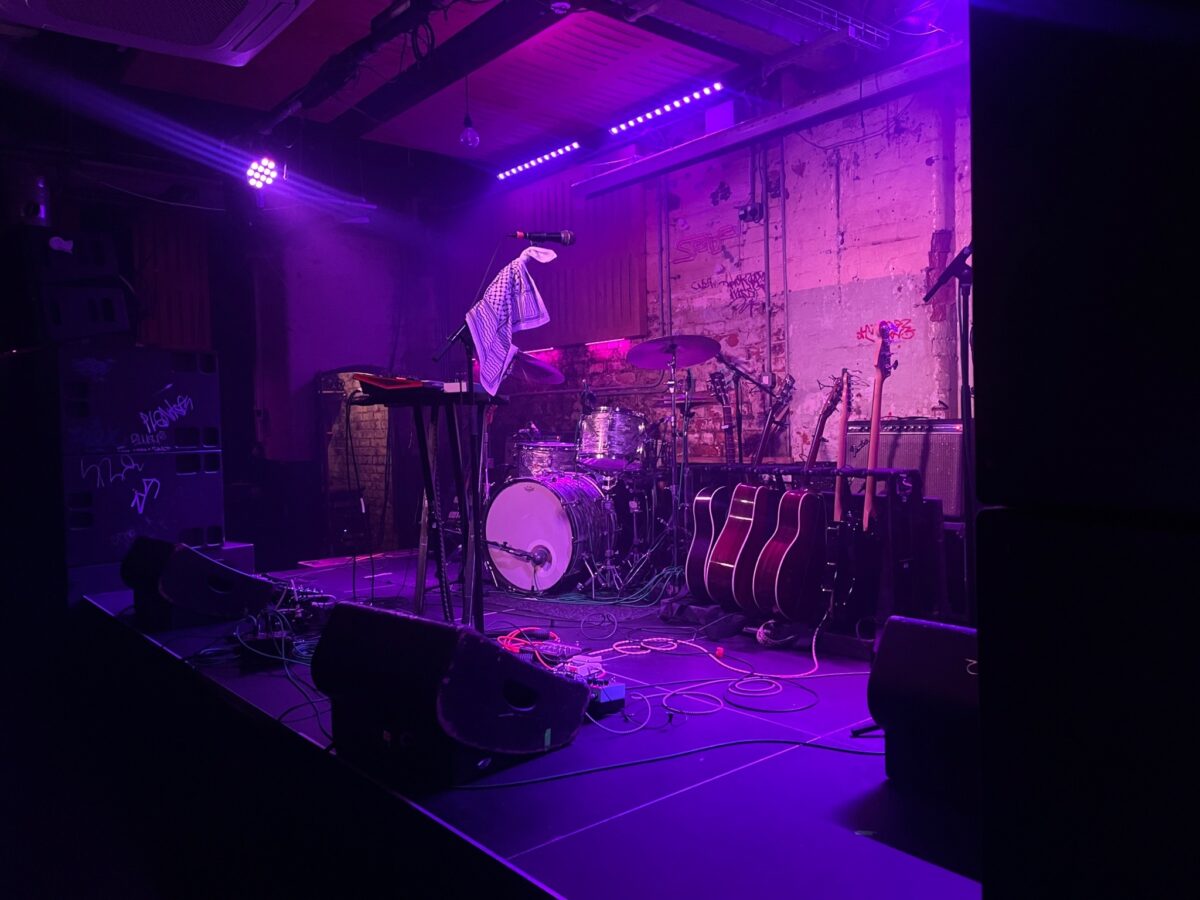
It was already shaping up to be a perfect day in Manchester – deliciously warm, no-jacket, late-spring. Armed with cold pints, hands marked with star-stamps, we made our way down to the basement of Soap, to a room basked in deep blue light, most aptly describable, without a hint of pretentiousness or irony, as intimate. The stage was ready, washed in magenta, with drums, a set of guitars, a keyboard, a microphone wrapped in a keffiyeh. The small space filled slowly, some arriving in pairs, some alone; standing idly, making anxious conversation – When did you find her? Isn’t it crazy, she’s here? England in summer always has that feeling of heaving towards greatness – the sun comes out and everyone is waiting for something to happen. In our own little world, there, so were we, suspended in a waiting we knew would lead us to our own slice of greatness.
As the room filled, the opener, Bells Larsen made his way to the stage. He played acoustic guitar, careful, considered. He was letting us in, it seemed, and the audience obliged, listened. He played a song of love and loss and change, ‘514-415’, afterwards explaining the lyrics, ‘When we met, I was a girl / Since then so much has changed / Now I could be your lover boy / You’d still look at me the same.’ He told us about the record, the album he’s spent the last year touring, how he recorded the vocals pre- and post-transition, harmonising with himself. It was beautiful, he was beautiful, and we were primed for softening. Perfect pieces falling into perfect place.
By the end of Larsen’s set, the space had filled marvelously: full, but not crushing, a fact I feel compelled to self-indulgently put down to the strong moral character of the crowd, by virtue of their good taste. In that delicious lull between opener and main act, our open-hearted contemplation gave way to that wonderfully jittery anticipation. Then, Eliza and her band walked onstage and, without ceremony or preamble, launched straight into ‘Better Song’. If Bells Larsen had spent his set drawing the room closer, ‘Better Song’ pushed it right back open. It’s the first track on Good Story, the record she’s been touring, which confronts the pull towards self-mythology, the impulse to string together a narrative from a life, making it art. In the wake of her debut album Going Through It, in which McLamb excavated her life’s experience and hurt, Good Story deconstructs that impulse. It poses that crucial question: where is the end of the road, when a life has been made narrative – where do we go from the story? For now, at least, we go here: to warm alive bodies moving, dancing; to guitars that heave, oversize the room, wrap us all under some heavy communion of excitement and feeling. From there, they move seamlessly into ‘Suffering’, opening with a lullaby-like piano figure. Eliza sings the first lines with a side-eyed irony, poking self-aware fun at her own tendency towards melancholy, ‘Poor Maudlin child / So wise beyond my years / Sigh here’. It’s a song that plays with the ways we can, and so often do, become attached to our own misery, holding our suffering less as a burden than a pillar of identity. We have, for whatever reason, found ourselves at the mercy of a conviction which dictates that incredible pain is the noble door to genius, and so suffering should be directed towards artistic creation accordingly. Of course, this cannot be true – there is nothing romantic about suffering. And this, McLamb makes clear, as the song lurches into its chorus, and the band follows suit. The audience shouts the lyrics back, and we’re a room full of people engaged in this dance of irony. But, as all good irony is, this is an irony engaged directly with feeling. Coming to terms with the compulsion, the only way out is through.
From there, the set moved easily. Eliza McLamb has this wonderful, grounded quality as a performer. She is embodied, assured, picking up and setting down acoustic and electric guitars when necessary. It all felt natural, whether more rock or folk-adjacent, it was all feeling – it was just a question of whether the feeling called for dancing or swaying. I joked later that I felt God at the Eliza McLamb concert in Soup, Manchester. Of course, I try to be funny, but ultimately I meant it. So many people feeling so much in one place. There’s something about music – no wonder all religions have song. Oh, and it is just so good to dance. And to dance to ‘Forever, Like That’, sing in unison along to ‘While it’s good to get a grip / It’s better to let go of it’ – to remember, to let go. Slow down, stand careful, watch Eliza sway, hands behind her back, singing ‘Mausoleum’. Back to dancing, stupid, uncaring, because they’re playing ‘Modern Woman’ and singing ‘I want something to feel, I want anything that’s real’, and I feel, and this is all so real and I don’t know what to do but dance – which is fine, because that is really all I have to do.
Between songs, Eliza spoke about the record, the tour, Manchester, how easy it is to find vegan food in England, how much she likes it, how lucky she feels to be able to tour here. I feel lucky, too, in the pulse of the room, laughing and cheering as one part of the audience-whole. I feel so incredibly, ineffably lucky, when she moves into ‘Girls I Know’, and within seconds I am holding my friend. I am here with Immy, experiencing in motion what has always, since the first listen, been to me the song of us. It’s a song about friendship; love when you are young and unwell, love when you are grown and better. When we met, we were so young and so unwell, spinning out in different directions, and ultimately it was a friendship that had to end. And for years that was it, and in those years we got better. We reconnected a few years later, drinking-age now. We met in a pub, and over outrageous mixed drinks, I told her she should listen to Eliza McLamb, her music, the podcast Binchtopia. I saw the UK tour announcement when I was on my way into class, I have never forwarded something on so fast. In seconds, a reply, mutual incredible excitement. She said I must stay with her, we can have a sleepover – she had been at university, living in Manchester for the last few years. I was on exchange studying in Prague for the year, I would have to get a plane. A few months later, then, I did, and so there we were. We hold each other, Eliza sings a few meters away from us, and it all washes over me, ‘We all meet in a new place, where nothing feels as good / And nothing feels as bad / That’s the choice we made’. My whole young life spreads out somewhere in invisible space, and nobody has ever been so lucky. To be young and in pain (‘When everything kicked in / When our bodies lost the fight’), to be older, to be happy. To be with my friend who I love so much, my arm around her, able to see her live, ‘smiling to herself, talking and eating well’. I look at my friend, the woman she is, the girl that I knew. Everything I have ever felt collapses into love.
As the concert comes to a close, Eliza lets us know that we’ve reached the point where she would usually leave the stage, the crowd cheering, and come back to play an encore. She says she finds this indulgent, and so instead stays put, plays ‘Salt Circle’. It’s the title song from her 2022 EP, and she plays it because this is her first time overseas, and so the first time most of us would have heard it live. I don’t think I’ve ever felt a room swell so much with feeling. Warm bodies so close together, hearts beating and voices catching and all singing, ‘I’m always gonna feel it / I’ve spent enough time trying not to believe it / I’m always gonna feel the way I do / And I do feel it all, all the time’. At the end of the song, as the intro to ‘Getting Free’ plays, Eliza calls out from the stage, “Keep your heart open.” I keep the love in my heart, keep my heart open. The girl next to me is dancing so zealously, and it’s my ticket to dancing with as much enthusiasm. There’s music to dance to and a life to apply it to, and Eliza is singing, ‘There’s so many ways it could have gone down / Pretty much all of it easier than right now’, and it’s all true to me now. My life is before and after me, and I’m in it, in the present, at the center. ‘When it’s just me and the world, I make a place I can find escape from / Running down the street, away from what I thought I wanted / Getting free.’
When the show ends, Immy and I stand eagerly at the merch table. We buy matching tour tees, and make our way to the bus stop, and most of what we have to say boils down to ‘Wow.’ We get back to her house, change into our new t-shirts and old pyjama bottoms, start a show on the TV, fall asleep on the sofa before the episode ends. It was a perfect day in Manchester. All I know is love.
This year, on June 11th, British artist David Hockney passed away at the age of 88 in his London home.
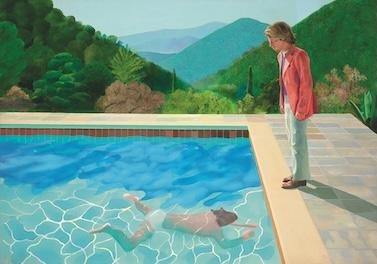
A record-breaker on many fronts, Hockney’s iconically bright and bold paintings garnered him immense success within the market. In 2018, his famous Portrait of an Artist (Pool with Two Figures) (1972) sold for $90 million at Christie’s, New York, making it the most expensive artwork sold at auction by a living artist.
Acrylic on canvas, 84 x 120 in.
Despite this, his is usually not the most famous name associated with the Pop Art movement (we likely imagine the technicolour renditions of Marilyn Monroe by Andy Warhol). However, David Hockney played a substantial role in defining not just the UK’s version of the trend, but also Modern British art more broadly.
Born in Bradford, West Yorkshire, and educated at various prestigious art schools, Hockney found his success, like many of his contemporaries, in railing against the traditional aesthetic values taught to him at the Royal College of Art. Tired of being expected to engage with the lofty subject matter and conventional techniques of ‘classical’ art, Hockney and other likeminded Pop artists turned to mass culture for their inspiration.
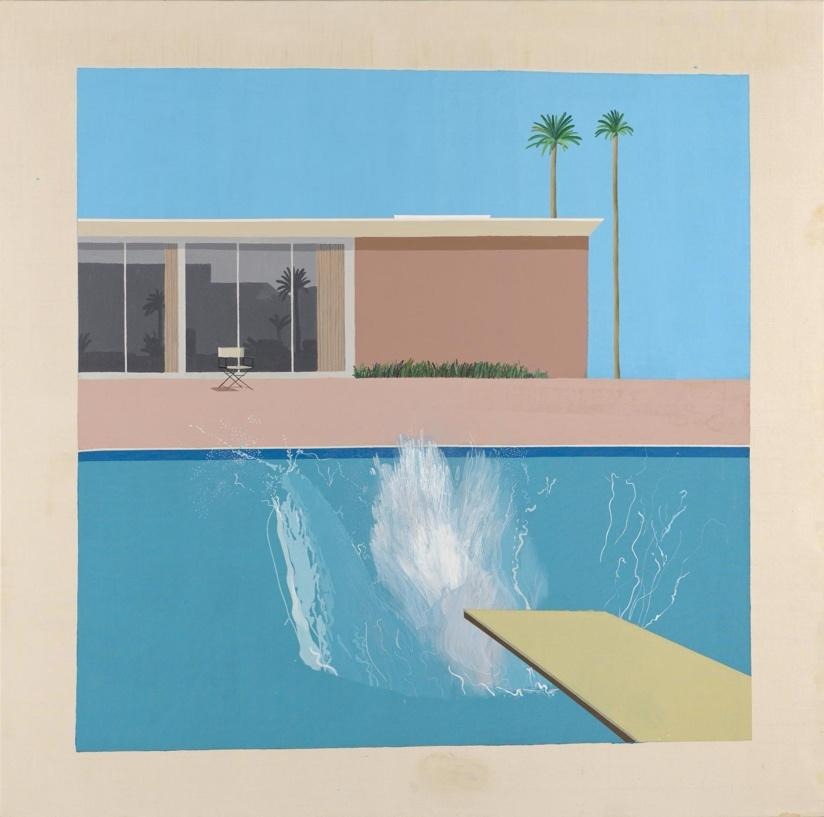
This is why 1960s California – a setting known for its post-war consumerist culture, booming media industries and shifting political landscape – served as inspiration for much of Hockney’s art when he was living out there. His use of acrylic paint on canvas, rather than oil, worked to capture the garish shininess of the swimming pools and glass houses that dotted the scenes of the American South West. A Bigger Splash (1967) depicts the almost eerie stillness of this lifestyle. Soaked and saturated in sun, with the splash of a swimmer frozen in time, this poolside scene captures leisure and wealth without a visible subject.
Acrylic on canvas, 95.5 x 96 in.
Returning to the UK and France in his later life, Hockney’s subject matter shifted to portraiture and the sweeping landscapes of his home county, Yorkshire. In the final decades of his life, Hockney became known for his iPad artworks of the area, with a print of his Arrival of Spring in Woldgate (2011) selling for $1 million at Sotheby’s in 2025, making it the most expensive iPad painting ever sold at auction.
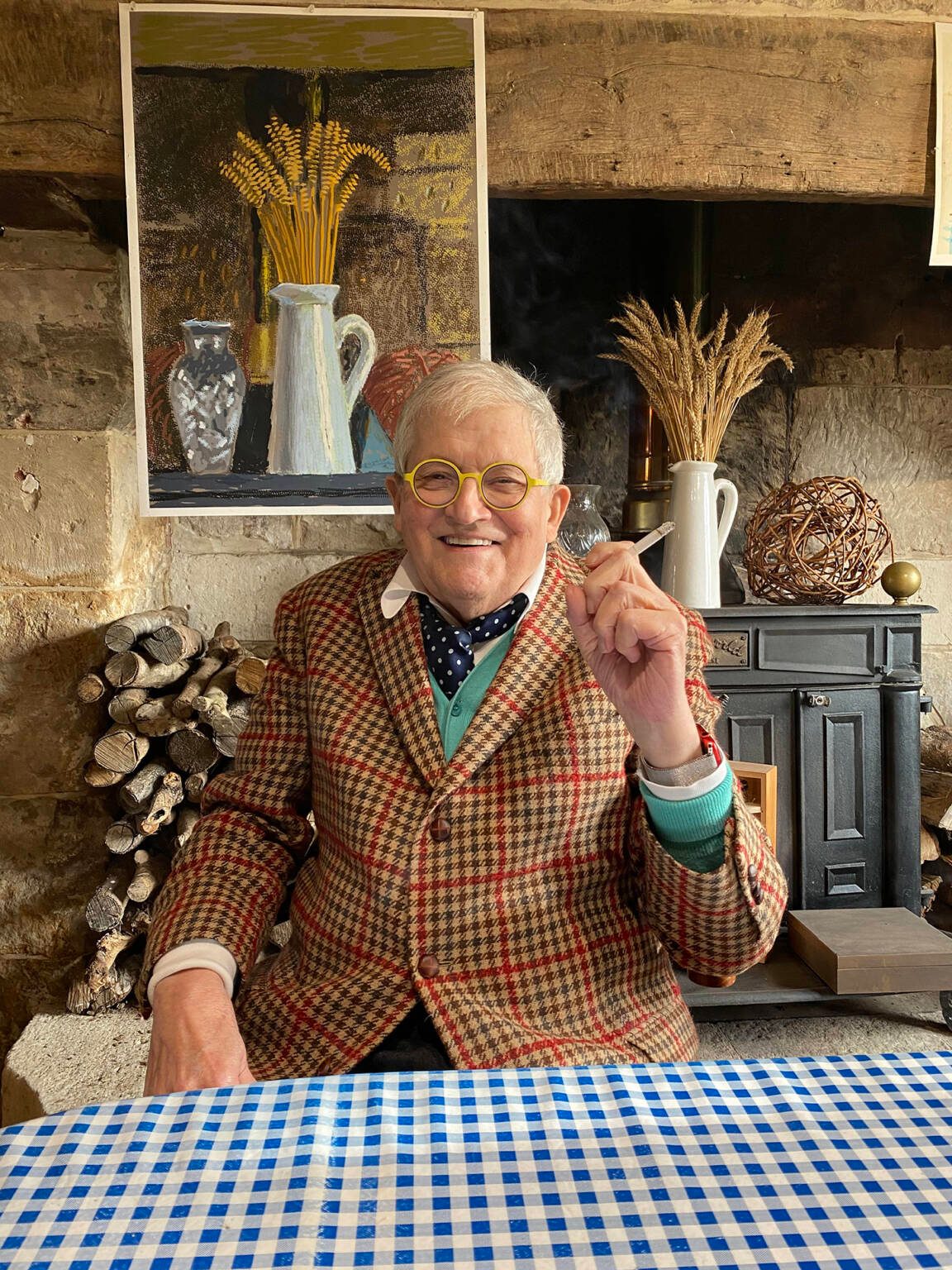
Beyond the successful and experimental artist, however, lay a man equally as memorable for his personal life. As a gay man who came out before the legalisation of same-sex relationships, Hockney has become an icon for the LGBT+ community – one who engaged boldly with touching scenes of same-sex love and intimacy in a time when many sought to bring down his emerging community. He was also an icon of style, famed for his signature round glasses, eccentric clothing and bright yellow Crocs, which he famously wore to meet the King at Buckingham Palace in 2022.
It seems, then, that there are many versions of Hockney to be remembered upon his death: the artist, the activist, the fashionista… But perhaps it was Dame Tracy Emin, another titan of Modern British art known for her provocative confessional works, who summarises him best:
‘[Hockney was] a great artist and a wonderful man, who with the power of art changed the perception of Britishness. [He was] a proud chain-smoking homosexual, who flew the flag higher than any other British artist.’
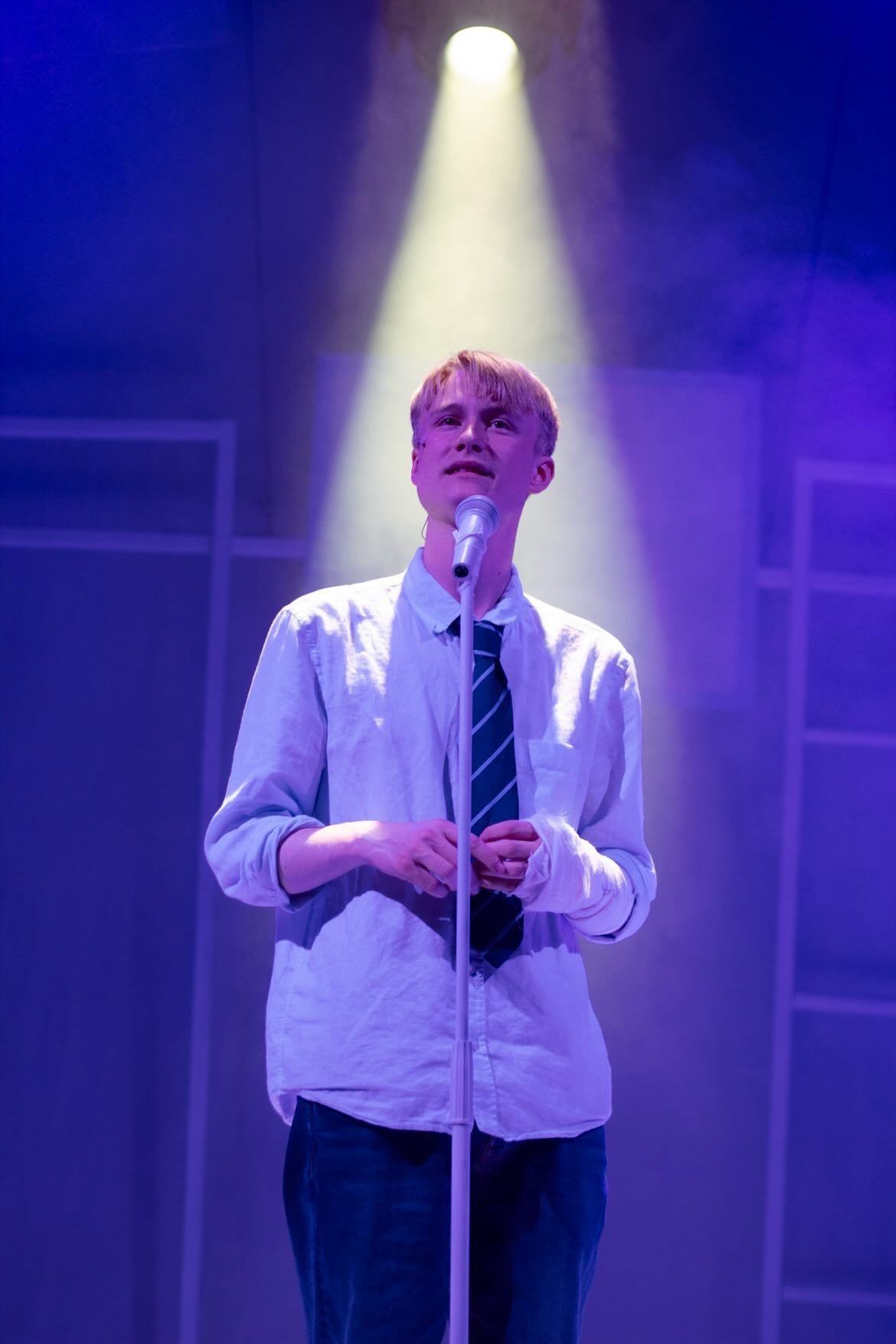
Connection unstable. The phrase appears in a small grey box at the top of the screen just as we’re about to launch into conversation. There is perhaps no musical more suited to a review conducted over a video chat than Dear Evan Hansen. A story shaped by emails, social media, likes and shares, digital grief and the uneasy gap between who we are in life and who we present as online – it feels oddly at home in the fragmented language of notifications, messages and screens. Tone Deaf Theatre Company’s inspiring production, co-directed by Lauren Williams and Estelle Pollard-Cox and assisted by Bee Wilkes, embraces that world full-heartedly while never losing sight of the human relationships beneath it. Supported by a live band, a fantastic creative team, a top-notch production crew, and a committed cast working in remarkable sync, the production navigates the show’s familiar emotional highs and ethical ambiguities with vivid energy, earnest sincerity, and no shortage of ambition.
It’s fitting, then, that our response should take the form of a conversation mediated by the internet. At its heart, Dear Evan Hansen is a musical about talking about it. Rather than write a conventional review, we reset our routers, opened a video call and started talking.
This conversation has been edited for clarity
R: The first thing that comes to mind when I think of this production is the demeanour of Ollie Painter’s Evan: the mannerisms, the gestures.
A: I was going to say that. He leads the show so confidently, it feels like he’s been born on the stage. I also think of the line in ‘For Forever’ when Evan sings ‘I climb till the entire sun shines on my face’. Jonathan Wilson-Down’s lighting design has this bright orange light bathing the audience, and it’s the most gorgeous, affecting rendition of the song I’ve ever experienced.
R: It’s so arresting. When it’s in the process of happening, you can’t really comprehend it until these lights are washing over and brilliantly blinding you.
A: Yeah. It’s also the first time it happens, and while it’s used a few more times in the play, I think this was the most effective instance.
R: Ollie Painter is so prodigious, so impressive. For a first-year student to have such firm control of the audience and to capture the mannerisms of Evan Hansen so well – he really adopts the perfect disposition. Some of the character choices he makes in the fidgeting of his shirt and the cracks and wavering inflection in his voice, and the cadence of his voice is present in his speech as much as in his vocals.
A: When you try to ramble, it can so easily come across as illegible. He makes it sound musical – it’s never hard to follow. And after watching, we were talking about how he has all of the best Ben Platt-isms without any of the drawbacks.
R: Yes, I think we should coin the term Ben Platt-ism.
A: Exactly, exactly. It redeemed every time I had to watch Ben Platt in the movie version.
R: I’m glad it was a healing process for you. Thank you, Tone Deaf Theatre Company!
PRODUCTION
A: I enjoyed the emphasis on the musical’s social media aspect, which every department leaned into. Wilson-Down’s lighting design had colourful rectangles projected behind the characters while they were speaking online, each assigned a specific one, and I thought it was an interesting way to highlight them as individual avatars. It brought the expanse of the Internet into the very sparse, peeled-back set.
R: It really does foreground the Internet aspect, which is so contemporary and so specific to Dear Evan Hansen. The conversations that happen between two characters are often online, and the squares with the frowning or smiling faces emphasised the distance and how centred everything is online, for better or for worse. One thing I found interesting was that Connor’s coloured squares were white, and at one point, Evan’s turned from blue to white. Connor’s presence lives on through Evan in this very unorthodox way; not in a traditional sense of a friend honouring a friend, but no less earnest.
A: Loosely connected, but I also really enjoyed the decision to keep Connor onstage throughout, especially during ‘Only Us’ where he watches Evan and Zoe confess their feelings to each other.
R: He haunts everything.
A: Exactly. And I think the co-directors show a keen awareness of how fucked up the situation is and refuse to make it a typical love song. They make us very aware of the Connor in the room.
R: He’s going to linger in their relationship no matter what, and he’s always going to poison it in that way, whether he wants to be present or not.
A: We’ll get into it later, but it rescues the more squicky aspects of the plot for me.
R: I do like how we’re first introduced to that haunting presence in ‘For Forever’ when the lie first starts, and he’s leaning on the balcony and watching as Evan starts to very awkwardly spin this tale. And as he gets more invested and starts to find his own catharsis and his own healing from his own personal trauma related to the tree through indulging in this fantasy, he gets more and more comfortable and confident in relying on it. There’s a moment where he makes eye contact with Connor on the upper part of the stage, and there’s almost this connection, and that’s the moment where you realise that Evan has become very attached to this lie himself; It’s not just about appeasing the Murphys anymore, he’s invested in it in his own narcissistic manner.
PERFORMANCE
A: I was very surprised by Maiwa Banda’s Alana Beck. They nuance a very two-dimensional character on-page and deepen the parallel isolation and disconnect each character experiences. She spends most of her time talking to a screen, and it’s only in ‘Good For You’ where she gets to express that frustration. Banda plays her so well, and they sound incredible.
R: One thing I really appreciated about that performance and that characterology was that Alana is not a contrast to Evan in that Evan is selfish, and she’s altruistic. She’s also getting something out of it – she didn’t know Connor very well, and she’s enjoying the fact that she’s doing good by raising money through him. Even though she exaggerates her connection to him and she arguably doesn’t do very morally sound things – in sharing his suicide note online without consulting his family, for instance – she does it from a good place. But she’s not vilified for it. The point is not that one character is good and one character is bad, the point is that they’re all teenagers, and they all connect to this guy in school who took his life in different ways. It’s not necessarily a bad thing. His death incites a call to action from many different people, even if he wasn’t personal to them himself.
A: Critiques of Dear Evan Hansen tend to exaggerate the unbelievability of Evan’s actions but, in very small ways, each character does the same thing. And this production projects that through deepening the portrayal of Heidi, Cynthia, Larry, Zoe and so on.
R: I was going to mention in my spotlight – Jared. Louis Williams: incredible comedic timing, incredible line delivery. Just elevates a side character who only really serves as Evan’s foil. Williams brings such life to him. I love the part where he tries to interject himself into the Connor narrative, and when Connor leaves the stage, they high-five as if they were old pals.
A: And the choreography! The awkward teenager of it all.
R: ‘Sincerely Me’! Jobe Hart himself is beyond great as Connor – personifying that triangularity of the volatile, angst-riddled young man and then the comedic role as Evan’s counterpart ‘best mate’ and then going on to embody Evan’s crises of conscience as well. He moves between character temperaments seamlessly. And I suppose we’re both in agreement as to which character ended up becoming the emotional nucleus of the play. Ollie Painter is going to continue to do great things for the rest of his student career with DST.
A: And beyond! I was very into Dear Evan Hansen as a teenager and it sort of went away when I saw the film version of it. I became a lot more critical of its message. The soundtrack by itself has amazing songs that oddly work less the more you know about the full story. This production made me realise that the success of Dear Evan Hansen as a musical hinges on its ability to sell the emotional sentiment of it without leaning into melodrama. We’re in agreement that Tone Deaf managed this easily.
R: I have a similar history with it. I was exposed to it when I was maybe twelve or thirteen. I was on my computer a lot and I think that there are certain times at that age where you really do feel like Evan or like Connor. It doesn’t really matter how present your family is, sometimes you feel this great divide and it’s difficult to reckon with that. So it’s nice to come across a play that understands that feeling that way doesn’t make you a bad kid or a bad person. It’s just something that you’re allowed to feel and that can be dealt with. It can be metabolised into something that does good in the world and incorporates others. It was very formative for me, and watching it as a twenty-year-old now it’s no less impactful, only in a far different way. I was quite emotional in the audience and I really felt giddy – like a child all over again. It took me back and healed that teenaged confusion, which was really lovely. And I think all student performances should aim to touch you in a deep part of your heart. Tone Deaf’s Dear Evan Hansen was very ambitious in all it aimed to achieve, but it paid off one hundred percent.
A: I think you can feel the personal relationship that every person in the production had to the show, too. It’s impossible to name everyone but the company clearly understood the heart of what it meant and represented, and they reinterpreted it in an incredibly specific manner. Rory Collins and Theo Henman (assisted by Kai Doak) create a set washed in a simple white so that anything could be projected onto its surface. And it parallels everybody’s experience with Dear Evan Hansen in a very lovely way. To turn a stageplay into a multimedia venture with film reels, video editors and stage performers as screen actors; it expands its space in an interesting way. Like the Internet, where you’re seeing the expanse of the world within the confines of a stationary computer screen, the set is static.
R: Absolutely. Very much a multidisciplinary production that reflects the musical’s narrative. I’m curious – are there any aspects that feel newly relevant to you in a way that the original writers didn’t intend? I really enjoyed the use of projections in two instances: seeing the emails actually written during ‘Sincerely Me’ and the TikToks during ‘You Will Be Found’. The sort of chronically online emphasis on virtue signalling, which in a sense is what Alana does, and the cult of virality that has become very present in this decade specifically. That culture has intensified from the Facebook days or the early Instagram days into something massive in terms of TikTok and Twitter/X. ‘Share this everywhere’ means something far greater than what it once did; the scale of the Internet has expanded so much. This musical certainly means something different when absorbed into modern pop culture and experienced contemporarily. I suppose it further emphasises the message that it’s trying to get across: that you can make a real difference with your words online.
A: Yeah. Characters like Jared and Alana are far closer to reality than the musical and their comedic positions would have it seem. It’s a believable part in teenage political awakening and self-construction. It’ll really have you share an Instagram story and think this is the most important thing in the world.
R: That idea of condensing something that is very morally weighty and traumatogenic into an Instagram infographic or Twitter post – and that aspect comes into the light more when you’re watching it in 2026 rather than 2015.
A: There’s also the element of the orchard’s tangibility, which all of the posting and campaigning has culminated in. Regardless of intention, it’s a physical place that the Murphys can be in to process their grief.
R: And I think that line that Zoe says at the end – where she says she wanted to be sure Evan saw the orchard – is very important, actually, because a lot of the story takes place online and the manner in which Evan connects to Connor or the Murphy family is very much through the Internet. Their affective connection has no tangible proof. All of the narrative is mediated through the digital. So Zoe makes sure that Evan has some sort of palpable, discernible place to come back to – a very literal opportunity to ‘go outside and touch grass’, if you will. It’s there, in part, to prove to him that this did happen. You can argue that sort of resonates in a post-COVID world of teenagers even more so than in 2015; you’re stuck inside all day and all of your relationships are forced to occur completely online. Once you do get the chance to go outside, you have to make sure you take it. The orchard is more important than the emails.
A: From a set perspective, I think it’s interesting to have the same tree branches hanging from the flys. Throughout the musical, it is kind of like a physical thing that’s there but it exists in Evan’s imagination.
R: Exactly.
A: And it only becomes real in the last scene where they’re actually at the orchard.
R: No, exactly. Was there one scene or number which really stood out to you? I personally am going to spotlight a rather underappreciated song, ‘To Break in a Glove’; I think that was an incredible performance – I loved the use of props, I loved the use of the baseball glove and the shaving cream and I thought that it was very moving. I thought the performance by Leon Perry-Masey as Larry Murphy was fantastic, having that disposition of being confused on how to metabolise his grief and deal with his lack of a son. It was very moving, very subtle. And then Evan not really knowing how to be a son to a father, I think the actors played off one another really well. That interplay of not knowing how to be a dad versus not knowing how to be a son and kind of figuring it out through the arbiter of the glove.
A: Yeah, it’s all very awkwardly boyish.
R: Yes! Yes, it is! It feels like something out of a coming-of-age film from the late 80s, very wholesome, and it’s a familiar picture, I think, which resonates with young and older audiences.
A: And it loops Mr Murphy into the teenage-boydom of his son; he’s never really been able to experience that relationship either. He’s kind of not been a father to his son, to Connor. For me, I’ll say I think that Lucy Rogers as Heidi Hansen plays such an interesting emotional arc throughout the musical and that really hits its stride when her rage boils over in ‘Good for You’.
R: Yes.
A: She has the energy of a rockstar!
R: The rasp in her voice!
A: I know! She plays a frazzled mum on the verge of a breakdown and it explodes into this incredible rock number in ‘Good for You’, which has this most incredible four-part harmony in the show, and it’s also one of my favourite songs and I was genuinely blown away by that number. That performance was also contrasted by the broken, small, emotional intensity of ‘So Big / So Small’ – I could hear the person behind me sobbing!
R: The duality of character that she embodies is very impressive and –
A: So good!
R: I totally agree with everything you’re saying. I like how she cares in the ways that she can, and how those become recurring motifs and refrains throughout: she always says ‘Don’t stay up too late, it’s a school night’ and also always asks him if he’s eaten. One of the first things she says to him in the opening is ‘So you just decided not to eat last night?’, and if she’s having to run off to work she always says something along the lines of ‘I’ve left money on the counter, you must order something for yourself for dinner’ or ‘Make sure you eat something’. So she’s always present in the way that she can be, and it’s almost as though when it’s too hard to be close to him in a more complex sense, those are the tools in her toolbox she returns to and relies on to make sure he knows she loves him.
A: And Lucy Rogers as well plays it with such an awkwardly childish energy. She finger-guns Evan, and she makes exaggerated poses – like Mr Murphy, her character is trying to relate to him in this very disconnected way, much like how all the teenagers are struggling to relate to each other in the world of the Internet. And the same can be said about India Vivian’s Cynthia Murphy, whose frazzled mum is more upfront in her desperation. Their dual ‘Anybody Have a Map?’ is an immediately engrossing opener.
R: Definitely. And I think it’s difficult to conceive of your child when your child is a teenager because when your child is a teenager, I feel in a lot of ways you interpret them as all the ages they have ever been at once.
A: Yes.
R: So you don’t know how childish you can be with them, because you don’t know the threshold of their embarrassment of you as a parent. And I think that’s a difficult thing to reckon with – how silly can you be? How seriously do they take themselves, and you? How much do they like you anymore? There are all these very strange questions you have to ask yourself about your child, and it’s awkward because you don’t know how to toe the line between treating them like your child and treating them with the respect of an adult because they’re in this limbo which is going to last quite a while.
A: Yeah, yeah. And, again, bringing it back to the sparseness of the set – and also the sparseness of the props – it feels like it supports this very clear message the entire production is trying to tell us.
R: Certainly. One creative decision I’d like to highlight is the costume design. I think that is a very underappreciated aspect of the musical. I think the teenage characters were dressed extremely true-to-life, but there was also a very clear divide between them and the older characters in the maturity of their choice of dress. But at the same time, it didn’t feel like a group of twenty-somethings attempting to pass themselves off as far younger or far older than they really were; there was no sense of wearing ‘big-kid’ clothes. I think it struck that balance really well. However, one thing that I especially loved about the costume design was the hand-drawn stars on the cuffs of Zoe’s jeans.
A: Yes!
R: It was such a subtle touch. You only really noticed it if you looked for it, and I think that was a design choice made by a team that truly loves the source material and is in deep dialogue with it and knows it very intimately. I really appreciated that decision.
A: Also, Eve Pearce as Zoe Murphy, her ‘Requiem’ made me cry!
R: Very moving voice, very powerful voice.
A: Very powerful.
R: One which can oscillate between extremely soft and quiet and very belt-y and rich in tone and emotion, for sure. And she wields that contrast very well.
A: Yeah. And she feels like she has a life beyond the stage and beyond the character which she plays in this theatrical moment. She feels very embodied.
R: Oh, for sure! She carries a presence with her which is not an easy thing to do as actors, especially a young actor. I almost feel like that’s something you have to accrue throughout your career as you embody different roles and gain different insights and wisdom. But she’s just got it from the jump; somehow, she has this quality about her.
A: Yeah. It also feels kind of criminal that we haven’t yet talked about ‘You Will Be Found’.
R: Haha, yeah! It’s the elephant in the room!
A: The Connor in the room!
R: If you will!
A: I love that the stage crew were dressed in fitting costumes –
R: Yes!
A: And that they came out during ‘You Will Be Found’. Because it felt like the ensemble beyond the cast was being acknowledged in the number that is supposed to bring everybody together. And it’s buoyed by the cast finally singing all as one, so beautifully. It’s the cumulative strength of everyone involved.
R: Absolutely. And in that way, it’s almost metatheatrical. Because when I was watching the musical, I don’t know about you, but it of course felt like I was watching a brilliant production of Dear Evan Hansen,but it also just felt like a love letter to the musical itself somehow –
A: Yeah, yeah.
R: And I think that comes across in the way the production team is so enmeshed in the performance. When the lights dim and you can sort of see them and their silhouette, it doesn’t feel jarring at all – because it feels like a group of people very lovingly telling a very new story that somehow feels very old since it’s very important to a lot of us as young adults who first experienced it in the beginnings of adolescence.
A: Completely.
LIGHTNING ROUND
Best performance?
A: Ollie Painter as Evan! But accompanied by a flawless cast.
R: Seconded! Ollie Painter as Evan!
Best song?
A: Incredibly hard question but ‘Good For You’. Isaac Short on the drums!
R: ‘Sincerely, Me’ – it’s the one I had the most fun with!
Most effective staging choice?
A: I liked the choice to put Connor on the decking overlooking everybody – and also in ‘Good For You’ when Heidi appears at the top of it, and all the characters surround Evan while he’s belting in the middle.
R: In ‘Waving Through a Window’, during the very desperate ‘falling in a forest’ bridge, the ‘there’s nobody around’ being captured through the cast walking around the stage engrossed in their phones and oblivious to Evan was excellent.
Most interesting or unorthodox choice?
A: I liked having actual liquid being drunk on stage. And when Heidi downed the whole glass of wine!
R: Oh! Jared’s Labubu! (A: Wait, he had a Labubu? / R: He had a Labubu! On his tote! I thought that was so fitting to his personality!)
Most emotionally devastating moment?
A: At the dinner table scene where Evan sings ‘Words Fail’. I think it’s just hit after hit when all of them start leaving the stage.
R: I’m just very moved by ‘For Forever’, very moved by the bridge when Evan starts to visualise Connor racing towards the trees, and he sort of gets to rewrite this awful self-inflicted trauma and author himself a friend and a happier circumstance. It’s very teenage.
Most unexpectedly funny moment?
A: How Eve Pearce chooses to interact with Evan as Zoe. I think she squeezes a lot of comedy and sentiment and endearment out of their dynamic, and you can see the seeds of them possibly being a good couple before everything goes down. She’s incredibly embodied as a performer.
R: Anything that came out of Jared’s mouth – the inflection of his voice! – and also in contrast to that, anything that came out of Alana’s mouth and her calm, monotonous manner of speaking. I love how into bureaucracy and efficiency she is. But their respective tones of voice and respective styles of comedy in their own characters are so great.
We blanch at our timer (twenty minutes we allotted, and approximately forty it has been) and nod to ourselves – virtually, to each other – in agreement: on a scale of 1-10, Tone Deaf Theatre Company’s Dear Evan Hansen achieves an easy 10. Our call blinks out, and we’re back, staring at our screens, buzzing. It’s hard to imagine it getting any better.
‘When you split me and my brother in the womb, you did not divide us evenly. He got kindness, and I got longing. He got complacence, and I got ambition. I want to kill him sometimes. I think sometimes he wants to die.’ – ‘Hevel’, Nathaniel Orion
‘You do not have a brother. You have never experienced anything this ferocious or intentional with another person.’ – ‘You Are Jeff’, Richard Siken
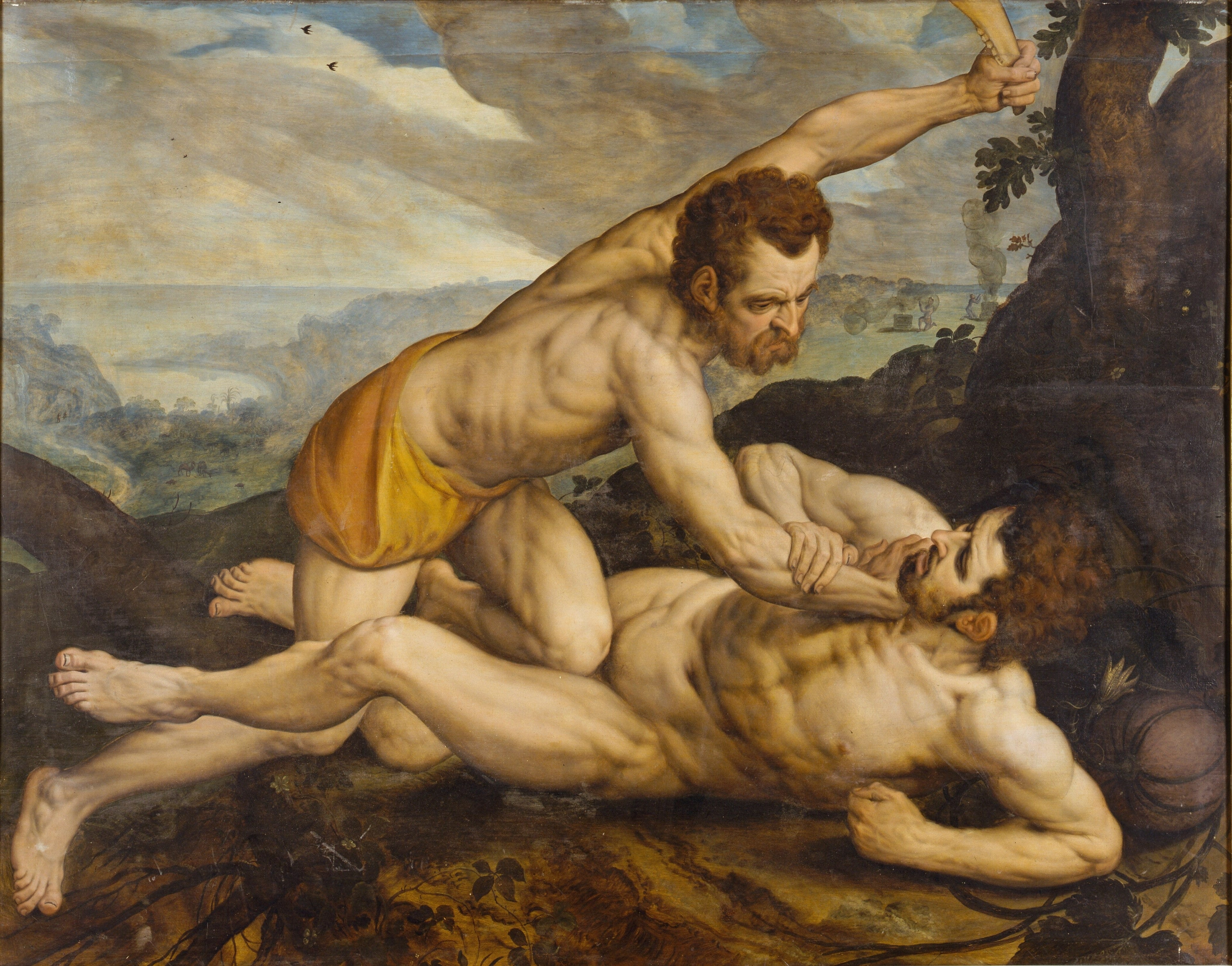
To be a brother and to have a brother is inherently, inexorably biblical. Brotherhood within the Western cultural imagination has historically served as arguably the most enduring structure of psychic and moral antagonism, saturated from its inception with asymmetry, rivalry, inheritance, obligation, violence and blood-guilt. The brother is never only familial: he assumes multiple roles, appearing instead as rival-double and shadow-self, intimate enemy and involuntary witness, the figure against whom identity is measured and comprehended and through whom it is displaced and dismantled. Fraternity, in this tradition, is no facile framework of mutual belonging, but a theatre of comparison, substitution, accusation and sacrificial demand. The literary canon bears the imprint of this logic: in Dostoevsky’s Karamazovs, brotherhood becomes a vehicle for metaphysical crisis staged through competing claims to divine silence, legislative punishment, erotic compulsion and rational unbelief, each brother functioning as a partial ontology belonging to the whole rather than a character unto himself; in King Lear, Edgar and Edmund recast fraternity as a juridical struggle over legitimacy and primogeniture, questioning the ideologies of inheritance and structural exclusion; for Steinbeck, Cal and Aron reproduce the schema of the first fratricide as an inherited structure of moral predestination, in which affection is metabolised through perceived grace and reprobation; in The Comedy of Errors, sibling doubling pushes identity into precarious ontological positions, whereby misrecognition exposes personhood as contingent on external attribution rather than any interior sense of coherence. It is, however, the image of Cain looming over Abel which most insistently haunts the theological, the literary and the psychic genealogy of fraternity: the brother as a node of ambivalent investment, a site of conflicting libidinal and moral investments – love, envy, resentment, safeguarding, substitution and an underlying logic of annihilatory desire. To pose the question Am I my brother’s keeper? is therefore necessarily to entrench fraternity within implications of burdenhood; it is to acknowledge that one brother is, by nature, psychically tasked with preserving, galvanising, monitoring, managing and accounting for the life of the other, even at the cost of his own singular psychic coherence.
‘Something / Happened to me, and I can’t tell / Anyone, so it will happen to you’ – Robert Bly, ‘Keeping Quiet’
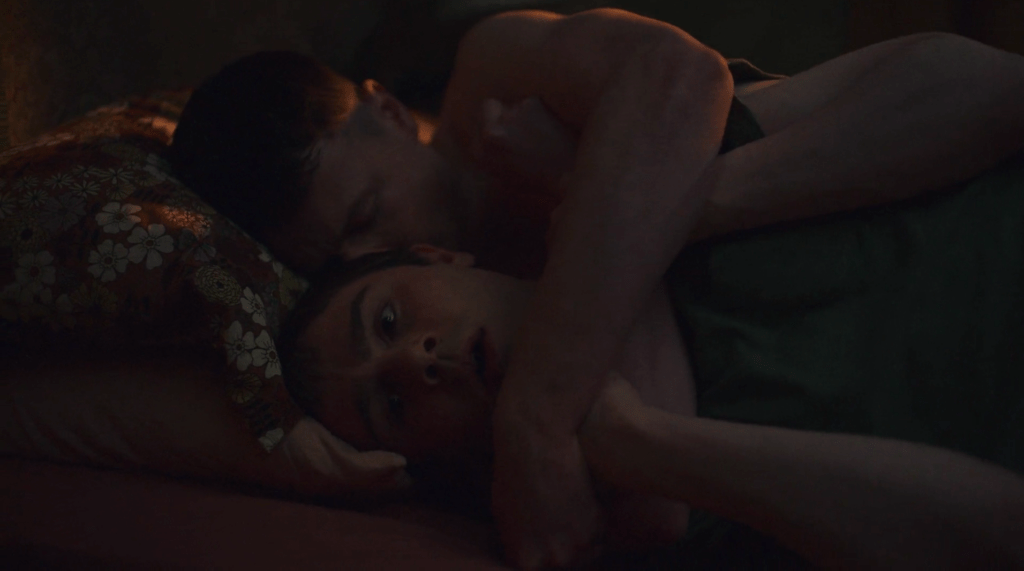
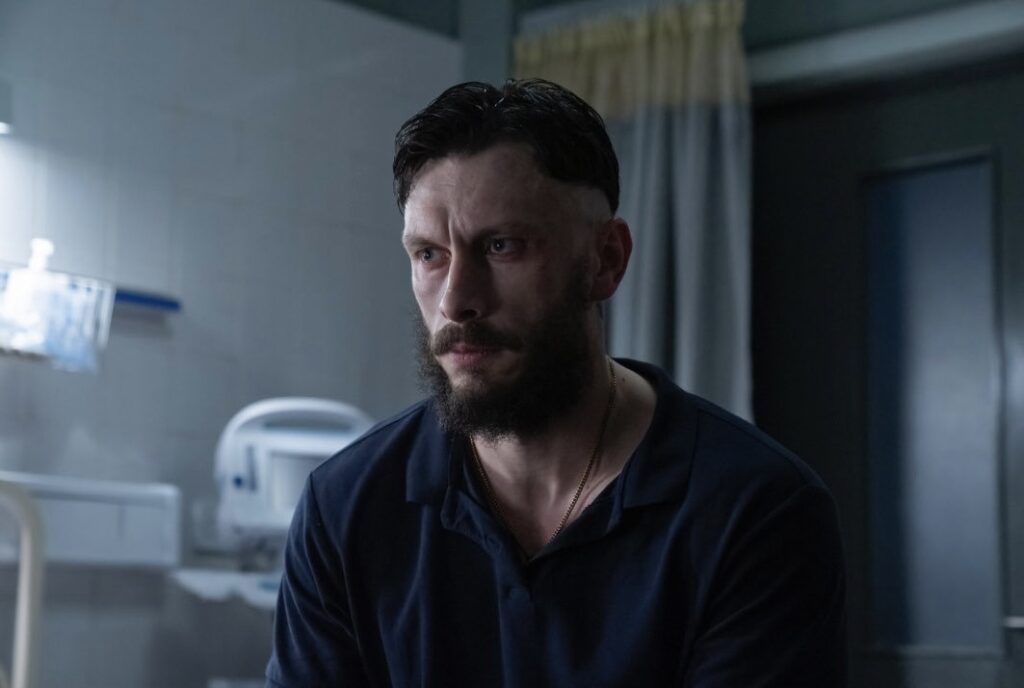
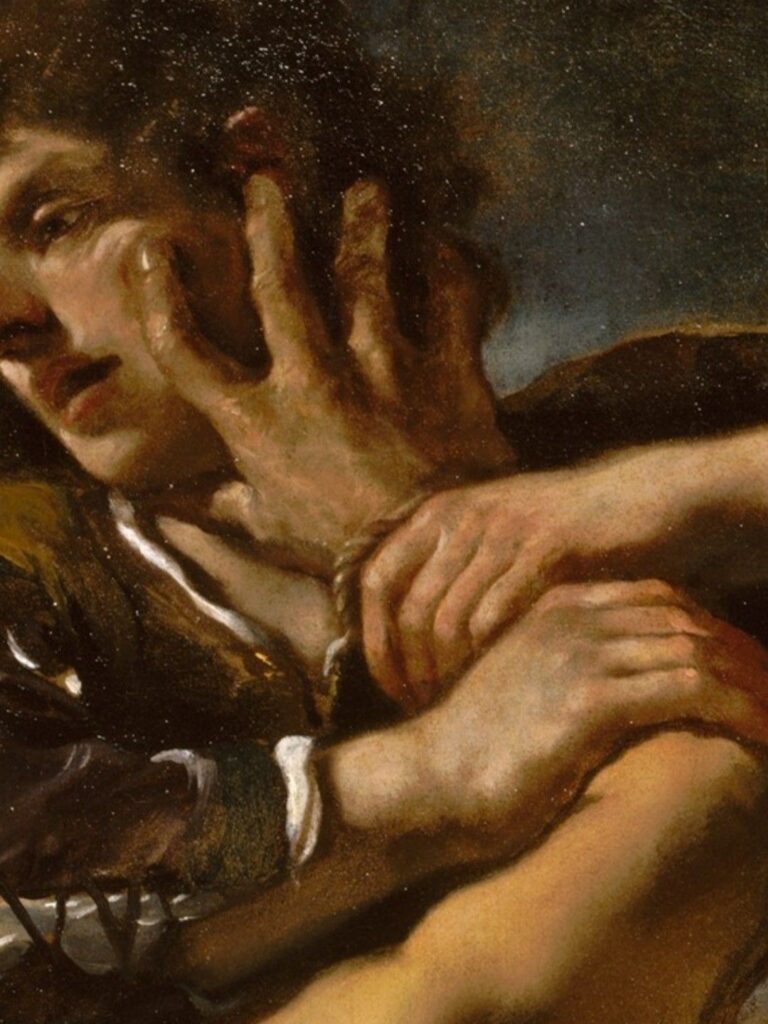
Half Man 1.06, dir. Eshref Reybrouck, 2026 / Frans Floris, c. 1531-1570
Richard Gadd’s limited series Half Man (2026) stages this question of brother-as-object and brother-as-keeper with a hand both violent and precise in equal measure. Centred upon Niall and Ruben – boys brought together through the relationship between their mothers and raised as brothers within a post-industrial Scottish milieu marked by pervasive Thatcherism, absent fathers, precarious identities and inherited familial violence – the series traces the evolution of an attachment whose intensity repeatedly exceeds the conceptual vocabularies available to describe it. Throughout the series, fraternity rewrites itself out of any stable structure of kinship and instead defines itself as a profound investment in one another’s existence as psychic objects. Each brother becomes indispensable witnesses to the other’s ego, undertaking the onerous affective labour of recognition in ways that render separation increasingly difficult to imagine. Brotherhood thus becomes a claustrophobic and internally recursive affective system in which care is reconfigured as Orwellian surveillance, intimacy as containment, dependency as a relational structure maintained by harm. The brother is simultaneously responsibility and rival, counterpart and counterbalance, object of preservation and possession, of desire and destruction. He is less a discrete subject than an extension of his kin, a living repository for his guilt, longing, resentment, obligation and projected selfhood. Niall and Ruben inhabit their siblinghood by way of enacting the retrospective effect of a prior fantasy of distribution gone awry: each is haunted by the suspicion that something essential has been allocated to the other, that identity itself has been unequally portioned at the level of origin. Gadd describes the two as ‘polar opposites’ – Niall marked by the soft-hearted, introspective self-consciousness of a fragile fifteen-year-old boy too far inside his own head; Ruben, in stark contrast, characterised by his volatility, his reckless, charming impulsivity and his comfortable physicality, present in the very way he carries himself. This asymmetry is intensified by the inverted paternal conditions under which the brothers are raised. Niall matures in the wake of paternal absence, the death of his father at the age of eight establishing a touchstone of irreparable loss which structures his later attachments as compensatory formations. Ruben, by contrast, remains ill-fatedly bound to a father whose lingering, haunting presence is no less injurious, his sense of self and relation to others organised unwittingly around an unwelcome intimacy interchangeable with violation. Stemming from patrilineal lack and ever-presence respectively, the brothers both develop a relational economy in which each appears to offer the other a kind of impossible redress. The father, in both cases, becomes what must be suffered through and survived; the brother becomes what might be lived through instead. Gadd thereby deconstructs the mainstream framework of familial intimacy, conventionally perched upon the clean promise of emotional soundness, presenting fraternity instead as a condition of psychic enclosure: a sealed and cyclical relational economy in which the distinctions between affection and abuse collapse and re-warp with increasing intensity.
Juliet Mitchell’s theorisation of sibling trauma proves indispensable here insofar as it reorients psychic injury away from the vertical axis of the Oedipal drama and toward the horizontal violence of replacement, rivalry and resemblance. Mitchell thereby positions fraternity as a constitutive rather than secondary psychosexual structure. The sibling, for Mitchell, arrives not only as a ‘second-chance child’ (Half Man, 1.04) but as a traumatic interruption of narcissistic continuity: ‘The new baby now lying in the place it occupied will be both narcissistically loved, as more of the toddler’s self, and hated, as a replacement for itself’ (‘Siblings: Thinking Theory’, 2013;emphasis mine). Brotherhood therefore originates via the friction of a profoundly unstable oscillation between identification and annihilation, between adoration and dispossession. The sibling is simultaneously the self and the usurper of the self; ‘the same’ and intolerably ‘other.’ Mitchell’s formulation that ‘jealousy is the modus vivendi for the arrival of the “other,” the one who is different but who should have been the “same”’ resonates with particular force in Half Man, where Niall and Ruben repeatedly apprehend one another less as opposite individuals than as distorted alternate selves through whom their own deficiencies are exhibited and desires are displaced. The psychic violence of this arrangement is further intensified by Mitchell’s claim that the infantile wish for ‘narcissistic sexual union with one who is the same’ is inseparable from its countervailing fantasy of destruction, such that siblinghood becomes the site at which love and annihilation are first rendered coextensive, born together as twins. Indeed, the series achieves much of its affective intensity in its persistent blurring of fraternal intimacy and erotic identification. Mitchell’s claim that ‘the narcissistic identificatory love for the baby who is the self can, via the transitivism of childhood, become the “we are as one” of adult couples’, offers a striking framework through which to read the unstable psychosexuality saturating Niall and Ruben’s relationship. Crucially, Half Man does not present incestuous possibility as aberrant deviation from safe, traditional fraternity, but rather as fraternity’s own latent logic under conditions of traumatic enclosure and collapsed relational boundaries. J. V. Caffaro observes there is no universally agreed upon definition which serves to differentiate abusive behaviour from mutually-initiated sexual encounter between siblings (‘Treating Sibling Abuse Families’, 2004); this becomes particularly significant insofar as the series repeatedly stages encounters which refuse stable categorisation within conventional binaries of coercion and consent, aggression and desire, victimhood and reciprocity and so on. The dyadic dynamic between the brothers occupies a profoundly unstable intermediate terrain in which intimacy itself has become structurally contaminated by lineages of domination, imitation, dependency and compulsive reenactment.
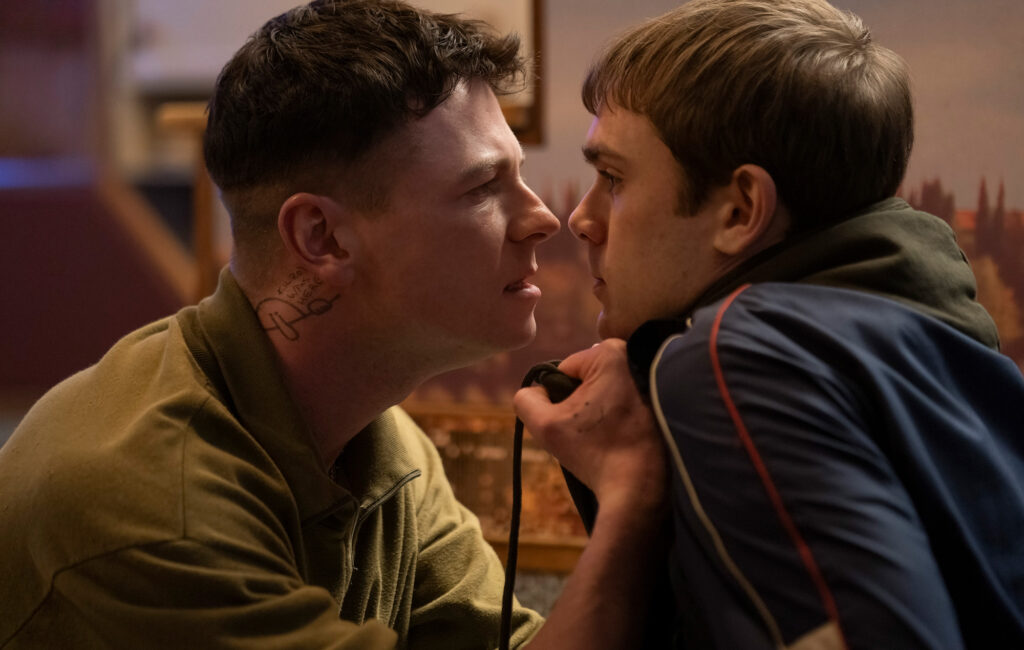
Half Man 1.01, dir. Alexandra Brodski, 2026
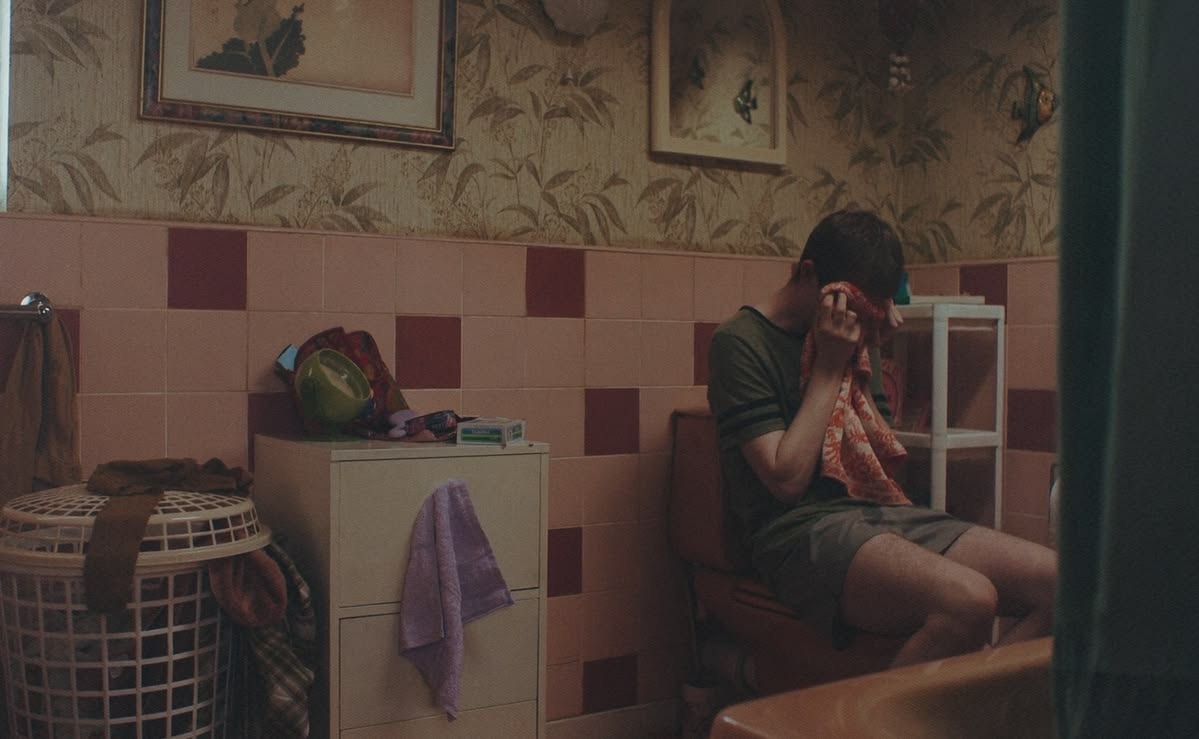
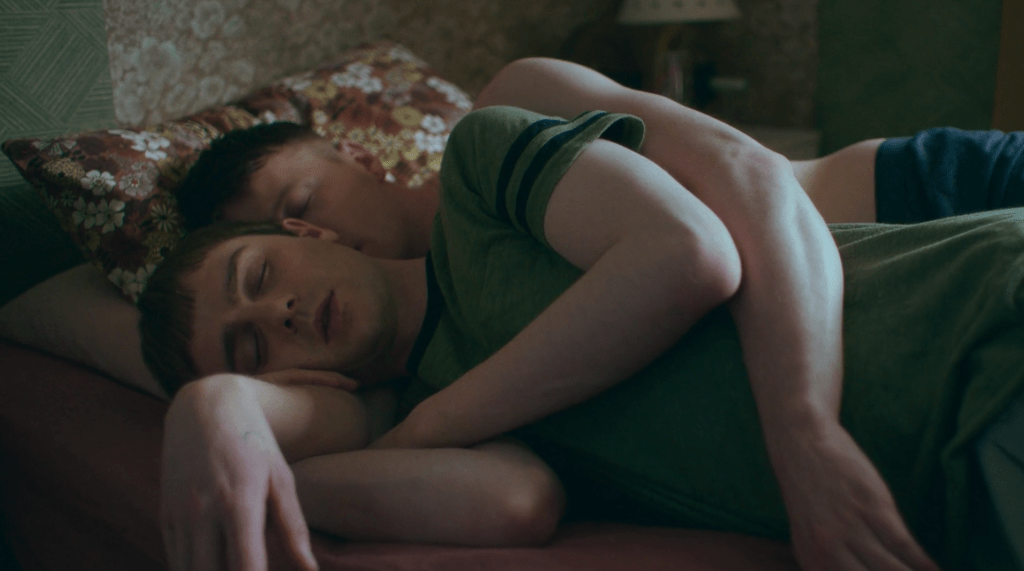
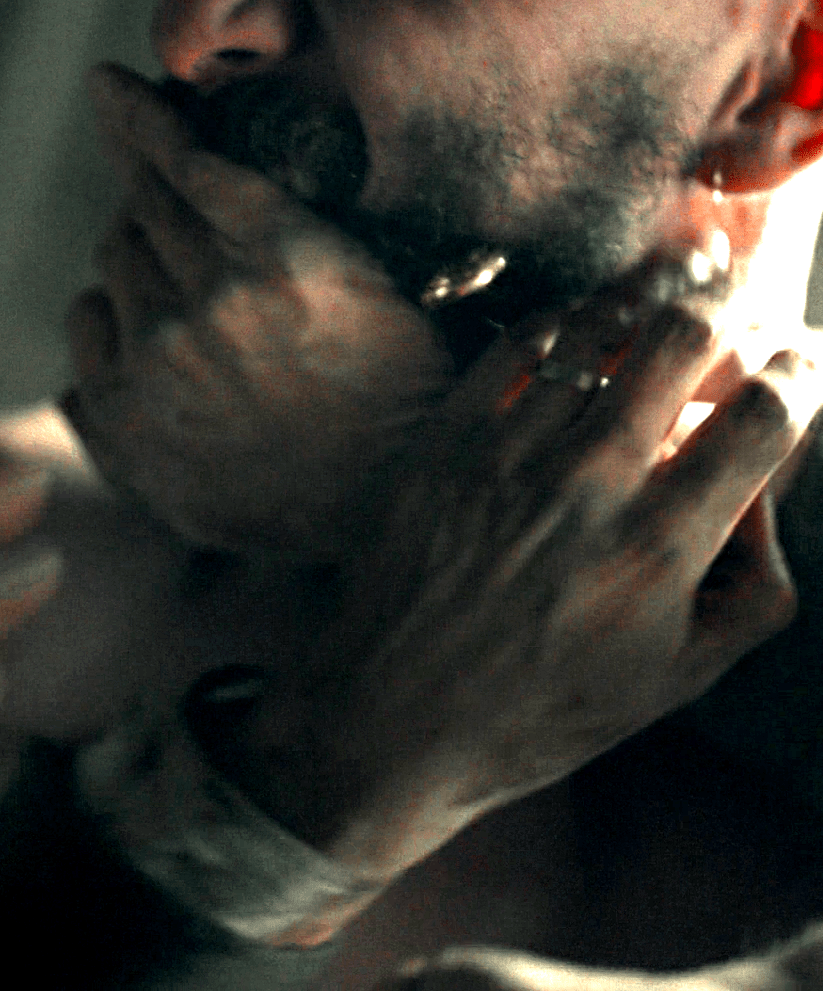
This perversion is already present in the very first episode. It is not yet clear, in these early moments, what kind of intimacy Ruben and Niall inhabit. They are not yet legible as enemies, nor as companions in any stable sense. What is discernible instead is a tense proximity which struggles to settle into category. In 1.01, Ruben restrains Niall in a harsh headlock after the latter suggests alerting their mothers to Ruben’s father’s late-night jeering outside the house (‘Why don’t you give your old man a big hug?’). The struggle quickly acquires an arguably erotic choreography: Ruben positioned behind Niall, rocking against him as the latter remains trapped between the hard line of Ruben’s body and his older brother’s mattress. Yet the scene simultaneously regresses toward infantilism, as the boys eventually fall asleep entangled together in an image oscillating between a lovers’ embrace and childlike clinging. Niall subsequently awakens to discover a wet patch staining his boxers – an image rendered deliberately ambiguous between ejaculation and the base, bed-wetting reaction of the body of a frightened child. Such moments exemplify the series’ persistent refusal to disentangle eroticism from terror and psychic helplessness, intimacy from humiliation or desire from frameworks of childhood. Sexuality and infancy become momentarily indistinguishable. Desire appears contaminated by vulnerability; vulnerability by desire. The result is a profoundly unsettling image of psychic life before differentiation has fully occurred. The body itself becomes unreadable within this libidinal economy of fraternity, incapable of clearly distinguishing arousal, fear, identification, submission or regression.
This ambiguity festers throughout the series as Ruben repeatedly mediates, orchestrates and mutilates the boundaries of Niall’s sexual subjectivity. Sexual initiation is no longer figured as a private threshold into adult relationality, but as a heavily scaffolded scene of fraternal governance in which access to desire is routed through Ruben’s regulatory presence. The sequence in which Ruben effectively ‘takes’ Niall’s virginity by proxy is particularly disquieting, arranging for Mona, the girl he himself is sleeping with, to deflower Niall (the same girl he will go on to marry) while physically regulating his somatic responses: coaching his breathing, placing a hand upon his chest to ground him, focusing his gaze upon his own face, repositioning his body when he loses rhythm. The scene’s psychosexual logic is unmistakably triangulated. What is decisive here is not only the substitution of partners, but the structural redistribution of agency: Ruben assumes a quasi-managerial position over Niall’s embodied experience. His access to heterosexuality is thus mediated through Ruben’s controlling presence, his brother insinuated in the architecture of all future possibilities. This renders Ruben simultaneously intermediary, author and witness – but also covert object of libidinal orientation and latent point of reference. The apparent heterosexual act becomes perverted with displaced fraternal eroticism, the brother the coloniser of the psyche and the body, coming-of-age’s most charged and visceral instant now irreversibly entangled with surveillance, watched by the panoptic gaze of Big Brother.
Half Man 1.04, dir. Eshref Reybrouck, 2026
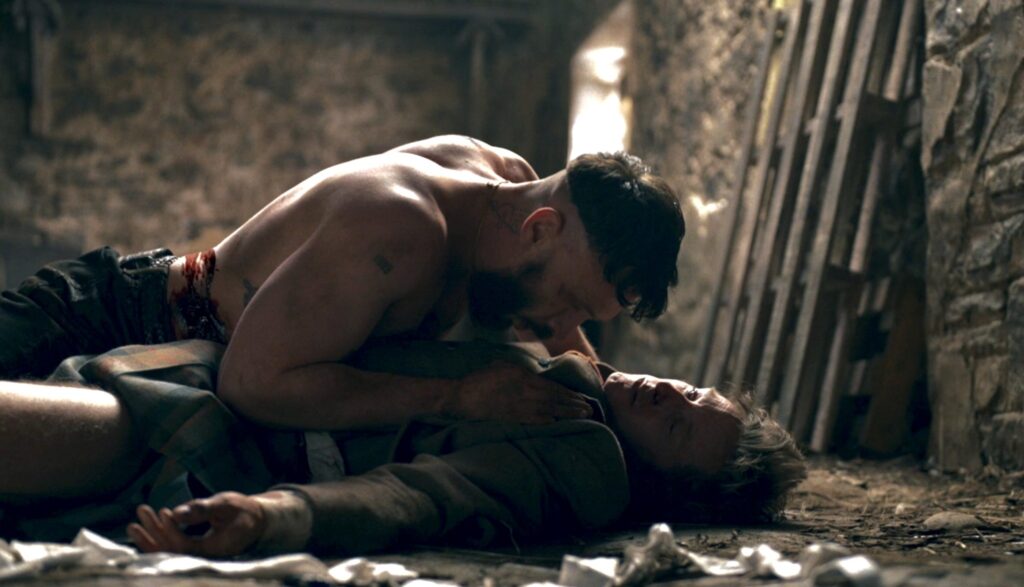
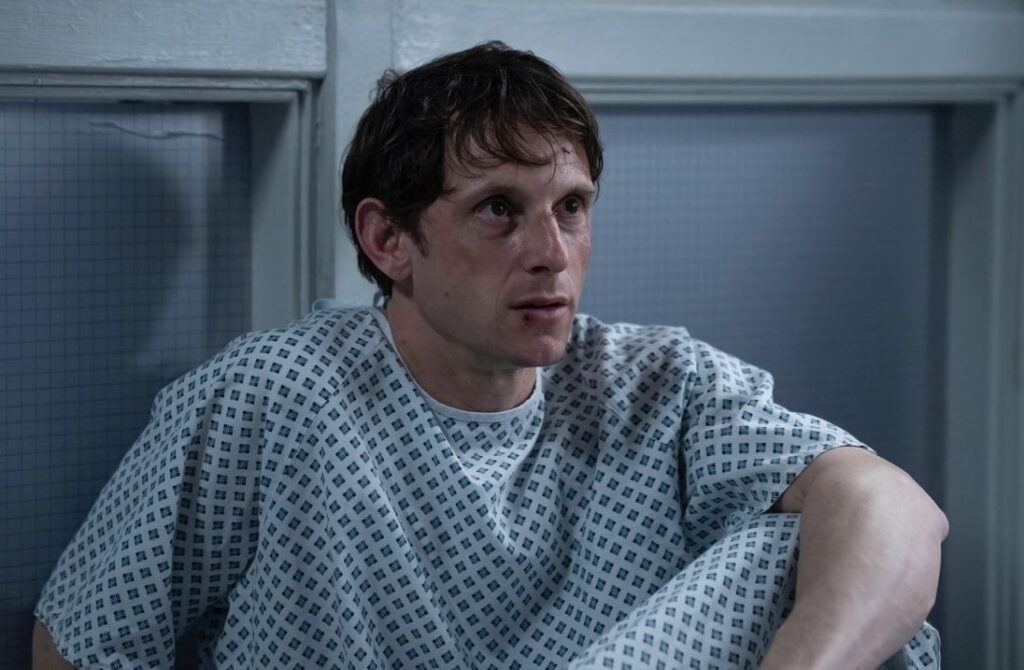
Many such instances of assault take place throughout the series, though the most violent culmination of such logic is in 1.04, in which Ruben rapes Niall in a hospital bed with his car hood ornament after threatening to ‘twist it up [his] ass without lube’ should he fail to tell him the truth. Here, the series abandons euphemism entirely and reveals the latent structure underwriting the brothers’ relationship from the outset: domination articulated through penetration, intimacy through violation, acknowledgement through bodily invasion. The existing logic of the dynamic becomes fully legible: the act does not interrupt fraternity, but reveals what fraternity has already become under the pressure of the precedent of trauma. In this sense, the scene cannot be reduced to unilateral sadism, nor the explicit dialogue deployed ‘frivolously’, as Gadd makes clear in an interview. This would be to flatten its horror into pathology. Ruben’s violence serves as an inexorable catastrophic intensification of fraternal attachment, a reenacting of the incestuous logic already embedded within his own abuse history and formulation of affection. Clementine Morgan states: ‘Incest is never an isolated event. Incest is always a family dynamic.’ (The Realm of Unreality: An Incest Memoir in Essays, 2024) She clarifies ‘if there is a child that is perpetrating incest, that child learned that incest dynamic from somewhere, and somewhere along the line it was learned from an adult’. This theory proves devastatingly resonant in this narrative context. Ruben’s abuse by his father situates incest as an inherited relational mode of intimacy, a way of apprehending closeness, interdependency, responsibility and bodily access learned through coercion and molestation and subsequently reproduced horizontally within the fraternal bond. The father’s greatest legacy is not the wound he leaves marred upon his eldest boy but the architecture through which that wound comes to organise future love; you are allowed access to the body over which you are responsible. Violence here operates as traumatic pedagogy; it reproduces itself precisely because it has become indistinguishable from the very conditions under which attachment is experienced and recognised between one another (‘This is what you’ve always wanted from me, isn’t it?’). Here is the wound gouged by the father, then. Niall is haunted by a paternal absence; Ruben by paternal persistence. This parallel is cardinal. A yawning maw lodged within the youngest boy; the eldest with his interior self stained beyond cleansing. In this sense, the series proposes a horrifying inversion of paternal function: the father fails as protective authority and is replaced by the brother as compensatory psychic infrastructure. Yet this substitution only further intensifies the burden of fraternity, because the brother cannot occupy paternal space without simultaneously contaminating it. The series thus arrives at an implicit but devastating proposition: the only cure for a father is a brother, and there is no cure for a brother.
What ultimately emerges in Half Man is therefore a vision of fraternity as unstable psychic cohabitation: two subjects trapped within an economy of identification, resentment, longing, imitation and inherited violence from which neither can fully individuate. Medieval theological discourse surrounding incest, as James Donavin notes, understood the term paradoxically as both abomination and mystical union, ‘both a sin and a way of remediating sin’. (Incest Narratives and the Structure of Gower’s Confessio Amantis, 1993) Half Man inherits something of this paradoxical logic. Fraternal intimacy within the series appears simultaneously catastrophic and salvific, violating and preservative, obscene and devotional. The brothers seek in one another precisely what destroys them: recognition, continuity, merger, absolution and the impossible fantasy of becoming whole through the body of the other.
‘I was born to watch over you / & you were born to keep my hands purposeful.’ – Bloodmercy, I. S. Jones
Encoded within every episode of Half Man is that same biblical refrain: Am I my brother’s keeper? The series’ most devastating gesture is its refusal to imagine ‘keeping’ as a benign or even coherent form of care. To keep a brother, the series suggests, is never merely to look after him. It is to monitor, regulate, preserve, possess, enable, contain and attempt to simultaneously annihilate and survive him. Can’t live with ‘im, can’t live without ‘im. Keepership is honed throughout the series as an affective relation in which nurturance becomes inseparable from domination, and whereby care mutates into a mode of psychic piloting. The brother is stewarded, and through that stewardship is loved to an abominable degree. Indeed, what renders the relationship between Niall and Ruben so profoundly discomfiting is that neither man appears fully capable of distinguishing where devotion ends and ownership begins, and neither do they seem set on drawing such a line. Gadd describes the brothers’ relationship as ‘idolatry mixed with love mixed with hatred mixed with adoration and need’. This is revealing precisely because idolatry already implies an asymmetrical structure of emotional investment: one subject becoming the site upon which another deposits meaning, reverence, dependency and psychic orientation. The brother is elevated into object-status, relic-status, transformed into something simultaneously worshipped and instrumentalised. When asked for one word to describe their dynamic, Gadd stated: ‘Contorted is one that springs to mind, but if I said loving, would you think I was insane?’ This, then, is the central tension structuring Half Man: the series does not oppose love to toxicity, but rather explores the extent to which love itself may become distorted into a coercive attachment style under conditions of childhood trauma and emotional entrapment. ‘I think for something to be toxic,’ Gadd says, ‘it has to also be intoxicating first’. What festers between Niall and Ruben is not necessarily the failure of fraternal care, but fraternal care rendered pathological through excess intimacy, asymmetrical dependency, the patrilineal wound and a sort of psychic conjoinedness from which neither brother can fully depart.
This impossibility manifests most visibly through the series’ recurrent obsession with provision, indebtedness and material subsumption. Ruben repeatedly installs himself in the role of provider despite his own economic precarity following the loss of his rigging job, accumulating catastrophic debt in order to continue financing the lives of others (including Niall) without their knowledge. When Niall confronts him over this compulsive assumption of responsibility, Ruben’s justification is startlingly naked in its ontological simplicity: ‘Because I liked it. I liked being the provider. I knew my place in the world.’ (Half Man, 1.05) To provide is to stabilise the self through indispensability; dependence furnishes Ruben with the only stable proof of his own role. Far from simple altruism, his acts of financial self-sacrifice therefore constitute an attempt to purchase recognition through utility, to render himself psychically inerasable by suturing his presence into the material conditions of others’ survival. Debt becomes an architecture of attachment through which emotional permanence might be forcibly secured.
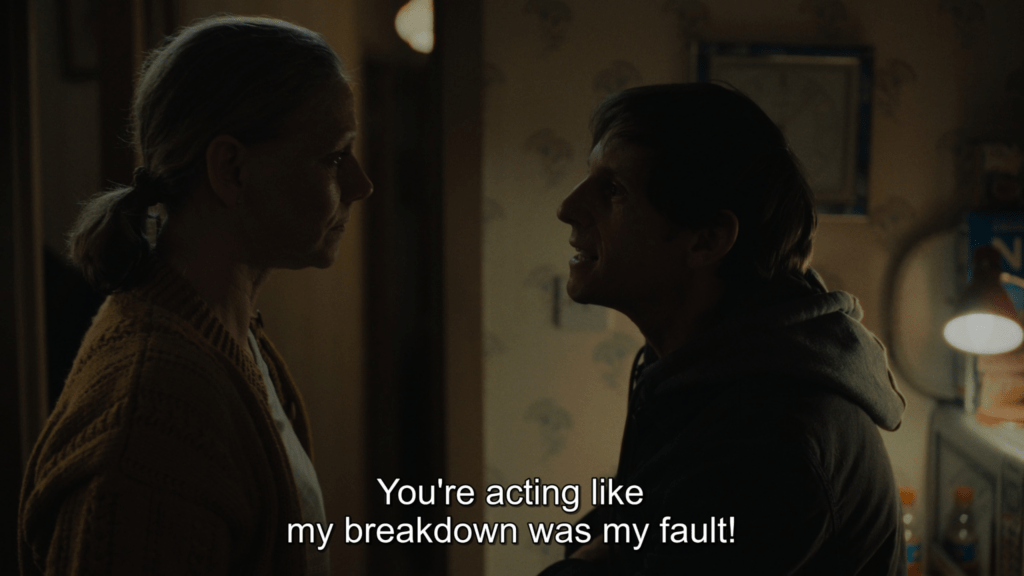
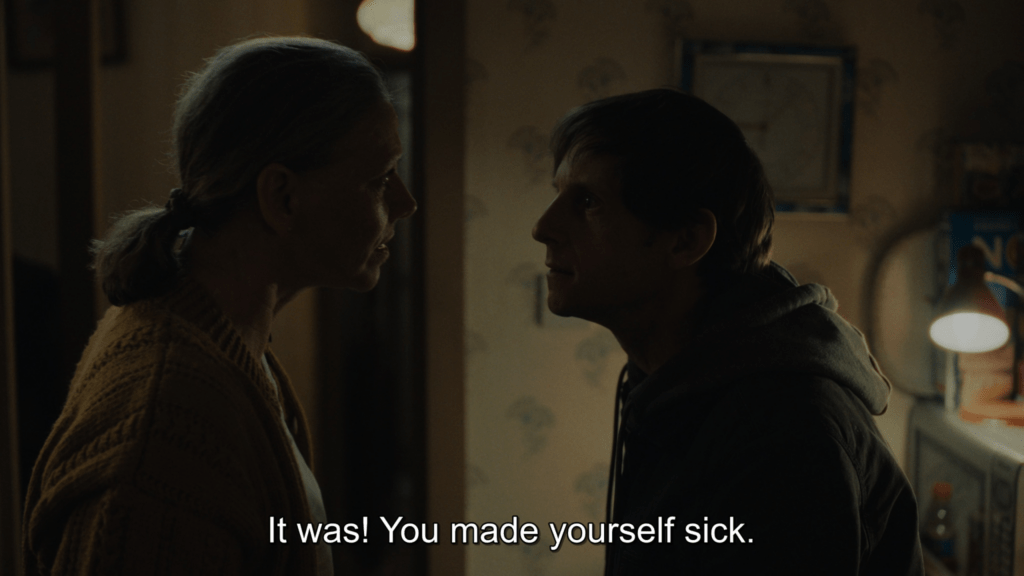
‘We share everything!’ / Half Man 1.02, dir. Alexandra Brodski, 2026
Niall, meanwhile, increasingly comes to occupy the complementary position of the kept object. Jamie Bell’s observation that Ruben becomes Niall’s ‘life support system’ captures the extent to which care in Half Man functions simultaneously as affective captivity. Niall’s attachment to Ruben is irreducible to facile fear or coercion alone; rather, Ruben’s volatility acquires the paradoxical status of security. Because Ruben is feared by the world, he may in turn shield Niall from that world’s hostility. Yet protection here is inseparable from capture. Niall becomes psychically and materially entangled within Ruben’s systems of provision to such an extent that separation itself begins to register as mutilation, as severance, as betrayal. This logic surfaces explicitly during their confrontation over Niall’s university accommodation, when Ruben rejects the very premise of independent existence: ‘We share everything! I mean you’re wearing my jumper right now … You should’ve brought me with you from the start!’ (Half Man, 1.02) The statement initially performs as childish, even petulant, yet its insistence that ‘it’s not about the room, it’s about the fucking principle’ reveals something considerably more disquieting. It is not a two-mattress-childhood at stake but ontological non-separation: a refusal of psychic distinction itself, an epistemic in utero in which selfhood can only be sustained through enmeshment. To leave is intolerable because departure threatens the collapse of the shared psychic infrastructure through which both brothers remain comprehensible to one another and to themselves.
The series repeatedly materialises this non-separation through patterns of possession, inheritance and symbolic circulation. Everything Niall touches has already passed through Ruben’s hands first: clothes, lovers, money, possessions, social identity itself. Ruben kisses nearly every person Niall kisses; he orchestrates Niall’s first time; he steals the domestic future Niall momentarily weilds for himself. The effect is competitive, certainly, but more so incorporative, implicating, insinuating – as though Ruben compulsively absorbs every emerging site of Niall’s autonomy back into the fraternal dyad before it can calcify independently. Eve Kosofsky Sedgwick’s account of male homosociality becomes especially illuminating here. Sedgwick argues ‘the use of women as exchangeable … property’ functions to cement bonds between men, revealing the extent to which heterosexual structures may conceal or serve as pretext for deeper currents of male homosocial desires, which the masculine nature deems more valuable. In Half Man, women repeatedly occupy precisely this mediating position. Mona does not inhabit the role of sexually autonomous woman within the narrative, but rather a conduit through which Niall and Ruben negotiate their own rivalry, identification, power and possession. Niall’s later affair with Mona cannot be comprehended in clean isolation; rather, it represents an attempt to access Ruben through what Ruben himself has claimed, achieved, won. To occupy his position of a man who has successfully settled in his masculinity by trespassing upon the intimate territory of his domestic life. Simultaneously, impregnating Mona (one of the few things Ruben is incapable of) offers Niall the possibility of both superseding his brother in the one way he can, and simultaneously giving Ruben the child his infertility denies him, reappropriating heterosexual reproduction itself into the convoluted economics of this libidinal fraternal economy.
The logic of keepership thus increasingly collapses distinctions between care and colonisation of the brother. Unbeknownst to Niall, during a fourteen-year-long rift between the two, Ruben pays for his bedsit, his therapy (‘The therapy I used to talk about him?’; Half Man, 1.04), his car, his Christmas presents. Debt in Half Man therefore functions past the economical and into the ontological: to owe the brother becomes indistinguishable from being constituted by him. Jessica Benjamin’s theorisation of domination as a distorted response to the crisis of recognition offers a crucial scaffolding through which to comprehend this relation. Benjamin argues ‘the most familiar conflict that arises from differentiation is between the need to establish autonomous identity and the need to be recognized’ (The Bonds of Love, 1980), and that domination itself shows its face precisely when subjects attempt to resolve this conflict without relinquishing dependency. The subject seeks autonomy whilst simultaneously refusing the separateness of the other, ‘possessing or controlling’ them in order to avoid the psychological desolation of aloneness. Ruben’s behaviour throughout Half Man repeatedly enacts this impossible negotiation. He cannot tolerate separation because separation threatens annihilation; yet he equally cannot sustain mutuality because mutuality requires recognising the brother as genuinely separate and unimplicated in one’s own self. Consequently, affection mutates into possession. Financial provision becomes a mode of management. Protection becomes surveillance. Violence becomes a means of retaining a form of closeness while repudiating unmasculine vulnerability. Benjamin goes on to claim violence operates as an attempt ‘to resolve the issues of autonomy and recognition while denying the other’s subjectivity’. This is certainly felt in Ruben’s wounded aggression toward Niall, which tends most commonly to crop up at moments when Niall threatens an independent subjecthood: leaving home, forming romantic attachments, imagining futures beyond the dyad. Violence becomes a desperate strategy for preserving a twinned continuity while simultaneously disavowing dependency itself. In this sense, Ruben’s brutality does not signify emotional absence but catastrophic overinvestment and cognitive dissonance. He requires Niall too intensely to allow him autonomy, yet cannot articulate this dependency except through domination, humiliation, sabotage, financial superiority or bodily invasion. The violence of keepership, then, is that the brother must remain close enough to guarantee psychic survival, but objectified enough to prevent abandonment. The little brother is a favourite toy one cannot grow out of and will not put down.
Crucially, however, Half Man refuses to position Niall as a poor, passive, pristine victim within this structure. Benjamin’s discussion of domination insists that both parties become organised around complementary relational positions: one asserting a joint-selfhood through control, the other relinquishing his own selfhood in favour of the safer doublet. Niall repeatedly resists Ruben’s authority and cruel hand while simultaneously relying upon the very structures which imprison him. He accepts Ruben’s money, his protection, his emotional counterbalance, his rare oblations of tenderness. It would be dishonest to describe their dynamic as one-sided when closer to truth is a reciprocal affective capture: a closed affective circuit in which the brothers require one another precisely through the mechanisms which shatter them. To keep a brother, then, is not to safeguard his happiness or to encourage his prosperity, but to direct him; blind him, take him by the shoulders and point him where you both need him to go. Keepership becomes a form of existential governance through which care and cruelty, guilt and shame, animosity and codependency, violence and validation circulate and permeate indistinguishably. One comes to find that neither brother can survive the fracturing of this structure, even as the structure itself marks survival impossible.
‘A brother is born for adversity’ – Proverbs 17:17
The distribution of suffering between Niall and Ruben is, as is evident, manifestly asymmetrical; Ruben’s violence and abuse cannot necessarily be transposed into any straightforward moral equivalence with Niall’s evasive transgressions, self-sabotages, or forms of passive complicity. Yet the series is careful not to allow this asymmetry to resolve into a sacred ethical geometry of victim and perpetrator either. Both brothers are intensely invested in the maintenance of a structure of suffering which wounds them. Victimhood in Half Man is thereby an existential orientation: a mode of self-constitution predicated upon the continual narration, citation and reopening of injury. What Richard Gadd is essentially interrogating within the series is what kinds of selfhoods are made available when one lives inside the role of the injured party.
This question is particularly acute in relation to Niall, whose interiority increasingly appears built around injury as both excuse and root cause. Upon discovering Ruben has been secretly financing significant portions of his adult life, the initial response is one of puerile moral indignation. The force of the reaction is disproportionate to the revelation itself, suggesting what is truly at stake is not simply the embarrassment of financial dependency, but the absolute collapse of a precarious and carefully maintained fantasy of autonomy. Niall stalks his converted childhood bedroom – a room he and Ruben once shared – smashing possession upon possession paid for by his brother’s pocket. Alarm clocks, CD players – all are sacrificed in his tantrum fit, accompanied by a verbal breakdown in which Niall screams at his mother: ‘I hate him! I fucking hate him! … I’m his bitch! I’m his bitch!’ (Half Man, 1.04) The oscillation between repudiation and identification is decisive. At the end of the day, he is nothing more than a little brother who has lost the game; this will always be his first and only role to play. The rage therefore originates at the point of narcissistic injury. To owe the brother is intolerable because it punctures the fantasy of self-authorship – of a life without training wheels or your big brother’s hand hovering out of sight but no less ready to catch. This anxiety recurs later when Ruben proposes Niall repay a debt through domestic labour. Niall’s immediate recoil – ‘You want me to be your bitch?’ (Half Man, 1.05) – again translates indebtedness into erotic subordination. The language of repayment is immediately converted into the idiom of humiliation, suggesting that, for Niall, dependency is never purely material but always already symbolically charged, always already inscribed within hierarchies of domination and shame.
Half Man 1.04, dir. Eshref Reybrouck, 2026
Yet the series repeatedly and consciously complicates this interpretation by demonstrating the degree to which Niall simultaneously seeks, reproduces and seemingly requires the very structures he claims to abhor. Dependency functions both as grievance and lifeline. The brother is resented precisely because he provides what is needed. Such contradictions invite a broader consideration of the relationship between victimhood, complicity and identity. Throughout the series, Niall repeatedly returns to the childhood court case involving Ruben as what he describes as ‘the turning point’ and ‘the seed of all of [his] issues’. (Half Man, 1.04) The ‘seed’ becomes a master narrative through which the contingencies of adult life are retrospectively organised into a coherent story of injury. Significantly, Niall’s mother repeatedly challenges this interpretation. ‘You’re always talking about the seed’, she remarks, before accusing him of being ‘too busy blaming everyone else’ for his problems. Her harshest attack is in her rejection of Niall’s own account of his psychotic breakdown, describing his institutionalisation as a stint in a ‘madhouse’ rather than ‘hospital’: ‘You made yourself sick … You became obsessed with it.’ When Niall shouts ‘I was ill!’, she responds with a dismissive wave of her hand: ‘You were self-involved.’ The series does not ask us to take a side here. Instead, Half Man remains deeply interested in the possibility that suffering itself can become narcissistically organised, a concept Richard Gadd is certainly no stranger to, as can be seen in his previous semi-autobiographical work Baby Reindeer (2024). Bell’s observation that Niall is frequently ‘manipulative and selfish’, and that many of his relationships revolve around ‘what he can get from people and what they can shoulder for him’ points toward a more uncomfortable truth: victimhood may become attractive because it offers coherence. To be injured is to possess a story, and to possess a story is to possess a self.
René Girard’s theory of victimage is pertinent here. Girard identifies the scapegoat as a figure through whom collective tensions are displaced, ritualised and rendered meaningful. The victim acquires a paradoxical status: simultaneously powerless and empowered by his own pain. Ruben is treated within Niall’s psychic economy as the origin point of suffering itself, the figure to whom every wound can be traced. Yet Ruben also constructs himself as a sacrificial figure: provider, protector, self-abnegating agent of care whose violence is retrospectively reinterpreted as a form of burden-bearing. This competition is rendered visible through the series’ parallel trajectories of self-destruction. Ruben externalises injury: rage, violence, destruction. Niall turns inward: drug abuse, compulsive unsafe sex, obsessive thinking. Injury thereby circulates between them, ever redistributed rather than resolved. Victimhood and perpetration thereby cease to designate clean labels and instead become positional effects within a shared system of affective exchange. What renders Niall particularly compelling in this formation is the extent to which his identity remains structurally tethered to Ruben even in moments of apparent autonomy. Bell’s description of him as ‘living as several different people and … not comfortable with any of them’ articulates this fragmentation precisely. Niall’s repeated attempts at self-reinvention – student, father, author, husband – all fail to acquire durable ontological weight because they remain shadowed by a far older and far more ‘primal’ structure of recognition, as Gadd puts it. Niall’s sense of coherence remains dependent upon Ruben’s gaze, upon his approval. ‘It pains you,’ Ruben tells him, ‘to know that all your achievements fill you with a void, whereas a smile from me fills you with all the fucking energy you need’. (Half Man, 1.04) Award, career mobility, self-reinvention – all indeed fail to provide satisfaction to Niall because they cannot replace the original structure through which meaning was first constituted in boyhood (‘It’s the only thing I’ve ever felt’, Half Man, 1.06).
This dynamic is perhaps most starkly condensed in the Freshers’ Week phone call. Isolated, miserable and struggling to adapt, Niall instinctively returns to Ruben as his primary site of regulation and comfort. The exchange is remarkable in its economy. Ruben immediately understands what Niall cannot bring himself to say. ‘You only need to ask’, he tells him. ‘Just say the words.’ (Half Man, 1.02) Eventually, after prolonged hesitation, Niall blurts out: ‘I need you’, before hanging up instantly, hand-over-mouth, unable to cope with the abominable truth of his own admission. The scene encapsulates the paradox at the heart of the series: Niall experiences dependence upon Ruben as humiliating, infantilising, self-destructive and frustrating, yet remains incapable of imagining himself outside it. The bond survives every injury because the injury confirms the bond. By the series’ conclusion, the question is no longer whether one brother can survive the other. It is whether either brother possesses a self that exists independently of the wound the other has left behind. Within such a configuration, victimhood no longer designates a position external to agency but serves as a dynamic and recursive structure through which the self is continuously assembled. Suffering ensures that neither subject within the dyad can fully exit its orbit.
‘We were the first two brothers, / I the first dead man and you the first / fratricide.’ – Inscriptions Cain Read in Abel’s Eyes, Silvina Ocampo trans. by Jason Weiss
I find myself returning to the Cain-and-Abel structure time and again, the origin of fraternity, where Gadd’s narrative logic acquires its most archaic inheritance. Abel is the first murder on God’s new earth, though he is also the one through whom fraternal violence first becomes narratable as moral inevitability, the figure whose elimination retroactively stabilises the meaning of the brother as victim. The scriptural designation of fratricidal violence is marked, in its Greek translational lineage, by the term ἀνθρωποκτόνος, a word whose semantic field exceeds the merely juridical ‘manslayer’ it is all too commonly translated as to approach the sacrificial register in which killing is already shadowed by a logic of offering and taking. In certain classical contexts, as in Euripides’ Iphigenia in Tauris, this same semantic drift allows human destruction to be incorporated into the framework of sacrifice, where the slain body persists as necessity. In Gadd’s Half Man, this sacrificial residue bears considerable weight beneath the surface of contemporary storytelling. For Niall and Ruben, injury is continually converted into justification, and justification into renewed intimacy. One is incapable of existing unimplicated in the other, as implication itself is what constitutes the boundary of the self.
Half Man 1.06, dir. Eshref Reybrouck, 2026 / Giovanni Francesco Barbieri, 1619
A brother bends himself over another in a dim interior that might be a room or might be the remembered reconstruction of one – somewhere between domestic chamber and the spectral architecture of religious myth-world, where childhood objects and adult consequences are no longer separable in their provenance. The light behaves badly here – diffuse, uncertain – everything slightly overdetermined by atmosphere, the air thick with implication. The movement is slow, none of the punctuation of rupture, proceeding with uncomfortable familiarity, the gesture rehearsed so often – across arguments, silences, reconciliations that were never quite so – that it has shed all promise of surprise, a kind of weary competence clinging to it. Violence in this place is habit, is careless, is intimacy outlived and outlasted. There is a strange epistemic confusion in its stillness, an inevitability and a monumental, omnipresent waiting – as though nearness has become indistinguishable from threat, and threat from recognition, and recognition from something like care, though none of these terms quite retain their boundaries anymore. Beneath him, the younger does not resist in any register of resistance legible to you or to me. Perhaps he does not know how, or does not want to know how. His body offers no clean opposition, only a kind of compromised responsiveness, sensation uncertain of its own category. Breath contracts unevenly. The click of a glottal stop.
Elsewhere – though perhaps only the kind of elsewhere produced by retrospect and by narrative co-option – a brother lies still in a barn in rural Scotland; it is his wedding day. The stillness is not peaceable; it is too exact and too deliberate in its negation of movement to be mistaken for rest. The body is arranged with the unsettling neutrality of something which has ceased to bother negotiating its own position in the world. Nothing resolves into clarity because nothing is permitted to conclude. The circumstances accumulate themselves, layering aftermath upon aftermath until the distinctions between what has happened and what is happening and what will happen become almost ornamental. There were or are or will be two still bodies in the barn; there is no other version of this story. But for now there is one. It is a catholic and ubiquitous scene, which Rilke depicts as so: ‘The brother did something to me that my eyes didn’t see. He veiled the light. He hid my face with his face. Now he is alone. I think he must still exist, for no one does to him what he did to me. I sense my older brother lies awake as if accursed. Night offers itself to me, not to him.’ (‘The Book of a Monastic Life’, 1905)
‘Change my dear, and it seems not a moment too soon’
– The Sixth Doctor, Doctor Who, 1984
‘I don’t want to go’
– The Tenth Doctor, Doctor Who, 2010
In the most unceremonious of ways, a midweek Instagram post, a British cultural institution of more than half a century was, not for the first time, put to rest. Or rather, it was, like a wounded dog limping from showrunner to showrunner, lifeline to lifeline, finally put out of its misery in an overwhelming cloud of indifference. Doctor Who – the British science fiction show launched in 1963, cancelled in 1989, temporarily resurrected in 1996, and brought back proper in 2005 – was confirmed by the BBC to not be returning to screens this Christmas, as was previously announced. Indeed, the show will not be returning to screens at all, until such time as a new co-production partner can be found. The current showrunner and production company have left the programme, and the property is to be put out to competitive tender in the coming months. Russell T Davies, the man who has the peculiar distinction of having both resuscitated and euthanised the programme, washed his hands of the show he credits with launching his interest in television – as well as, in no small part, his career – with curious detachment: ‘and so GOODBYE from me to Doctor Who but HELLO to a big new future for the show’, he wrote in a rambling Instagram caption. In the same caption, he admitted that he never had a plan for the show going forward, and that previous assertions to the contrary were but a clever piece of theatrical misdirection.
As any fan of the longest running Sci-Fi show in history will know, Doctor Who has long been lumbering through crisis after crisis, constantly battling an existential danger far worse than any Dalek or Cyberman. The show has been haemorrhaging viewers for over a decade and hasn’t been the nationally unifying Saturday night staple it once was since Matt Smith left the TARDIS. Their own worst enemies, Doctor Who fans will endlessly debate when it was that the show went off – after David Tennant morphed into a CGI goblin, after Russell T Davies left the first time, after Matt Smith made an erection joke with his sonic screwdriver, after Chris Chibnall rewrote the show’s mythology and cast Bradley Walsh, etc., etc. – but the truth is that the show has been held hostage by its own mythology from the very beginning. For twenty years it has grown heavy under the weight of its own narrative baggage. In this way, it has become the archetype for the kind of cultural inertia experienced across our contemporary mass media: a self-reflexive world of ‘fandom’ written by and for people who already know and love the property. For a show so fundamentally about change, Doctor Who – like so much of our modern culture – is terrified of the unknown.
The great trick to Doctor Who’s longevity is both narrative and practical. In 1966, when William Hartnell, the first actor to play the titular role, was becoming an increasingly difficult and unreliable presence on set, the show’s producers came up with a novel idea to continue the show without its hero: regeneration. In regeneration – the in-universe mechanism by which The Doctor is able to heal himself from mortal injury by changing his chemical construction – had the effect of offering Doctor Who a method to continue in perpetuity. Regeneration allowed for characters to be reshuffled alongside writers, directors, and design philosophies. If the show was failing under one team, regeneration offered a mechanism to swap them out, supported by the show’s own mythology. Under such a guise have instrumental changes been made to the show’s format, soundtrack, logo, and everything in between. More than that, however, regeneration cemented the central theme of the show as one of change. When Patrick Troughton emerged as the Second Doctor, he proclaimed to his questioning companions that ‘life depends on change, and renewal’. It’s that notion of constant evolution, of the way in which we all live many lives in our one, which has guided the show for sixty years. As long as the show believed in that conviction, it could live forever. In recent years, however, change has been overtaken as the driving force of the show by its more sinister cousin, regression. So then, we might contend that the moment Doctor Who precipitated its own doom was not with any shift in writer, actor, or storyline, but rather when David Tennant’s Tenth Doctor looked towards the camera in his final outing and, with tears mounting in his eyes, proclaimed, ‘I don’t want to go’.
The moment functions well in its context. It is the tragic sight of a character, burdened by years of narrative angst, finally buckling under the weight of trauma and accepting, as we all must, our innate fear of death. A few seconds later, Matt Smith arrived on screen and the machinery of the Whoniverse began running once more, with a successful rebrand under showrunner Steven Moffat. Yet it represented a paramount concession to fan expectation and the reluctance to change. It was, perhaps, not a major incident at the time – the show would achieve wide international acclaim in the Moffat era – but nevertheless planted a seed of reactionaryism that would come to the fore years later. Tennant was, and remains, certainly the most popular of the modern iterations of The Doctor. As such, it was no surprise that his leaving the show should be worth a teary adieu. Yet, compared to the departures of previous fan favourites, his can’t help but feel egregious. When Tom Baker’s Fourth Doctor – by far and away the most popular of the original run – left the show, his final words were of hope and perseverance: ‘it’s the end, but the moment has been prepared for.’ The turn from one philosophy to the other, from the stoic farewell to the bleary-eyed plea, is a turn inward: the sign of a show rapidly becoming centred on itself.
Hayao Miyazaki, the great Japanese animator, courted controversy for his criticism of anime – a genre he helped to popularise – as being ultimately doomed in the modern day by its lack of inspiration. As a young director, he recalled being inspired by the films of Kurosawa and the writing of Ursula K. Le Guin, and how these broad multimedia influences came through and were synthesised in his animation. Now, he claims with regret, anime directors are expressly and solely influenced by other anime. As such, the genre becomes self-feeding and incapable of genuine growth. We can track the same trend in the sphere of western popular culture. In the 1980s, when Steven Spielberg and George Lucas wanted to make an homage to The Treasure of the Sierra Madre and the adventure films of their youth, they made cinematic history with Indiana Jones. In 2023, when James Mangold was tasked with making an homage to Indiana Jones, he made a sequel to Indiana Jones. In the same vein, we need only look at the most culturally ubiquitous of American cinematic exports: Star Wars.
With the first film in 1977, George Lucas was drawing on his love of Kurosawa’s The Hidden Fortress – at one time considering Toshiro Mifune for the role of Obi-Wan Kenobi – and concerns about the imperial machinery of the United States. In the franchise’s most recent outing, The Mandalorian and Grogu, the inspirational roots of the film are found nowhere deeper than those previous Star Wars films, as well as the attached apocrypha of television shows and comic books. The leads – heralded as the faces of a new era – are, in effect, stand-ins for two of the franchise’s original characters, Boba Fett and Yoda. This, concocted with a culture of ‘fandom’, has created a cultural ouroboros. As Roger Ebert observed in 2009, ‘a lot of fans are basically fans of fandom itself. It’s all about them. They have mastered the “Star Wars” or “Star Trek” universes or whatever, but their objects of veneration are useful mainly as a backdrop to their own devotion.’ It is these extreme fans who now hold the keys to our popular culture: either as the creative minds behind the latest Star Trekreboot, or else the ‘influencers’ endlessly agitating about their pet franchises. The studio system upholds this cultural stunting: why take the risk on a new property, or even a new character, when you can endlessly resuscitate an old one? In 2026, we reach a new low in this chronic resistance to the new with HBO’s Harry Potter. After J.K. Rowling’s prequel series Fantastic Beastsand Where to Find Them failed to live up to the box-office juggernaut which was its predecessor, Warner Bros have returned to the, by now, decomposing horse of the Harry Potter corpus to create a reboot which shares music, designs, plots, and even actors with the original films. There is nothing new to be extracted from this project, only subscriptions to the newly launched HBO Max streaming service. Popular culture is becoming a simulacrum of itself.
Doctor Who provides, perhaps, the clearest and largest scale example in British popular culture of this destructive self-reflexivity. The seeds of Doctor Who’s undoing have always been rooted in an over-reverencing of the show’s canon. When the show returned under Russell T Davies in 2005, it presented itself as something genuinely new. The original show, though a national institution, had become something of a laughing stock by the time of its cancellation. It was a show for strange, emotionally stunted men in anoraks, replete with over-complicated plots, flimsy sets, and saltshaker robots. With Christopher Eccleston, it became must-watch television. It was well-written, funny, and grounded. The world of the show felt genuinely relevant and rooted in the experience of 21st century British life. Rose Tyler, the Doctor’s companion across the first two series of the revived show, was a shop assistant who lived on a council estate, offered the keys to the universe. The monsters were analogues for trauma, weight loss fads, the Iraq war, and modern slavery. The stories were personal and drawn together by coherent thematic threads: escapist fairy tales that were never afraid to touch on the real. After twenty years in the wilderness, Doctor Who was a show that meant something again. Two decades later, with Russell T Davies once more at the helm, Doctor Who has never felt more out of touch.
A popular prognosis for Doctor Who’s decline has been its surrender to so called wokeism. Nigel Farage, leader of Reform UK, blamed the BBC for ruining a show he once loved with its flagrant kowtowing to the militant left (we are to assume this was an allusion to the recent introduction of Ncuti Gatwa, the first black Doctor). In their autopsy of the show, The Telegraph contended that its downfall was having become ‘mired in preachiness and identity politics’. The suggestion that Doctor Who had suddenly shifted towards social and political concerns in the last few years is both laughable and ahistorical. Genesis of the Daleks, one of the original run’s most acclaimed stories, drew direct comparisons between the creation of the villainous Daleks and the rise of fascism in Nazi Germany; in 1971’s The Claws of Axos, Jon Pertwee’s Third Doctor admonishes the nationalist Minister of Defence Mr Chinn for his cries of ‘England for the English’; the Davies written Turn Left depicts an alternate timeline where economic crisis leads the British government to intern settled immigrants, whilst the war veteran Wilf laments, ‘labour camps, that’s what they called them last time.’ Indeed, when it launched in 1963, Doctor Who was helmed by the BBC’s only female producer, Verity Lambert, and directed by the gay, Indian-born Waris Hussein. All this to say, the heart of Doctor Who has always been one of progressive social and political conviction. The issue with the contemporary show is not that it has become exceptionally left-wing, but rather that it has become painfully reactionary.
The major turn to wokery, in the popular consciousness, came about with the announcement in 2017 that Jodie Whittaker would portray the first female incarnation of The Doctor. The news was divisive: Fifth Doctor actor Peter Davison mourned ‘the loss of a role model for boys.’ Yet the show under Jodie Whittaker was not a polemic work of left-wing propaganda. Quite to the contrary, in Kerblam!, The Doctor comes face to face with a disgruntled worker at a space-age version of Amazon who turns to domestic terrorism to protest the harsh and dehumanising conditions at the company. Her response to him is one of chronic centrism: ‘the systems aren’t the problem! How people use and exploit the system, that’s the problem!’ In the same series, the Malorie Blackman penned Rosa sees The Doctor and co. have to help ensure that Rosa Parks ends up launching her bus protest – portrayed in the show as a random accident rather than a coordinated act of political disruption – and find themselves forced to sit and watch her be racially abused as, were they to leave, they would create enough space on the bus for the white man to sit down. The most egregious case, perhaps, occurs in the episode Spyfall, when The Doctor’s nemesis The Master – played by Sacha Dhawan – appears as a Nazi officer, using a perception filter to disguise his race. Having already foiled his plans, The Doctor deactivates the filter and warns that ‘now they’ll see the real you’. The rest of the episode implies that The Doctor had his archenemy sent to a Nazi concentration camp. Such episodes display a deeply noncommittal if not conservative politics, buried under the veneer of progressivism.
With the return of Russell T Davies, the disconnect between how the show presented itself and how it operated only deepened. His first episode back in post, The Star Beast, has The Doctor berated by his old friend Donna for his inability to just let things go – ‘something a male presenting Time Lord will never understand’ – mere moments after asserting the character’s fundamentally non-binary nature. The show integrated social politics in the most oblique and clunky of ways – often fundamentally misrepresenting sensitive issues – to become a kind of self-caricature, characters operating less as psychologically grounded figures but conduits for well-intentioned but frequently malformed social critique. Beneath this dusting of progressivism persisted the undercurrent of conservatism: in The Interstellar Song Contest, The Doctor appears to take pleasure in torturing a genocide survivor for his attempt at revenge against the corporation that destroyed his home planet. What has become increasingly clear is that the issue of ‘Doctor Who gone woke’ and the issue of its self-mythologising are one and the same.
During the ‘Wilderness Years’, those between Doctor Who’s cancellation in 1989 and return in 2005, the franchise was kept on life support by a dedicated fan culture, manifest in books, comics, and Comic Relief sketches. A key element of this culture met regularly in London’s Fitzroy Tavern, where they would, over some number of pints, wax lyrical on their love for the programme, and notions of how they might write it if they were only given the chance. Amongst this crowd were Russell T Davies, Steven Moffat, Chris Chibnall, Mark Gatiss, Nicholas Briggs, and Paul Cornell – to name a few. When Davies was offered the chance to bring back Doctor Who in 2005, he brought the Fitzroy set with him. Twenty years later, they have not left. This group of upper middle class white men have controlled the show’s direction since its return, and, like any group that governs for decades, the waning of their creative insight has become ever more apparent. Instrumentally, the show has not been allowed to change. This is, of course, not entirely the fault of the writers. When Chris Chibnall left (in something of a cloud) in 2022, the rumour mill suggested that Davies returning was the only thing that would stop the BBC from pulling the plug entirely. Just as Hollywood studios favour established IP over new ideas, the BBC sought the certainty of the old guard rather than risking anything on the new. Davies brought back Doctor Who in 2005 as a bright young thing, fresh off his groundbreaking series ‘Queer as Folk’, and made it something new and exciting. Increasingly clear now is that, despite his great recent successes with shows like ‘It’s a Sin’ and ‘Years and Years’, the attitude he brings to Doctor Who, alongside his Fitzroy peers, is quite simply at odds with the freshness of his original stint and instead feels blisteringly stagnant.
As with Star Wars and Miyazaki’s anime warnings, Doctor Who has become a show that self-destructively recedes into itself. In Davies’ second run as showrunner, he has leant on the show’s back catalogue in lieu of creative advancement. When David Tennant said he didn’t want to go sixteen years ago, we could accept it as a tragic denouement for a beloved character, rather than a genuine resistance to progress. When, twelve years later, Tennant was returned to the role in a move that amounted to little more than exaggerated fan service, it became more difficult to write off. In bringing back David Tennant as the Fourteenth Doctor, Davies seemed to concede that the best ideas were behind him, and that there was nothing wrong with regression into the familiar. Across the next two series he would make similar allowances – bringing back characters largely unremembered by those of us who hadn’t pored over the 700 episodes of the show’s original run. This kind of writing does nothing to bring in any new audience members, playing purely to those already caught up on at least two decades of narrative lore. For a show like Doctor Who, at its core a family show, this is especially fatal. No child can stumble upon an episode of this new series and be drawn into its wonder, because it functions in effect as half a story, with the other half scattered across 700 previous episodes. Davies’ final blaze of glory, the image on which Doctor Who appears to be left for the foreseeable future, was Ncuti Gatwa, having killed himself to ensure that his companion remains a single mother, regenerating into none other than Billie Piper, the actor who played The Doctor’s companion Rose twenty years ago. It was, perhaps, one wink to the camera too many, and an ultimate declaration that this was a show no longer concerned with change, or indeed anything other than itself. As Davies had sinisterly declared on returning to his role, the intention was simply ‘to generate content’ by an endless retreading of the past. No more were episodes inspired by geopolitical conflicts, or philosophical debates, or even simple interpersonal dynamics. Instead, the show is governed by a principle of content creation: of which surprise reveal can get the most engagement on Twitter. Doctor Who has become a show, more than anything else, about Doctor Who. Every episode, good or bad, is an argument for or against its own existence; every success is read as a manifesto on how the show ought to be.
Aside from its position as one of the longest running television shows ever made, Doctor Who is an institution of paramount importance to our national culture. It has, across the last sixty years, become a kind of oral poetry, passed down and shared, reiterated and expanded upon. It was a triumph of collaborative creativity – a germ of an idea, rolling through the minds of other writers until it became something far bigger than any one author – and remains a testament to the possibilities of televised storytelling. In its current state, it has become, like so much of our contemporary culture, drawn into its own centre of gravity, under the pull of which it is slowly crushed. If it wants to survive, it must be about something again. It must be a show both escapist and humanist, about the broad spectrum of experience and the wonder of the universe’s infinite beauty. Whether it’s with an allegory for radicalisation or a story that preys on an innate human fear of the dark, Doctor Who must blossom out of a novel idea, not a recession into its own history. No longer can it be inward-looking, speaking only to the faithful with no care for the as-yet-unconverted. Should it be allowed to wither away, a martyr for our modern culture of inertia, it would be a colossal failure of imagination. Doctor Who has, by nature, a concept of boundless inventiveness: an open invite to a universe of possibility. To turn from that, and regress instead into known territory, is to place a limit on our self-belief. Fundamentally, Doctor Who is a show that has meant perhaps too much to too many people – this writer included – and one whose personal importance to countless self-styled whovians cannot possibly be overstated. At its best, it is a grand narrative of hope, compassion, and growth; of triumphing good and the dignity of life; of the monsters who live under the bed and the imaginary friend who will always be there to save us. Like all of us, it must be unafraid of change, of jumping into the unknown with nothing but belief and hope. To be held hostage by our pasts is an affront to the possibilities of our futures. We all regenerate throughout our lives, casting off one skin for another, and it is the readiness to change and evolve that makes a life, to coin a phrase, fantastic. Our culture is a mirror, and what hope can there be if it reflects only itself?
‘One day I shall come back. Yes, I shall come back. Until then, there must be no regrets, no tears, no anxieties. Just go forward in all your beliefs and prove to me that I am not mistaken in mine’
Are bad people concerned by their own badness? Is guilt therefore what makes a person good? Philosophers have spent a great deal of time agonising over the anatomy of goodness in both character and behaviour, and I grew fond and heartily committed to this pastime at the age of fourteen when I became convinced I was an axe murderer. I had not, in fact, murdered anybody, but this did not help. I believed that on a conveyor belt deep within the body-packing district my soul was being assembled by some god, or maybe an angel, or transcendental mind-body sweatshop worker whose performance had lapsed in the assembly of me. My brain had naturally, therefore, been deployed squarely into the wrong body, a very bad body belonging to a very bad person. My mind was sure of this, connected to my new body via a kludgy workaround that surged with vague but assured notions that, unfortunately, I was indeed inhabiting a psychopath. As such, guilt was all I felt, and if guilt is indeed the measure of goodness, I, a 21-year-old pervert, killer, potential terrorist and anything else bad and ending in ‘ist’ appear to be Jesus. Regrettably, loyal disciples, your God is corrupt, and as such it is now her turn in the confession booth. Forgive me, me, for I have sinned!
Reddit (PhD), the black hole of any and every shameful bodily query bore the brunt of the majority of my mea culpa. Some very real searches spanning the past six years submitted as evidence:
(1st June 2024, 12:00am) Google: am I a bad person quiz
(1st June 2024, 12:02am) Google: am I a bad person quiz free
(22nd February 2023, 2:41am) Google: if I find a dog cute does that mean I’m attracted to it but I really don’t want to be
(19th October 2020, 3:18pm) Google: intrusive thought about hurting someone but I don’t mean it but because I thought it does it mean I secretly want to
(6th April 2026 8:26pm) Google: how likely is it for someone to plant your DNA at a crime scene
(9th May 2025 10:46am) Google: what to do when you’re so scared of your own brain
The misfortune of being palmed off with an incorrect brain, I’ve found, can be rather insulting to anyone trying to establish themselves as a functioning member of society- a degree-haver becoming an adult and a writer whose bread and butter might be aided by a coherent and unified brain. It’s difficult to find and cultivate a voice when one’s brain is garbling lies or half-truths or elusive absolutisms that are so combative to establishing any semblance of selfhood. One might console themselves by noting that the Kafkas, Bukowskis, Plaths and Woolfs of the world were on the whole, rather unwell, and perhaps, suicides aside, the odds are in my favour. Yet, their particular strains of derangement tend toward the more languid and romantic, and alas I was left to reckon with the fact that my iteration of madness is, by comparison, profoundly unsexy. In the end, the doctor alleged that I was in fact in my own body, it was just an obsessive and a compulsive one.
The most frustrating aspect of such a strange affliction is how farcical it appears to any level-headed confidante. Your body can’t really move past the bad thoughts it conjures, if any distressing thought passes (as they so often do), they cannot pass as entities separate from one’s character, the obsessive brain lurches at the live-wire thought, its fleshy neurotic muscle seizes into tetany, incapable of release until untangled and swiftly attended to. As such, loved ones will inevitably end up chewing the cud with you at one point or another, reasoning with you as to why it’s almost certainly impossible you submitted a sex tape alongside your dissertation, mostly owing to the fact one simply does not exist. Or that you’ve been composing and uploading finely-tuned manifestos detailing elaborate bomb plots to the dark web in your sleep. Perhaps even that when you’ve forgotten what you had for dinner yesterday you’ve also blocked out one of your potentially routine killing sprees, and that knock at the door was really a SWAT team and so on and so on.
(May 17th 2022 5:48pm) Google: is it normal to have the same thought over and over again
(May 17th 2022 5:52pm) Google: i think my brain is making up wrong memories
Very soon, you turn inward and stay there. Days are consumed by the sorting and resorting of thoughts until Sisyphus and Prometheus become your brothers in arms. It’s a breakless shift employed as your mind’s own crooked bathroom attendant, hunched and sour and deliberating between the noose or bottle of Prozac when you clock off in twelve lifetimes time. You may even come very close to asking a frightened stranger to take you to a nice field to gaze upon the Salinas River and dream of tending to rabbits before they shoot you in the back of the head. Because, you see, obsessive compulsive disorder is a beast fattened by shame, and I was shovelling heaps of piping hot shame into my brain’s mouth’s stomach. The particular cruelty of this symptom is that in suppressing any form of release, it becomes a self-sustaining feedback loop, transmitting the knowledge that, no, you cannot seek comfort because you certainly do not deserve it, and to speak of it would be to die of it.
This is where many are often left, chugging around a circular track miles away from the nearest doctor’s office or much semblance of real civilisation- and this is where we must castrate the beast (shame, naturally, lives in the testicles) with its only known predator, the willing ear of another. Unfortunately, this feels a great deal like seppuku, the samurai auto-disembowelment ritual, which at points feel preferable to the possibility of a doctor carting you off to a high-security prison for crimes against humanity, the likes of which never before seen by man nor beast.
(January 9th 2024 9:49am) Google: do drs know about intrusive thoughts or will they think I’m crazy
(October 14th 2025 9:49am) Google: how to talk to a dr about pure ocd
(October 14th 2025 10:02am) Google: can a gp diagnose ocd
Obsessive compulsive disorder makes little sense to most, and the prospect of becoming convinced you’re really a serial killer because you listened to a true crime podcast despite being a fourteen year old, very sensitive, very neurotic girl is superficially quite funny. But one’s obsessions do feel like immutable facts one has to coax out of themselves and attempt to disprove before the brain consents to think about anything else again, albeit temporarily. Obsessions do feel inextricable with, or definitive of, one’s character- however they tend to be the precise inverse of it, the obsessive and compulsive brain fixates on that which it fears most to be true, making the thoughts not confessions but rather fundamental contradictions of one’s core values. This is at least what the less fun BuzzFeed quiz at the doctors office and a formal diagnosis eventually confirmed.
I suspect the vast majority of readers will not be suffering from obsessive compulsive disorder, and may be reading confused or acutely concerned, which is okay, this is the piece of writing I sailed the seven seas of search engines looking for, and perhaps it will be that for a few sitting somewhere someplace. Moral scrupulosity is, however, a universal dread, and so I leave you with this: bad people tend not to be concerned with their own badness. Our goodness is entirely in our hands. It is not characterised by cognitive misfires of unrelenting bad thoughts, it is comprised of curated choices, a lifelong project exacted through continuous self-examination. One must let thoughts pass, weatherlike, observed as the waste product of a brain untethered to character. As Socrates, perhaps the North star of ethical life, died positing: the un-examined life is indeed not worth living, so perhaps there is something to be learnt from the obsessive and compulsive brain? The disorder is indeed a disorder, not a moral saviour in paradoxical disguise, yet, it boils down to the purest, most potent expression of Socratic self-interrogation available to man- morally rigorous albeit factually deranged.
Featured Image – detail from Édouard Manet, Olympia, 1863, oil on canvas