Categories
Poetry

Sonnet: for Spring

By Saoirse Pira

I want to tell you how winter stayed too long
sealed the world into its endless night;
we forgot that we had ever known
a morning not this shade of white.

I won’t pretend the season was a gift.
The birds left and I understood
But something in the air has shifted—
The light does what the light does: good.

There’s spring in my step, and it’s summer again,
and we’re anchored in that warm delight.
It’s a prayer I say before I sleep, then
wake to find the world remade in light.

You see, the earth does this. It always will.
It breaks, it opens. It opens, still.

Featured Image: Toby Dossett

Categories
Reviews

bitknot, feeble little horse: Review

By Edward Clark

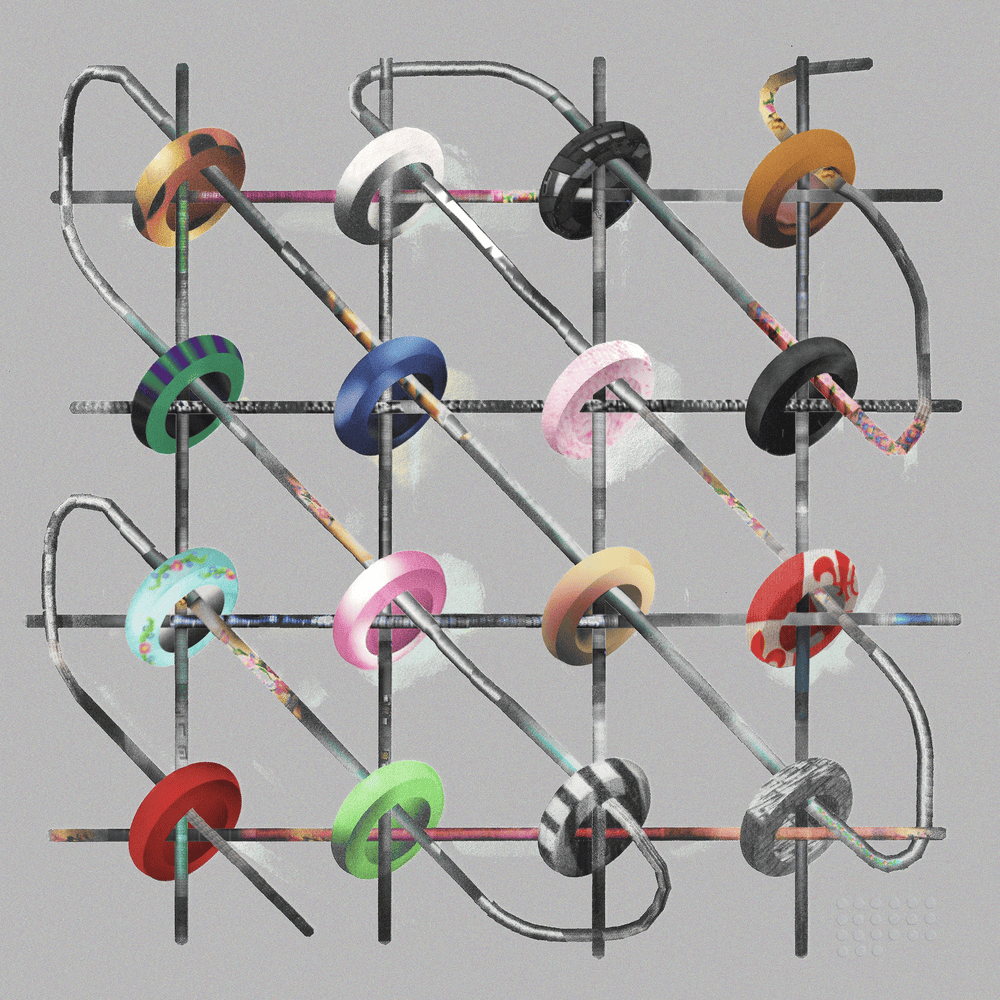
feeble little horse are the outlier. Not only possessing one of the greatest band names maybe ever, nothing else sounds quite like them. Their newest album pushes this musical boat out even further. Crunch and distortion are balanced by shimmering vocals and enchanting melodies, transforming bitknot into a sonic kaleidoscope.

The first album without founding guitarist Ryan Walchonski, bitknot wears the band’s new three-piece structure on its sleeve, exchanging cascading guitar melodies for more synthesisers and more chaotic post-production. This instrumental decision is mirrored in every layer of feeble’s branding – check out their website or the series of eleven music videos made for each song on the album. A digicore aesthetic is inseparable from the band’s identity. On their two previous full-length releases, Girl with Fish and Hayday, the blend of this experimental production with lo-fi rock and pop cemented feeble as a band blurring genres to produce something wholly unique. But, with bitknot, feeble little horse has broken the boundaries of genre altogether. I don’t know what genre the album is, and it seems like the band aren’t sure either. They are label-less. Lead vocalist Lydia Slocum used to call feeble a ‘noise pop band’, but now they just call themselves ‘a band from Pittsburgh’. 

Chipmunked vocals, heavily distorted guitar lines, and digital synthesisers support Slocum’s gentle delivery. The end result is a twenty-five minute album which shifts seamlessly from intense drone to twinkling melodies. bitknot makes up for the short runtime through a tight structure where no song outstays its welcome. Catchy, sub-two-minute tracks such as Paris or Poison are made up of snappy hooks, repeated a few times and sometimes connected by a bridge. The pace is quick and the album varied. Slocum’s vocals are so delicate, so hypnotic, that they provide a necessary balance to in-house-producer and multi-instrumentalist Sebastian Kinsler’s heavy mixing. The sheer detail in each song’s instrumental makes bitknot sound very muddy through most speakers. Through headphones, however, this detail is what makes the album so addictive. Guitar riffs, droning chords, and intense percussion which verges on blast beat, are supported by digital twinkles, glitches, and abrasive noise. 

Like many of the band’s hyperpop contemporaries – Nanajirachi or 100 gecs, for example – bitknot is a response to everyday reliance on technology, both sonically and lyrically. Digital dissonance is weaponised to emphasise Slocum’s lyrical frustration with consumerism, capitalism, and their ever-prevalence in the modern day. ‘She’s in my feed, I need her clothes, I need her hair’, she sings on Shopping over a repeated deep guitar riff. Her criticism is implicit and her vocal nonchalance a deliberate subversion of the maximalist instrumental. The final track, DMT, stands for ‘Death, Money, Taxes’. Slocum’s previously gentle vocals build to a scream in the album’s final moments, bitknot’s passive anger building to its concluding crescendo. But the listener doesn’t get the release, and bitknot loops back to its opening track Doorway, an intense introduction into bitknot’s digital hypnosis. 

Some listeners have started to categorize feeble little horse as a part of a new genre coined “Laptop Twee”, a rewiring of indie pop with a Y2K aesthetic. We can keep trying to fit new artists into a box, but maybe we should let feeble little horse be who they say they are: ‘a band from Pittsburgh’.

Featured Image: Genius

Categories
Poetry

Field Note Extremities

By Robin Reinders

The engines wind down real slow –
Each cylinder kicking once or twice more –
Reluctant machine, spooked like some creature.
The airfield lies under an anaemic morning light –
Mist clinging dim and dewy along the perimeter markers –
And the lamps beside the runway burning weak and washy –
Like tired, winking moons.

Inside the cockpit of the fortress
The air is cloyed with cold and damp –
Spent warmth and breath gone sour under rubber.
The gunners –
Both young bucks from Tennessee –
Eagerly out the rear door.
Your hands are still fixed on the throttles
Though the engines have been quiet
Nearly a minute-and-a-half now.
‘You can let go’, I say –
Unhelpful.
You do not look at me.
Tighten your jaw –
‘Thought of that.’
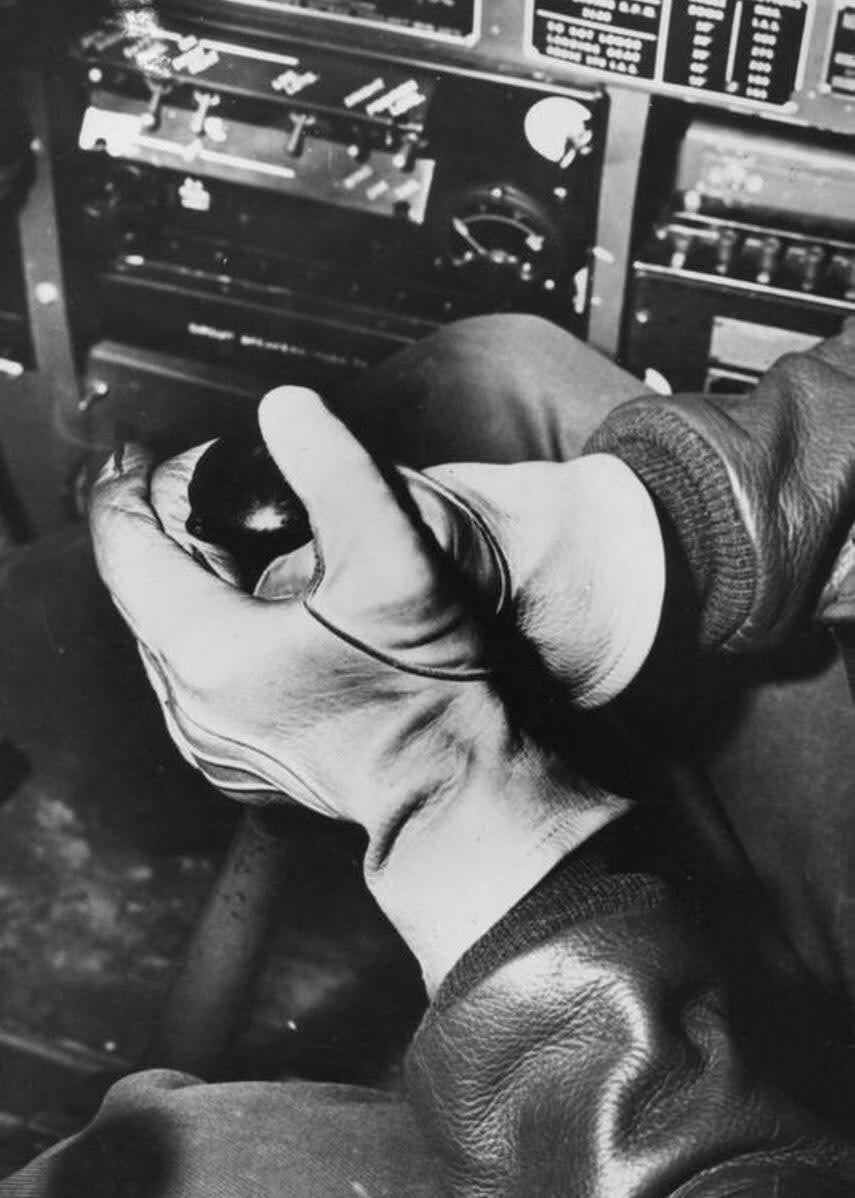
But the leather of your gloves is still wrapped
Tight around the metal –
Creaking like skin
Stretched across the white bone
Of a palsied hand –
Or the cracking leather of an
Old Midwestern diner booth.

Your shoulders ache –
I see it in the way they sit too high –
Tell it by the faint tremor
That runs through the
Strong line of your forearm.
You finally pull your hands back –
And the gloves do not follow suit.
They stay hooked on the controls –
The mould hugging your fingers
To the metal –
As though the cold
Has nailed them there.
You stare at them.
At me.

‘Don’t start’, you warn –
I haven’t spoken.

The frost at elevation has worked its way
Into the seams of the leather –
The hardened grip of wool and hide
Holding them fast.
The glove lacquered with altitude –
A fine rime worked into the stitching –
White crust clinging to edged thread –
To the stitching across the knuckles.
They have stiffened
Into the exact shape
Of your stolid, icicled grip.

You wrench your wrist in small,
Sharp motions –
Breathe out
Through your nose –
And in
Through your teeth.

I lean across the narrow space
With the same slow cadence as a horsemaster –
Feel bile at the back of my throat –
Note the swallow inside yours –
Your keyed-up caballine kick inevitable.
Our knees interfere under the instrument panel.
The smell of you is richer now –
Fuller, more animal –
Sweat,
Sheepskin,
The bitter ghost of oxygen.
My thumb presses along the seam of the glove –
The leather rigid as bark.
‘Don’t make a business of it’, you mutter.
‘Not a chance, pilot’, I defend –
Business-like.

Frost breaks
Under the pressure
Of the pad of my finger
With a brittle crackle of protest –
A small granular fracture,
Like biting soft and sweet into glacé.
Your idle attention flares in my periphery.
‘You always do that’, you whinge –
And it sounds like you have nine cylinders behind your ribs.
I can hum at the bait.
You clarify –
‘Act like you’re the only one
Who knows how to use your hands.’
And that throws me a bit –
Makes me take a hard look at you.
‘That so.’
‘You fuss’ –
Snarled from your shark-mouth.
‘I told you to wear your electric gloves.’
‘And you enjoy being right.’
‘And I enjoy you being wrong more.’
It seems to ease you out of your mood –
The mouthy play-fighting.
Eight months from now
I won’t be able to get a word out of you.

When I work the seam open
It feels like a part of you goes with it.
It yields by degrees –
Each finger released in phases –
The glove stubborn in its claim
On your extremities.
Your hand inside remains
Determinedly still –
I do not expect to notice this –
To feel the restraint in it –
The effort not to assist –
Not to betray need.
Mangy mutt drooling at the muzzle.
Terribly still.
The abominable heat of your cheek reaches the skin
Beneath my helmet strap.

The glove begins to give.
Each finger crooked and reluctant –
Your hand swelled and distended
By pain and cold.
When I tug harder –
A little mean –
You set your jaw firm and brave.
‘That hurt?’ I ask –
A little meaner.
Your head is angled
And gracious
And acquiescent against the seat rest.
‘Just get it off.’

My hands cupping yours –
Your wrist braced in the recess of my palm.
Small bones
Shifting like the
Slight, sinewy spars of
The very first bomber bird.
I pull and
You watch –
Like Hughes watches his own films.

The gauntlet releases its grip.
The skin of your hand dark red –
Flushed
Deep and swollen
Like fruit bruised beneath the rind.
Blooming blood vessels,
Tender contusions.
Your knuckles shine faintly –
Blood forced close to the
Taut, tight surface
Of your stinging skin
By the returning warmth.
You flex your fingers once –
Tendons moving all a-jitter
Beneath the skin.
Indecent, somehow.
Your mouth pulls askew .
‘Bad?’ I ask.
‘Raw, ‘s all.’
‘You’re shaking’ –
Unhelpful.
‘So are you.’
It’s not often you man up
And choose to be right about something.

The second glove is worse.
Your knuckles have caught stiff and dry-skinned
In the lining.
When I pull –
The cowhide gives only grief.
You shift impatiently.
Your knee jams harder into mine –
Pressure deliberate –
Provoking –
Desperate for horseplay.
Hell,
You’d romp with the Germans
If they gave you no reason not to.
Scuffle right in Stuttgart –
Half a bottle of brown in your belly
And a dollar on the line.
I look up.
Your eyebrow raised
Like fists by your face.
Your features etched with irritation.
‘You like telling me what to do’, you state plain.

‘Someone has to.’
I think of you behind the wheel.
Bail-out siren blaring –
And your parachute somewhere not on your person –
And all our boys with their silks torn open, safe and settled upon the ground –
Waiting for you to listen to your Kraut-crazed copilot and eat your grief –
And jump –
And come home to them –
Wounded –
And weepy –
And wonderful.

‘Thought that was the colonel’s job.’
‘He makes a poor go of it.’
‘And you manage well?’
‘Well enough.’
I think of you caught in the collapse –
Strapped fast –
While the fuselage folds upon itself,
The harness holding you
In saintly posture –
Head bowed slightly,
Arms drawn in,
As though the machine had arranged you
For burial.
I think of the long, awful fall
And the ground rising
To meet what is left of you.

I hook my fingers beneath the cuff
And yank harshly.
The leather complains.
Your mandible too –
Molar on molar.
For a moment I think
Your hand will come off like a doll’s.
When your wrist slips free –
And lands atop
The heel of my palm –
The heat of it is scalding.
Pulse jumping as the recoil of a gun
Just fired against
The heel of my palm.
You look down at the mess of limbs you put there –
Your wrist and
The heel of my palm.
Some small noise comes from you then
Which I have not yet heard –
Angry and frustrated,
Simpering and childish.
‘You do this’, you strain after.
‘What.’
‘This—’

The familiar edge in your voice.
The small flare of fury
That lives just under our skin –
Has festered since basic training –
Worsened in one another’s pockets.

You do the rest of the work –
Pull your hand away –
Flex strong fingers again. –
The redness all but gone.
‘Better?’ I ask –
Cringe at my own condescension –
‘Better.’
You do not thank me,
But when you reach for the latch
And haul yourself down the forward nose hatch,
You are there
To push your palm between my shoulder blades –
All pesky and puerile –
And send me stumbling over my own boots.
That wicked smile –
With all your teeth
Still in their right place.

Featured Image: Imperial War Museum, United States Eighth Air Force in Britain, 1942-1945

Categories
Creative Writing

Surface Tension

By Saoirse Pira

“Michael, I told you already: you can go swimming later, when your father gets back,” from behind her sunhat – too big, he thought, ridiculous – “now eat your sandwich, please. You’ll be getting sand in it, Michael, do you want sand in your sandwich? I won’t make another sandwich if you get sand in that one, and dinner isn’t until six. Do you want to go hungry until dinner, Michael? Eat your sandwich. Christ, where is your mother? Anna!”

All in that horrible nasally lilt. He turned to watch her disappear up the steps, away from the beach, toward the house – calling, all the while, his mother’s name. He hated Aunt Helen, and thought she spoke too much: a feeling only made stronger, more pronounced, by that terrible radio voice she spoke with. Despite both Aunt Helen and his mother both being reared and raised in Ballina, only his mother retained this mark of her becoming in her speech. Aunt Helen moved to Dublin during the Celtic Tiger and made what they all thought to be a fortune selling office supplies to companies that were now most certainly out of business. Then, of course, she married Uncle Declan, who stank of stale tobacco and went red from walking up the stairs, and who had made an actual fortune selling American fridge-freezers to the upwardly mobile. Somewhere along the way, Aunt Helen adopted what Michael thought to be the most annoying accent that he had ever heard. Michael’s father said she listened to RTÉ Radio at night to absorb it as through osmosis. He also said she learned it through those tapes people would listen to to learn languages. Michael had seen those tapes at the back of the library, but they were all for people that spoke English to learn Spanish or French or German or Italian, not for people from County Mayo to learn Dublin 4. If his father was joking, as he suspected he was, the humour was most certainly lost on his mother, who would sigh and roll her eyes whenever his father got onto the subject of Aunt Helen and her middle-class metamorphosis. It was worse than the radio though, he thought, because at least he could turn the radio off. Aunt Helen just kept talking.

Michael looked down at his sandwich, sitting in a plastic bag on the hot sand. It was going to be horrible, and its contents getting warm from the heat of the sand couldn’t possibly make it worse. Maybe the cheese would melt, he thought, and mask the horrors of slimy pink ham. He prodded the bag there with a stick, flipped it over. It was no use. He wasn’t going to eat it anyway. He didn’t want to eat it; he didn’t want to eat anything. Besides, he wasn’t altogether convinced that this could be classed as food, legally, or maybe scientifically, speaking. It might be better used as a kind of glue or to manufacture bouncy balls. Now there’s an opportunity to earn a real fortune, he thought, if he could only find a way to mass produce them. He turned back around to the sea – yes, yes, that was it. He wanted to swim, he was going to swim. 

Down the steps again came Aunt Helen, with her horrible frantic air that loomed about her like a stink, one of those cartoonish green clouds, and his mother. She followed Aunt Helen uneasily down the steps and toward the beach. A quiet woman was Mammy, kind and scared. He often thought her not unlike a stray cat in nature – skittish, that was it. She hated the family holidays, but insisted on them for a reason Michael couldn’t understand. It was different when there was Granny and Grandad. Now it’s just Aunt Helen and Uncle Declan and he just didn’t see the point. As the pair approached, Michael noticed the blue cooler bag in his mother’s hand, and the beach bag slung over her shoulder. Inside that bag he knew would be his costume, goggles, and towel, and this little piece of knowledge was enough to get his heart racing, anticipation settling in his body as though it were happening in real time.

His mother and Aunt Helen found their way to the deck chairs, where they joined Uncle Declan, who had been lying wordless on his stomach since breakfast, his back growing relentlessly pinker despite Helen’s periodical suncream applications. His mother unzipped the cooler bag and passed two cans to Helen, who passed one again over to Declan, calling his name as she held it out. This, it seemed, was the only thing enticing enough for the pink man to peel himself off his deck chair. He sat up, taking the can from Helen, saying something or other about the heat. Finding Michael’s eye then, he grinned, bearing his long yellow teeth, and popped the tab. “There’ll be no tins of mineral for naughty children!” he said, bringing the can to his lips and drinking it at such an angle and eagerness that the contents streamed down the sides of his mouth, dripping onto his shorts. Michael looked back down at the sand, at his sandwich, anything but the sight of that strange man. He noticed a shadow approaching and looked up to find his mother standing over him. She crouched down, her kind face meeting his, and revealed a small white package. “Here child,” she said, unwrapping it carefully, and pulled out a bright orange ice lolly, his favourite. His face lit up at the sight and he felt his spirits infinitely lifted, his faith instantly renewed. 

He took it from her, replacing her fingers with his over the wooden stick. “Thank you, Mammy.”

She smiled softly, touching her hand to his shoulder before lifting herself back to a stand. With her hand to her brow, shielding her eyes from the sun, she glanced out towards the sea, then back to the house, then finally down at her son, the orange lolly already melting in his hand. She glanced down briefly, before walking carefully away, back to the chairs. 

Whoever discovered the wonders that could be gleaned from frozen juice must be a genius, Michael thought. He should like to meet them, thank them for their service, and maybe if he asked kindly enough, they’d give him a lifetime supply, like those people that win truckloads of chocolate or washing up liquid on the television. Though, people have probably been eating the likes of these since the Ice Age, because well, if everything was ice, surely the fruits would freeze too, and someone had surely juiced something by then. They’d have dropped an orange at some point, at the very least.

It was gorgeous. Just wonderful. Almost perfect, if not for the fact of it melting faster than he could enjoy it, forcing him to lap it up with a rabid sort of gluttony. He was embarrassed, of course, but the rush with which he consumed it left little room for contemplation. It was a race against the sun and time and probably God, and one he simply had to win. He turned away from the deckchairs, toward the sea, to indulge this savagery in some sort of privacy; it was bad enough that he knew, there was no need for this affront to his self-image to be known to anyone else.

Soon enough, it was finished, and there was no way of knowing if he had won, just that it was gone, and his hands were unthinkably sticky. His face, too, he noticed, trying then to wipe his face clean, only to remember the thing about his hands. There was just no winning. His hands were coated with that thick orange stick, and now the wasps would be all over him. He had never been stung. A boy in his class told him once that he was allergic to bees. Michael had no way of knowing if he was allergic to wasps, and if he was and they got him then, that’d be the end, and he’d be dead, and it could have all been saved had he only not been so incredibly greedy. He looked up again at the sea, then back up towards the house, staring with such intensity as if he could will his father into being there, like if Michael looked and thought and hoped hard enough, he would materialise then, making his way down the steps toward him.

It was no use, he was not magic. He didn’t understand why he had to wait, anyway. He’d been learning to swim in school, he was one of the best in his class. He didn’t even need armbands anymore. It just wasn’t fair. He’d built sandcastles all that morning, there was nothing left to do. Though, there was the map. He’d started one of the beach that weekend, on his dad’s suggestion. It was fun enough, he liked playing pretend at being an explorer; he hated that everywhere had been explored now, satellites and GPS had ruined all the fun. There was still the sea, but he didn’t even want to explore that, he just wanted to swim in it.

He stood up, wiped his hands on his shorts, and turned to walk toward the deck chairs. If he walked with enough confidence, they wouldn’t notice the fresh orange stains – still, better his shorts than his hands. He made his way to his mother, rummaging in her bag no doubt for the same magazine she had been pretending to read all week. “Mammy, I’m an explorer. Is my map there? I need it.” Her head bolted upright – he had surprised her. Her shock softened into a smile, relief no doubt at the child being occupied by something other than that sea. She lifted the bag to her lap, fished out the folded-up piece of A3 paper and marker pen. “There you are,” she smiled, “don’t go too far.”

He took the paper and pen from his mother, promised to be back soon, and turned to plot his excursion. He pocketed the pen and considered the paper. It had softened already, its corners curling slightly from days of damp sea air, folding and unfolding, mingling with paperbacks and bottles of suncream. He smoothed it over with his fingers as best he could. Then he was really moving, darting down the beach with the tilted gait of a child absorbed, already elsewhere entirely.

He had already plotted the house, the chairs, the steps down, in careful lines to the left of the page, having decided to focus his expedition eastward. This was due, in large part, to the wall of rocks to the west that rendered any exploration in that direction near-impossible. He knelt down, marking the rocks on the page with an array of sharp, angry shapes, thinking himself remarkably useful – should somebody come to use the map, they would know to proceed with caution. There was the obvious business of the shore to attend to. He decided he would mark it as he walked, he would complete the whole map from left to right. Any approximation would defeat the point, he would have to be exact. And so he set off walking slowly, drawing carefully as he went; marking lines of kelp and shells and the small, wet signatures of footprints, pointing this way and that before being swallowed by the tide. On approaching a groyne, he would place his map flat on its surface, the pen on top to secure it, before fixing his hands on the wood, hoisting himself up, and standing there, basking in that glory, his sweet bravery, for a few precious seconds before jumping down, retrieving his tools, and marking the site on the page. The beach narrowed as he went, cliffs and tide closing in on the sand. He noted this discovery, slowing every so often to consider the shape of the cliffs, the best lines to draw. After some time, it occurred to him that he would soon run out of space, at which point he turned around and realised the chairs were almost completely out of view.  

He didn’t need to be afraid; he had a map, he couldn’t get lost. And anyway, he was almost out of space, he would have to go back soon, and he would fill in any more details on his return. Fixing himself eastward again, he considered where his map might have to end. Ahead of him, the cliff closed in sharply to a point before receding again, at its point meeting a group of large rocks. The rocks varied slightly in size and shape, though altogether they gave Michael the impression of being not unlike small asteroids. And unlike the impenetrable wall by the deckchairs, the rocks here seemed relatively easy to climb. It was perfect, he had just enough space left. He would draw the rocks, climb them to be sure his depiction was accurate, and make note of what was on the other side.

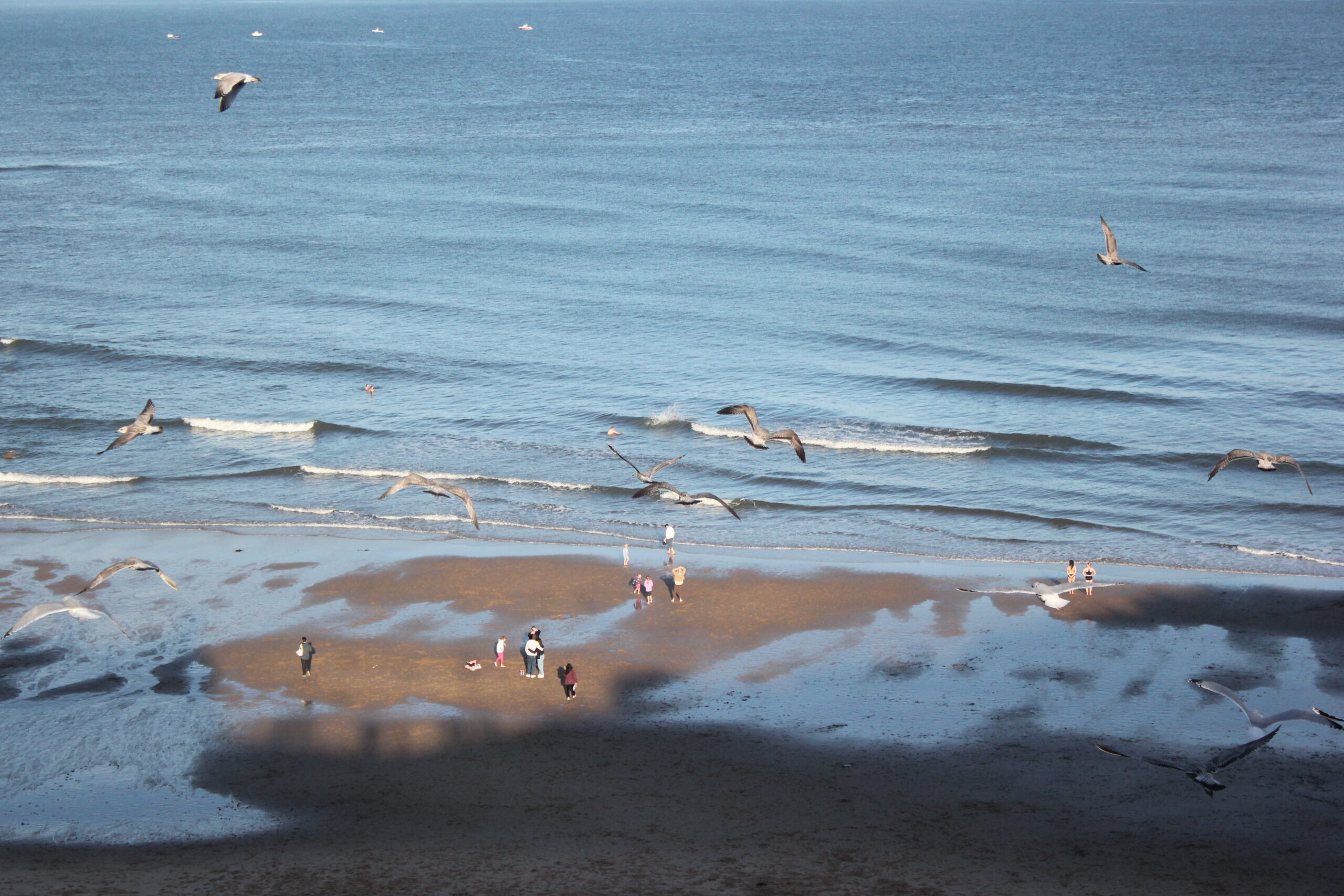
He drew what he could see, set his map and marker down, and began the climb with relative ease. He was practised now, felt himself professional and decidedly athletic. The rocks were warm and damp, and after each successful summit, he would stop to admire the feat, his progress and new artificial height. Most were relatively flat, though some sloped slightly this way or that, and he would have to stick his arms out to catch himself from falling. The final few were anticlimactically easy, stacked as they were simply, altogether more like steep steps than satisfying boulders or asteroids. As he reached the top, it occurred to him that he could hear the sea a great deal louder than before, a theory confirmed when he reached the top, that final rock slanting off over the beating tide. The other side of the wall was pure water, all kelp and beating waves. He felt so powerful, there, standing over so much blue, he thought first of Poseidon and his trident, then of Lir and his children. Seagulls brayed overhead, and Michael closed his eyes and thought of Lir’s children, those swans. With closed eyes and slow breath, those gulls might be swans, their calls were almost song. Aoife couldn’t bring herself to kill the children, she took them to the water to bathe instead. 

He wouldn’t be able to say, later, just how it happened – only that it did, only that he fell. He hit the water before he knew he was falling, he was under before he knew he was in. He was reaching for something and grabbing at nothing, he was trying to swim up but he was flat on his back. He was kicking and swiping but he knew that he was sinking. He didn’t want to be an explorer, he didn’t want to be brave. He was swallowing so much water and it occurred to him that people didn’t live forever.

Everything seemed suddenly remarkably slow. He knew it was the sky above him, the light blue and the white. He’d always drawn the sun yellow, he’d always been so wrong. It looked like there were dark blue clouds cast over. He thought again of Lir’s children. He was no longer moving. He wondered if they were scared, when they bathed in the Loch, if they knew what was coming, if the water was cold. Or if they played before the spell was cast, if they played when they were swans. He let his head fall back. It was all blue on forever.

He felt the hands before he saw the body, the shape fixing itself into meaning, pulling him in and lifting him up. It wasn’t Poseidon or Lir, no catalogue of gods, just kin. The yellow shirt he had worn at breakfast, the steady arms that carried bikes and bags and bedtime blankets – his Dad, finally swimming. The sea loosened its hold, with that crash through the surface, running off his face – it gave him back. Gulls sang in circles overhead, the impossible nearness of the sky. There, yes, sky – so close to taking flight.

Featured Image – Toby Dossett.
Categories
Poetry

In the Name of the Father

By Robbie Foster

L’enfant I


Go with me now raising nothing,
For nothing will come from nothing.
Your hands, they will brush against mine
And feel the marks of adulthood
So rudely and so freshly forced
Upon me and my shaking palms.
Go with me now raising nothing,
For I’ve nothing left to tell you.
Your hair will fall over your brow,
My world will be shapeless to you
And you’ll feel me gently trembling
As I lead you to your slaughter.

Eden II


Hold my hand and take me to the river,
We were born there after all – and will die
Some day. I’d like to return before then.
I want to listen to the familiar roars:
Mum shouting to stand back and that picture
Dad drew to let me know that I was seen
As I dissolved into the peripheries
Of the river’s great undying torrent.
I’d like to return there before I die,
To run my hands through the hopeless waters
Flowing slowly into obscurity:
From the moment I touch them – from that place
On the bank to which I haven’t returned.
I’d like to return there before I die,
To feel my hands be gently swept away,
By the waters, into obscurity –
To know that there was some real in all this.

Shutting the door III

Walk a few steps ahead of me.
We’ve said everything that we can
For now, and the day isn’t getting

Any shorter. I like to think
You were like this once – long ago –
The overcoat looser, less grey,
And the drink that we could’ve had
So much the more understanding.
Still you wanted us to walk home
Together, just for old times sake,
And I know that you’ll leave the door
Hopefully ajar, just in case
My nostalgia for being at home
Can tempt me back inside with you.
It will probably, and this will
Be a silly flight of fancy,
Stopped then forgotten forever –
My last desperate gasp in all this,
Stopped then forgotten forever.

Featured Image – Toby Dossett

Categories
Culture

Leading Ladies Must Return to the Rovers Return

By Tess Cato

You’re sitting under your kitchen table in Pendlebury, Greater Manchester. It’s the early forties, the height of the Second World War, and your mum, aunty, gran and neighbour chat – about the war, but also about literally anything. Their voices are raspy from too many cigarettes and too many spirited conversations. You don’t sit there because you’re hiding or scared, you’re just listening because you like to. These women are the pillars of your world, and the inspiration for your life’s greatest artistic achievement.

This was the childhood Tony Warren recalled. Born Anthony McVey Simpson, Warren grew up, like most children brought up in the midst of the war, in the absence of a father. Instead, he was surrounded by women from the working-class English north who chatted away with that charming rhythm that can only be found in Manchester. These women and these completely mundane conversations inspired Warren to write Coronation Street. “I used to sit under the kitchen table, on a cushion, on the flagged floor, and listen to how people talked.” he told Charles Sturridge, who wrote the Bafta award-winning film about his career. “Here’s me Auntie Renee who married money and she talks posh, and here’s lovely Auntie Gladys whose husband is a prison warder and she doesn’t [talk posh]. It was wonderful training.”

In the sixties, seventies and eighties, when Corrie was watched by a good 18-21 million viewers, the characters that dominated it included Elsie Tanner, Betty Williams, Diedre Barlow and Hilda Ogden. And what do these characters have in common? They were women, northern, working class and ‘of a certain age’. Most importantly, though, they were sharp-tongued and sharp-witted. Their husbands seemed almost like secondary characters, moaning about their wives behind their backs while the women laughed, fought or gossiped, or did all three simultaneously. It was these women that were the true stars of the show. Corrie wasn’t just revolutionary for normalising proper good ol’ northern-ness on the TV – “eh, chuck”, “nowt” and “by ‘eck”with the Queen’s English being the preferred dialect of the BBC and ITV, Corrie put probably the most under-appreciated demographic in the limelight for once: the working class, middle-aged, northern woman. She who was the backbone of British society during the war, as the men went off to fight. She whose strength, humour and love has been acknowledged far too infrequently, but which Warren captured like flies in the amber.

Fast forward to today. While still carving out space for this type of woman – Mary, Rita, Tracey and Sally bringing classic feminine northern charm to the show – Coronation Street‘s story lines get wackier, less realistic and often more depressing. There is always someone with a terminal illness, someone who’s been kidnapped and someone who’s been wrongly accused of murder – and that’s just before the first advert break. It almost seems like Corrie gets sponsored by so many charities that its storylines feel forced, and thus the natural funniness that came so easily in the earlier days is lost.

Without a doubt, less people watch Corrie today. Even I – once a superfan who was starstruck to see Dev walking around the Trafford Centre – must confess that I haven’t properly watched it for years. Its presence on social media is stark, an indicator that ITV desperately needs to engage with younger viewers in an age of Tik Tok and dwindling attention spans. But when there are millions of creators on social media platforms, I wonder how many kids ditch their phones full time for the soap. 

For me, Corrie lost its way when the classic Corrie women lost their ‘main character energy’, so to speak. They were strong, hilarious, fiery and proud. Not twenty-something year olds with perfect legs, refined accents and swanky jobs reminiscent of the chick flick heroine. Just real, normal, hard-working women you would be proud to call your mum, aunty or nan. Women like this carried the show on their backs, and made Corrie the success that it was.

Louis Theroux’s Inside the Manosphere documentary revealed that there is a crisis in how women are presented in the mass media today. Kids who stumble across a HS Tikky Tokky video may grow up thinking that women are powerless, worthless and unintelligent – the very antithesis to the classic Coronation Street woman. If only Corrie would return to its roots, and focus its stories on the types of women Tony Warren grew up to be inspired by, the world might be a slightly brighter place.

Featured Image: Coronation Street, ITV