By Ashley Zhou
Antigone, one of Sophocles’ three Theban Plays, has been widely modernised and adapted, ripely complex in its interplay of personal grief and political struggle set within a fractured nation. For instance, The National Theatre’s 2012 production and Kamila Shamsie’s novel Home Fire relocate the war-torn Thebes to post 9/11 Britain, acutely interrogating traitorship during the sensationalised racism of the “War On Terror”. Antigone follows the titular character’s attempt to ceremoniously bury her brother’s body against the decree of King Creon, and the subsequent series of tragic deaths following his refusal to bend arbitrary laws.
Inside the Assembly Rooms, the Greek city is transformed into a repurposed British cotton factory. A ‘Thebes Mill Ltd.’ sign hangs from the fly loft: a prop highlighting the 1950s Burnley industrial landscape of which director Estelle Pollard-Cox (assisted by Jess Cloake) and producer Nat Pryke (assisted by Jamie Duncan and Tom Milnes) set their production. The creative team emphasise the intentional incorporation of some of their actors’ own regional Northern accents on top of adopted Lancashire accents, expanding the characters’ struggle outwards of Burnley and onto the wider political context of the North. The dialect fully grounds the Greek tale in Britain, exemplified in the scene-stealing Leon Perry-Masey’s (Soldier/Messenger) offhand ‘localised-like, innit?’.
Crippled under political-economic fracturing following the Second World War, industrial struggle is clear in the cumulative ensemble of DUCT’s production, managed by Lucy Smith (assisted by Cameron Howe), stage managed by Matilda Bell and deputy stage managed by Leon Ansorg (assisted by Erin Bullen). Theo Henman’s set design sees windows filmy with grime; crates, boxes, and barrels which actors interact with freely; and steel bars which line raised decking. Leyla Aysan’s lighting design supports this seamlessly as white light filters through from “outside” and casts stark window-grill shadows on the floor. Oli Fitzgerald’s sound design has piano music blending into industrial-adjacent trap beats, scoring scene transitions with an assertion of tonal confidence in the play’s modernity. My favourite touch is a line of Union-Jack bunting strewn across the steel, hinting at a sort of conservative celebratory nationalism that Creon clings to as the British Empire continues its collapse, threatened (according to him) by greed and espionage: ‘Who paid? How much? What purpose?’.
It’s hard to tear your eyes away from Jasper Hinds’ Creon. As much as the character insists upon his manhood, Hinds imbues the king with a nuanced vulnerability as his eyes flit between believable questioning and shuttered conviction. Progressively frazzled in orientation and costume, he ends the play in a boylike state, face glossy with tears in the light. As Antigone suggests that nationhood is conflated with the individual patriarch, the production’s Burnley sits similarly young and broken by the ghost of old ways. This is particularly poignant when he faces his son, Harry Robinson’s Haemon, who meets his anguish head-on. Here, Henman and Aysan collaborate on an exciting set piece that I’m inclined not to spoil, but is unbelievably effective.
Playing the titular Antigone, Pearl D’Souza exudes agonised grit; in her grief and feeling, words struggle past her set jaw. ‘Do you understand!’ she yells at us as she’s martyred. Her teeth chatter with rage. Once gone, her onstage presence is dearly missed. The same can be said about Isobel Willis as Ismene. Directly opposing her sister, Willis expertly embodies Ismene with a stiff back, her entire body curling inwards. The strain of siblinghood is felt in their arguments, as is the absence of the dead.
Aaliyah Angir maintains a constant presence, kept between two worlds as she leads a, notably, all female-presenting chorus and advises Creon over his shoulder. To portray women as Theban Elders – usually ‘older men of the establishment’ as Robert Coleman notes – invites an element of gender trouble, messing with their implicit neutrality. Roles are metatheatrically blurred even as Creon insists on their fixity. Angir plays with this expertly, vocally disagreeing with Creon and quietly showing Antigone support. As Creon rages, Angir’s mouth curls at the audience, her eyes shining with approval. Shrouded in darkness as the spotlighted Creon speaks, she unties Antigone’s bound hands and the two share a quiet moment, only vaguely intelligible even to the audience.
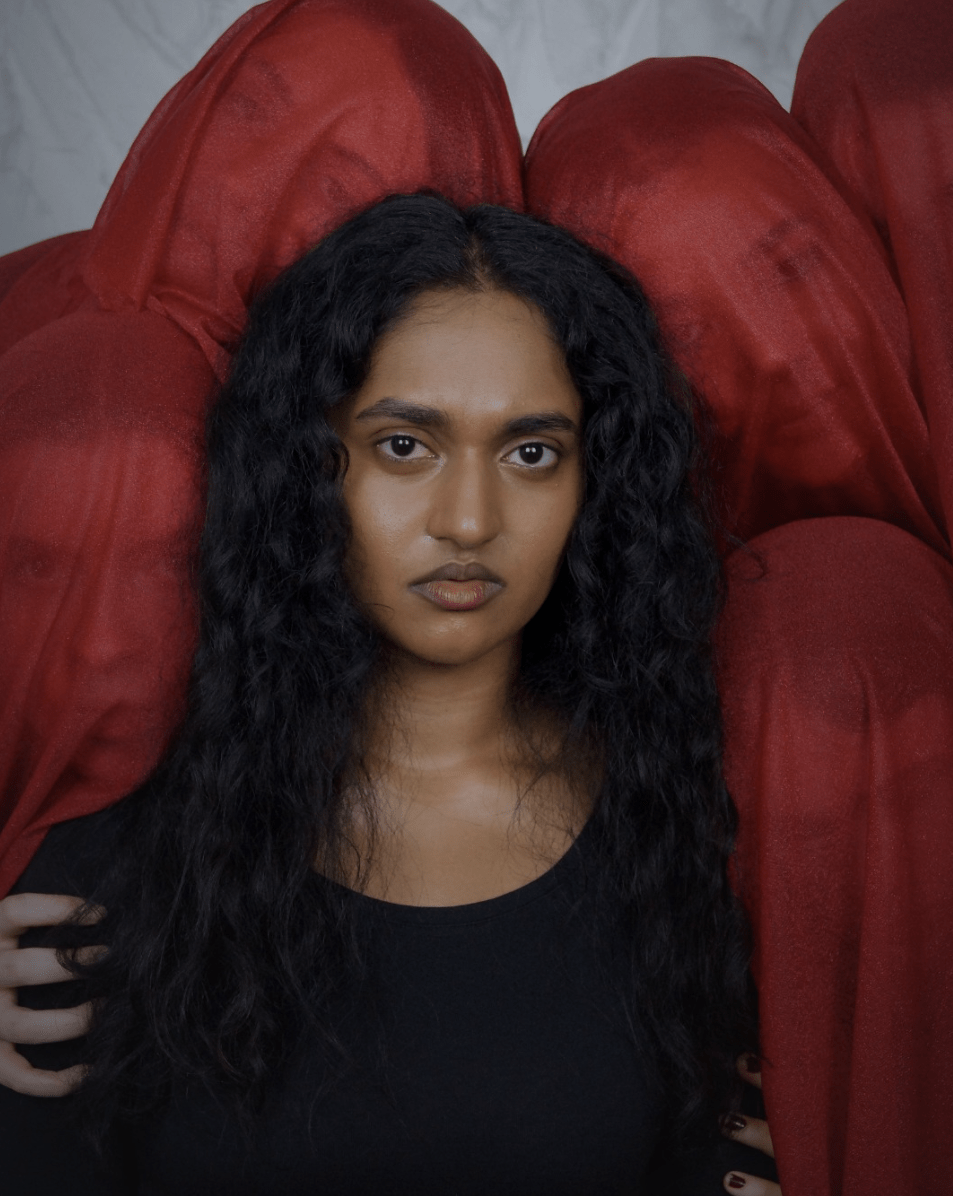
The Chorus (Eva Tozzi, Milly Hale, Sophie Browning, and Willis) are the production’s lifeblood, an amalgam of perfectly pitched performances, excellent blocking, and effective costuming by Uli Haaurhaus. They don crimson cloths which they draw over their head when silent, little acts of self-burial that litter their narration. They freeze like statues, refusing to be stared at. They mostly speak one at a time, underscoring their isolation. Delivering the truth of Creon’s stubborn folly, Nefertari Williams’ Tiresias is instantly compelling, her entrance shifting the energy of the play. Her voice carries a stormy musicality, every line delivered with the flow of intense roiling waves. Dressed in a blood-coloured robe with a dark red blindfold over her eyes – a Haaurhaus touch that implicitly aligns the seer with the play’s women – every word believably lives beyond him. Destruction is distant to the out-of-touch ruler despite being starkly experienced by everyone surrounding him – that is, until the bitter end of his family.
Antigone stands tall in death while Creon falls to his knees. Laws remain collapsible; power and patriarchy remain dangerous corrupting forces, as pervasive as in Sophocles’ time. Aristotle believed in the cleansing power of katharsis and as I rise to join the standing ovation, a little lighter, I’m inclined to agree.
Featured Image: DUCT