By Emilia Brookfield-Pertusini
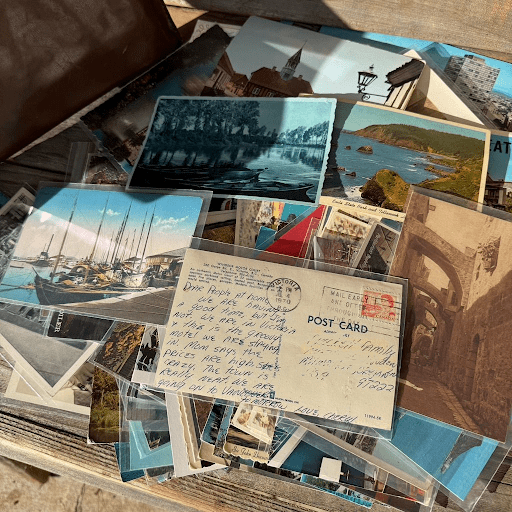
Part of the holiday ritual was always writing a postcard. Off we would set to a shop selling ice creams, beachballs, booze, and tat, to stand in front of the revolving galleries. The glossy sheen shone back at our suncreamed faces as we would choose the ones with the nicest photos of flowers or donkeys, or with the most vibrant Word Art font to attest to the fun available at the destination it read out. We always wrote them, be it to grandparents in Blighty, or school friends we had felt a particular attachment to in the school year just gone; I don’t remember a holiday without them. We spoke of the crunchyness of sandwiches with foreign bread and sand, the infinite fun a child can conjure up upon being provided with open water, all in a sprawling, phonics directed hand. Now, my handwriting is less sprawling and my excitement over water has lessened into a blissful anticipation, but my postcard writing remains. Chances are most people whose names appear on my phone’s contact list will have received a postcard from me. I still write them, and offer them as my preferred medium of communication. I never graduated past primary school postcard activities offered by my parents, the letter form never really stuck with me, but I am content with my little postcard world.
I had never given postcards much thought, attributing my attachment to them with a misquoted Virginia Woolf phrase – ‘there is no such joy like receiving post’ (which I think explains most of our Vinted habits too). These A6 tokens are dime a dozen, but they have a particular specialness to them. Something irresistible in their form keeps me coming back whenever I need to say anything. Subconsciously my habit of choosing a postcard at a young age was helping form a visual language for when words couldn’t fit. In looking for postcards with flowers and animals, I was hoping to provide the recipient with more than just the juvenile details of a holiday, but a symbol representative of my time.
Berger’s 1972 series Ways of Seeing, based on his collection of essays under the same name, scrutinises the way art has come to exist in the 20th century. Reproductions of art are everywhere. If Berger could have seen how this would evolve into being able to see Carivaggio from a tool in your pocket I wonder what he would say. As a result of all this reproduction, postcards of your favourite works are readily available at any good or bad museum across the world. ‘Pictures [are] like words rather than holy relics’ observes Berger, using the postcard epidemic as a case study. No longer contained within the sanctuary of the museums or chapels they live in, art has come to take a new meaning that is less shrouded in its uniqueness to one place. Each postcard stuck on your fridge, wall, or mantel piece, regardless of their content or the photo/reproduction on the front, helps form a ‘visual language. Used for describing or revealing experience’. The back and front work in tandem, building a vision from words and symbols that captures the moment in which you are writing, the location of where you are, the reason for your stamping the address. The postcard becomes the most ephemeral form, capturing a fleeting language of a holiday or period that necessitates the visual.
I stick the postcards I receive in return all over my walls, lodged inside my books, and wrapped in ribboned piles once the walls and books get too heavy. I can’t bear to throw them away. It would be like throwing away a little piece of the personal history of myself and the sender. ‘Wish you were here!’ is not merely just a cliched saying but an invite into the sender’s perception. The thought of you was triggered and aligned by the postcard they brought, the images on it, aspects of their perspective while abroad brought them back to you. It is very rare to see how other people actually perceive you, and is a major source of thought if you are a vain twenty-something year old (insert THAT quote from Jemima Kirk). The postcard allows us to see the visual language the sender uses for you. Pieces of art people thought I would like. Holidays people thought of me on. Designs and objects people recognised me in. While postcard writing was originally an exercise provided by my parents to ensure we wouldn’t return back to school having lost all ability to write, now the postcard becomes the relic of a moment. Its small, undaunting form can be scribbled out in the spur of the moment. Moments of thanks, longing, or simple upkeep of a relationship all compel the postcard into creation. When we write to someone while abroad, or simply just away, we are telling them through this very act, regardless of how simple or cliche the message, that we are thinking of them there in that moment. That despite the distance, our existence remains aligned with theirs, existing against these new insights and perspectives.
By writing we hope to preserve, to cross through time, and for our words to land at someone’s feet. Be it postcard form or longer form, as I am writing to you now, we hope our words capture and travel. We hope our use of language become symbols for sentimentality, symbols of a life. Laced in every postcard is the complete ephemerality of a moment and a journey. Thoughts, perspective, symbol, emotion, and weather land at your doormat, containing it all in only 105 x148 mm of space.
Featured Image – Pinterest