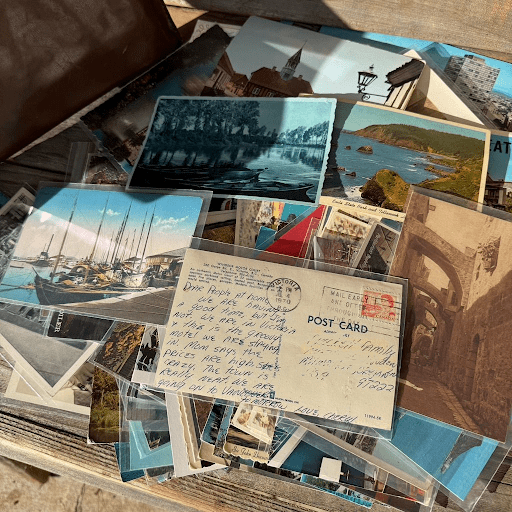
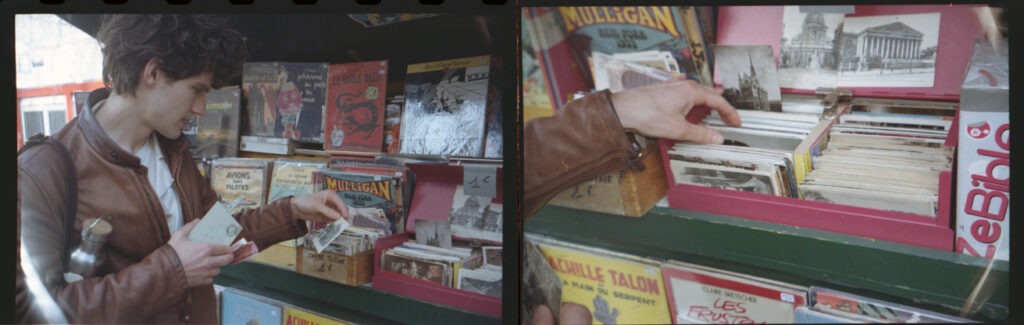
Part of the holiday ritual was always writing a postcard. Off we would set to a shop selling ice creams, beachballs, booze, and tat, to stand in front of the revolving galleries. The glossy sheen shone back at our suncreamed faces as we would choose the ones with the nicest photos of flowers or donkeys, or with the most vibrant Word Art font to attest to the fun available at the destination it read out. We always wrote them, be it to grandparents in Blighty, or school friends we had felt a particular attachment to in the school year just gone; I don’t remember a holiday without them. We spoke of the crunchyness of sandwiches with foreign bread and sand, the infinite fun a child can conjure up upon being provided with open water, all in a sprawling, phonics directed hand. Now, my handwriting is less sprawling and my excitement over water has lessened into a blissful anticipation, but my postcard writing remains. Chances are most people whose names appear on my phone’s contact list will have received a postcard from me. I still write them, and offer them as my preferred medium of communication. I never graduated past primary school postcard activities offered by my parents, the letter form never really stuck with me, but I am content with my little postcard world.
I had never given postcards much thought, attributing my attachment to them with a misquoted Virginia Woolf phrase – ‘there is no such joy like receiving post’ (which I think explains most of our Vinted habits too). These A6 tokens are dime a dozen, but they have a particular specialness to them. Something irresistible in their form keeps me coming back whenever I need to say anything. Subconsciously my habit of choosing a postcard at a young age was helping form a visual language for when words couldn’t fit. In looking for postcards with flowers and animals, I was hoping to provide the recipient with more than just the juvenile details of a holiday, but a symbol representative of my time.
Berger’s 1972 series Ways of Seeing, based on his collection of essays under the same name, scrutinises the way art has come to exist in the 20th century. Reproductions of art are everywhere. If Berger could have seen how this would evolve into being able to see Carivaggio from a tool in your pocket I wonder what he would say. As a result of all this reproduction, postcards of your favourite works are readily available at any good or bad museum across the world. ‘Pictures [are] like words rather than holy relics’ observes Berger, using the postcard epidemic as a case study. No longer contained within the sanctuary of the museums or chapels they live in, art has come to take a new meaning that is less shrouded in its uniqueness to one place. Each postcard stuck on your fridge, wall, or mantel piece, regardless of their content or the photo/reproduction on the front, helps form a ‘visual language. Used for describing or revealing experience’. The back and front work in tandem, building a vision from words and symbols that captures the moment in which you are writing, the location of where you are, the reason for your stamping the address. The postcard becomes the most ephemeral form, capturing a fleeting language of a holiday or period that necessitates the visual.
I stick the postcards I receive in return all over my walls, lodged inside my books, and wrapped in ribboned piles once the walls and books get too heavy. I can’t bear to throw them away. It would be like throwing away a little piece of the personal history of myself and the sender. ‘Wish you were here!’ is not merely just a cliched saying but an invite into the sender’s perception. The thought of you was triggered and aligned by the postcard they brought, the images on it, aspects of their perspective while abroad brought them back to you. It is very rare to see how other people actually perceive you, and is a major source of thought if you are a vain twenty-something year old (insert THAT quote from Jemima Kirk). The postcard allows us to see the visual language the sender uses for you. Pieces of art people thought I would like. Holidays people thought of me on. Designs and objects people recognised me in. While postcard writing was originally an exercise provided by my parents to ensure we wouldn’t return back to school having lost all ability to write, now the postcard becomes the relic of a moment. Its small, undaunting form can be scribbled out in the spur of the moment. Moments of thanks, longing, or simple upkeep of a relationship all compel the postcard into creation. When we write to someone while abroad, or simply just away, we are telling them through this very act, regardless of how simple or cliche the message, that we are thinking of them there in that moment. That despite the distance, our existence remains aligned with theirs, existing against these new insights and perspectives.
By writing we hope to preserve, to cross through time, and for our words to land at someone’s feet. Be it postcard form or longer form, as I am writing to you now, we hope our words capture and travel. We hope our use of language become symbols for sentimentality, symbols of a life. Laced in every postcard is the complete ephemerality of a moment and a journey. Thoughts, perspective, symbol, emotion, and weather land at your doormat, containing it all in only 105 x148 mm of space.
‘Breaking the rules, buggering about with the reader, drawing attention to himself’ – Kingsley Amis on Martin Amis
My biggest disappointment with my English Literature BA at Durham is that I never got to talk to people about Nabokov’s Lolita as promised in my third year sexology module. It’s not a particularly challenging or niche text, most people are at least familiar with that lip lickingly good first paragraph, but christ it is a can of worms in a seminar room of people who still covet Jane Eyre aged 21. How could you like a text about something like that! Why would someone write that! The clamours of condemning cries ringing through the room, all of us ultimately missing the point. To say it’s a beautiful novel is not very tasteful, but I certainly think it’s true. It’s a reading exercise in taste and tolerance. Nabokov toys with his reader and uses voice to sugarcoat the hardest pill to swallow, but ultimately it will always be unfairly known as the noncey novel. We are apprehensive about its taste, and more frequently we have become a population of readers who spit out challenges to our tastes on the mediocre grounds.
This month The Guardian, short on change for an idea of their Saturday magazine, ran ‘The 100 Best Novels of All Time’: an updated version of their 2003 list. The Pilgrims’ Progress has been dethroned and completely denounced from the list (thankfully), Money by Martin Amis is nowhere to be seen, replaced by another theoretical hinterland from Italo Calvino, and for some reason we are continuing to pretend that Elena Ferrante is better than Virginia Woolf (che schifo!). The only hope is that Lolita has climbed the ranks to 25. In 20 years, can ‘The Best Novels of All Time’™ really change that much? Apparently so. Our new list is, dare I say, tame. There is nothing shocking or unexpected held in the ranks: it looks like a list of the most name-dropped titles in a y13’s UCAS personal statement. What happened! Why have we become so ubiquitous, so agreeable, so inoffensive? I blame taste.
Enter Evelyn Waugh, in all his snobbish forgery. Almost a century ago Waugh, in his usual arrogance, decried good taste as a psy-op, made by the British Wartime government to interfere with people’s lives. He rallied his readers to fill their homes with what they liked and bollocks to your neighbours opinions. While he did base his dislike for taste in an typically elitist colour (oh, Evelyn), blaming the ‘plague’ of taste on some upstart at a polytechnic, his snarky observations ring true: ‘it seems odd that Colonel Brown’s wife who disagrees with you about politics and religion and how to bring up her daughters should see eye to eye with you[r taste]’. Surely the point in curating individual taste is to be, well, individual. To like things that others do, yes, but for differing reasons, and to let yourself disagree with people’s takes. Can we really say someone has the ‘best’ taste in books if they have read the majority on that list? Or do they just have the most acceptable and agreeable? Waugh took his anti-taste agenda further, animating his cir-de-coeur in the form of A Handful of Dust’s Mrs Beaver: a modern woman (bad) who likes chromium plating (worse) and fills her home with other people’s furniture (criminal). Mrs Beaver’s yoghurt gobbling habits are scorned by Waugh, perceiving her role as a tastemaker as a detriment to society as she refuses to let eccentrics be eccentrics when there are tasteful, fashionable interiors to sell. Whatever, I wonder, would he make of the hoards of people now telling us to run into corporation backed trends. To give up whatever quest of personal taste cultivation they could have embarked on to run head first into the new popular thing that won’t give them odd looks on the Tube. I wonder what he would make of Martin Amis…
Opening a Martin Amis novel is opening a can of grotesque, extreme, bravadoing worms. His novels spiral and debauch, with his most canonical work Money being a novel where characters ingest their sexuality savagely while guzzling on grease and nursing a neverending cigarette. Despite the amount of ingesting within this novel, purging is its driver, as John Self spills his high cholesterol guts on every facet of his life to the reader. He is truly unbearable, and considerably unlikeable. And yet, it is fantastic. Amis’ novel of voice aims to make us wince and recoil, recalling his inspiration from Nabokov. Nabokov and Amis’s novels are testing, not for their writing style or themes, but because they aim to test our patience and practice. You get the sense that Amis had good fun playing about with what Money could be – so much so he includes moments of self-insertion just to get even more in on the action. The rules were altogether ignored, Self doesn’t give a toss – or at least superficially does -about how he comes across, and it is an unpleasant novel – read it!
Reading isn’t meant to be tasteful, it is supposed to be taste making. Push your senses to the extreme and heighten your taste, man. Upon the publication of a paperback edition of Lynch’s 2024 Booker Prize winner Prophet Song, my grandma sent me a copy. Shortly followed by a postcard, her preferred mode of communication for all forms of message, stating ‘DO NOT READ. UTTERLY MISERABLE BOOK!’ I read it. Every minute spent with it felt like a panic attack. And yet I recommend it for such a reason. Being brought to panic attack levels of stress from words is truly fantastic – art can do that! It’s not safe, it’s not fun, and it’s certainly not tasteful, but it helped make my taste. Sod what Waterstones tell you, or some corporate plug online, or even an author – read what YOU like and make your own taste. If the taste is good, you relish it. Be opinionated, break the rules, and be original. And if we are going to start curating our reading avenues based on universal taste, then call me the filthiest reader alive.
Bourdain has his noodles and coke, I have my greasy spoon. All I want after a night bracing the cold in the name of a dance and drinking is a good breakfast. A proper breakfast. No avocados. Thick white bread and conspicuous eggs. Some form of repackaged potatoes, fried. Clattering of cheap cutlery on wellworn plates. The greasy spoon has been the hangover haunt of ravers, drinkers, and night-owls for as long as people have found only a tenner left in their wallet after a night of lambasting the liver. The rich history of these unassuming cafeterias spell out an answer for our ‘identity crisis Britain’ of 2026, and celebrate the contributions people from around the world and across the social ladder have made to British cuisine and culture. With a round of toast at the ready, a strong brew at hand, and an endless supply of bubble-and-squeak, welcome to Caff Society.
The infamous egg-sandwich a la ‘Withnail and I’ – the opening of the best British film ever made bases itself in a 1960s caf
The greasy spoon was born out of a hunger for cheap and filling food, fast. Against the embers of WWII and its subsequent rations, a new war-time industrial workforce demanded feeding. Labouring round the clock, Britons needed places that could fill their bellies up at any hour. A far cry away from the post-war lagging vegetal ration at home, they intrigued workers with plates of hot food full of carbs and meat. These workers’ cafeterias, soon baptised to ‘caffs’ – cafes being too continental – unquestionably became a post-war phenomenon, transforming their one-time necessity into a perennial staple of the high street. With populations from across the world arriving in Britain in search of new opportunities, these eateries were repurposed by immigrants, serving British bellies with the food they knew, with a few twists. The arrival of Italians in the UK made Britain start to switch the teapot for the mokapot, leading to the caff embracing the pillars of Italian coffee culture: cheap and strong coffee, served at a bar, quick no-fuss service, and a brief chit-chat to start the day. As Greeks, Cypriots, Turks and more came ashore, each country’s cafe culture was brought into this new British scene. Caffs slowly moved beyond their utilitarian purpose and became the epicentre for newly emerging immigrant populations to establish home on new soil, whilst also integrating with the locals and their cuisine. To this day, most greasy spoons are owned by families who came to Britain in search of something new, displaying menus that celebrate both the beige comfort of Britain and traditional breakfasts from across the globe. Sausages sit next to shatsuka, jacket potatoes next to pasta al forno. All is equal on the laminated pages of the caff menu. Founded on the promise of cheap, warm and hearty food, the greasy spoon has been a faithful hallmark of the highstreet. Serving savvy shoppers, bulking builders with long cold shifts ahead, and flustered mums in search of a hot drink and satiating slice of cake for the school run, the greasy spoon is a truly egalitarian eatery.
As the post-war industrial workforce began to decline, the greasy spoon was able to keep the friers on by continually meeting a British appetite for cheap food. The austerity of the 80s, strikes, changing pallets of aspirational metrosexual cityslickers, the greasy spoon soldiered it all. Cheap, filling food with familiarity, if not nostalgia. It is not uncommon to go to a greasy spoon and see ‘school cake and custard’ on offer, satiating our hunger for cheap thrills and blasts from the past. What these slabs of stodge consist of is besides the point; the e-number infused fluorescent pink icing and molten custard bring back all the child-like wonder of a cold schoolhall in a polyester sweatshirt. The greasy spoon caters to both our bellies and minds – something trendy cafes and bohemian attitudes fail to do. Walls are decorated with more nostalgic relics. Mario’s Cafe (Kentish Town, est. 1989/1958) boasts a collection of Italian merchandise, photos of the band Madness, who used to hang out in Mario’s with Saint Ettienne, and PEZ machines all serving to delineate the personal history of its Italian owners, and its place within pop culture over the years. Prints of favourite footballers, drawings by local children or the next generation of caff owners, and relics from the homeland all serve in the greasy spoons’ nostalgia trip, physicalising a personal yet shared history of Britain. Part of the nostalgia for those effervescent, unlocatable ‘simpler times’ is the community that we somewhere along the line had been told had been lost. Enter the caff and the community is right there, alive as ever before.
Unified in an appetite for a quick, no-frills meal on a fornica table, striking up conversation in a greasy spoon is encouraged, if not expected, amongst those who dine there. The cheap promise of the greasy spoon solidifies its position as a sanctuary for many who otherwise might not talk to others as frequently. It is no wonder the first lines of Withnail and I are said in a caff as I’s hangover epiphany takes head. It is in looking at all these faces, all these Londoners, that he realises his place among them, and the state of the world he has found himself in. Be it through working unsociable hours, the unaffordability of congregating in other spaces for long periods of time, or elderly isolation, the caff provides a space for all to sit, receive something warm with a smile, and to talk to a stranger whilst passing unbranded sauces back and forth. It is for this reason many artists, like Saint Etienne or Gilbert and George, who refuse to eat in their home and prefer their local Market Cafe, have come to love the caff. Not only does the promise of a hot meal appeal to the starving artist, but they are fertile grounds for inspiration due to the heart of the caff being found in the people that make and frequent them. Local and tourist alike commune under the roofs of these community sanctuaries, filling in the space for community centers, workers cafeterias, and social clubs when the state fails.
However, it hasn’t been all golden for the greasy spoon. Whilst the greasy spoon helped change British pallets by serving their owners’ homeland favourites alongside British staples, British snobbery can never be underestimated. Caffs are working-class institutions and it wasn’t long until their locations and plates were going to be scorned for being rough, unnutritious, and showcasing an unpolished Britishness.
There is a lot to be said for the unimaginative quality of British cuisine (‘bombs flying overhead’ springs to mind), but there is a time and a place for it, particularly if you’re hard up or facing a long, laborious shift ahead. As more Britons began working the 9-5 in offices, the need for a hearty fry-up breakfast, or an omelette, chips, and salad lunch, waivered, and palates became more aspirational with this turn away. Rationing gave British food a bad name, blighting any chance of British food actually having a renaissance – note how during the 90s ‘Cool Britannia’ era, all touched by Britain turned to gold, besides our food. Moreover, the grease that gave these caffs their name was no longer a desirable hallmark of a good meal. A more health conscious, aspirational Britain didn’t envision greasyspoons in its 21st century make-over. Hit with the blow of rising rents and food prices, the greasy spoon is more of a treat than ever on our high streets.
In a climate where luxury items have been replaced by luxury experiences, even your morning cuppa has to be a signifier of your wealth, with brand name coffee cups becoming the must-have item on the morning commute. People love them for their in-n-out service, consistency across cities, and variety of different combinations to give your day a sugary caffeinated start. Each coffee shop has its own unique appeal, from a trendy logo to being matcha pioneers. If you frequent Blank Street coffee, your coffee won’t even be made by a person – how fantastic! Breakfast spots have transformed from a necessity and a local hub, to an overdone, overpriced experiment in the power of marketing. As a South London native, watching my local high streets succumb to this trend has further pushed the greasy spoon to the side as we favour slick coffeeshops with the familiar comfort of an instantly recognisable logo and name. The caffs of London, built off post-war spirit and optimism, have now been replaced by heartless corporations, pushing locals further away. However, there is cash to be made in nostalgia, so we can trust corporations to cash-in. Norman’s, a shallow imitation of the ‘working-class cafe, yah’, is the prime example of the co-opting of British nostalgia and working class culture in order to market an experience to audiences who want the caff ‘vibes’ without the actual grease or Common People. Norman’s hipster-facing, venture capitalist-backed attempt to gentrify the caff fell flat on its face after 5 years, despite being used by Burbury in a campaign in 2023. It’s uncanny in its hollow evocation of these institutions with owners who should have listened to Jarvis Cocker more. A picture of the England men winning the ‘66 cup is slightly too neatly hung on a freshly painted wall; no one who works there was around for that moment and there is no sense of personal attachment to anything. The signage is too curated, informed by a vision board, not picked from a list of slightly funky, slightly carnival-esq, slightly formal fonts from a signage company. There are wine bottles next to the cans of pop. It wants all the aesthetic, with none of the authenticity. British class dynamics are a contradictory, intricate, and often confounding series of movements to follow, but the love of the higher-classes to play poor will forever haunt our culture. Norman’s and other such institutions that owe their success, failure, or idea from the caff will never live like common people, they’ll never do whatever common people do, but attempt to capitalise off the uniquely British romanticisation of the common person. Norman’s failed due to its inauthenticity, bringing hope back to the local caff as customers crave the ethos that powers them on.
I propose to embrace the current nostalgia trip trend affording greasy spoons the current attention they’re receiving – viva the greasy spoon renaissance. Instagram accounts like @cafss_not_cafes and @eggchipbeanpint are reintroducing these spaces to a younger, digital clientele to whom the greasy spoon is the relic of the past with olden times prices. We like them for their cheapness, their familiarity, and their authenticity as local establishments, but let’s take that further. Whilst my local Pret by Brixton station has responded to the fact that the local homeless population often bed down outside its doors by promising it donates to homelessness charities, The Hope, a caff on Holloway Road, boasts a sign that encourages those in need to come in from the cold and have a bite to eat, paid for by a charity pot on the counter filled by its local customers. Whilst not all caffs operate on such a charitable basis, their place as institutions that offer cheap cups of tea and toast, where cash is always king, and there are no questions asked about the length of your stay (most caffs operate on a counter service leaving tables unsurveyed by floor staff) provides refuge for many in need. They stand as a testimony to the optimism of a post-war society where local businesses could serve as local community hubs, ensuring all were well-fed – including the new arrivals to the country that took on the leases. They became the physical incarnation of Modernity Britain, a tolerant multi-cultural society that provided for all, and perhaps could help glue together the fragmented country we find ourselves in today, one sausage bap at a time.
It’s a never-ending pursuit, and I think that’s the point. When you start thinking differently is when you’re going to get yourself into trouble. – Braxton Haugen
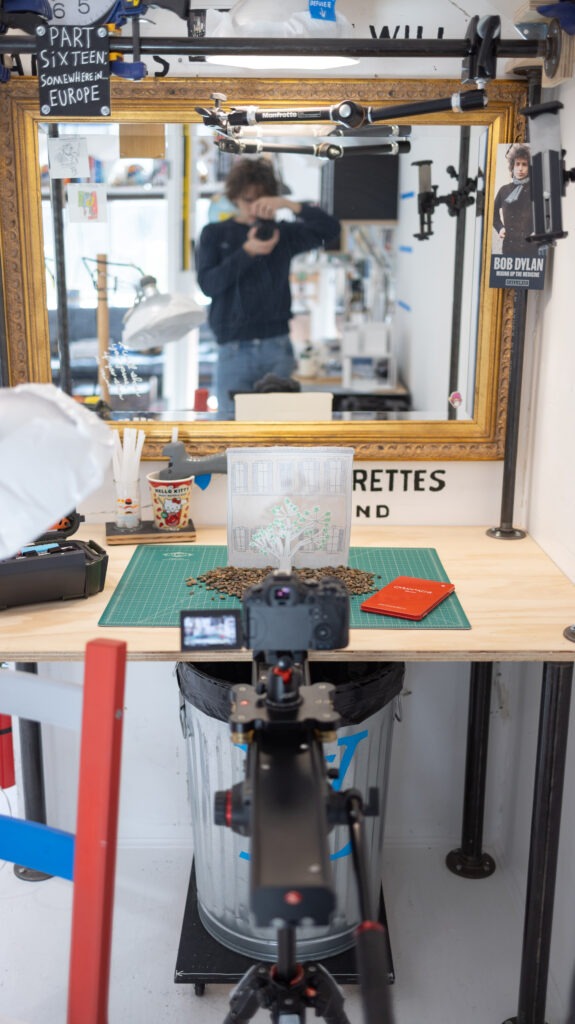
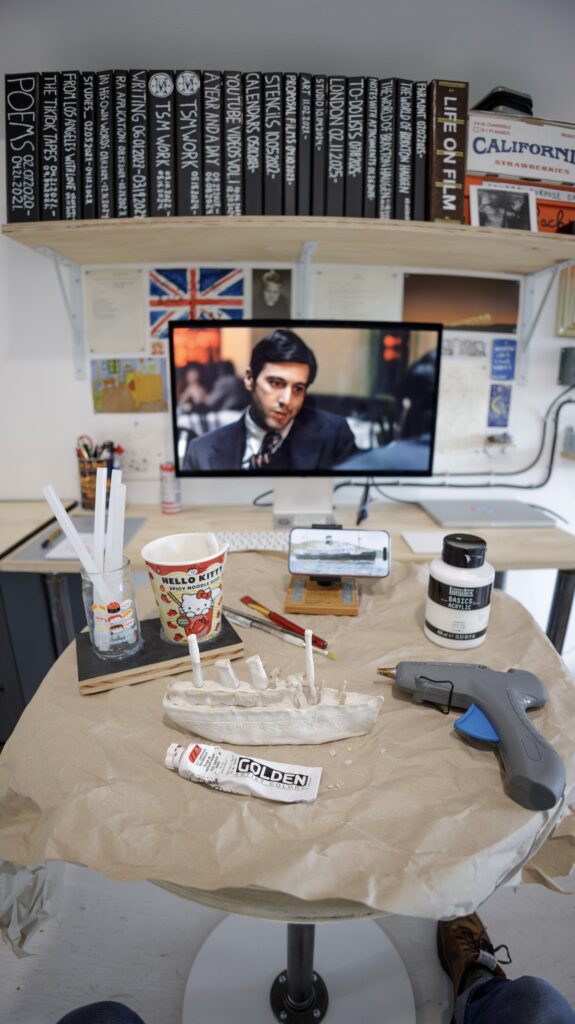
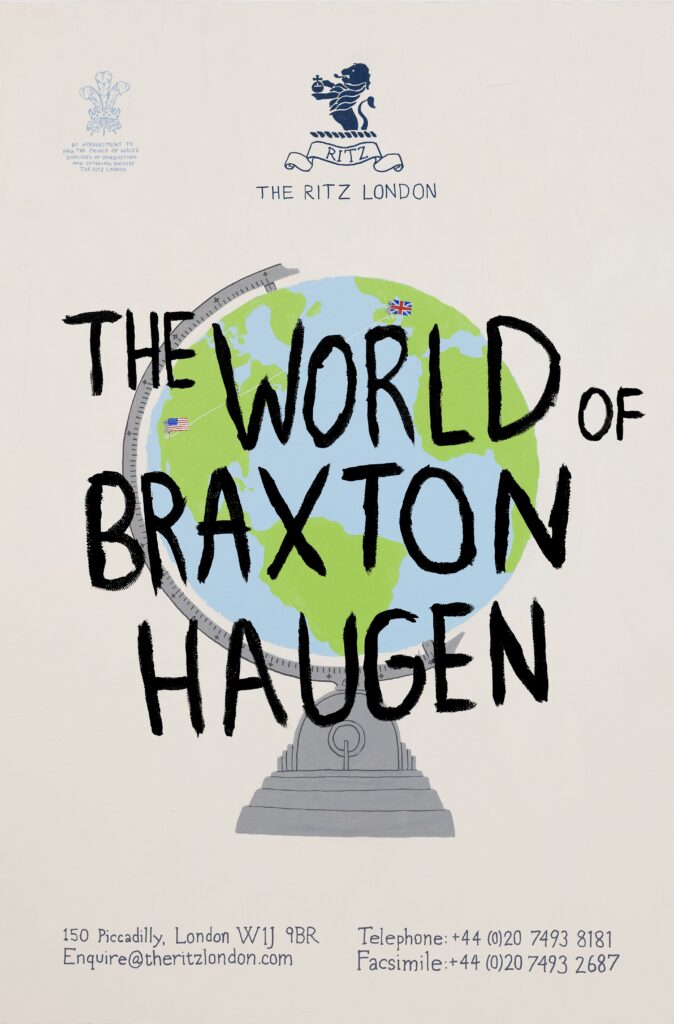
Let us go then, you and I, and enter the technicolour world of Braxton Haugen. It is rather easy to find his rabbit hole, and chances are you have stumbled across it before. Braxton’s niche corner of the internet that he inhabits is one of poetry, carefully made props, hotel stationery – asked very politely for at reception desks across the world – and curios, the music of the 1960s, and most importantly film. Taking the form of the artistic polymath for the 21st century, Braxton has dabbled and triumphed in art and film-making in its myriad forms, yet his colourful, twee, vibrantly personal series The World of Braxton Haugen has catapulted this filmmaker onto the cultural radar. It is with this world that we are reminded of what makes our own world so dear; the ability to hold things, the ability to personalise our spaces and the ability to be an individual. In a time of increasingly digitalised, uniformed existences, Haugen’s world embraces the tangible, the uniquely man made, and is an ever increasing reminder of the necessity for art and artists. Haugen’s world is a culmination of and testimony to all that he has learnt, seen, done and forayed in other years; it is the attention to detail of place, character and identity that has given us these glimpses inside a life as nourished with artistic endeavour as Haugen’s. Drawing on one of his many artistic inspirations when asked to introduce himself, “There’s that great Dylan line off ‘Farewell Angelina’ that goes, ‘call me any name you’d like, I will never deny it.’”, Haugen encapsulates his world and his artistic story in Dylan’s line. The World of Braxton Haugen is one of experiment, of trying a new name when called to and never denying the character you are working with, quirks and all. Fascinated by the world Braxton has carved out for himself, I spoke with Haugen to get to the core of his world, and discover what it could teach ours.
“There were ten years before the sun came up” on Braxton’s seemingly “overnight success” with the World mini-series, ten years during which longform film, feature films, poetry series and being suspended between Los Angeles and London all had to happen in order for Braxton’s world to finally reach us. The series started in June and quickly rose to reel prominence, but like the emergence of a new star in the sky, his light had always been there – it just took us time to receive it.
BH – World was initially a difficult project to get off the ground. […] I guess I was looking for something I could do that was of a smaller scale than the kind of work I’d done in the last year. I actually made three prototype episodes in January, but they were missing something. I wasn’t ready. Some of the ideas were there, or rather the seeds, but the execution was underdeveloped and lacked vision. I watched the rough cut of the first part and didn’t buy it. I ended up scraping that early version and put the entire project on the shelf.
In the meantime, I went back to London and kept myself busy with a couple of new writing projects. But I wasn’t especially happy with anything that was coming out on the page either. I guess somewhere in the back of my mind the idea of World had stuck around long enough that I began scribbling down little ideas for it while I was supposed to be writing. Around May I knew I had to make a decision about getting serious about a project. It felt like one of those fork-in-the-road moments. What I was writing then and the short films I imagined comprising World were very much two separate things and I knew I couldn’t do both, and I knew once I’d started on one sincerely that I wouldn’t want to change horses midstream. So I just said to myself: “World is going to be your next project, come hell or high water. You’re going to make these movies.”
It began as a way for me to document some of the people, places and things that were meaningful to me. I found the process challenging and rewarding enough that I’ve just kept making them. It was also the first project I’d ever received attention for right out of the gate. I’ve been publishing movies like these on the internet for almost ten years. I’d gotten used to people not really caring about me, so it was validating to see these movies connect so quickly with an audience. I’m incredibly grateful for that. But it took me showing up in the right place and in the right moment for that to happen. I guess I’d always resisted showing up in these places for one reason or another. But my girlfriend really encouraged me to think about sharing my movies on Instagram. So I started an account. At the time I posted the first part of my series, I don’t think I’d ever seen a Reel all the way through in my entire life other than the ones I was making for Van Neistat. So the whole thing was new to me. I think it gave the impression that I was some kind of overnight success, but of course there were ten years before the sun came up. That’s how the story goes.
However, World wasn’t the first time the phone screen had seen Haugen. Answering also to the call of ‘poet’, In His Own Words saw Haugen publish his poetry using film. The words are zany, there’s a frenetic strength of delivery and energy held in the lines, and a spontaneity worthy of the Beat Generation’s urgency of feeling. Filmmaking and poetry aren’t foreign entities, explains Haugen, but rather he “look[s] at it as the same dance, but with a different partner”. It’s all part of the same creative process, vision and world.
BH – I write, I paint, I make movies, I build sculptures, I take pictures – and when you put it like that, it can seem like these are separate mediums, but I choose to look at it all as more or less the same thing. I think it all comes from the same place. But film is my native medium. Even in my written work, I chose to visualise my manuscripts as opposed to binding them in a book. So in that way, filmmaking is at the core of my creative life.
The four written collections were initially born out of a dissatisfaction I felt with filmmaking at the time. It was 2020, I’d dropped out of university, I was living on my own I’d just come off making 50 short films in a row for my series The Home Movies. I was disappointed and disillusioned with the reception, the film festivals, the whole scene really. I just didn’t feel like there was much space left for me to grow. I’d become increasingly uncomfortable with the self-obsessed, attention-seeking spirit of the times and I think I was curious what my life would look like if it didn’t revolve around making movies. I needed to step away from everything for a while to figure out what it was I had to say next. I wanted to push myself as an artist.
So that was where my head was at going into COVID. It was a strange time. It was a strange time for everyone. I was pretty isolated for the lockdowns. I spent most of it reading. I became fixated with blues music, the Beat Generation, and the films of the French New Wave. I would read all day long and write through the night. Looking back, I don’t really know where all that energy was coming from. I felt this fire in me to learn as much as I could about the things I was interested in. I was hungry. I just soaked up everything I could get my hands on about the lives of writers, poets, painters, musicians and filmmakers. I saw myself in that whole bunch of people and figured I was going to need all the help I could get along the way. I was giving myself an education. I was doing a lot of writing just for the page, which is something I’d never really done up until that point; I’d always just written for the screen. That feeling of newness and the challenge that came with it sustained me for those collections. I feel like, in the end, I more or less said everything I had to say with them.
Writing is still at the cornerstone of how I work now, but it just takes on a different final form. What I am doing now has more in common with what I was writing when I was seventeen than what I was writing when I was twenty-two. I’m really proud of some of those stories. I read them today, and I don’t really know where a lot of them came from. I’m interested in eventually putting some of those years of experience writing prose and poetry towards a fictional screenplay. There are a few ideas that really excite me, but right now I’ve got my hands full as is.
It is not only Haugen’s hands that are full, but his past credits. Since turning to filmmaking as a child, Haugen has worked on personal projects aplenty, but has also collaborated with some of his greatest inspirations. Van Neistat’s The Spirited Man series was a reflective, poetic series, and gave Haugen the chance to work with a hero.
BH – Working with Neistat was the thrill of a lifetime. He was one of my formative influences growing up, and to be up close and personal with a hero was nothing short of a life-changing experience for me. Maybe life-affirming is a better word for it. It was the ultimate validation to work so closely with him for the last few years. It was like going into battle with an old samurai master. I learned a lot from Neistat, and I think he learned some from me too. We worked really well together. Even though there’s an entire generation between us, our approach to things really wasn’t dissimilar. It felt as if we both sort of came from the same place out of the earth. There was a shared language of our tastes and references that I think came as a surprise to both of us. When we met for the first time, I felt as if I’d known him all my life. I’ve never felt that way about anyone before or since.
Haugen’s experience on the eclectic set of The Spirited Man enriched his creative vision further. Neistat’s embrace of the tactile and tangible within his films and general life – he is a keen repairman and tinkerer – has revitalised an interest in the physical in an increasingly digital age. Impersonal consumerism, new apps set on making our lives vaguely better and a common acceptance that nothing is built to last anymore. Neistat and Haugen’s physical media revolution feeds into a wider desire to return to a time when the physical, the real and the held was top dog. Armed with a garrison of props, collections, prized possessions and curios, Haugen is an advocate for the handmade and handheld.
BH – The handmade ethos is a really important part of my filmmaking. It goes beyond just aesthetics for me. I think it’s a way of celebrating the human touch in the arts. Filmmaking can be such a magical and mysterious medium, and I am drawn to seeing just a little bit behind the curtain. It’s also an attitude as much as it is a technical kind of thing. It’s Springsteen choosing to put out Nebraska in the format he did. That record has got a sound and a quality to it that no amount of studio polish could possibly capture. I feel the hand of the artist in every one of those songs. It’s like seeing the brushstrokes of a master painter. It’s part of the composition. Nothing is concealed. It’s all right there in front of you, in all of its beauty and contradiction. I think in our time, with the age of artificial intelligence upon us, that’s the kind of humanity that should be at the centre of the arts.
His penchant for the handheld is not a mere quirk or flourish of artistry, but part of his success. Episode 4 of World saw Haugen reveal his hotel stationery collection. Keen observers of his work will have already noted the apparition of these headed sheets – with their monolithic crests and elegant typefaces – throughout Haugen’s work, acting as part of his utilisation of everyday objects to transform his vision into tangible art. The dissection of his stationery habits and rituals resulted in his videos being brought to prominence online, reminding us that there is still a fascination in the physical object despite the intrusion of the digital.
BH – It’s so funny to me that was the movie which really introduced people to the World. Hotel Stationery was the fourth part of this new series and very quickly took on a life of its own. I had no idea that many people would be interested in this thing I kind of thought was my own weird little hobby. The stationery community really came out for it, and God bless them for it. It was really cool to see the positive reception. There’s a comment on that video with something like four thousand likes by the designer who is working on the Hilton’s stationery redesign, and all kinds of people are chiming in with their suggestions and preferences. I think I responded that the best ones give plenty of room to write with the letterhead not eating into the page too much. I definitely prefer unlined stationery for drawings and a little extra paper weight is always appreciated. Oh, and absolutely under no circumstances is it acceptable to put social media icons on stationery. I think even a website link is pushing it, but we do live in the 21st century. Other than that I’m not too picky. Good typography, tasteful logos – I suppose just your basic tenets of good design.
Palpable visualisation is at the forefront of Haugen’s world, allowing the creation of a world for us on screen that is colourful, carefully curated, exudes personality and revolves around the tactile and the textural. For a dyslexic, like myself and Haugen, the visual becomes all the more important when articulation can be a stifling endeavour. When words frustrate but the nag to tell stories still persists, the visual and the tangible become all the more vital to artistic expression and conveying what words fail to reach. “As a little boy all I wanted to do was tell stories”, Haugen says, “I had a lively imagination, but it was restricted by my ability to read and write as fluently as my peers. I can remember I would get so worked up over not being able to spell that I would just start crying, and I’d get so upset that I would forget the story I wanted to tell. I had all these ideas and pictures in my head, and getting them out was a painful process”. A tumultuous relationship with reading and writing led to Haugen discovering filmmaking at a remarkably young age: “When I discovered that I could tell stories through the little movies I made in the backyard, it was like discovering a loophole. I suddenly didn’t feel stupid. I taught myself to edit when I was seven years old. I embraced those skills as some kind of superpower or something.” With a talent for vision and articulation, Haugen has refused to let his filmmaking be stopped, and wants his films to reflect the “humanity and truthfulness” that is at the heart of all his endeavours. Each film is not another chapter in a manifesto, but rather a search for the humanity and truthfulness that lies at the core of each of our worlds.
Haugen refuses to walk the road for humanity and truthfulness alone, and his scripts, poems and soundtracks all ring as an homage to the artists that shaped his artistry and individuality. An avid reader, his library is an eclectic menagerie of genre, perspective, time and thought.
EBP – You talk about living for stories and making a living from stories – what pieces of literature have inspired you the most, and what is it you look for within a story? What do you want your story to say about you?
BH – I guess the books that come to mind first are what I was reading during the pandemic. My library is really all over the place. Those early Hemingway novels, particularly A Farewell to Arms, really struck me. Edith Wharton’s beautifully written novel The Age of Innocence. I also really fell in love with poetry in that time. The Inferno and Paradise Lost. The Odyssey. Everything Rimbaud ever wrote. William Blake’s Songs of Innocence and Experience made a big impression on me. Ginsberg’s‘Howl’ and Kerouac’s Dharma Bums. Baldwin’s essays. I read all the big Dylan biographies. Patti Smith’s stunning memoir Just Kids. Those are a few that come to mind off the top of my head. I just picked up Patti’s new memoir Bread of Angels, and am really looking forward to reading that. Just Kids is probably the book I find myself recommending the most, especially to young artists. I think it’s maybe the most generous book I’ve ever read. What a gift she shared with the world in writing that book. It’s a masterpiece. I’m completely in awe of her artistry and her spirit. I’m not really sure I’m looking for anything specific from stories beyond some kind of truthfulness. But I certainly found what I was looking for in her writing.
In a world where individuality is increasingly obscured, where digitalisation is prioritised before human experience and truth is lost within a murky echo of voices, Haugen’s artistic vision strikes an urgently compelling, charming note within this chaotic symphony. Taking a chance on your vision and developing your own world to explore and share is what drove Haugen, and something he believes any artist should hold dear to their pursuit. Putting life and humanity back into the arts is essential, and acts as a rebellion against the noise of the art world. Life should be vast, vibrant and – most importantly – human.
BH – Read a lot. Watch a lot. Listen to different music. I hope I’ve mentioned enough in this conversation that there’s a reading list or a watchlist someone could pull out of this. Getting an education doesn’t mean going to school. I’m a dropout, and I care more about learning now than I ever did sitting in a classroom. I think that talent can only ever be as great as one’s curiosity. And in the beginning, your curiosity is the thing powering everything. I’d say travel. Fall in love. Take big risks. Do things that make you feel as if your life depends on it. When you’re scared or nervous, that means you’re growing. It means you care. If you want to be an artist or a writer or a filmmaker, don’t put ‘aspiring’ in front of it. Just be it. We live in a time where anyone reading this interview has what they need in their hands to tell great stories. So there’s no reason to diminish yourself by placing a label like that in front of what you want to be. These are vocations which consume your life. You’re going to need to learn to live with it sooner than later; you might as well give yourself the head start. Life is about becoming who you want to be. I don’t really like the connotation that once you make a film or get a paycheck for your art, that somehow that means you’re no longer aspiring, because great artists are always aspiring to something more. It’s a never-ending pursuit, and I think that’s the point. When you start thinking differently is when you’re going to get yourself into trouble.
Get out, make art, live and – most importantly – be as generous to your art and to others in order to make your world as human and vibrant as Braxton Haugen’s.
“Famed for her devotion to all that is most vapid and mindless in this world […] and her appalling taste in clothes” – Kingsley Amis
I am a thoroughbred republican. Gaudy displays of wealth, inherited titles, birthdays (of which they have more than the average poloi), and dogs seldom impress me. Faced with the prospect of another royal wedding, jubilee, or cause celebre I turn my back and grumble. Armed with my quip that they don’t actually contribute anything to our economy, I have come to loath anything that merely is touched by the royal hand, orientating their ordained seal of approvals into the category of the hopelessly unfashionable and tragedy of organised, mandated fun. In recent years it has become easier to hold this, what for some is, offensively ‘un-British’ opinion of our rulers as each line of succession has slowly snipped away at the ties that hold it in a place above the rest, forcing them to decline and fall to a cacophony of disgrace as clamorous as Handel’s ‘Zadok the Priest’. Where I falter, where the entertainment and pride that this family bestows upon the nation is finally realised by my red-blooded heart is in the ever-contentious Princess Margaret.
Margaret’s name is synonymous with the idea of being ‘spare’ – that provocative term that her great-nephew would coin into popularity many years later. Living in the shadow of her sister, Margaret was unable to escape the sphere of influence of centuries-old orders and rules about how a royal should behave. The more her sister performed her role as matriarch, the less influence Margaret had at court, slowly slipping down the ranks of succession and jobs. Given both the regiment of her life, and the lack of purpose given to her as an individual, her name became a by-word for royally bad behaviour. Late nights, excessive drinking, large bills from hairdressers, jewellers, and designers. She pioneered a great brat-ishness as opposed to a great Britishness, making herself well known in both tabloid and broadsheets with her wryly brutal comments and controversial love affairs. As she later said to avant-guard filmmaker and harbinger of pretension Jean Cocteau, “disobedience is my joy”. The pomp and circumstance of her position stifled her and, whilst it certainly gave her the grace and excuse of lofty privilege, ultimately left her with little shape to carve out her own public persona, unless she actively took a step against protocol. It is in this very quote, said to a French Surrealist no less (not the usual member of a royal audience), that makes Margot more than a spare; she understood what she, and in turn the monarchy could be: artistic, engaged, interesting beyond expectation, and ultimately colourfully characterful.
My disdain for the royal image often extends beyond the national, as I scorn their attempts to invade the personal privacy of my own phone with their out-of-touch, Cath-Kidston-meets-Barbour-inspired Instagram shoots that somehow always worm their way into my algorithms. This attempt to be ‘modern’ and ‘relatable’ misses the mark, royally. These people will never be ordinary; why pretend that they are like us? Modernity doesn’t mean engaging with us in forms that are new, but rather encapsulating a new age and the interests of a time, and knowing how to position yourself within this. The public persona of the royal family is a difficult PR stunt to execute, but only difficult if the authenticity is taken out of it. Growing up my nonno would recite the phrase “anche la Principessa Margherita mangia pollo con la dita (even the Princess Margaret eats chicken with her fingers) at any sly attempt to rise above our station as children; why though, with her name being a by-word for gaudy exuberance and privilege, is Margaret’s name invoked as a way to quieten children and for them to be humble in their actions? Margaret did nothing but show the public herself, who wasn’t afraid to get her fingers dirty in order to further her own cause of making herself look modern and engage with the contemporary society around her, refusing to be stuck in the lofty illusions and portences of being different to her subjects.
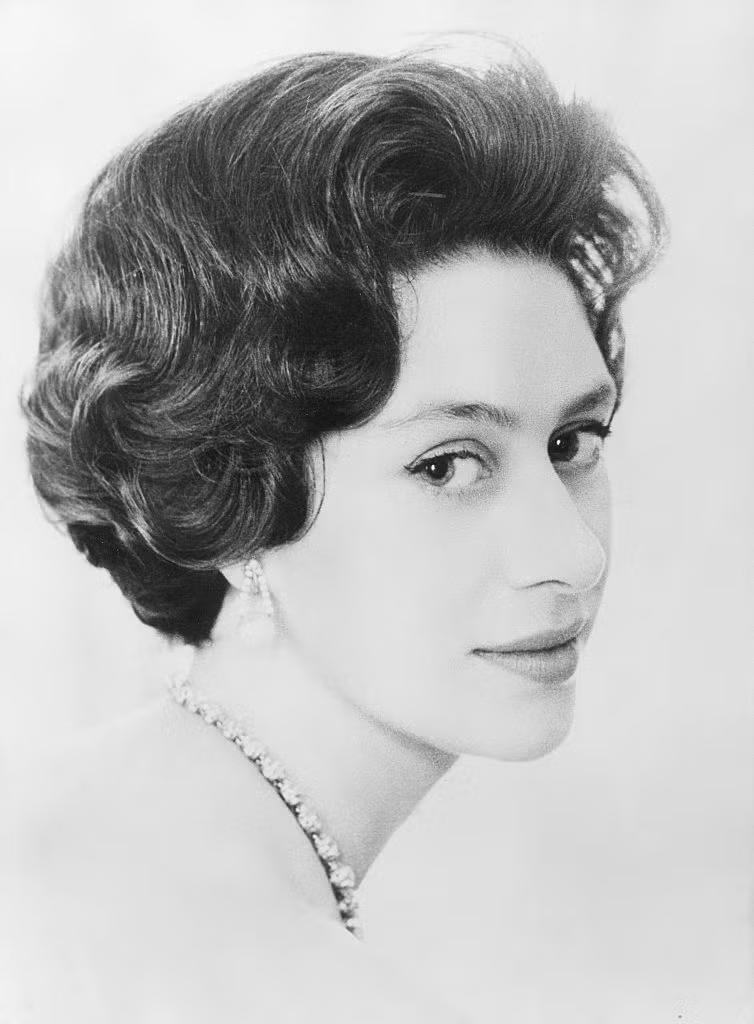
1959 Portrait of Princess Margaret by her future husband, Lord Snowdon (Anthony Armstrong Jones)
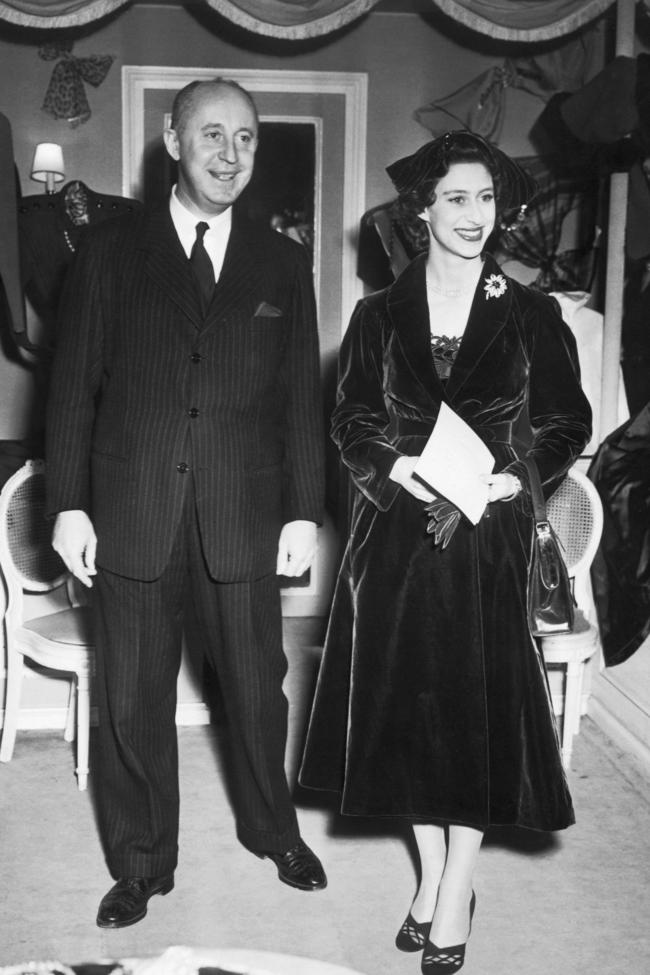
The eclipsing power of the royal family is another strike against their name in my books. Erring continually to the side of caution in a scrambled attempt to save their faces they pass round their hands and some well-briefed, sensible words of praise, shielding their real feelings with cliched sayings and sentiments, hoping the camera will stay focused on their extended hands and the label of their dress. With her fate sealed, Margaret realised no matter how she behaved her name would slowly climb down the list, eclipsed by each announcement of a new royal birth. Her entrance in society gave her the first instance of agency in curating her own look and name amongst the crowd of other majesties. She rose to this occasion in 1951 wearing a Christian Dior dress. She debuted her adult persona in the New Look, hoping to bring the principles of this new fashion in her time as princess; modern, a new shape that dismisses traditional expectation, feminine, cosmopolitan, active, sexual. This first slight, her first disobedience, gave her the joy that inspired her to later run off and create a new look for what a royal could be and could look like.
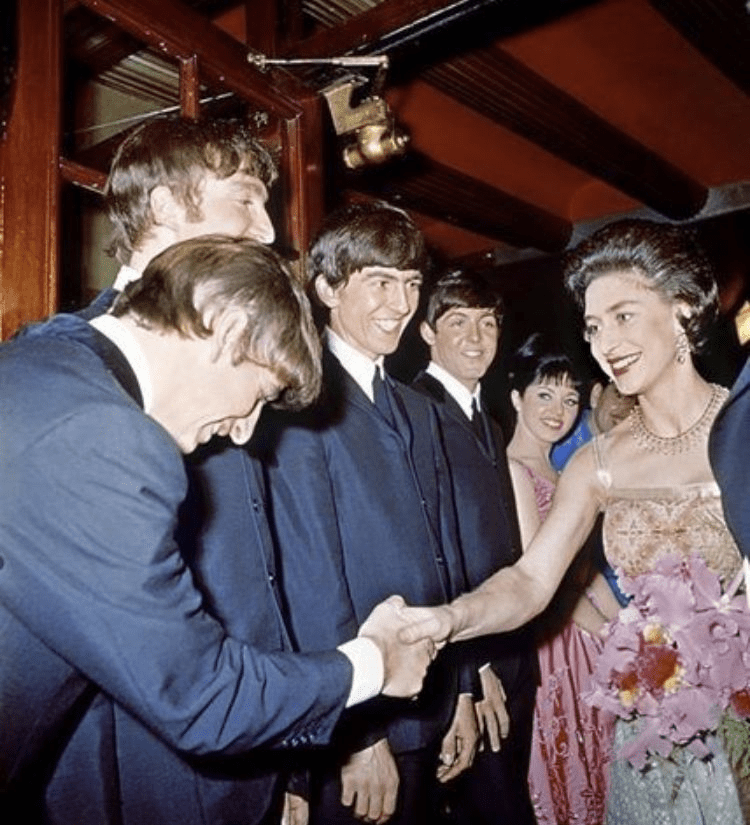
Cameras came to love her through her ability to strike against protocol. Tweed was swapped for silks. Shoulders were worn bare. Bright colours with bright patterns swayed against revealed legs. The tiaras and heavy metal seen around Margaret’s face were brought with her own money in auctions, suited to her own tastes, rid of the weight of inheritance. She drank with the Beatles. Ate with artists. Danced with Presidents. Wanting to be seen frequently besides what she loved, she positioned herself within the urbane interests of theatre, dance, music, and fashion. Whilst public tastes moved from the countryhouses of Wilde to the Salford kitchen sinks of Delaney, Margaret lavished recognition within the royal box of whatever play the theatre could offer her, regardless of traditional tastes and images. During dowager dinner parties, Margaret and Armstrong-Jones, her commoner husband (if you look past the private education, Society debutant mother, and Earl step-father), would create piles of pieces of torn bread, each nugget representing another cliche that had been passed around the table with the wine. Despondent to hackneyed sentiments, the President of the Royal Ballet and the patron of the newly built Brutalist National Theatre took the tabloids by storm in their fashionable silhouettes and sophisticated tastes, turning their backs to the traditional, country-centric interests of previous princesses, and embracing the lavish artistic explosion around them.
Margaret with the Beatles at the Premier of ‘Help!’ – 1965Margaret with Christian Dior (Bettmann Archive)
Rising from the hairdresser’s chair, as she so frequently did, Margaret goes to sign the cheque for her obedient servant. ‘Margaret’ appears on the dotted line. Simply ‘Margaret’. No HRH. No Princesses. No Windsor. The tragedy of the royal family, the reason I believe they grow to become so terrible or simply bland, is their lack of vocation. From the moment they are born they have one job to do and are told they can never want for another. This is what is desirable: waiting in line and shaking hands until it’s their time to wear the headgear. Instead of descending into ruin within this maddening, archaic environment, Margaret made her job ‘the Margaret job’, not the royal job. The unfairness (a boldly sympathetic word for a republican to use, I know) of such a dogmatic dynasty was exposed in Margaret’s youth, not just through her position as ‘spare’ but also in her unfortunate affair with Group Captain Townsend. Living in her sister’s shadow and orbit, governed by the cruel spinster of centuries-old royal protocols and Acts, Margaret refused to throw a silver spoon out of her mouth and complain, but played by her own rules, being simply Margaret, not just a pawn or a rebel. By fashioning herself as a cut different to the rest, she built a persona of modernity and hedonism that suited her. Her push and pull of the rules that governed her life allowed her to both uphold her position and tear down the farce of pomp and circumstance. Craig Brown’s wickedly witty biography on the Princesses is aptly subtitled ‘99 glimpses of Princess Margaret’, because the princess only gave us peeks of the life she lead. Her dazzling provocative exchanges with the public eye fashioned her as a sight of modernity and difference, often obscuring her declining place within her own family and the difficulties of protocol.
Whilst Margaret certainly had a privileged life (to say the least), and neither desired to be nor was considered ordinary, she dismissed the idea of being of a different cut to the people around her. As the Elizabethan age came into definition, Margaret learned to change with the times and aim towards modernity in building a persona that she could comfortably recognise as herself. She didn’t pretend to be anything she was not; she didn’t want to relate to us, to appear to us in a football scarf for a team she would have no relation to, or to say some shallow remarks about a cause she had been told to care about. She didn’t try to be liked by all, as she knew that was impossible, in the same way she knew her job of being the perfect princess was also impossible. She gave us Margaret, not a Princess. She was self-affacing and affected, yes, undeniably, and at times she was stuck up and rude. At other glimpses she was bohemian and cultured; in the next instance she could be lost in a sea of organised celebration maintaining her royal name. However, in all these sightings, in person, press, or in piercing rumours, she was always Margaret. Not the Princess of York, or the Countess of Snowdon, or Her Royal Highness Princess Margaret Rose, just Margaret, acting in her own interests with her own agency, wherever possible.
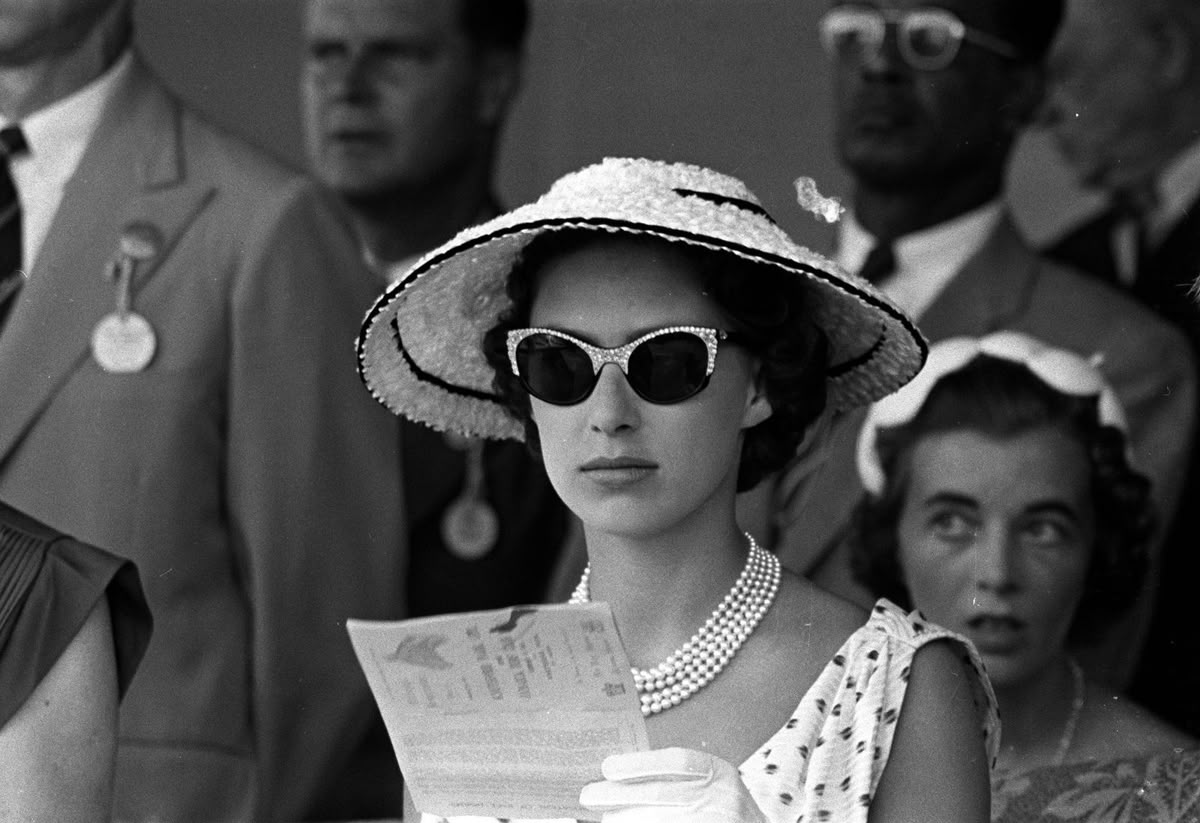
Featured Image: Margot in Kingston, Jamaica at the races, 1955 / Popperfoto
‘It wasn’t for long, I wasn’t there long. But drinking bitter black coffee I catch that medicinal smell in a cloud of ancient tobacco and something touches me in that still place and a wound from two years ago opens like a cadaver and a long-buried shame roars its foul decaying grief.’ – 4:48 Psychosis
House lights on. Audience, now visible, is made of a wash of parents, siblings, and supportive peers. Five teenage girls blink up as the lights turn on. There is mascara running down their face. Their hair is knotted, tangled, and shines against the lanterns. Ribbons surround them. Small little ribbons litter the stage, peeping out in gaps where they dared to tread. Long red ribbons slink and slack around the girls’ arms, crawling up their wrists and following them like a veil. No one claps. No one smiles. The girls are out of breath, cautiously grinning at each other, unable to speak until the examiner dismisses them. Still, no one claps. They rise, bow, and begin to clear the stage. Still, no one claps. These spectators have just watched somebody kill themselves for 45 minutes. Can their clapping augment the pain? Can their proud smiles for their daughters exist against the ferocity of violence and the macabre they have been subjected to in their slightly too small classroom chairs? Was it a play even? It was the vast violent living of Sarah Kane.
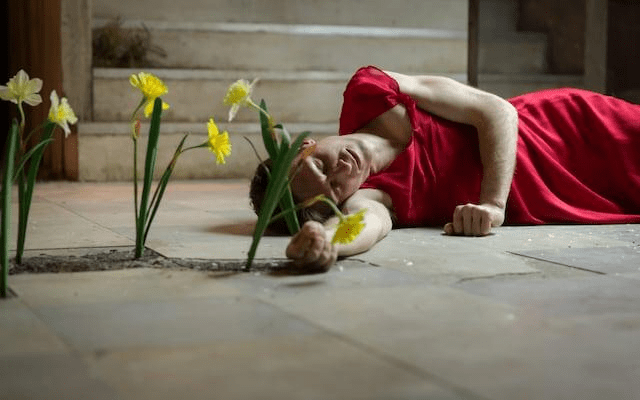
Sarah Kane lived in the shadow of a decade that pickled sheep for art, pumped music out of factories, and prescribed an incessant need to be ‘Cool’ to combat a Britain that lay bare, devoid of iron. Her short career spun across the 90s, beginning with the Balkan Wars and ending with a cri de coeur of disillusionment and defeat. Her stages gorge and delight in all consuming actual violence and self-violence. Blasted transforms a Leeds hotel room into the epicentre of brutality and manufactured human violence, where an eyeless journalist and a soldier violently mourn one another, attempting to carve survival out of an obliterated, wretched reality. Boards are trodden with obscene language, an unhinged sexuality, and bloodshed that appears unflinchingly before the audience’s eyes. Equally, flowers ‘burst upwards, their yellow covering the entire stage’ that was once filled with blood; daffodils blossom from Cleansed’s arena of furious passion. Love exists with violence; disgust resides in the belly of beauty. To experience the vast violent living is to experience, to bear witness, to learn to stomach and scream at all the frightening dualities Kane caught within her stage.
Cleansed – credit the National Theatre
Roland Barthes’ A Lovers Discourse is the key that unlocks the maddening world of Sarah Kane. ‘Amorous seduction (a pure hypnotic moment) takes place before discourse and behind the proscenium of consciousness: the amorous “event” is of a hieratic order: it is my own local legend, my little sacred history that I declaim to myself, and this declamation of a fait accompli is the lover’s discourse.’. The discourse Kane flings on stage is personal, a ‘sacred history’ of both self and society that exists both within language and action. Love exists not behind rehearsed lines and revised scripts, but in a fraught mentality catapulted on stage that examines all the crevices of consciousness that define love’s existence. Barthes furthers Kane’s manifesto by celebrating the theatre for being a place in which extremes can live, where the consciousness of love and life can be understood in its capacity for juxtaposition. Beauty, horror, violence, adoration, sex, lies, truth – all exist layered on top of one another, crashing together, muddling and catastrophising our world view. In one instance the stage is a funeral pyre, in the next instance it is transformed into a wedding.
The glaring surface of Kane’s work is cruel and provocative. It dares to be disliked. After leaving Blasted’s Press Night, critics called it a ‘feast of filth’ and ‘devoid of intellectual and artistic merit’ due to its obscene portrayals of human suffering and longing. Kane is still stained by this, even today. She is ‘tricky’ to put on, and people question whether an audience would even consent and pay to watch something so dark in a place of entertainment. However, this is not the full picture. The shock of the violence is a stinging reminder of the pain that comes with living; that living can be strained and fraught with peril, and yet there exists a capacity for a hopeful growth within the bleak depths of humanity. That flowers can grow again. That a scene of abject horror can change into one of comedy. That love will always exist, in its mysterious and desperate ways, amongst the fall out. Kane both wrote and experienced suffering, yet also loved, vibrantly and violently. She danced to Joy Division – an action that cements the duality of her works; songs of deep darkness from a band named after a grotesque Nazi operation, changed utterly by the action in ‘pure hypnotic moment[s]’, holding both woe and wonder within that instance.
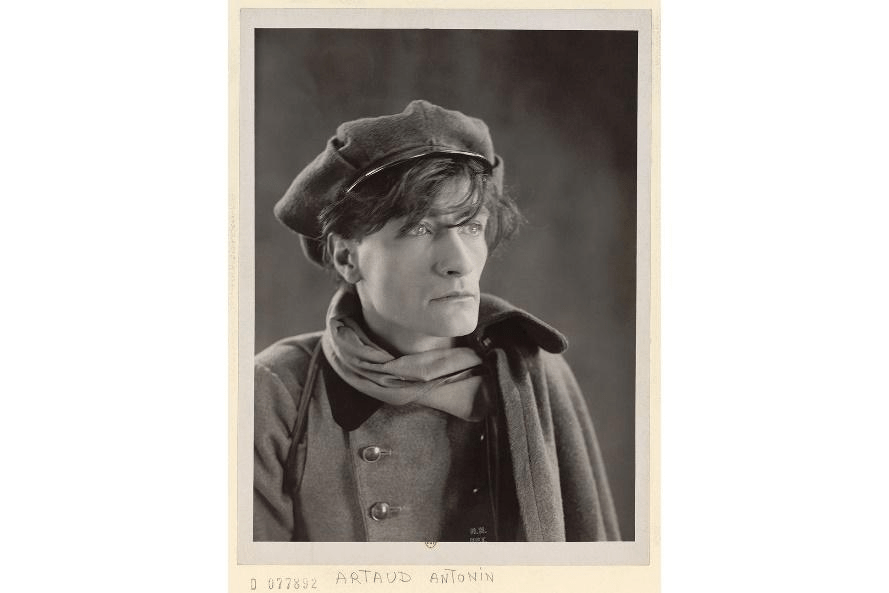
The battle of locating ‘artistic merit’ within violence was not instigated by Kane. The trenches ran deep in the popular consciousness of how art should be. ‘Father of Cruelty’ Antonin Artaud wanted theatre to induce ‘very violent reactions’, leaving the audience with ‘no misunderstanding’ that going to the theatre was not simply a pastime for melodramatic entertainment, but a spectacle to encapsulate human resilience and variety. His manifesto, The Theatre and Its Double, holds true to Kane’s desire for the full force of life to be displayed, to have Barthes’ instantaneousness of love play to effect; for every feeling, action or thought there is an equally fierce opposite, its double. For Artaud, as for Kane living in the grey waters of post-Thatcherism, ‘our sensibility has reached the point where we surely need theatre that wakes up heart and nerves’. Classical ideas of catharsis were reinstalled, where breaking point and release had to be met by both actor and audience alike: a communal epiphany and energy beating back against the ordinary.
100 years prior to Artaud, Percy Shelley’s The Cenci caused equally shocking waves amongst theatre goers. Banned and brutalised for the play’s demand for the audience to witness the relentless abuse of the real Beatrice Cenci of Rome, the murder of a patriarch, and the godless, lawless abandon of his house. The secular venom in which Shelley approached his radical theatrics caused the play to be censored, never performed in his lifetime. The rebellion within both Shelley’s original material and Artaud’s Cruel interpretation of The Cenci force a new perspective, capturing the full capacity of human extremities, asking audiences to not fear the abhorrent but to stare it in the face. Kane’s plays act as a late 20th century renewal of these demands. Her violence is not without reason, and her manifesto lies within a radical tradition of redefining theatre in the quest for accurate realism.
Artaud – 1926
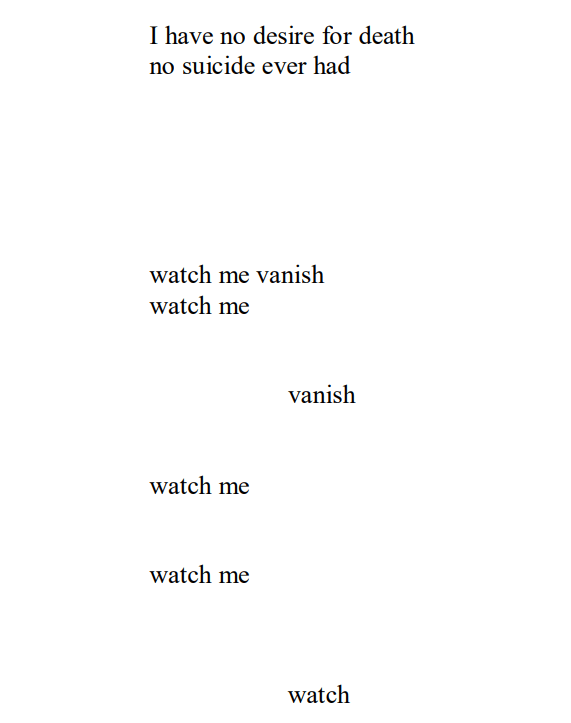
The cruelty Kane inflicts is not baseless. It is a mission to find the double, the duality, the full picture of life. Her final, posthumous play cements this mission. The interpretation of 4:48Psychosis as a performed suicide note helps soften the blow, diverts the attention from the screaming pain and wrongdoing that lies within its core; it is a play about misunderstanding. Kane’s theatre continues to be misunderstood, and upon her own suicide in 1999 her work still brayed on her mind, her critics unable to decipher her poetry. Her own suicide has come to be misunderstood, as her staged suicide did. 4:48 comes from a writer, and centres its ambition in a place beyond tears, in a place away from sentimentality and sensibility. The poetics of mental decline hold the audience hostage. The tragedy is unrefined and unapologetic in its brutality. 4:48 pivots on the inability for true feelings to be communicated, with no designated speaker or roles, and is at once confessional and deeply private. Stifled conversations, the inability to decipher reality within the pain of mental anguish – nothing on Kane’s stage is sacred or secure. The realities of living with severe mental anguish are documented, as a speaker cries ‘my life is caught in a web of reason spun by a doctor to augment the sane’; suffering is misunderstood in order to be palatable to those without pain. In order to attempt to reason the unreasonable, it is only through achieving a true, cruel, Artaudian realism on stage that the misunderstanding of Kane’s reality can be understood. By unrelenting in the tragedy, Kane exposes a realism to the audience that is not a pretty or entertaining reality, but a harsh one. Yet one that is not pure violence and tragedy but showcases the abundance of life even under the strain of tragedy; 4:48 is the moment in which laughter, love, sorrow, loss, anger, and desperation co-exist in a gaudy explosion of life at the edge of death.
The last page of script for Kane’s 4:48 Psychosis – 2000
Kane’s dramatic manifesto demands you to ‘watch me’, to endure and experience all volumes of life. By turning away from the violence we forget about its unfortunate reality, and we demand that art must engage in only certain forms and demerit the poetry of the darker shades of living. Kane did not intend for people to enjoy her plays, but to be moved by them. Whether 4:48 is met with the stunned silence of concerned parents, or the stage becomes a flower bed of praise, it doesn’t matter. The lamentable, the obscene, the catastrophic is the concern of Kane’s punching poetics, and her need for radicalism, for discomfort, for upset helps theatre achieve its full capacity of realism, even in its strangest stagings. The shockwaves from her performances will always ring out, cringing upon audience and critic alike, her formidable ideas still causing contention. But when the flowers rise from the boards, when blood spills across the audience, when moments of vulnerability are documented with force, Kane shows the realest truth of all in her theatre; that life, love, and passion have never been so violently fragile, obliterating and launching at once.
Featured Image: Marianne Thiel / Getty Images, 1998
When the moon slivers right in silver, and the cloud crowd around, expect to see the silhouette etch its away on the window. The gas hue of the lamp dances around the curtains, flirting with the supersonic glow of the TV. Mugs jingle. A smile creeps out. Rows of books, obscured by trinkets, memories, and the private and confidential. And all of this transmutes from your night-in by the fire side, to the kick inside of the footsteps, that stop momentarily, tying a shoe or checking their phone?, and feed off that light. The eyes that widen and feast whilst hands remain in pockets and lips blister in the chill, take the tableau in delight. You are being watched. Let us feast on your existence.
Inventory taken of your surface existence, let’s turn those eyes up, give them a real wedding breakfast. If those eyes were to take their shoes off by the door, weerily sigh as the keys clatter in the dish, and yawn and stretch towards the kettle, where do you expect them to go? A quick rummage through the notes on the fridge, a glance at the calendar, a poke through the medicine cabinet. But you curated your quarters so well, and wouldn’t you rather they dine on the print you choose to hang just there, or even at the way you placed the fruit in the bowl. How could these eyes be so cutting, so searching for clues in an investigation only Kafka could decipher, rifle through your home, your heart, your legacy of objects. Why, they delight in this seeing the mudnade objectivity of your existence, how perverse! But I gave you things to look at, some entertainment here and there, why must you devour all of me now – slurping the last drops of the tea from the pot like that gruesome teatime tiger expecting to be satiated from the stewed embers. Please, dear eyes, leave. Bolt the door behind you, and please, don’t come back here, just look at the way the window sill changes for you, and be content with that.
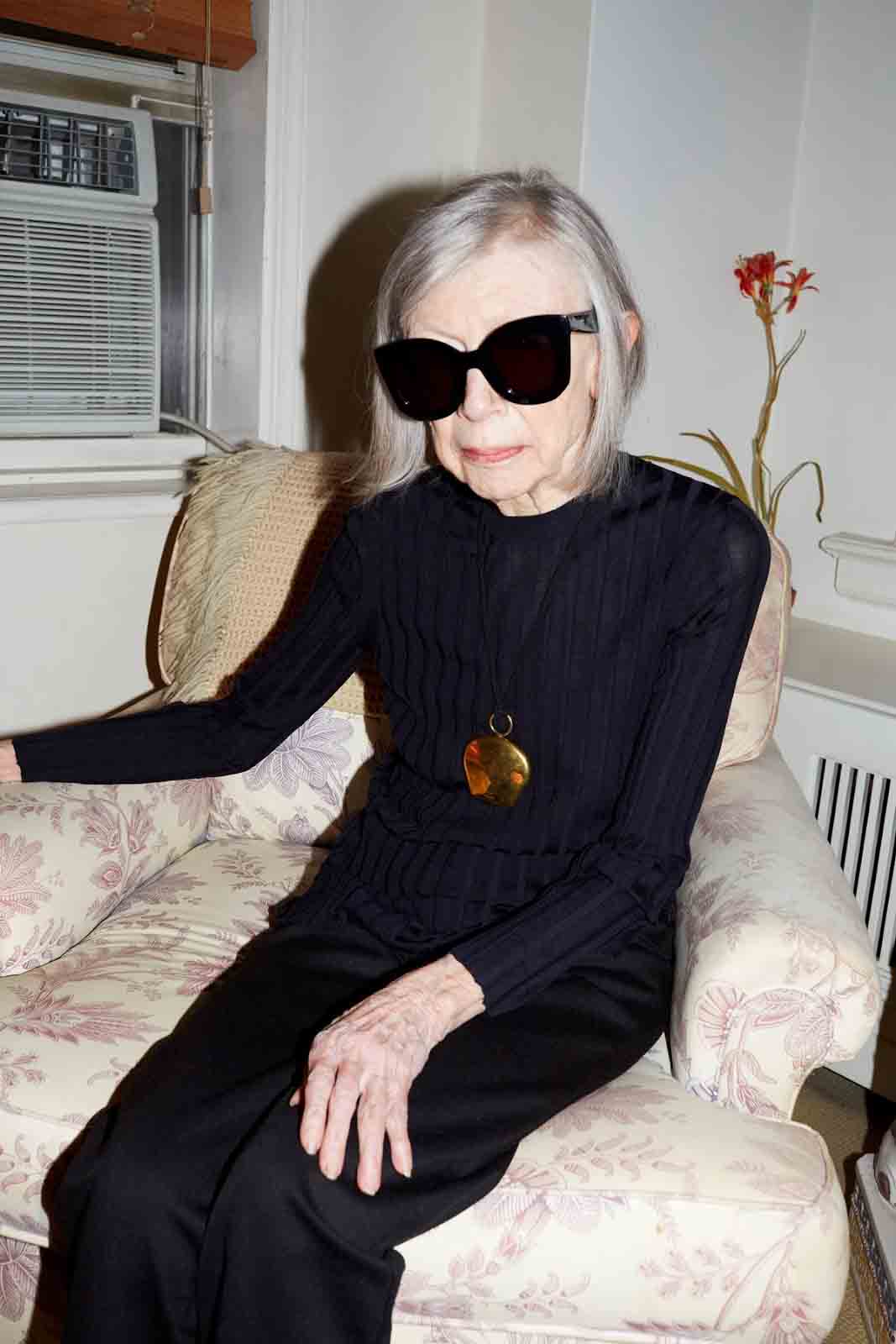
5th of February, 2025. My 21st birthday. And what better present, for a girl like me, to receive the news that Joan Didion’s therapy notes could soon belong to me. Isn’t this the news we have all wanted since her death? Finally, a chance to take stock of this brilliant mind, to really understand her. The literary community yelped.
Joan Didion is one of the US’s most defining writers. With needle-like precision she dissected America’s later 20th century. Her unrelenting commitment to journalism has rendered her with a wry, poignant voice, even its novelistic utterances. However, whilst she captured the world around her in her words, preserving the cultural offshoots and fascinations of America for us to gawk and examine like limbs in formaldehyde, Didion never quite captured herself. Her essays and articles harbour an essence, fleeting and distinct; like a stranger’s perfume as they walk past, we know it’s there but what is it, and where did it come from? From the Sharon Tate murders to the LSD shrouded Haight-Ashbury district, we locate a vision of Didion from the cultural landmarks she fashions herself around. This highly curated double-exposure of both author and object has enshrined Didion as the defining figure of a generation and that ‘California belongs to Didion’ without actually revealing the intricacies of being the woman who keenly observed the West Coast zeitgeist .
Did Didion pre-empt the sudden urge we would have to dissect, to own, that voice presented to us, thus her careful consideration of what she wanted us to know. She was a keen follower of Hemmingway, learning to structure sentences to the same acute precion by laboriously studying the very syntax and rhythm of them and synthesising this with her own literary vision. Everything she did was careful, precise, and exactly how she wanted to say it. Therefore, to leave something out in Didion world is not merely forgetfulness, or not being able to work it in, or being embarrassed, but a clear message about what she does and does not want us to see. Noli me tangere, for Didion’s I am. Her two most autobiographical works, My Year of Magical Thinking and Blue Nights, continue to approximate Didion in relation to what is around her. As her world becomes swallowed by the shock of her husband’s sudden death, the continual murmuring anxiety of her daughter’s life and upbringing, the beeping of heart monitors, the gare of x-ray prints, the calendar squares with the sames of different hospitals and departments, we see Didion reconfigure her world on these terms, showing us her life in the truest forms, unsensational and unsympathetic.
The word raw enjoys being thrown around the confessional, personal writing scene. This piece was raw as when I cut into it all that came out were tears, and blood, and guts, and juice. Maybe Didion saw that the rawest piece is the one that submits to be cut into and exposes a fleshy marbling, the blood shocked still in the veins. This craving for the ‘raw’ – the supposed real – voice behind the author has led to the letters and diaries of most of the canon to be available. Reading another’s diary no longer feels like sneaking about into another’s bedroom, searching under the bed, the dresser, the piles of clothes, and cracking the code, but a right we expect to receive; why write and not publish it for us, your peanut crunching crowd. The harrowing entries of the Plath journals show one of the fiercest writers of the 20th century at her most fragile. She speaks of an immeasurable, unrelenting pain, that she attempted to make sense of through her nightly writing campaigns to her ferocious psyche. The readiness we are to access them leaves a sour taste in the mouth, as we realise the perverse voyeurism on display as we are delivered an author’s life on a slab.
I am by no means a literary critic, no less one who believes in the autonomy of the text and the death of the author. Life informs art, afterall. But, when reading Plath’s diaries do I really get a better sense of the pain trapped between her lines? Does knowing that Woolf ate an egg or some beef or a trifle on the same day she began to pen Orlando help us unlock the text? Probably not… The ownership of the diary is a grab to owning the author; we hold their lives in our hands and scrutinise the mundane details they flourish poetically attempting to figure them out. Didion was a mother and wife as well as the writer and icon that emerges in her writings. Her careful curation of self to ensure her other selves only appeared under her watch, her direction, her discretion, was an attempt to assert herself as a public writer with an enchanting capability to fascinate and entertain with her pen, not a public figure whose life fascinates us. The intimacy of Notes to John goes against the constructed self that Didion intended.
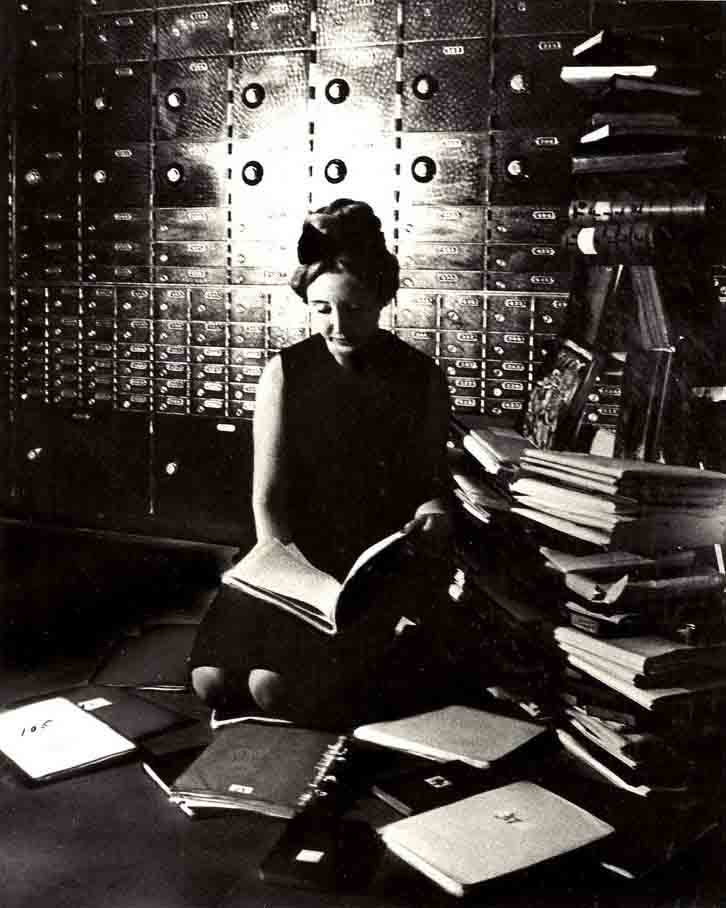
Anais Nin, storing her diaries in a bank vault (supposedly). The holy relic of the author’s diary is pestered by prying eyes.
A honey prickled voice rolls through the chambers of my Koss portaPros during an anticipatory Spring walk in Durham. The Spotify algorithm has decided that me, right here, right now, is the perfect audience for such a tender serenade. ‘Grace Elizabeth Harvey – Familiar’ flashes back up at me. The chords and charmingly brutal lyrics, in spite of the optimism of Harvey’s voice, recall etching memories of syrupy mornings, sunlight slipping in and out of curtains, after some bleary eyed sleepover of youth, singing whilst waiting for pancakes. This a truly trancentry, transportive experience, against the Medieval, faith woven paths of Harvey’s alma mater The gentle intimacy of Harvey’s sound is profound, and is apparent within her new single ‘Lullaby for Wasted Time’ (out 4th of April).
Harvey’s delicate sound is informed by a frenzy of folk artists. The rolling, dreamy guitar resonates and hums with the haze of Nick Drake. The somber dewyness of Leonard Cohen drips against the delicately placed cello and gossamer lyrism. A communion of folk is created by Harvey, staying devoted to her folk roots. Her upcoming tour and EP, ‘Other Faith’ ( 9th of May), is a passage through faith’s many formed manifestations; Harvey’s own faith clearly lies within the grooves of folk LPs. Faith appears as a confusing gauze, fragile when untangling, trapping in its covetousness. Yet, the apparitional iterations of Harvey’s music enchantingly unravel the holy, melancholic, and loving underpinnings of faith. The push and pull of faith, and faithlessness, moves Harvey’s music into crushing crocendos, and gentle frolics.
Adrianne Lenker, a fountain of inspiration for Harvey and the 21st century’s brand of folk, has a conjuring quality about her. Her presence and the ability to melt the world around her, and Big Thief, during performance, possesses a transient magic that illuminates her moody ethereality further. This 21st century iteration of folk, one that is moodier and bolder in its whimsy, has clearly been captured by Harvey, with her new single, ‘Lullaby for Wasted Time’. A beautifully damning lyricism, with crushing dejection, the sentimentality and abandon run clear. The chords brim and bubble with honesty, meandering, brooklike, into a captivating haze.
The suspension held in the musicality of Grace Elizabeth Harvey’s song is dazzling. Precious, personal, and relentlessly poetic. The subtle power that spurs Harvey’s creativity relinquishes faith in folks’ new form. So, whether meandering down carpeted avenues sun blinded, or rain shafted, curled up in the intimacy of a morning cup of tea, or simply blessed with a voraciousness for new gems within the music scene, Grace Elizabeth Harvey’s gold-spun rhymes will transport you to a personal poetic elysium.
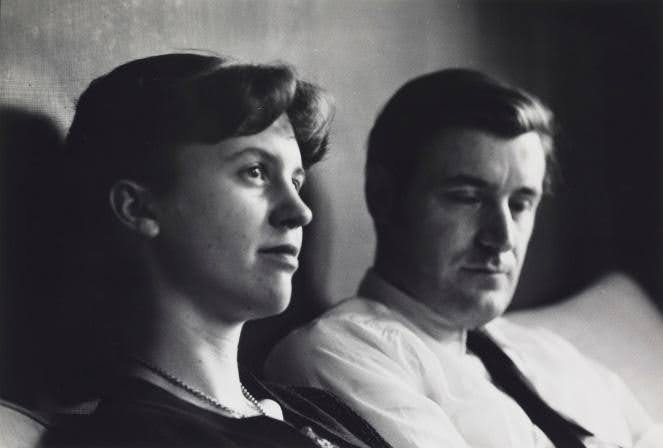
Image Credit: The National Portrait Gallery, Sylvia Plath; Ted Hughes by Rollie McKenna
By Emilia Brookfield-Pertusini
I shut my eyes and all the world drops dead; I lift my lids and all is born again. (I think I made you up inside my head.)
– Sylvia Plath, Mad Girl’s Love Song
On this day, in 1963, during the coldest winter in living memory, a woman died. Her name was Sylvia Plath.
So, there she is, the American genius, sent to Cambridge on the promise of extraordinary, who by the age of 30 would change English poetry for a damnable good. Boyfriends numerous, looks renowned, tongue sharp. She is Miss America – coming to our shores to dazzle us out of post-war grey prose, and into the neon lexicon of exceptionalism. A double exposure of both catastrophe and creative flair. A bright tragedy, burning brighter, brightest now. Shadowed now, by the 1980’s answer to poet laureateship, and a gas oven.
This is not a piece of anti-Hughes venom. This is not a piece of excuses and blame. This is a piece against sensation. This is not a fairytale. There is no winner, no villain, no dastardly plot; this is vast, violent living. A prose we can only hope to grasp, with each word holding a negative side, a double exposure of intention and sight. Words left unsaid. Double Exposure, diaries, drafts burnt. This is the reality of a tragedy; we now live in the fallout. The world is utterly changed by this, yes, but this is not a world ending story. This is life in its most phenomenal form.
It would be naïve of me to say that Plath’s marriage was complicated. It would be more naïve of me to say that it was brilliant. From the moment of its inception, on the 25th of February 1956, in a smoky poetry-infused evening, a terrible beauty was born. Plath bites Hughes cheek, much to the dismay of Shirley, Ted’s girlfriend of the time, whilst Hughes steals Plath’s earrings. This was Hughes’ launch for his Saint Botolph’s Review, a stab in the dark for an emerging poet in an upstairs room in Cambridge that would change the course of poetry forever. Even their passionate meeting, a fatal poetry; the apple-cheeked bite that damned the soul, thwarting the fate of man. An explosive longing and ruinous sentencing, at once. It is easy to see why the pair came together with such intensity. The pair would later marry on ‘Bloomsday’ adding further fuel to the fire of their literary perfection. Two poets, both alike in dignity, matched their courage, and embarked on a love that violently bit away for decades to come. With such intensity steeped and stewed in literary coincidence and allusion it is easy to glamourise, pine, attack, and mythologise the events that surrounded this pairing. The myth that has surrounded a marriage, a union simply brought on by bureaucratic necessities, has terrorised the literary scene since, dividing and demonstrating the passionate love begot from Plath’s prose within its captivated readers.
To read The Bell Jar for the first time, as I did like every other lonesome 13 year old girl, is to bear the burden of a beating prose. Plath’s poetry refuses to retire when in novelistic form, each sentence upholding a thumping march towards utter depraved bleakness. ‘I am, I am, I am’ becomes not only the echo of a worn out heart, but the attitude we take on when immersing ourselves into the dazzlingly twisted light of Plath. We become Esther, we take those miseries to heart, each assertion against an unjust, wretched world clarifying our own world view. We all have a fig tree growing in our heads, whose branches have always been braying against each battled decision we must take. To be met then, aged 14, with Ted Hughes’ seismic war poem Bayonet Charge, so vastly different yet equally enrapturing as Plath’s own war of words, in my GCSE classroom and the chaotic contextual notes that come with it, shattering. The Plath I had found solace in, who’s writing resonated in such an extraordinary echoing concert of nuances, had been with him? The magical meeting I have just described is destroyed by such a crushing piece of sensation. The literary clad love is stripped and moulded into a story of abuse and blame, furthering the dramatisation of Plath’s life. The monolithic marriage glossing over the exposures that lie beneath, glossing over Sylvia herself.
Teenage loyalty follows Plath, even in her non-teenage followers. Her mythic haunting of the canon has tormented her legacy within both pop culture, Hughes’ life, and the literary scene. The fascination with the Hughes/Plath union has spiralled into a morbid mutilation of itself, with stubborn opinions shadowing the past. The understated and overlooked element of their relationship, what to me is the Rosetta stone that unlocks the intensity of both their marriage and poetry, is their closeness. Apart from Sylvia’s Michaelmas term in 1956, when they lived apart in fear of the Newnham College seniorities, they often didn’t spend more than half a day away from each other, living during the climaxes of their marriage on the road across America together, or in a secluded part of Devon. Their writing is in constant conversation with each other – each partner lurking in the lines of the other’s, and often they were in conversation with each other whilst writing, editing and guiding each other.
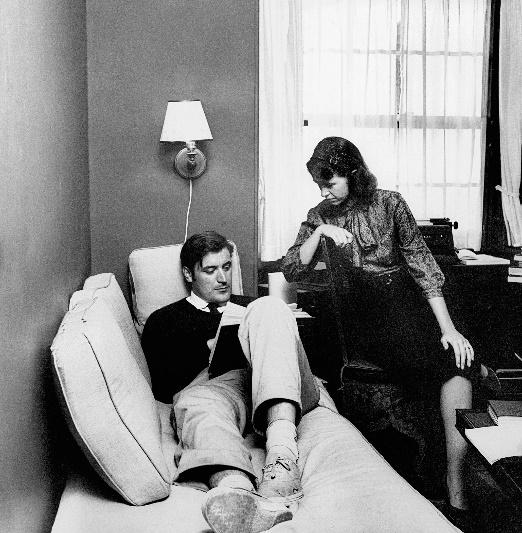
Image courtesy of James Coyne, 1958
‘Oh, he is here; my black marauder; oh hungry hungry. I am so hungry for a big smashing creative burgeoning burdened love: I am here; I wait; and he plays on the banks of the river Cam like a casual faun’ – Plath, Unabridged Diaries, March 10th 1956
Even in its all-consuming poetic brilliance, the poetic candour of this relationship is embellished. The ‘Bloomsday’ ceremony, a coincidence. The biting encounter, a drunken flurry. Plath’s perspective on the pairing, even in the private confines of her rigorous kept journal, is ever poetic. Nothing is casual coincidence. From Plath’s private notes on Hughes, throughout their relationship, we see her use her life and mind as a way to explore the poetic boundaries of her confessional style. Her life is her muse, yet, like all muses, it was the way in which she captured it that cemented it as a grand, glowing, myth, not the object itself. Their married life was fairly ordinary. There were holidays, work parties, and hobbies taken up in harmony. Household business went unorganised and mounted. Worries about money came and went. The marriage failed, as marriages do. People betrayed promises, as people do. They shared a closeness that couldn’t be contained in the boundaries of the ordinary marriage they attempted construct. It is a sad story, made sadder by Hughes’ attempts to reach Plath during her final days, but this is not an extraordinary story. It is a marriage mythologised and a life absorbed.
Reduced to a moment of unimaginable pain, her words misconstrued, the marriage’s pain magnified; she is yet to exist as just Sylvia. She has become a teen idol – appearing in Lana del Rey lyrics, appearing alongside Kat Stratford in 10 Things I hate About You, appearing in quotes and illusions as Angelina Jolie wreaks an effortlessly cool havoc on Plath’s own alma mater McClean Hospital. This is a lot to attach to one 30 year old, catapulting her name beyond the canon and into the canonised veneration of cultural icon. By attaching so much to a life and works, things get lost. The complicated tones of discussing Hughes and Plath are reduced into tangible volatile forces, the complicated nature of Plath’s own mind and poetry is reduced to throw away lines that carry a weight beyond their intention. Plath becomes an object, part of the make up for some aesthetic that is abstract from her and unrecognisable from her own time. Her confessional style that opened the world to the workings of her mind has now bore a life of its own, trapping her in those poetic moments, obscuring the life that existed around them.
Attending a star-spangled poetry class with Anne Sexton and taught by Robert Lowell in 1959, Plath ventured headlong into the confessional form. The art of confessional poetry is a controversial form, one that strives to unleash the inner most perspectives and psychologies from the poet onto the world, teaching the reader about escape in a most intimate form, straying away from the abstracted, open form of poetry that came before it. Plath’s poems explore her own mind, they don’t attempt to convince us, but rather to feel beyond the surface. She captures the double exposure of humanity, the identification of the world, and the terrible beauty that brays persistently beneath it. There is no simpleness, no stillness; there is more to the world that meets Plath’s eyes. This double exposure identification has left Plath herself double exposed, with her writing being used to further prescribe her with her tragedy, condensing her to her most profoundly rapturous creative outbursts.
All these iterations of Plath leave her in a manipulated, mutilated legacy. For some she will be dying forever. Her suicide being the morbid fascination that pins her manic adorations and depressive tirades together. After all, death has always mystified our interests more than life. For others, her bruises will never heal, as she gets wheeled out to puppet the cries against Hughes, her mouth filled with venom that corrodes the love and artistic companionship that existed alongside the bitterness and pain until the end. Sometimes, she’s a bright girl from the States who took the poetry world by storm, carefully typing away with thesaurus on her lap, other times she is the tortured poet writing in the dark in an unbreakable artistic frenzy. All of these should exist at once. Each glimpse of Plath pertains to a negative exposure – a double exposure of a rich, verbose life. These glimmers of life should be respected for their beauty and magnitude, whilst the urge to hold them forever, to understand why the light breaks through the darkness thus, is to destroy and falsify what is there. We must learn to be content with the Plath we know briefly, be fascinated by what she is, not what she was not, refusing to let our love for her madden us to transform Plath into a figure we make up in our heads.
Image courtesy of Newnham College, Cambridge
If the moon smiled she would resemble you. /You leave the same impression/Of something beautiful, but annihilating’. Let Sylvia close. Let the ideal of a mythic poetess live in the imaginary. She can only resemble our hopes and dreamy projections, but her life leaves a lingering presence, ‘something beautiful, but annihilating’ its shocking, ordinary reality.
I hate tradition. I possess a bah-humbug approach to these supposedly ‘heart-warming’ events we must trudge through for time’s sake. However, I allow myself three indulgences, exceptions to the rule: 1) re-read The Secret History every December. 2) Listen to the King’s College, Cambridge choir carols on a blistering walk. 3)Watch a theatrical telling of A Christmas Carol. Upon hearing A Christmas Carol was descending upon Durham’s vastly beautiful wintery mood, I couldn’t help but be delighted (my student finance imposed tightfistedness, echoing Scrooge, in my refusal to seeThe Old Vic’s Carol this year). Upon watching, this elation hasn’t departed. Whilst Walkabout’s production doesn’t attempt to sugarcoat the obvious haunting and wrath that lies within this tale, the delicate adaptation of Dickens’ most recognisable plot, the craftsmanship of the design team, and the bravado of the actors cannot help but bring an audience to smile with pure, innocent joy. Lily Gilchrist and Harry Threapleton, the directors and adaptors, have marvelled in their sharp, poignant, and ultimately Victorian, to its truest sense, production.
The bustle of the stage works in A Christmas Carol’s favour well. To be moved by a cast, who stop, look at you, extend their arm and holiday wishes, before moving on, retiring in their own magical scenes elsewhere, that you are privy to, is a truly magical voyeuristic experience. All whilst a superbly talented choir is fully incorporated into the momentum of the play, embellishing the scenes with further tenderness. These Victorians manoeuvre around a set, designed by Carrie Cheung and her team, that strikes a careful balance between kitsch Victoriana, and haunting minimalism. With the names of cast members upon gravestones in the corner, and a hearty dinner setup in the other, the balance is struck brilliantly between the two moods of the story and is maintained as audience moves carefully between the two, savouring in each. Charlie (Cara Crofts), our dutiful tour guide of Victorian London encapsulates this boundless energy that possess us during such festivity. The bubbly nature of a character who drives the plot, and encapsulates the cultural artifice that Carol has become, was not lost; this is an actor who understood their role to their fullest potential and brought the Dickensian prose into startling, striking life. The now diffuse and diluted term of Dickensian is often misused, not in the case of Crofts however, who elevated the practical necessity of her character to a person an audience member was delighted to see shepherd us spritely and provide us with brilliantly timed witty asides.
Wit is often prescribed to Scrooge in order to make the shamelessly brutal character easier to digest. Gilchrist and Threapleton’s adaptation struck a considered balance with Scrooge, allowing Edward Clark to channel the disturbing miser to his fullest, whilst giving the audience moments of comedic breathing space, necessary to hammer home in the absurd, condemnable nature of Scrooge. Clark’s masterful performance delved into the psyche of such a miser at points, humanising Scrooge with pathos carefully being delivered in beautifully fraught and tender moments between Clark and his cast mates. Whilst I have often been considered as someone who enjoys the bleak moroseness that theatre can harbinger, Clark’s performance of a transformed Scrooge was simply too joyous to consider. The beauty of immersive theatre, I believe, lies in the fact the audience become less isolated, both from the actors and their fellow audience members; upon being shook by a contagiously gleeful Scrooge, I couldn’t help but smile, catching the same elation beaming out of Scrooge, and in my shock of being touched by both theatre and character, looked around to witness my fellow travellers through Victorian London beaming in the same manner. The strength of the adaptation of this complex figure, and the magisterial delivery of Clark, was something to behold.
Mark Gatiss remarks on how Carol’s “status as a ghost story has been somewhat undervalued”. This is shocking considering the Victorian preoccupation with ‘the other side’ yet cannot be said about this production; the consideration of lighting (Rory Collins) emulating the haunting necessity of the story thrillingly from the offset, despite not being utilized as fully later on. The introduction of our first ghost, by means of a howling metamorphosing doorknocker, confirms Carol’s status within the ghost story genre, with Raphael Henrion’s Marley being a startingly frightening, yet darkly humorous figure. Despite the script occasionally lapsing into the silliness that often grasps adaptations of Carol, Henrion managed to create a presence that channelled irksome impressions of the lost, tormented souls of Dante’s Purgatorio that Marley should be reminiscent of. The spectral reigns are then taken up by the Ghost of Christmas Past (Nell Hickson), who catapults us through the pangs of Christmas nostalgia with a foreboding deliverance. Her delivery and duplicity came into full force in her scathing departure from a relenting Scrooge, leaving both him and the audiences’ jaw on the floor. Bounding on stage after is Grace Heron as Present, emitting such a warmth onto stage it is hard to believe the phantom categorising of this being. A bountiful harbinger of news, we, like the marionettes cleverly chosen to physicalise the ghosts’ message, are caught up in the rapturous display of Christmas truths, forcing the message of change and charity to the forefront of the production; an understanding of the duality of this character, and the tale itself, was on full display. Finally, Future (Iphis Critchlow), who’s silent existence on stage sliced through the audience, allowed for the spectral potential of the production to be achieved in its completion. Each actor of this sinister quartet played with the audience’s perception of haunting, bring performances that kept the pace of the haunting at a constant revelry.
The whimsy and magic of the immersive experience embraces the auditorium, handling every aspect with such clear sensitivity. The Cratchits are, despite my fond revisiting of this tale annually, cause for contention; Tiny Tim and his family cawing in mockney Victorian poverty pomp behind him makes one cringe under the amount of Victorian ‘virtuous’ poor narrative and disability fetish typically on display. However, a refreshing, modern consideration for the family were incorporated against the Victoriana. The pity porn was replaced with a quintet of talented actors who handled their roles with care, creating tender scenes; their warmth on stage was something to behold, and the dynamic between Charlotte Walton’s Bob and Scrooge was masterfully handled without the usual retreat into caricaturist workplace abuse. Instead, the ignorant optimism reserved for them was wholly invested into the pompously cheerful Fred (Nemo Royle). Adorned in a perfectly festive turquoise blazer, we were captivated around the dinner table, whilst he stood on a chair, like a true festive host, to address us, his guests, into parlour games; whilst at points the character began to sentimentalise and err on the side of tangent, the gusto of deliverance was to be relished, and an invitation back to his table would be received wholly.
The playfulness of the novella is fully anticipated when, on sofa or on theatre seat, one sits down to watch A Christmas Carol, yet the unbridled, unrelenting imaginative magic is full realised when we’re invited into stand within the tradition of this tale. If only more people could be invited to spend an evening around a Dickensian Christmas tale, then perhaps this tale would not need to be told year upon year, as the cast, crew, and production team clearly understood in their adaptation the unfortunate poignancy of the charitable message, which, as Scrooge does in the final moments of the play, grips you. The combination of theatrical enchantment and spectral illusion ensures that Christmas magic is released upon all who enter into this glimpse of Victorian London. The fun, nuanced, and gripping production affirms why A Christmas Carol is a powerhouse of a Christmas tradition.