
By Nicole Ruf
They want the culture, not the immigrant.
They will stream the music, push it up the charts, but never protect the bodies that make it. They want rhythm without remittance, spectacle without the subject, pieces of our culture in their country, but not us.
Lest we forget: America is not a country, America is a continent. Maybe two, depending on who draws the map.
Benito says it plainly: together, we are America. His claim is not new, either; José Martí wrote Nuestra America over a century ago, Silvio Rodríguez then played it on his guitar, Residente now repeats it in stadiums. The argument always: the continent does not stand under a single flag.
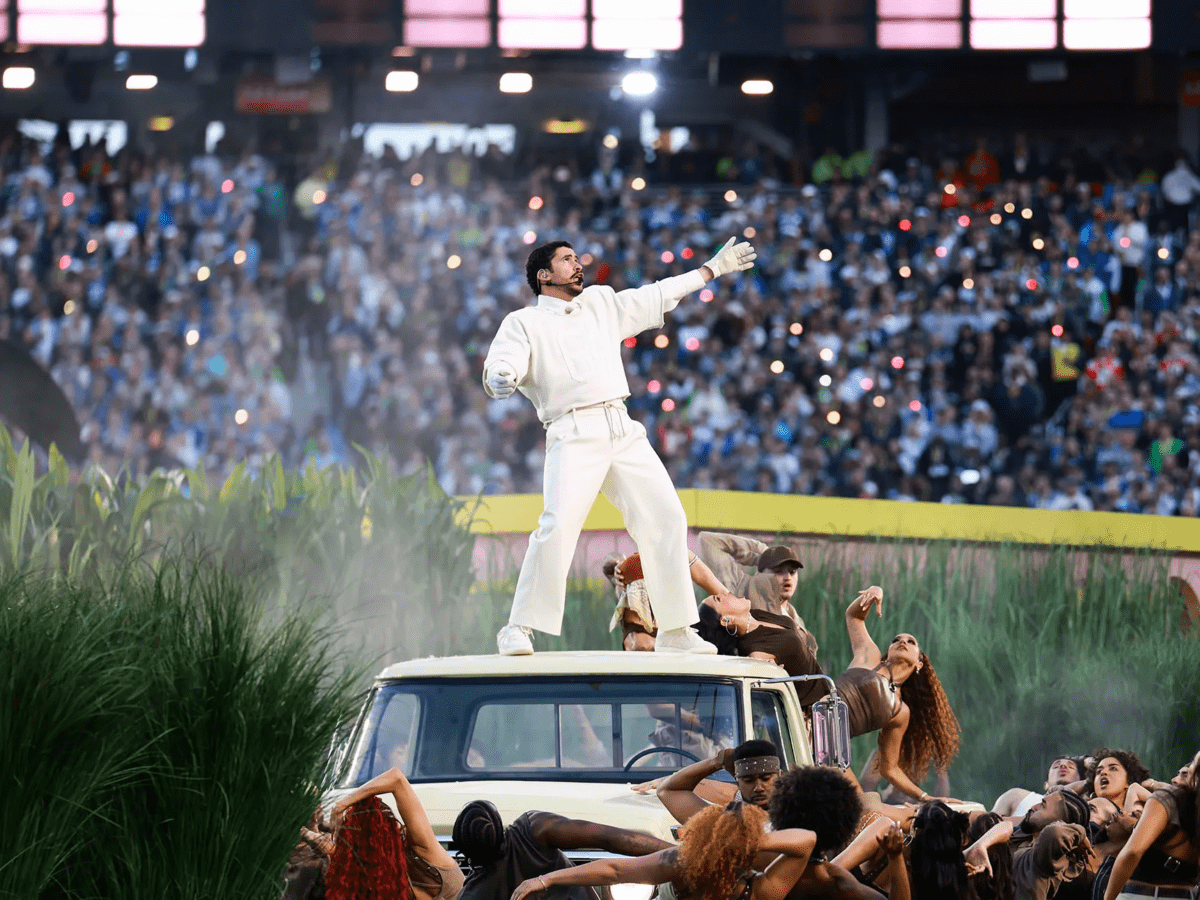
El Gran Tazón (The Super Bowl) has long served as liturgy to U.S nationalism: corporate excess baptised in red, white, and blue. Historically, a space both white and anglophone. To step onto that stage in Spanish, to dembow, under floodlights usually reserved for ‘The Star-Spangled Banner’, is no accident nor mere aesthetic choice; it is intervention, and it is political.
It is a claim to stolen land, exploited land, land worked, plowed, and nurtured by migrant hands. It unfolds at a moment when immigration is once again framed as invasion. Eduardo Galeano knew to warn us that the North depended upon the extraction of the South; silver, sugar, oil, labour. Our veins remain open. Now the mining is cultural: reguetón everywhere, streams and ticket sales and halftime show; the rhythm circulates freely, the people do not. The irony should not be lost on us: one Latin body is welcomed onto the most-watched stage in the country, others detained and deported.
Bad Bunny’s show unfolds in constant motion, shifting from song to song, and scene to scene, transitions far from arbitrary. His setlist is deliberate architecture, each song laid carefully in constructing a history:
LA MuDANZA (the move)
The show opens with movement; salsa and colour. Why translate ourselves when we express everything perfectly in our own tongue? From the first strum it is clear this performance is not asking to be understood, it is demanding to be witnessed.
We are engulfed by sugarcane and suddenly we are somewhere humid, somewhere worked. It feels García Marquezian; Macondo in a NFL area, a place both marginal and mythical. Latin America has always occupied that paradox: peripheral in geopolitics, indispensable to global imagination. They want all the magic, and none of the realism.
The stage feels like a stifling tropical summer, and the sweat on worker’s brows. Heat is aesthetic, but it is also historical.

Tití Me Preguntó (Tití asked me)
Benito appears, dressed in Zara; not couture, not luxury. An accessible brand, found in the fluorescent aisles of shopping centres across continents, and a Spanish-owned one at that. His value does not depend on elite approval.
It is Latin America’s economy on full display. Behind this moment sit the tienditas: street food vendors, liquor shops, nail salons; that “informal labour”, migrant labour, that sits at the backbone of the U.S economy.
Yo Perreo Sola (I dance alone)
The casita is decorated with Latin icons; Karol G, Pedro Pascal, Jesica Alba, Cardi B, all your favourites in one place, all of them Latin. Look how far we can come, all that we can build. To see ourselves centre stage, is to shift the frame, and the power.
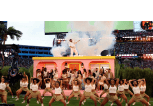
Perreo, it turns out, can also be political; to move the body and occupy space. Latina women flood the stage; frizzy hair and thick thighs, real, sexy. Not diluted or softened, not assimilated into something palatable. They are bodies I recognise. To see them like this, desired and desirable, self-possessed, does something tender, it feels like being seen.
“Las mujeres en el mundo entero, perreando sin miedo” (women across the world, dancing without fear). In a country where women’s bodies are legislated, to dance like this is to reclaim sovereignty.
Safaera (chaos; or the moment during a party where things tip over into it)
This is this generation’s Gasolina, it saw us through adolescent parties and coming-of-age. We all know the lyrics, I know because I mouth them as I watch, and the stadium shouts them back. It had to make the setlist, and we are glad it did, even those of us who think ourselves feminists (sure, the lyrics are questionable). But that, too, is part of it. Culture is not curated for moral purity, it is contradictory, chaotic if you will, but it unifies us with its chaos.
VOY A LLeVARTE PA PR (I’m going to take you to PR)
If anything, Benito has been taking us to Puerto Rico since the show began. I watch from my kitchen before a morning lecture, ten thousand kilometers from home, and yet, suddenly, I am there. He falls into a living room: a family gathered around a television. It feels familiar, recursive. We watch them watch him, and in doing so, watch ourselves.
His jersey reads Ocasio, Benito knows where he comes from. Tego Calderon, Don Omar, Daddy Yankee; the patriarchs. He names his lineage. “Están escuchando música de Puerto Rico, de los barrios y los caseríos”
(you’re listening to music from Puerto Rico, from the hoods and the villages)
EoO (literally: on occasion, or a cue given before a beat drops)
And then the dembow; the body understands even before the mind. If there is one thing Latinos know how to do, it is move (there is a joke there I will leave for you to find).
MONACO
“Buenas tardes CalifoLnia, mi nombre es Benito Antonio Martinez Ocasio”
(Good afternoon, California. My name is Benito Antonio Martínez Ocasio)
The intentional use of a full name, the stereotype spoken out loud, and then a reminder: “Y si hoy estoy aquí en el Super Bowl 60 es porque nunca dejé de creer en mí. Tú también deberías de creer en ti, vales más de lo que piensas, créeme”
(And if I’m here at the 60th Super Bowl today, it’s because I never stopped believing in myself. You should believe in yourself too, you’re worth more than you think. Trust me.)
He breaks the fourth wall, for an instant the performance recedes, and the man remains.
The American Dream has been sold as: work hard, rise alone, transcend your origin story, and you may succeed, you may belong.
Die With A Smile
What follows is a display of belonging as Latinos conceptualise it. A (real) wedding ceremony on the halftime stage, the knot tied between a Latina and an American. They kiss, and like a kiss on the Berlin Wall, their marriage is a symbol of the collapse of borders. Intimacy where rhetoric insists on separation. A kiss for peace.

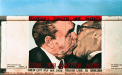
Lady Gaga is no coincidence either; a globally famous English-speaking singer with a globally famous English-language song enters a Latin space. Anyone is welcome at a Latin wedding. You dance alongside the family. The tías (aunts) dance cumbia, the tíos (uncles) are already drunk, the children asleep in makeshift beds between chairs. Benito also dances with her.
BAILE INoLVIDABLE (unforgettable dance)
To us, these dances are almost forgettable, precisely because they are so ordinary. We dance at weddings, and in kitchens, and on streets, and everywhere. But ordinariness becomes radical when movement is policed, to dance without fear is no small demand, and yet Benito urges us: “Baila sin miedo, ama sin miedo” (dance without fear, love without fear).
NUEVAYoL
The stage obeys, they dance. It is theatrical, a musical number refracted through diasporic memory: perhaps West Side Story, perhaps In The Heights. The American Dream feels staged within reach.
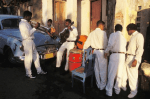
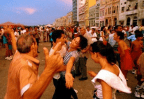
A tribute unfolds: Willy Colon, Frida Kahlo, those trumpets! Toñita, named in the song, now standing there, in front of him, hands him a shot, and “PR se siente cerquita” (PR feels so close).
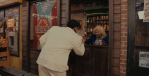
Benito hands over his Grammy; it belongs to us all, to those who listen, to the children watching at home who look up to him, to his inner child too, perhaps, and to all those children who are now living in fear.
LO QUE LE PASÓ A HAWAii (what happened to Hawaii)
“Quieren al barrio mío y que tus hijos se vayan” (they want my neighbourhood, and for your children to leave). That Ricky Martin sings this matters, a voice our mothers grew up with, a Puerto Rican idol shaped by American industry and polished for export. He opened a door in the 90s, when ‘Latin explosion’ meant temporary fascination. Benito does not ask for fascination. He now walks all the way through that door and closes it; we no longer need subtitling.
El Apagón (the blackout)
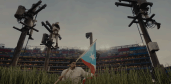
Electric poles and risky jobs; infrastructure turned symbol. What keeps the States united: building, repairing, cleaning, maintaining. The blackout is no metaphor. Puerto Rico knows this too well; a colony left waiting for power to be restored, political and electrical.
Immigration in the United States is not a crisis of numbers, but a crisis of ethics. Migrants sustain the nation’s infrastructure while being systematically denied its protections.
Benito holds his flag, and his country, high. He climbs upwards, and at the top, a lyric cuts through everything: “Ahora todos quieren ser latinos, pero les falta sazón, batería y reguetón” (Now everyone wants to be Latino, but they lack seasoning, battery/drums, and reguetón)
And then, a targeted warning: “Cuidao con mi corillo, que somo’ un montón” (careful with my crew, there’s a whole lot of us).
CAFé CON RON (coffee and rum)
The first few notes and something stirs, my soles itch. I want the dim light of a club, voices hoarse, someone’s arm heavy over my shoulder. I want the bitter coffee my father brews in the mornings, and the rum and coke poured generously before we step out into the night. Ours has always been a culture of effort and enjoyment in the same breath.
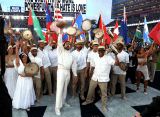
Flags rise from every corner of the stage, and something tightens in my chest; pride, anger, homesickness, then pride again. Everything converges now; the flags, the songs, the story, the way we do, inevitably, even scattered across continents.
“God bless America.” He says, and names it properly:
Chile, Argentina, Uruguay, Paraguay, Bolivia, Perú, Ecuador, Brasil, Colombia, Venezuela, Guyana, Panamá, Costa Rica, Nicaragua, Honduras, El Salvador, Guatemala, México, Cuba, República Dominicana, Jamaica, Haití, Las Antillas, United States, Canada, and Puerto Rico
He does not abbreviate, so neither will I.
DtMF (I should have taken more photos)
He ends with the song everyone knows, even los gringos, and feelings just as familiar. Not a naive plea for unity, but rather something of a challenge: togetherness requires seeing and being seeing.
They jump, shout, laugh, sing, because despite detention centres, policy debates, headlines, we are excessive with life, and joy, and above all, we are most certainly, loud.
Power is rarely threatened by silence. It is not coincidental that the performance drew criticism from certain political figures, whose careers are built on policing borders, territorial and epistemic. But sound refuses containment.
Sound travels, and apparently it crosses borders. Latin America has always been an act of sonic resistance.
The only thing stronger than hate is love.
Featured Image: Kathryn Riley / Getty
2 replies on “El Espectáculo de Medio Tiempo del Super Tazón: The Histories Behind Bad Bunny’s Halftime Show”
Love it!
Fantastic explanation of the subtleties of the songs for non-reguetón speakers