Categories
Culture

“unnecessarily VIOLENT, SEXIST, and DISGUSTING”: a Look into Richard Kern’s Abject Women

By Liv Thomas

“Oddballs dancing, leering at camera, guy shaving a nontraditional part of his body and man ripping his own throat out, woman stabbing herself to death.” 

The synopsis above pertains to Richard Kern’s Submit to Me Now (1987). Recognised as a thematic symbiote to its older sister short, Submit to Me (1985), and fashioned with the genre description as a ‘no-wave erotic horror’ that explores the aesthetics of kink, sadism, mutilation, and suicide. The sequel differs from its predecessor with the introduction of one Lung Leg, nee. Elizabeth Carr. 

Portrait of Lung Leg, taken by Richard Kern 

Lung Leg emerged in the 1980s as one of the defining symbols of New York’s ‘Cinema of Transgression’. When asked to define the word transgression and its applied use within the ‘Cinema of…’, director Kern uses a royal ‘we’ to describe himself and a loose collection of like-minded creatives who sought to make films that put people outside of their comfort zones, emphasising their intention to make the audience feel as though they were seeing something they weren’t supposed to.  

“Basically, taking a person’s established ethics and morals and trying to get them a little bit beyond it… to transgress their boundaries”. What this manifesto created was an action painting of experimental film, angry punks, and cow’s blood in place of the human stuff. 

Lung Leg first met Kern while he was on set for Sonic Youth’s music video, Death Valley 69. “Lung Leg was just… well, I had never met anyone like that before. I think I was 30 by then and I had met a lot of people, but I had never met someone as weird as her.” 

Lung Leg on the cover of Sonic Youth’s 1986 album, EVOL

Together, both director and actor participated in a culture that embalmed the no-wave era, working on projects such as You Killed Me First (1985), Worm Movie (1985), and Fingered (1986) -making any other attempt at transgression look emaciated in comparison. 

The concept of a plot doesn’t really exist within these movies, from my viewing experience anyway; what audiences watch instead is a tableau of sadism and masochism and self-mutilation. Having watched a handful of low-quality clips of his work online, I can attest to Kern’s claim that his work transgresses the average viewer’s comfort zone. I also wouldn’t go out of my way to personally recommend his work to the casual viewer. On the surface, his films consist of young women rolling on the ground, making faces at the screen, and handling an array of bugs and reptiles – sometimes men are there too, wrangling themselves into bloody messes. There’s no dialogue in most of them, only the riffing of multiple instruments, making his work easily mistaken for a low-budget music video. 

“You work a lot with violence and drug abuse”, asks one interviewer. Kern simply laughs. 

When watching Kern’s films, it would be easy to make this association too. The 1980s, New York City, and the underground scene all evoke explicit drug use. In terms of violence, one just needs to refer back to the synopsis for Submit to Me Now. However, beneath the grime, gore, and grain, Kern’s depiction of “women in their 20s” unravels as his self-proclaimed subject matter. It has been the primary focus of his work since Kern himself was a 20-year-old filmmaker in the 80s, and it remains so during his current career as a photographer.  Now, it’s through Lung Leg’s jagged persona that I turn towards Kern’s early depictions of women. In You Killed Me First, Lung Leg plays a demented daughter who finally snaps and guns down her family at the dinner table. In Fingered, poor Lung Leg again gets subjected to a spree of sex and violence enacted by Lydia Lunch and her partner. The tagline for Fingered even warns that some may find it “unnecessarily VIOLENT, SEXIST, and DISGUSTING”.

In these reactions, I recognise what literary theorist Julia Kristeva coins as ‘the abject’, that which society casts off in order to hold itself together. “It is not lack of cleanliness or health that causes abjection but what disturbs identity, system, order… the in-between, the ambiguous, the composite”. The women in Kern’s filmography embody what we’re not supposed to see: female anger, female cruelty, female mess. They vomit, they bleed, they brandish weapons. The daughter is flesh of her mother’s flesh and a murderous stranger; the pin-up model is a punk. I think of Lung Leg’s character shrieking at her WASP parents in You Killed Me First: “I’m flesh of your flesh… and you’re just as disgusting as I am!” 

To mistake this subject matter of 20-something-year-old-women as perverted and typical for a now 70-year-old man is plausible for anyone all too familiar with the creative industry’s voyeuristic eye. “Just not when it comes to Kern”, I argue to myself. 

Medicated (2010-2013) – my favourite modern-day project of his – is a photo series of models staring straight into the camera, holding up the prescriptions that they take and, as the visual narrative develops, depend upon to survive in an ever-confusing adolescence. Most of these women are half-naked, but that’s not the vulnerability Kern wants you to look at. Your eyes scan over the pill bottles in each hand. What’s the prescription? Is it one I know, or will I have to look it up? The bathroom settings are undeniably human and lived-in, each product a glimpse into these girls’ routines and habits. The variation of bodies, faces, antidepressants, antipsychotics, anticonvulsants, amphetamines, attention-deficit drugs, sleeping pills, and birth control (etc.) is enough to make any like-minded and medicated 20-year-old-girl see herself as being a part of this compilation.  

“Klonopin/Relpax”, 2014, Richard Kern

“My mom put me on them—no second grade kid is gonna say “I want to go on drugs”. The reason they put me on it was they would tell me to put stuff in my cubby and go sit down and I would just wander around cause I was always thinking about other stuff. That’s what kids do. I’ve only taken this maybe two times in the last year so I can’t say I really think about quitting. I’ve seen too many friends ruins their lives to want to use it much.” – Quotation from Medicated Series, by Richard Kern  

Portrait from Medicated – Richard Kern, 2014

Each image is accompanied by a continual written transcript. The dialogue loses its rhythm beside the page’s respective model and her respective prescription. Soon, nothing aligns, and their voices become one. 

Kern uses the phrase “since the internet” in one of his interviews as if the establishment of the World Wide Web were some cataclysmic event. This is true, in a way. For someone like Kern, the sudden interconnectedness between everyone and everything made it nearly impossible for transgressive cinema to exist as an underground medium. “I don’t know what underground means… in today’s world”, he states.  

During the 80s, Kern’s work was genuinely underground: passed around on VHS tapes, shown at seedy clubs or tiny galleries, utterly removed from the mainstream… a great assault on good taste. Now, those once-scandalous films are readily available: remastered on Blu-ray, streaming online, even screened at MoMA. The taboos that made the ‘Cinema of Transgression’ so bracing have seeped into mass culture. Murder, gore, sex, blasphemy. “Basically all of the shock tactics they employed are all part of the mainstream now,” one blogger notes. He’s right. What was subversive art in 1985 becomes an internet aesthetic this century. The underground didn’t so much disappear as get folded into an algorithm. When every teenager can find extreme horror clips, BDSM imagery, or the latest outré performance art with a quick search, what does transgression even mean? Is transgressive art even possible in a world where nothing is underground for long?  

Kern’s own evolution offers one answer: context is everything. He once said, citing John Waters, that it’s fine to be an “angry young man,” but if you carry that rage into old age you just look ridiculous. Times change, and I guess shock must change alongside it. In an era where explicit content is ubiquitous, perhaps the new transgression is to expose what we habitually conceal. With Medicated, Kern turns his lens to the kind of private despair that normally plays out at home or in a psychiatrist’s office. He shows it clinically, yet not without empathy. We, the viewer, are confronted with the epidemic of medicated youth, the normalisation of psychological distress. No cow’s blood is needed here. 

Still, I can’t help but feel a twinge of loss for the old underground’s gritty camaraderie. Kern’s was a tight-knit group of punks, artists, and weirdos who needed some form of a transgressive outlet (and were willing to go to physical, often grimy spaces to find it). Today, those spaces have been supplanted by digital ones. To be transgressive now often means pushing into interdicted zones of identity, politics, or morality, which is a different game altogether. Present-day artists have to find new pressure points to press. Some turn the provocation inward, some turn it outward to social critique, and some simply escalate the shock. 

So, what remains when the dust settles? For me, it’s the women – Kern’s women. There’s Lung Leg. There’s Lydia Lunch. There are all those dead-eyed girls and their prescription bottles. The raging daughter, the self-destructive punk, the dissociated depressive. Aren’t these all facets of the collective female psyche that society has struggled to acknowledge?  

Perhaps that’s why, decades on, these figures still hold a semblance of power… dragging the abject into view, and doing so with women at the centre-frame, in a way that forces a reckoning with how we view that form. 

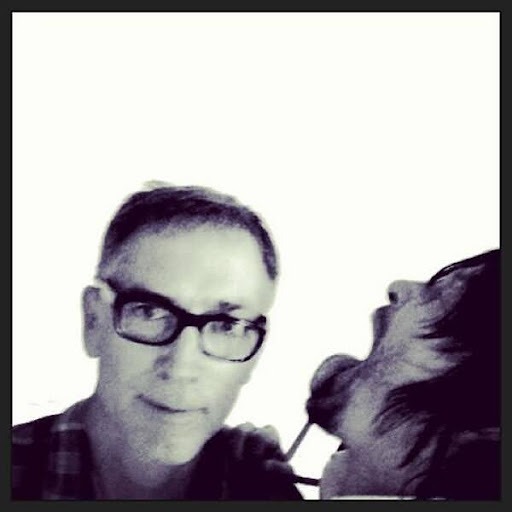
Cover Photo – Richard Kern

Works referenced:

  • “Abjection.” Wikipedia: The Free Encyclopedia, 23 Oct. 2025, en.wikipedia.org/wiki/Abjection.
  • Interview with American Underground Filmmaker Richard Kern. YouTube, uploaded by Film&Clips, 22 Aug. 2018, https://youtu.be/yqakhvFdrDo.
  • Morris, Gary. “Snapshots from Hell: Richard Kern – The Hardcore Collection on DVD.” Bright Lights Film Journal, 1 Oct. 2001, brightlightsfilm.com/snapshots-hell-richard-kern-hardcore-collection-dvd/.
  • Reinoos, Dana. “Films by Richard Kern.” Screen Slate, 11 Dec. 2017, www.screenslate.com/articles/films-richard-kern.
  • Supervert. “As Needed for Anxiety: Richard Kern’s Photographs of Pharmaceutical Chic.” Please Kill Me, 12 Jan. 2021, pleasekillme.com/richard-kern-photographs-medicated/. 
  • Storm, Christian. “Richard Kern’s Films Are Still Shocking as Hell.” VICE, 7 Dec. 2012, www.vice.com/en/article/richard-kerns-films-are-still-shocking-as-hell.
  • The Bloody Pit of Horror. “You Killed Me First (1985).” The Bloody Pit of Horror, 23 Oct. 2020, thebloodypitofhorror.blogspot.com/2020/10/you-killed-me-first-1985.html.

Videowave. 1985 Interview with Richard Kern. YouTube, uploaded by Videowave, 6 Jan. 2018, https://youtu.be/8HXpmk-7NaM.

Categories
Perspective

For Whom is the Funhouse Fun?

By Liv Thomas

“For whom is the funhouse fun?”

‘Lost in the Funhouse’ makes up one out of four short stories within John Barth’s 1968 collection of the same name –  Lost in the Funhouse.

The opening lines of the tale ask a question to the reader that not only evokes the meaning of its own title, but, in doing so, also introduces one of its central themes – the formation of identity. 

Having read that question (“For whom is the funhouse fun?”), I – like many other readers, presumably – gave my own subconscious answer that I only vaguely remember… I found it interesting that the text then gave a response to its own musings with the contemplative “Perhaps for lovers.” Through this, we are offered the perspective of its central character, Ambrose, for whom, instead, the funhouse “is a place of fear and confusion.” 

Already, the text gives the reader a glimpse into its own identity crisis, flitting over various stages of question and answer, only to provide its own unsure conclusion.

For the use of voice to convey a message, I saw these opening sentences as an ascension of perspective varying from the reader, narrator, and central character, constructing a point I note as the story’s ability to inquire into what we think is reality – or in this case, the funhouse.

To summarise, Lost in the Funhouse follows a thirteen-year-old Ambrose on a Fourth of July outing with his older brother Peter, their parents, Uncle Karl, and their fourteen-year-old neighbour Magda, a girl both brothers are attracted to. Upon finding out that the beach is closed, the group enter a funhouse, in which Ambrose and Peter fantasise about walking alongside Magda as they pass the winding mirrors and shadows. As he wanders, Ambrose begins to associate the funhouse with things beyond his teenaged understandings – sexuality, desire, and the choking inevitability of getting older. Lost in the funhouse, Ambrose realises he isn’t like Peter or Magda; the laughter and illusions that delight others only unsettle him.  

Now, Barth’s work belongs to that late-twentieth-century literary niche in which writers discovered that their work could become realised – self-aware, even. He might be grouped with like-minded authors such as Thomas Pynchon, Donald Barthelme, and Robert Coover, all of whom challenged whether literature still had the potential to offer clarity in a world increasingly obscured by its own reality. 

With this in mind, in Lost in the Funhouse, Barth not only deconstructs the awkwardness of adolescence as it’s portrayed within the coming-of-age genre, but also the awkwardness of fiction itself. Each metafictional aside exposes his realism as artificial, all while Ambrose’s understanding of his youth is increasingly disturbed.

I would like to believe that this was the sole reason for my initially confused first read-through of the short story, in that it hadn’t occurred to me that I would be reading a narrative that was so – some may say critical, others introspective – of its own style and plot. 

“Is it likely, does it violate the principle of verisimilitude, that a thirteen-year-old boy could make such a sophisticated observation?”, questions Barth. 

Speaking outside of Ambrose’s perspective and addressing the reader instead… Not only does this line disturb stereotypes as to how thirteen-year-old boys like Ambrose are portrayed within the coming-of-age-genre, but it also forces the reader to question these verisimilitudes. 

During my second read-through, the whole point of deconstruction became more apparent to me with the story’s own writing-out of linear plots. In particular, the listing of “The beginning […]”, “The middle […]”, and “The ending […]” made me feel as though Barth’s writing had its own painstaking way of telling the reader exactly when and where to expect key moments, all while shamelessly condensing such specification to three sentences on the sixth-something page. 

Here, Barth is not just making a statement on the culture of fiction surrounding adolescents but is also contesting the use of conventional narratives to effectively portray the fragmented reality of such characters. 

Truly, Lost in the Funhouse stands out to me as something I need to understand better, the same way Ambrose supposes he needs to understand the course of his life, but the tale nonetheless stands out as a contemplation on writing and those who are both appreciative and critical of it.

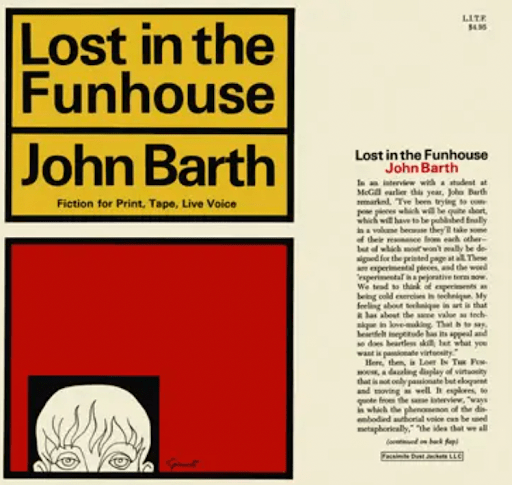
Feature Image – dustjackets.com

Categories
Culture

A Day with Alberto Giacometti, Told in Notes 

By Liv Thomas

17/07/2025 

Morning 

I was in the Tate Modern when I saw my first Giacometti statue.  

It was a grey day, blanketed by a sweltering heat, and I was alone in Paddington Station.  

No one around me knew that I’d started the day buzzing with that small, yet bright, excitement that comes from seeing someone you haven’t seen in half a year. 

They didn’t know that I was sitting on a bench in complete humiliation after receiving a response to my “here” text that read “I thought we were meeting tomorrow?”. 

I didn’t want to catch the next train home; I’d paid for this journey, after all. So I walked through, in my head, all the things I would want to do in London if I ever found myself alone there. Art galleries are a great place to explore if you want to blend in among a crowd of people who are perfectly content to be within their own company. I decided on the Tate Modern – and that’s where my day turned from strange to true.  

Midday 

The spatial layout of most art galleries carries the intention of leading you from one piece to another until you finish your journey with a new sense of meaning. The Tate Modern, on the other hand, makes you feel very, very small. 

Upon entering, the concrete walls and glass panels on either side of me stretched above to what I can only vaguely remember as a bright light. Facing the entrance, I turned left; if you were to see a map of the Turbine Hall, this would be in the direction of a tumorous-looking structure leeching onto an otherwise square building. 

This tumour is where I saw my first Giacometti statue.  

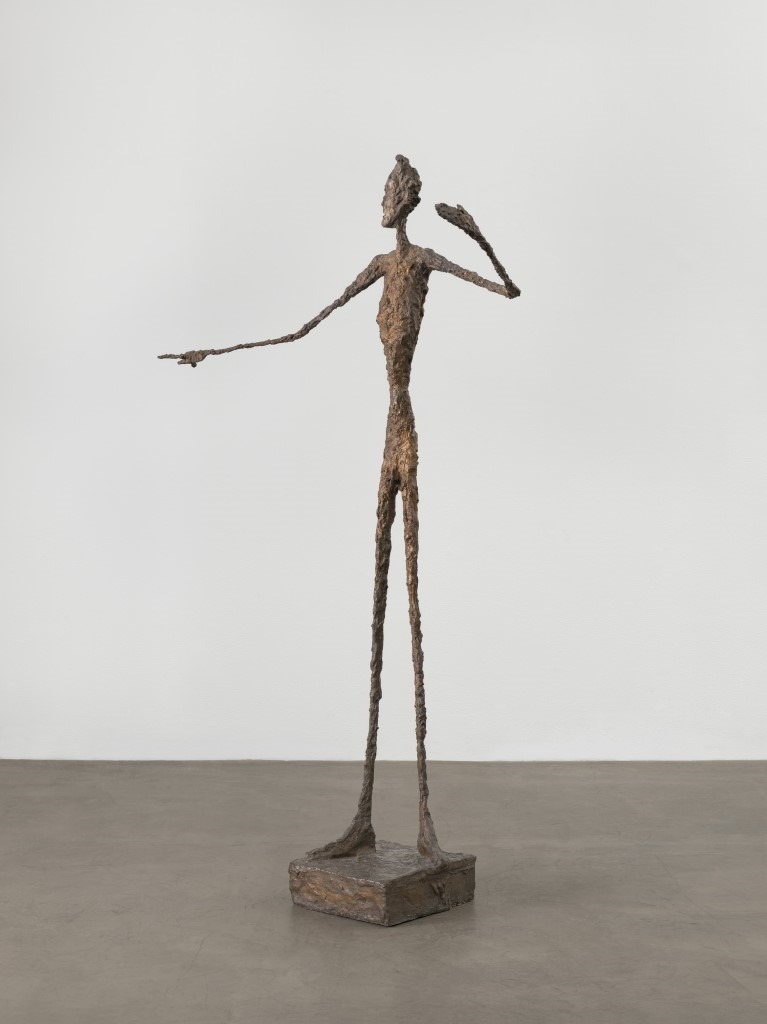
You enter this space and you’re presented with several openings, each leading to its own exhibition. You look down the corridor to one and see an alien standing at the end. Except it’s not an alien, it’s L’Homme au doigt

(Giacometti’s Man Pointing, 1947, bronze, 179 cm, The Museum of Modern Art) 

Existentialist philosopher Jean-Paul Sartre described the statue as “always halfway between nothing and being,” and that’s exactly how I felt when I found myself in this liminal space between the rest of the Tate Modern, and the works of Alberto Giacometti.  

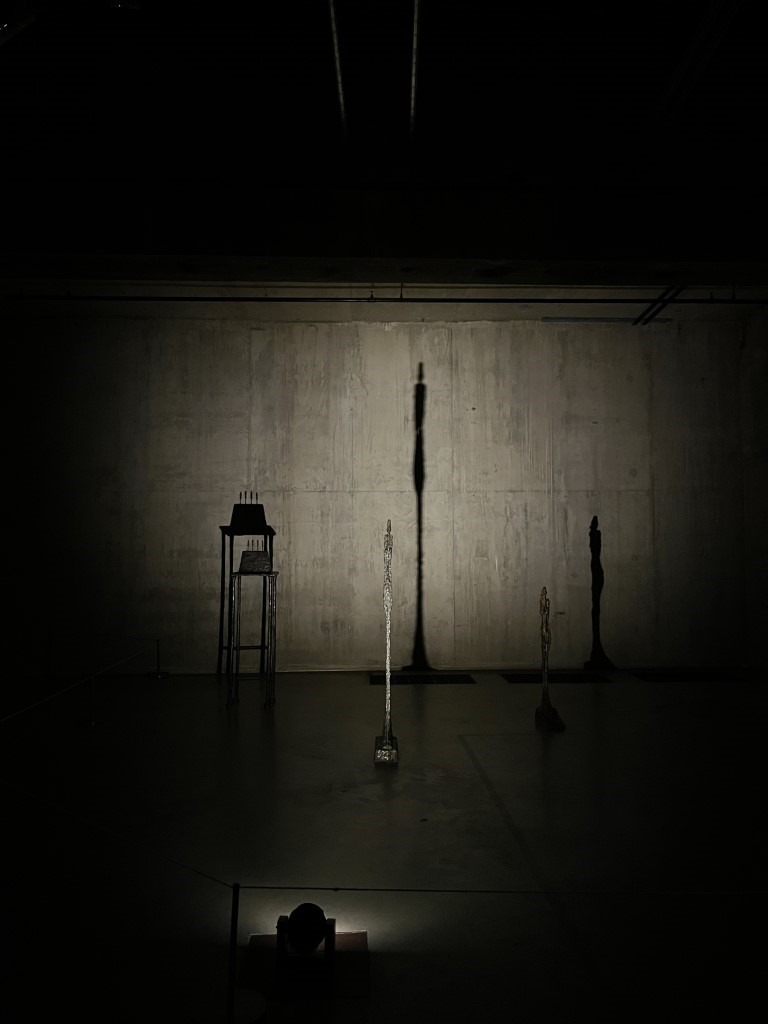
The exhibition was lit in a way that made the square-shaped corridor look like a tunnel, with the dark corners of each four-pointed frame bending over the sculptures, as a light pointed directly at them stretched their shadows against the wall.  

My first association was with Plato’s Cave. On the one hand, this matter of perspective accentuates Giacometti’s study of the human form and its relationship to the environment. On the other hand, these silhouettes and the figures that cast them represent the dual significations between alienation and endurance, fragility and resistance, and our anxieties and hopes.  

Notes on Giacometti 

Giacometti is often regarded as a late modernist who reaffirmed figuration after World War II.  Similar to T.S. Eliot’s The Waste Land — only translated here through plaster, clay, and bronze — Giacometti’s sculptures capture the fading afterimage of a society laid bare by war, fixating on humanity seen through a lens of thin, metal limbs, as if the world itself had been whittled down to its trembling bones. 

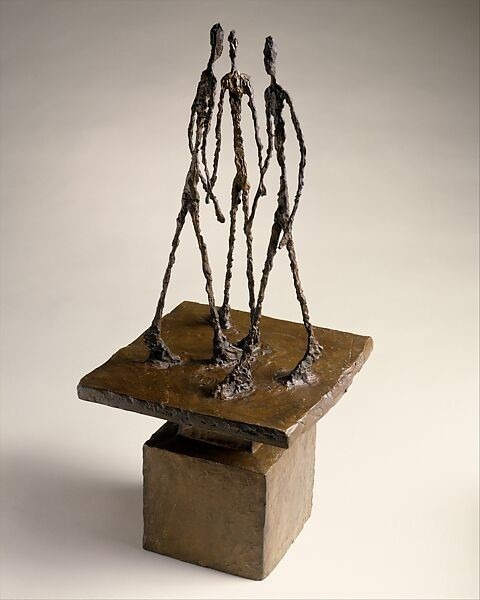
(Giacometti’s Three Men Walking II, 1949, bronze, 188.5×27.9×110.7 cm, The Met) 

Despite their proximity, the figures wander aimlessly, with neither direction nor acknowledgement – their identities blur, yet they are completely disconnected. 

Giacometti rejected the artistic notion of replicating reality; instead he sought to uncover the truth of life by reducing it to its barest principles. His art serves as an alternative to the superficiality of hyper-realism in sculpting.  

(Giacometti’s Walking Woman I, 1932, Bronze, 150.3 x 27.7 x 38.4 cm, Fondation Giacometti) 

This specific figure is inspired by Egyptian artistic traditions. While the name of the piece suggests otherwise, the sculpture conveys no sense of movement and rather reflects a wider awareness of varying 20th century stylisations.  

Final thoughts 

My thoughts at the Tate Modern gather to the present day.  

Plato’s Cave tells the story of prisoners trapped in a cave, and the shadows cast by a fire are mistaken for reality. Mimesis is an illusion that distracts us from the fragmented nature of human existence, and authenticity is needed now more than ever in a digital age that conglomerates everything fed into it.  

When you cast a shadow against Giacometti’s works, you don’t see reality –  you see a half-starved person, a physical manifestation of psychological confinement, a charred body… or maybe you would even see yourself.

Seeing this for myself in London, surrounded by strangers, and with a lost purpose for the day – left with the lingering feeling of reading whatever was in the news that morning – I couldn’t help but let Giacometti’s shadows speak to me. A lone person faces another human in the form of a sculpture; both carry multitudes. 

Featured Image: Liv Thomas