By Liv Thomas
“For whom is the funhouse fun?”
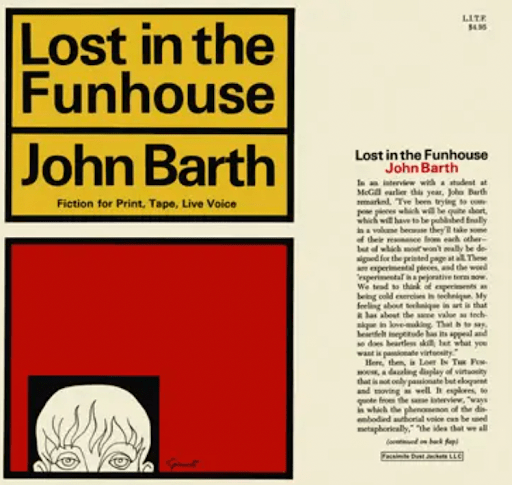
‘Lost in the Funhouse’ makes up one out of four short stories within John Barth’s 1968 collection of the same name – Lost in the Funhouse.
The opening lines of the tale ask a question to the reader that not only evokes the meaning of its own title, but, in doing so, also introduces one of its central themes – the formation of identity.
Having read that question (“For whom is the funhouse fun?”), I – like many other readers, presumably – gave my own subconscious answer that I only vaguely remember… I found it interesting that the text then gave a response to its own musings with the contemplative “Perhaps for lovers.” Through this, we are offered the perspective of its central character, Ambrose, for whom, instead, the funhouse “is a place of fear and confusion.”
Already, the text gives the reader a glimpse into its own identity crisis, flitting over various stages of question and answer, only to provide its own unsure conclusion.
For the use of voice to convey a message, I saw these opening sentences as an ascension of perspective varying from the reader, narrator, and central character, constructing a point I note as the story’s ability to inquire into what we think is reality – or in this case, the funhouse.
To summarise, Lost in the Funhouse follows a thirteen-year-old Ambrose on a Fourth of July outing with his older brother Peter, their parents, Uncle Karl, and their fourteen-year-old neighbour Magda, a girl both brothers are attracted to. Upon finding out that the beach is closed, the group enter a funhouse, in which Ambrose and Peter fantasise about walking alongside Magda as they pass the winding mirrors and shadows. As he wanders, Ambrose begins to associate the funhouse with things beyond his teenaged understandings – sexuality, desire, and the choking inevitability of getting older. Lost in the funhouse, Ambrose realises he isn’t like Peter or Magda; the laughter and illusions that delight others only unsettle him.
Now, Barth’s work belongs to that late-twentieth-century literary niche in which writers discovered that their work could become realised – self-aware, even. He might be grouped with like-minded authors such as Thomas Pynchon, Donald Barthelme, and Robert Coover, all of whom challenged whether literature still had the potential to offer clarity in a world increasingly obscured by its own reality.
With this in mind, in Lost in the Funhouse, Barth not only deconstructs the awkwardness of adolescence as it’s portrayed within the coming-of-age genre, but also the awkwardness of fiction itself. Each metafictional aside exposes his realism as artificial, all while Ambrose’s understanding of his youth is increasingly disturbed.
I would like to believe that this was the sole reason for my initially confused first read-through of the short story, in that it hadn’t occurred to me that I would be reading a narrative that was so – some may say critical, others introspective – of its own style and plot.
“Is it likely, does it violate the principle of verisimilitude, that a thirteen-year-old boy could make such a sophisticated observation?”, questions Barth.
Speaking outside of Ambrose’s perspective and addressing the reader instead… Not only does this line disturb stereotypes as to how thirteen-year-old boys like Ambrose are portrayed within the coming-of-age-genre, but it also forces the reader to question these verisimilitudes.
During my second read-through, the whole point of deconstruction became more apparent to me with the story’s own writing-out of linear plots. In particular, the listing of “The beginning […]”, “The middle […]”, and “The ending […]” made me feel as though Barth’s writing had its own painstaking way of telling the reader exactly when and where to expect key moments, all while shamelessly condensing such specification to three sentences on the sixth-something page.
Here, Barth is not just making a statement on the culture of fiction surrounding adolescents but is also contesting the use of conventional narratives to effectively portray the fragmented reality of such characters.
Truly, Lost in the Funhouse stands out to me as something I need to understand better, the same way Ambrose supposes he needs to understand the course of his life, but the tale nonetheless stands out as a contemplation on writing and those who are both appreciative and critical of it.
Feature Image – dustjackets.com