
By Robin Reinders and Ashley Zhou
‘Prodigious. Sleek. Attuned.’ – Robin Reinders
‘Confident. Specific. Genuinely emotional.’ – Ashley Zhou
‘Oh – I think my line is bad.’
‘Sorry, what?’
‘My int—ernet.’
Connection unstable. The phrase appears in a small grey box at the top of the screen just as we’re about to launch into conversation. There is perhaps no musical more suited to a review conducted over a video chat than Dear Evan Hansen. A story shaped by emails, social media, likes and shares, digital grief and the uneasy gap between who we are in life and who we present as online – it feels oddly at home in the fragmented language of notifications, messages and screens. Tone Deaf Theatre Company’s inspiring production, co-directed by Lauren Williams and Estelle Pollard-Cox and assisted by Bee Wilkes, embraces that world full-heartedly while never losing sight of the human relationships beneath it. Supported by a live band, a fantastic creative team, a top-notch production crew, and a committed cast working in remarkable sync, the production navigates the show’s familiar emotional highs and ethical ambiguities with vivid energy, earnest sincerity, and no shortage of ambition.
It’s fitting, then, that our response should take the form of a conversation mediated by the internet. At its heart, Dear Evan Hansen is a musical about talking about it. Rather than write a conventional review, we reset our routers, opened a video call and started talking.
This conversation has been edited for clarity
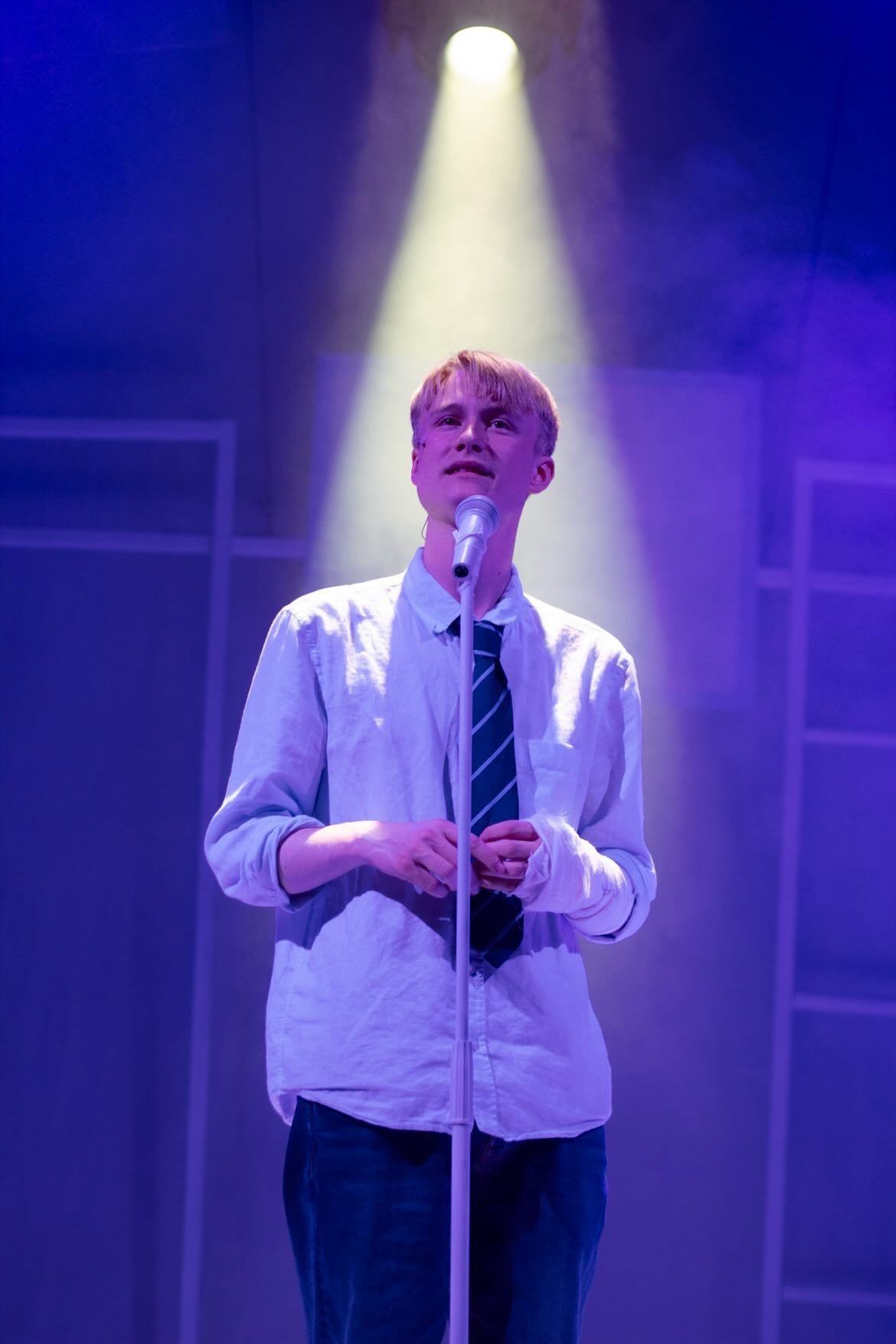
R: The first thing that comes to mind when I think of this production is the demeanour of Ollie Painter’s Evan: the mannerisms, the gestures.
A: I was going to say that. He leads the show so confidently, it feels like he’s been born on the stage. I also think of the line in ‘For Forever’ when Evan sings ‘I climb till the entire sun shines on my face’. Jonathan Wilson-Down’s lighting design has this bright orange light bathing the audience, and it’s the most gorgeous, affecting rendition of the song I’ve ever experienced.
R: It’s so arresting. When it’s in the process of happening, you can’t really comprehend it until these lights are washing over and brilliantly blinding you.
A: Yeah. It’s also the first time it happens, and while it’s used a few more times in the play, I think this was the most effective instance.
R: Ollie Painter is so prodigious, so impressive. For a first-year student to have such firm control of the audience and to capture the mannerisms of Evan Hansen so well – he really adopts the perfect disposition. Some of the character choices he makes in the fidgeting of his shirt and the cracks and wavering inflection in his voice, and the cadence of his voice is present in his speech as much as in his vocals.
A: When you try to ramble, it can so easily come across as illegible. He makes it sound musical – it’s never hard to follow. And after watching, we were talking about how he has all of the best Ben Platt-isms without any of the drawbacks.
R: Yes, I think we should coin the term Ben Platt-ism.
A: Exactly, exactly. It redeemed every time I had to watch Ben Platt in the movie version.
R: I’m glad it was a healing process for you. Thank you, Tone Deaf Theatre Company!
PRODUCTION
A: I enjoyed the emphasis on the musical’s social media aspect, which every department leaned into. Wilson-Down’s lighting design had colourful rectangles projected behind the characters while they were speaking online, each assigned a specific one, and I thought it was an interesting way to highlight them as individual avatars. It brought the expanse of the Internet into the very sparse, peeled-back set.
R: It really does foreground the Internet aspect, which is so contemporary and so specific to Dear Evan Hansen. The conversations that happen between two characters are often online, and the squares with the frowning or smiling faces emphasised the distance and how centred everything is online, for better or for worse. One thing I found interesting was that Connor’s coloured squares were white, and at one point, Evan’s turned from blue to white. Connor’s presence lives on through Evan in this very unorthodox way; not in a traditional sense of a friend honouring a friend, but no less earnest.
A: Loosely connected, but I also really enjoyed the decision to keep Connor onstage throughout, especially during ‘Only Us’ where he watches Evan and Zoe confess their feelings to each other.
R: He haunts everything.
A: Exactly. And I think the co-directors show a keen awareness of how fucked up the situation is and refuse to make it a typical love song. They make us very aware of the Connor in the room.
R: He’s going to linger in their relationship no matter what, and he’s always going to poison it in that way, whether he wants to be present or not.
A: We’ll get into it later, but it rescues the more squicky aspects of the plot for me.
R: I do like how we’re first introduced to that haunting presence in ‘For Forever’ when the lie first starts, and he’s leaning on the balcony and watching as Evan starts to very awkwardly spin this tale. And as he gets more invested and starts to find his own catharsis and his own healing from his own personal trauma related to the tree through indulging in this fantasy, he gets more and more comfortable and confident in relying on it. There’s a moment where he makes eye contact with Connor on the upper part of the stage, and there’s almost this connection, and that’s the moment where you realise that Evan has become very attached to this lie himself; It’s not just about appeasing the Murphys anymore, he’s invested in it in his own narcissistic manner.
PERFORMANCE
A: I was very surprised by Maiwa Banda’s Alana Beck. They nuance a very two-dimensional character on-page and deepen the parallel isolation and disconnect each character experiences. She spends most of her time talking to a screen, and it’s only in ‘Good For You’ where she gets to express that frustration. Banda plays her so well, and they sound incredible.
R: One thing I really appreciated about that performance and that characterology was that Alana is not a contrast to Evan in that Evan is selfish, and she’s altruistic. She’s also getting something out of it – she didn’t know Connor very well, and she’s enjoying the fact that she’s doing good by raising money through him. Even though she exaggerates her connection to him and she arguably doesn’t do very morally sound things – in sharing his suicide note online without consulting his family, for instance – she does it from a good place. But she’s not vilified for it. The point is not that one character is good and one character is bad, the point is that they’re all teenagers, and they all connect to this guy in school who took his life in different ways. It’s not necessarily a bad thing. His death incites a call to action from many different people, even if he wasn’t personal to them himself.
A: Critiques of Dear Evan Hansen tend to exaggerate the unbelievability of Evan’s actions but, in very small ways, each character does the same thing. And this production projects that through deepening the portrayal of Heidi, Cynthia, Larry, Zoe and so on.
R: I was going to mention in my spotlight – Jared. Louis Williams: incredible comedic timing, incredible line delivery. Just elevates a side character who only really serves as Evan’s foil. Williams brings such life to him. I love the part where he tries to interject himself into the Connor narrative, and when Connor leaves the stage, they high-five as if they were old pals.
A: And the choreography! The awkward teenager of it all.
R: ‘Sincerely Me’! Jobe Hart himself is beyond great as Connor – personifying that triangularity of the volatile, angst-riddled young man and then the comedic role as Evan’s counterpart ‘best mate’ and then going on to embody Evan’s crises of conscience as well. He moves between character temperaments seamlessly. And I suppose we’re both in agreement as to which character ended up becoming the emotional nucleus of the play. Ollie Painter is going to continue to do great things for the rest of his student career with DST.
A: And beyond! I was very into Dear Evan Hansen as a teenager and it sort of went away when I saw the film version of it. I became a lot more critical of its message. The soundtrack by itself has amazing songs that oddly work less the more you know about the full story. This production made me realise that the success of Dear Evan Hansen as a musical hinges on its ability to sell the emotional sentiment of it without leaning into melodrama. We’re in agreement that Tone Deaf managed this easily.
R: I have a similar history with it. I was exposed to it when I was maybe twelve or thirteen. I was on my computer a lot and I think that there are certain times at that age where you really do feel like Evan or like Connor. It doesn’t really matter how present your family is, sometimes you feel this great divide and it’s difficult to reckon with that. So it’s nice to come across a play that understands that feeling that way doesn’t make you a bad kid or a bad person. It’s just something that you’re allowed to feel and that can be dealt with. It can be metabolised into something that does good in the world and incorporates others. It was very formative for me, and watching it as a twenty-year-old now it’s no less impactful, only in a far different way. I was quite emotional in the audience and I really felt giddy – like a child all over again. It took me back and healed that teenaged confusion, which was really lovely. And I think all student performances should aim to touch you in a deep part of your heart. Tone Deaf’s Dear Evan Hansen was very ambitious in all it aimed to achieve, but it paid off one hundred percent.
A: I think you can feel the personal relationship that every person in the production had to the show, too. It’s impossible to name everyone but the company clearly understood the heart of what it meant and represented, and they reinterpreted it in an incredibly specific manner. Rory Collins and Theo Henman (assisted by Kai Doak) create a set washed in a simple white so that anything could be projected onto its surface. And it parallels everybody’s experience with Dear Evan Hansen in a very lovely way. To turn a stageplay into a multimedia venture with film reels, video editors and stage performers as screen actors; it expands its space in an interesting way. Like the Internet, where you’re seeing the expanse of the world within the confines of a stationary computer screen, the set is static.
R: Absolutely. Very much a multidisciplinary production that reflects the musical’s narrative. I’m curious – are there any aspects that feel newly relevant to you in a way that the original writers didn’t intend? I really enjoyed the use of projections in two instances: seeing the emails actually written during ‘Sincerely Me’ and the TikToks during ‘You Will Be Found’. The sort of chronically online emphasis on virtue signalling, which in a sense is what Alana does, and the cult of virality that has become very present in this decade specifically. That culture has intensified from the Facebook days or the early Instagram days into something massive in terms of TikTok and Twitter/X. ‘Share this everywhere’ means something far greater than what it once did; the scale of the Internet has expanded so much. This musical certainly means something different when absorbed into modern pop culture and experienced contemporarily. I suppose it further emphasises the message that it’s trying to get across: that you can make a real difference with your words online.
A: Yeah. Characters like Jared and Alana are far closer to reality than the musical and their comedic positions would have it seem. It’s a believable part in teenage political awakening and self-construction. It’ll really have you share an Instagram story and think this is the most important thing in the world.
R: That idea of condensing something that is very morally weighty and traumatogenic into an Instagram infographic or Twitter post – and that aspect comes into the light more when you’re watching it in 2026 rather than 2015.
A: There’s also the element of the orchard’s tangibility, which all of the posting and campaigning has culminated in. Regardless of intention, it’s a physical place that the Murphys can be in to process their grief.
R: And I think that line that Zoe says at the end – where she says she wanted to be sure Evan saw the orchard – is very important, actually, because a lot of the story takes place online and the manner in which Evan connects to Connor or the Murphy family is very much through the Internet. Their affective connection has no tangible proof. All of the narrative is mediated through the digital. So Zoe makes sure that Evan has some sort of palpable, discernible place to come back to – a very literal opportunity to ‘go outside and touch grass’, if you will. It’s there, in part, to prove to him that this did happen. You can argue that sort of resonates in a post-COVID world of teenagers even more so than in 2015; you’re stuck inside all day and all of your relationships are forced to occur completely online. Once you do get the chance to go outside, you have to make sure you take it. The orchard is more important than the emails.
A: From a set perspective, I think it’s interesting to have the same tree branches hanging from the flys. Throughout the musical, it is kind of like a physical thing that’s there but it exists in Evan’s imagination.
R: Exactly.
A: And it only becomes real in the last scene where they’re actually at the orchard.
R: No, exactly. Was there one scene or number which really stood out to you? I personally am going to spotlight a rather underappreciated song, ‘To Break in a Glove’; I think that was an incredible performance – I loved the use of props, I loved the use of the baseball glove and the shaving cream and I thought that it was very moving. I thought the performance by Leon Perry-Masey as Larry Murphy was fantastic, having that disposition of being confused on how to metabolise his grief and deal with his lack of a son. It was very moving, very subtle. And then Evan not really knowing how to be a son to a father, I think the actors played off one another really well. That interplay of not knowing how to be a dad versus not knowing how to be a son and kind of figuring it out through the arbiter of the glove.
A: Yeah, it’s all very awkwardly boyish.
R: Yes! Yes, it is! It feels like something out of a coming-of-age film from the late 80s, very wholesome, and it’s a familiar picture, I think, which resonates with young and older audiences.
A: And it loops Mr Murphy into the teenage-boydom of his son; he’s never really been able to experience that relationship either. He’s kind of not been a father to his son, to Connor. For me, I’ll say I think that Lucy Rogers as Heidi Hansen plays such an interesting emotional arc throughout the musical and that really hits its stride when her rage boils over in ‘Good for You’.
R: Yes.
A: She has the energy of a rockstar!
R: The rasp in her voice!
A: I know! She plays a frazzled mum on the verge of a breakdown and it explodes into this incredible rock number in ‘Good for You’, which has this most incredible four-part harmony in the show, and it’s also one of my favourite songs and I was genuinely blown away by that number. That performance was also contrasted by the broken, small, emotional intensity of ‘So Big / So Small’ – I could hear the person behind me sobbing!
R: The duality of character that she embodies is very impressive and –
A: So good!
R: I totally agree with everything you’re saying. I like how she cares in the ways that she can, and how those become recurring motifs and refrains throughout: she always says ‘Don’t stay up too late, it’s a school night’ and also always asks him if he’s eaten. One of the first things she says to him in the opening is ‘So you just decided not to eat last night?’, and if she’s having to run off to work she always says something along the lines of ‘I’ve left money on the counter, you must order something for yourself for dinner’ or ‘Make sure you eat something’. So she’s always present in the way that she can be, and it’s almost as though when it’s too hard to be close to him in a more complex sense, those are the tools in her toolbox she returns to and relies on to make sure he knows she loves him.
A: And Lucy Rogers as well plays it with such an awkwardly childish energy. She finger-guns Evan, and she makes exaggerated poses – like Mr Murphy, her character is trying to relate to him in this very disconnected way, much like how all the teenagers are struggling to relate to each other in the world of the Internet. And the same can be said about India Vivian’s Cynthia Murphy, whose frazzled mum is more upfront in her desperation. Their dual ‘Anybody Have a Map?’ is an immediately engrossing opener.
R: Definitely. And I think it’s difficult to conceive of your child when your child is a teenager because when your child is a teenager, I feel in a lot of ways you interpret them as all the ages they have ever been at once.
A: Yes.
R: So you don’t know how childish you can be with them, because you don’t know the threshold of their embarrassment of you as a parent. And I think that’s a difficult thing to reckon with – how silly can you be? How seriously do they take themselves, and you? How much do they like you anymore? There are all these very strange questions you have to ask yourself about your child, and it’s awkward because you don’t know how to toe the line between treating them like your child and treating them with the respect of an adult because they’re in this limbo which is going to last quite a while.
A: Yeah, yeah. And, again, bringing it back to the sparseness of the set – and also the sparseness of the props – it feels like it supports this very clear message the entire production is trying to tell us.
R: Certainly. One creative decision I’d like to highlight is the costume design. I think that is a very underappreciated aspect of the musical. I think the teenage characters were dressed extremely true-to-life, but there was also a very clear divide between them and the older characters in the maturity of their choice of dress. But at the same time, it didn’t feel like a group of twenty-somethings attempting to pass themselves off as far younger or far older than they really were; there was no sense of wearing ‘big-kid’ clothes. I think it struck that balance really well. However, one thing that I especially loved about the costume design was the hand-drawn stars on the cuffs of Zoe’s jeans.
A: Yes!
R: It was such a subtle touch. You only really noticed it if you looked for it, and I think that was a design choice made by a team that truly loves the source material and is in deep dialogue with it and knows it very intimately. I really appreciated that decision.
A: Also, Eve Pearce as Zoe Murphy, her ‘Requiem’ made me cry!
R: Very moving voice, very powerful voice.
A: Very powerful.
R: One which can oscillate between extremely soft and quiet and very belt-y and rich in tone and emotion, for sure. And she wields that contrast very well.
A: Yeah. And she feels like she has a life beyond the stage and beyond the character which she plays in this theatrical moment. She feels very embodied.
R: Oh, for sure! She carries a presence with her which is not an easy thing to do as actors, especially a young actor. I almost feel like that’s something you have to accrue throughout your career as you embody different roles and gain different insights and wisdom. But she’s just got it from the jump; somehow, she has this quality about her.
A: Yeah. It also feels kind of criminal that we haven’t yet talked about ‘You Will Be Found’.
R: Haha, yeah! It’s the elephant in the room!
A: The Connor in the room!
R: If you will!
A: I love that the stage crew were dressed in fitting costumes –
R: Yes!
A: And that they came out during ‘You Will Be Found’. Because it felt like the ensemble beyond the cast was being acknowledged in the number that is supposed to bring everybody together. And it’s buoyed by the cast finally singing all as one, so beautifully. It’s the cumulative strength of everyone involved.
R: Absolutely. And in that way, it’s almost metatheatrical. Because when I was watching the musical, I don’t know about you, but it of course felt like I was watching a brilliant production of Dear Evan Hansen, but it also just felt like a love letter to the musical itself somehow –
A: Yeah, yeah.
R: And I think that comes across in the way the production team is so enmeshed in the performance. When the lights dim and you can sort of see them and their silhouette, it doesn’t feel jarring at all – because it feels like a group of people very lovingly telling a very new story that somehow feels very old since it’s very important to a lot of us as young adults who first experienced it in the beginnings of adolescence.
A: Completely.
LIGHTNING ROUND
Best performance?
A: Ollie Painter as Evan! But accompanied by a flawless cast.
R: Seconded! Ollie Painter as Evan!
Best song?
A: Incredibly hard question but ‘Good For You’. Isaac Short on the drums!
R: ‘Sincerely, Me’ – it’s the one I had the most fun with!
Most effective staging choice?
A: I liked the choice to put Connor on the decking overlooking everybody – and also in ‘Good For You’ when Heidi appears at the top of it, and all the characters surround Evan while he’s belting in the middle.
R: In ‘Waving Through a Window’, during the very desperate ‘falling in a forest’ bridge, the ‘there’s nobody around’ being captured through the cast walking around the stage engrossed in their phones and oblivious to Evan was excellent.
Most interesting or unorthodox choice?
A: I liked having actual liquid being drunk on stage. And when Heidi downed the whole glass of wine!
R: Oh! Jared’s Labubu! (A: Wait, he had a Labubu? / R: He had a Labubu! On his tote! I thought that was so fitting to his personality!)
Most emotionally devastating moment?
A: At the dinner table scene where Evan sings ‘Words Fail’. I think it’s just hit after hit when all of them start leaving the stage.
R: I’m just very moved by ‘For Forever’, very moved by the bridge when Evan starts to visualise Connor racing towards the trees, and he sort of gets to rewrite this awful self-inflicted trauma and author himself a friend and a happier circumstance. It’s very teenage.
Most unexpectedly funny moment?
A: How Eve Pearce chooses to interact with Evan as Zoe. I think she squeezes a lot of comedy and sentiment and endearment out of their dynamic, and you can see the seeds of them possibly being a good couple before everything goes down. She’s incredibly embodied as a performer.
R: Anything that came out of Jared’s mouth – the inflection of his voice! – and also in contrast to that, anything that came out of Alana’s mouth and her calm, monotonous manner of speaking. I love how into bureaucracy and efficiency she is. But their respective tones of voice and respective styles of comedy in their own characters are so great.
We blanch at our timer (twenty minutes we allotted, and approximately forty it has been) and nod to ourselves – virtually, to each other – in agreement: on a scale of 1-10, Tone Deaf Theatre Company’s Dear Evan Hansen achieves an easy 10. Our call blinks out, and we’re back, staring at our screens, buzzing. It’s hard to imagine it getting any better.
Featured Image: Tone Deaf Theatre Company