By Ollie Cochran
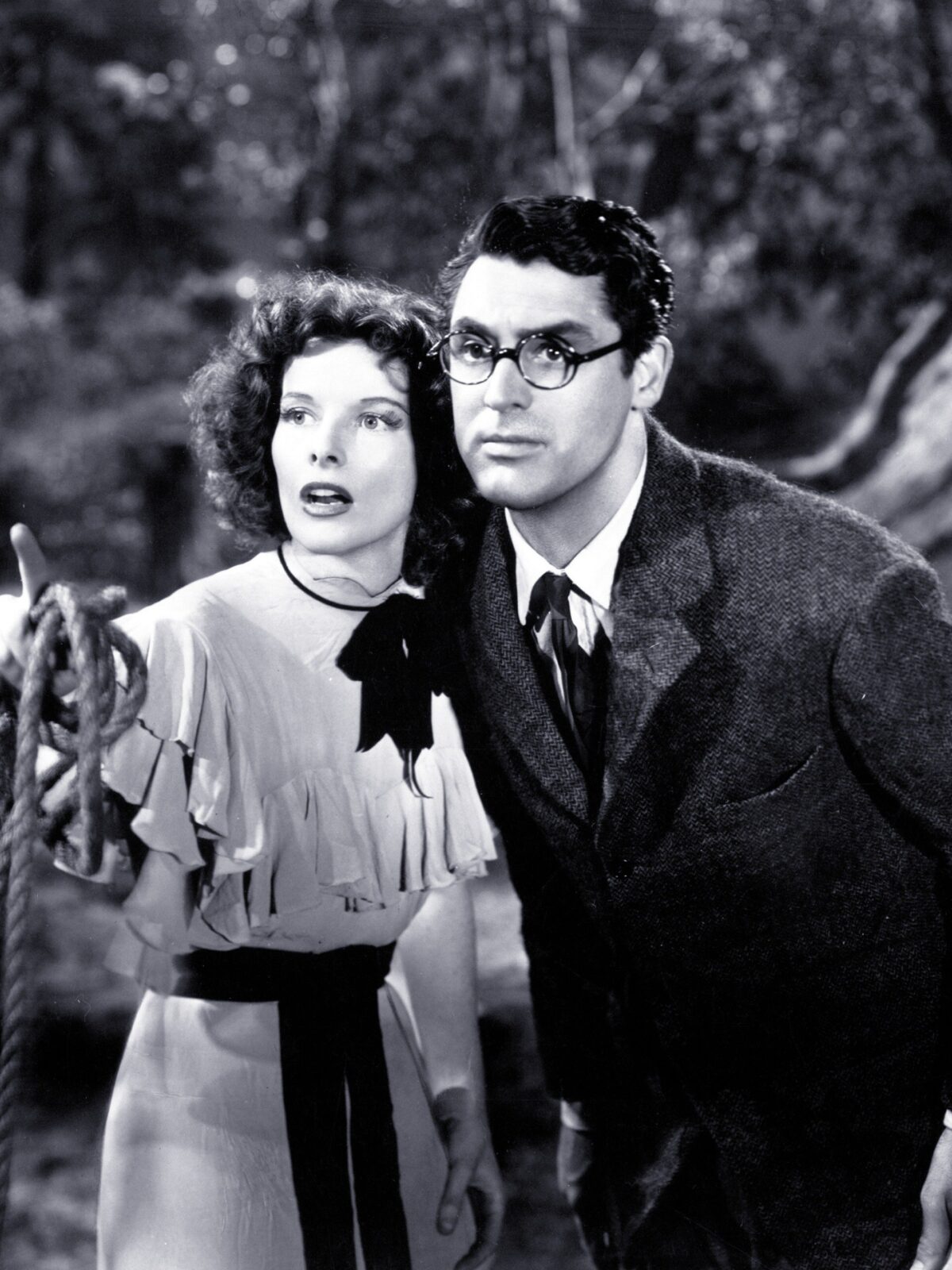
There’s a moment in Howard Hawks’ seminal comedy Bringing Up Baby (1938) where Cary Grant’s David Huxley, a mild-mannered palaeontologist, has completely lost control of his life. He has spent a turbulent day being pursued by a woman he barely knows, tricked into escorting a leopard named Baby to Connecticut, kept from his own wedding, and, finally, relieved of his clothes. Now, wearing a ludicrous negligee and trying desperately to explain his garb, he responds with an exasperated, though now iconic, one-liner: “I just went gay all of a sudden!”
It is a ridiculous line in a ridiculous situation, made all the more remarkable by its reputation as the first use of “gay” (at least in its modern sense) in a Hollywood motion picture. But it also gets at something essential about Grant as a screen presence: no matter the circumstances, no matter the absurd getup, the persona seems to survive. Indeed, Grant is almost synonymous with the pinnacle of polished heterosexual masculinity – he wears immaculate clothes, he speaks with a clipped delivery, he carries the faint air of someone inherently aware of how the world works. But here these elements have been scrambled.
Scrambled by what? Well, the question perhaps should be scrambled by whom. As it is Katharine Hepburn’s Susan Vance who has done the scrambling. She has made off with his clothes, as she earlier made off with his golf ball and car, and the line is uttered by a man finally dragged into her realm of nonsense. A lesser comedy might make one of them the clown and the other the foil. Here, both are funny, albeit in different registers. Hepburn’s comedy is momentum: Susan sails through each catastrophe in the film with total serenity, never once suspecting that her scatterbrained temperament is the cause. Grant’s comedy, on the other hand, is reaction: the double take, the strangled protest, the sentences he can never quite finish. Their lines collide at such a breakneck pace that the dialogue almost becomes percussion. Neither is the straight man, so every exchange lands twice.
For, underneath the bickering, what they are doing is playing. There is scarcely a love scene in sight. Instead, Hawks treats us to scenes where two people who can hardly hold a conversation turn out to move perfectly together. Leaving a restaurant with her dress torn open, they walk out in lockstep, bodies pressed together, like a music-hall double act. Trying to coax a wayward leopard down from a roof, they find themselves singing in harmony. These are the film’s love scenes, disguised as slapstick: the pair are far more in sync long before they would admit to being in love. David’s fiancée promises him a marriage with no domestic entanglements, only work; Susan offers him a game. So, when Susan accidentally knocks over the giant brontosaurus skeleton David has spent four years painstakingly assembling, he can only admit that he has never enjoyed himself more.
It is almost poetic that this same argument, that the right partner is the one who will play with you, is made in another film starring the pair. Released in the same year, George Cukor’s Holiday even repeats the set-up. Once again Grant is engaged to a woman who offers him work in place of fun: where David had his museum, Johnny Case has a nice desk reserved for him at his future father-in-law’s bank, when all he desires is a respite from the corporate ladder whilst he is young enough to enjoy it. And once again it is Hepburn who offers the game. Her Linda, the fiancée’s sister, keeps a playroom at the top of the family mansion, the only room which the Seton fortune has not managed to make solemn, and she recognises a fellow truant the moment Johnny walks in. On New Year’s Eve, whilst the engagement is announced to a ballroom of upper-class bigwigs downstairs, the real party is upstairs, among the toys.
Where Susan and David collided, Linda and Johnny conspire, and this time the comic roles have been inverted. It is now Grant who supplies the momentum, with his somersaults and his scheme to retire young and work later, and Hepburn who is granted the reactions – the delighted stare, the slow grin of someone who has been waiting years for the right man to show up. Once again, the love scene arrives disguised as a stunt. The two tumble in the playroom together – the acrobatics performed by Grant himself with his background as a vaudevillian performer – and the game carries more weight than ever. Linda is falling for her sister’s fiancé and cannot say so. Play is the only language afforded to her, and lucky for her he is the only in the house who speaks it.
This is why their screen partnership still works. Other couples of the period fall in love; Hepburn and Grant find someone to play with, and their films are all the more fun for it. As for the polished Cary Grant we began with, he never stood a chance. He looks far happier in the negligee.
Featured Image: RKO Radio Pictures