By Cara Crofts
“Sometimes, while I am making a tapestry, a melody comes to my head. Then I stop, grab the guitar, and the melody flows with the same ease as if… I was preparing soup!” – Violeta Parra.
Chilean folksinger and artist Violeta Parra dismisses any struggle in her relationship with song – tunes seemingly arrived to her on the breeze amidst the day to day dreariness of stock pots and weaving. Her life could not be characterised by the same soup-making, lyric-writing ease. Financial hardship following the death of their father sent a 13-year-old Parra and her siblings to the streets, playing music for spare change or food in the midst of Chile’s Great Depression of the early 30s. It was through singing for supper that her lifelong need for lyricism began to grow; she came to find – and to crave – solace in the storytelling capacity of music. Songwriting became an addictive antidote for her ensuing bouts of depression. In her poetic autobiography Parra prescribes writing as a remedy which “calms the torments of the soul” but, although her soul might have found some lightness in outpourings of words and melodies, a deep-rooted melancholy tugs on many of her verses.
Parra’s haunting “Gracias a la Vida” is a bittersweet thank you to life, released on her final album Las últimas composiciones in 1966 before her suicide in 1967. Some of its mournful tone is stripped away by the more upbeat tempo of Joan Baez’s famous 1974 anti-war cover. For Baez, recording a home performance in 2020 during the Covid lockdown, “Gracias a la Vida” has the potential – as it always did – to be an anthem which can “help to raise our spirit in difficult times”.
Gracias a la vida que me ha dado tanto
Me ha dado la risa y me ha dado el llanto
Así yo distingo dicha de quebranto
Los dos materiales que forman mi canto
Thanks to life that has given me so much
It has given me laughter and it has given me tears
Thus I distinguish joy from sorrow
The two materials that make up my song
This image, popularised by Khalil Gibran’s 1923 poem “On Joy and Sorrow”, of being “suspended like scales between your sorrow and your joy” is certainly not an original one, but Parra’s tender rendition rescues her lyrics from being trite. Somehow this gentle ode to life was penned by the same self-proclaimed fiery spirit who smashed 48 guitars over people’s heads. In her creations, too, Parra is anything but predictable. Even Las últimas composiciones mixes sorrowful tracks with the playful riffs and satire of “Mazúrquica modérnica” and “El Albertío”. It is an album which wraps us in the highs and lows of life; it cannot decide between heartbroken laments and poking fun at society, but swoops easily between the two. It was a back and forth Parra relished: “I feel happy to be able to wander between my soul, very old, and this life of today”.
It wasn’t until the 50s that Parra became a folklorista. A conversation in 1953 with her brother Nicanor revealed that Chilean folk culture, following its decline during the 40s, was being put under the academic microscope by university students as though it was a thing of the past. “Tradition is already almost a corpse”, lamented Parra at the time, so she began crossing the country to learn the traditional folk music of the Chilean countryside. She would help rural families in the fields or with the household in exchange for being taught to sing. An elderly farmer taught her to play the 25-string Chilean guitarrón, an instrument normally only for men. Not knowing musical notation did not deter Parra – she invented her own. The stories and skills she collected fuelled the songs which Parra started to write and release, and the national reception of these albums popularised a culture that had been on the verge of extinction; her Dylan-like breathing of new life into traditional folk music was a radio success. Across the Atlantic over a century earlier, 19-year-old Edward Bunting began a 47 year-long project recording and preserving music of the last Irish harpers. The titular poem of Moya Cannon’s brilliant collection Bunting’s Honey (2025) pays tribute to him with words that ring true of Parra’s preservation of her country’s music: “for what do a musician’s hands ever hold / but the hammered treasure of the human soul?”
During Chile’s 50s folk revival, photographer Sergio Larraín accompanied Parra to a working class boliche (pub) in a disadvantaged neighbourhood of Santiago. She began drumming the table, singing until the crowned joined in. “They sang beautiful songs,” recalled Larraín, “they were guys who seemed very dejected, but that’s where the music was.” Shared hardship continued to inspire Parra’s musical output with her pioneering of the Chilean nueva canción (new song) musical and political movement in the 1960s. The nueva canción did not stay confined within Chile’s bordering Andes mountain ranges; it spread across Latin America and brought social consciousness and protest to the core of the continent’s music.
Photographs of Parra depict her curled over an acoustic guitar, or a 25-string Chilean guitarrón, but she had a polymath career as a composer, singer, writer, poet, painter, textile artist, ceramicist and sculptor. In 1959, she contracted hepatitis, and the following bedridden months spurred on her main burst of production of visual art, which continued until 1965. Chile’s elitist art scene during the early 60s favoured traditional oil on canvas, so Parra’s arpilleras (embroidered burlap tapestries) or papier-mâché sculptures were not well received. 1960’s Europe, brimming with experimentation and New Realism’s ‘poetic recycling’, took more kindly to Parra’s abstract style and creative use of materials. She was the first Latin American artist to have a solo exhibit at the Louvre in Paris in 1964, turning her space in the gallery into a traditional Chilean ramada by playing guitar and serving Chilean food. Few items beat empanadas for uniting groups of people, but the floors of the Louvre did not erupt into cueca dancing in the way Parra might have hoped.
Alongside scenes of rural campesino culture, Parra advocated for peace through much of her art. Her tapestry Contra la Guerra denounces the harsh political oppression in Chile during the years leading up to Pinochet’s dictatorship.
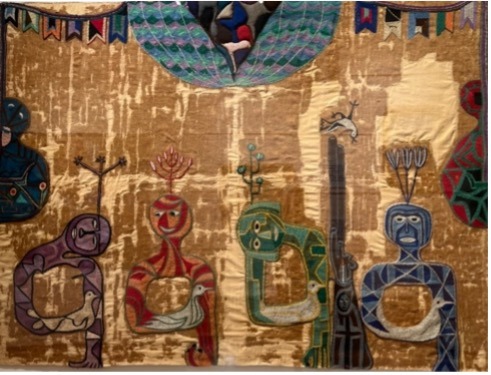
Contra la guerra (Against War), 1962, embroidery on fabric.
“This [political unrest] I don’t like at all,” Parra bluntly stated in a 1965 interview , “so my way of protesting is through painting.” She explains the four embroidered figures in Contra la Guerra: herself and three Latin American friends, united by their desire for peace, each holding a dove. Unambiguous symbols are at play; a dove is shot in mid-flight by a rifle – those in power do not listen to their people. The flowers sprouting from the heads of the friends suggest continued resistance. Parra is unpretentious with her protest art; the pacifist messages are consistently clear and striking, much like her songs.
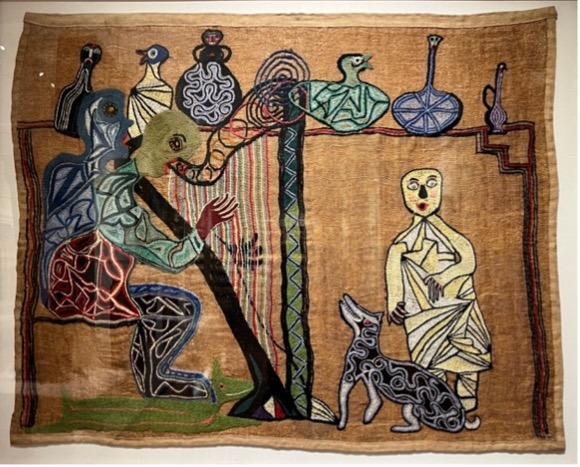
La cantante calva (The Bald Soprano), 1960, yute embroidered with wool.
With embroidering and painting Parra found an alternative to singing during her period suffering from hepatitis, but in her artwork sound still manages to explode out of the visual. La cantante calva evokes Parra’s frustration with her temporary inability to sing; the bird-shaped vases seem to be attempting to squawk a tune, but the swirling cords of wool are bottled up in their stomachs, unable to escape from the beaks in song form. Simultaneously, sound appears to be gushing out of the harpist’s mouth. The ascending circles serve a double function as the harp’s curvature and an outpouring of speech bubbles from the harpist’s perfectly aligned lips. The onlooking yellow figure adds to the imagined soundscape with a mouth curled into a neat ‘O’, perhaps whistling along.
As in La cantante calva, the neck of the player in Parra’s papier-mâché Violinista bends to meet the instrument.
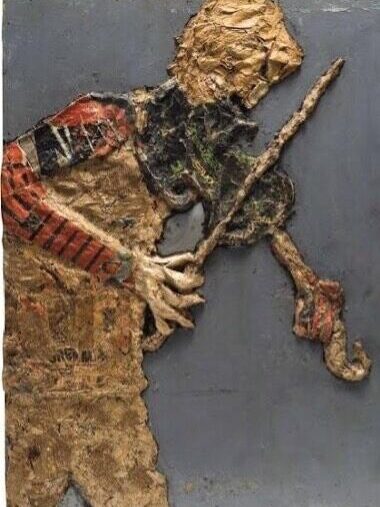
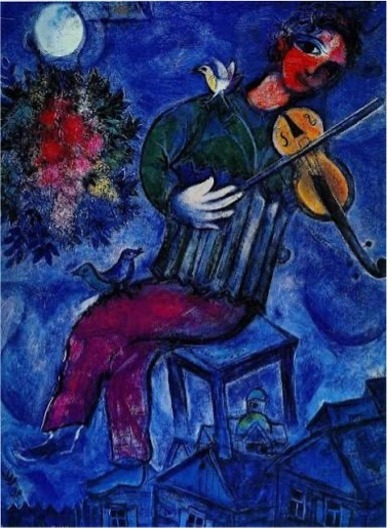
Violeta Parra, Violinista (Violinist), 1964-1965, papier-mâché (left); Marc Chagall, Le Violiniste Bleu (The Blue Violinist), 1947, oil on canvas (right).
It is difficult to tell where the violin ends and the musician begins; in the three-dimensional crumpled fusion of paint and paper the instrument and its player appear inseparable. The figure’s tilting stature and colour tones are reminiscent of Chagall’s The Blue Violinist (1947). In both, a hand glows white as though reflecting moonlight, the fingers splayed widely around the violin’s bow. The hand takes centre stage and seems detached from the violinist’s body, playing of its own accord while the newspaper man’s face tilts towards us expectantly, willing us to hear some musicality.
Parra’s own expression captures her artwork perfectly – her arpilleras are “songs that paint themselves”. It is impossible to imagine Parra at a blank canvas. She sought out the fabric of her country and was a whisperer of the threads of people’s stories; as if under her spell they wove together into words, tapestries and song. Her hunger for stories never died. To hear and see Parra’s art and music is not to be bowled over by perfection, but to encounter people. When asked to choose between song, painting or embroidery as the only form of artistic expression, she replied simply: “I would keep people.” The response of a true folklorista. What Violeta Parra craved more than creating was to connect with and connect the folk behind the lore.
Featured image: Thiago de Mello, 1960-1961, Museo Violeta Parra
One reply on “Violeta Parra: Singing for More Than Supper”
escritura maravillosa, mi corazon