
By Pedro Couto
There were only three things I knew about Harlan Ellison’s writing. First, that it was highly influential, and had inspired writers among the likes of Neil Gaiman. Secondly, that Ellison seemed to take pleasure in writing horror and sci-fi, and speaking to the depths of the self-destructive capacities of the human condition, reflective perhaps of his highly volatile and controversial personality. Lastly, I knew that he wrote much in the same way that an oracle speaks prophecies. I read arguably the most famous of his works, I Have No Mouth and I Must Scream when I was still in sixth-form and was shaken by it, reading a super-intelligent AI claim the title of God for itself, in an age in which AI companies increasingly put us all at risk by trying to make that very reality possible, was eye-opening to say the least. Since reading that short story, I had wanted to read more of Ellison’s works but hadn’t quite landed on the opportunity. That was, until I found a collection of his greatest short-stories for rather cheap at a TK Maxx. Once again, reading Ellison, I found myself afraid, vulnerable – but unlike in the past, hopeful, too.
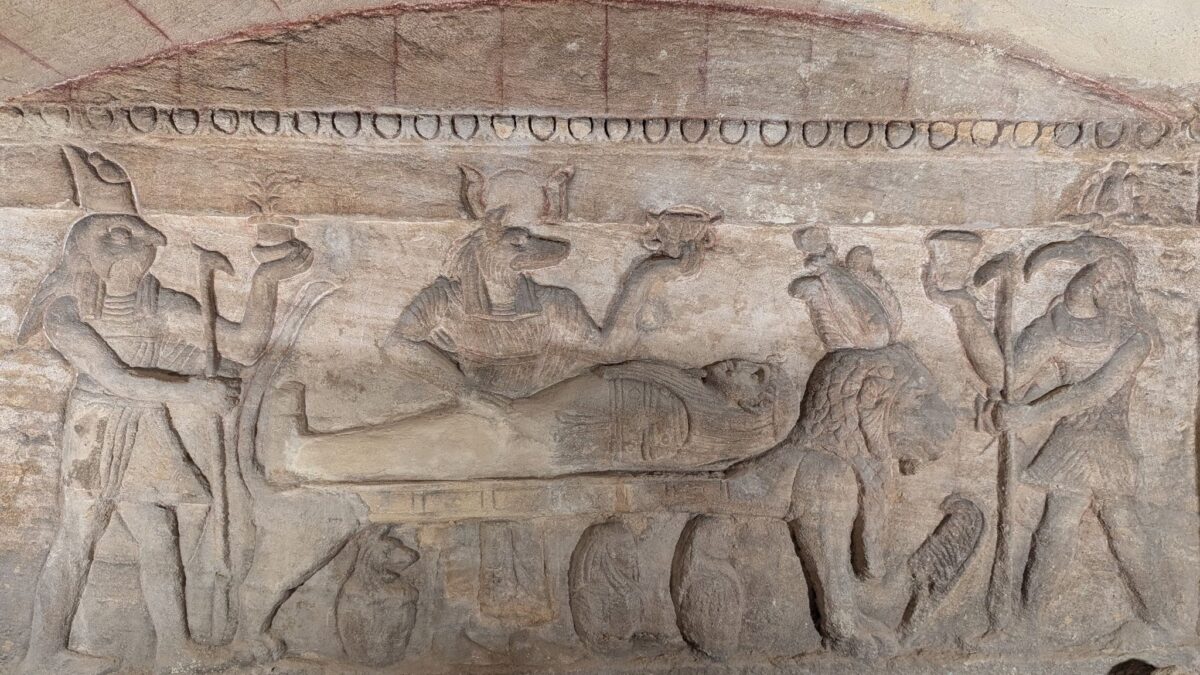
The story I’d like to focus on is called Chatting with Anubis (1995), and it is easy to see where the fear and vulnerability materialise here. Two paleoseismologists, Wang and Amy, delve under the Siwa Oasis and uncover a tomb. There, the Egyptian god Anubis begins to speak to them – he tells them that the tomb belongs to Moses, and that he guards the tomb to stop Moses from going to the afterlife as revenge for his killing the Egyptian pantheon. This grave secret is the core of the story: humanity, led by the herald of Moses, rejected ancient gods; in their rejection those gods died as people ceased to believe in them. It’s there, too, in Genesis: the 10 plagues of Egypt (such as the Nile, symbolic of the goddess Isis, turning to blood). The greater fear is that this pattern repeats itself; the god of Moses is just “yet another god”, and later, as Christ is crucified, this god is killed once again.
This very secret is given as the reason to why Alexander the Great, who also came to this tomb in search of forbidden blessings, fled back to Babylon to engage in drunken sprees of debauchery, until he died of a mysterious and sudden ailment. It is implied by the end of the story that likewise happened to Amy and Wang, as Wang says, “Nobody will bother to say what has taken me. Or Amy Guiterman.”
So why has this secret taken Alexander the Great, Amy and Wang to the grave? In a world in which the gods have existed and ceased to exist as people have ceased to believe in them, it is a wonder why Anubis is still alive. People still believe in death, and fear it. Thus, Anubis’ life is maintained; even if people have forgotten his name, no one has forgotten that their lives are short – that is, except for these three characters, whom Anubis reminded. Alexander the Great claimed association to the divine and searched for immortality, searching especially for the Fountain of Youth. It is perhaps this very search that led him to the Tomb of Moses which Anubis guarded. This search for immortality is still an affront on the god of death’s existence. Alexander does not find the fountain of youth, but instead finds Death himself awaiting him, ready to share the full truth with him. The same is true with Wang and Amy Guiterman. Are we to expect that these secular scientists really believed in the Fountain of Youth, or some kind of eternal life-giving force in that tomb? It is unlikely, but this notion of immortality is the one that comes with fame and legacy; to be the first to discover a tomb at the bottom of a fault-line, to lay claim to that accomplishment. Ultimately however, the reality of death crushes those dreams of recognition. Even Alexander, though his memory has lived on, has perished – what good is his legacy to him, if he cannot enjoy it? The story itself is told to us by Wang, writing in an ancient language and leaving it behind for future peoples to find; a desperate attempt to cling onto his idealised immortal image.
As readers, then, we are left with these words that line up as a reminder of that infamous adage: memento mori. It’s a fact that strikes us, still. I mentioned earlier that this time reading Ellison, I felt hope. When Wang and Amy first talk to Anubis, he thought they were ‘”that great conqueror” come again’. Wang asks if he means Alexander, to which Anubis says that Alexander has no reason to return since he’s already heard the secret, that of the finality of death. Then, who is this great conqueror, who has visited Anubis and made it out alive? In spite of Ellison’s personal atheism, I read this as a nod to Christ, who is also said to be coming back. As a Christian myself, I believe that hope of a future beyond death comes down to Christ’s resurrection. Irrespective of Ellison’s personal faith or strict intention, this is where his story resonated with me. Death may be a guarantee, a totality, but it does not negate hope. To hope is to have faith in the possible – to hope is to truly live.
Featured Image: Maysam Yabandeh