By Cadance Whawell
Durham’s mining history, despite its importance in shaping the cultural identity of the North East, often is unfamiliar to the city’s term-time inhabitants. Unknown to many students is the swarm of people, who flood Durham for one day every summer. Colourful banners, brass bands, and a proud community, alien to Durham’s term-time self, transform the city into a day of remembrance, celebration, and solidarity.
It’s the 11th July 2026, and it is clear this is no ordinary day. As I approach the Gilesgate Roundabout, there is a noticeably shorter wait to cross the usually busy road. It’s only 9am, yet families are already making their way into the city centre, whilst a whisper of music crawls up Claypath. By the time I reach Market Place, the few families have turned into dense crowds, and that distant sound has amplified into the distinctive blast of marching bands. From the Market Place, to Saddler Street, to Elvet Bridge, Durham has been transformed by parades of bands, crowds, and emblematic banners. The Big Meeting has begun.
After weaving through the crowds, and dodging the banners of mining collieries and trade unions, I find the perfect spot. Elvet Bridge in front of me, and the County Hotel directly behind me, I keep hold on my ‘barriers spot’ and wait impatiently for the procession to begin.
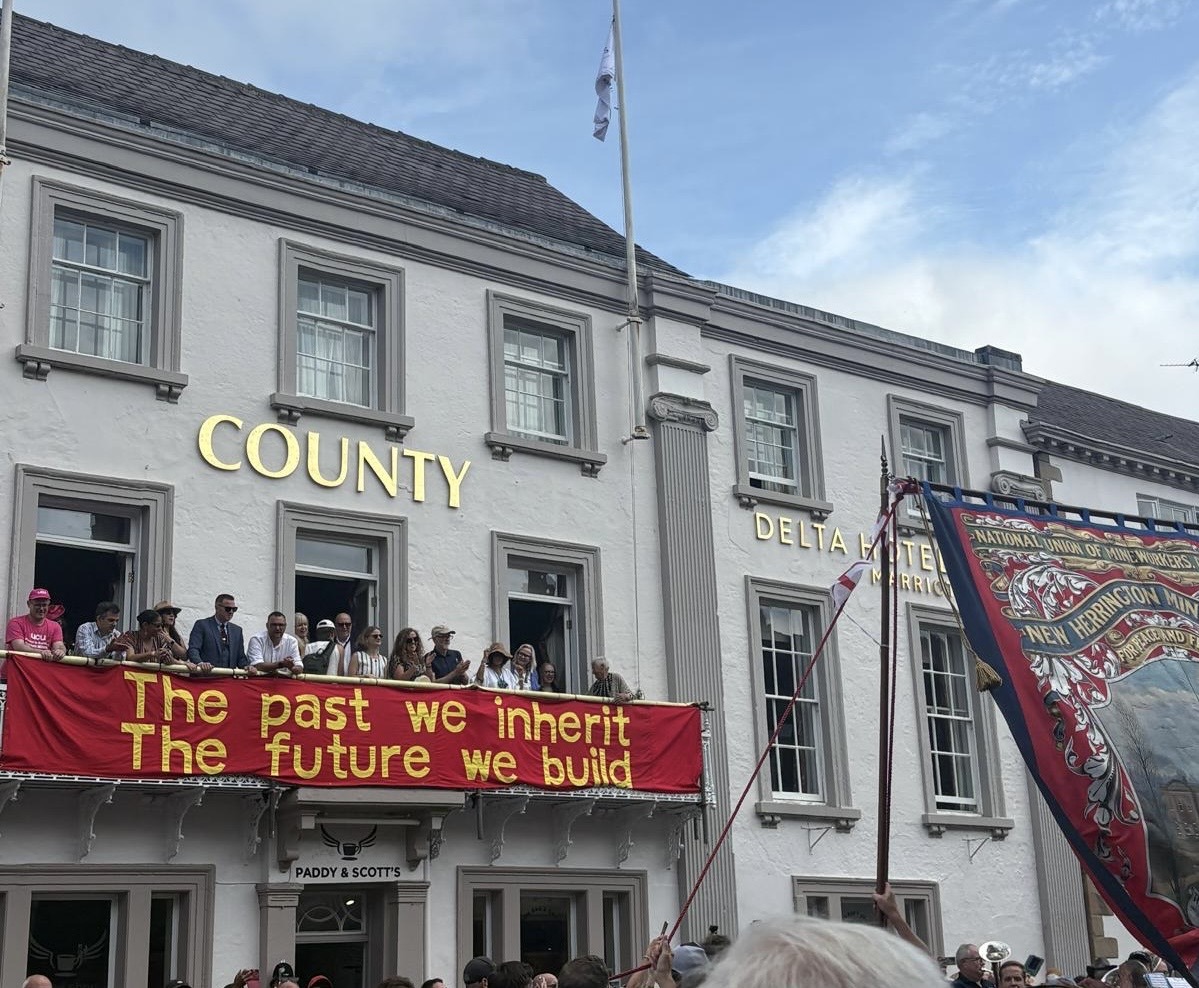
Signalled in groups towards Old Elvet, processions converge from New Elvet and Elvet Bridge before advancing towards the Racecourse. Mining lodges, trade unions, community and political organisations pass by me carrying their distinctive banners, accompanied by the sound of brass bands and bagpipes. Many of the marchers stopped outside the County Hotel, where bands electrified the crowds and onlookers from the hotel’s balcony with renditions of contemporary hits such as Freed from Desire and Sweet Caroline. The juxtaposition of modern music and traditional instruments and symbolic banners poignantly captures this year’s 140th anniversary theme, ‘The past we inherit, The future we build,’ emblazoned across the balcony. A reminder to all that this is not only a celebration of the past, but hope and solidarity as we move towards the future.
After two hours of observing the parade, word of food and festivities at The Racecourse inspired a change of location. Following the procession down Old Elvet, we arrived at The Racecourse, except this wasn’t the familiar picnic spot many students enjoy during Easter term. The green field was concealed beneath a sea of people, lined with the gala’s historic banners, and alive with stalls, food trucks and a main stage. Transformed into a festival celebrating North East and working class culture, The Racecourse was certainly not a quiet cricket pitch today.
This festival ground offered the perfect opportunity to admire the Gala’s emblematic banners. Their symbolism, craftmanship, and detail gave the day an artistic dimension. Like wandering through an open-air gallery, each banner told a different story, reflecting both the histories and the present-day identities of the communities it represents. From mining lodges and miners’ families, to trade unionist, and campaign groups, the curation of banners created a unique representation of solidarity and community spirit.
In the midst of the activity of the day, it became impossible to see Durham only through the sheltered lens of its university prestige. The Big Meeting offers a glimpse into the region’s history, yet football chants ahead of England World Cup match that evening and brass-band rendition of Three Lions revealed how tradition and modernity coexist, allowing heritage to continue evolving. Durham Miners’ Gala is a reminder that the North East’s heritage is not simply something confined to the past. Contemporary culture slips naturally into the event through its songs and festivities, allowing tradition to evolve and be alive in the present, without losing its historic roots. Whilst the Gala preserves and celebrates working-class history, its message of solidarity continues to resonate today. Its socialist foundations continue to adapt to contemporary causes, bringing over 200,000 people to Durham each year from across the country.
Although Durham is best known for its historic landscapes, defined by its cobbled streets, cathedral and architecture, it is the annual Big Meeting that brings the city’s history to life, showing how heritage continues to live within communities today.