
By Verity Browne
Content warning: This article discusses grief, trauma, mental and physical health problems, suicidal feelings, sexual abuse and abortion.
My first encounter with Dame Tracey Emin’s work was at the Tate Modern this summer, at her exhibition A Second Life. A confessional, iconoclastic, and introspective showcase of sculpture, painting, photography, installation, film, writing, and textiles, Emin traverses media and, in doing so, encapsulates the female experience. It was from here that I was hooked on her story, which she details so poignantly throughout her evocative oeuvre. In viewing her exhibition, I picked up on themes of trauma and grief, and in her most recent works, physical illness, as Emin creates art reflecting upon her battle with bladder cancer. In earlier works, this idea of using bodily vulnerability and physical trauma as a subject is also present, as Emin’s two medically complicated and mentally challenging abortions in the early 1990s play a large role in shaping the narrative of her works – as well as triggering an artistic and personal reinvention.
As can be proven by her first-class degree from Maidstone College of Art, before her attendance at the Royal College of Art in 1987, Emin possesses a breadth of technical ability and prowess. In her school years, she favoured printmaking and woodcuts with a German Expressionist feel, without exploring too much the abstract; her subjects were often either dark landscapes inspired by her hometown of Margate, or representations of her turbulent relationship with Billy Childish. Her rarely seen 1980s watercolour paintings depict seascapes from her home in Kent, and interpretations of cityscapes as she explored her familial heritage in Turkey, for example, Istanbul (1989). However, while there are some differences in medium and colour scheme, Tracey’s rendering of people remains, throughout her oeuvre, Munch-like, with distorted or simplified faces, as can be seen in Disposition of Christ (1990).
Around 1990, after her abortions, Tracey Emin experienced what she refers to as an ‘emotional suicide’. Severely depressed and battling intense physical and psychological trauma, she burned all of the paintings which she had previously produced, in a vehemently driven attempt to rid herself of a part of her life which she believed no longer purposefully served her, or positively benefitted her. At her Tate exhibition this summer, I noted a wall decorated with small photographs, ordered in rows, of all of these destroyed works. To me, this arrangement seemed almost cemeterial and struck me in its emotional weight, while I simultaneously could appreciate there was an eerie beauty in such an homage, in Emin’s recognition of the brutality of her past. It can be difficult to comprehend the sheer significance which art has in her life, in order that the eradication of her artworks might be likened to a suicide of part of her soul, and that a material act of destruction can mirror an entirely individual and intimate mental one. In many ways this was the beginning of Emin’s effort to fracture the norms of how art is perceived: not only in the way that it is created and appears, but in the way that it resonates with all who encounter it. She meant to, and means to, challenge what art is and what it can signify – in her case, her art is a part of her very being.
A hiatus from art and creation ensued after her ‘emotional suicide’, until a return in 1993 at White Cube, with her first solo exhibition – My Major Retrospective, in which she debuted a tender assemblage of memorabilia, text, and paintings. Already, a drastic shift in style was apparent, Tracey adopted a more diaristic, honest tone, while also beginning to favour raw imagery of the female body in her paintings and sculptures, and the painting of rageful canvases inspired by her history as a victim of sexual abuse. She was experiencing an emotional rebirth, and this had encouraged an artistic switch from expressionism to a philosophical, and culturally critical, postmodern exploration.
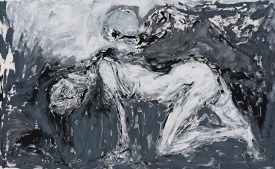
Like the Moon, You Rolled Across My Back, 2022, monoprint
In 1998, Emin created her seminal installation My Bed, and we are thus provided with another example of how reimagination is so vital in her art and in her life. At the time, My Bed divided public opinion and shocked critics. As pictured below, the installation featured a precise replica of her room after a four-day depressive episode, in all of its uncensored and intimate reality. Despite intense initial backlash to Emin’s confrontation of taboo topics, from depression to sexual liberation, it was nominated for the Turner Prize and had immense commercial success, being sold at Christie’s London in 2014 for over £2.5 million.
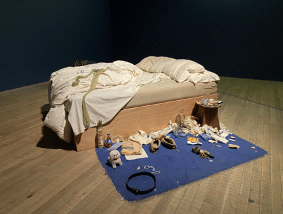
My Bed, 1998, at the Tate Modern 2026
My Bed pushed what art could be to the very precipice, and is now accepted and celebrated for having done so. In Artist Talk: Tracey Emin (2025) by The Yale Center for British Art, Emin confesses that this installation saved her and opened up doors for her. There is something remarkable about the fact that a recreation of one of the most pernicious times in her life could have been reclaimed in a positive way. Moreover, in this interview, she explains her process of installing My Bed each time it is exhibited and how she subtly changes certain elements – it is constantly being adapted and reinterpreted depending on her memory and perception of the site of her depressive episode back in the late 1990s. Thus, My Bed is subject to physical alteration as well as alteration of what it means to its creator; every aspect of the installation is always morphing, and from destruction, Emin produced something insightful and resonant.
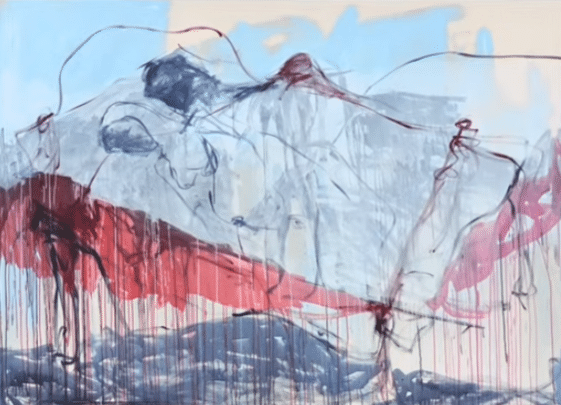
The Saddest Tomb, 2024
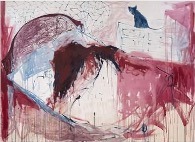
The End of Love, 2024
(Beds became a motif in Emin’s later works.)
In both her personal and artistic life, Tracey Emin has undergone a metamorphosis; from mental and physical turmoil, she takes inspiration and is constantly developing her style and improving upon herself. She has reclaimed her trauma by making it into beautiful, emotive artworks which evoke pathos and convey feminine rage, while remaining sharp and socially conscious.
Interview: Artist Talk: Tracy Emin (2025), YaleBritishArt
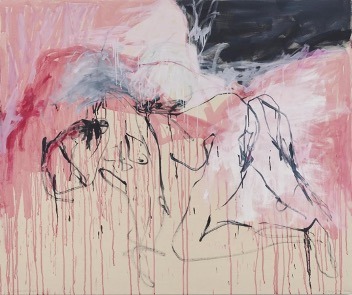
Featured image: Like a Cloud of Blood, 2022