‘The last beachheads of uniqueness have been polluted if not turned into amusement parks: language, tool use, social behavior, mental events – nothing really convincingly settles the separation of human and animal.’ – Donna Haraway
Donna Haraway’s reference to the ‘last beachheads of uniqueness’ being polluted points to the collapsing myth of human exceptionalism and ‘uniqueness’ – a collapse Arne Næss takes further than most. This article will consider Næss’s theory of ‘the ecological self’, actively challenging Western individualism and human supremacy, as radically complicating the concept of human, not through mere entanglement but through philosophical expansion.[1] Whilst Haraway touches on the difficulty of separating the animal and human, Næss believes firmly in the mythic nature of this difference, seeking to dissolve the boundary entirely. Contrasting Haraway’s posthuman irony, Næss offers a serious, ethical vision of the self that redefines identity as inseparable from the nonhuman world. Where Haraway appreciates polluted boundaries, Næss’s transformative philosophy of ‘deep ecology’ erases the dividing line between human and nonhuman, redefining the self, and showing us that, indeed, ‘nothing really convincingly settles the separation of human and animal.’
Næss’s conception of the ecological self fundamentally rejects the human/animal dichotomy Haraway describes, proposing, instead, a radical redefinition of identity as inherently relational, in which the human is not a master but, like all organisms, a mere ‘knot in the biospherical net … of intrinsic relations.’ Næss, who coined the term in 1973, describes ‘deep ecology’ as a rejection of the ‘man-in-environment image in favour of the relational, total-field image’, instead emphasising ‘biospherical egalitarianism.’ Næss critiques shallow ecology (focused on ‘pollution and resource depletion’ and, by nature, undemanding and ‘shallow’ – but, Næss concedes, ‘presently rather powerful’) for almost solely emphasising the ‘health and affluence of people in the developed countries.’ Næss’s deep ecological approach goes beyond mere environmentalism. Indeed, the etymology of ‘environment’ itself encodes and perpetuates an anthropocentric, man-in-environment view, having its roots in the Old French ‘en-vironer’ – referring to the act of surrounding – and suggesting both anthropocentrism and invariable separation. The use of the image of a man-in-environment illustrates the human desire for dominion, with mankind rendered as the sole autonomous actor, with earth as his playground. This desire itself is explained away by social ecologists as a symptom of human hierarchies, with thinkers like Bookchin arguing for social revolution as a prerequisite for ecological restoration. But Næss rejects this view, arguing that, whilst exploitation of nature can be linked to intrahuman hierarchies, it is (1) irresponsible to view ecological relations as merely symptomatic, (2) downright dangerous to delay action against crises until the fall of all oppressive systems, and (3) counterintuitive to centre the human at all. This deep green philosophy is not anti-human, as some, like Eccy De Jonge who suggests the ideology contains ‘palpable misanthropy’, suggest – it is, instead, deeply post-individual. Næss’s concept of the ecological self describes a deeper, interconnected sense of self that transcends the individual ego and embraces the natural world: that is to say, one is inseparable from the ‘biospherical net’ in which they are a knot. And this brings us a new assumption: the needs of the whole biosphere must outweigh any individual species. This assumption, ‘the equal right to live and blossom,’ is one he describes as an ‘intuitively clear and obvious value axiom.’
Whilst Haraway critiques human ‘uniqueness’ through irony, hybridity, and cultural entanglement, Næss’s deep ecology dismantles the same boundary through ontological identification, offering a unifying and arguably more ethically demanding account of what it means to be a human in a shared world. Haraway’s critique is distinctly sarcastic, wrapped up in the rejection of essentialism embodied in A Manifesto for Cyborgs – a constructivist work which favours entangling and merging the machine, human, and animal in bizarre, unpredictable, chimeric ways. For Haraway, the divide between culture and nature becomes inconsequential through the ‘cyborg’, a dual figure that blends the boundary. Whilst Haraway’s comment is ironic, celebrating the blurring and complication of seemingly fixed lines, Næss is sincere, metaphysical, and insistent on our transcendence of boundaries through radical identification with the non-human. Haraway sees the line between animal and human as both corruptible and culturally produced, where Næss sees it as ontologically false. Indeed, Næss’s description of deep ecology contains an excellent synthesis of this relational ecology: he essentially argues, through the figures of ‘A’ and ‘B’, that A and B only exist as A and B because of how they relate. Entities do not pre-exist their relationships – the relationship between them makes them what they are. Whilst the objective of both thinkers is the destabilisation of these boundaries, Næss seeks to replace it with a vision of selfhood (‘“Self-realisation!” as an ultimate norm’) instead of simply playing with its erosion.
Arne Næss’s deep ecology is valuable in understanding both the human and the literature they produce. His works give us the tools and language to interrogate the representation of relations between mankind and nature in the literature we read. The poetry of Ted Hughes and Wendell Berry, for instance, seems to align with this collapse of human primacy by staging a metaphysical return and refusing symbolic domestication – offering space to stage the transcorporeality of matter. That is to say, both poets ostensibly present the animal as something raw, unknowable, and untranslatable – something to be encountered and understood as having ‘the equal right to live and blossom’, aligning with Næss’s vision of the nonhuman as an agentic equal. In ‘I Go Among Trees’, for instance, Berry takes a radical approach to describing the natural world. Refusing to name the creature his speaker encounters in the woods, Berry describes it simply through their interactions: ‘Then what is afraid of me comes / and lives a while in my sight. / What it fears in me leaves me, / and the fear of me leaves it.’ His approach, here, is one of total empathy and identification – one in which equality and mutual respect is integral. Embodied in his employment of grammatical parallelism, this is, at its core, an embodiment of Næss’s concept of the ecological self – an interaction between two beings on wholly equal footings. In ‘The Thought Fox’, likewise, Hughes notes ‘Something else is alive / Beside the clock’s loneliness’, lines which quietly expand the self to include the non-human. Hughes’s poem is a strikingly innocent and peaceful study of one animal carefully watching another. Indeed, the works of Berry and Hughes perhaps go even further in this sense: it would seem that the animal is actually not unknowable, so long as it is encountered on its own terms and not reduced to metaphor merely for the human writer’s self-indulgent self-knowledge. Through their refusal to instrumentalise the nonhuman, Hughes and Berry enact Næss’s philosophy: to truly encounter the animal is not to master it, but to identity with it as an unpretentious equal.
Ultimately, Haraway’s image of the ‘last beachheads of uniqueness’ embodies Næss’s desire to complicate the human as a concept – not through mere entanglement, but through a radical, ontological redefinition of identity. His deep green ecology and conception of an ecological self do not simply trouble the line between human and animal: Næss renders it meaningless. Where Haraway emphasises hybridity, he insists on identification – a radical ontological claim that challenges the very definition of the human. In a moment of ecological crisis, Næss calls us not simply to act differently, but to understand ourselves differently – as beings who are inextricably animal.
Featured Image: Honor Adams
[1] Quotes provided are taken from Næss’s ‘The Environmental Crisis and the Deep Ecological Movement’ and ‘The Shallow and the Deep, Long-Range Ecology Movement.’
Bourdain has his noodles and coke, I have my greasy spoon. All I want after a night bracing the cold in the name of a dance and drinking is a good breakfast. A proper breakfast. No avocados. Thick white bread and conspicuous eggs. Some form of repackaged potatoes, fried. Clattering of cheap cutlery on wellworn plates. The greasy spoon has been the hangover haunt of ravers, drinkers, and night-owls for as long as people have found only a tenner left in their wallet after a night of lambasting the liver. The rich history of these unassuming cafeterias spell out an answer for our ‘identity crisis Britain’ of 2026, and celebrate the contributions people from around the world and across the social ladder have made to British cuisine and culture. With a round of toast at the ready, a strong brew at hand, and an endless supply of bubble-and-squeak, welcome to Caff Society.
The infamous egg-sandwich a la ‘Withnail and I’ – the opening of the best British film ever made bases itself in a 1960s caf
The greasy spoon was born out of a hunger for cheap and filling food, fast. Against the embers of WWII and its subsequent rations, a new war-time industrial workforce demanded feeding. Labouring round the clock, Britons needed places that could fill their bellies up at any hour. A far cry away from the post-war lagging vegetal ration at home, they intrigued workers with plates of hot food full of carbs and meat. These workers’ cafeterias, soon baptised to ‘caffs’ – cafes being too continental – unquestionably became a post-war phenomenon, transforming their one-time necessity into a perennial staple of the high street. With populations from across the world arriving in Britain in search of new opportunities, these eateries were repurposed by immigrants, serving British bellies with the food they knew, with a few twists. The arrival of Italians in the UK made Britain start to switch the teapot for the mokapot, leading to the caff embracing the pillars of Italian coffee culture: cheap and strong coffee, served at a bar, quick no-fuss service, and a brief chit-chat to start the day. As Greeks, Cypriots, Turks and more came ashore, each country’s cafe culture was brought into this new British scene. Caffs slowly moved beyond their utilitarian purpose and became the epicentre for newly emerging immigrant populations to establish home on new soil, whilst also integrating with the locals and their cuisine. To this day, most greasy spoons are owned by families who came to Britain in search of something new, displaying menus that celebrate both the beige comfort of Britain and traditional breakfasts from across the globe. Sausages sit next to shatsuka, jacket potatoes next to pasta al forno. All is equal on the laminated pages of the caff menu. Founded on the promise of cheap, warm and hearty food, the greasy spoon has been a faithful hallmark of the highstreet. Serving savvy shoppers, bulking builders with long cold shifts ahead, and flustered mums in search of a hot drink and satiating slice of cake for the school run, the greasy spoon is a truly egalitarian eatery.
As the post-war industrial workforce began to decline, the greasy spoon was able to keep the friers on by continually meeting a British appetite for cheap food. The austerity of the 80s, strikes, changing pallets of aspirational metrosexual cityslickers, the greasy spoon soldiered it all. Cheap, filling food with familiarity, if not nostalgia. It is not uncommon to go to a greasy spoon and see ‘school cake and custard’ on offer, satiating our hunger for cheap thrills and blasts from the past. What these slabs of stodge consist of is besides the point; the e-number infused fluorescent pink icing and molten custard bring back all the child-like wonder of a cold schoolhall in a polyester sweatshirt. The greasy spoon caters to both our bellies and minds – something trendy cafes and bohemian attitudes fail to do. Walls are decorated with more nostalgic relics. Mario’s Cafe (Kentish Town, est. 1989/1958) boasts a collection of Italian merchandise, photos of the band Madness, who used to hang out in Mario’s with Saint Ettienne, and PEZ machines all serving to delineate the personal history of its Italian owners, and its place within pop culture over the years. Prints of favourite footballers, drawings by local children or the next generation of caff owners, and relics from the homeland all serve in the greasy spoons’ nostalgia trip, physicalising a personal yet shared history of Britain. Part of the nostalgia for those effervescent, unlocatable ‘simpler times’ is the community that we somewhere along the line had been told had been lost. Enter the caff and the community is right there, alive as ever before.
Unified in an appetite for a quick, no-frills meal on a fornica table, striking up conversation in a greasy spoon is encouraged, if not expected, amongst those who dine there. The cheap promise of the greasy spoon solidifies its position as a sanctuary for many who otherwise might not talk to others as frequently. It is no wonder the first lines of Withnail and I are said in a caff as I’s hangover epiphany takes head. It is in looking at all these faces, all these Londoners, that he realises his place among them, and the state of the world he has found himself in. Be it through working unsociable hours, the unaffordability of congregating in other spaces for long periods of time, or elderly isolation, the caff provides a space for all to sit, receive something warm with a smile, and to talk to a stranger whilst passing unbranded sauces back and forth. It is for this reason many artists, like Saint Etienne or Gilbert and George, who refuse to eat in their home and prefer their local Market Cafe, have come to love the caff. Not only does the promise of a hot meal appeal to the starving artist, but they are fertile grounds for inspiration due to the heart of the caff being found in the people that make and frequent them. Local and tourist alike commune under the roofs of these community sanctuaries, filling in the space for community centers, workers cafeterias, and social clubs when the state fails.
However, it hasn’t been all golden for the greasy spoon. Whilst the greasy spoon helped change British pallets by serving their owners’ homeland favourites alongside British staples, British snobbery can never be underestimated. Caffs are working-class institutions and it wasn’t long until their locations and plates were going to be scorned for being rough, unnutritious, and showcasing an unpolished Britishness.
There is a lot to be said for the unimaginative quality of British cuisine (‘bombs flying overhead’ springs to mind), but there is a time and a place for it, particularly if you’re hard up or facing a long, laborious shift ahead. As more Britons began working the 9-5 in offices, the need for a hearty fry-up breakfast, or an omelette, chips, and salad lunch, waivered, and palates became more aspirational with this turn away. Rationing gave British food a bad name, blighting any chance of British food actually having a renaissance – note how during the 90s ‘Cool Britannia’ era, all touched by Britain turned to gold, besides our food. Moreover, the grease that gave these caffs their name was no longer a desirable hallmark of a good meal. A more health conscious, aspirational Britain didn’t envision greasyspoons in its 21st century make-over. Hit with the blow of rising rents and food prices, the greasy spoon is more of a treat than ever on our high streets.
In a climate where luxury items have been replaced by luxury experiences, even your morning cuppa has to be a signifier of your wealth, with brand name coffee cups becoming the must-have item on the morning commute. People love them for their in-n-out service, consistency across cities, and variety of different combinations to give your day a sugary caffeinated start. Each coffee shop has its own unique appeal, from a trendy logo to being matcha pioneers. If you frequent Blank Street coffee, your coffee won’t even be made by a person – how fantastic! Breakfast spots have transformed from a necessity and a local hub, to an overdone, overpriced experiment in the power of marketing. As a South London native, watching my local high streets succumb to this trend has further pushed the greasy spoon to the side as we favour slick coffeeshops with the familiar comfort of an instantly recognisable logo and name. The caffs of London, built off post-war spirit and optimism, have now been replaced by heartless corporations, pushing locals further away. However, there is cash to be made in nostalgia, so we can trust corporations to cash-in. Norman’s, a shallow imitation of the ‘working-class cafe, yah’, is the prime example of the co-opting of British nostalgia and working class culture in order to market an experience to audiences who want the caff ‘vibes’ without the actual grease or Common People. Norman’s hipster-facing, venture capitalist-backed attempt to gentrify the caff fell flat on its face after 5 years, despite being used by Burbury in a campaign in 2023. It’s uncanny in its hollow evocation of these institutions with owners who should have listened to Jarvis Cocker more. A picture of the England men winning the ‘66 cup is slightly too neatly hung on a freshly painted wall; no one who works there was around for that moment and there is no sense of personal attachment to anything. The signage is too curated, informed by a vision board, not picked from a list of slightly funky, slightly carnival-esq, slightly formal fonts from a signage company. There are wine bottles next to the cans of pop. It wants all the aesthetic, with none of the authenticity. British class dynamics are a contradictory, intricate, and often confounding series of movements to follow, but the love of the higher-classes to play poor will forever haunt our culture. Norman’s and other such institutions that owe their success, failure, or idea from the caff will never live like common people, they’ll never do whatever common people do, but attempt to capitalise off the uniquely British romanticisation of the common person. Norman’s failed due to its inauthenticity, bringing hope back to the local caff as customers crave the ethos that powers them on.
I propose to embrace the current nostalgia trip trend affording greasy spoons the current attention they’re receiving – viva the greasy spoon renaissance. Instagram accounts like @cafss_not_cafes and @eggchipbeanpint are reintroducing these spaces to a younger, digital clientele to whom the greasy spoon is the relic of the past with olden times prices. We like them for their cheapness, their familiarity, and their authenticity as local establishments, but let’s take that further. Whilst my local Pret by Brixton station has responded to the fact that the local homeless population often bed down outside its doors by promising it donates to homelessness charities, The Hope, a caff on Holloway Road, boasts a sign that encourages those in need to come in from the cold and have a bite to eat, paid for by a charity pot on the counter filled by its local customers. Whilst not all caffs operate on such a charitable basis, their place as institutions that offer cheap cups of tea and toast, where cash is always king, and there are no questions asked about the length of your stay (most caffs operate on a counter service leaving tables unsurveyed by floor staff) provides refuge for many in need. They stand as a testimony to the optimism of a post-war society where local businesses could serve as local community hubs, ensuring all were well-fed – including the new arrivals to the country that took on the leases. They became the physical incarnation of Modernity Britain, a tolerant multi-cultural society that provided for all, and perhaps could help glue together the fragmented country we find ourselves in today, one sausage bap at a time.
I remember the last day I spent outside without a hijab. The frigid gasps of winter were fading into a peaceful springtime. Meditating on my forthcoming decision while meandering down cobbled walkways, I remember feeling the wind rake nails against my scalp, tousling hair chaotically around my ears and mouth. I felt small, lost in a sea of people who didn’t know my commitment to my faith, the most important part of my life. They saw a girl with brown skin drowning in her decisions with a furrowed brow, and I didn’t know if they saw anything past that. I didn’t feel free without the headscarf; I felt exposed and vulnerable, small and forgettable.
My first week of wearing the hijab outside, I kept having the feeling of being watched. I would walk hurriedly through campus, trying to outpace the sun on my way home through the easy spring air. Cherry blossoms unfolded overhead, the serene sight dampened by my rising self-consciousness. With the hijab draped over my head and shoulders, dress fluttering shyly in the wind, I tried not to scrutinize every look thrown my way, wondering if every mutter and muffled laugh was targeted at me. I wondered what generalizations were being piled onto me, if they thought I was oppressed, if they thought I was judging, or rude, or a thousand other stereotypes.
This feeling of being watched, scrutinized because of my visible difference to the rest of society, wasn’t new. Prior to proudly wearing my Muslim identity, I had grown up as an Indian-American girl in the white suburbs of Chicago. Before I ever learned that the skin I wore was different from everyone else, I found myself drawn to the few other girls of colour in my elementary school. We never acknowledged the force that had drawn us together, never said out loud that, for some reason, we felt more comfortable around each other than our peers. We didn’t understand the implications of race, and maybe we were better for it – it was totally fine that most of the kids in our class went to the same church camp and their dads played at the same country club. We had each other when we wanted to share stories of our nanis’ cooking and favourite Bollywood songs.
I was made very aware of my differences in high school. One frustrating afternoon spent in our white-majority school, my Filipina friend ranted to me that she wished she was “just called a slur” instead of experiencing the institutional, hidden racism that made us both feel unwelcome in a way that was impossible to articulate without sounding paranoid. At that school, both of us had felt that bone-deep certainty that we were treated differently than everyone else, but carried around the awful feeling of “what if” – what if that teacher didn’t mean to be racist, what if I really am that bad of a student, what if my feelings aren’t valid? What if nobody will believe me?
It was the same pseudo-paranoia that had been following me around for weeks after putting on the hijab. I am incredibly proud of my religion, but also incredibly aware of the assumptions now placed upon me by people who had never met me. The first friend I met up with after putting on the hijab asked me, eyeliner drawn thickly around concerned eyes, “Did your parents make you wear that?”
I had laughed slightly, my smile fading once I realized that she wasn’t joking. I took a calming sip of the hot chocolate in front of me and made myself actually consider an answer. “My mom doesn’t wear the hijab, actually. It’s her choice whether or not to put it on, to dress as covered as they want. I choose to dress modestly because I like being known by my faith.” I twisted my lips to the side, considering. “Just like how your goth clothes,” I gestured to her fashionable all-black ensemble, “let people know that you’re a theatre kid with great taste, my hijab lets people know how I conduct myself, just like my Indian jewelry lets people know that I’m proud of my heritage. I choose to dress in a way that displays my identities, and how happy I am to represent them.”
She pouted at the thought that she was goth and we laughed it off. She never brought up the subject again. One night a few months later, preparing to walk home from the library into the frigid air, she turned to me while tying her scarf into a balaclava. “Can you teach me how you do your scarf? I want it to look elegant like that.”
I remembered our conversation in the spring a few weeks after making the big decision. I was walking with my mother around the quiet streets of my American hometown, a green scarf covering my head, a blue scarf covering her shoulders. “You’re already all the way in England, beta. What if something happens to you? What if someone tries to attack you because you wear a hijab?”
I smiled at her gentle, protective prodding. “I’ll be okay. I’ve been a brown girl in this town,” I flung my arms out, gesturing to Chicago, “for my whole life. I already know what it’s like to be scared around people who might not understand me.” She pursed her lips. “I know, I know you’ll be careful.” She paused, collecting her words. “It’s a brave thing to do. I’m just so worried about you.”
I hate that I have to carry my mother’s worry around. I hate that I can’t tell her about my hijabi friend who had her scarf pulled off, violently, suddenly, in the middle of the street just a town over from my university campus. I hate that her worries have so much validity.
“By the way,” a full smile returned to my mother’s face, “I know some Indian moms in the community who want a ‘good Muslim girl’ for their sons.”
I laughed, well aware of the trope. Yes, I wear hijab with mindfulness, and I know the stereotypes that come along with it. But I am not a “good Muslim girl,” and my mother knows that. I am not good. I am passionate, I’m angry, and I cry during rom-coms that aren’t really that sad. “Good Muslim girls” don’t exist, they are a colonial figment of the collective Western imagination. It’s the idea of every Muslim man who doesn’t take into account how difficult it is for their daughters and sisters to be “good”, to be polite all the time knowing that the second she shows a bad temperament in public, it reflects badly on her entire religion.
My mom knows the kind of girl I am. The day I flew home from the UK to the US that fateful spring, I landed in the ever-bustling O’Hare airport. I was wearing a comfortable black hijab and fidgeting with it while listening to my own pounding heartbeat. I hadn’t told my parents
about my decision to put it on, and was nervous about what they might think. I knew about my mom’s fears, and also my dad’s indifference to the whole idea – in the Indian family he’d
grown up with, hijab was a choice not made by many, and I wondered if he would mirror my mom’s reaction.
They didn’t say anything about it at first, just welcomed me home with open arms and squeezing hugs. It was only after we got onto the highway when my mom started, quietly. “I had a dream about this.”
“About what?” I questioned nervously, still fidgeting with a frayed edge of my scarf.
“I had a dream last night that you came out of the airport wearing a hijab. And you looked… you look so grown up.” She smiled, tears in her eyes as she looked at her daughter, the girl that she knows so well.
I stopped being self conscious about being stared at since then. The people that love me understand that putting on the scarf never changed who I was – it just made me less invisible, made my identity more clear, and put the declarations I’ve made to my God at the forefront of who I am.
The ability to be seen for who I really am is why I wear my hijab, why I wear Indian jumkahs and eat paneer and celebrate Eid. It makes me feel at home, protected from gazes that seek to put me in a box. The people that love me, know me – and I hope anyone staring at me in public, transfixed by my brown skin and modest clothes, will know who I am as well.
“He had known that she would pass from his hands and eyes, but had thought she could live in his mind, not realising that the very fact we have loved the dead increases their unreality, and that the more passionately we invoked them the further they recede”
E.M. Forster, A Passage to India, p. 47
The first time I read this quote in A Passage to India, it shocked me profoundly. It uprooted all my beliefs and assumptions about death and memory by challenging sayings such as ‘they will be with you in your heart’, or ‘they may physically be lost, but your memories of them are not’. The thought that the more I tried to remember deceased loved ones the more they would slip away, terrified me. No one wants death to be absolute.
It is safe to say that reading this quote flung me into an existential crisis. Here, it is as if Forster is trying to suggest that being loved in life does not ensure that you – the real you – is remembered in death, but can taint the memories of you in the minds of those who knew and valued you. The greater the love, the greater the loss is a well is a commonly cited phrase. However, I always wanted to believe that this loss is only in a physical sense and not in a spiritual way.
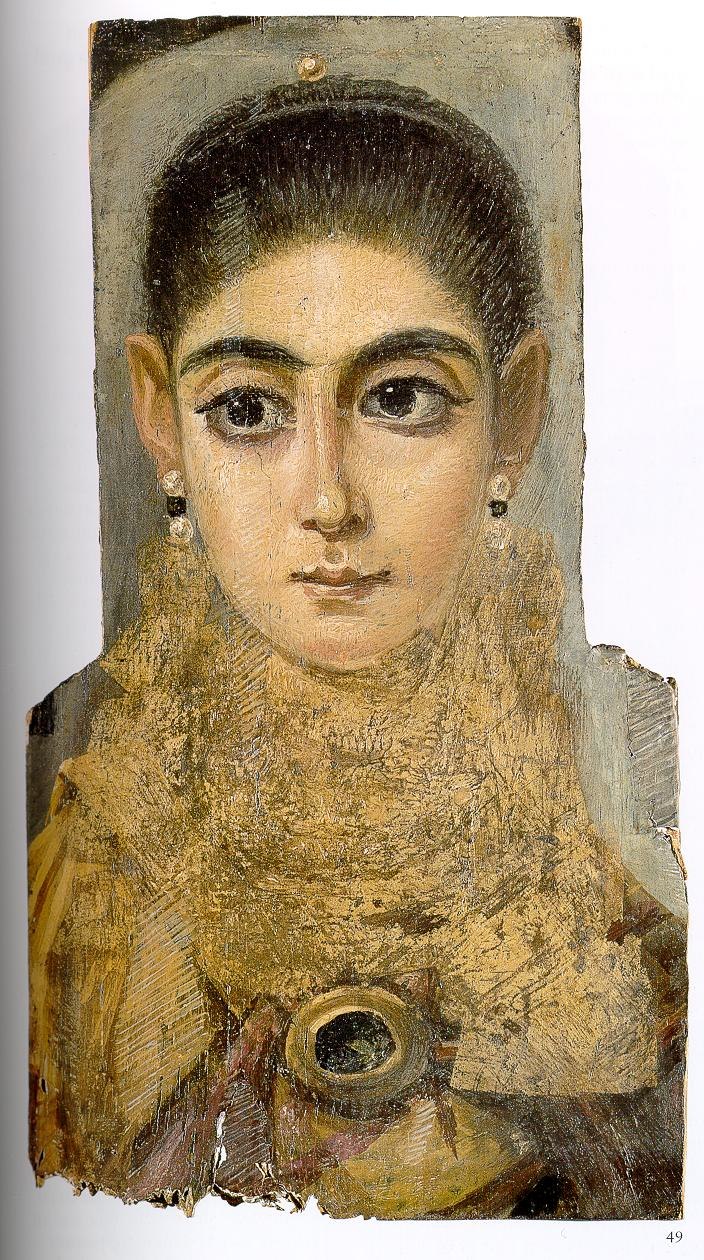
So, as Forster suggests, if being loved cannot save us from being forgotten, then what can? The Fayum Portraits offer us an interesting perspective. Painted between the 1st and 3rd centuries and mostly found in the Fayum region in Egypt, these portraits capture people with an uncanny sense of reality and vitality ‘as if they have just tentatively stepped towards us’ (John Berger, Portraits, p. 9). They were placed on top of the coffins of the dead to act as a marker of identity for their journey to the kingdom of Osiris, and to serve as a remembrance tool for the family and friends they left behind. Although it is difficult to discern how far the artists of these portraits captured the likeness or ‘mimesis’ of their subjects in the absence of photographs to compare them to, their two-pronged function as an early ‘passport photo’ (Berger, p. 8) and an aid to memorialisation suggests that an accurate representation of reality was imperative. The Fayum portraits were produced centuries before the Renaissance, when the function of portraits underwent a major evolution to no longer simply depict an individual’s physical appearance but also their ‘charisma’ and inner virtues.
In the twenty-first century, we now have the ability to take photos which can capture the likeness of an individual to an accuracy arguably unachievable by painted or drawn portraiture. However, what is remarkable about the Fayum portraits in contrast to their digital descendants is their survival. This was a point highlighted by art historian Simon Schama in discussion of the question “Why portraits still matter?”, discussed during a Sotheby’s Talk in 2023. Schama suggested that in an age where images simply disappear after twenty-four hours on Snapchat and we are reliant on ‘the cloud’ for the storage of our photos, the worry is that the images we create and collate digitally will someday be lost. It is indeed common practice to put a photograph of the deceased on the front page of printed orders of service for funerals and memorials – maybe our modern-day equivalent to the Fayum portraits? Nonetheless, surely the innate value of works of art means that we are more inclined to ensure the survival of a painted or drawn portrait over a digital one?
Unfortunately, for everyone to have a portrait painted or drawn is an unattainable reality. However, a consideration of the Fayum portraits, at least to me, acts as a prompt to move away from a reliance on the digital to capture yourself and your loved ones in an analogue form. Portraiture is one way of eternalising your physical self whereas writing, specifically private, personal writing, offers a more accessible way of ensuring that your essence does not ‘recede’. Anything from poetry to quotidian prose can become a vehicle through which the recollections of the deceased can avoid slipping into ‘unreality’.
However, the effectiveness of using personal writing as a way of eternalising the reality of a person is contingent on two factors: the writing has to be contained in a physical body to increase its chances of survival, i.e. in a notebook or in a paper folder rather than stored digitally, and the writing has to be guided by ‘how it felt to me’ or the ‘implacable “I”’, as articulated by Joan Didion in her essay On Keeping a Notebook.
‘We are not talking here about the kind of notebook that is patently for public consumption, a structural conceit for binding together a series of pensees; we are talking about something private, about bits of the mind’s string too short to use, an indiscriminate and erratic assemblage with meaning only for its maker’,
Joan Didion, On Keeping a Notebook (1968)
Just as when portraits began to be co-opted by Renaissance rulers as a visual language through which they could articulate political messages and dynastic ties when put on public display, the “I” of a notebook is lost when it is written for others. Maybe, if we all engaged in more personal, analogue modes of reflection – whether a work of art or a piece of prose – we would be more likely to win the fight against being forgotten, the essence of our person is less likely to be blurred and retold in the minds of those who outlive us.
War exposes the foundations of any society, both in its manifestation of power and its propensity for cruelty. Perhaps the most striking sign of this is the historical pattern of women in conflict: they are consistently the first to be attacked in specific, targeted ways and the last to be included in peace calculations.
This observation is not an attempt to diminish the experience of men, who bear the primary weight of frontline combat. Any conflict driven by the realities of the trenches, be this conscription, physical harm, or the general sacrifice of the male body when serving, is an absolute and central tragedy of the state. But recognising this does not mean the specific nature of violence aimed elsewhere should be overlooked. While male casualties are largely the result of kinetic engagements between armed forces, violence against women (particularly that of sexual and psychological nature) often functions as a purposeful, non-kinetic weapon. It is a tool used to accomplish a very specific military goal: the destruction of the internal cohesion and functionality of a community.
Rather than being a byproduct of chaos, it is a calculated instrument of force. We see this in the systematic recruitment of “comfort women” during the 1940s, or the use of mass rape as a tool of ethnic cleansing in the Balkans and Rwanda, these being just a few examples. They are a part of the long lineage of conflicts where the harm visited upon women was not a side effect of combat; it was the combat. By turning the body into a battleground, an aggressor effectively shifts the frontline from the geographical boundary to the domestic centre. It targets the primary caregivers and the links of social life, ensuring that the war’s devastation is generational rather than just infrastructure-deep, and effectively poisons the social foundation upon which any future stability must be built. The efficiency of this strategy lies in its long-term impact; even if the governmental occupation ends, the society faces a fundamental challenge in reorganising itself at its most basic level, because the “victory” was achieved by breaking the social unit from the inside out.
But this tactical utility is followed by a predictable political pivot once the kinetic phase of conflict concludes. Diplomacy, by its very nature, requires a narrowing of focus and a prioritisation of the immediate cessation of hostilities over the resolution of deeper social trauma to function.
Thus, in this context, being “the last to be considered” is typically a result of the technical limitations of the peace process, where the urgency of reaching a consensus forces negotiators to discard any variables that cannot be easily measured or traded. For those tasked with designing a new order, the specific abuses that are inflicted upon women represent “messy” data, or in other words realities that complicate the straightforward math of territory and disarmament because they cannot be settled with a signature. In this calculus, peace is treated as a technical binary (the absence of gunfire) while the restoration of the community is categorised differently. This move recontextualises the focus from the political agenda to a charitable one and allows the formal peace process to remain streamlined, even if it remains incomplete. By shifting these issues into the realm of “humanitarian” concerns, the state effectively removes them from the political table, treating them as secondary casualties of war instead of primary peace objectives. Admittedly, there have been genuine advancements in how these issues are recognised. The inclusion of gendered crimes in international legal structures and the presence of women in peace delegations represent a significant shift toward a more comprehensive record and a growing admission that a stable state cannot be constructed on top of unaddressed atrocities.
These developments are often able to provide a legal and ethical vocabulary for violations that were once entirely ignored, and are coming to signal a slow but real evolution in global standards, as well as a transition from total impunity to at least a baseline of accountability. Yet, even with these tools, the transition to stability remains a multidimensional issue. It is often simpler for an administration to focus on the visible markers of statehood (borders, banks, and the formal structures of a regime) under the assumption that once the formal structures are in place, the rest of society will naturally be able to follow suit. The official conclusion of a war is rarely a full resolution. More often, it is just a bureaucratic milestone. By treating the specific targeting of women as a secondary issue, diplomacy settles for only a very narrow and fragile definition of stability. It treats peace as a political deadline that can be met by drawing a line under the measurable aspects of war, and leaves the unmeasurable human consequences to fade into the background of both the private home and the female body. The result is a landscape that is technically at rest, where the maps are once again redrawn and records are closed, yet the fundamental work of social reconstruction continues, largely unacknowledged, in the margins.
The English language has been used consistently in the United Kingdom for over 1,500 years. When Germanic dialects were brought over by Anglo-Saxon settlers in early medieval England, what we know today as “Old English” was born. Celtic languages which dominated the country, those known collectively as “Common Brittonic”, which themselves are ancestors of modern-day Cornish and Welsh, were soon replaced by this Germanic influence. However, despite both being given the name “English”, how similar is today’s language to the Old English of the past?
The switch between Old and Middle English
A well-preserved jewel of Old English is the opening line of the famous poem “Beowulf”, which reads, “Hwæt! Wē Gār-Dena in geārdagum þēodcyninga þrym gefrūnon”. As an English speaker in the 21st century, you likely skimmed over that; it is simply illegible to you. However, it might make you wonder just what happened over the centuries to make Old English so different from the version we use today.
It is widely considered that the two are separate languages. Many factors shaped modern-day English into something unrecognisable when put next to Old English, a major one being French and Latin influences that came about after the Norman Conquest in 1066. The ruling class in 11th century England swiftly adopted Norman French due to the influence of William the Conqueror; for around 300 years, it was considered the prestigious language of law, government and the court in England. However, it was only being used by a certain elite, leaving a large majority continuing to use English. This ultimately led to a major linguistic split, serving as a catalyst for the development of Middle English, a new variation of the language which was heavily influenced by French. Due to the split, a drastic flood of French vocabulary was stirred into the midst of a developing language, creating an immense semantic shift from Old to Middle English.
How Middle English evolved into Early Modern English
Middle English’s life span is accepted to be between 1100-1500. A major differentiation between this form and its predecessor is the extreme pronunciation differences caused by the Great Vowel Shift. Taking place primarily between 1400-1600, this was the process through which vowel pronunciations in the English language underwent several significant changes. Its exact cause is debated, however many linguists believe the phenomenon could be attributed to the Black Death, natural language change or social class differences. The Black Death, for one, triggered a massive population migration to Southeast England and London. This huge shift involved mixing a range of dialects from all over England, encouraging middle-class Londoners to distinguish themselves from newcomers by changing their vowel pronunciations. In this way, Middle English slowly parted with its traditional features, evolving into what is now known as Early Modern English, commonly referred to as “Shakespeare’s English”.
The Evolution of Modern English
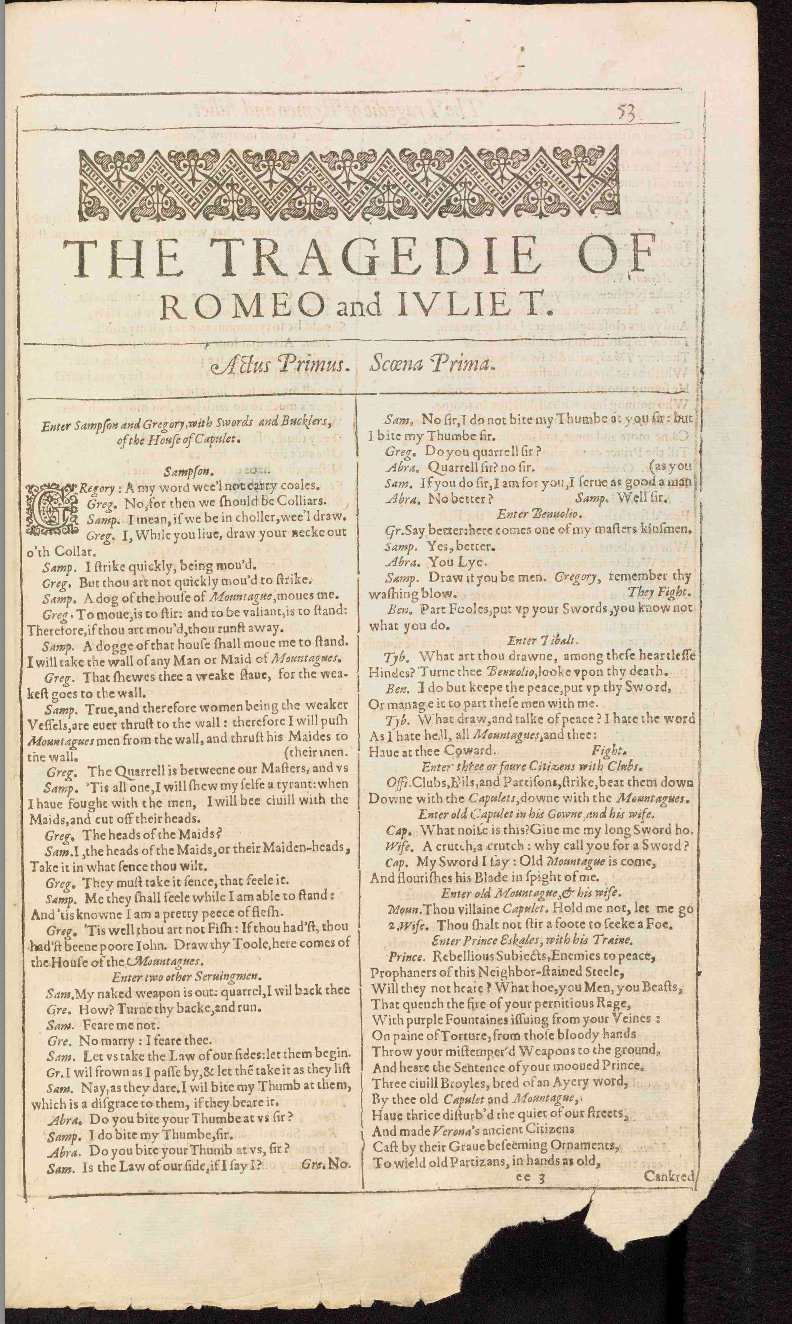
Early Modern, or Shakespearean, English is not considered a distinctly separate language from that which we use today (Late Modern English). And yet, despite this, many modern-day English speakers would much prefer studying Romeo and Juliet with a 21st-century translation running down the side. Bearing in mind that Early Modern English was a bridge between Middle and Late Modern versions, there are notable features from both variations of the English language throughout Shakespeare’s works.
If you’ve ever stepped foot in a GCSE English classroom full of students studying Romeo and Juliet, you have, without a doubt, heard several students utter that famously mistaken line: “wherefore art thou Romeo?” The present-day usage of the adverb “where” typically results in many people using context clues and guessing that Juliet is asking about Romeo’s location. However, the archaic term “wherefore” generally translates to “for what reason” or “why”, showing Juliet is asking why Romeo has to be Romeo, a child of the Montagues, her family’s generational rivals. Shakespeare also famously invented, adapted and popularised words to create meanings when he felt pre-existing words were too weak to describe the intense plots and characterisation in his work. For example, he popularised the modern-day meaning of “addiction”, which stems from the Latin word “addicere”, signifying to devote or assign.
Over time, the archaic features of Shakespearean English faded out, leaving the 19th century with a new version of English that is largely similar to that which we use today. We might think of the first lines of Charles Dickens’ A Christmas Carol – “Marley was dead: to begin with. There is no doubt whatsoever about that. The register of his burial was signed by the clergyman, the clerk, the undertaker, and the chief mourner.” This version of English is generally legible to a present-day English reader without the support of a translation. But are we really, in the 21st century, in the same linguistic stage as that of Dickens and the Victorians? Some might argue that the digital era and the advent of other technologies have transformed the language once again. Nowadays, many individuals communicate over the internet using nothing but emoticons and emojis. Instead of “I laughed at this!” a simple “😂” can say the exact same thing with no words used. A debate that can often become heated is whether these features are “killing” the language, but if this article has shown us anything it is that English, in short, loves to change. Features of language brought in by technology are simply new and telling developments – not a threat. One of the oldest symbols of communication were cave paintings and rock art, which date as far back as 30,000 BCE. Given that, could we argue that in using emojis we are going back to our roots, reconnecting with humanity’s earliest forms of communication?
It’s a never-ending pursuit, and I think that’s the point. When you start thinking differently is when you’re going to get yourself into trouble. – Braxton Haugen
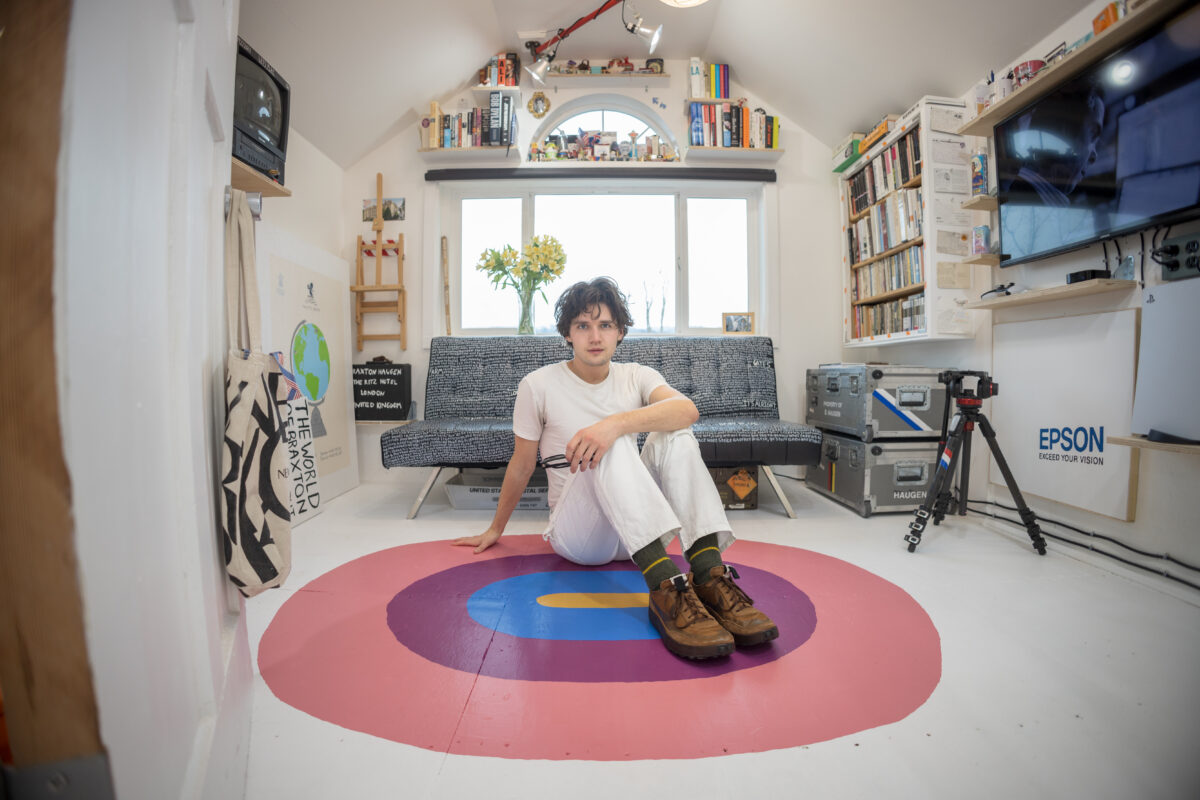
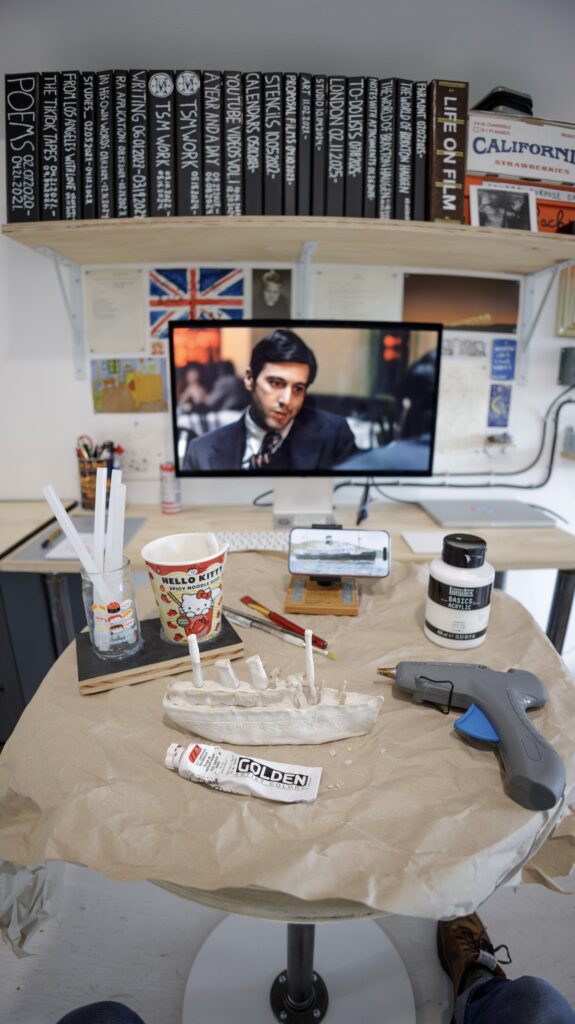
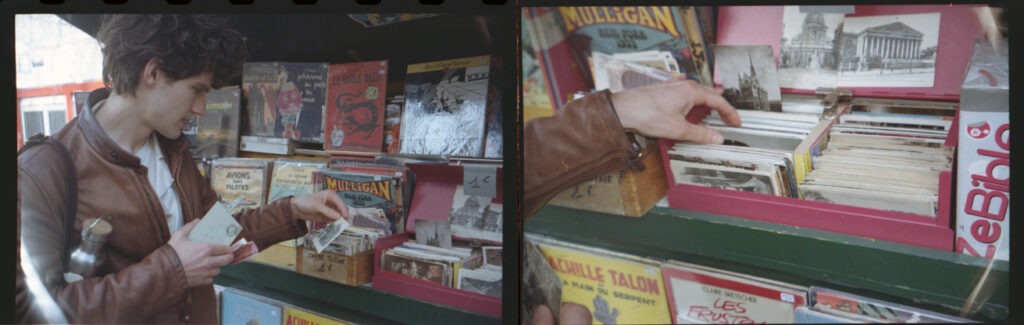
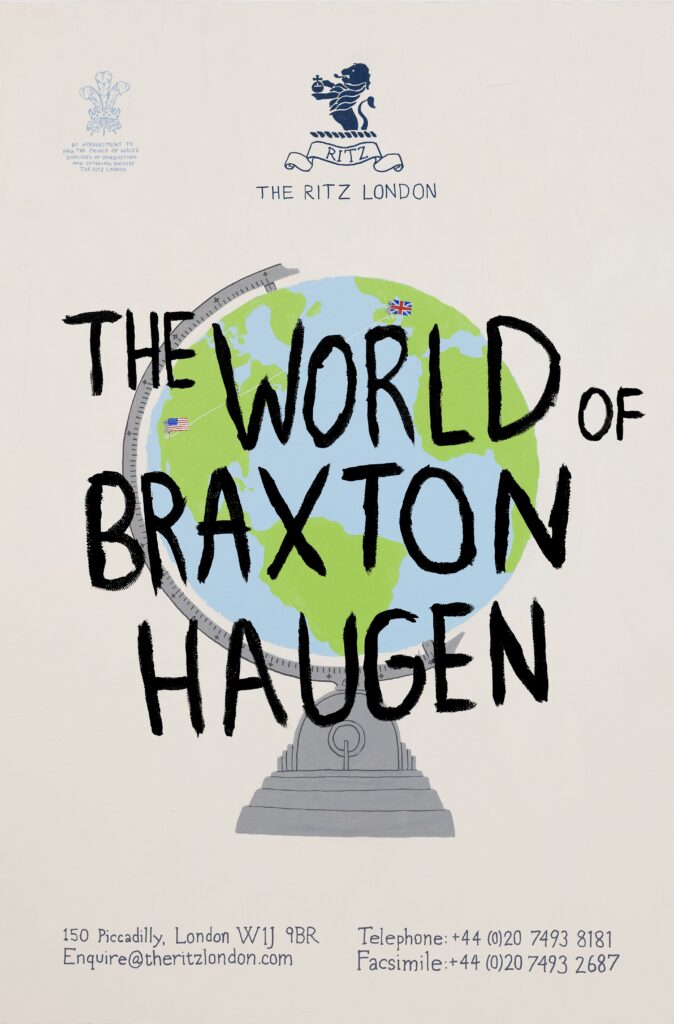
Let us go then, you and I, and enter the technicolour world of Braxton Haugen. It is rather easy to find his rabbit hole, and chances are you have stumbled across it before. Braxton’s niche corner of the internet that he inhabits is one of poetry, carefully made props, hotel stationery – asked very politely for at reception desks across the world – and curios, the music of the 1960s, and most importantly film. Taking the form of the artistic polymath for the 21st century, Braxton has dabbled and triumphed in art and film-making in its myriad forms, yet his colourful, twee, vibrantly personal series The World of Braxton Haugen has catapulted this filmmaker onto the cultural radar. It is with this world that we are reminded of what makes our own world so dear; the ability to hold things, the ability to personalise our spaces and the ability to be an individual. In a time of increasingly digitalised, uniformed existences, Haugen’s world embraces the tangible, the uniquely man made, and is an ever increasing reminder of the necessity for art and artists. Haugen’s world is a culmination of and testimony to all that he has learnt, seen, done and forayed in other years; it is the attention to detail of place, character and identity that has given us these glimpses inside a life as nourished with artistic endeavour as Haugen’s. Drawing on one of his many artistic inspirations when asked to introduce himself, “There’s that great Dylan line off ‘Farewell Angelina’ that goes, ‘call me any name you’d like, I will never deny it.’”, Haugen encapsulates his world and his artistic story in Dylan’s line. The World of Braxton Haugen is one of experiment, of trying a new name when called to and never denying the character you are working with, quirks and all. Fascinated by the world Braxton has carved out for himself, I spoke with Haugen to get to the core of his world, and discover what it could teach ours.
“There were ten years before the sun came up” on Braxton’s seemingly “overnight success” with the World mini-series, ten years during which longform film, feature films, poetry series and being suspended between Los Angeles and London all had to happen in order for Braxton’s world to finally reach us. The series started in June and quickly rose to reel prominence, but like the emergence of a new star in the sky, his light had always been there – it just took us time to receive it.
BH – World was initially a difficult project to get off the ground. […] I guess I was looking for something I could do that was of a smaller scale than the kind of work I’d done in the last year. I actually made three prototype episodes in January, but they were missing something. I wasn’t ready. Some of the ideas were there, or rather the seeds, but the execution was underdeveloped and lacked vision. I watched the rough cut of the first part and didn’t buy it. I ended up scraping that early version and put the entire project on the shelf.
In the meantime, I went back to London and kept myself busy with a couple of new writing projects. But I wasn’t especially happy with anything that was coming out on the page either. I guess somewhere in the back of my mind the idea of World had stuck around long enough that I began scribbling down little ideas for it while I was supposed to be writing. Around May I knew I had to make a decision about getting serious about a project. It felt like one of those fork-in-the-road moments. What I was writing then and the short films I imagined comprising World were very much two separate things and I knew I couldn’t do both, and I knew once I’d started on one sincerely that I wouldn’t want to change horses midstream. So I just said to myself: “World is going to be your next project, come hell or high water. You’re going to make these movies.”
It began as a way for me to document some of the people, places and things that were meaningful to me. I found the process challenging and rewarding enough that I’ve just kept making them. It was also the first project I’d ever received attention for right out of the gate. I’ve been publishing movies like these on the internet for almost ten years. I’d gotten used to people not really caring about me, so it was validating to see these movies connect so quickly with an audience. I’m incredibly grateful for that. But it took me showing up in the right place and in the right moment for that to happen. I guess I’d always resisted showing up in these places for one reason or another. But my girlfriend really encouraged me to think about sharing my movies on Instagram. So I started an account. At the time I posted the first part of my series, I don’t think I’d ever seen a Reel all the way through in my entire life other than the ones I was making for Van Neistat. So the whole thing was new to me. I think it gave the impression that I was some kind of overnight success, but of course there were ten years before the sun came up. That’s how the story goes.
However, World wasn’t the first time the phone screen had seen Haugen. Answering also to the call of ‘poet’, In His Own Words saw Haugen publish his poetry using film. The words are zany, there’s a frenetic strength of delivery and energy held in the lines, and a spontaneity worthy of the Beat Generation’s urgency of feeling. Filmmaking and poetry aren’t foreign entities, explains Haugen, but rather he “look[s] at it as the same dance, but with a different partner”. It’s all part of the same creative process, vision and world.
BH – I write, I paint, I make movies, I build sculptures, I take pictures – and when you put it like that, it can seem like these are separate mediums, but I choose to look at it all as more or less the same thing. I think it all comes from the same place. But film is my native medium. Even in my written work, I chose to visualise my manuscripts as opposed to binding them in a book. So in that way, filmmaking is at the core of my creative life.
The four written collections were initially born out of a dissatisfaction I felt with filmmaking at the time. It was 2020, I’d dropped out of university, I was living on my own I’d just come off making 50 short films in a row for my series The Home Movies. I was disappointed and disillusioned with the reception, the film festivals, the whole scene really. I just didn’t feel like there was much space left for me to grow. I’d become increasingly uncomfortable with the self-obsessed, attention-seeking spirit of the times and I think I was curious what my life would look like if it didn’t revolve around making movies. I needed to step away from everything for a while to figure out what it was I had to say next. I wanted to push myself as an artist.
So that was where my head was at going into COVID. It was a strange time. It was a strange time for everyone. I was pretty isolated for the lockdowns. I spent most of it reading. I became fixated with blues music, the Beat Generation, and the films of the French New Wave. I would read all day long and write through the night. Looking back, I don’t really know where all that energy was coming from. I felt this fire in me to learn as much as I could about the things I was interested in. I was hungry. I just soaked up everything I could get my hands on about the lives of writers, poets, painters, musicians and filmmakers. I saw myself in that whole bunch of people and figured I was going to need all the help I could get along the way. I was giving myself an education. I was doing a lot of writing just for the page, which is something I’d never really done up until that point; I’d always just written for the screen. That feeling of newness and the challenge that came with it sustained me for those collections. I feel like, in the end, I more or less said everything I had to say with them.
Writing is still at the cornerstone of how I work now, but it just takes on a different final form. What I am doing now has more in common with what I was writing when I was seventeen than what I was writing when I was twenty-two. I’m really proud of some of those stories. I read them today, and I don’t really know where a lot of them came from. I’m interested in eventually putting some of those years of experience writing prose and poetry towards a fictional screenplay. There are a few ideas that really excite me, but right now I’ve got my hands full as is.
It is not only Haugen’s hands that are full, but his past credits. Since turning to filmmaking as a child, Haugen has worked on personal projects aplenty, but has also collaborated with some of his greatest inspirations. Van Neistat’s The Spirited Man series was a reflective, poetic series, and gave Haugen the chance to work with a hero.
BH – Working with Neistat was the thrill of a lifetime. He was one of my formative influences growing up, and to be up close and personal with a hero was nothing short of a life-changing experience for me. Maybe life-affirming is a better word for it. It was the ultimate validation to work so closely with him for the last few years. It was like going into battle with an old samurai master. I learned a lot from Neistat, and I think he learned some from me too. We worked really well together. Even though there’s an entire generation between us, our approach to things really wasn’t dissimilar. It felt as if we both sort of came from the same place out of the earth. There was a shared language of our tastes and references that I think came as a surprise to both of us. When we met for the first time, I felt as if I’d known him all my life. I’ve never felt that way about anyone before or since.
Haugen’s experience on the eclectic set of The Spirited Man enriched his creative vision further. Neistat’s embrace of the tactile and tangible within his films and general life – he is a keen repairman and tinkerer – has revitalised an interest in the physical in an increasingly digital age. Impersonal consumerism, new apps set on making our lives vaguely better and a common acceptance that nothing is built to last anymore. Neistat and Haugen’s physical media revolution feeds into a wider desire to return to a time when the physical, the real and the held was top dog. Armed with a garrison of props, collections, prized possessions and curios, Haugen is an advocate for the handmade and handheld.
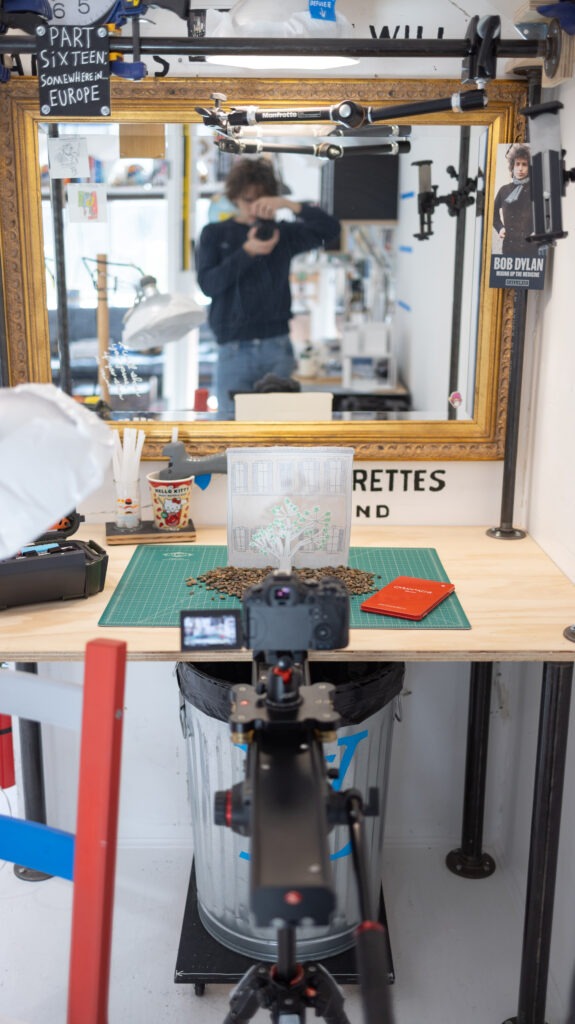
BH – The handmade ethos is a really important part of my filmmaking. It goes beyond just aesthetics for me. I think it’s a way of celebrating the human touch in the arts. Filmmaking can be such a magical and mysterious medium, and I am drawn to seeing just a little bit behind the curtain. It’s also an attitude as much as it is a technical kind of thing. It’s Springsteen choosing to put out Nebraska in the format he did. That record has got a sound and a quality to it that no amount of studio polish could possibly capture. I feel the hand of the artist in every one of those songs. It’s like seeing the brushstrokes of a master painter. It’s part of the composition. Nothing is concealed. It’s all right there in front of you, in all of its beauty and contradiction. I think in our time, with the age of artificial intelligence upon us, that’s the kind of humanity that should be at the centre of the arts.
His penchant for the handheld is not a mere quirk or flourish of artistry, but part of his success. Episode 4 of World saw Haugen reveal his hotel stationery collection. Keen observers of his work will have already noted the apparition of these headed sheets – with their monolithic crests and elegant typefaces – throughout Haugen’s work, acting as part of his utilisation of everyday objects to transform his vision into tangible art. The dissection of his stationery habits and rituals resulted in his videos being brought to prominence online, reminding us that there is still a fascination in the physical object despite the intrusion of the digital.
BH – It’s so funny to me that was the movie which really introduced people to the World. Hotel Stationery was the fourth part of this new series and very quickly took on a life of its own. I had no idea that many people would be interested in this thing I kind of thought was my own weird little hobby. The stationery community really came out for it, and God bless them for it. It was really cool to see the positive reception. There’s a comment on that video with something like four thousand likes by the designer who is working on the Hilton’s stationery redesign, and all kinds of people are chiming in with their suggestions and preferences. I think I responded that the best ones give plenty of room to write with the letterhead not eating into the page too much. I definitely prefer unlined stationery for drawings and a little extra paper weight is always appreciated. Oh, and absolutely under no circumstances is it acceptable to put social media icons on stationery. I think even a website link is pushing it, but we do live in the 21st century. Other than that I’m not too picky. Good typography, tasteful logos – I suppose just your basic tenets of good design.
Palpable visualisation is at the forefront of Haugen’s world, allowing the creation of a world for us on screen that is colourful, carefully curated, exudes personality and revolves around the tactile and the textural. For a dyslexic, like myself and Haugen, the visual becomes all the more important when articulation can be a stifling endeavour. When words frustrate but the nag to tell stories still persists, the visual and the tangible become all the more vital to artistic expression and conveying what words fail to reach. “As a little boy all I wanted to do was tell stories”, Haugen says, “I had a lively imagination, but it was restricted by my ability to read and write as fluently as my peers. I can remember I would get so worked up over not being able to spell that I would just start crying, and I’d get so upset that I would forget the story I wanted to tell. I had all these ideas and pictures in my head, and getting them out was a painful process”. A tumultuous relationship with reading and writing led to Haugen discovering filmmaking at a remarkably young age: “When I discovered that I could tell stories through the little movies I made in the backyard, it was like discovering a loophole. I suddenly didn’t feel stupid. I taught myself to edit when I was seven years old. I embraced those skills as some kind of superpower or something.” With a talent for vision and articulation, Haugen has refused to let his filmmaking be stopped, and wants his films to reflect the “humanity and truthfulness” that is at the heart of all his endeavours. Each film is not another chapter in a manifesto, but rather a search for the humanity and truthfulness that lies at the core of each of our worlds.
Haugen refuses to walk the road for humanity and truthfulness alone, and his scripts, poems and soundtracks all ring as an homage to the artists that shaped his artistry and individuality. An avid reader, his library is an eclectic menagerie of genre, perspective, time and thought.
EBP – You talk about living for stories and making a living from stories – what pieces of literature have inspired you the most, and what is it you look for within a story? What do you want your story to say about you?
BH – I guess the books that come to mind first are what I was reading during the pandemic. My library is really all over the place. Those early Hemingway novels, particularly A Farewell to Arms, really struck me. Edith Wharton’s beautifully written novel The Age of Innocence. I also really fell in love with poetry in that time. The Inferno and Paradise Lost. The Odyssey. Everything Rimbaud ever wrote. William Blake’s Songs of Innocence and Experience made a big impression on me. Ginsberg’s‘Howl’ and Kerouac’s Dharma Bums. Baldwin’s essays. I read all the big Dylan biographies. Patti Smith’s stunning memoir Just Kids. Those are a few that come to mind off the top of my head. I just picked up Patti’s new memoir Bread of Angels, and am really looking forward to reading that. Just Kids is probably the book I find myself recommending the most, especially to young artists. I think it’s maybe the most generous book I’ve ever read. What a gift she shared with the world in writing that book. It’s a masterpiece. I’m completely in awe of her artistry and her spirit. I’m not really sure I’m looking for anything specific from stories beyond some kind of truthfulness. But I certainly found what I was looking for in her writing.
In a world where individuality is increasingly obscured, where digitalisation is prioritised before human experience and truth is lost within a murky echo of voices, Haugen’s artistic vision strikes an urgently compelling, charming note within this chaotic symphony. Taking a chance on your vision and developing your own world to explore and share is what drove Haugen, and something he believes any artist should hold dear to their pursuit. Putting life and humanity back into the arts is essential, and acts as a rebellion against the noise of the art world. Life should be vast, vibrant and – most importantly – human.
BH – Read a lot. Watch a lot. Listen to different music. I hope I’ve mentioned enough in this conversation that there’s a reading list or a watchlist someone could pull out of this. Getting an education doesn’t mean going to school. I’m a dropout, and I care more about learning now than I ever did sitting in a classroom. I think that talent can only ever be as great as one’s curiosity. And in the beginning, your curiosity is the thing powering everything. I’d say travel. Fall in love. Take big risks. Do things that make you feel as if your life depends on it. When you’re scared or nervous, that means you’re growing. It means you care. If you want to be an artist or a writer or a filmmaker, don’t put ‘aspiring’ in front of it. Just be it. We live in a time where anyone reading this interview has what they need in their hands to tell great stories. So there’s no reason to diminish yourself by placing a label like that in front of what you want to be. These are vocations which consume your life. You’re going to need to learn to live with it sooner than later; you might as well give yourself the head start. Life is about becoming who you want to be. I don’t really like the connotation that once you make a film or get a paycheck for your art, that somehow that means you’re no longer aspiring, because great artists are always aspiring to something more. It’s a never-ending pursuit, and I think that’s the point. When you start thinking differently is when you’re going to get yourself into trouble.
Get out, make art, live and – most importantly – be as generous to your art and to others in order to make your world as human and vibrant as Braxton Haugen’s.
It is Sunday evening so I am hoping for the release of death. I know that I am being perhaps dramatic- that two nights spent putting alcohol in my body may simply be having its consequences. Nonetheless, I cannot help but think the only sensible course of action is a sudden and immediate death. Instead, I will tell housemates that I “have really bad hangxiety lol” and stay in my room, thinking about such things as What I Have Done and The Person I Am Becoming. Wonderful. It’s ridiculously indulgent: navel gazing as self-flagellation.
It has been a rollercoaster of a weekend. Jubilant nights: eyes swimming in their sockets, seeing angels in the Jimmy’s bathroom, possessing but a Woodgate and a dream. Oh to be back there! Slurring obscenities in the smoking area, mouth agape and acrid! Shit-eating grin, doing the dance, having SO MUCH FUN. Forget academic validation, sporting success, reciprocated feelings of love- that’s the good stuff. Things do often take a turn for the worse- blacking out, being replaced by a stranger with my face and my voice and the moral compass of a Spartan. Hungover me is terrified of blacked-out me. It’s Jekyll and Hyde, and Hyde is a D1 rascal- she does not play well with others.
Waking up brings fresh horrors. Sober, finally, I feel the weight of the day in my palm. Nasty ritual I have developed: listless, partially dressed, staring at my phone, half-baked platitudes circling my mind like that will soothe me. Nauseous, shaking slightly, breathing manually- the hangover-resistance of my youth has left me.
First come the resolutions. What a creature I promise to be! No drinking to excess, be more mindful of others… I devise all manner of plans to become a sparkling paragon of virtue. It’s fine! I have been cast as Woman In Her Twenties. Who am I to veer off-script? I have a responsibility to the fans. The path to self-actualisation is paved with humiliation, I tell myself. This is simply growth in disguise. I’m in the bargaining stage, junkie limbo (my drug of choice being… Isla Negra?). An Augustine confessional- “Lord make me chaste, but not yet!”.Promises to ‘be better’ like so many Hail Marys, sycophantic and hollow. My insides are necrotic but my heart is hopeful.
This optimism eventually fades, of course. The world is colder on Sundays. Christian vindication, I suppose. Sabbath, day of rest and repentance and a very Catholic kind of guilt. Mutatis mutandis, I will be delivered from sin. I know things are bad when I go all ‘New Age’, listening to Ram Dass and googling “Ayahuasca retreat UK”. Pick a god and pray, baby! It hits four PM and gets dark- there is no reprieve to be had tonight, no warm light of absolution. I realise I am the architect of my own misery. I want my mother, or some abstract concept of my mother. My teetotal housemate has just been for a run and is off to the library. I hate her with every fibre of my being.
Tomorrow will be a new day, I am sure. Next weekend I will put on a similar performance. Is it all worth it? Hard to say. Is it worth Sisyphus getting to the top of the mountain? Seeing a big rock roll down a mountain is always pretty cool. Amen to that.
It was the busiest it had been in years. I walked up there with one of my closest friends, caked in the mist that had surrounded us since our car journey there. It made the stone circle seem slightly more magical. My friend kept pointing out water droplets, imperfect rocks, branches. They have such a good eye for this type of thing. We immediately parted once we got to the stone circle; I to reflect on prayer, my friend to do some sketching. We both knew the drill by now.
I tied my mandala on the branch of the Wishing Tree. I had made it in a rush 10 minutes before we left the house. Maybe next year I’ll have more time to make something better, something more special. I overheard somebody explaining the Wishing Tree to somebody else, and she specifically pointed me out. “That lady is tying a note on the tree,” she said. I’m so happy to be perceived as an adult.
I walked to the middle of the stone circle. Nobody shouted at me, much to my relief. My eyes alighted to the familiar sight of the fruit left in the middle of the circle as offering. I layed out orange slices in a circle around the rind, trying (and failing) to set it alight. I lit my incense, and crouched next to it for about 10 minutes, once again staring at the circles rising from it. It’s all circles, really. At the end of the day. The earth is a circle, the sun is a circle, the moon is a circle, smoke rises in a circle. Time is a circle.
Sitting next to my incense stick, I confess I did get distracted. A man said to his partner “you need to walk round the circle for good luck. I’m making my own rituals now.” He said it in jest, but I thought it was so beautiful. There were some people burning what looked like sage on the far end of the circle. Several people were there with their dogs. It’s so beautiful how everyone got something different out of it, how everyone came from a different place. I walked back to the Wishing Tree, away from my incense stick: I knew it would continue burning. As I was tying some pieces of string onto the tree, I saw a man on the other side, looking at my mandala. We caught each others eyes. We smiled at each other. I’ll never see him again.
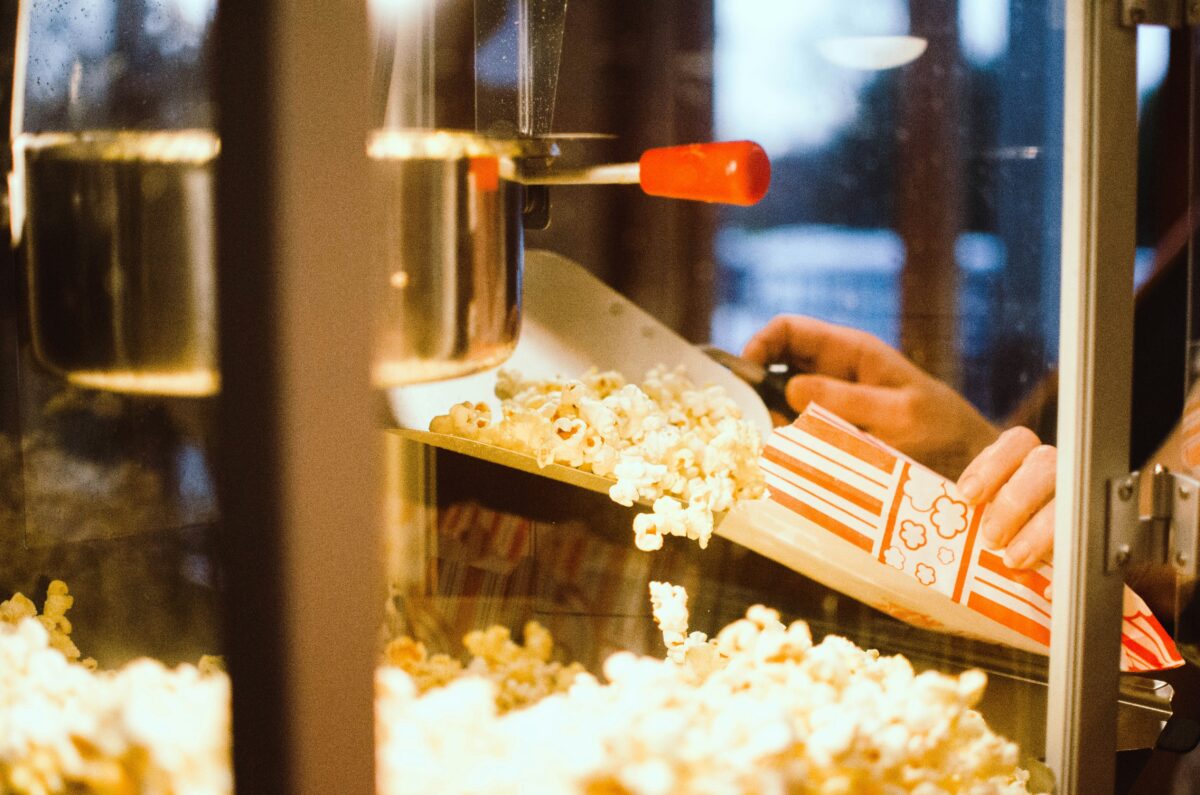
Popcorn, encased in a rich and buttery history, first started popping up in the Americas thousands of years ago – but has far transcended its original purpose as a means of ceremonial decoration, now a delicious snack enjoyed by all. Sweet, salty, caramel – popcorn comes in all shapes and colors, ranging from diabolical flavors to more subtle appreciations. Throughout my life, I have eaten popcorn from far and wide, trying innovative flavors from various manufacturers, however, there has always been one that stood out against the rest: Garret’s Popcorn.
Godfrey’s Popcorn, starting from humble beginnings, was born from a love of film, design, and flavor. Being a British soldier during the Second World War, Alfred Godfrey saw that cinema became a much-needed escape, with a particular fondness for fresh popcorn served in the picture house. Driven by a desire to create something tasty, Godfrey’s Popcorn was created; a sweet new maker who experimented with unique flavors, shocking customers. Luke Godfrey, Alfred’s grandson and the co-founder of the company, has recently opened a store in Covent Garden, reintroducing his grandfather’s techniques to a modern audience.
As you may have gathered, this article is not about the best popcorn I have tasted, but rather the second best. Last week, I mistakenly ordered a box of Godfrey’s Popcorn, thinking it to be Garret’s, the best popcorn I tasted as a kid. Ecstatic about the prospect of reaching this high again after a ten year wait, I cracked open a bag. At first, although shocked at the discovery that this popcorn was, in fact, an imposter, I was pleasantly surprised. The caramel was well balanced, perfectly savory and not too sweet, with subtle accents of vanilla and a crunch unmatched. The second bag was one filled with a Biscoff flavored delight. The choice of flavor intrigued me, yet it also left me with a bit of skepticism, fearing it may overpower the natural flavor of the corn. My doubt, however, quickly became a feeling of ecstasy as a moment of realization struck me – popcorn is the best medium for which the brilliance of Biscoff may shine. My fears instantly vanished as the two flavors danced in my mouth in a graceful pás de deux, balancing each other perfectly. The third and final bag was the one I was most excited for, a cheddar cheese flavored popcorn. As an avid cheese fan I knew instantly that I would enjoy this, yet I was not prepared for what came next. The savory cheesiness enveloped my mouth. Each bite, each crunch, left me craving more. Delivering on its signature funk, the cheddar cheese tasted authentic and of high quality, which paired beautifully with the popcorn, being a perfect vessel to deliver such deep flavors.
Although not my intended purchase, I was more than happy to receive this enormous box of popcorn, as one should be. The flavors were playful and inviting and worked brilliantly in the canvas that is corn, with enough surprise to keep taste testers on the edge of their seat. Mass-produced popcorn, being the preferred choice of many, has long overshadowed family run makers, often sacrificing quality for convenience. Commercialization of the product has led many small businesses to shut down due to rising pressure from larger companies, forcing smaller competitors to either bend the knee or leave. I hope, upon reading this, that we give more thought into the ethical concerns of our purchases, whether we are supporting a business worth our time, and if a tastier alternative is out there. The bright red logo of ‘Godfrey’s’ is sure to be a household name, being an example of dedication to craft, quality, and just a hint of luxury. With excellent customer support and a speedy response team, why shouldn’t you go for Godfrey’s?