
By Samuel Davie
Bless, O Lord,
Us Thy servants who minister in Thy temple,
Grant that what we sing with our lips,
We may believe in our hearts,
And what we believe in our hearts,
We may shew forth in our lives.
Through Jesus Christ our Lord,
Amen.
“the Choristers’ Prayer”
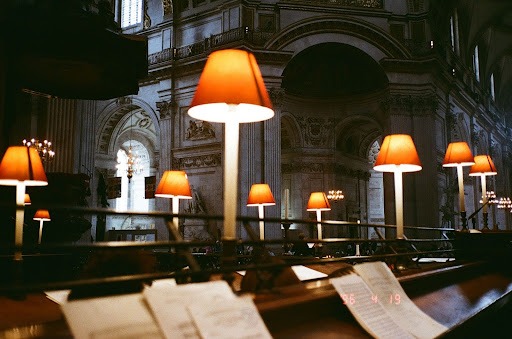
The organ stirs from silence, the ponderous sighing of the pedals scarcely audible, yet shaking the woodwork, as technicolour whirls of cavorting songbirds, or glistening waterfalls, or raging torrents, or a distant, sombre procession rise above – perhaps a far-off echo of the ‘royal banners, forward go[ing]’we sometimes sing of. Into this strain emerges a pair of purple-clad snakes, first a train of slightly ragtag, smaller figures, some clutching waterbottles, or still wearing trainers from their school PE lessons earlier that same day; following them, six larger figures on each side, solemnly disinterested in their surroundings. The clergy follow behind, and all bow together toward the altar upon entering their allotted stalls. The organ subsides, trailing off to give a starting note for the cantor, who dutifully intones: ‘O Lord, open Thou our lips’.
‘And our mouth shall shew forth Thy praise’, the choir responds. Thus begins yet another service of Evensong.
Service is an interesting word. The Oxford English Dictionary gives three principal definitions pertaining to personal actions:
‘a form of liturgy or ritual […] for an act of worship’
‘the action of serving someone or something’
‘the state or condition of being a servant’
Singing Evensong places one in all three of these states at once; one is a servant, serving God (and also the Dean and Chapter of the Cathedral) in an act of worship. If one serves, the question surely follows, why does one serve? To answer this is a complex task. Since it is as part of an act of worship, surely there is some personal devotion or other belief at work?
To speak personally, I’m not sure; if asked about my religious beliefs, I generally answer stating that I am a Christian. On a matter-of-fact basis, this is true: I am a communicant, confirmed member of the Church of England, who regularly participates in public worship. Unless one is of one of the schools of thought that assert that Anglicans are not Christians, I meet the standard definition. I affirm my faith, along with others present, in the words of either the Nicene or Apostles’ Creeds, laid down over a millennium ago as statements of faith encompassing what the Church as a body believes (disputes over added lines aside). And yet, I am frequently not sure exactly what I believe.
I suppose a better word would be ‘hope’. I hope that a man put to death in a truly barbaric fashion two millennia ago was, as claimed, the Son of God, thereby offering those to follow a path away from eternal damnation, should such a thing exist. I’m not sure I believe it, though; there’s still a lot of doubt. Why would God subject and denigrate Himself to render us that service, if we were so undeserving of Paradise because of our own actions? Those with any theological background reading this are probably already silently screaming at me to read x or y; I apologise for my ignorance. I will, however, continue on: if we are so undeserving of Paradise because of our conduct, then why is the sacrifice required of us for redemption so small? Not being wilfully horrible, and owning up to it or any inadvertent mistakes should they happen is hardly a big ask: frankly, it’s just being a decent human being. Flawed as I’m well aware this reasoning may be, I suppose this is exactly why I hope in the way I do – by not being an awful person, I have an opportunity to avoid something that may or may not happen to me in the future, but that I have no possibility of ascertaining.
I still wouldn’t say that this is why I sing the eight services a week that I subject myself to, though. Frankly, part of it is the money: although the relatively low remuneration may be a fairly frequent source of griping, the money has meant that I have (for example, and rather fortunately) never been overdrawn. It would be dishonest to suggest that that weren’t an incentive. Day to day, however, the money is sufficiently low (sufficiently insufficient, if you will) that it doesn’t really matter. Besides, the effect of a sharply worded rebuke ‘Mr Davie, would you care to look at the music?’ is such that a purely mercenary attitude cannot apply: such a rebuke is cutting in a way beyond that of merely being called out for not being ‘on it’. Such a rebuke is instead, in my personal view, a rebuke against my very abilities at a musician, those that I generally view as defining me. It is therefore evidently the case that I view the service I render, day-in-day-out, as a defining part of who I am; the pursuit of perfection in my craft is something which I allow to define myself, thereby exposing me to the harshest impacts of such a rebuke.
A well-known Ancient Greek maxim is that one should ‘know thyself’. It is however apparent that knowledge of oneself is – or should be – crafted, not acquired by happenstance. To take ownership of the acquisition of knowledge of oneself requires courage: Rollo May, writing in Man’s Search for Himself, defines courage as ‘the capacity to meet the anxiety which arises as one achieves freedom’ and ‘the willingness to differentiate’. Further, he describes the opposite to courage as ‘not cowardice: that, rather, is the lack of courage’, stating instead that it is ‘automaton conformity’. Whilst we must remain conscious of the fact that May was writing seventy years ago, reflecting on his patients in a very different world to now, I believe the core message remains true: a blank sheet is itself devoid of meaning; a meaning must be created for it – for myself, I must create a meaning for my own blank slate, and it is courage that is required as a virtue to do this. Thus, courage is required for one to know oneself.
How does this relate to service, though? I see a number of ways: firstly, is that I have exercised the courage to expose an aspect which I have adopted as crucial to my identity (that itself requiring courage to do) to rebuke, and also to offer it to a larger purpose. I may not be sure what I believe religiously, but I have undertaken the courage to exercise the convictions I do have; I do this by rendering a service, as part of a service, in the state of a servant. I suppose it is courageous, too, to be willing to decline my own status to that of servitude for a greater purpose that I’m not wholly convinced I believe in. Reflecting religiously again, the Crucifixion was thus an ultimate act of courage – willingly declining and submitting to the greatest denigration imaginable, to render a service for the benefit of all.
I would always encourage anyone I meet, should it come up in conversation, to attend Evensong, regardless of any bovine ruminations on courage; it is a wonderful opportunity to take less than an hour out of the day, to sit with others and maintain a centuries-old living tradition in ancient buildings. A time to reflect, and to enjoy music offered as a service, regardless of any religious sentiments one may or may not have. Should you attend, however, or if you attend any display of personal craft: music, theatre, visual art, sports or anything else
– take a moment to appreciate the courage that those individuals have undertaken, to expose themselves and to render a service to you, the viewer enjoying their craft, and to themselves, to their own betterment and self-knowledge. Finally, take the message of the Choristers’ Prayer from the beginning: exercise the courage you undertake in order to serve others, in order also to better know yourself.
Feature Image – Matthew Dodd