I’ve been thinking a lot about Brian Friel’s masterpiece, ‘Translations’: a story of the anglicisation of Irish place names by the British government in the 1830s. I absolutely recommend reading this short wonder of a play, suitable for all journeys, such as my own on a dusty Transpennine to Manchester last summer.
Reading ‘Translations’ will not just imbue an intimate understanding of those of us across the Irish Sea, but communities across the world who have experienced similar numb erasure of their cultures, heritage, and identity. At a point in the play, a character named Hugh is talking to a British soldier and explains why he does not speak their language, saying ‘English […] couldn’t really express us.’
Why, apart from my deep-rooted Nationalism and unwavering resentment, did this line stick with me so steadfastly? My reason is not exactly what I feel Friel had in mind, and it is slightly ironic that I’m going to try to explain myself using English, but I really will try – just bear with me.
I’ve been thinking a lot about how difficult it can be to express ourselves, especially when it feels that language is failing us. It is noticed particularly when trying to cope with some sort of hurt or grief, how difficult (near impossible) it is to translate our own feelings. In Adichie’s ‘Notes on Grief’, she talks about how ‘glib condolences can feel’, and how much ‘grief is about language, the failure of language and the grasping for language.’ This failure, and grasping for something, anything that feels big enough. Some words large enough, massive enough, encompassing enough, to even touch the periphery of grief. Saying it over and over doesn’t help, saying it over and over doesn’t help. How can we truly express ourselves if language is incapable?
The ebbs and flows of our minds don’t always feel explainable by words. What I’m feeling in this present moment isn’t always able to be transcribed. How can we possibly convey the depth of our love for a friend, the joy or sorrow of a moment, feeling so frustratingly restrained by our words? English can feel so bland, so empty of all nuances. A feelings chart of choices staring back, suggesting mad, bad, sad, glad – how can we expect to slot ourselves neatly into such boxes, such maddeningly smug rhyming boxes?
For Irish people, at least, there seems a visceral reason for this weakness, which I can admit (humbly) was put more eloquently by Joyce than I ever could. He describes the Irish as a people, ‘condemned to express themselves in a language not their own’ (Portrait of the Artist in Exile). Following these meandering thoughts, it reminded me of something Woolf says in ‘A Room of One’s Own’ (please observe a moment of reverence for this hallowed work). She talks about the struggle of female authorship for the Austens, Elliots, and Brontës who came before us, illuminating their struggle of translating their ‘female thoughts’, when the only tools they had were masculine novels. For this intrepid female author, ‘there was no common sentence ready for her to use’ and instead she had to make her own.
Could something like the loss of language be the source of our emotional impotence, perhaps the reason we communicate through dry wit rather than emotive phrases and ‘feeling’ words? All Irish people, and I suspect many non-Irish people, can recognise the sometimes stifling, suffocating inability to express our feelings, itself a feeling of such intense discomfort at the thought of even approaching vulnerability that we’d sooner keep it inside.
To turn back to Friel, and with a more positive spin than the gloomy picture I have been painting thus far, it is through art and literature, and music and film that we become able to translate ourselves. A poem or song can reverberate across the world, regardless of language. It is writers, like Woolf and Friel, who can translate our suffering and struggles into something that makes sense, that feels that it does us justice.
It is art, and language, that can bring us comfort in these times, a fierce reminder that we are not alone. — Particularly the Irish language, which Friel so lovingly depicts in ‘Translations,’ a language that certainly was not created for efficiency. Some Irish is wonderfully silly, such as Smugairle ron (smug-AR-leh ROAN)– the word for jellyfish that translates to ‘seal snot’ and Bunbhriste (bunya-vreesh-ta), which are trousers that are nearly worn out but still wearable.
Then others can leave more of a mark, like one my brother ,Conall, shared with me recently – Aduantas (ah-dwon-tes), which is the feeling of being somewhere new, a light fear with a tinge of sadness. The idea that a language can describe something so familiar so perfectly, is encapsulated by the author Manchan Magan (man-han magan) who says the Irish language is not just ‘different forms of grammar and syntax, but different ways of seeing the world.’
How beautiful and comforting that someone before us has not only been through this same thing, felt these feelings, traversed the emotional landscape, but felt them to the extent that they needed a word just for it! I think this, for me, is the true beauty of Friel’s writing, every Irish word and phrase has SO much meaning in it. From our Irish souls to our history, conflict, and craic, it is a beautiful language that somehow says so much more than words usually can. It cannot really be translated because the words are a feeling and they are who we are.
So, whether you take from this that you should listen to more Kneecap (which you probably should), or learn more Irish (I definitely should), the language is closer than you may think. It surrounds us, and with words such as Saoirse (freedom) and Cara (friend) comes an ability to express something beyond words.
Grá mór.
(FOOTNOTE: Massive thank you to my dear friend Caleb for his recommendation of this play, and for all the books I’ve stolen from him since.)
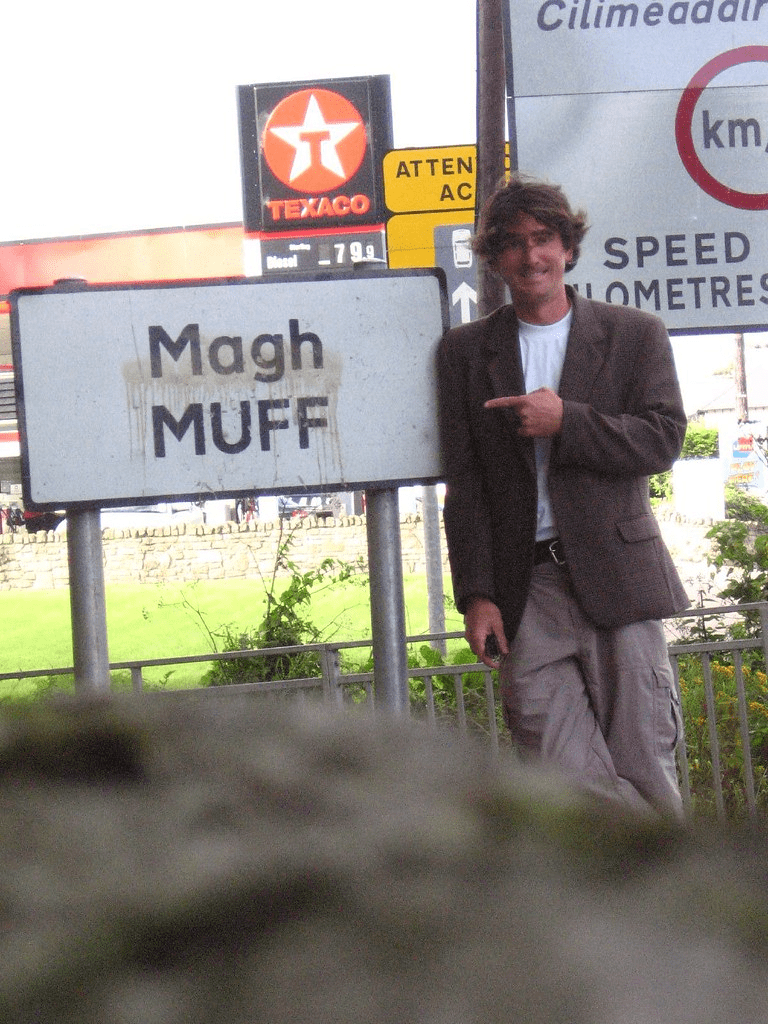
Featured Image: One of the more unfortunate results of the anglicization of place names – from the Irish word ‘Magh’, meaning ‘plain’. / Flickr
On the night of the 20th of October, thousands of Madrileños gathered in the Plaza de Callao, milling beneath the overhead screens. They were followers of an artist whose career has moved unpredictably between flamenco, reggaetón, and experimental pop, anticipating the release of her new album’s title and cover. The moment was oddly subdued; there would be no spectacle, just the pause of a crowd prepared to read meaning into an image. Rosalía, having taken a three-year hiatus since MOTOMAMI, reclaims the spotlight with her monumental fourth album, LUX. This time, she collaborates with the London Symphony Orchestra for a record meshing pop, classical, and operatic influences, while nodding to her flamenco roots. She sings in thirteen languages (Spanish, Catalan, Italian, English, Sicilian, Hebrew, Mandarin, German, Arabic, Ukrainian, Portuguese, Latin, and Japanese), and blends almost as many genres.
CatalanNews, Rosalía’s Lux: A search for meaning in the doomscrolling era / Madrid’s Callao Square with thousands of Rosalia fans during the presentation of her latest album, Lux, on October 20, 2025 / Rafa Ortiz – Sony
LUX stands out as Rosalía’s most poetically and sonically ambitious work to date, but its stylistic multiplicity is far from self-indulgent; instead, it serves a singular theme: the collective longing for the divine. Critics’ year-end lists have placed LUX at the top of 2025’s defining albums, not for its ambition so much as for its rare candour in approaching faith and interior life without irony. Even the Vatican’s Culture Minister gave his blessing – “When a creator like Rosalía speaks of spirituality, it means that she captures a profound need in contemporary culture to approach spirituality, to cultivate an inner life.”
The album arrives amid a wider cultural moment in which the music industry routinely borrows religious symbolism for popular reproduction, while neglecting its theological meaning (Terry Eagleton, Culture and the Death of God). It is a trend nowhere more visible than in pop music and its surrounding visual imagery, where narratives of the divine are handled with a flippancy rarely extended to other traditions (rock music tends at least to engage its source material with a degree of fidelity).
In practice, this produces a familiar cycle of provocation, most recognisably with Christian symbols: Madonna’s burning crosses and stigmata in the music video for Like a Prayer, Lady Gaga’s Judas released a week before Easter, or artists such as Lil Nas X masquerading as Christ on the cross, a figure whose appropriation now seems uniquely consequence-free. Most recently, Sabrina Carpenter’s Feather got a priest demoted. These popstars arrive primed for the inevitable, perhaps staged controversy, armed with a sassy clapback (“Jesus was a Carpenter”), but always sorry-not-sorry. Irony functions here as a safety net, allowing artists to touch the sacred without risking the accountability of belief or the vulnerability of transformation.
All hope is, as ever, not lost. It is into this landscape, saturated with religious imagery yet starved of its respective meaning, that Rosalía releases LUX. The album offers one of the most sustained engagements with faith in global pop since Kanye West’s Jesus Is King, a parallel underscored by common collaborator, Yeezus producer Noah Goldstein. Throughout LUX, Rosalía reclaims religious symbolism by striking visual and lyrical means.
CatalanNews, Rosalía’s Lux: A search for meaning in the doomscrolling era / Album artwork for ‘Lux’, the fourth album by Rosalía / Noah Dillon – Sony
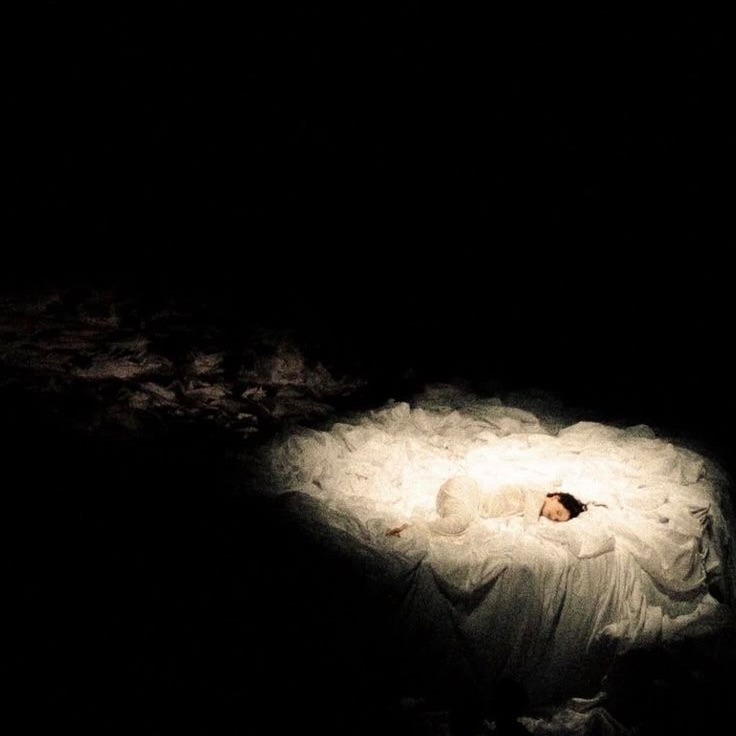
On the album cover, she dons a white nun’s veil and hugs herself in a top resembling a straitjacket. But her expression reads more as ecstasy than pain. The image holds the kind of ambivalence Rosalía, like a good theologian, seems to have mastered. Perhaps she’s communicating the idea of self-love through spiritual discipline and self-restraint. Like many of the record’s songs, it echoes an all-embracing motif: the intimacy of being seen by God.
The title, meaning “light” in Latin, is echoed in the album’s fourth song Porcelana, “ego sum lux mundi” (“I am the light of the world”), quoting Jesus’ speech to his followers at the temple in the Gospel of John (8:16). Perhaps the title is also inspired by Simone Weil, whose quote from Gravity and Grace, “Love is not consolation, it is light”, features as an epigraph on the vinyl and CD editions. This book is one of many mystical works that influenced Rosalía’s lyrics, nestled amongst biblical passages and the hagiographies of female saints and mystics, including St. Joan of Arc and St. Teresa of Ávila.
Mystics, or those who have experienced mysticism, are classified by the rare, sometimes ecstatic and always transcendent experiences of the “immediate or direct presence of God” (Bernard McGinn, The Presence of God…The Foundations of Mysticism, Vol. 1). Rosalía cites the work of Clarice Lispector as a literary touchstone, less a mystic than a modern articulator of mystical intimacy, whose prose reflects the inwardness her lyrics seek to embody. She tells The Guardian, “I’m tiring of seeing people referencing celebrities, and celebrities referencing other celebrities. I’m really much more excited about saints.”
The songs themselves draw faithful inspiration from age-old Christian theology. Relíquia (Relic) references the tradition of relics and their veneration, and Berghain’s lyrics touch on the Eucharist and the Communion of Saints. She was challenged in an interview with the New York Times, “Are you asking a lot of your audience to absorb a work like this?” Her response: “Absolutely, I am. The more we are in the era of dopamine, the more I want the opposite. That’s what I’m craving.”
The Guardian, Rosalía: Lux review – a demanding, distinctive clash of classical and chaos that couldn’t be by anyone else / Abandon preconceptions … Rosalía
Cortona Polyptych by the Italian early Renaissance painter Fra Angelico / Diocesan Museum of the Cortona Chapter, Cortona, Italy
Rosalía’s visual language refuses to ironize religious symbols by placing discipline above indulgence. In the album’s visual rollout, she appears with a bleached ring dyed onto the crown of her head, visible in each song’s Spotify canvas and in recent interviews. It’s a mark that reads as more than a contemporary halo, and instead evokes the tonsure historically worn by Catholic monks as a sign of submission and withdrawal from self-fashioning. Here, Rosalía’s specific style recalls the Roman corona, formerly worn by St. Cuthbert and St. Bede. These shorn crowns rendered interior discipline visibly legible on the body. Paired with gloves that evoke penitential or flagellatory vestments, Rosalía’s styling resists the theatrics of costume, gesturing towards the ascetic formation of the body rather than the body as styled for consumption.
In the mystical tradition Rosalía draws from, the body is disciplined to become capable of exposure to the divine, of being seen without disguise. That logic comes into full view in Dios es un Stalker (“God is a Stalker”). The song draws on a tradition of writing that confronts the intolerable intimacy of an all-seeing God, from the theological insistence on divine proximity found in Simone Weil, to a stylistic affinity with Clarice Lispector’s prose, which exposes consciousness at its most unguarded. Rosalía boldly sings from a God’s eye view, something she admits to France Inter is “absurd – [the song] contains a sense of humour.” Through this lens, she adopts the metaphor of a stalker who follows her and knows her every move, but… in a loving way.
That divine knowledge extends even to what we would rather conceal. When Rosalía sings “Lo sé tus deseos indeseables” (“I know your undesirable desires”), she confronts the listener with a God who sees beneath the layers of moral self-presentation. She continues, “Mi aliento es el viento que te roza el pelo” (“My breath is the wind grazing your hair”), indicative of a distinctly biblical intimacy. Psalm 139 gives this knowledge its theological weight – “O Lord, you have searched me and known me… Where can I go from your Spirit?” Rosalía allows the discomfort of being fully seen to remain unresolved, placing the listener inside that exposure. The effect recalls the interior pressure found in Clarice Lispector’s The Passion According to G.H., which dismantles irony entirely and forces her narrator into a consciousness so exposed it borders on annihilation.
Rosalía modernises the concept of omniscience through technological language. The image of God with an “exploding inbox” (“Tengo un buzón explotado”) reminds me of the scene in the 2003 film Bruce Almighty, where Bruce (Jim Carrey) gains powers from God (Morgan Freeman), and has to manage just that.
YARN, What a bunch of whiners. This is gonna suck up my whole life. / https://getyarn.io/yarn-clip/b5ff545e-e029-49f7-bf10-267aea0e01ca
Rosalía attempts to communicate the impossibility of relating to divine characteristics, a notion underscored by the song’s most self-aware line, “Mi omnipresencia me tiene agotada” (“My omnipresence has me exhausted”). The exhaustion, of course, belongs to the metaphor, not to God. Yet Rosalía’s phrasing recalls the human struggle to imagine infinitude; we project our limits onto God because no other language is available. This echoes the concept of the analogia entis, in which every analogy for God’s identity both reveals and fails. Rosalía knowingly writes within this failure and continues to meditate on such contradictions throughout LUX. In fact, it forms the central motif of La Yugular: “you who are far and at the same time closer than my own jugular vein.”
The stalking metaphor’s greatest weakness lies in Rosalía’s simultaneous portrayal of divine pursuit as non-coercive. “Detrás de ti, voy” (“Behind you, I go”) is immediately tempered by “yo que siempre espero que vengan a mí” (“I who always waits for them to come to me”). This is the song’s central tenet – the paradox of God as omnipresent yet partially hidden. Were God’s presence unavoidable, human freedom would collapse into inevitability. In the Gospel of John, Jesus refuses to jump off the Temple roof and save himself miraculously to prove his divinity to surrounding crowds. Rosalía acknowledges this: “No me gusta hacer intervencion divina” (“I don’t like doing divine intervention”), conveying that love cannot force itself. Also explored in the film Bruce Almighty, Bruce can do almost everything with his divine powers except convince his girlfriend (Jennifer Aniston) to stay with him, because it’s against her free will.
Simone Weil speaks on the hiddenness of God in Gravity and Grace, insisting that He withdraws precisely to make room for human love. For Love to be real it presents a choice to accept it or to flee from it, a condition essential also to human existence: “There exists a ‘deifugal’ force. Otherwise all would be God” (Simone Weil, Gravity and Grace). In Dios es un Stalker, Rosalía does not resolve the tension of divine withdrawal but renders it as waiting, marked by a presence that watches and loves without interference.
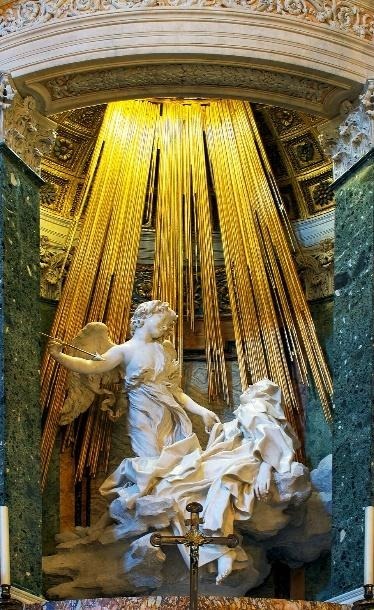
Ecstasy of Saint Teresa, by Gian Lorenzo Bernini / Santa Maria della Vittoria, Rome
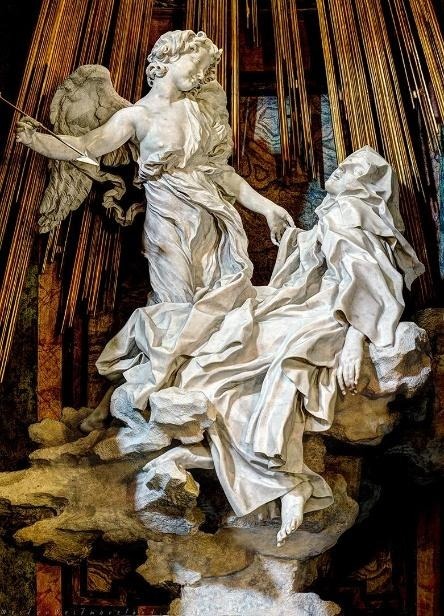
Once such a divine gaze is acknowledged, Rosalía asks herself what must be relinquished. This forms the basis of Sauvignon Blanc. The song conveys how once irony is refused and intimacy faced, familiar understandings of pleasure and consumption are transformed. The song draws on the writings of St. Teresa of Ávila (1515-1582), Spanish mystic, Patron saint of Spain and chess, and first female Doctor of the Church for her advanced spiritual writings. As a Carmelite nun she renounced her wealth for the convent. She is often recognised today from Bernini’s sculpture The Ecstasy of Saint Teresa (1647-1652) in Rome, depicting a vision famously detailed in her autobiography as her Transverberation. During the vision, she experiences her heart being pierced by an angel’s spear, a moment she describes as “a sweetness so extreme that one could not possibly wish it to end.”
In Sauvignon Blanc, Rosalía rejects the idolisation of material things, perhaps, like St. Teresa and other ascetics, denying material pleasures entirely. She even sings that she’ll burn her Rolls-Royce and that she doesn’t want pearls or caviar anymore: “To my God, I’ll listen / My Jimmy Choo’s, I’ll throw them away”. As Spencer Kornhaber says in The Atlantic, “Rosalía, like many of us, is asking herself what she’d be willing to give up to save her soul… Her autonomy? Her convenience? Her Jimmy Choos?”
Rosalía’s Savvy B isn’t about “making wine cool and fun again” for Gen Z like I’ve seen suggested recently. It’s worlds apart from Drake namechecking Moscato, Jay-Z on Cristal, or Taylor Swift’s many lyrical wine references. In an interview with Apple Music, Rosalía affirms she cited inspiration for the song from St. Teresa’s work, likely The Interior Castle, in which the saint describes her experience of “divine intoxication,” or spiritual ecstasy. Teresa used the metaphor of a “wine cellar,” where God invites the soul to drink “divine love” – a Love that Rosalía sings she would leave all worldly pleasures for. Teresa herself derives the image of the wine cellar from Song of Songs 2:4, which reads“He brought me into the cellar of wine; he set in order Love in me.” Wine is also evoked as a symbol for spiritual fulfilment in Psalm 23: “my cup runneth over”, meaning “I have more than enough for my needs”.
Diana Fountain in Lerwick, Shetland, by James Hunter
Sauvignon Blanc isn’t a wine of status, but poured abundantly for the soul. One of St. Teresa’s greatest quotes, “Let nothing disturb you, let nothing frighten you, all things are passing away… Whoever has God lacks nothing; God alone suffices”, has sure influence on Rosalía’s lyrics: “Ya no tengo miedo del pasado, esta en el fondo, de mi copa de Sauvignon Blanc” (I no longer have fear / of the past / it is at the back / of my glass of Sauvignon Blanc). In a cultural economy fluent in irony, religious symbols are safe because they can often be inverted and discarded without consequence for the artist. Rosalía’s LUX reveals that mysticism offers pop culture what irony cannot… a commitment to truth, whether understood ontologically, as fidelity to the moral and metaphysical claims carried by religious source material, or artistically, as the discipline of approaching that material in a way that maintains harmony with its origins rather than merely borrowing its surface. In doing so she opens onto a reordering of desire largely absent from contemporary pop music, exploring intimacy without irony, pleasure without detachment, and faith without spectacle. Amid a popular culture saturated with symbols starved of meaning, that assertion may be the album’s most radical gesture.
Like any film Vincent Gallo has conjured, Buffalo’ 66 is steeped in narcissism. Gallo stands on stage and essentially cry-wanks in your face, captured on 35mm film, It’s a blatant display of self-aggrandising and a masturbatory pat on the back (or dick) – perhaps best surmised in one of the beginning scenes of the film, in which Gallo beats up a man in at the urinal next to him for staring – and exclaiming – it’s just so big! Naturally, it is my favourite film, ever. There is a job-lot of chin-scratching discourse and pacing back and forth over the success of Gallo’s attempt to curate an ‘art film’, and his portrayal (and in-film treatment) of his deuteragonist, Christina Ricci, but before discussing such a heated debate one should be familiar with the plot of Buffalo’ 66.
In the rotted, snowy streets of New York we lay our scene. Billy Brown (Gallo) has just been released from prison for a crime he didn’t commit. Following a montage of greyscale, grainy overlays chronicling Billy’s 5 years locked up – cue crying in shower – cue mugshots – cue piano tune (written by Gallo himself) lamenting on being such a lonely, lonely boy. We then cut to a scene of Billy running into every nearby shop locally available maniacally searching for a bathroom which he finally finds in a dance studio (where the aforementioned urinal scene takes place). Gallo is all sharp shadowed brows and spindled limbs – speaking in staccato whines and quips, the cold daytime shots of New York were, to me, reminiscent of a more expansive and somewhat hollowed colour grading akin to Wong Kar Wai’s ‘Fallen Angels’. It’s all set up to feel very alien. Billy is strange looking, strange speaking, running around this apocalyptic cold expanse. After relieving himself, he calls his mother from a payphone – declaring he’s just touched down from a nondescript work related trip, staying at a fancy hotel, and wants to introduce his family to his wife. Wife? You ask – well Billy proceeds to snatch a girl walking out of the bathroom – wife acquired! Her name is Layla (Played by a 17 year old Ricci), wearing a powdery blue babydoll dress, silver sparkly tap shoes and a white shrug cardigan. Layla is bemusingly passive – obliging Billy’s demands to drive him to his parents house, pretend to be his wife (under the alias Wendy Balsam) and to essentially ‘make him look good’ – promised with the reward of being his best friend. Billy then has a panic attack sort of episode on the porch before his parents open the door – and we are greeted with worlds best mum and dad.
After serving Billy courses of food he is allergic to the vast majority of, Billy’s mum explains to Layla her devotion to the Buffalo Bills, recounting how the only game she missed was the day Billy was born, sighing how she wishes she never had him as they eat platefuls of tripe (cow stomach lining, for the less culinary inclined). Billy’s dad is a retired singer, now part-time pervert, occasionally motorboating Layla under the guise of a fatherly hug – ‘ you know, daddy really loves his new little sweet young daughter!’ It is difficult to say whether Billy’s father really looks at Billy during the entire dinner scene, but we do get a fond flashback scene of him killing Billy’s childhood dog, Bingo. During the Godard-like dinner scene montage, it’s my belief that this is where Layla really falls in love with Billy. Mummy AND daddy issues? Bless. She takes it upon herself to declare that Billy is her boss at the CIA, where she worked as his typist, and that they have a child on the way. The parents aren’t overly affected, watching the Buffalo Bills game over Layla/Wendy’s shoulder, but it’s a tender moment.
It transpires that the reason Billy went to prison was in order to keep a bookie from hurting his parents, a bookie whom he owes $10,000 after betting the Buffalo Bills would win the 1991 Super Bowl – presumably in an attempt to connect with his emotionally negligent mother. We discover that the next chunk of the movie is a manhunt for Scott Woods, the disgraced Buffalo Bills kicker whom Billy blames for losing the Super Bowl, in turn losing everything, who now owns the local strip joint, Billy learns that Woods doesn’t show up at the strip club until around 2 in the morning, so we then see Billy and Layla killing time, shuffling through his hometown. The meat of the film here becomes tender, and warmth pervades the vignette of scenes as the neon city signs are woken up by the dark, we arrive at the bowling alley where Billy’s countenance softens oh so slightly, it seems to be the place in which Billy spent the majority of his youth. This is my favourite scene of the film, for a great number of reasons really: the first being Billy’s incredible outfit, a striped grey and black wifebeater, with tight flared trousers, and patent red platform cowboy boots. The harshness of his nose, his jaw, his eyes as he hits strike after strike, his body is all angles. We then pan to Layla, ambling around, a noncommittal observer – the lights dim and all is a deep red, with her silver tap shoes spotlighted, she then breaks the fourth wall by tapdancing to King Crimson’s ‘Moonchild’ – the baby blues of her dress, eyeshadow and tights chime in accordance with the song’s vibraphone and chatter of symbols, puncturing a tight staccato through the hollow grey of the film. The scene operates as a rare invitation to Layla’s interior world, underscored by a warm and deep loneliness, top-noted by innocence.
‘Lonely moonchild, dreaming in the shadows of the willow’
The next scene, arguably the film’s most famous, is their time in the photo booth – shot through the photobooth camera, we’re peeking through a small, grainy rectangle in the centre of the screen. Layla sits on Billy’s lap and is chided over several attempts to take photos, first for sticking out her tongue, then for kissing him on the temple – ‘we’re a couple that doesn’t touch’. Billy is scared, albeit moved by Layla’s burgeoning empathy she bludgeons him with, he consistently berates Layla in his broken, repetitive and disjointed sentences while she peers back doe-eyed and unaffected. Like Layla, it’s quite difficult to see Billy as venomous, he comes across as a gentle yet imperilled piece of shit with a frustration that hurls itself toward any moving target – it appears he wants to be loved, and he slowly allows himself to feel what it may be like, they have a bath together (clothed, naturally) then lie in silence next to each other awkwardly-limbed, like discarded barbie dolls. A dulcet saxophone seeps into the background of the scene, as they touch hands – snatch them away – touch again – eye contact – look away – then kiss. It’s brief and angular, reminiscent of Billy’s bowling, but then he folds in on himself and lets himself be held.
Billy then wakes up at 2:08, we’re reminded of his sacrificial mission. As he sneaks out, he wakes Layla:
‘I really like you
I’m gonna be really sad if you don’t come back.
Unless you tell me
If you’re not gonna come back, just tell me, don’t lie to me.
Are you going to come back or not?’
Layla declares her love for him as he closes the door. Next, is one of the greatest examples of scoring in the history of film (I believe) and even if you won’t ever watch this movie – I completely urge you just to skip to 1:38. Heart Of The Sunrise by Yes begins to play as Billy walks into the velvet-clad strip club in slow motion, topless dancers (in granny pants – weirdly) lit up in icy neon and surrounded by fat, wobbling men – it looks like a scene from the Twin Peaks backrooms with an incredible prog rock bassline. Billy pulls out his pistol and shoots Scott, then himself – everything is still, yet the camera pans around the scene and then away to some faraway vision of Billy’s largely unmoved parents watching a Buffalo Bills game on his grave, naturally.
But what’s this – we pan back in – it was all a dream! Rejoice! Billy flees and runs to a shitty 24-hour café where he buys Layla a hot chocolate (large) and a special heart cookie. It’s a truth universally known that narcissistic homicidal depressed maniacs can, in fact, be fixed, girls. The movie ends with a still of Layla and Billy in bed, sleeping, and holding one another.
Now there’s plenty of discourse surrounding its semi-autobiographical nature, as Gallo himself grew up in Buffalo, New York and had similar parents – in fact, in the premiere of Buffalo 66, attended by those who knew the family, continually burst out laughing in recognition of the parents’ depictions. Gallo describes Billy as a character portraying feelings true to those that Gallo has felt himself, and the last five minutes of the film are him on a really good day. So, in essence, Gallo Dr Frankenstein-ed Billy using the darkest parts of himself to depict what he could have been. The semi-autobiographical nature of the film, paired with its total self-indulgence, (the fantasy of its plot is apologised for by its atmosphere, which is uncontestably beautiful) persuades many watchers to land in the ‘this film is a piece of shit’ camp. Many firmly situated in this camp owe it to Gallo’s deeply bemusing online presence; he famously advertises himself as an escort on his website, in which he writes,
‘I, Vincent Gallo, star of such classics as Buffalo 66 and The Brown Bunny, have decided to make myself available to all women. All women who can afford me, that is. For the modest fee of $50,000 plus expenses, I can fulfil the wish, dream, or fantasy of any naturally born female’ (transphobia duly noted), he goes on to say: ‘Heavy set, older, red heads etc can have me if they can pay the bill (…..) However, I highly frown upon any male having even the slightest momentary thought or wish that they could ever become my client. No way, José. However, female couples of the lesbian persuasion can enjoy a Vincent Gallo evening together for $100,000. $200,000 buys the lesbos a weekend. A weekend that will have them second-guessing.
Gallo is also selling his sperm for $1,000,000 (cash or check only, mind you). Owing to his online ramblings, nobody would really be surprised if Buffalo 66 is really just his incel wet dream, an intangible simulacra in which Layla represents the fantasy of unconditional female care in spite of the woes and hardships of being a man of the narcissistic variety. Gallo, in interviews following Buffalo ‘66’s release declared Christina Ricci to be on cough syrup – or just drinking heavily – throughout filming, however it’s clear he just didn’t like Ricci, who has since called him a raving lunatic. It is obvious Gallo is a bad man, whether his persona is some kind of reactionary performance art or tasteless extremism, it still pulls us back to the age old question – can we separate the art from the artist?
Many Substack articles frame Buffalo ’66 as a chronicle of misogynistic romanticism, yet I like to think Layla is, in fact, the only character with real emotional agency in the film, taking emotional charge of each scene she inhabits. Billy does not overtly assert a coherent or sustained form of male domination (though his frankly futile attempt at kidnapping her cannot be ignored) and is objectively desexed. This leaves us with the question: if Billy is not meaningfully exerting control over Layla, does she instead function as a Manic Pixie Dream Girl – existing to facilitate his self-actualisation? While the film undeniably traffics in a dated belief in the transformative power of a woman’s love, Layla is neither narratively contained within a neat psychological arc nor positioned as someone who ultimately ‘fixes’ him. It’s interesting, and awkward to position their dynamic – I think Gallo as a person, and director enormously taints what could be interpreted as two people, a strange encounter, and an unlikely sweetness.
Nonetheless, it is my favourite film, ever. I think I put this down to the outfitting, the prog-rock scoring and the cinematography that synthesise to create such an offbeat, alien, experimental yet extreme atmosphere. If you have, or are planning to watch the film, you’ll note the downright strangeness of the dialogue, it’s stilted and devoid of natural cadence in a way that’s blackly comic, Billy is merely the body of a broken child. I sustained a very emotional reaction when watching Buffalo ’66 for the first time, so maybe you will too – my legs and eyes both pricked, I felt wrought with an urgency I couldn’t quite articulate, pioneered by excitement. I was seeing something totally new and weird and epic – look guys are you seeing this? holy shit, guys, are you fucking seeing this? – pan round to ten minutes of a man trying to find somewhere to piss. Hey, whatever moves you, moves you.
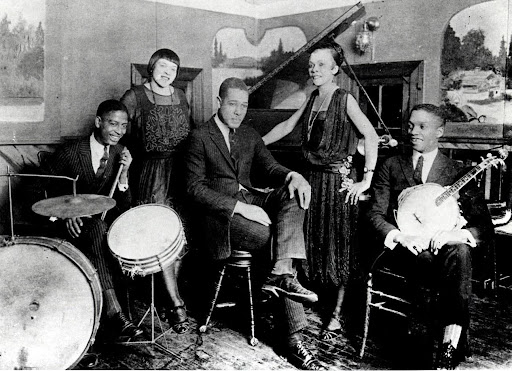
The ‘Ellington Band’, early 1920s, at Louis Thomas’ cabaret speakeasy in Washington DC
By Edward Clark
“You can say anything want on the trombone, but you gotta be careful with words” – Duke Ellington to the New Yorker, 1944
In January 1920, the United States government passed a total prohibition on the sale of alcohol. Owners of bars either repurposed them into restaurants or shops or were forced to shut them down. In response, speakeasies began to quietly open their doors all over the country. Named for the patrons’ need to ‘speak easy’ when telling doormen the pass-word, speakeasies offered an illicit environment for drinking, socialising, and enjoying performances of the vogue music genre: jazz.
Although the genre originated in New Orleans during the 19th century, racial animosity led to many jazz musicians moving elsewhere. As newspapers like The New Orleans Times-Picayune called the movement an ‘atrocity in polite society’, groundbreaking artists like Louis Armstrong, Sidney Bechet and Jelly Roll Morton moved from The Big Easy to Chicago. There, within dimly lit illicit bars serving homebrewed whiskey and gin, audiences were receptive to New Orleans style ‘ragtime’ – or what audiences were beginning to call ‘jass’.
Speakeasies were the prominent feature of American urban ‘20s social life. In Carl Van Vechten’s 1930s novel Parties: Scenes from Contemporary New York Life, the protagonist Hamish frequents the illicit bars. Van Vechten describes: ‘It was nearly time for luncheon and he had yet to enjoy his first drink. He might, in search of this, visit his club, or any one of the fifty thousand speakeasies with which central New York was honeycombed’. 50,000 may be a small exaggeration – the Mob Museum estimates that at the peak of prohibition there were 32,000 speakeasies in New York. Nevertheless, the large number of illicit bars in one city alone gave way to extreme competition. In order to set themselves apart from competing establishments, owners looked to musicians to draw customers.
Stimulated by a period of extreme social development, urban audiences had the disposable income to support the new genre; speakeasies functioned as vessels to allow jazz acts to experiment and solidify their sound. The best example was at New York’s Hollywood Club at Forty-ninth Street and Broadway. Patronage from the speakeasy’s owner provided the financial support for Duke Ellington’s legendary ‘Ellington Orchestra’ to form, as the band took on a permanent roster in 1923 and regularly played an evening for four years. These gigs were hard work. As guitarist Freddie Guy commented in a New Yorker interview: “Once you put your horn in your mouth you didn’t take it out until you quit. Until period. You started at nine and played until’.
Prohibition-era performance like this allowed some of the age’s most notable musicians to cement themselves as the genre’s staples. In Ellington’s case, he wrote some of his most popular songs: ‘Black and Tan Fantasy’, ‘Creole Love Call’, and ‘Birmingham Breakdown’, for example, were all written during his stint at the Hollywood Club. Performances in speakeasies also coincided with the inception of commercial radio, with 600 stations broadcasting by the end of the decade; jazz performances recorded within speakeasies were broadcast to audiences beyond the cityscape.
Often, speakeasies resulted in African-American musicians performing for wealthy white audiences. For example, the Cotton Club, a popular New York club in Harlem, was positioned by its owner Owney Madden as offering ‘an authentic black entertainment to a wealthy, whites-only audience’. As the aforementioned quote from Ellington displays, whilst segregated speakeasies spread jazz to a new, powerful community, popular musicians renowned for their talent were forced to perform without expressing their opinions or politics. By the latter half of the 1920s, however, the illicit nature of speakeasies promoted integration, creating multiracial – or ‘black and tan’ – clubs. Opposing government policy, speakeasies broke down cultural barriers and created an environment where Americans from all backgrounds stood side by side, watching a new jazz age flourish.
When Sam Fender was announced as the 2025 Mercury Prize winner for People Watching, it felt like something bigger than just another music award. As someone who frequently gets involved in the North East music scene, hearing him call our area the ‘best region in the country’ and show pride in his roots felt more inspiring than most musical milestones in recent years. For the North East, the award could be seen as a symbolic turning point: a recognition of not only Fender’s talent, but also the cultural energy of the North East finally getting its time to shine.
People Watching was praised by the Mercury judges as standing out for ‘its cohesion, character and ambition’, which couldn’t ring truer. Songs like ‘Chin Up’ and ‘TV Dinner’ are deeply powerful due to both their melodic qualities and their raw honesty. Personally, however, the highlight of People Watching was the use of the Easington Colliery Band for the accompaniment on ‘Remember My Name’. The use of this brass band harkens back to the North East’s industrial roots and gives voice to his family’s working-class heritage; it is therefore all the more important that he chose to use a County Durham band, granting visibility to North East musicians and musical tradition.
For the first year, the Mercury Prize celebrations were held outside of London, instead being held at Newcastle’s Utilita Arena. This is incredibly significant in recognising that the North East is often overshadowed. The region has long produced talent such as James Arthur, Sting, and Maximo Park, but is rarely framed as a cohesive ‘scene’ in the same way as places like Manchester. The region’s industrial decline and economic inequality have often shaped its identity, with musical output often framed as isolated success stories rather than evidence of a living, breathing (yet underfunded and overlooked) ecosystem.
There is a possibility that this could become a catalyst for wider improvement. Firstly, visibility in itself matters. When a globally recognised artist succeeds without abandoning his background, it validates the ambitions of those in his wake, changing the idea of ‘making it’ from a dream into a feasible possibility. Moreover, this visibility could attract public arts funding and more touring investments, giving venues like Newcastle’s Cluny, Sunderland’s Independent and Stockton’s Georgian Theatre the help they need to nurture the next wave of talent. The Mercury Prize itself has directly facilitated this through their 2025 Mercury Fringe, creating workshops and performance opportunities for upcoming local artists. A highlight of this initiative was seeing Middlesbrough’s Finn Forster, fresh off supporting Stereophonics on tour and playing the main stage at Kendal Calling, both perform and discuss the importance of support for North East creatives on BBC Look North.
However, we must remain realistic in our optimism. A single win for the North East cannot overturn decades of centralisation within the music industry. Many labels, media outlets, and funding opportunities still lie in the South; without investment in North East musical infrastructure, there is a risk that this victory will remain as a symbol rather than cause tangible change. We must, then, turn our heads towards the projects creating positive opportunities that are already present within the North East. For instance, regional festivals The Gathering Sounds and Stockton Calling occur yearly, bringing big names in the indie scene to headline local venues, such as Keo and Circa Waves, therefore bringing paying music lovers into local music venues. In doing so, they also generate gigs for upcoming musicians, such as Newcastle’s Labyrinthine Oceans, Teesside’s Marina Josephina and Durham’s own Jam Tub. There are also groups such as Generator, an organisation committed to uplifting the North by providing opportunities to grow and progress for those pursuing music.
In an interview following his win, Sam Fender was asked what this achievement means for other North East musicians, to which he told the interviewer to ‘ask them’, placing the conversation back into the hands of grassroots artists. This year’s Mercury Prize encouraged critics and audiences to look beyond the centralised creative hubs and reframe the map of British music. Whether this moment becomes a watershed or a footnote depends on what happens next and whether the industry decides to finally act. But, for now, support North East venues, stream local bands – and who knows? Not only might you get bragging rights when your new favourite artist blows up, but you can help facilitate the dreams and livelihoods of talented creatives who may have been overlooked otherwise.
I’d love to speak with Leonard. He’s a sportsman and a shepherd. He’s a lazy bastard, living in a suit. – Leonard Cohen, ‘Going Home’
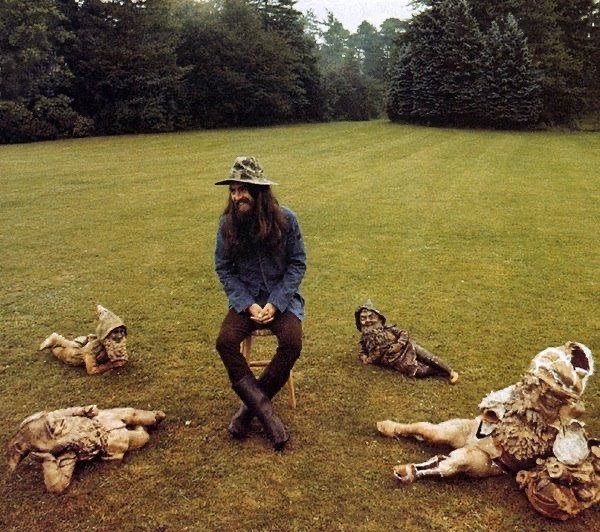
In 1994, the Canadian poet and musician Leonard Cohen escaped to the mountains outside Los Angeles to study Zen Buddhism with the monks at Mount Baldy Zen Center. He lived there five years, becoming himself an ordained Buddhist monk, drinking whisky and writing poetry, before returning to civilisation. “I wasn’t looking for a religion,” claimed Cohen, “I already had a perfectly good one of those.” The abscondment to the mountains was, to Cohen, the only logical way to escape the hard-drinking, depressive malaise into which he’d fallen during the early 90s. Failing to find answers in psychoanalysis, Cohen “bumped into someone who seemed to be at ease with himself and at ease with others” and headed for the hills. Many of the poems Cohen wrote during his time at Mount Baldy would appear in Book of Longing, his first book of poems since the 80s. The five years at Mount Baldy did not grant Cohen inner peace but nevertheless exerted a manifold influence on his post-millennium work. In 2023, eight years after Cohen’s death, his song Anthem was invoked on boygenius’ track Leonard Cohen, in which Lucy Dacus quotes his observation that “there is a crack in everything, that’s how the light gets in.” before adding her own, that “I am not an old man having an existential crisis at a Buddhist monastery writing horny poetry, but I agree.”
In the years since his death, Leonard Cohen has only continued his elevation to the saintlike status that had begun being afforded him in life. The prototypical poet-singer, the image of his steeled jowls half-covered by the brim of his fedora, grimly crooning his way through one of a lifetime’s worth of sung reflections stands firm in the popular consciousness. He is, alongside friend and contemporary Bob Dylan, one of the true folk heroes of modern culture. He is synonymous with a style of confessional, dreary talk-singing; the standard bearer of a genre which would be picked up by everyone from Nick Cave to Fiona Apple to Cameron Winter. This mystique, however, has always been steeped in his reputation as one of music’s pre-eminent womanisers. Joni Mitchell, his one-time lover, recalled him as a ‘‘boudoir poet’’; his numerous attachments to various artists, musicians, and actresses remain the stuff of musical legend. It was an infamy Cohen himself disavowed: ‘‘my reputation as a ladies’ man was a joke that caused me to laugh bitterly through the ten thousand nights I spent alone’’, he would later reflect. And yet, it is Cohen’s steadfast commitment to cataloguing life’s sordid physicality which sets him apart from the bulk of his peers and embeds his influence into the firmament of popular music.
When Taylor Swift released her twelfth album, The Life of a Showgirl, much criticism was levied against the song Wood and its metaphorical allusions to the penis of Kansas City Chiefs’ tight end Travis Kelce. The song, which compares said appendage to everything from a ‘redwood tree’ to a ‘hard rock’, was described by Guardian critic Alex Petridis as one which ‘‘clambers on a table in a Wetherspoons pub with a skew-whiff bridal veil on its head and an L-plate around its neck and favours everyone in earshot with a loud paean to the size of her fiancé’s penis.’’ As Swift learnt, to write well about the realities of sexual life is no mean feat. In this arena, Leonard Cohen is an unparalleled talent. A poet before a musician, Cohen revels in marrying off the sacred and the profane with wry aplomb. On Chelsea Hotel #2, a beautiful ode to fleeting love that recounts the author’s short-lived affair with Janis Joplin, Cohen offers music’s prettiest account of oral sex: ‘I remember you well in the Chelsea Hotel / you were talking so brave and so sweet / giving me head on the unmade bed / while the limousines wait in the street.’ Cohen finds no shame in confessing his sexual exploits. Heroic couplets and the lilting internal rhyme of ‘bed’ and ‘head’ sublimate the awkward physicality of fellatio into a scene of both aesthetic and emotional gentility. It is as proper to describe one’s lover as ‘so brave and so sweet’ as it is to describe them ‘giving me head’: for Cohen they are two clauses in the same sentence. Cohen does not parse out the beauty from romance, deeming the physical unworthy of poetic attention, but instead accepts the whole.
The body is the central vessel of human expression, in Cohen’s world. Poetry is not the dominion of ideals, but should derive from the hands, mouths, legs and shoulders of the poet. ‘I locked you in this body / I meant it as a kind of trial / you can use it for a weapon / or to make some woman smile’ , a father – whether the connection is one of patrilineage or divine creation is unclear – tells his son on Lover, Lover, Lover. This liturgical notion of life as a ‘trial’ on how to use one’s body is essential and the album at large, New Skin for the Old Ceremony, finds Cohen at the crossroads of this crisis. Written and recorded at the onset of the Yom Kippur War, Cohen is wracked by the spectre of violence. The first verse of Lover, Lover, Lover sees Cohen implore the Father, ‘change my name / the one I’m using now it’s covered up with fear and filth and cowardice and shame.’ – his nomic allegiance to Kohenism becoming itself a summons to arms. Performing on the battlefield in Sinai, Cohen told audience members “I don’t care if their war is just or not. I know only that war is cruel, that it leaves bones, blood and ugly stains on the holy soil.” The question, then, of using one’s body as ‘a weapon’ is not mere poetic speculation. Physical love is the Other to physical violence and, by extension, the imperative. In no uncertain terms, Leonard Cohen is a lover, not a fighter.
Deleuze wrote that “to desire is to become delirious in some way.” Few artists have been as delirious as Leonard Cohen. For him, desire is debasement, the utter annihilation of the self. Voyeurism and the painful art of yearning are as much a part of Cohen’s system of desire as sex itself. With I’m Your Man, Cohen brings to the fore the inherently animal nature of passion – ‘I’ll crawl to you baby and I’d fall at your feet / and I’d howl at your beauty like a dog in heat.’ On Paper-Thin Hotel, a jilted lover listens through the wall as the subject of his affection makes love to another – ‘the struggle mouth to mouth and limb to limb / the grunt of unity as he came in.’ This non-adultery is, to the speaker’s surprise, a relief: ‘A heavy burden lifted from my soul / I heard that love was out of my control.’ Without the bodily specificity, such a song fails in its object. It is the realities of physical love, the grunting, struggling messiness, which knock the speaker out of his poetic revery. Life moves on whilst we wax lyrical. Indeed, Cohen’s most enduringly popular love song centres on a woman with whom he never actually had a relationship. Suzanne Verdal, with whom Cohen walked Old Montreal and drank Constant Common tea, was a woman Cohen only “imagined” having sex with. The lack of physical intimacy is no hindrance, it would seem, as the bodily connection extends to a mental-spiritual one: ‘you’ve touched her perfect body with your mind.’
boygenius’ ironic half-dismissal of Cohen the horny poet speaks to the gross missteps of our modern musical luminaries. It seeks, with superior morality, to extract the poetry (‘there is a crack in everything / that’s how the light gets in’) whilst distancing itself from the old man who wrote it. The truth is, of course, that we can’t have one without the other. The same Cohen who wrote Bird on a Wire also wrote Don’t Go Home With Your Hard-On. More urgently than that, though, is the latent desire on the part of many artists to painfully over-correct from the hyper-sexualised misogyny of the pre-MeToo cultural sphere by sanitising life to the point of sterility. For many contemporary artists, the reality of bodily existence is a messy inconvenience, best kept at an arm’s length. Artists like boygenius’ component parts are at their best when they front the truth of human connection in all its seediness – ‘you are sick and you’re married and you might be dying / but you’re holding me like water in your hands’ – but too often resist the grotesqueness that it is to live and love in a human body. Self-described Cohen acolyte Cameron Winter seems to understand this, mentioning feet in no less than six of the songs he’s released in the last eighteen months. Humanity is inescapably bodily, in its beauty, frailty and vulgarity. Any artist with a claim to understanding life must see the beauty in this as Leonard Cohen so effortlessly did. Bring on the perverts.
It’s like our visit to the moon or to that other star I guess you go for nothing, if you really wanna go that far – Leonard Cohen, ‘Death of a Ladies Man’
“Oddballs dancing, leering at camera, guy shaving a nontraditional part of his body and man ripping his own throat out, woman stabbing herself to death.”
The synopsis above pertains to Richard Kern’s Submit to Me Now (1987). Recognised as a thematic symbiote to its older sister short, Submit to Me (1985), and fashioned with the genre description as a ‘no-wave erotic horror’ that explores the aesthetics of kink, sadism, mutilation, and suicide. The sequel differs from its predecessor with the introduction of one Lung Leg, nee. Elizabeth Carr.
Portrait of Lung Leg, taken by Richard Kern
Lung Leg emerged in the 1980s as one of the defining symbols of New York’s ‘Cinema of Transgression’. When asked to define the word transgression and its applied use within the ‘Cinema of…’, director Kern uses a royal ‘we’ to describe himself and a loose collection of like-minded creatives who sought to make films that put people outside of their comfort zones, emphasising their intention to make the audience feel as though they were seeing something they weren’t supposed to.
“Basically, taking a person’s established ethics and morals and trying to get them a little bit beyond it… to transgress their boundaries”. What this manifesto created was an action painting of experimental film, angry punks, and cow’s blood in place of the human stuff.
Lung Leg first met Kern while he was on set for Sonic Youth’s music video, Death Valley 69.“Lung Leg was just… well, I had never met anyone like that before. I think I was 30 by then and I had met a lot of people, but I had never met someone as weird as her.”
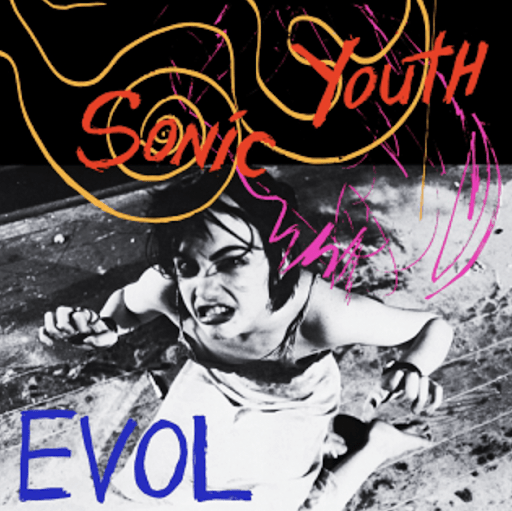
Lung Leg on the cover of Sonic Youth’s 1986 album, EVOL
Together, both director and actor participated in a culture that embalmed the no-wave era, working on projects such as You Killed Me First (1985), Worm Movie (1985), and Fingered (1986) -making any other attempt at transgression look emaciated in comparison.
The concept of a plot doesn’t really exist within these movies, from my viewing experience anyway; what audiences watch instead is a tableau of sadism and masochism and self-mutilation. Having watched a handful of low-quality clips of his work online, I can attest to Kern’s claim that his work transgresses the average viewer’s comfort zone. I also wouldn’t go out of my way to personally recommend his work to the casual viewer. On the surface, his films consist of young women rolling on the ground, making faces at the screen, and handling an array of bugs and reptiles – sometimes men are there too, wrangling themselves into bloody messes. There’s no dialogue in most of them, only the riffing of multiple instruments, making his work easily mistaken for a low-budget music video.
“You work a lot with violence and drug abuse”, asks one interviewer. Kern simply laughs.
When watching Kern’s films, it would be easy to make this association too. The 1980s, New York City, and the underground scene all evoke explicit drug use. In terms of violence, one just needs to refer back to the synopsis for Submit to Me Now. However, beneath the grime, gore, and grain, Kern’s depiction of “women in their 20s” unravels as his self-proclaimed subject matter. It has been the primary focus of his work since Kern himself was a 20-year-old filmmaker in the 80s, and it remains so during his current career as a photographer. Now, it’s through Lung Leg’s jagged persona that I turn towards Kern’s early depictions of women. In You Killed Me First, Lung Leg plays a demented daughter who finally snaps and guns down her family at the dinner table. In Fingered, poor Lung Leg again gets subjected to a spree of sex and violence enacted by Lydia Lunch and her partner. The tagline for Fingered even warns that some may find it “unnecessarily VIOLENT, SEXIST, and DISGUSTING”.
In these reactions, I recognise what literary theorist Julia Kristeva coins as ‘the abject’, that which society casts off in order to hold itself together. “It is not lack of cleanliness or health that causes abjection but what disturbs identity, system, order… the in-between, the ambiguous, the composite”. The women in Kern’s filmography embody what we’re not supposed to see: female anger, female cruelty, female mess. They vomit, they bleed, they brandish weapons. The daughter is flesh of her mother’s flesh and a murderous stranger; the pin-up model is a punk. I think of Lung Leg’s character shrieking at her WASP parents in You Killed Me First: “I’m flesh of your flesh… and you’re just as disgusting as I am!”
To mistake this subject matter of 20-something-year-old-women as perverted and typical for a now 70-year-old man is plausible for anyone all too familiar with the creative industry’s voyeuristic eye. “Just not when it comes to Kern”, I argue to myself.
Medicated (2010-2013) – my favourite modern-day project of his – is a photo series of models staring straight into the camera, holding up the prescriptions that they take and, as the visual narrative develops, depend upon to survive in an ever-confusing adolescence. Most of these women are half-naked, but that’s not the vulnerability Kern wants you to look at. Your eyes scan over the pill bottles in each hand. What’s the prescription? Is it one I know, or will I have to look it up? The bathroom settings are undeniably human and lived-in, each product a glimpse into these girls’ routines and habits. The variation of bodies, faces, antidepressants, antipsychotics, anticonvulsants, amphetamines, attention-deficit drugs, sleeping pills, and birth control (etc.) is enough to make any like-minded and medicated 20-year-old-girl see herself as being a part of this compilation.
“Klonopin/Relpax”, 2014, Richard Kern
“My mom put me on them—no second grade kid is gonna say “I want to go on drugs”. The reason they put me on it was they would tell me to put stuff in my cubby and go sit down and I would just wander around cause I was always thinking about other stuff. That’s what kids do. I’ve only taken this maybe two times in the last year so I can’t say I really think about quitting. I’ve seen too many friends ruins their lives to want to use it much.” – Quotation from Medicated Series, by Richard Kern
Portrait from Medicated – Richard Kern, 2014
Each image is accompanied by a continual written transcript. The dialogue loses its rhythm beside the page’s respective model and her respective prescription. Soon, nothing aligns, and their voices become one.
Kern uses the phrase “since the internet” in one of his interviews as if the establishment of the World Wide Web were some cataclysmic event. This is true, in a way. For someone like Kern, the sudden interconnectedness between everyone and everything made it nearly impossible for transgressive cinema to exist as an underground medium. “I don’t know what underground means… in today’s world”, he states.
During the 80s, Kern’s work was genuinely underground: passed around on VHS tapes, shown at seedy clubs or tiny galleries, utterly removed from the mainstream… a great assault on good taste. Now, those once-scandalous films are readily available: remastered on Blu-ray, streaming online, even screened at MoMA. The taboos that made the ‘Cinema of Transgression’ so bracing have seeped into mass culture. Murder, gore, sex, blasphemy. “Basically all of the shock tactics they employed are all part of the mainstream now,” one blogger notes. He’s right. What was subversive art in 1985 becomes an internet aesthetic this century. The underground didn’t so much disappear as get folded into an algorithm. When every teenager can find extreme horror clips, BDSM imagery, or the latest outré performance art with a quick search, what does transgression even mean? Is transgressive art even possible in a world where nothing is underground for long?
Kern’s own evolution offers one answer: context is everything. He once said, citing John Waters, that it’s fine to be an “angry young man,” but if you carry that rage into old age you just look ridiculous. Times change, and I guess shock must change alongside it. In an era where explicit content is ubiquitous, perhaps the new transgression is to expose what we habitually conceal. With Medicated, Kern turns his lens to the kind of private despair that normally plays out at home or in a psychiatrist’s office. He shows it clinically, yet not without empathy. We, the viewer, are confronted with the epidemic of medicated youth, the normalisation of psychological distress. No cow’s blood is needed here.
Still, I can’t help but feel a twinge of loss for the old underground’s gritty camaraderie. Kern’s was a tight-knit group of punks, artists, and weirdos who needed some form of a transgressive outlet (and were willing to go to physical, often grimy spaces to find it). Today, those spaces have been supplanted by digital ones. To be transgressive now often means pushing into interdicted zones of identity, politics, or morality, which is a different game altogether. Present-day artists have to find new pressure points to press. Some turn the provocation inward, some turn it outward to social critique, and some simply escalate the shock.
So, what remains when the dust settles? For me, it’s the women – Kern’s women. There’s Lung Leg. There’s Lydia Lunch. There are all those dead-eyed girls and their prescription bottles. The raging daughter, the self-destructive punk, the dissociated depressive. Aren’t these all facets of the collective female psyche that society has struggled to acknowledge?
Perhaps that’s why, decades on, these figures still hold a semblance of power… dragging the abject into view, and doing so with women at the centre-frame, in a way that forces a reckoning with how we view that form.
Cover Photo – Richard Kern
Works referenced:
“Abjection.” Wikipedia: The Free Encyclopedia, 23 Oct. 2025, en.wikipedia.org/wiki/Abjection.
Interview with American Underground Filmmaker Richard Kern. YouTube, uploaded by Film&Clips, 22 Aug. 2018,https://youtu.be/yqakhvFdrDo.
Morris, Gary. “Snapshots from Hell: Richard Kern – The Hardcore Collection on DVD.” Bright Lights Film Journal, 1 Oct. 2001, brightlightsfilm.com/snapshots-hell-richard-kern-hardcore-collection-dvd/.
Reinoos, Dana. “Films by Richard Kern.” Screen Slate, 11 Dec. 2017,www.screenslate.com/articles/films-richard-kern.
Supervert. “As Needed for Anxiety: Richard Kern’s Photographs of Pharmaceutical Chic.” Please Kill Me, 12 Jan. 2021, pleasekillme.com/richard-kern-photographs-medicated/.
Storm, Christian. “Richard Kern’s Films Are Still Shocking as Hell.” VICE, 7 Dec. 2012,www.vice.com/en/article/richard-kerns-films-are-still-shocking-as-hell.
The Bloody Pit of Horror. “You Killed Me First (1985).” The Bloody Pit of Horror, 23 Oct. 2020, thebloodypitofhorror.blogspot.com/2020/10/you-killed-me-first-1985.html.
Videowave. 1985 Interview with Richard Kern. YouTube, uploaded by Videowave, 6 Jan. 2018, https://youtu.be/8HXpmk-7NaM.
‘In order to communicate the message entrusted to her by Christ, the Church needs art. Art must make perceptible, and as far as possible attractive, the world of the spirit, of the invisible, of God. It must therefore translate into meaningful terms that which is in itself ineffable.’
– ‘Letter of His Holiness Pope John Paul II to Artists’, 1999
The visual culture of Catholicism does not naturally derive from an appetite for ornament. The earliest occupants of its interior life were men who fled from it. In the deserts of fourth-century Egypt and Syria, the first Christian monks stripped worship of every available excess, reducing religious life to silence, fasting, prayer and the barest material conditions requisite for survival. That this tradition of radical asceticism lies at the root of Catholic theology already complicates any easy association between worship and sensory indulgence. Indeed, Catholic form does not intrinsically lend itself to illustration nor to expression nor even to the beautiful – but crucially it does not refuse these as byproducts of the sensible mediation of grace. To beg the question Why does Catholicism look like that? is to interrogate the means by which the Catholic church makes belief legible – why it translates scripture into bodies and things and space and craft, and why it continues to argue that beauty, when shepherded by the proper hands, is not betrayal of truth, but one of its modes.
At the root of Catholic visual representation lies the doctrine of the Incarnation: the assertion that the Word became flesh, and so the divine enters and inhabits matter without diminishing Creator or elevating creation. Catholicism habitually locates revelation in the transubstantiation of things: bread, wine, oil, water, fabric, light, gold. It is obsessed with the material, the corporeal and the kinaesthetic. The science of Catholic sacramentality firmly insists that the sign is not necessarily signifying in the semiotic, Saussurean sense of things, but efficacious, meaning it both points to and communicates what it signifies. The icon is allowed and venerated not for its own sake, but because it points beyond to the subject which it stands for. It is the sacramental telescope by which we see that which is invisible. Cardinal Nicholas of Cusa made this clear: ‘Creative art, which it is the soul’s good fortune to entertain, is not to be identified with that essential art which is God himself, but is only a communication of it and a share in it.’ (Dialogus de Ludo Globi) Communication, then, lends itself to teaching, does it not? The imagery of the church, as is possibly rather plain, once primarily served a practical purpose as the visual vehicle of catechism. For much of Western history, the fluctuating Catholic population remained largely illiterate. Pictorial gospel allowed for the narration of salvation to the faithful who could not consume the inaccessible Latin of vernacular texts. For this reason, such figures as Saint Thomas Aquinas and Pope Saint Gregory the Great endorsed the theological basis for an aesthetic that privileged intelligibility.
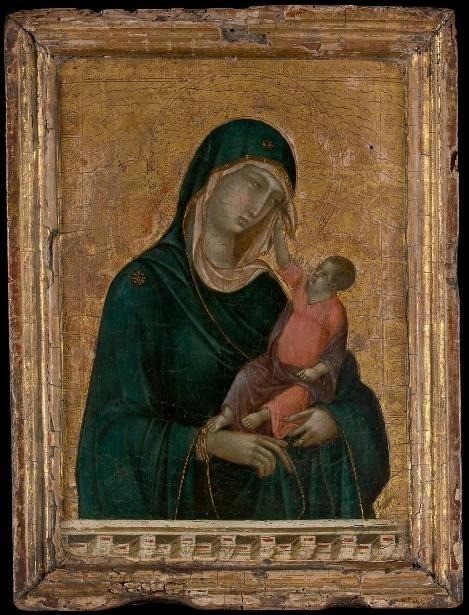
Madonna and Child, Duccio di Buoninsegna, ca. 1290–1300 / Madonna and Child, Il Sassoferrato, c. 1650.
If the visual culture of the Catholic church is solely fashioned for ‘the instruction of the uneducated’ (Aquinas, Commentary on the Sentences), why then do we begin with the dull, painfully emblematic representation of the Madonna and Child in the sacred catechistic art of the Middle Ages, and how do we burgeon into the diffused and delicate, near-ethereal proto-Baroque style of the Counter-Reformation? What necessitates and rationalises this shift? Theologian Hans Urs von Balthasar understands beauty as entirely inextricable from the glory of God, claiming that ‘beauty demands for itself at least as much courage and decision as do truth and goodness, and she will not allow herself to be separated and banned from her two sisters’. (The Glory of the Lord) Beauty is thus the manner in which earthly creatures manifest that glory, and thereby invite love and prayer. This synthesis of ideas finds parallel claim in the more classical, Greco-Roman metaphysic of beauty put forth by Plato: ‘The power of the Good has taken refuge in the nature of the Beautiful.’ (Philebus) It is also an idea agreed upon by ecclesiastical authorities of our contemporary day – the late Pope John Paul II concurred: ‘beauty is the visible form of the good, just as the good is the metaphysical condition of beauty’. The virtuous and the picturesque are essentially tied-up; that which is more lovely to look at is more noble by nature.
Early Christianity inherited from Judaism a deep suspicion of sacred imagery, shaped by Old Testament prohibitions against graven forms (‘Thou shalt not make unto thee any graven image, or any likeness of any thing that is in heaven above, or that is in the earth beneath, or that is in the water under the earth’, Exodus 20:4) and made sharper by the ever-present danger of idolatry (‘Confounded be all they that serve graven images, that boast themselves of idols: worship him, all ye gods’, Psalm 97:7). Under the Roman Empire – where Christians were a persecuted minority and pagan visual culture was both ubiquitous and polytheistic – Christian imagery emerged furtively, under a cloak of ambiguity. The earliest surviving artefacts of Catholic art are to be found in the subterranean caverns of the Roman Catacombs. The grapevine, the peacock, the Good Shepherd – each illustrated motif throughout the tombs deftly held a secondary latent meaning, operating as polyvalent signs intelligible to the initiated, yet inconspicuous within a familiar pagan visual economy.
‘Good Shepherd’ fresco and ‘fish and loaves’ fresco from the Catacombs of San Callisto in Rome.
It was only by way of prolonged doctrinal discourse – finally culminating in the Second Council of Nicaea in 787 – that the Church formally resolved the iconoclastic crisis, and confirmed that honorary veneration of images was permitted, though true adoration was to be reserved only for God Himself. With this conciliar decision, the image was finally affirmed as a legitimate participant in Christian devotion: not an idol or a mimetic attempt at rendering the divine, but a relational object and instrument of worship. This hesitant and cautious quality of early Christian iconography reflects an aesthetic history rooted in vigilance and restraint – certainly not in excess – whether due to fear of persecution or of deceiving one’s own faith. The legitimacy of the Catholic ‘look’ has always been something earned with time.
As Christianity travelled from the margins of Roman society to its imperial centre, its aesthetic posture necessarily shifted. The legalisation of Christianity under Constantine in the early fourth century precipitated a dramatic change in scale: worship moved from the domestic home and secreted altars into public space. And with this transition arrived architecture.
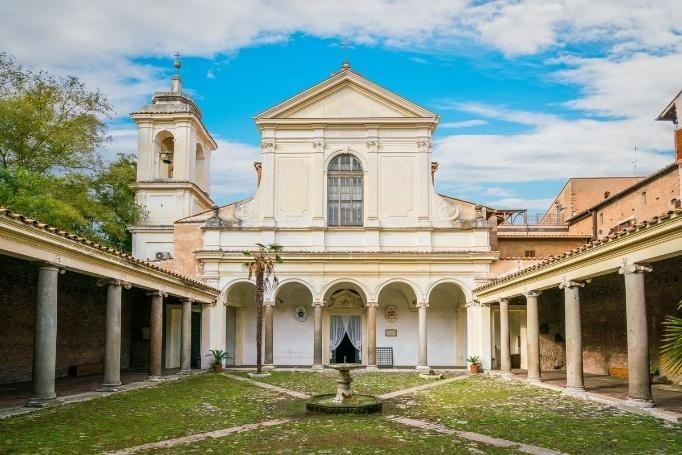
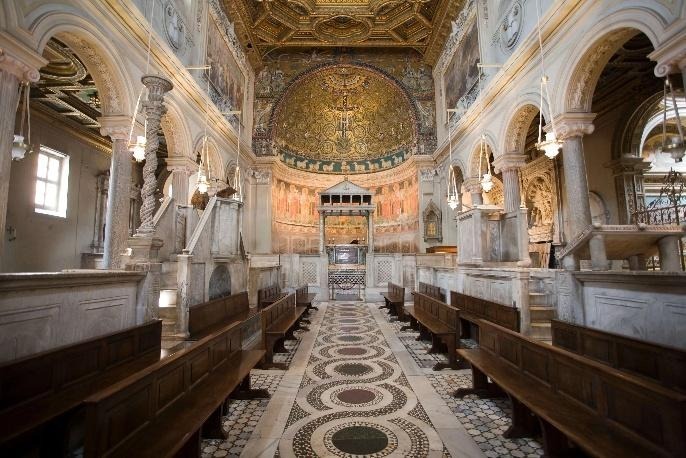
Basilica di San Clemente al Laterano in Rome. Once a private home and site of covert Christian worship in the first century, now a public basilica since the sixth century.
The earliest monumental Christian churches did not invent a new architectural idiom so much as appropriate one already embedded within Roman civic life. Ancient temples or civil buildings, such as the Pantheon in Italy or the Baptistère Saint-Jean in France, were common targets of conversion. Though it was the Roman basilica – used for legal proceedings, commercial exchange and public assembly – which offered a site uniquely suited to Christian worship. Unlike pagan temples, which functioned antithetically as enclosed dwellings for deities and were often visually inaccessible to the populace, the basilica was designed to hold bodies in common, encouraging ritual and interaction. This distinction is paramount: Christianity did not require a house for God, it sought a space for divine encounter. The basilican plan with its longitudinal axis, central nave, flanking aisles and projecting apse embodied the Church’s self-consciousness as a gathered community of people rather than a cult of contained divinity. Particular attention is paid toward space and orientation because this inscribes certain eschatological expectation into the building itself. As clerical hierarchies developed, so too did the structure of the church; the bema, transept and eventually the Latin Cross plan emerged among sacral architects to accommodate liturgical complexity whilst embedding salvation history into the body of the church.
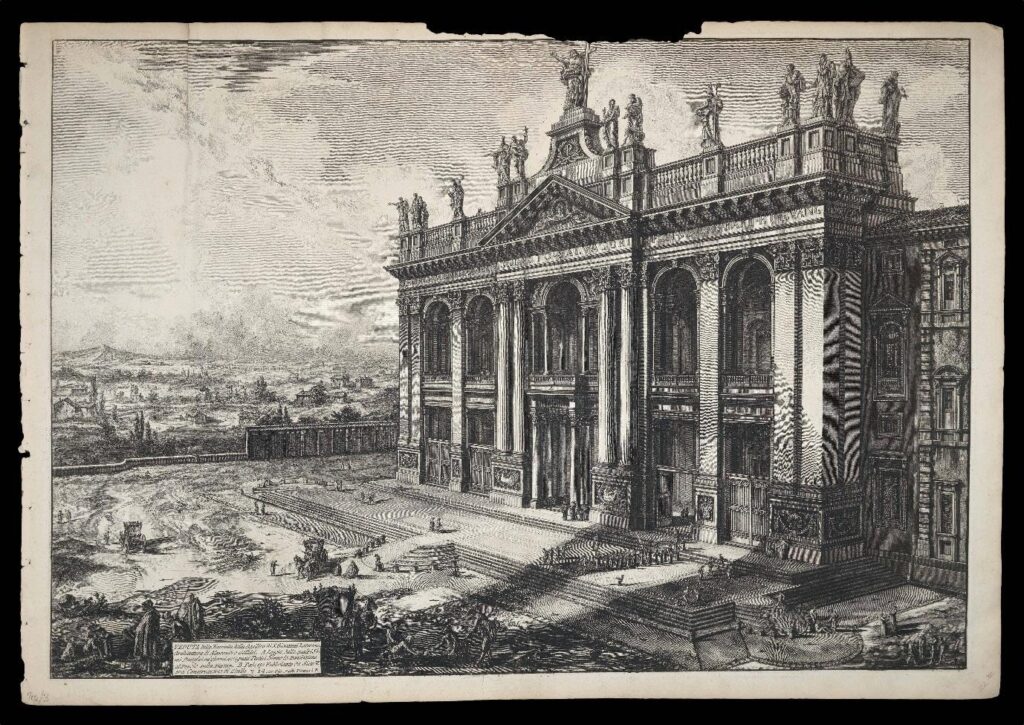
Yet even as scope increased, imagistic restraint largely remained in situ. Early basilicas such as the Archbasilica of Saint John Lateran exhibit an almost paradoxical sobriety. Exteriors relatively plain, often brick, resisting the monumental façades of surrounding imperial architecture. Interiors luminous though hieratic: figures hovering static rather than occupying space as you or I might. Saints rendered frontal, flattened, deliberately dimensionless and disembodied by virtue of theological caution. The sacral image was not yet trusted with naturalism.
Archbasilica of Saint John Lateran, engraving by Giovanni Battista Piranesi (1775). Founded in 324, it is the oldest basilica in the Western world.
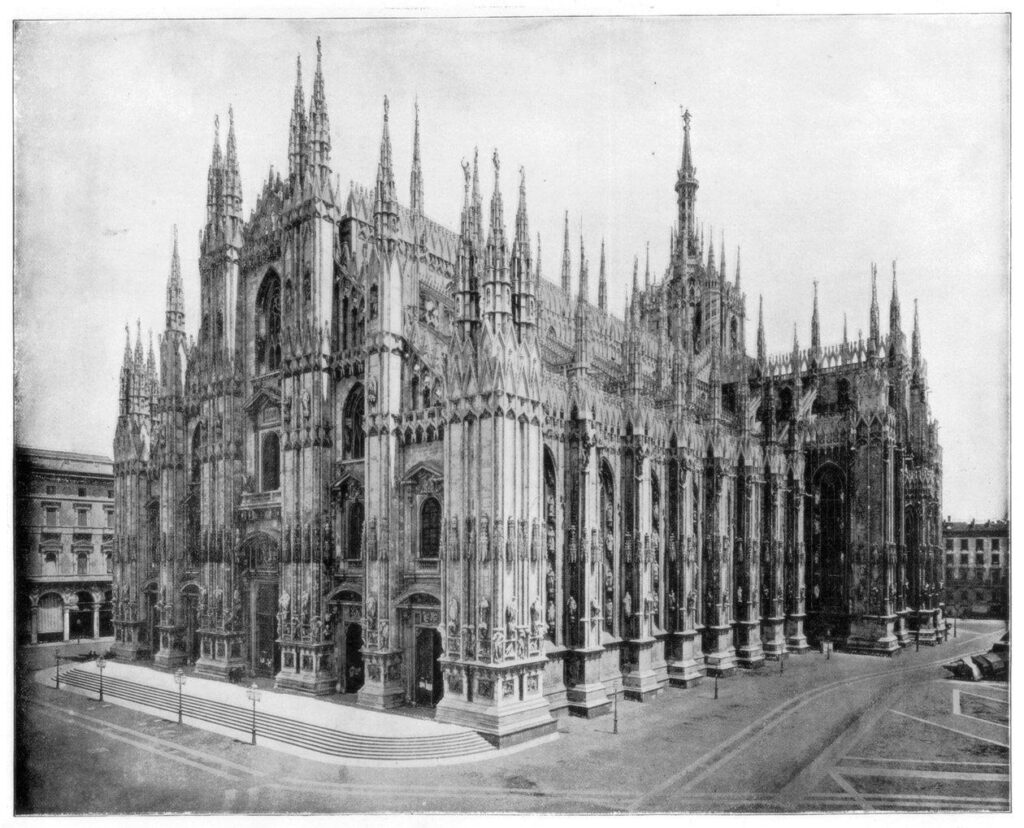
With the emergence of Gothic architecture in twelfth-century France came a decisive aesthetic turn towards aspiration and height – both literally and religiously. The introduction of such iconic features as the pointed arch, rib vault and flying buttress reconfigured the model understanding of how the Catholic church presents itself. By redistributing structural weight outward and downward, Gothic architects freed interior walls, allowing for new height and light. Churches rose vertically, straining upward as though neck vertebrae, their skeletal frames reaching into dizzying spires and dissolving into expanses of stained glass. Worshippers were bathed in truth and righteousness, God’s presence streaming in from the apertures, cradling faces with long, kind, coruscating fingers.
Characterised by immense human labour, intricate geometrical design and centuries-long construction projects, the building of a Gothic duomo or cathédrale must be understood first and foremost as an act of worshipful tribute, not an indulgence in creation itself. The church was a collective offering on behalf of the people, a sustained and painstaking liturgy enacted across generations of effort and attempt. Effigies grew increasingly vivid, rose windows with intricate mullions and tracery impressed the eye, detailed frescoes spilled marvellously onto lofty cross vault ceilings. The Church was no longer the self-effacing provider of a place of worship; it had now begun to shape the Catholic’s sensory imagination. Still, the visual of the Gothic remains vertical, gestures heavenward; it does not yet engulf. That shift only comes on the heels of crisis.
Duomo di Milano, John L. Stoddard, 1893.
The Protestant Reformation of the sixteenth century saw an attack on sacred material culture. Images were condemned as distractions, the splendour of structure as a corruption of pure faith. Iconoclasm was the logical terminus of reformist zeal, the consequence of a faith-branch which understood entitfied religious practice as an obstacle to worship rather than its vehicle. In response, the Catholic Church was forced to articulate – explicitly and defensively – the core principles which had long undergirded its aesthetic culture. The Council of Trent reiterated the legitimacy of sacred images as pedagogical and pastoral necessities: art was reaffirmed as the endeavour of teaching, moving and converting. The Counter-Reformation – soon to be followed by the Baroque – had settled upon the Western religious world.
Intensely concerned with the bodily, the Baroque church is the church of the corporeal. It is a space – elastic and kinetic where it was once static and axial – engineered to produce affective response. Awe, disorientation, intimacy, rapture, overwhelm. Columns twist and hurtle upward. Ceilings open into illusionistic heavens which collapse the now-foggy distinction between the earthly and the divine. Perhaps most critical is the dissolution of inherited boundaries between artistic mediums in order to overburden the spectator’s capacity for detachment. Architecture frames sculpture; sculpture erupts into painting; painting bleeds into the calculated orchestration of light itself. Nothing remains autonomous, nothing stands in solitary. The gesamtkunstwerk of the Baroque church constitutes a single persuasive apparatus, calibrated to render theological abstraction experientially irrefutable. Devotion is no longer confined to the mind or mediated primarily through scripture; it is staged as a transcendent encounter unfolding in real time before and around the worshipper. God feels proximate, inconceivably so.
Ecstasy of Saint Teresa, Gian Lorenzo Bernini, 1652.
I ask you to consider Bernini’s Ecstasy of Saint Teresa as a prime instance. The collapse of the body, the slackness of the jaw, the give of the posture inviting divine invasion. Hidden windows flood the chapel with golden light; marble becomes skin before you; architecture frames the allegory of revelation as a spectacular event. Grace acts upon the body. We are less observer and more witness here, are we not? Hand over mouth, breath held, frozen in this theatre of the ecclesiastical.
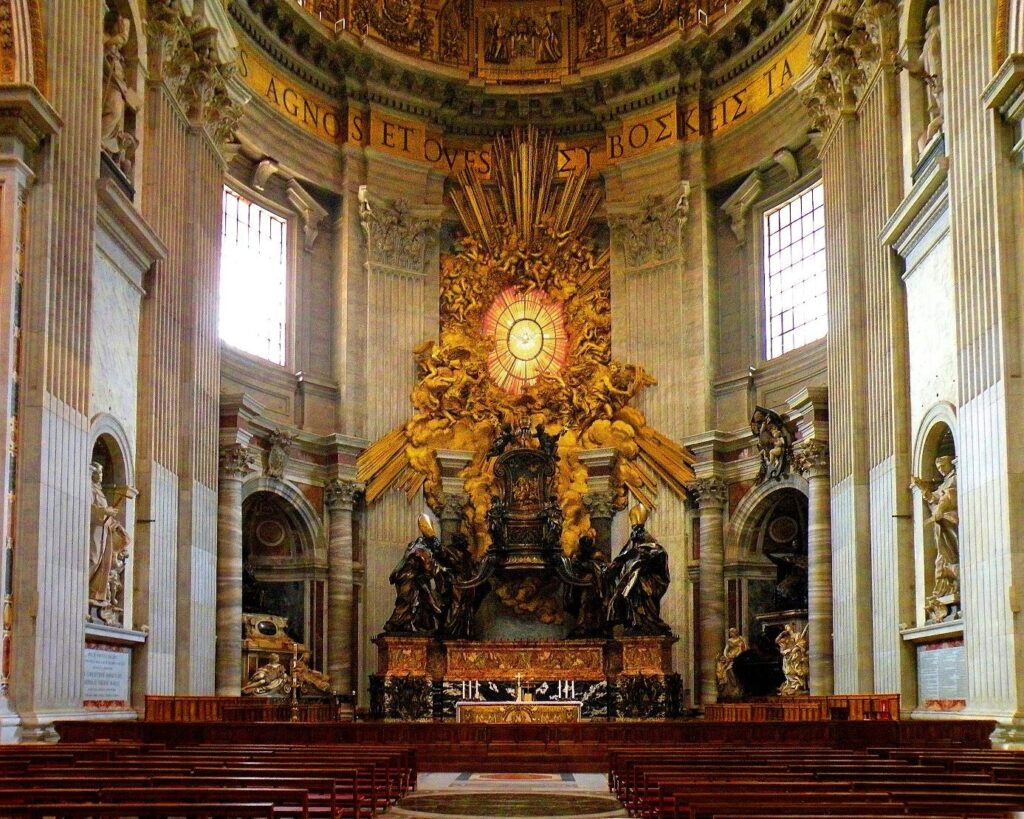
At the risk of sounding impious, when one steps into a seventeenth-century cathedral at times it does very much feel like stepping into an opera house. The Baroque is infatuated with theatricality, with staging and motion and chiaroscuro and synergy with the senses. Gold leaf and incense and marble and mosaic and choral polyphony and monastic chant and processional banners. It adores texture and lustre and materiality. Urges lavishness as well as durability. And what of scripture – the written Word? ‘Forasmuch then as we are the offspring of God’, the New Testament insists, ‘we ought not to think that the Godhead is like unto gold, or silver, or stone, graven by art and man’s device’. (Acts 17:39) I remind you that objects of sacramental action command honour, serving as intermediaries between heaven and the earth. What are the vestments and vessels of Catholic worship if not the Church’s firm and concrete assertion that the sensible is our only means to communicate the eternal? To signify the worthwhileness of the world God has created? Gold cannot make God more precious.
Apse of St Peter’s Basilica in Vatican City.
One of our greatest popes, John Paul II, wrote a deeply galvanising letter addressed to the artists of our day in 1999. Within this letter, he asks the question ‘Does the Catholic Church need art?’ He responds in the affirmative:
‘Art has a unique capacity to take one or other facet of the message and translate it into colours, shapes and sounds which nourish the intuition of those who look or listen. It does so without emptying the message itself of its transcendent value and its aura of mystery.’ (‘Letter of His Holiness Pope John Paul II to Artists’)
Though perhaps more of interest and quite remarkably, he also begs the question: ‘Does art need the Catholic Church?’ On this dynamic, he says ‘it has been a great boon for an understanding of man, of the authentic image and truth of the person’, and invites artists to ‘enter into the heart of the mystery of the Incarnate God and at the same time into the mystery of man.’ In our contemporary cultural economy, it is compelling and tremendously significant that the Catholic visual language survives in secular culture.
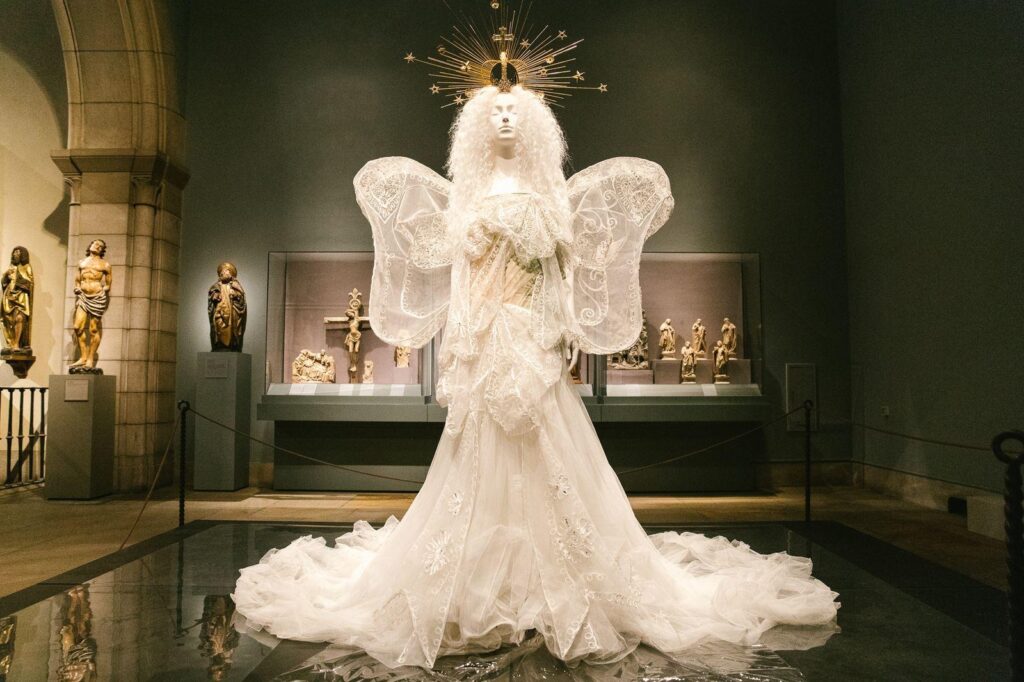
Its aesthetic vocabulary of precious metals, brocade, embroidery, architecturally-informed silhouette and sacred motif continues to resonate, particularly in the world of fashion. In 2018, the Metropolitan Museum of Art Costume Institute hosted an exhibition titled Heavenly Bodies: Fashion and the Catholic Imagination. Curated to explore the intersection of sacral visual codes and haute couture, it featured creations from Dior, Valentino, Jean Paul Gaultier and Dolce & Gabbana among many others, highlighting how liturgical chasubles, conical mitres and bejewelled reliquary crosses may function as purely visual language, divorced from worship though still inviting conversation and commemoration.
Heavenly Bodies: Fashion and the Catholic Imagination at the Metropolitan Museum of Art / John Galliano for Dior: Evening Ensemble, Autumn/Winter 2005–6 Haute Couture.
Catholic imagery seems to thrive in this postmodern cultural afterlife because it carries an almost preternatural formal logic. For non- or nonpracticing Catholics, its characteristic verticality, hierarchy, symmetry and ornamentalism are legible even without contextual doctrinal framing. Gold filigree retains its connotations of sacredness, authority and value whether it is found in the Igreja de Santa Clara or the bodice of a John Galliano gown. Crucifixes and rosaries become motifs in jewellery, home decoration, graphic design. Even sans liturgical function, they signal drama, gravitas or a sense of ritualised performance, making them attractive to visual directors and cultivators of culture. The potency of Catholic iconography persists – whether celebrated or critiqued – independently of explicit belief, and its visual lexicon continues to exert cultural influence even in a world that may no longer consciously acknowledge its origins.
Featured Image: ‘María Santísima de la Aurora’, Francisco Romero Zafra, 2008
I prefer my heroes a bit shit, thanks very much. Dour and perturbed out on the peripheries, frankly I’d prefer it if they didn’t even save the day. Leaning against an oblique wall, my beau ideal cups their crooked fag against the jetsam and bluster of the battle they slope to inattention for.
David Berman leant this way, I think. He seemed, wearily, to be laboring against something; in a costume of faded jeans, an unwashed shirt and a cape of stale cigarette smoke fluttering behind him, he fought strange fights of hearts backfiring and red-rusted souls. With a smoked southern drawl of weary nonchalance and jagged pain, he seemed to be drenched in the idiosyncrasies that one finds watching a beautiful sunrise from a motorway flyover, completely off your face.
His main band, the Silver Jews, sputtered into existence sometime in the late 80s, someplace in upstate New York, and started life recording shambling tunes into peoples answering machines. Working as security guards at the Witney museum, Berman and his bandmate Stephen Malkmus were, I imagine, immersed in the post-modern abstraction and rarified boredoms of a conceited new culture. If I were pretentiously inclined I may say they strove to redress the exploding of structure’s ensuing isolation and other such brave new bullshit. Abandon your post-structural theses and assaults on the continuity of comprehension here, however, as we see before us a layman’s group in the most beautiful possible sense.
Releasing seven studio albums over fourteen years, the Silver Jews charted the course of the weirdos and wanderers of the American landscape. Despite holding an MA in poetry and being a published poet, Berman’s group was not an urbane exercise in the oddities of parochial backwaters and faltering dreams. His was a true and trembling band of somewhere in-between. Lyrics spun out of Kenneth Koch and William Faulkner’s acid infused dreams, and a group of musicians who played like their trousers were falling down, made a group that seemed too weird to live, too rare to die. Their loping shabby songs of lo-fi indolence and ingenuity were too piercing and too perverse to ever take center stage, too poignant and profound to be relegated to the annals of indie landfill.
Cruelly then, it is fitting that the 90s music press maligned them as a side project to Malkmus’s main group Pavement, darlings of the alternative era. Fulfilling your own prophecies I should imagine is seldom an enviable position to find yourself in, and in this sidelining David Berman got rather too close for comfort to the reflection of the half forgotten worlds about which he wrote. That intimacy with the inverse of the American ideal, however, gave birth to what is generally considered Silver Jews’ defining record, American Water. The album epitomized the wit and wonderment, the gothic and the absurd, with sardonic disaffection, a disillusioned prophet incanting his drole wisdom, merely glimpsed through the creaking screen door of a tumble down honky tonk.
I shan’t say though that they triumphed over adversity, for the opulent sweep of a triumph seems an anathema to their elegizing of the down at heel and just plain peculiar. Rather I imagine it bought Mr Berman a step too close to embodying his subject matter. Hailing from West Virginia, our raffish hero did not come into this world as an introverted troubadour or baleful soothsayer of a forgotten world of rickety dreams. Berman was the son of one of the most egregious and hateful lobbyists in Washington, so grew up for all intents and purposes affable and affluent, far from suckling on the American dream he came to find so disreputable. So maybe there’s the tension, the catalyst behind his catalogue of slackers and outcasts. When Berman disbanded the band in 2009 he claimed, defeatedly, that his music couldn’t begin to undo the enormity of the damage his father had done to American society.
I suppose that clung to him and his art throughout his career, peppered with depression and suicidal thoughts. You can hear it in the conclusory song ‘Pretty Eyes’ off 1996’s The Natural Bridge, his voice ringing hollow and profound with the unearthly anguish of an extreme sleep deprivation he was hospitalized for the moment he finished the song. Post-American Water, in a scene that veers between the prophetic and the melodramatic, he crawled into the Tennessee hotel suite Al Gore watched his 2000 election loss from to overdose on painkillers, proclaiming his wish to die where democracy did.
Berman took his own life in 2019, days after releasing his final album, Purple Mountains, pre-empting grief and bereavement with his unique amalgamation of insight and deflection, repartee and honesty – the funniest and most wrenching suicide note one could possibly conceive of. So where does that leave me and my languid sage? If nothing else, the wonderful immersion of his curling lyrics proved invaluable to me when I was looking for someone to rip off when writing crap angsty poetry as a teen. I suppose the appeal lies in that mercurial world of catharsis, for I can imagine him saying that the view from the second place podium is a tonic of bittersweet wist. I don’t want to hackney the sentiment that he makes one feel sufficient in place of inadequacy, so I posit that he speaks to the clouds drifting across the sun, of the erroneous beauties whispered through the battles of each day. He seems to me to be the hero of what could have been, of falling short of the mark, of an unusually vivid humanity.
‘Repair is the dream of a broken thing, like a message broadcast on an overpass, all my favourite singers couldn’t sing’.
David Cloud Berman, never a truer word was spoken. God knows you can’t sing, but I wouldn’t have it any other way.
As a footnote, that is the only lyric quote I have included here because I cannot bring myself to spoil the visceral poignancy you may find in them when you are particularly low.
There’s something about George Harrison’s All Things Must Pass that feels uncannily British — not the old empire kind of British, but the rain-soaked, quietly resilient, half-resigned version. Released in 1970, the triple album came out just as the country began to feel the slow ache of decline: post-Beatles, post-utopia, post-swinging-sixties London. Even its title felt like an elegy for a fading Britain.
Fifty-five years later, the sentiment lands harder than ever. All Things Must Pass nowplays like a requiem for a country trying to convince itself it’s still special — a soundtrack for the long, unglamorous hangover after the party of empire, of cool Britannia.
When Harrison wrote All Things Must Pass, he wasn’t being cynical. He was being spiritual. He’d seen the machinery of fame and ego up close and come out the other side searching for something gentler, truer. The song’s calm acceptance of “sunrise doesn’t last all morning” felt like wisdom at a time when Britain still thought the sixties might never end. But in 2025, it sounds more like a prophecy. It seems like the sun’s been setting for a while now.
Public services are crumbling, rivers are filling with sewage, and politics has become performance art for bitter men with microphones. Reform UK gains traction by promising renewal but selling racial resentment; Labour promises competence, not hope, yet fails to deliver on both. Everyone’s tired, and the rain keeps falling.
Harrison’s voice, patient and forgiving, may hum through the noise like a counterpoint: It’s not always going to be this grey. But yet, it is — for now.
Britain has always excelled at melancholy. We make poetry of drizzle and drama of decline. From The Waste Land to The Crown, we aestheticise decay until it almost looks romantic. Harrison, though, wasn’t interested in performance. His melancholy wasn’t self-pitying; it was cleansing. He offered resignation not as despair, but as liberation, which is a lesson the modern political class could use. Today’s leaders — Farage shouting from a pub, ministers performing contrition on breakfast TV — cling to power like it’s still 2012, still possible to summon optimism with a slogan. “Levelling Up” has become a punchline; “British values”, a meme.
Harrison would have recognised this noise for what it is: pure ego.
Beware of Darkness, one of the album’s most haunting tracks, could be mistaken for a sermon to the electorate. “Beware of greedy leaders / They take you where you should not go.” In 1970, that might have sounded like Eastern mysticism. In 2025, it’s practically the daily news cycle.
The album was partially recorded at Friar Park, Harrison’s eccentric gothic estate, and the iconic album cover was shot there — half-mansion, half-monastery. The walls, lined with gargoyles and silence, gave him the distance to write a work of self-reflection, something Britain rarely manages. Today, the country feels like it’s still living in that house — ornate, damp, haunted by the past. We’ve filled the rooms with nostalgia: wartime mythologies, royal weddings, Great British Bake-Offs. It’s charming, but it’s also claustrophobic. Every institution, from Parliament to the BBC, feels like it’s decaying in slow motion.
Harrison’s mantra — all things must pass — isn’t just an observation; it’s an instruction. Empires fall. Economies falter. Cultures shift. The task isn’t to stop it happening, but to let it happen, and then begin again.
But Britain doesn’t let go. We polish the relics instead.
But for one moment, imagine if we actually took Harrison seriously — if the country released its grip on the fantasy of exceptionalism. Reform UK wouldn’t exist; it depends on the illusion that decline is reversible, that we can simply vote our way back to the 1950s. Nor would the endless nostalgia industry that props up our media — the monarchy, the Blitz spirit, the Beatles themselves — work without the promise that the past can be restored.
Harrison’s message was the opposite: transcendence through impermanence. Growth through surrender. The idea that endings aren’t failure, but natural order, and maybe that’s the radical politics we need now — not rage, not revival, but acceptance. To look honestly at what’s rotting and stop pretending it can be repainted.
Listening to All Things Must Pass in 2025 Britain feels like stepping outside the chaos for a moment. The songs drift like prayer — full of humility, humour, resignation. Harrison’s slide guitar sounds like light breaking through fog. It’s an album that insists, even amid decay, on grace.
And perhaps that’s the hope we’re left with. Not a new golden age, but a quieter one — where kindness outlasts the slogans, where humility replaces bluster, where we stop shouting about greatness and start doing small good things.
Because if Harrison was right — if all things must pass — then this too will. The populism, the cruelty, the endless decline. The question is what we’ll build in the silence that follows.
Until then, the rain keeps falling. The records keep spinning. And somewhere, faintly, George Harrison’s voice reminds us: