By Honor Adams
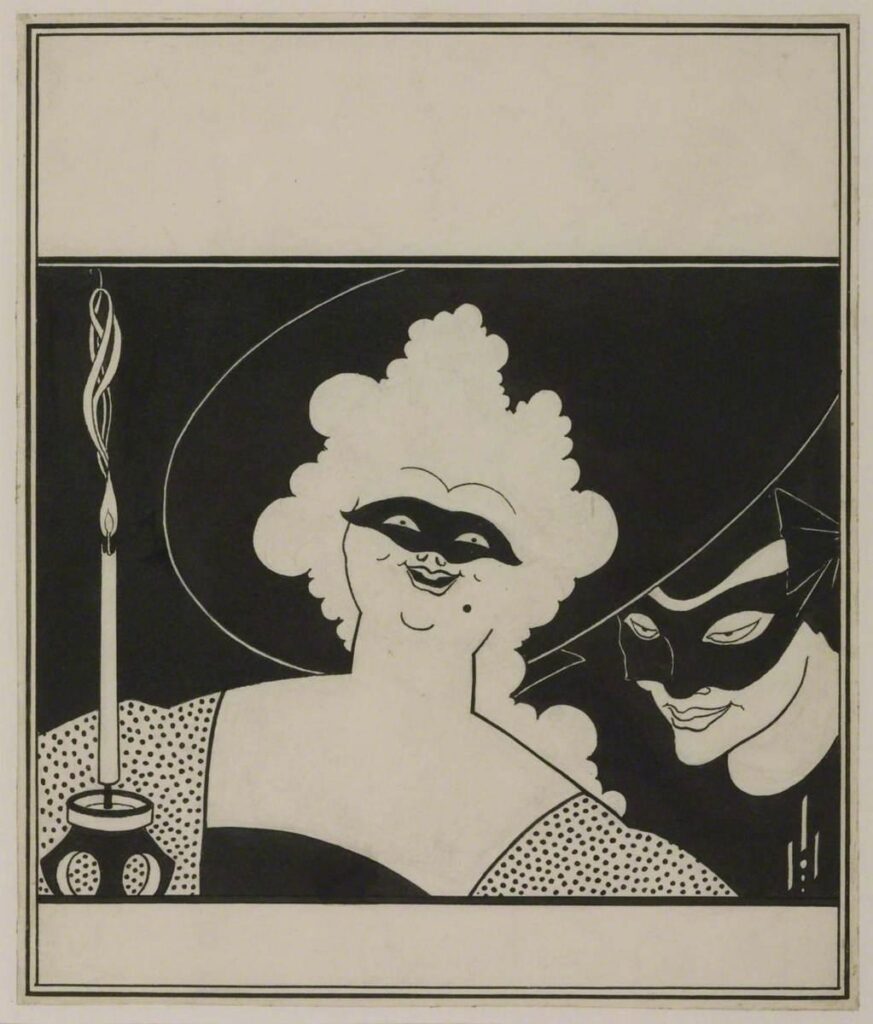
I first encountered Aubrey Beardsley in a solid red shop on Oxford’s fading high street. Amid draws of outdated maps and horticultural prints, his intricately simple woodblock prints began to creep out. Black and white visions writhed into life – their elegance tinged with irony, excess and restraint.
Within the quiet confines of Saunders of Oxford, I found myself entranced, flicking through each leaf of shocking, ironic, and playful illustrations, where line and curve dissolved into a theatre of desire and defiance. Poised between the quaint and the transgressive, my experience felt like an initiation into the strange allure of the fin de siècle.
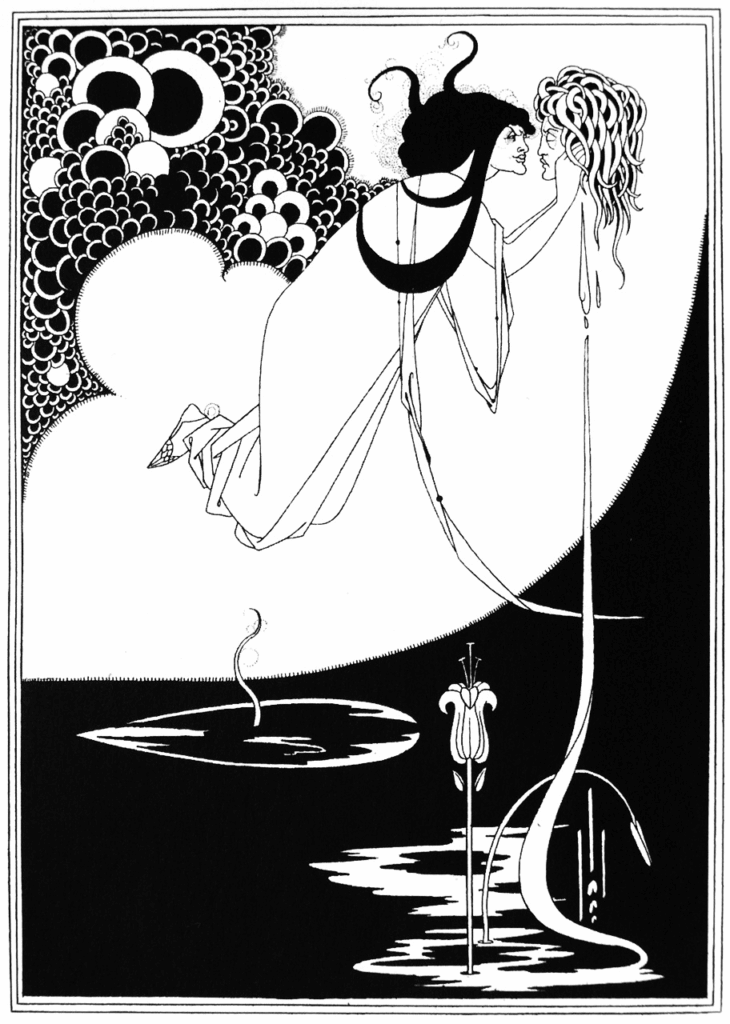
Shocking the modern viewer has become increasingly difficult in the progression of contemporary art. However, Beardsley’s fictitious illustrations snipped from Wilde’s Salomè, Thomas Malory’s Morte d’Arthur or The Savoy, left me gawking through a window into the world of Victorian England. For Beardsley, audacity was a simply humorous exercise; continuing a tradition of political and societal mockery. And as with any contentious creation, objections were, and remain, multiplicitous.
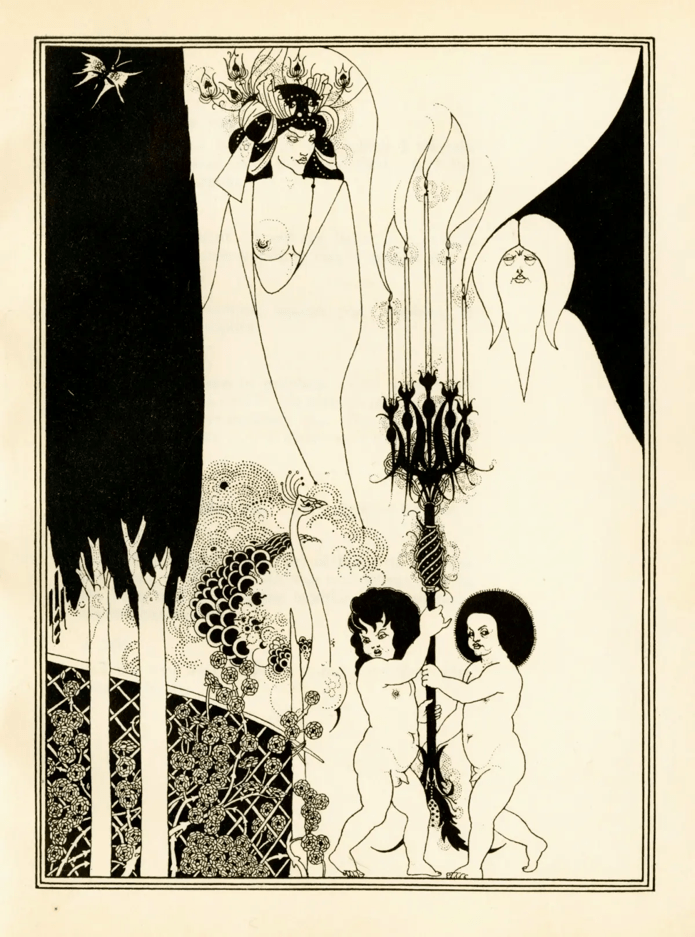
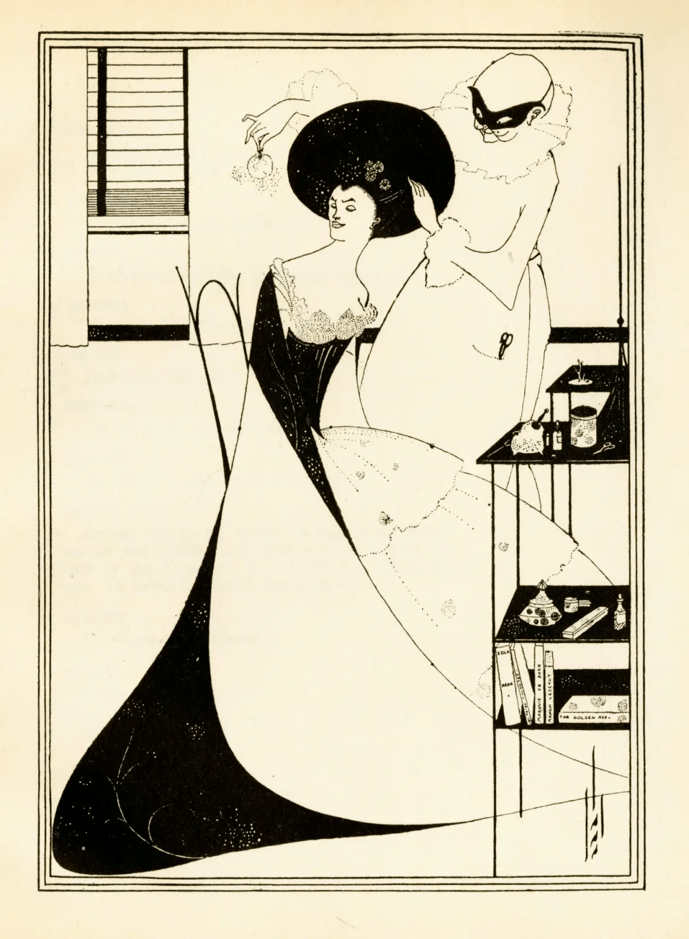
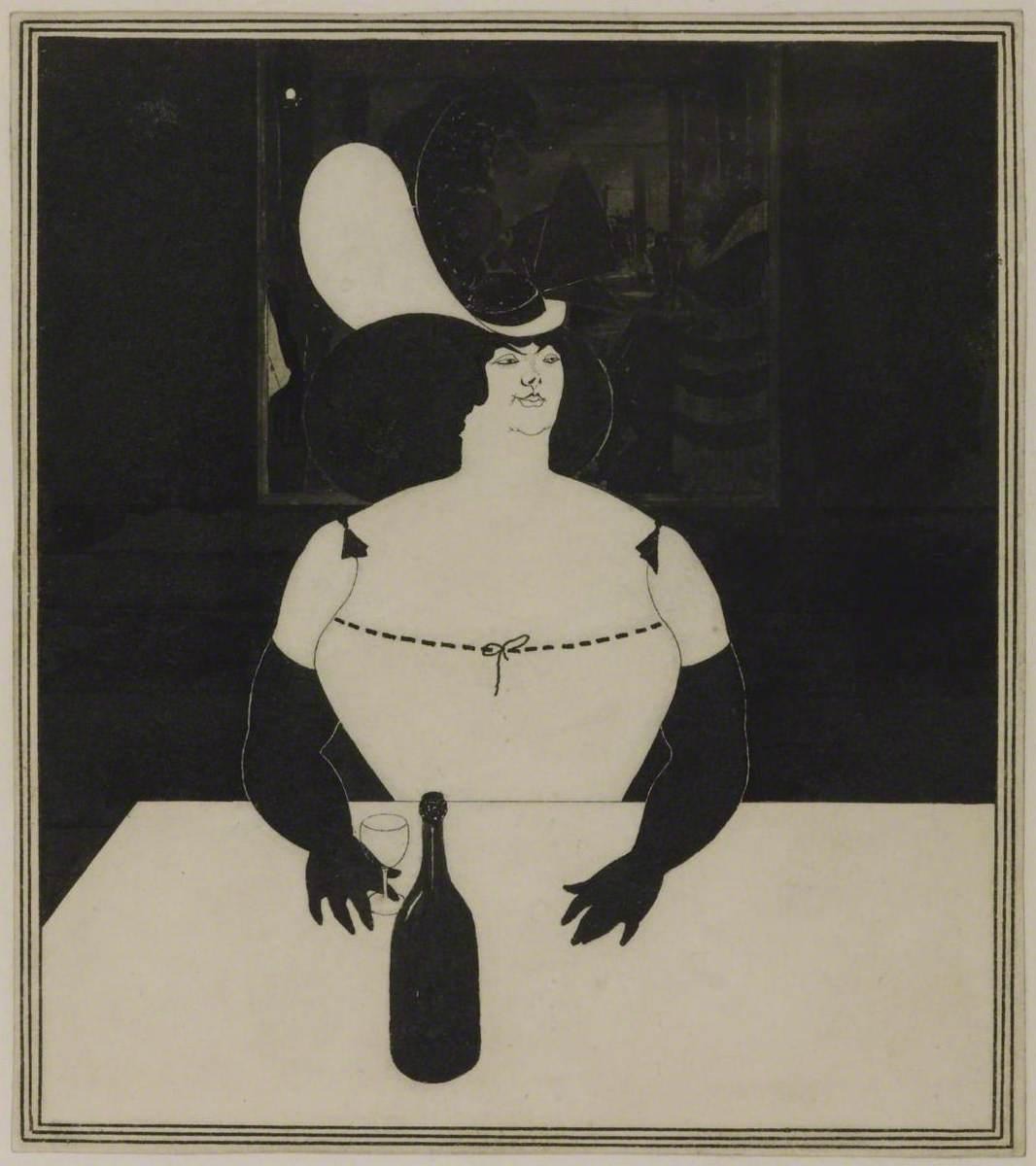
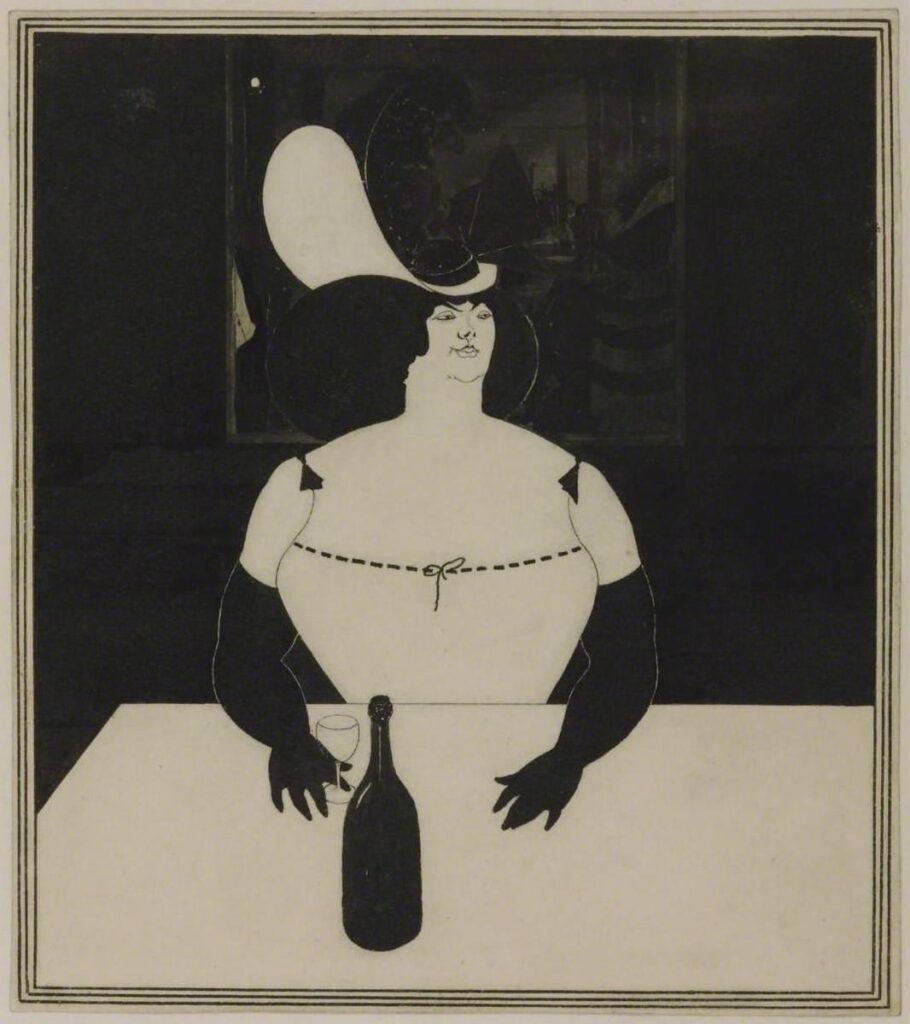
Beardsley’s grotesque, scandalous, and immoral subject matters gave him the attention he desperately desired. The bulk of his illustrations depict women, many of whom embodied deviance and corruption in the eyes of the conservative Victorian reviewer. Beardsley drew upon the taboos of the era, forming a subversive commentary on societal norms. Synchronous to his short working life, the feminist ideal of the ‘New Woman’ was salient, a term coined by the novelist, Sarah Grand, in 1894. These ‘New Women’ challenged values already being attacked by fin-de-siècle modernism and the societally deviant dandies of the Decadent movement. Women demanding social opportunities and emancipation were boxed into the same category as prostitutes or the promiscuous. Rather than attacking such unruliness, Beardsley mocks the ludicrousness of a dated categorization, gaining attention whilst revealing his progressive mindset. Despite backlash, gender was being redefined, and Beardsley harnessed such change as a platform for recognition and contentiousness.
Subversive subject matters and a tendency towards sexualised themes were often associated with his infliction of ‘consumption’ (Tuberculosis), a bizarre 19th-century perception with no medical affirmation. Ironically, with continually poor health, Beardsley turned to Catholicism and rejected his previous work on the subject.
The question of Beardsley’s own sexuality, or his advocacy for homosexuality more generally, has been debated. Despite this debate, his early death and contemporary taboos prevented any conclusions on his part. Linda Gertner Zatlin argues that he “advocated neither homosexuality, androgyny, nor heterosexuality”. Although, I would contend that his true nature or beliefs can never be uncovered, and any speculations produce no valuable theory. His work remains sexually ambiguous on a personal level, presenting us with a distinctly asexual depiction of Victorian taboos. The fluidity within his work was rare by Victorian standards, but the artist’s lack of comment on such matters reveals little of himself other than a liberal and risqué attitude. What cannot be doubted is that Beardsley was an eccentric dandy (a contemporarily mesmerising characteristic) and his confrontation of evolving issues came at a turning point in women’s and sexual history.
“I have one aim – the grotesque. If I am not grotesque, I am nothing” Aubrey Beardsley, 1897.
Beardsley initially drew inspiration from the Pre-Raphaelites, taking motivation from his desire for fame and encouraged by his mother’s expectations. He followed the works of William Morris, Dante Gabriel Rossetti, and Edward Burne-Jones. A shared interest in the medieval, symbolic subjects, as well as a rejection of contemporary art, drew Beardsley to these characters. Burne-Jones specifically acted as a mentor, strongly supporting his initial work. However, Beardsley grew tired of his Morte d’Arthur commission and the two diverged as the illustrator began to embrace his own more individualistic and increasingly erotic style. Morris held an unsupportive stance from the outset, leading to Beardsley breaking away from the Pre-Raphaelites and migrating towards a Parisian clique, further alienating British reviewers. The xenophobic normality of the late 19th-century criticised his French connections and grumbled over the otherness of his Japanese style. Nonetheless, contemporary judgment was not universally negative, and the elegance of his line and precise decorative style landed praise from several critics, including Joseph Penell.
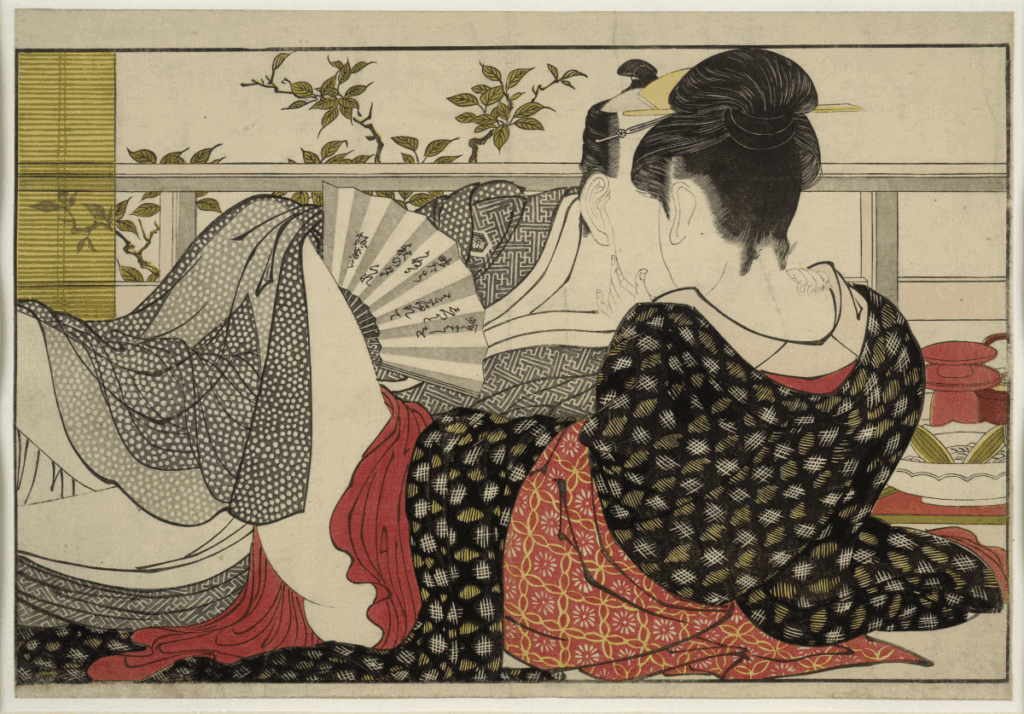
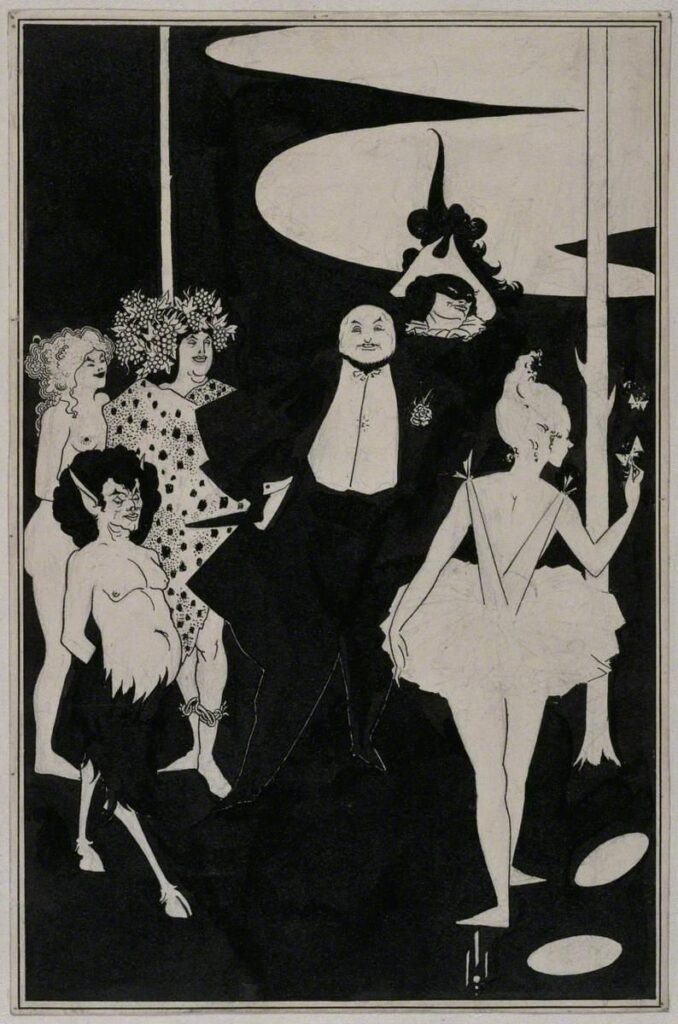
His hard-edged line forced his work to become visually aggressive. Contradictions weave throughout, blending elegance, classicism and purity of line while meshing between the scandalous and perverse. The result is a definite visual power. The line block technique and Japanese influence remain a thread throughout Beardsley’s work, allowing for its mass reproduction at a time when printed culture was particularly prevalent. Beardsley pushed back against the self-proclaimed cultural superiority of the British art scene, lacing ironic and mocking messages into his work. In contrast, Japanese artistic practice didn’t acknowledge erotic or sexual themes in the same disgust as the Victorian Brit. Distinct parallels can be drawn both in style and motif to artists such as Kitagawa Utamaro or Katsushika Hokusai. Prints such as The Dream of the Fisherman’s Wife (Hokusai) or Lovers in the Upstairs of a Teahouse (Utamaro) portray undisguised sexualised themes far more shameless than those of Beardsley and almost a century earlier.
Irony and satire weren’t unknown to the British media, and Beardsley himself often found himself the brunt of such commentary. Beardsley and his subversive advocacy saw him riddled with salacious scandal in the eyes of Victorian England. A poem from April 1894 in Punch magazine mocked the artist in a distinctly fin-de-siècle way:
Mr Aubrey Beer de Beers,
You’re getting quite a high renown;
Your Comedy of Leers,
You know,
Is posted all about the town;
This sort of stuff I cannot puff,
As Boston says, it makes me “tired”;
Your Japanee-Rossetti girl
Is not a thing to be desired.
Mr Aubrey Beer De Beers,
New English Art (excuse the chaff)
Is like the Newest Humour style,
It’s not a thing at which to laugh;
…
(Owen Seaman: “Let’s Ave A Nue Poster” (Punch, 21 April 1894, p. 189))
In April 1895, two weeks following the arrest of Oscar Wilde, Aubrey Beardsley was fired from his position as art editor of The Yellow Book. Wilde was thought to be carrying a copy of the controversial periodical during his arrest. This was revealed to be simply a yellow-bound French novel, and the two men’s relationship was by now hardly amicable. However, the need to disassociate Wilde’s scandals from the periodical cost Beardsley his job. The Book’s sales fell with his illustrations no longer adorning the pages of Decadent writings. Beardsley is often associated with the life and literature of Wilde, and whilst his work depicted the society that Wilde inhabited, Beardsley’s creations hold their own gravity.
By 1898, Beardsley’s health had deteriorated. An awareness of his impending death led to his conversion to Catholicism. Before he died, he wrote to his publisher, Leonard Smithers, to dispose of his work Lysistrata and many other shocking pieces. This request, for the sake of artistic appreciation and historical study, I am glad was never completed. Aubrey Beardsley’s career spanned less than 7 years, dying of Tuberculosis in 1898. He will forever be associated with The Yellow Book, Oscar Wilde and the controversial characters of Victorian Britain’s evolving society. For those who, like me, find themselves flicking through Beardsley’s work in an antique print shop, it is evident that his work has impacted far more than just a yellow bound book.
Featured Image: Tate Britain