Categories
Reviews

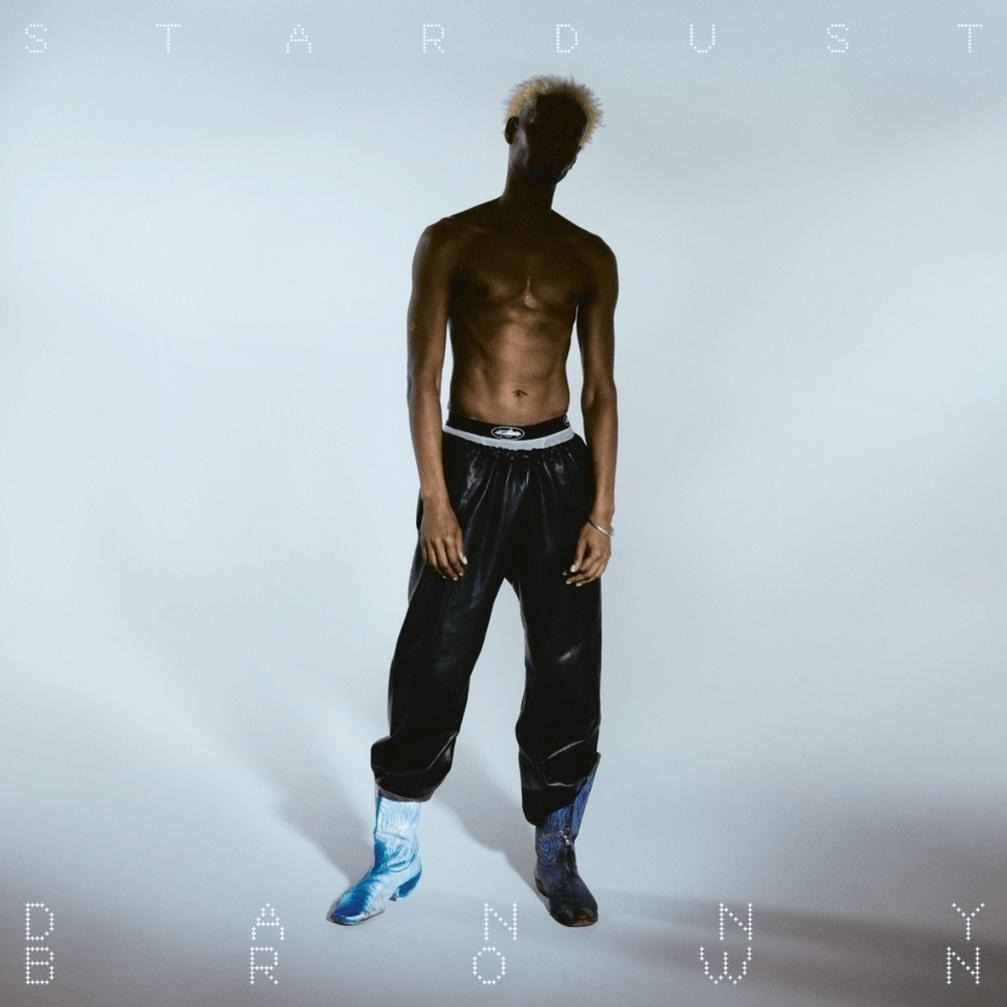
Review: Danny Brown’s Stardust Explodes with Creativity

By Edward Clark

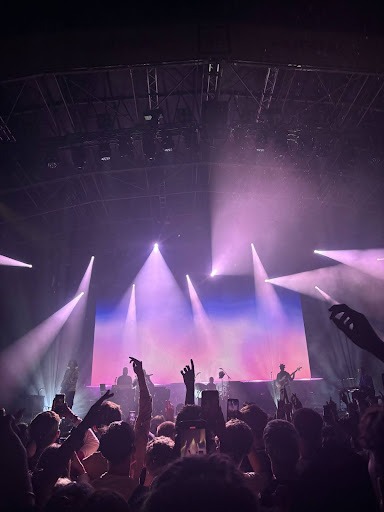
Danny Brown is on an all-time run. For a veteran rapper with over twenty years of experience behind him, Brown shows no sign of stopping, and even less sign of becoming out of touch. Stardust is stuffed with head-turning features. Although he has worked with cult artists Jane Remover and Quadeca before, collaborations with underground artists like 8485, ta Ukrainka, and NNAMDÏ is something unparalleled by any of Brown’s hip-hop contemporaries. As his collaborators frequently express online and in interviews, ‘he’s so tapped into the scene’ (underscores to The Face magazine); Brown’s assimilation of so many up-and-coming artists makes Stardust shine.

This album is Brown’s first ever made completely sober. As he worried to the Guardian in 2023, “I’ve seen so many artists get sober and their music sucks”. His concerns were unfounded: from the album’s first single, Danny Brown showed that he was not letting sobriety hinder his out-of-the-box style. If anything, ‘Starburst’ is one of Brown’s most inventive songs to date. Over a hypnotic beat produced by Holly – a collaborator on Brown’s previous album Quaranta – Brown displays his everlasting ability to rap over seemingly anything. Still as genuinely funny as ever, Brown comes in swinging from the first, wielding ridiculously inventive and memorable one liners. “Better shape up and get them squares up out ya circle” he demands in his first moments, his delivery so potent that you’ll probably consider it. Fantastically confusing songs like ‘Starburst’ are plentiful here. ‘1999’ with JOHNNASCUS is an overstimulating cacophony of glitchy synths and punk-rap; ‘Whatever the Case’ sees Brown and ISSBROKIE take a braggadocious approach over a syncopated, bubbling beat.

However, these outlandish alt-rap bangers are accompanied in equal measure by songs that would not be out of place at a pop club night. ‘Copycats’ features a mesmerising hook by underscores, an artist leading the wave of forward-thinking pop. Her mantra of ‘Rap star, pop star, rock star / Gimme that, gimme that’ is both an earworm and a reflection of Danny Brown’s career trajectory at this point. Stardust is an absolute refusal to be bound by genre. ‘Flowers’ features 8485 singing the chorus with ease, making a welcome accompaniment to Brown’s flora-related punchlines – all over an EDM instrumental which seems to have been sent into your speakers first-class from 2009. This is not to say that Brown relies on features to achieve this new sound. ‘Lift You Up’, a solo cut which functions as the album’s centrepiece, is a head-bopping banger, Brown fitting seamlessly into a Y2K pop-rap hit. 

Whilst this blend of hyperpop and experimental rap may seem like a novelty, Stardust is far too refined to be a gimmick. Indeed, a recognition of the ‘terminally online’ nature of hyperpop is a running theme through the LP. Angel Prost, one half of pop duo Frost Children, provides narration throughout the album, which leans knowingly into online slang. “I essencemaxxed on half-severe vibe casts” she declares, merging the album’s message of self-betterment and optimism with an ironic recognition of the genre’s reputation. Building on Danny Brown’s reflections on his own career, she directly addresses him, and by proxy the listener: “To lighten the jealousy, you compare your star power to others / You jot down all the reasons you’re goated”. As the album develops, the use of internet slang blends with Brown’s actual self-doubt, suggesting that his being ‘terminally online’ is negatively affecting his sense of self. Prost’s narration functions as an embodiment of online criticism. In his sobriety, he’s forced to face his imposter syndrome head on.

Danny Brown ended his breakout album XXX on the line “Doin’ all these drugs, hope an OD ain’t next, triple X’. Thirteen years on, Stardust is an explosive meditation on his career; of all the colour on the album, his gratitude for his success and sobriety glows the brightest. ‘The End’, oddly the penultimate track, is a nearly-nine minute behemoth of a song, combining production from Rye Mann, Cynthoni (better known under her previous alias Sewerslvt), and Quadeca. Over Rye Mann’s mystical beat Brown reflects on his experience with alcohol and drug abuse: ‘Addiction had me by the throat, I couldn’t breathe, just choke’ he admits. The track is broken up by Polish indie-pop artist ta Ukrainka, who sings in Ukrainian and Polish, providing a satisfying balance to Brown’s frantic delivery; as Cynthoni’s overstimulating breakbeat production takes over, Brown is optimistic as ever. “It’s better days, my life got saved, I’m focused on the future”. Sobriety is where Brown is most stable, and as he brags on the album’s final moments, “I’ma keep goin’ ‘til my life is over’. If he keeps going at this standard, the future of experimental hip-hop is in good hands.

Featured Image: genius

Categories
Poetry

afterswim

By Orla Cowan

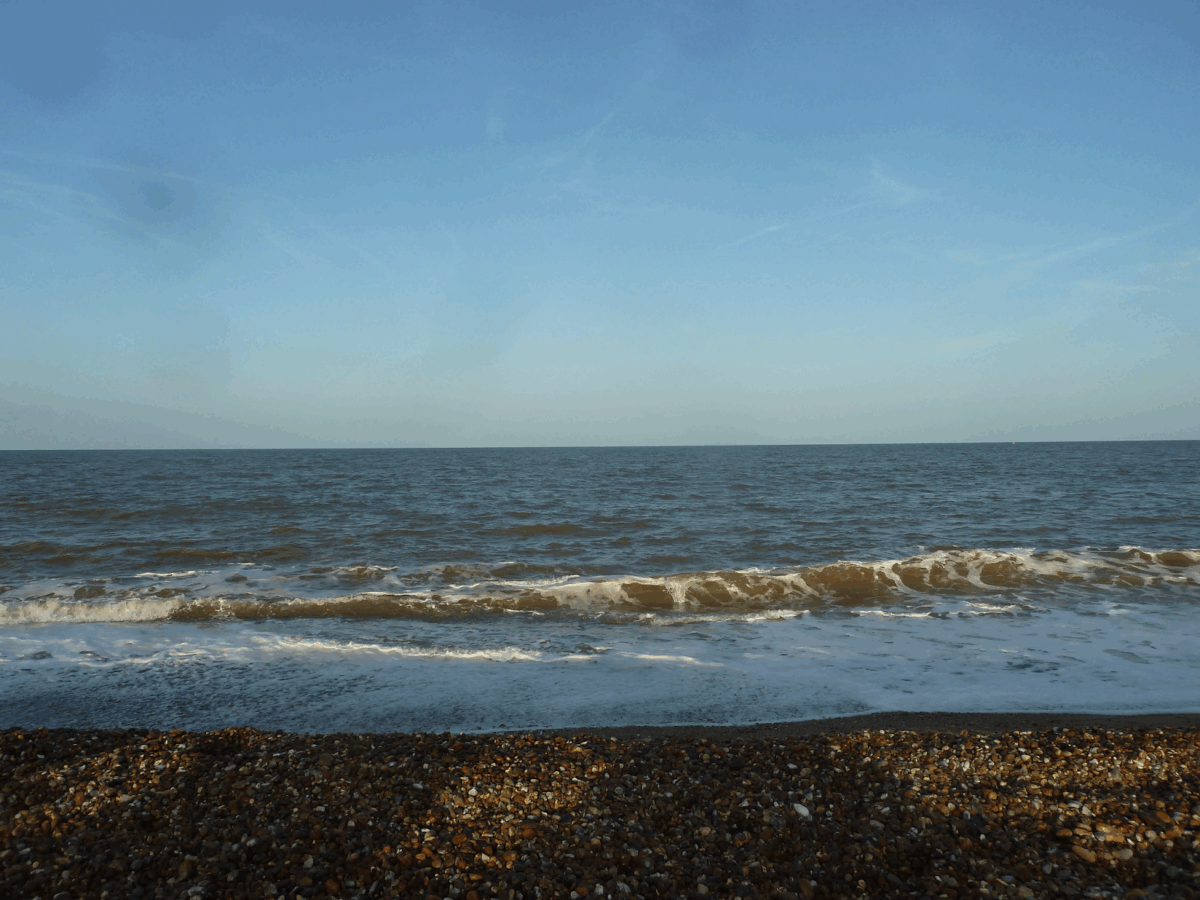
let me give you reason to run rhyming down the beach
horizon your eyeline: claggy timeline of sea over sky
gulls like gills flit with waves so rousing
seas right through you, all you know
is now – thrown off towel

succumb sparring lungs with every, each –
sandy second of the upturned
hourglass, momentary
motionless ocean

enclosed in a conch, an echoed Irish ‘ach’
rush of a last wave goodbye
salt-pinched toes meet

shell-shocked sand with a crun ‘ch’ –
hold hand up to face

breathe out, aspired ‘h’ –

Featured Image: Honor Adams

Categories
Perspective

I Believe

By Henry Tennessee

I’m watching an interview with Erich Fromm. I know nothing about him. He speaks very eloquently, and speaks truth.

It makes me want to write something that hopefully, you will be reading now in the goose publication.

How do I convey a feeling in such a way that you might understand? What am I trying to say?

What has inspired me, moved me so much to start trying to attempt this, this thing?

God.

Let’s call it God.

But what I am trying to get at is not so much the religious version of it: yet in some ways it is. But that’s my personal journey. I do not want to confuse the two right now.

Here lies the problem I feel I must address.

I love life. I could never find something to do, because the true love of my life is it itself.

It is a joy to be here. 

Do you ever have these moments? 

Do you ever realise, that right now, you are breathing, and the more you realise this insane fact, you realise all the things around you are equally as magnificent and worthy of your adoration?

Here we find ourselves in 2025, and many a smart and wise person just under 70 or so years ago began to say “look, we might be screwing it a bit”. In 2025, we find ourselves scratching our heads wondering what the bloody hell is going on. I want to tell you what I believe is going on.

What I believe is going on, is the evolution of man, or of society. I believe that this has happened before, around the 60s and perhaps before as well. Why do I believe this? Look at how people talk on social media. Some of the things I see are very wise indeed, and it comes out as people just talking on their phones, getting information out to as many people as they can, because they feel they must. They must because that’s how wisdom works. It flows from one mouth to ears willing to hear, and so on. 

This is happening more and more. But it has happened before.

I believe that’s what the 60s was. The parallels with our time are plausible. Vietnam and Palestine, for example.

The need for more expression. Many people believed we would wear less clothes by the 50s. Isn’t that a strange thought?

But what stops it? Money. People that believe they own this glorious land. You don’t own it. I don’t own it. God owns it. 

It is not meant to be owned, to be dominated, it is meant to be lived on and with.

I believe that the elite classes are still clawing on. They claw because it is all they know, it is all they must do to survive. Their model is archaic. They know it is dying. To borrow a phrase, a wart must come to a head before it may burst. Well, the head is now. 

That is why people are rising up. That is why people are slowly, very slowly, beginning to understand that God is not a white man on a cloud, but a loving entity that goes beyond anything we could conceive. Some call it the universe, or talk of vibration. But this loses its awe and only holds the logic as sacred. 

How does this all sound? Crazy? Reasonable? Why?

Crazy because the idea of God goes out of your head, or perhaps you see it as a more religious entity? 

Reasonable because you feel something in my words?

I tell you God is writing this. Not Henry. I get this when I play music. People say ‘how does that voice come from you’, and I say it’s not mine, it is a gift. I say it’s not Henry singing, it is a voice on loan. And the more you go into this thought, this feeling, the more you realise what God is, you begin to see not the differences between religions but how identical they truly are. And this is not trying to down play the beauty of each individual religion. Their traditions are unique, this is undeniable. 

Now here is why I wrote this in the first place, I am realising the point now. The antidote to the problems of the world are what I have just described. What I have just described is how to access God, not from a materialistic stand point, nor an egoic one- that is to say an identity, but purely leaning into God. Remember, God is the adjective, not the noun. And if we, collectively, can realise this faster, we have the potential to divert catastrophe. Because as we go into ourselves, the things that used to satisfy us no longer do. They can not because everything becomes superficial. The things that you love become more and more apparent, not what you think you love. You dissolve. I have dissolved and set and dissolved many a time, and will probably continue to do so. We are doing this inevitably. True progress is this realisation, it has to be. And if enough of us collectively realise this, we are amplified enough to create a better world. A truer world. 

This is the feeling of Christ. It is hard to do. What made him so remarkable was he did it 24/7. Go into yourselves. Really. Especially whilst you are young and at university. It may feel like you have many exams and things to worry about, but I promise you that you are at a time of your life where you can entertain these notions with more ease. It is dark at times, and very lonely. But it is truth.

Image Credit: Tashy Back

Categories
Perspective

For Whom is the Funhouse Fun?

By Liv Thomas

“For whom is the funhouse fun?”

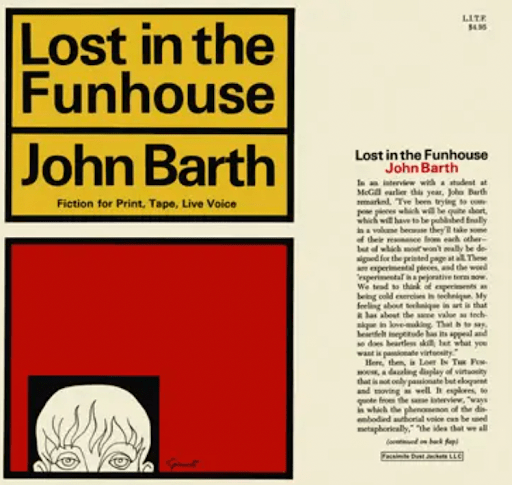
‘Lost in the Funhouse’ makes up one out of four short stories within John Barth’s 1968 collection of the same name –  Lost in the Funhouse.

The opening lines of the tale ask a question to the reader that not only evokes the meaning of its own title, but, in doing so, also introduces one of its central themes – the formation of identity. 

Having read that question (“For whom is the funhouse fun?”), I – like many other readers, presumably – gave my own subconscious answer that I only vaguely remember… I found it interesting that the text then gave a response to its own musings with the contemplative “Perhaps for lovers.” Through this, we are offered the perspective of its central character, Ambrose, for whom, instead, the funhouse “is a place of fear and confusion.” 

Already, the text gives the reader a glimpse into its own identity crisis, flitting over various stages of question and answer, only to provide its own unsure conclusion.

For the use of voice to convey a message, I saw these opening sentences as an ascension of perspective varying from the reader, narrator, and central character, constructing a point I note as the story’s ability to inquire into what we think is reality – or in this case, the funhouse.

To summarise, Lost in the Funhouse follows a thirteen-year-old Ambrose on a Fourth of July outing with his older brother Peter, their parents, Uncle Karl, and their fourteen-year-old neighbour Magda, a girl both brothers are attracted to. Upon finding out that the beach is closed, the group enter a funhouse, in which Ambrose and Peter fantasise about walking alongside Magda as they pass the winding mirrors and shadows. As he wanders, Ambrose begins to associate the funhouse with things beyond his teenaged understandings – sexuality, desire, and the choking inevitability of getting older. Lost in the funhouse, Ambrose realises he isn’t like Peter or Magda; the laughter and illusions that delight others only unsettle him.  

Now, Barth’s work belongs to that late-twentieth-century literary niche in which writers discovered that their work could become realised – self-aware, even. He might be grouped with like-minded authors such as Thomas Pynchon, Donald Barthelme, and Robert Coover, all of whom challenged whether literature still had the potential to offer clarity in a world increasingly obscured by its own reality. 

With this in mind, in Lost in the Funhouse, Barth not only deconstructs the awkwardness of adolescence as it’s portrayed within the coming-of-age genre, but also the awkwardness of fiction itself. Each metafictional aside exposes his realism as artificial, all while Ambrose’s understanding of his youth is increasingly disturbed.

I would like to believe that this was the sole reason for my initially confused first read-through of the short story, in that it hadn’t occurred to me that I would be reading a narrative that was so – some may say critical, others introspective – of its own style and plot. 

“Is it likely, does it violate the principle of verisimilitude, that a thirteen-year-old boy could make such a sophisticated observation?”, questions Barth. 

Speaking outside of Ambrose’s perspective and addressing the reader instead… Not only does this line disturb stereotypes as to how thirteen-year-old boys like Ambrose are portrayed within the coming-of-age-genre, but it also forces the reader to question these verisimilitudes. 

During my second read-through, the whole point of deconstruction became more apparent to me with the story’s own writing-out of linear plots. In particular, the listing of “The beginning […]”, “The middle […]”, and “The ending […]” made me feel as though Barth’s writing had its own painstaking way of telling the reader exactly when and where to expect key moments, all while shamelessly condensing such specification to three sentences on the sixth-something page. 

Here, Barth is not just making a statement on the culture of fiction surrounding adolescents but is also contesting the use of conventional narratives to effectively portray the fragmented reality of such characters. 

Truly, Lost in the Funhouse stands out to me as something I need to understand better, the same way Ambrose supposes he needs to understand the course of his life, but the tale nonetheless stands out as a contemplation on writing and those who are both appreciative and critical of it.

Feature Image – dustjackets.com

Categories
Creative Writing

The Honeymoon Period

By Charles Fitzgerald

“Oh bother”, said Winnie-the-Pooh.  

He lowered his bong, constructed from an empty honey pot. He saw Piglet shuddering, clinging  onto himself for dear life. Piglet recently developed a habit of greening out and becoming very  anxious. Rabbit warned him that skunk plays havoc with rationality and self-esteem. Piglet didn’t listen. 

“Y’alright mate?” sighed Pooh. 

“Yeah yeah, I’m… I’m just…” Piglet trailed off, his mind abuzz with self-loathing. “He tweaking for real”, Eeyore piped up. “Does he want some coke?” 

“Did someone say…” Tigger bounced in, his whiskers erect. “Coke?”. Tigger had been prescribed  medicinal cannabis for his ADHD. It worked for a while, until his cocaine habit reared its ugly head  again. 

“That’s the last thing anyone needs right now, mate”, said Pooh, as he set aside the bong.  “Especially you, Tigger. You’re hopped as a frog”. 

Piglet’s world was caving in on itself. The perpetual rush of humiliation, angst, regret, anxiety, isolation, sunken-costs, unfulfilled ambition. This was Piglet’s world. His everyday. 

“I wouldn’t mind some coke, to be fair”, Eeyore’s tail waggled. “Only thing that stops the voices”. Long ago, Eeyore promised himself to draw the line at any tooting. Now, his snout was in tatters – a rag of self-destruction. 

“Don’t be a dick, Eeyore”, Pooh sunk back into the floor. “I’m not cleaning up your piss and tears  again”. Pooh, despite appearances, was having an incredible time. The rotten wood panelling of  this decrepit tree-house was a bed of honey, welcoming him with open arms. Pooh, of all the  inhabitants of the hundred-acre wood, nursed the healthiest attitude towards drugs. Aside from  the odd bit of speed on birthdays and special occasions, Pooh reserved himself for weed and  weed only. Weed listened to Pooh. Pooh listened back. 

“The truth is…” Pooh would say. “Anything to take my mind off Christopher”. 

Christopher Robin moved to Balham, eighteen years prior, to pursue a career in artificial  insemination. He hadn’t returned once to play with his old friends, and now ran his own fertility  clinic in Milton Keynes. Pooh’s sadness wore off around six years in, steadily fermenting into bitter  resentment. 

Piglet had taken it the worst. Curled up in a small pink ball on the floor, he just couldn’t shake the  guilt. I should’ve been better. He’d given up all attempts to seek reassurance from his friends. A  futile endeavour. They knew it. He knew it. If only Christopher knew it, too. 

I just want to play with him, one last time

“Anyone seen Rabbit?” asked Pooh. “Not gonna lie, bloke’s really been getting on my tits lately”. “Mm”, mused Eeyore. 

“Thank you for that contribution”, Pooh sat up. 

“No no, I agree. Proper knob.” Eeyore was elsewhere – busy thinking about the afterlife. Tigger  sprung up.

“He’s off his tramadol. Said it made him dream of hurting us”. Tigger was, put simply,  educationally subnormal. Nice guy, by all accounts. Buys his round. Just thick as mince.  Disconnected. 

“There’s a surprise,” said Pooh, rolling his marble-eyes. “Anyway, look, if he swings by… Really  gonna fuck up my high”. 

“This calls for gear!” Tigger shrieked with excitement. 

“Simmer down, mate”, groaned Pooh. “This really doesn’t call for gear”. 

“It might do”, Eeyore shrugged. 

“Christopher”, squealed Piglet. His friends turned to him. “I’m… I’m sorry, Christopher”. “You what, mate?” Pooh inquired. 

“You… You never…” Piglet spluttered. “You never really know what you have… ‘Till it’s… ‘Till it’s  gone”. His friends stared at him, deathly silent. Pooh closed his eyes. Eeyore sniffled. Tigger didn’t know what day of the week it was. 

“Come on, mate” said Pooh. “Let’s just… I dunno, talk about QAnon conspiracy theories or  something… Something funny. I just wanna laugh.” 

“I haven’t laughed in years”, Eeyore sorrowed. 

“I have”, Tigger laughed. 

“Gone”, Piglet purred. “Gone.” 

Note: Surprisingly, this work is not affiliated with, endorsed by, or approved by the estate of A.A. Milne, the estate of E.H. Shepard, The Walt Disney Company, or any other rights holders  associated with Winnie-the-Pooh.

Featured Image: Disney

Categories
Travel

The Greeks Have Lost Their Marbles

By Jacob Cordery

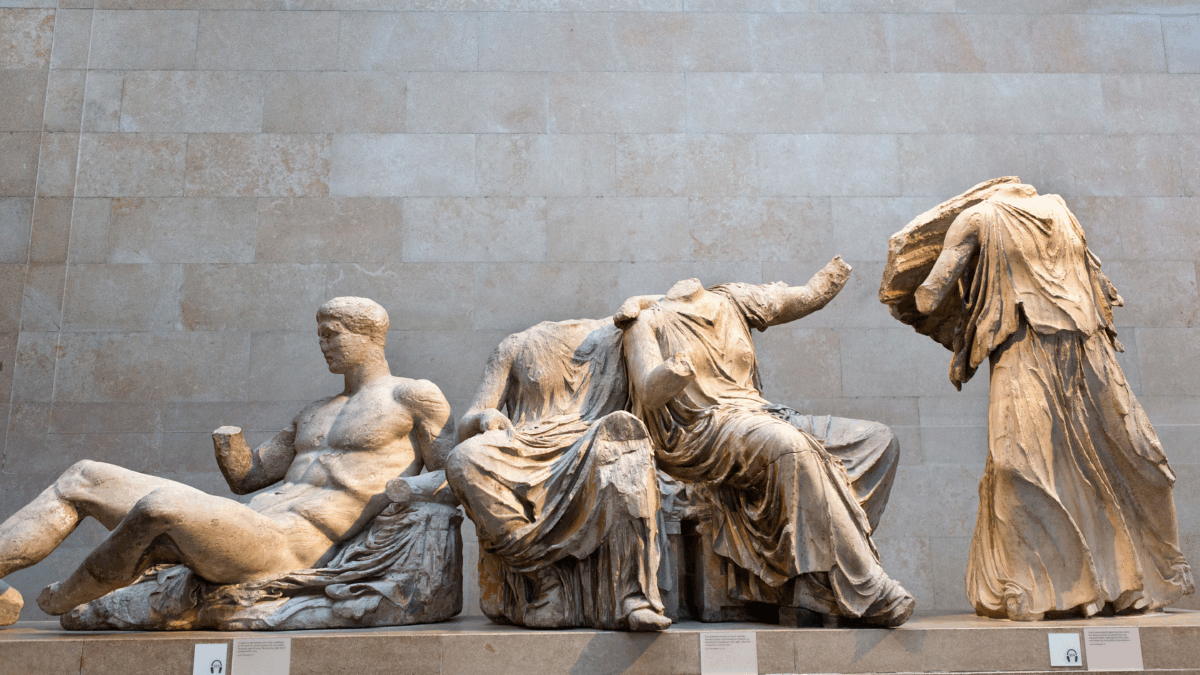
“Who owns great works of art?” is a question posed by classicist Mary Beard. It’s a good venture into the flaws of identity politics in a world where things ranging from cuisine to museum exhibits are increasingly appropriated or stolen. In a globalised world it is hard to know who gets to own what, whether words, traditions or objects. Few examples display this better than the Parthenon (or for the traditionalists – Elgin) marbles.

The marbles displayed in the British Museum, taken from Athens, have become the poster child for dismantling Western colonial structures. But this misses the point – the marbles are not colonial spoils of war but always have been, and will continue to be, nationalistic propaganda.

Carved in the 5th century BCE under Pericles, the marbles the British Museum have are some of the friezes, metopes and pediments that decorated the Parthenon at the peak of Athens’ imperial swagger. Scenes on the stone – like the Centauromachy – man triumphing over beast, civility over barbarism – cast the Athenians as superior and enlightened, most likely in symbolic comparison to their Persian rivals. The marbles are not neutral works of beauty, but obvious declarations of superiority over the East. Athens also subjugated other Greeks within her empire, the Parthenon itself housed the treasures of all the plucky Greek cities that had to pay tribute to Athens – out of obligation, and surprisingly not out of the kindness of their hearts. Ironically, sending them back to Greece would not subvert Western dominance but reinforce it – since they represent the very idea of the civilised West looking down on the rest. If Greece is the cradle of Western civilisation, then the Parthenon marbles are the cherished toys that still get thrown out the cot.

The legal story is equally hazy. In 1801, Lord Elgin, ambassador to the Ottoman Empire, received a firman which now only an Italian translation survives. The text states that “no opposition be made when they wish to take away some pieces of stone with old inscriptions and figures”. Questionable? Yes. Illegal? No. Elgin obtained the marbles from a state which no longer exists, before the state of Greece was conceived. There was Parliamentary concern that Elgin had abused his influence as ambassador, but this was considered mute when it was suggested the French might have taken the marbles if Elgin had not. When Elgin went broke, he sold the marbles to the British Government; Parliament grumbled but voted 82-30 to buy them for £35,000 – half of what Elgin wanted. Crucially, Elgin acquired them as a private citizen, not as a colonial looter.

That distinction matters. If the Museum returned the marbles, it would set a precedent for artefacts originally acquired privately or under grey-zone circumstances, to be returned – the J. Paul Getty Museum, The MET and half the Vatican would theoretically be empty – but where would their exhibits go? For example: take a Roman statue, commissioned by an Italian, made of Egyptian stone from a quarry owned by a Jew, sculpted by a Syrian, then painted by a Greek, all over two-thousand years ago – to which modern country should this return to? Repatriation is not a moral crusade; it is too often a modern projection of national pride upon ancient stone.

It is also different to cases of colonial theft, like the Benin Bronzes, ripped violently from what is now Nigeria through British colonial violence. That is a valid and just argument for their return. The marbles, however, were not looted. Several other museums, well actually seven, hold pieces of the Parthenon – why then is Britain the only villain in this story?

Much of the commotion comes from emotion. The ‘silent sister’ caryatid – one of the six female columns of the Erechtheion temple, that now resides in the British Museum – has been turned into a melodrama about exile and sorrow, and thrown in with the Parthenon marbles, just because it is also from the Acropolis. The sculpture is described either as a “lonely girl” or even a “diva”, trapped in a pseudo-empowering Madonna-whore complex. A solo cabaret by Evi Stamatiou even dramatized the loneliness of the caryatid in England and called for “her” return. In 1950 the British MP Julian Snow argued that the “poor girl” should be given back on the basis that Greece were “trying to create a new conception of democracy”.  It’s a great metaphor, but it is just that. A country with a monarchy that has constitutional power to dissolve democratic processes, cannot claim to reward democracy with marble. There is only one other problem with this – Greece has not actually asked for the sculpture back – the 2000 Greek petition refers only to the “repatriation of the architectural sculptures and structural elements of the Parthenon on the Acropolis of Athens”. The caryatid is from the Acropolis, yes, but is “of” the Erechtheion, not the Parthenon. It cannot be allowed to be used as an emotionalised poster-child for the return of the Parthenon marbles. Repatriation deserves logic, not poetry.

Even if Britain wanted to give back the statues, it legally can’t. The British Museum’s Board of Trustees adhere to the British Museum Act of 1963, which restricts “de-accessioning” objects unless they are duplicates or fakes. Both the current British Parliament and the British Museum Board of Trustees are unlikely to back a reform to this act. For the marbles to be returned, the laws of Britain would have to be changed, which is left to quarrelling political parties, lobbyists and the whims of the few MPs that can be bothered to show up to Parliament. However, there is British desire to return the marbles, which takes the form of the British Committee for the Reunification of the Parthenon Marbles. The Greek government also ought and rejected advice for taking legal action to retrieve the sculptures, preferring a diplomatic approach.

That is not to say that the British Museum is not blameless. An overzealous “cleaning” in 1937-8 stripped away any remaining paint or patina, erasing history in service of a fantasy of Classical purity. And the argument that Greece cannot look after them is no longer valid, the new Acropolis Museum is as impressive as it is accurate, with its more authentic display of the remaining Parthenon marbles. Still, Elgin did not steal nor oppress – he arguably saved what the Ottomans stored gunpowder in, and what Venetian artillery had blown to bits in 1687. Furthermore, the British Museum is free, while the New Acropolis Museum charge €10-20.

Both sides have turned marble into ideology. Greece hide their nationalism with a thin veil of emotional victimhood; while Britain hides behind legal formality. Both claim virtue, but neither face the truth – there are no moral absolutes here, only pride in dubious Italian documents or cabarets that don’t really prove anything.

The debate is pervaded by people who would turn ownership of the marbles into a matter of nationalistic pride. If the marbles go back, it should be through collaboration, not guilt or patriotism. A cultural partnership (such as the Parthenon Partnership) could reflect what both sides say they care about – shared cultural heritage, not competing ownership; although, the minute the marbles set foot on Greek soil, I am sceptical if they will ever leave. Until the day of their demise, the marbles will continue to do what they have always done – reflect the politics, pride and vanity of those who claim to speak for civilisation. 

Featured Image: The Times

Categories
Poetry

After Hours

By Saoirse Pira

It’s all the city, the smile that’s
plastered, the spring in my step
and the heart on my sleeve—
it’s the moving from one country

to the city, finding me. It’s the
street-clocks and the cheap beer,
and the drinking too much wine. 
Then it’s the people and the tramlines
and in Prague, I am alive.

In the city, I wake dreaming
and then I’m moving with the crowds
and I’m learning and I’m breathing;
it’s the city, I think in rhyme. 

Featured Image: Saoirse Pira

Categories
Culture Uncategorized

Nodding to Nietzsche in Never Went to Church

By Noorie Hussain 

‘Two great European narcotics: alcohol and Christianity’ – Never Went to Church, by the Streets. 

Mike Skinner opens his emotional ballad with a nod to Nietzsche – the notorious German philosopher who claimed that there have been ‘two great narcotics in European civilisation: Christianity and alcohol’.  An immediate tone-setter of how these lyrics will unfold into a raw acknowledgement of humanity’s reliance on religion as an emotional crutch.

Never Went to Church stands as the powerfully moving centrepiece of the Streets’ 2006 album We Never Made a Living. Written as a vulnerable tribute to his late father, Mike Skinner communicates his own experience with grief, and his struggle to move on with life without him (But it’s hit me since you left us, /And it’s so hard not to search. /If you were still about, /I’d ask what I’m supposed to do now). 

The lyrics force upon the listener to feel as if they are intruding on a private conversation, with Skinner addressing his father directly throughout with ‘you’. It’s gut-wrenching to listen in on this emotionally distraught dialogue, and only exacerbated by the simplicity of the piano line underpinning these lyrics. The chord progression and rhythm are reminiscent of the Beatles’ Let It Be – Paul McCartney’s own tribute to his late mother, Mary, who appeared to him in a dream and told him ‘Let it be’ as an offer of comfort during the stress of the band’s impending break up.   

Yet, it is in laying his emotions bare that Mike Skinner’s lyrics touch the likes of you and me, in his suggestion that religion only remains in secular societies to comfort us, as and when we need it. In revealing that ‘I never cared about God when life was sailin’ in the calm’, Skinner allows us to connect his lyrics with further Nietzschean ideas about the death of God in post-enlightenment culture. Skinner’s use of nautical imagery connects with Nietzsche’s madman, who frantically questioned ‘How could we drink up the sea?’ in a plea for people to understand that God is dead, and humanity killed Him. 

The very premise of Nietzsche’s death of God rests on the idea that humanity dismantled the entire framework of meaning and morality provided by religion – a similar experience communicated by Skinner in Never Went to Church. Nietzsche’s use of nautical metaphors highlights the vastness of what has been lost – the religious foundation that once gave purpose to human life and explained the mechanics of the universe. For Skinner, his dad was the ‘sea’ that has been ‘drank up’. The death of his father was the abandonment of all his traditional beliefs, leaving him with a void that is a chaotic and terrifying new reality, much like that which Nietzsche describes through the death of God in modernity. 

In acknowledging that ‘We never went to Church’, Skinner points to the fact that this terrifying new reality has left him clueless with the fragments of religion scattered in secular society. He goes so far as to end the song by making a joke with his dad about this, ‘I got a good one for you dad/ I’m gonna see a priest, a Rabbi, and a Protestant clergyman/ You always said I should hedge my bets’. Yet is this joke just a clothed coping mechanism? 

At surface level, Skinner’s lyrics act as a prayer to his father, to help him seek comfort in his grief. Yet, upon further reflection, Skinner’s experience is one reflective of Nietzschean philosophy and thought. He becomes Nietzsche’s ‘madman’ who is faced with the reality of accepting the loss of his ‘religion’. In today’s secular society, our ‘religions’ are everything we believe and stand for, and so much of that comes from our parents. This emotional ballad masks a deeper understanding of the place and value of religion within contemporary life – how, although we may never go to church, we still need the church to function as a comfort blanket when we find ourselves abandoned by that which we depend on. The death of Skinner’s father was the death of his ‘religion’, and Never Went to Church is a beautifully touching capture of this experience.

Featured Image: Noorie Hussain

Categories
Perspective

On Service

By Samuel Davie

Bless, O Lord, 

Us Thy servants who minister in Thy temple, 

Grant that what we sing with our lips, 

We may believe in our hearts, 

And what we believe in our hearts, 

We may shew forth in our lives. 

Through Jesus Christ our Lord, 

Amen.  

“the Choristers’ Prayer” 

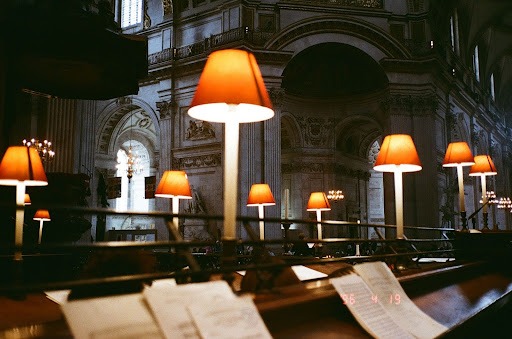
The organ stirs from silence, the ponderous sighing of the pedals scarcely audible, yet shaking  the woodwork, as technicolour whirls of cavorting songbirds, or glistening waterfalls, or raging torrents, or a distant, sombre procession rise above – perhaps a far-off echo of the ‘royal banners,  forward go[ing]’we sometimes sing of. Into this strain emerges a pair of purple-clad snakes, first a train of slightly ragtag, smaller figures, some clutching waterbottles, or still wearing trainers  from their school PE lessons earlier that same day; following them, six larger figures on each  side, solemnly disinterested in their surroundings. The clergy follow behind, and all bow  together toward the altar upon entering their allotted stalls. The organ subsides, trailing off to  give a starting note for the cantor, who dutifully intones: ‘O Lord, open Thou our lips’. 

‘And our mouth shall shew forth Thy praise’, the choir responds. Thus begins yet another  service of Evensong. 

Service is an interesting word. The Oxford English Dictionary gives three principal definitions pertaining to personal actions:  

‘a form of liturgy or ritual […] for an act of worship’ 

‘the action of serving someone or something’ 

‘the state or condition of being a servant’ 

Singing Evensong places one in all three of these states at once; one is a servant, serving God  (and also the Dean and Chapter of the Cathedral) in an act of worship. If one serves, the question surely follows, why does one serve? To answer this is a complex task. Since it is as  part of an act of worship, surely there is some personal devotion or other belief at work?  

To speak personally, I’m not sure; if asked about my religious beliefs, I generally  answer stating that I am a Christian. On a matter-of-fact basis, this is true: I am a communicant,  confirmed member of the Church of England, who regularly participates in public worship. Unless one is of one of the schools of thought that assert that Anglicans are not Christians, I  meet the standard definition. I affirm my faith, along with others present, in the words of either  the Nicene or Apostles’ Creeds, laid down over a millennium ago as statements of faith  encompassing what the Church as a body believes (disputes over added lines aside). And yet,  I am frequently not sure exactly what I believe. 

I suppose a better word would be ‘hope’. I hope that a man put to death in a truly  barbaric fashion two millennia ago was, as claimed, the Son of God, thereby offering those to  follow a path away from eternal damnation, should such a thing exist. I’m not sure I believe it,  though; there’s still a lot of doubt. Why would God subject and denigrate Himself to render us  that service, if we were so undeserving of Paradise because of our own actions? Those with  any theological background reading this are probably already silently screaming at me to read  x or y; I apologise for my ignorance. I will, however, continue on: if we are so undeserving of  Paradise because of our conduct, then why is the sacrifice required of us for redemption so  small? Not being wilfully horrible, and owning up to it or any inadvertent mistakes should they  happen is hardly a big ask: frankly, it’s just being a decent human being. Flawed as I’m well  aware this reasoning may be, I suppose this is exactly why I hope in the way I do – by not being  an awful person, I have an opportunity to avoid something that may or may not happen to me  in the future, but that I have no possibility of ascertaining. 

I still wouldn’t say that this is why I sing the eight services a week that I subject myself  to, though. Frankly, part of it is the money: although the relatively low remuneration may  be a fairly frequent source of griping, the money has meant that I have (for example, and rather  fortunately) never been overdrawn. It would be dishonest to suggest that that weren’t an  incentive. Day to day, however, the money is sufficiently low (sufficiently insufficient, if you  will) that it doesn’t really matter. Besides, the effect of a sharply worded rebuke ‘Mr Davie,  would you care to look at the music?’ is such that a purely mercenary attitude cannot apply:  such a rebuke is cutting in a way beyond that of merely being called out for not being ‘on it’.  Such a rebuke is instead, in my personal view, a rebuke against my very abilities at a musician,  those that I generally view as defining me. It is therefore evidently the case that I view the  service I render, day-in-day-out, as a defining part of who I am; the pursuit of perfection in my  craft is something which I allow to define myself, thereby exposing me to the harshest impacts  of such a rebuke. 

A well-known Ancient Greek maxim is that one should ‘know thyself’. It is however  apparent that knowledge of oneself is – or should be – crafted, not acquired by happenstance.  To take ownership of the acquisition of knowledge of oneself requires courage: Rollo May,  writing in Man’s Search for Himself, defines courage as ‘the capacity to meet the anxiety which  arises as one achieves freedom’ and ‘the willingness to differentiate’. Further, he describes the  opposite to courage as ‘not cowardice: that, rather, is the lack of courage’, stating instead that it is ‘automaton conformity’. Whilst we must remain conscious of the fact that May was writing  seventy years ago, reflecting on his patients in a very different world to now, I believe the core  message remains true: a blank sheet is itself devoid of meaning; a meaning must be created for  it – for myself, I must create a meaning for my own blank slate, and it is courage that is required  as a virtue to do this. Thus, courage is required for one to know oneself.  

How does this relate to service, though? I see a number of ways: firstly, is that I have exercised the courage to expose an aspect which I have adopted as crucial to my identity (that itself requiring courage to do) to rebuke, and also to offer it to a larger purpose. I may not be  sure what I believe religiously, but I have undertaken the courage to exercise the convictions I  do have; I do this by rendering a service, as part of a service, in the state of a servant. I suppose  it is courageous, too, to be willing to decline my own status to that of servitude for a greater  purpose that I’m not wholly convinced I believe in. Reflecting religiously again, the  Crucifixion was thus an ultimate act of courage – willingly declining and submitting to the greatest denigration imaginable, to render a service for the benefit of all. 

I would always encourage anyone I meet, should it come up in conversation, to attend  Evensong, regardless of any bovine ruminations on courage; it is a wonderful opportunity to  take less than an hour out of the day, to sit with others and maintain a centuries-old living  tradition in ancient buildings. A time to reflect, and to enjoy music offered as a service,  regardless of any religious sentiments one may or may not have. Should you attend, however,  or if you attend any display of personal craft: music, theatre, visual art, sports or anything else 

– take a moment to appreciate the courage that those individuals have undertaken, to expose  themselves and to render a service to you, the viewer enjoying their craft, and to themselves,  to their own betterment and self-knowledge. Finally, take the message of the Choristers’ Prayer  from the beginning: exercise the courage you undertake in order to serve others, in order also  to better know yourself.

Feature Image – Matthew Dodd

Categories
Reviews

To Rest Our Minds and Bodies: My Thoughts and a Discussion With the Author

By Bel Radford

To Rest Our Minds and Bodies is an incredibly yielding book. Its contents are tender and vulnerable, falling clean off the bone and seeping hot into my palms — my fingerprints were stained for hours after, marking everything I touched. Yet there’s weight to it too, a pressure that finds old bruises I’d almost forgotten — ah yes, we’ve been here before.

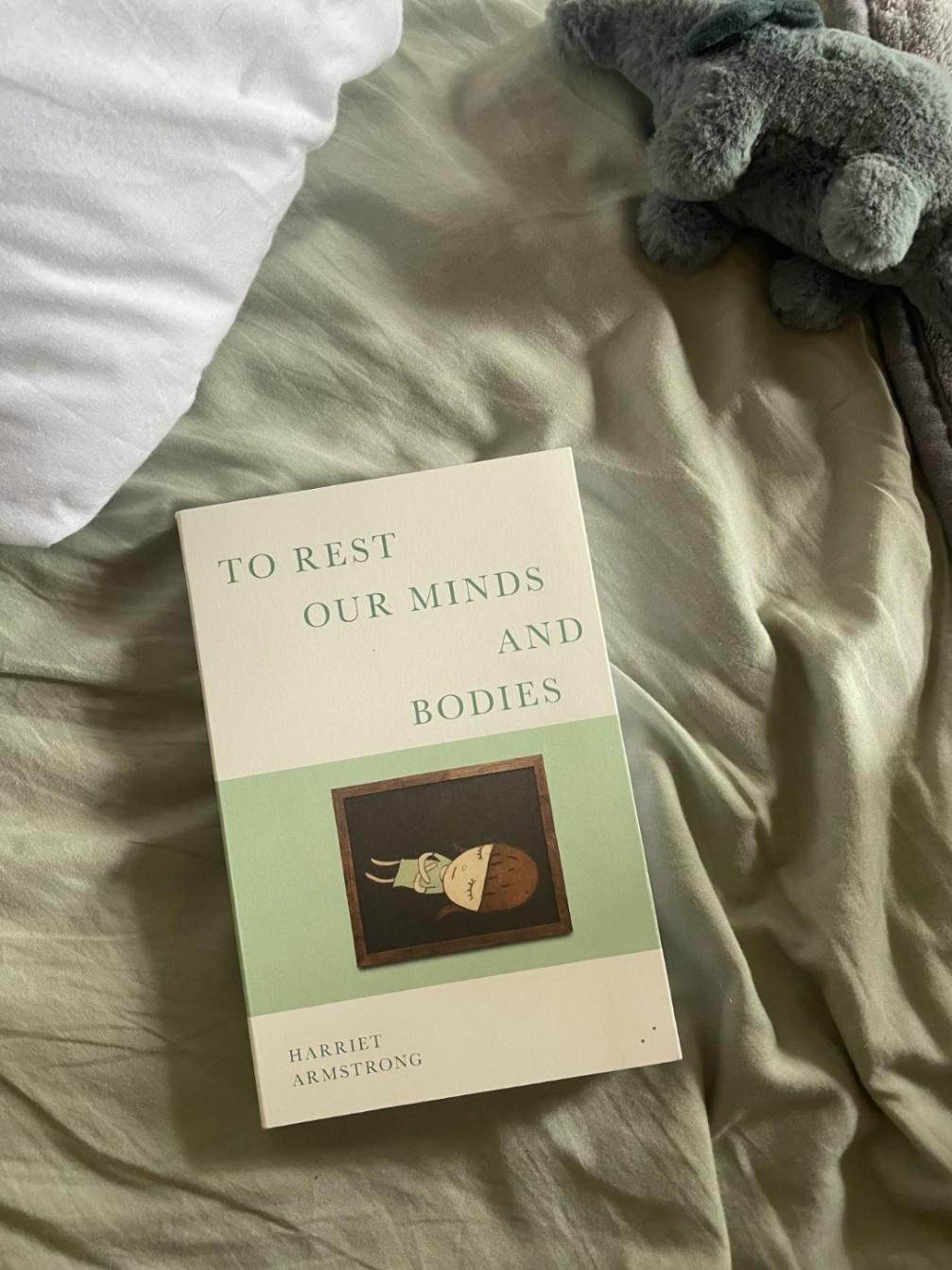
Harriet Armstrong’s book is, at its simplest, a reckoning with intense feeling: it weaves through the debris of unrequited love, the attempt to contextualise oneself within the world, self-destruction, redundancy, and mundanity. I am ashamed to admit I did entirely judge the book by its cover — it shows a Yoshimoto Nara-esque girl, pale and lying (or perhaps floating) in an oaken abyss. Her arms are crossed, the mark-making is gentle and roundish — the girl appears acutely peaceful in a way that made me envious. I recall being curled over, kneeling on the bookshop floor and finding myself enjoying the front cover — it anointed my scorched retinas, a cruel aftereffect of the pervasive LED shop lighting. I was also particularly frayed that day. Oh book so small and gentle, if you look like a lullaby, will you read like one too?!

It doesn’t exactly. It’s not necessarily a happy nor uplifting story — in fact, a great many bad things happen. It bleeds out slowly and hums along with the low timbre of humiliation thick in the everyday negotiations of awkwardly aged semi-adults. We are ripe with shame! The narrative engages with themes of redundancy and mundanity within these hangnail years; one hand turns over these old stones, the other hand holds your own — guiding you through an exacting jaunt across the minefield of your own souring youth. I found great comfort in its deep recognition; the novel really is good, compassionate company. Just a few pages in, I typed into my Notes app: “somebody appeared to be taking minutes in my brain a few years ago. they’ve since gone, gathered their findings, and returned it back to me bound in paper. harriet armstrong … who are u….”

The plot is as follows: the nameless protagonist begins her final year at university studying psychology. The book spans the entirety of the academic year. She meets her flatmate, Luke, one afternoon in the kitchen. He is a postgraduate student doing a vaguely defined degree in computer science. Luke is a kind boy, though some might categorise him as the manic-pixie-dream type — he introduces the protagonist to The Microphones, he wears guyliner, his presence is soundtracked by breathy, incomprehensible, and highly distorted music that fills the kitchen he cooks in, and he vaguely resembles Tilda Swinton. In one of their first encounters, Luke kicks a loose wooden board beneath the stove, making a soft, punctuated staccato that he remarks sounds like that of a heartbeat. He then feeds her spoonfuls of his curry.

“As he laughed he passed me a teaspoon of his curry and I couldn’t even taste the curry because I was thinking about how his fingers had touched each piece of onion, each piece of potato, some of the lentils, some of the mustard seeds — all of these things which were now inside my mouth.”

But despite his charm, irreverence, and unavailability (as we later discover), it would probably be very wrong to call Luke a manic pixie dream boy. The term is mostly used to describe a Ramona-Flowers-adjacent character, defined by Oxford Languages as “a vivacious and appealingly quirky character whose main purpose within the narrative is to inspire a greater appreciation for life in the protagonist.” These characters often exist as a mechanism or catalyst for growth, lacking real depth, and are defined more by the effect they have on others as a force for optimistic change than by their own interior lives. Luke is not vapid, and his feelings do not synchronise with the protagonist’s to produce a neat arc of self-learning. The protagonist falls in love with him, but it is fraught with resistance — unlike a classic manic pixie dream scenario: a down-and-out protagonist meets a quirky, optimistic character, a chemical reaction occurs, and the protagonist emerges enlightened. Our protagonist arguably ends the novel even more down-and-out than she began: punching trees, vomiting in a gutter, and running drunkenly into a lake.

Throughout the book, Luke and the protagonist form a seismic connection. Though the novel gestures toward friendly coffees and catchups with a handful of other friends, none possess the same intimacy nor gravitational pull as theirs. They show each other music and talk and talk and talk and cook and sit and talk. Luke and his girlfriend break up, thus galvanising the protagonist — their connection is so deep, makes so much sense — they should surely be together! It is frustrating even to us, the reader, on some level. It feels so emotionally and practically right and inevitable. The protagonist describes a kind of vaginismus, or perhaps an emotional block that has only ever been transcended when Luke is thought about. As Harriet herself puts it, love and truth collapse into one another in the book — the desire is undeniable, yet fundamentally inaccessible. This impossibility is heeded early on in the novel, when the protagonist imagines the two of them living together.. Luke insists they never could; it wouldn’t work. They’d never have time, he says, “to rest their minds and bodies.”

It is fruitless, and so the story becomes an exercise in trying to exist alongside this unresolvable attachment. From Luke’s perspective, the intensity of their bond is unsustainable — alas! The candle that burns twice as bright burns half as long! In the novel’s latter half, the protagonist spirals into a kind of blackly comic mode de la self-destruct: she seeks out sex with seedy men and runs until she shits herself or vomits, etc. etc.

It’s this specific trope I resonated with the most deeply — the pursuit of breaking through a period of murky bleakness with anything of dramatic consequence; provoking big feelings or big repercussions to bring you out of yourself and into the realm of consequence and danger. In To Rest Our Minds and Bodies, this translates for our protagonist as seeking out sexual relationships online. At one point, the protagonist meets an older comedian, Richard, on a dating app. She asks if he has any pets — he replies: “Only if you count this monster cock.” Richard is her first sexual experience, and the protagonist mentions the seediness of the encounter feeling appropriate, somewhat pleased when he reveals a gauche tattoo of some coyote on his upper arm. Her exploration of sex reads like an experiment with self-harm. I talked to Harriet about it:

BR: Does the protagonist seek out encounters with men like Richard as a craving for some kind of consequence — as if bad, awkward, degrading sex is still something to be felt? I sort of imagine she wants to get as close to the edge as possible, to provoke the universe into giving her big, intense feelings or repercussions as surrogate intense feelings that Luke gives her.

HA: That’s actually so moving to read because yes, I think that’s exactly what I wanted to get at! The protagonist is definitely seeking out intensity and extremity to try and find some kind of outlet for her intense and inexpressible feelings for Luke — and I think she’s also trying to prove to herself that she’s capable of causing intense, serious, “adult” things to happen, because she’s so unable to make anything “happen” with Luke. I honestly feel like your question puts it better than I can — she’s definitely trying to get closer to the edge and to access these extreme situations as surrogates for the intense way Luke makes her feel, I love the way you put it! I think she also perceives a kind of very binary split between Luke, who she loves, and other men, with whom she has these horrible encounters — and perhaps it feels easier, to her, to keep those two things so extremely separate. I couldn’t really imagine her having more pleasant or neutral “dating” experiences: I felt this character would be drawn to these more sort of degrading, unemotional situations because they reinstate Luke’s role as the only safe/special person. Also, I definitely remember having those sorts of sexual experiences at that age, and maybe not even seeing them as degrading or bad because I didn’t know what a more healthy, comfortable sexual experience might look like. So I think there is definitely an element of that too!

The vast difference between the tenderness she shares with Luke and the physical awkwardness, clinical detachment, and general unpleasantness of her encounters with these other men is really, truly palpable. Many might wonder where the comfort I found in reading this book really came from — it’s just good to know the self-destruct button has been as appealing to others as it has been to me.

As I’m sure is normal when reading, one tends to contextualise the story and situate it somewhere familiar within their own world. In café scenes I imagined them at Whitechurch; at the pub, under the heated lamps at the Swan. During the protagonist’s monologues, my mind surrendered to peculiar feelings; that which resonated in the book felt as if it came from some muddy dream. The closest comparison I can make is the act of trying to make out the shapes of your childhood bedroom in the dark — your carrot-lacking eyes squinting in an attempt to discern a dressing gown from some Slenderman figure at the foot of your bed. That’s how it felt. Sometimes, when the protagonist described her isolation, I imagined a waxed wooden floor — maybe a ballet studio — big mirrors in my periphery that I couldn’t quite look at, shame-bound and anchoring my gaze to my feet. It’s the same room I often find myself in when I’ve been alone too long and my feelings start to become physical sensations. Particle emotions rub against one another in my head, hot, volatile, and fast like a kettle about to boil. I feel it pressing against my temples. The protagonist’s thought process often brought me back to this room, particularly in moments when loneliness, or Luke, was discussed. When we are trapped in ourselves like this, and we feel (at last) a big feeling from something outside of ourselves — we feel as if we have found God.

The novel reaches its crescendo after a period of semi-estrangement between the protagonist and Luke, culminating in her invitation to Luke’s twentysomethingth birthday party. She arrives, knowing nobody else. When Luke quips that he “can’t spend the whole night just with her,” we see, paradoxically, both constraint and release. The protagonist then goes outside and watches the party through the great glass door. She sees Luke’s gangling limbs curl and twist around the faces and bodies of those he knows. His body fractured betwixt the rooms and people — the intimate yet dispersed birthday boy politely doing the rounds — his presence dispersed yet shared among many. How unfair: they get to be touched by him, feel him move past and through them with no consequence and in a way that’s not completely devastating. The protagonist is on her knees in Luke’s father’s vegetable patch. She proceeds to vomit in a gutter, send Luke an unelucidated unkind message, then run, drunk, into the lake they swam in just weeks before. The protagonist’s corporeal reactions are, of course, extreme; perhaps mental devastation becomes more tangible, more legible when translated into bodily experience. I also talked to Harriet about this.

BR: On the back of the book a guy called Luke B. Goebel describes the book as “the real truth about being too big for the container of the body of youth.” The protagonist’s obsession often manifests in extreme bodily acts — vomiting, running into the lake, punching trees. Do you see these gestures as the body attempting to articulate emotions or intensities that exceed the self’s capacity for containment?

HA: Yes!! Again — beautifully put!! I think the narrator is feeling such intense things emotionally, and cognitively even, but lacking a physical outlet for those things, and an understanding of how to gain that outlet. Even her sexual experiences feel so random and failed and don’t really allow her to express anything or even have a real experience — I think she finds them all so partial and unfulfilling, and totally unrelated to her real feelings and instincts. The book is quite concerned, I think, with her dis/connection from the physical world — and how, even through sex and her vaguely self-harming actions, she remains essentially insulated from the world. And I think she’s also having these feelings — like love, I guess — that feel huge and almost transcendent, but again, can’t be physically expressed or even expressed to Luke through language — and there’s definitely a claustrophobia in that, and a desire to try and break out of the self.

A final note I made whilst reading was the culturally referential breadcrumbs left along the way. When setting up her dating profile (to meet the aforementioned disappointing men), the protagonist includes a photo of herself dressed as Phoebe Bridgers from the Halloween before. She mentions listening to Mitski and “The Place Where He Inserted the Blade” by Black Country, New Road. Luke introduces her to The Microphones. Anyone familiar with these artists will immediately note their common denominator — a certain attentiveness to the emotionally fragile and generally soul-crushing. We spoke about this also.

BR: I really liked the musical references dotted along the way; it made a sort of soundtrack for the book in my head. Why was it important to include these musical references?


HA: I really liked the idea of the book feeling like an accurate depiction of life — or at least that narrator’s life — and to me that meant including lots of little daily details like music, just because those things are a big part of my day-to-day life, so it felt really natural and almost obvious to add those details into the book too. I also really liked the idea of exploring how the character is experiencing her own thoughts and feelings through music, as a way to make sense of them — I felt this fitted with her tendency to overanalyse things and try to understand their deeper “meaning.” Also, it was fun to explore the excitement of her connection with Luke — and the way it made her see herself in a new way — through her excitement about his favourite music. I wanted, also, to explore the way she uses music as a way of expressing how she feels when she speaks with Luke — I thought there was something sad and maybe interesting in the idea that she doesn’t know how to communicate her feelings to him except through other people’s art.

I think it’s particularly interesting that this impulse — to find resonance elsewhere — runs throughout the entire novel. The amorphous presence of identity is slippery and exceedingly difficult to pin down. It is hard to know who you are, what you like, what you mean, or what you give, and To Rest Our Minds and Bodies gently bears witness to this. It soothes the neurotic twenty-something heart with teeth worn down to the gum — and for that, it deserves to be held like a precious stone. Alongside its practical and emotional acuity, it is written with a compassionate beauty — a feat, considering that at the same time it kneels beside you, elbow-deep in your wretched guts, tugging out long-carried feelings that can finally be felt and made sense of.

By no means should you take my thoughts as universal truth; everyone I’ve lent my copy to has offered staunchly different emotional accounts of their experience. My mother read the second half over my shoulder on a long train ride, convinced the protagonist was chronically self-interested. My boyfriend was unsettled by her pursuit of unpleasant sexual encounters as a way to feel — a surrogate of sorts — even when he recognised it as a symptom of her desperate attempt to access her own emotions. He was particularly frustrated that the protagonist and Luke couldn’t end up together, though they inhabit the same orbit. These different responses fascinated me; it reminded me of the first time I watched 500 Days of Summer, labelling myself a passionate Tom sympathiser, then scrolling through the Letterboxd reviews of the majority. Safe to say, I learned something about myself that day. I think these varied reactions also illuminate the most profound facet of Armstrong’s writing: she accommodates the kaleidoscope of human feeling, offering complicated yet very real scenarios that each reader digests and responds to differently — a reflection of the ways we inhabit our own interior worlds. In all, To Rest Our Minds and Bodies is a truly beautiful book. Most readers will derive their own unique meanings from it, but I suspect that those in their twenties will find themselves recognising much of the prose — rehearsed, written, thought, and even cried — as their own.

Featured Image: Bel Radford