I’ve been thinking a lot about Brian Friel’s masterpiece, ‘Translations’: a story of the anglicisation of Irish place names by the British government in the 1830s. I absolutely recommend reading this short wonder of a play, suitable for all journeys, such as my own on a dusty Transpennine to Manchester last summer.
Reading ‘Translations’ will not just imbue an intimate understanding of those of us across the Irish Sea, but communities across the world who have experienced similar numb erasure of their cultures, heritage, and identity. At a point in the play, a character named Hugh is talking to a British soldier and explains why he does not speak their language, saying ‘English […] couldn’t really express us.’
Why, apart from my deep-rooted Nationalism and unwavering resentment, did this line stick with me so steadfastly? My reason is not exactly what I feel Friel had in mind, and it is slightly ironic that I’m going to try to explain myself using English, but I really will try – just bear with me.
I’ve been thinking a lot about how difficult it can be to express ourselves, especially when it feels that language is failing us. It is noticed particularly when trying to cope with some sort of hurt or grief, how difficult (near impossible) it is to translate our own feelings. In Adichie’s ‘Notes on Grief’, she talks about how ‘glib condolences can feel’, and how much ‘grief is about language, the failure of language and the grasping for language.’ This failure, and grasping for something, anything that feels big enough. Some words large enough, massive enough, encompassing enough, to even touch the periphery of grief. Saying it over and over doesn’t help, saying it over and over doesn’t help. How can we truly express ourselves if language is incapable?
The ebbs and flows of our minds don’t always feel explainable by words. What I’m feeling in this present moment isn’t always able to be transcribed. How can we possibly convey the depth of our love for a friend, the joy or sorrow of a moment, feeling so frustratingly restrained by our words? English can feel so bland, so empty of all nuances. A feelings chart of choices staring back, suggesting mad, bad, sad, glad – how can we expect to slot ourselves neatly into such boxes, such maddeningly smug rhyming boxes?
For Irish people, at least, there seems a visceral reason for this weakness, which I can admit (humbly) was put more eloquently by Joyce than I ever could. He describes the Irish as a people, ‘condemned to express themselves in a language not their own’ (Portrait of the Artist in Exile). Following these meandering thoughts, it reminded me of something Woolf says in ‘A Room of One’s Own’ (please observe a moment of reverence for this hallowed work). She talks about the struggle of female authorship for the Austens, Elliots, and Brontës who came before us, illuminating their struggle of translating their ‘female thoughts’, when the only tools they had were masculine novels. For this intrepid female author, ‘there was no common sentence ready for her to use’ and instead she had to make her own.
Could something like the loss of language be the source of our emotional impotence, perhaps the reason we communicate through dry wit rather than emotive phrases and ‘feeling’ words? All Irish people, and I suspect many non-Irish people, can recognise the sometimes stifling, suffocating inability to express our feelings, itself a feeling of such intense discomfort at the thought of even approaching vulnerability that we’d sooner keep it inside.
To turn back to Friel, and with a more positive spin than the gloomy picture I have been painting thus far, it is through art and literature, and music and film that we become able to translate ourselves. A poem or song can reverberate across the world, regardless of language. It is writers, like Woolf and Friel, who can translate our suffering and struggles into something that makes sense, that feels that it does us justice.
It is art, and language, that can bring us comfort in these times, a fierce reminder that we are not alone. — Particularly the Irish language, which Friel so lovingly depicts in ‘Translations,’ a language that certainly was not created for efficiency. Some Irish is wonderfully silly, such as Smugairle ron (smug-AR-leh ROAN)– the word for jellyfish that translates to ‘seal snot’ and Bunbhriste (bunya-vreesh-ta), which are trousers that are nearly worn out but still wearable.
Then others can leave more of a mark, like one my brother ,Conall, shared with me recently – Aduantas (ah-dwon-tes), which is the feeling of being somewhere new, a light fear with a tinge of sadness. The idea that a language can describe something so familiar so perfectly, is encapsulated by the author Manchan Magan (man-han magan) who says the Irish language is not just ‘different forms of grammar and syntax, but different ways of seeing the world.’
How beautiful and comforting that someone before us has not only been through this same thing, felt these feelings, traversed the emotional landscape, but felt them to the extent that they needed a word just for it! I think this, for me, is the true beauty of Friel’s writing, every Irish word and phrase has SO much meaning in it. From our Irish souls to our history, conflict, and craic, it is a beautiful language that somehow says so much more than words usually can. It cannot really be translated because the words are a feeling and they are who we are.
So, whether you take from this that you should listen to more Kneecap (which you probably should), or learn more Irish (I definitely should), the language is closer than you may think. It surrounds us, and with words such as Saoirse (freedom) and Cara (friend) comes an ability to express something beyond words.
Grá mór.
(FOOTNOTE: Massive thank you to my dear friend Caleb for his recommendation of this play, and for all the books I’ve stolen from him since.)
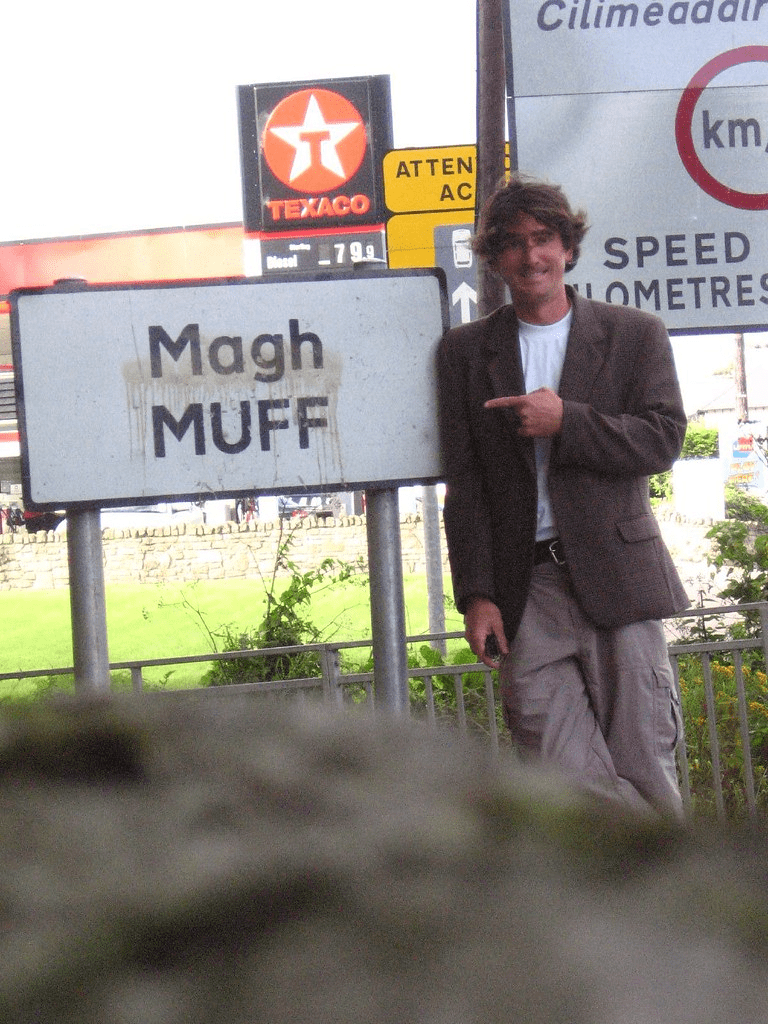
Featured Image: One of the more unfortunate results of the anglicization of place names – from the Irish word ‘Magh’, meaning ‘plain’. / Flickr
“He had known that she would pass from his hands and eyes, but had thought she could live in his mind, not realising that the very fact we have loved the dead increases their unreality, and that the more passionately we invoked them the further they recede”
E.M. Forster, A Passage to India, p. 47
The first time I read this quote in A Passage to India, it shocked me profoundly. It uprooted all my beliefs and assumptions about death and memory by challenging sayings such as ‘they will be with you in your heart’, or ‘they may physically be lost, but your memories of them are not’. The thought that the more I tried to remember deceased loved ones the more they would slip away, terrified me. No one wants death to be absolute.
It is safe to say that reading this quote flung me into an existential crisis. Here, it is as if Forster is trying to suggest that being loved in life does not ensure that you – the real you – is remembered in death, but can taint the memories of you in the minds of those who knew and valued you. The greater the love, the greater the loss is a well is a commonly cited phrase. However, I always wanted to believe that this loss is only in a physical sense and not in a spiritual way.
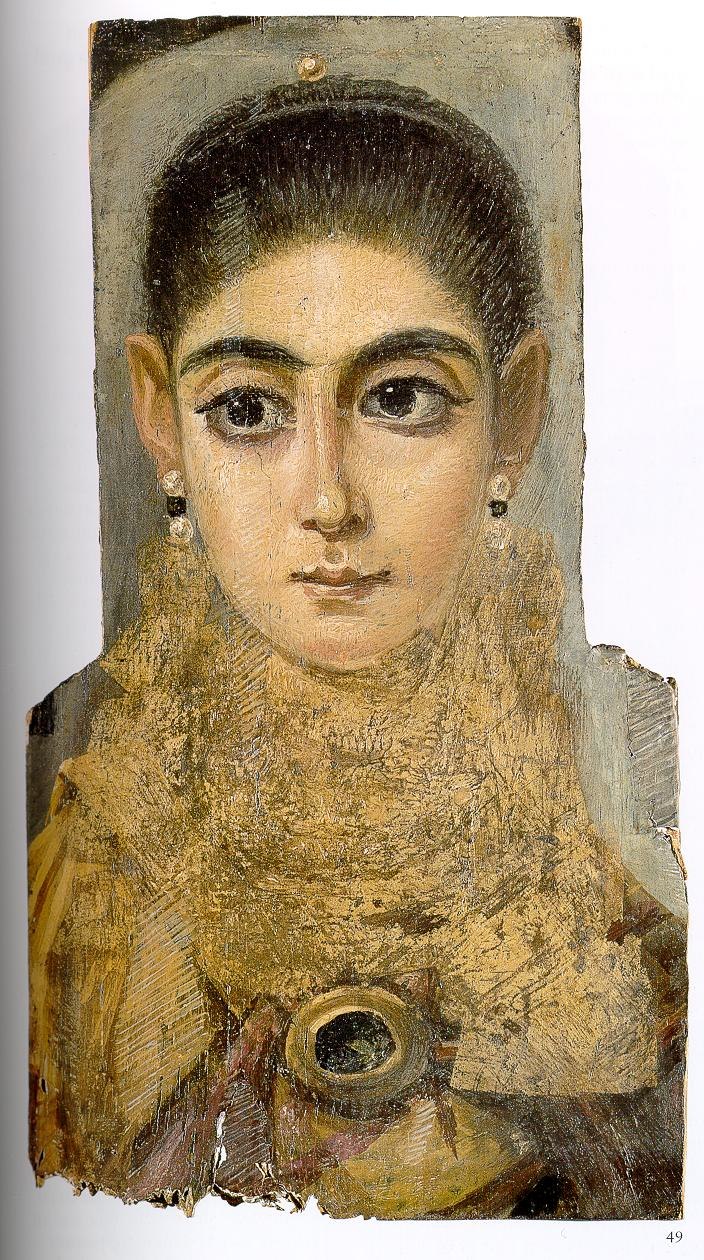
So, as Forster suggests, if being loved cannot save us from being forgotten, then what can? The Fayum Portraits offer us an interesting perspective. Painted between the 1st and 3rd centuries and mostly found in the Fayum region in Egypt, these portraits capture people with an uncanny sense of reality and vitality ‘as if they have just tentatively stepped towards us’ (John Berger, Portraits, p. 9). They were placed on top of the coffins of the dead to act as a marker of identity for their journey to the kingdom of Osiris, and to serve as a remembrance tool for the family and friends they left behind. Although it is difficult to discern how far the artists of these portraits captured the likeness or ‘mimesis’ of their subjects in the absence of photographs to compare them to, their two-pronged function as an early ‘passport photo’ (Berger, p. 8) and an aid to memorialisation suggests that an accurate representation of reality was imperative. The Fayum portraits were produced centuries before the Renaissance, when the function of portraits underwent a major evolution to no longer simply depict an individual’s physical appearance but also their ‘charisma’ and inner virtues.
In the twenty-first century, we now have the ability to take photos which can capture the likeness of an individual to an accuracy arguably unachievable by painted or drawn portraiture. However, what is remarkable about the Fayum portraits in contrast to their digital descendants is their survival. This was a point highlighted by art historian Simon Schama in discussion of the question “Why portraits still matter?”, discussed during a Sotheby’s Talk in 2023. Schama suggested that in an age where images simply disappear after twenty-four hours on Snapchat and we are reliant on ‘the cloud’ for the storage of our photos, the worry is that the images we create and collate digitally will someday be lost. It is indeed common practice to put a photograph of the deceased on the front page of printed orders of service for funerals and memorials – maybe our modern-day equivalent to the Fayum portraits? Nonetheless, surely the innate value of works of art means that we are more inclined to ensure the survival of a painted or drawn portrait over a digital one?
Unfortunately, for everyone to have a portrait painted or drawn is an unattainable reality. However, a consideration of the Fayum portraits, at least to me, acts as a prompt to move away from a reliance on the digital to capture yourself and your loved ones in an analogue form. Portraiture is one way of eternalising your physical self whereas writing, specifically private, personal writing, offers a more accessible way of ensuring that your essence does not ‘recede’. Anything from poetry to quotidian prose can become a vehicle through which the recollections of the deceased can avoid slipping into ‘unreality’.
However, the effectiveness of using personal writing as a way of eternalising the reality of a person is contingent on two factors: the writing has to be contained in a physical body to increase its chances of survival, i.e. in a notebook or in a paper folder rather than stored digitally, and the writing has to be guided by ‘how it felt to me’ or the ‘implacable “I”’, as articulated by Joan Didion in her essay On Keeping a Notebook.
‘We are not talking here about the kind of notebook that is patently for public consumption, a structural conceit for binding together a series of pensees; we are talking about something private, about bits of the mind’s string too short to use, an indiscriminate and erratic assemblage with meaning only for its maker’,
Joan Didion, On Keeping a Notebook (1968)
Just as when portraits began to be co-opted by Renaissance rulers as a visual language through which they could articulate political messages and dynastic ties when put on public display, the “I” of a notebook is lost when it is written for others. Maybe, if we all engaged in more personal, analogue modes of reflection – whether a work of art or a piece of prose – we would be more likely to win the fight against being forgotten, the essence of our person is less likely to be blurred and retold in the minds of those who outlive us.
Jades of exploit and diamonds of orient: An antagonistic pair still yet attuned. Say ‘feign me a geisha, an idol, a porcelain doll’ And you shall hear the jade crack, the silk rip, my chest heave. Found, not forged they hope But impurities are collated and considered, Caressed through knowing hands in consequence. Finger my ridges, moisten my craters, buff me right even. File me down, maintain the purity, oh a chink at my discretion! Carbon lattices stand fixed though; a resounding frigidity Yet You siphon my value, Melded into frocks of organza so deftly torn apart for this momentary warmth.
Infantry was adorned with those hues of green, A basque of tongue-ties, of brown eyes, of hushed mires. The rabbit on the moon blows me a draughty kiss, My untainted pride all but sealed and so tragically for naught. Childhood exchanged those colours of mine For crystals of salt unravelled my tongue; And balls of aquamarine bludgeoned me petrified, Those bellies of laughter estranging the forlorn chick. Slumber laid the palette to rest – After all, an artisan works not at night! Here black conquered gold, Here lines struck curves, Here diamond and jade became deities alike.
Oysters pierced into adolescence. Their putrid, faecal husk offering an unsightly match Against my mother-of-pearl. A murk so ubiquitous they summoned mines to encrust me whole. Diamonds. Only diamonds. Serrated was the exterior And a pathetic taste to the interior: “Lap me up like fools’ gold” Unacquainted with my exotic flush or unfeigned touch. My viridian became thus vanquished But carve him an eighth wonder, Mask those fissures And deem her palatable. She’s hardly fragile once bejewelled.
I am older now. Strangely these days they prise me open, Caress this carcass of emerald so desirable And I am cradled. Warmth. So now penetrate me, Permeate my crevices, Plough into my core For I am not pungent nor marred anymore! Strip my carats And exhibit me for the voyeur – Ascertain his preference And I shall deliver: Submit. Conform.
Predictably a shrapnel remains; Declare me wanton at best But never have such tender gazes nested in green. Pry into muted chambers And engorge those fractures, Again, again, again. Festering wounds but behold me still I’ll plead and render the heavens for this. But he knows not of certainty Instead forgotten is the ink, the crescents, the onyx. Turn to that of amber, of sapphire, of moonstone. Misshapen as it was this vessel had harboured hope: Beyond gemstones of allegory Beyond tormented verse. What to do but remould these splinters of glass Or resume one’s seat at the gouache? Tears will garnish this commodity again I am sure – My attributes to be thus converged: An antagonistic pair still yet attuned, Diamonds of orient and jades of exploit.
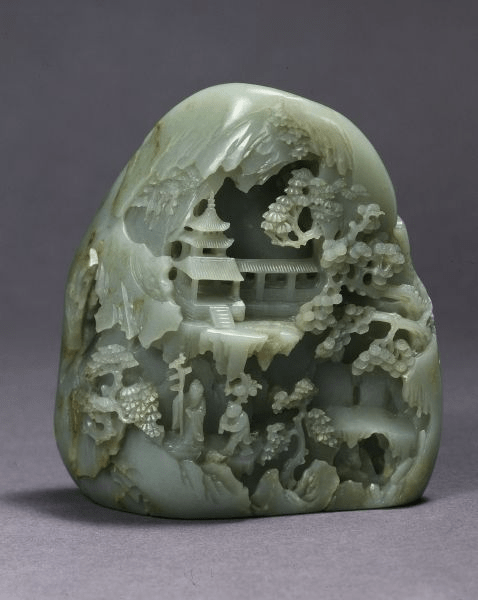
Featured Image: “Philosopher’s Repose” Jade Mountain, British Museum
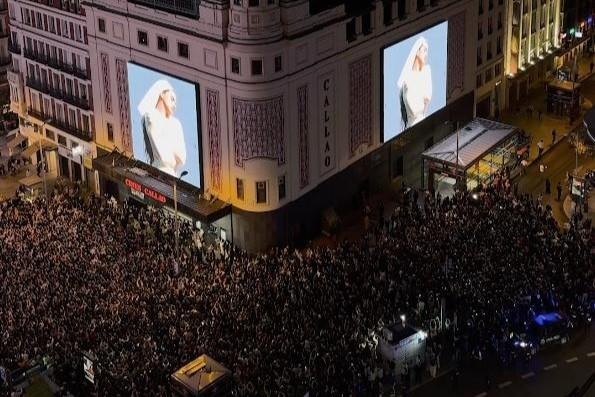
On the night of the 20th of October, thousands of Madrileños gathered in the Plaza de Callao, milling beneath the overhead screens. They were followers of an artist whose career has moved unpredictably between flamenco, reggaetón, and experimental pop, anticipating the release of her new album’s title and cover. The moment was oddly subdued; there would be no spectacle, just the pause of a crowd prepared to read meaning into an image. Rosalía, having taken a three-year hiatus since MOTOMAMI, reclaims the spotlight with her monumental fourth album, LUX. This time, she collaborates with the London Symphony Orchestra for a record meshing pop, classical, and operatic influences, while nodding to her flamenco roots. She sings in thirteen languages (Spanish, Catalan, Italian, English, Sicilian, Hebrew, Mandarin, German, Arabic, Ukrainian, Portuguese, Latin, and Japanese), and blends almost as many genres.
CatalanNews, Rosalía’s Lux: A search for meaning in the doomscrolling era / Madrid’s Callao Square with thousands of Rosalia fans during the presentation of her latest album, Lux, on October 20, 2025 / Rafa Ortiz – Sony
LUX stands out as Rosalía’s most poetically and sonically ambitious work to date, but its stylistic multiplicity is far from self-indulgent; instead, it serves a singular theme: the collective longing for the divine. Critics’ year-end lists have placed LUX at the top of 2025’s defining albums, not for its ambition so much as for its rare candour in approaching faith and interior life without irony. Even the Vatican’s Culture Minister gave his blessing – “When a creator like Rosalía speaks of spirituality, it means that she captures a profound need in contemporary culture to approach spirituality, to cultivate an inner life.”
The album arrives amid a wider cultural moment in which the music industry routinely borrows religious symbolism for popular reproduction, while neglecting its theological meaning (Terry Eagleton, Culture and the Death of God). It is a trend nowhere more visible than in pop music and its surrounding visual imagery, where narratives of the divine are handled with a flippancy rarely extended to other traditions (rock music tends at least to engage its source material with a degree of fidelity).
In practice, this produces a familiar cycle of provocation, most recognisably with Christian symbols: Madonna’s burning crosses and stigmata in the music video for Like a Prayer, Lady Gaga’s Judas released a week before Easter, or artists such as Lil Nas X masquerading as Christ on the cross, a figure whose appropriation now seems uniquely consequence-free. Most recently, Sabrina Carpenter’s Feather got a priest demoted. These popstars arrive primed for the inevitable, perhaps staged controversy, armed with a sassy clapback (“Jesus was a Carpenter”), but always sorry-not-sorry. Irony functions here as a safety net, allowing artists to touch the sacred without risking the accountability of belief or the vulnerability of transformation.
All hope is, as ever, not lost. It is into this landscape, saturated with religious imagery yet starved of its respective meaning, that Rosalía releases LUX. The album offers one of the most sustained engagements with faith in global pop since Kanye West’s Jesus Is King, a parallel underscored by common collaborator, Yeezus producer Noah Goldstein. Throughout LUX, Rosalía reclaims religious symbolism by striking visual and lyrical means.
CatalanNews, Rosalía’s Lux: A search for meaning in the doomscrolling era / Album artwork for ‘Lux’, the fourth album by Rosalía / Noah Dillon – Sony
On the album cover, she dons a white nun’s veil and hugs herself in a top resembling a straitjacket. But her expression reads more as ecstasy than pain. The image holds the kind of ambivalence Rosalía, like a good theologian, seems to have mastered. Perhaps she’s communicating the idea of self-love through spiritual discipline and self-restraint. Like many of the record’s songs, it echoes an all-embracing motif: the intimacy of being seen by God.
The title, meaning “light” in Latin, is echoed in the album’s fourth song Porcelana, “ego sum lux mundi” (“I am the light of the world”), quoting Jesus’ speech to his followers at the temple in the Gospel of John (8:16). Perhaps the title is also inspired by Simone Weil, whose quote from Gravity and Grace, “Love is not consolation, it is light”, features as an epigraph on the vinyl and CD editions. This book is one of many mystical works that influenced Rosalía’s lyrics, nestled amongst biblical passages and the hagiographies of female saints and mystics, including St. Joan of Arc and St. Teresa of Ávila.
Mystics, or those who have experienced mysticism, are classified by the rare, sometimes ecstatic and always transcendent experiences of the “immediate or direct presence of God” (Bernard McGinn, The Presence of God…The Foundations of Mysticism, Vol. 1). Rosalía cites the work of Clarice Lispector as a literary touchstone, less a mystic than a modern articulator of mystical intimacy, whose prose reflects the inwardness her lyrics seek to embody. She tells The Guardian, “I’m tiring of seeing people referencing celebrities, and celebrities referencing other celebrities. I’m really much more excited about saints.”
The songs themselves draw faithful inspiration from age-old Christian theology. Relíquia (Relic) references the tradition of relics and their veneration, and Berghain’s lyrics touch on the Eucharist and the Communion of Saints. She was challenged in an interview with the New York Times, “Are you asking a lot of your audience to absorb a work like this?” Her response: “Absolutely, I am. The more we are in the era of dopamine, the more I want the opposite. That’s what I’m craving.”
The Guardian, Rosalía: Lux review – a demanding, distinctive clash of classical and chaos that couldn’t be by anyone else / Abandon preconceptions … Rosalía
Cortona Polyptych by the Italian early Renaissance painter Fra Angelico / Diocesan Museum of the Cortona Chapter, Cortona, Italy
Rosalía’s visual language refuses to ironize religious symbols by placing discipline above indulgence. In the album’s visual rollout, she appears with a bleached ring dyed onto the crown of her head, visible in each song’s Spotify canvas and in recent interviews. It’s a mark that reads as more than a contemporary halo, and instead evokes the tonsure historically worn by Catholic monks as a sign of submission and withdrawal from self-fashioning. Here, Rosalía’s specific style recalls the Roman corona, formerly worn by St. Cuthbert and St. Bede. These shorn crowns rendered interior discipline visibly legible on the body. Paired with gloves that evoke penitential or flagellatory vestments, Rosalía’s styling resists the theatrics of costume, gesturing towards the ascetic formation of the body rather than the body as styled for consumption.
In the mystical tradition Rosalía draws from, the body is disciplined to become capable of exposure to the divine, of being seen without disguise. That logic comes into full view in Dios es un Stalker (“God is a Stalker”). The song draws on a tradition of writing that confronts the intolerable intimacy of an all-seeing God, from the theological insistence on divine proximity found in Simone Weil, to a stylistic affinity with Clarice Lispector’s prose, which exposes consciousness at its most unguarded. Rosalía boldly sings from a God’s eye view, something she admits to France Inter is “absurd – [the song] contains a sense of humour.” Through this lens, she adopts the metaphor of a stalker who follows her and knows her every move, but… in a loving way.
That divine knowledge extends even to what we would rather conceal. When Rosalía sings “Lo sé tus deseos indeseables” (“I know your undesirable desires”), she confronts the listener with a God who sees beneath the layers of moral self-presentation. She continues, “Mi aliento es el viento que te roza el pelo” (“My breath is the wind grazing your hair”), indicative of a distinctly biblical intimacy. Psalm 139 gives this knowledge its theological weight – “O Lord, you have searched me and known me… Where can I go from your Spirit?” Rosalía allows the discomfort of being fully seen to remain unresolved, placing the listener inside that exposure. The effect recalls the interior pressure found in Clarice Lispector’s The Passion According to G.H., which dismantles irony entirely and forces her narrator into a consciousness so exposed it borders on annihilation.
Rosalía modernises the concept of omniscience through technological language. The image of God with an “exploding inbox” (“Tengo un buzón explotado”) reminds me of the scene in the 2003 film Bruce Almighty, where Bruce (Jim Carrey) gains powers from God (Morgan Freeman), and has to manage just that.
YARN, What a bunch of whiners. This is gonna suck up my whole life. / https://getyarn.io/yarn-clip/b5ff545e-e029-49f7-bf10-267aea0e01ca
Rosalía attempts to communicate the impossibility of relating to divine characteristics, a notion underscored by the song’s most self-aware line, “Mi omnipresencia me tiene agotada” (“My omnipresence has me exhausted”). The exhaustion, of course, belongs to the metaphor, not to God. Yet Rosalía’s phrasing recalls the human struggle to imagine infinitude; we project our limits onto God because no other language is available. This echoes the concept of the analogia entis, in which every analogy for God’s identity both reveals and fails. Rosalía knowingly writes within this failure and continues to meditate on such contradictions throughout LUX. In fact, it forms the central motif of La Yugular: “you who are far and at the same time closer than my own jugular vein.”
The stalking metaphor’s greatest weakness lies in Rosalía’s simultaneous portrayal of divine pursuit as non-coercive. “Detrás de ti, voy” (“Behind you, I go”) is immediately tempered by “yo que siempre espero que vengan a mí” (“I who always waits for them to come to me”). This is the song’s central tenet – the paradox of God as omnipresent yet partially hidden. Were God’s presence unavoidable, human freedom would collapse into inevitability. In the Gospel of John, Jesus refuses to jump off the Temple roof and save himself miraculously to prove his divinity to surrounding crowds. Rosalía acknowledges this: “No me gusta hacer intervencion divina” (“I don’t like doing divine intervention”), conveying that love cannot force itself. Also explored in the film Bruce Almighty, Bruce can do almost everything with his divine powers except convince his girlfriend (Jennifer Aniston) to stay with him, because it’s against her free will.
Simone Weil speaks on the hiddenness of God in Gravity and Grace, insisting that He withdraws precisely to make room for human love. For Love to be real it presents a choice to accept it or to flee from it, a condition essential also to human existence: “There exists a ‘deifugal’ force. Otherwise all would be God” (Simone Weil, Gravity and Grace). In Dios es un Stalker, Rosalía does not resolve the tension of divine withdrawal but renders it as waiting, marked by a presence that watches and loves without interference.
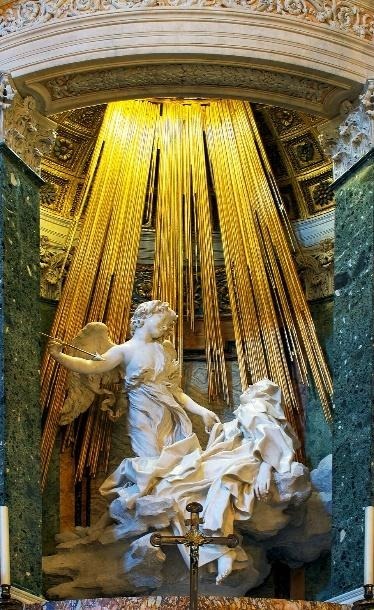
Ecstasy of Saint Teresa, by Gian Lorenzo Bernini / Santa Maria della Vittoria, Rome
Once such a divine gaze is acknowledged, Rosalía asks herself what must be relinquished. This forms the basis of Sauvignon Blanc. The song conveys how once irony is refused and intimacy faced, familiar understandings of pleasure and consumption are transformed. The song draws on the writings of St. Teresa of Ávila (1515-1582), Spanish mystic, Patron saint of Spain and chess, and first female Doctor of the Church for her advanced spiritual writings. As a Carmelite nun she renounced her wealth for the convent. She is often recognised today from Bernini’s sculpture The Ecstasy of Saint Teresa (1647-1652) in Rome, depicting a vision famously detailed in her autobiography as her Transverberation. During the vision, she experiences her heart being pierced by an angel’s spear, a moment she describes as “a sweetness so extreme that one could not possibly wish it to end.”
In Sauvignon Blanc, Rosalía rejects the idolisation of material things, perhaps, like St. Teresa and other ascetics, denying material pleasures entirely. She even sings that she’ll burn her Rolls-Royce and that she doesn’t want pearls or caviar anymore: “To my God, I’ll listen / My Jimmy Choo’s, I’ll throw them away”. As Spencer Kornhaber says in The Atlantic, “Rosalía, like many of us, is asking herself what she’d be willing to give up to save her soul… Her autonomy? Her convenience? Her Jimmy Choos?”
Rosalía’s Savvy B isn’t about “making wine cool and fun again” for Gen Z like I’ve seen suggested recently. It’s worlds apart from Drake namechecking Moscato, Jay-Z on Cristal, or Taylor Swift’s many lyrical wine references. In an interview with Apple Music, Rosalía affirms she cited inspiration for the song from St. Teresa’s work, likely The Interior Castle, in which the saint describes her experience of “divine intoxication,” or spiritual ecstasy. Teresa used the metaphor of a “wine cellar,” where God invites the soul to drink “divine love” – a Love that Rosalía sings she would leave all worldly pleasures for. Teresa herself derives the image of the wine cellar from Song of Songs 2:4, which reads“He brought me into the cellar of wine; he set in order Love in me.” Wine is also evoked as a symbol for spiritual fulfilment in Psalm 23: “my cup runneth over”, meaning “I have more than enough for my needs”.
Diana Fountain in Lerwick, Shetland, by James Hunter
Sauvignon Blanc isn’t a wine of status, but poured abundantly for the soul. One of St. Teresa’s greatest quotes, “Let nothing disturb you, let nothing frighten you, all things are passing away… Whoever has God lacks nothing; God alone suffices”, has sure influence on Rosalía’s lyrics: “Ya no tengo miedo del pasado, esta en el fondo, de mi copa de Sauvignon Blanc” (I no longer have fear / of the past / it is at the back / of my glass of Sauvignon Blanc). In a cultural economy fluent in irony, religious symbols are safe because they can often be inverted and discarded without consequence for the artist. Rosalía’s LUX reveals that mysticism offers pop culture what irony cannot… a commitment to truth, whether understood ontologically, as fidelity to the moral and metaphysical claims carried by religious source material, or artistically, as the discipline of approaching that material in a way that maintains harmony with its origins rather than merely borrowing its surface. In doing so she opens onto a reordering of desire largely absent from contemporary pop music, exploring intimacy without irony, pleasure without detachment, and faith without spectacle. Amid a popular culture saturated with symbols starved of meaning, that assertion may be the album’s most radical gesture.
We first met Joanna and Mark when we moved into Crowley Avenue, nearly thirteen years ago. We sent our kids to the same school, where my wife was introduced to Joanna at pickup time. Playground pleasantries turned into play-dates, play-dates turned into dinner parties – and lots of those. Through Joanna and Mark, we met Paula and Neil, Eileen and Andrew, and Tessa and Adam (since divorced). I quite like Joanna. She can be very good company after a few drinks, albeit a bit loud. And she was very helpful with the kids when my mother-in-law passed.
Problem is, I think Mark’s a cunt.
He’s pious, boorish, drinks too much, pretends to laugh at Shakespeare, drives a new Aston Martin and – for some reason – reminds me a lot of my step-father. I haven’t a clue what he thinks of me. Nor do I really care. On the surface, you’d be excused in mistaking us for firm friends. Our civility’s pretty unwavering. Curry nights with Andrew and Neil on Wednesday. Golf every other Sunday. I used to regularly give him lifts back from the pub, in the days before he was partial to drink-driving.
Reluctantly, we’re indebted to Joanna and Mark. It’s sort of an unspoken truth. They’re responsible for the friendships we’ve entered since arriving here, and we’re pretty unsocial otherwise. I think my wife feels this a lot more than me, so I’ve resigned to keep my mouth shut. Otherwise, I’d have no problem with never speaking to Mark again – or suffering through his stories from Harrow, or pretending to give a shit about his new TV (one of those ones which transforms into a painting when idle).
It seems, nowadays, ‘disliking someone’ is not a good enough reason to cut a friendship short. I used to dream of the day Mark, or even Joanna, might execute some inexcusable faux pas – something which would immunise our radio silence from criticism. No such luck.
We were hosting last Thursday. I cooked one of my braised ducks. Joanna and Mark arrived forty-minutes late. He quickly entered into a relentless recounting of something he’d heard on LBC. I was alert to even a slither of boredom from Andrew and Neil, but they actually seemed pretty interested. Even my wife played ball. I tuned out until they left, far too late as per.
I could tell my wife was bothered by something. Just in the way she dropped plates into the dishwasher. “I think Joanna’s holding secret PTA meetings”, she eventually cracked.
“Really?” I felt a delightful opportunity brewing.
“She’s planning some sort of coup. Y’know when you just get that… I dunno, that feeling?” I didn’t really know ‘that feeling’, but I nodded along. “Can you do me a favour?”
“Of course” I suppressed a smile.
“This is gonna sound really weird, but… Would you mind popping over, after work tomorrow? Peering through their window or something. I’m just… I’m sure she’s holding them on Fridays. Sonia let slip the other day…”
“Absolutely, no problem at all”, I interrupted. “I’ll swing by tomorrow. You know me. Discreet voyeur”.
The next day, I took the scenic route home. I felt a bit like Taggart. Snow Patrol on the stereo. Joanna and Mark live in an end-of-terrace on the other end of town, which they routinely describe as “semi-detached”. I pulled up beside their empty drive, where I had an unrestricted view into the kitchen.
Joanna stood alone beside her kitchen-island, pouring a large glass of red wine. I could just about make out her eyes – certainly glazed, perhaps even watering. It wasn’t unheard of for PTA meetings to end in tears. She lifted the glass to her lips, as her eyes caught mine. I jolted into gear and drove on.
I stopped off at M&S for some oven pizzas. I honestly didn’t know if I’d gathered the sort of evidence my wife desired. But, I reasoned, maybe it wouldn’t be so bad to play it up slightly. I parked in a nearby cul-de-sac and prepped my forthcoming dossier. Rounding the corner into Crowley Avenue, I nearly collided with Mark.
“Ha, look what the cat dragged in!”, he spat. “Tell you what… Christ, Jo left her bloody gloves at yours last night. Somehow it’s my fault, so…”
“Ah, that’s… Bad luck, yeah”. I attempted a smile. “You get ‘em, then?”
“Yeah, yeah, all fine”. Mark patted his gilet pocket. “Lovely duck, by the way. I’m still full”.
“Cheers, yeah, s’just… Good fun, wasn’t it?” I suddenly remembered locking eyes with Joanna. Oddly, the significance of this hadn’t occurred to me until then.
“Great fun, yeah, erm… I was meaning to text you actually. Might have to sack off curry next week. I’m meeting some old Harrovians for a bit of a piss-up. Go ahead though, by all means”.
I smiled, genuinely this time. “No worries. Have fun”.
“Yeah, yeah… Not too much fun, not too much fun”, he smirked. “Anyway, look… You take care, mate”. Mark held out his hand. As I shook it, I caught the scent of my wife’s perfume.
I wish I had grown up with you. I imagine us both sat in the back of a Catholic private school, two continents and an ocean apart. Pleated skirts below our knees and His Holiness all up and down our stocking hoses. I imagine us both tip-tapping in black leather Mary Janes, humming to the same choir bells, sat at mass head bowed and ponytail coming undone in a few whiskers. I imagine us both muttering our Hail Maries in the same breath, clueless to Eves and evenings spent at an underground wine bar in Central–Plume It was appropriately decorated with bird fixtures and feather ornaments crowding its walls. Did we both look out and see the same bird, its wings far more interesting than the Spanish or Latin splashed across our desks?
I could’ve watched you play with your hair and maybe put a braid in it, or two. I could sit in the very back row and write about you all day. Across my spinal-cord notebooks would be starry stories of your freckles and the way you drew birds, maybe you would have asked me what I was reading on my lap and we could get taller together reaching for Plathian trees.
Instead I learned about your netball practices and family estates in the line to the National Gallery, over tea in Covent Garden you told me about your friend that was a duke and the dead ferrets you shot. In the wine bar we talked religion and love and blue mascara because what else is there to talk about? Another pub where a poorly performed Ed Sheeran wannabe sat on a high chair and we got drunk over lager. You beat me at scrabble and I fell in love with your annoying habit of never taking anything seriously.
I never sent the letter.
Eight months later we are sitting in the corner of a student bar and I try to explain why I’ve traveled across the country to give you a few pages of my messy cursive. An hour ago I leaned against the back corner of the room, wine glass in hand, and imagined what my face must’ve looked like to your closest friends as it changed from admiration and awe to the sincerest wave of grief I’d ever dawned. I was scared to touch you from this uncomfortable distance on this angular sofa. I could watch you forever I love you I want to remember you.
But I am not here, I am not there, nor everywhere. There is so little of you that I can remember. I don’t want to only occupy your life in intangible mythical ways. I want to know how you sneeze and how often, I want to paint your nails and bite them off. To know how you take your tea and which mug is your favorite? Put candy in your stocking and pick daffodils from our back garden, sunrise in the Alps, sunsets in Paris, midnights in Vienna. I want to see you spin to Jazz and take you home after too much muddy red wine. Win at family charades and fill the grill up with charcoal. A pie by the window, mow the lawn, a jar of honey.
I want a life with you in any boring place at all.
There is nothing wrong about us. No logic or star crossed fortunes for us to be bending down pleading and crying.
Can I ask you, what is more true than how I look at you across this crowded place?
What could be less real than the memory of us rising in coffee steam and first class Queens’ postage stamps? What is more definite than carefully chosen flowers and how we speak to each other like Ophelia did the waters? You’re my favorite person and I think our souls are made from the same color. I could stitch us back together and embroider our initials on pillows, socks, collars, something blue. I’ll knit us a family tweed. If I could look at you from across this room forever I think I might just be okay with never touching you again. If I could hear you laugh and your lashes flutter I might just be okay with never talking again.
I try not to let my mind wander of our future, utopian illusions envisioned by someone who is not used to not getting what she wants. My spoiled temperament makes me stupidly stubborn and all entitled but I swear I am not asking for much.
Last Saturday I found myself not nearly drunk enough to handle the small talk of a university house party. Tequila rose chasing vodka, 3 pound XL Tescos lemonade, purple glitter on eyelids and button down polo shirts flooded my peripheral. Girls overcompensating for their boyfriend’s dissatisfying performances with speech-lists of things that he’s given her, we all stand in a circle in the smoking garden and allow them to convince themselves all the way from uni to a surrey estate with golden retrievers and worn down waxed jackets .
When I excuse myself to the restroom I look back twice and almost expect to see you across the room, smiling at me behind your fringe. I wanted so desperately to burst out laughing at a clever remark you’d make all cloaked with sarcasm about that boy’s misuse of “sesquipedalian” or reference some Baroque musical piece and I’d be the luckiest man in the world.
When I’m caught in these unnecessary conversations and excessive alcoholic consumptions I wish you were here.
I could half listen to a friend’s story about their summer trip to Mallorca or Ibiza and look up lazily at you standing next to the fireplace, wine glass in hand, telling a joke that makes the people around you laugh. I’d move around everyone because you’re just my person, there would be no more loneliness if I could just exist next to your holiness, witness your life.
Instead I let my eyes drift off away from the lit houses and towards the dark of the night. Outside, rain is puttering perilously against the pavement and the slugs have come out. My nailbeds are picked at and slowly bleeding, my hair is damp from rainwater and vodkawaters.
(I never told you about how I used to brave the streets after a summer storm and carefully rehome all the lost snails and slugs and worms. I know you’d have found the image endearing: me waddling in wellies and talking to the cicadas.)
The slow sway of the seasons and the city’s descent into an undeniable autumn brought about a great sense of becoming, an atonement of fog that seemed to me followed along all the students of the university. A likened quietness began to come over me as well, manifesting itself in a complete disinterest in the practicalities of romance. Its very essence bored me terribly, the lethargy of conversation, the exhaustion of rehearsed intimacy, going through the motions of physicalities. It is a dull chore. It is dull to be doing the things one does when in love: thumb brushing against my knee, dilated pupils in pub gardens, holding hands down cobblestone. It had not been that long since I managed those motions with sincerity, the only forgiving aspect about these foolish courtships are when they do not happen through compliance. The ridiculousness of running your fingers through my hair! But when you see it in their eyes all doubts cease… how unoriginal we are as a species, moved by the heart to proceed along the same old same old same old endearments.
The cold frigidity of northeast England will forever be enchanting to me, something to be adored, something to be abhorred. To watch the seasons fade and river water run wild, color appearing on passersby cheeks and noses and ears, the instinct to retreat.
I smoke and drink and smoke even more, mostly. I feel classless and petty and vengeful. But I try to do good.
I think about you today like I do any other. In reading the letters from Hildegard and Heloise and their declaratory devotion to the living light I let myself stare out the window and towards the red orange and yellow trees. If my letters to you were ever retrieved and ascribed I can say with confidence another group of eagerly bored pupils would elaborate on my longing just as I did this morning. Nothing is good without you, not much of anything is anything away from you.
Damn the soul. Alma, you are in my blood as you are in my bones.
Like any film Vincent Gallo has conjured, Buffalo’ 66 is steeped in narcissism. Gallo stands on stage and essentially cry-wanks in your face, captured on 35mm film, It’s a blatant display of self-aggrandising and a masturbatory pat on the back (or dick) – perhaps best surmised in one of the beginning scenes of the film, in which Gallo beats up a man in at the urinal next to him for staring – and exclaiming – it’s just so big! Naturally, it is my favourite film, ever. There is a job-lot of chin-scratching discourse and pacing back and forth over the success of Gallo’s attempt to curate an ‘art film’, and his portrayal (and in-film treatment) of his deuteragonist, Christina Ricci, but before discussing such a heated debate one should be familiar with the plot of Buffalo’ 66.
In the rotted, snowy streets of New York we lay our scene. Billy Brown (Gallo) has just been released from prison for a crime he didn’t commit. Following a montage of greyscale, grainy overlays chronicling Billy’s 5 years locked up – cue crying in shower – cue mugshots – cue piano tune (written by Gallo himself) lamenting on being such a lonely, lonely boy. We then cut to a scene of Billy running into every nearby shop locally available maniacally searching for a bathroom which he finally finds in a dance studio (where the aforementioned urinal scene takes place). Gallo is all sharp shadowed brows and spindled limbs – speaking in staccato whines and quips, the cold daytime shots of New York were, to me, reminiscent of a more expansive and somewhat hollowed colour grading akin to Wong Kar Wai’s ‘Fallen Angels’. It’s all set up to feel very alien. Billy is strange looking, strange speaking, running around this apocalyptic cold expanse. After relieving himself, he calls his mother from a payphone – declaring he’s just touched down from a nondescript work related trip, staying at a fancy hotel, and wants to introduce his family to his wife. Wife? You ask – well Billy proceeds to snatch a girl walking out of the bathroom – wife acquired! Her name is Layla (Played by a 17 year old Ricci), wearing a powdery blue babydoll dress, silver sparkly tap shoes and a white shrug cardigan. Layla is bemusingly passive – obliging Billy’s demands to drive him to his parents house, pretend to be his wife (under the alias Wendy Balsam) and to essentially ‘make him look good’ – promised with the reward of being his best friend. Billy then has a panic attack sort of episode on the porch before his parents open the door – and we are greeted with worlds best mum and dad.
After serving Billy courses of food he is allergic to the vast majority of, Billy’s mum explains to Layla her devotion to the Buffalo Bills, recounting how the only game she missed was the day Billy was born, sighing how she wishes she never had him as they eat platefuls of tripe (cow stomach lining, for the less culinary inclined). Billy’s dad is a retired singer, now part-time pervert, occasionally motorboating Layla under the guise of a fatherly hug – ‘ you know, daddy really loves his new little sweet young daughter!’ It is difficult to say whether Billy’s father really looks at Billy during the entire dinner scene, but we do get a fond flashback scene of him killing Billy’s childhood dog, Bingo. During the Godard-like dinner scene montage, it’s my belief that this is where Layla really falls in love with Billy. Mummy AND daddy issues? Bless. She takes it upon herself to declare that Billy is her boss at the CIA, where she worked as his typist, and that they have a child on the way. The parents aren’t overly affected, watching the Buffalo Bills game over Layla/Wendy’s shoulder, but it’s a tender moment.
It transpires that the reason Billy went to prison was in order to keep a bookie from hurting his parents, a bookie whom he owes $10,000 after betting the Buffalo Bills would win the 1991 Super Bowl – presumably in an attempt to connect with his emotionally negligent mother. We discover that the next chunk of the movie is a manhunt for Scott Woods, the disgraced Buffalo Bills kicker whom Billy blames for losing the Super Bowl, in turn losing everything, who now owns the local strip joint, Billy learns that Woods doesn’t show up at the strip club until around 2 in the morning, so we then see Billy and Layla killing time, shuffling through his hometown. The meat of the film here becomes tender, and warmth pervades the vignette of scenes as the neon city signs are woken up by the dark, we arrive at the bowling alley where Billy’s countenance softens oh so slightly, it seems to be the place in which Billy spent the majority of his youth. This is my favourite scene of the film, for a great number of reasons really: the first being Billy’s incredible outfit, a striped grey and black wifebeater, with tight flared trousers, and patent red platform cowboy boots. The harshness of his nose, his jaw, his eyes as he hits strike after strike, his body is all angles. We then pan to Layla, ambling around, a noncommittal observer – the lights dim and all is a deep red, with her silver tap shoes spotlighted, she then breaks the fourth wall by tapdancing to King Crimson’s ‘Moonchild’ – the baby blues of her dress, eyeshadow and tights chime in accordance with the song’s vibraphone and chatter of symbols, puncturing a tight staccato through the hollow grey of the film. The scene operates as a rare invitation to Layla’s interior world, underscored by a warm and deep loneliness, top-noted by innocence.
‘Lonely moonchild, dreaming in the shadows of the willow’
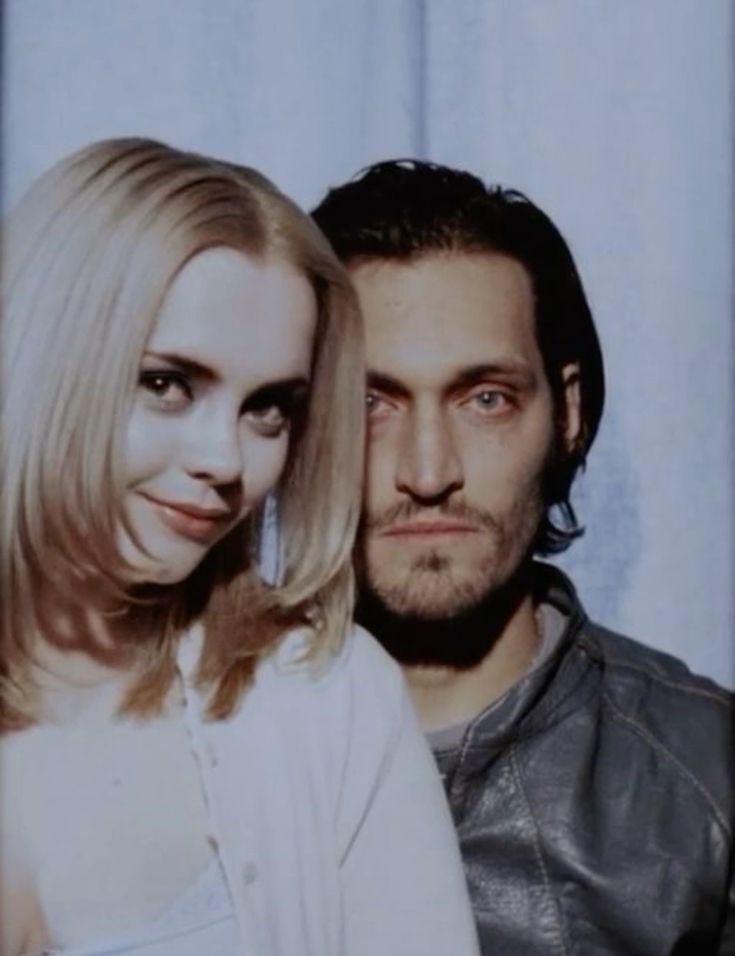
The next scene, arguably the film’s most famous, is their time in the photo booth – shot through the photobooth camera, we’re peeking through a small, grainy rectangle in the centre of the screen. Layla sits on Billy’s lap and is chided over several attempts to take photos, first for sticking out her tongue, then for kissing him on the temple – ‘we’re a couple that doesn’t touch’. Billy is scared, albeit moved by Layla’s burgeoning empathy she bludgeons him with, he consistently berates Layla in his broken, repetitive and disjointed sentences while she peers back doe-eyed and unaffected. Like Layla, it’s quite difficult to see Billy as venomous, he comes across as a gentle yet imperilled piece of shit with a frustration that hurls itself toward any moving target – it appears he wants to be loved, and he slowly allows himself to feel what it may be like, they have a bath together (clothed, naturally) then lie in silence next to each other awkwardly-limbed, like discarded barbie dolls. A dulcet saxophone seeps into the background of the scene, as they touch hands – snatch them away – touch again – eye contact – look away – then kiss. It’s brief and angular, reminiscent of Billy’s bowling, but then he folds in on himself and lets himself be held.
Billy then wakes up at 2:08, we’re reminded of his sacrificial mission. As he sneaks out, he wakes Layla:
‘I really like you
I’m gonna be really sad if you don’t come back.
Unless you tell me
If you’re not gonna come back, just tell me, don’t lie to me.
Are you going to come back or not?’
Layla declares her love for him as he closes the door. Next, is one of the greatest examples of scoring in the history of film (I believe) and even if you won’t ever watch this movie – I completely urge you just to skip to 1:38. Heart Of The Sunrise by Yes begins to play as Billy walks into the velvet-clad strip club in slow motion, topless dancers (in granny pants – weirdly) lit up in icy neon and surrounded by fat, wobbling men – it looks like a scene from the Twin Peaks backrooms with an incredible prog rock bassline. Billy pulls out his pistol and shoots Scott, then himself – everything is still, yet the camera pans around the scene and then away to some faraway vision of Billy’s largely unmoved parents watching a Buffalo Bills game on his grave, naturally.
But what’s this – we pan back in – it was all a dream! Rejoice! Billy flees and runs to a shitty 24-hour café where he buys Layla a hot chocolate (large) and a special heart cookie. It’s a truth universally known that narcissistic homicidal depressed maniacs can, in fact, be fixed, girls. The movie ends with a still of Layla and Billy in bed, sleeping, and holding one another.
Now there’s plenty of discourse surrounding its semi-autobiographical nature, as Gallo himself grew up in Buffalo, New York and had similar parents – in fact, in the premiere of Buffalo 66, attended by those who knew the family, continually burst out laughing in recognition of the parents’ depictions. Gallo describes Billy as a character portraying feelings true to those that Gallo has felt himself, and the last five minutes of the film are him on a really good day. So, in essence, Gallo Dr Frankenstein-ed Billy using the darkest parts of himself to depict what he could have been. The semi-autobiographical nature of the film, paired with its total self-indulgence, (the fantasy of its plot is apologised for by its atmosphere, which is uncontestably beautiful) persuades many watchers to land in the ‘this film is a piece of shit’ camp. Many firmly situated in this camp owe it to Gallo’s deeply bemusing online presence; he famously advertises himself as an escort on his website, in which he writes,
‘I, Vincent Gallo, star of such classics as Buffalo 66 and The Brown Bunny, have decided to make myself available to all women. All women who can afford me, that is. For the modest fee of $50,000 plus expenses, I can fulfil the wish, dream, or fantasy of any naturally born female’ (transphobia duly noted), he goes on to say: ‘Heavy set, older, red heads etc can have me if they can pay the bill (…..) However, I highly frown upon any male having even the slightest momentary thought or wish that they could ever become my client. No way, José. However, female couples of the lesbian persuasion can enjoy a Vincent Gallo evening together for $100,000. $200,000 buys the lesbos a weekend. A weekend that will have them second-guessing.
Gallo is also selling his sperm for $1,000,000 (cash or check only, mind you). Owing to his online ramblings, nobody would really be surprised if Buffalo 66 is really just his incel wet dream, an intangible simulacra in which Layla represents the fantasy of unconditional female care in spite of the woes and hardships of being a man of the narcissistic variety. Gallo, in interviews following Buffalo ‘66’s release declared Christina Ricci to be on cough syrup – or just drinking heavily – throughout filming, however it’s clear he just didn’t like Ricci, who has since called him a raving lunatic. It is obvious Gallo is a bad man, whether his persona is some kind of reactionary performance art or tasteless extremism, it still pulls us back to the age old question – can we separate the art from the artist?
Many Substack articles frame Buffalo ’66 as a chronicle of misogynistic romanticism, yet I like to think Layla is, in fact, the only character with real emotional agency in the film, taking emotional charge of each scene she inhabits. Billy does not overtly assert a coherent or sustained form of male domination (though his frankly futile attempt at kidnapping her cannot be ignored) and is objectively desexed. This leaves us with the question: if Billy is not meaningfully exerting control over Layla, does she instead function as a Manic Pixie Dream Girl – existing to facilitate his self-actualisation? While the film undeniably traffics in a dated belief in the transformative power of a woman’s love, Layla is neither narratively contained within a neat psychological arc nor positioned as someone who ultimately ‘fixes’ him. It’s interesting, and awkward to position their dynamic – I think Gallo as a person, and director enormously taints what could be interpreted as two people, a strange encounter, and an unlikely sweetness.
Nonetheless, it is my favourite film, ever. I think I put this down to the outfitting, the prog-rock scoring and the cinematography that synthesise to create such an offbeat, alien, experimental yet extreme atmosphere. If you have, or are planning to watch the film, you’ll note the downright strangeness of the dialogue, it’s stilted and devoid of natural cadence in a way that’s blackly comic, Billy is merely the body of a broken child. I sustained a very emotional reaction when watching Buffalo ’66 for the first time, so maybe you will too – my legs and eyes both pricked, I felt wrought with an urgency I couldn’t quite articulate, pioneered by excitement. I was seeing something totally new and weird and epic – look guys are you seeing this? holy shit, guys, are you fucking seeing this? – pan round to ten minutes of a man trying to find somewhere to piss. Hey, whatever moves you, moves you.
War exposes the foundations of any society, both in its manifestation of power and its propensity for cruelty. Perhaps the most striking sign of this is the historical pattern of women in conflict: they are consistently the first to be attacked in specific, targeted ways and the last to be included in peace calculations.
This observation is not an attempt to diminish the experience of men, who bear the primary weight of frontline combat. Any conflict driven by the realities of the trenches, be this conscription, physical harm, or the general sacrifice of the male body when serving, is an absolute and central tragedy of the state. But recognising this does not mean the specific nature of violence aimed elsewhere should be overlooked. While male casualties are largely the result of kinetic engagements between armed forces, violence against women (particularly that of sexual and psychological nature) often functions as a purposeful, non-kinetic weapon. It is a tool used to accomplish a very specific military goal: the destruction of the internal cohesion and functionality of a community.
Rather than being a byproduct of chaos, it is a calculated instrument of force. We see this in the systematic recruitment of “comfort women” during the 1940s, or the use of mass rape as a tool of ethnic cleansing in the Balkans and Rwanda, these being just a few examples. They are a part of the long lineage of conflicts where the harm visited upon women was not a side effect of combat; it was the combat. By turning the body into a battleground, an aggressor effectively shifts the frontline from the geographical boundary to the domestic centre. It targets the primary caregivers and the links of social life, ensuring that the war’s devastation is generational rather than just infrastructure-deep, and effectively poisons the social foundation upon which any future stability must be built. The efficiency of this strategy lies in its long-term impact; even if the governmental occupation ends, the society faces a fundamental challenge in reorganising itself at its most basic level, because the “victory” was achieved by breaking the social unit from the inside out.
But this tactical utility is followed by a predictable political pivot once the kinetic phase of conflict concludes. Diplomacy, by its very nature, requires a narrowing of focus and a prioritisation of the immediate cessation of hostilities over the resolution of deeper social trauma to function.
Thus, in this context, being “the last to be considered” is typically a result of the technical limitations of the peace process, where the urgency of reaching a consensus forces negotiators to discard any variables that cannot be easily measured or traded. For those tasked with designing a new order, the specific abuses that are inflicted upon women represent “messy” data, or in other words realities that complicate the straightforward math of territory and disarmament because they cannot be settled with a signature. In this calculus, peace is treated as a technical binary (the absence of gunfire) while the restoration of the community is categorised differently. This move recontextualises the focus from the political agenda to a charitable one and allows the formal peace process to remain streamlined, even if it remains incomplete. By shifting these issues into the realm of “humanitarian” concerns, the state effectively removes them from the political table, treating them as secondary casualties of war instead of primary peace objectives. Admittedly, there have been genuine advancements in how these issues are recognised. The inclusion of gendered crimes in international legal structures and the presence of women in peace delegations represent a significant shift toward a more comprehensive record and a growing admission that a stable state cannot be constructed on top of unaddressed atrocities.
These developments are often able to provide a legal and ethical vocabulary for violations that were once entirely ignored, and are coming to signal a slow but real evolution in global standards, as well as a transition from total impunity to at least a baseline of accountability. Yet, even with these tools, the transition to stability remains a multidimensional issue. It is often simpler for an administration to focus on the visible markers of statehood (borders, banks, and the formal structures of a regime) under the assumption that once the formal structures are in place, the rest of society will naturally be able to follow suit. The official conclusion of a war is rarely a full resolution. More often, it is just a bureaucratic milestone. By treating the specific targeting of women as a secondary issue, diplomacy settles for only a very narrow and fragile definition of stability. It treats peace as a political deadline that can be met by drawing a line under the measurable aspects of war, and leaves the unmeasurable human consequences to fade into the background of both the private home and the female body. The result is a landscape that is technically at rest, where the maps are once again redrawn and records are closed, yet the fundamental work of social reconstruction continues, largely unacknowledged, in the margins.
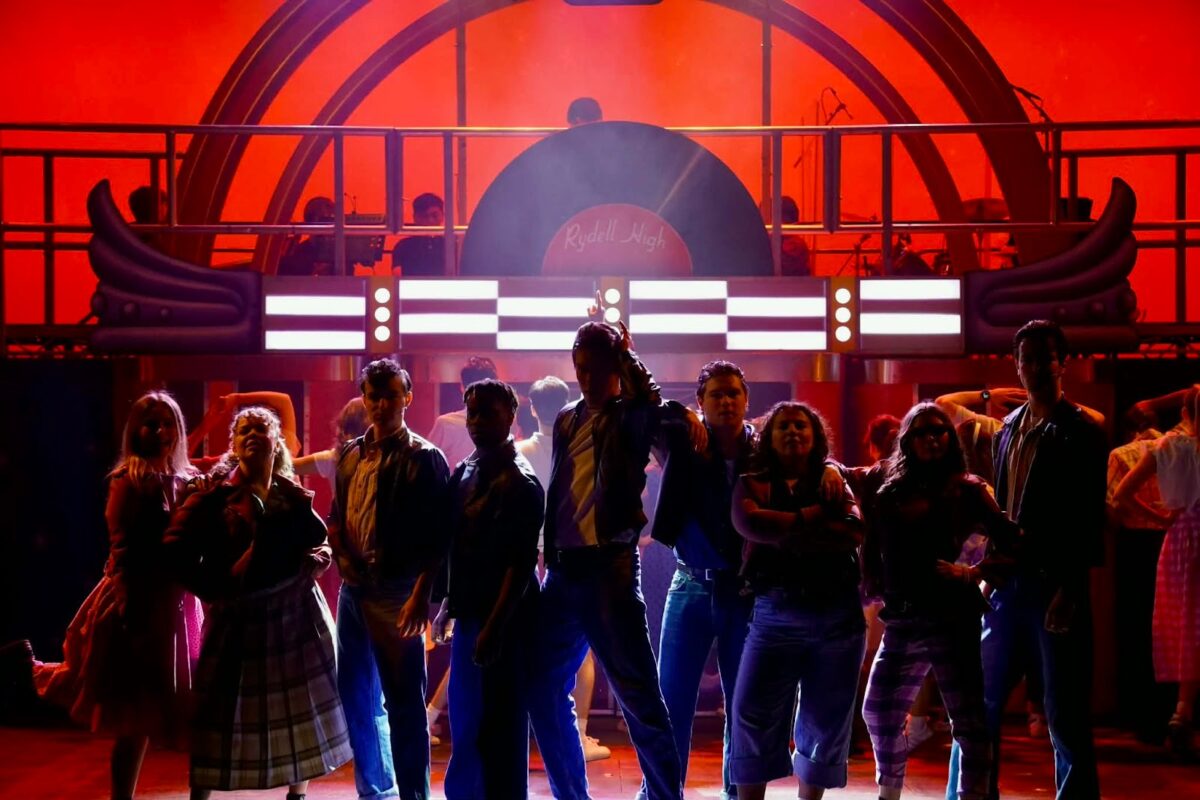
The milestone musical Grease is a tough one to take on, but this raucous classic seemed light work in the hands of DULOG, Durham’s renowned student musical theatre company. With Michael Nevin and Sarah Johnston in the directors’ chairs, this highly anticipated production lived up to expectations, paying homage to the original film in all its riotous and camp glory. Some very minor hiccups did not detract from this rip-roaring testimony to both the talent of Durham’s student population and the exceptionally high standard of DULOG’s productions.
Kitted out in leather jackets and slicked-back hairdos, the directors’ vision for this play was clear from the get-go: to present 1980s adolescence in all its absurdity and glamour, both mocking and paying tribute to the iconic hierarchy of popularity that governed high-school life. Jocks, nerds and belles-of-the-ball leant into their stereotypes with a campness that was hysterical and almost never overdone.
Nowhere was this more the case than in Max Hildred’s portrayal of Danny, who was suave to the point of hilarity. Hildred’s character glided across the stage with that Travolta-esque fluency, as if every movement were a step in some ongoing dance. His knowing winks to the crowd and obsessive hair grooming perfectly captured the ridiculousness of the musical’s protagonist without compromising his undeniable sense of charm.
All of Grease’s lead roles were brilliant, and backed by an equally impressive ensemble, whose mastery of complex choreography and harmonies left little to be desired. Every chorus member merged seamlessly into the ensemble yet maintained enough individuality to be memorable in their own right. In general, it must be said that the musical side of this production was immensely impressive – there were no points at which the cast lost control of the harmony, and the orchestra was synced with the action on stage to a professional level. From the opening number, the ensemble had the audience sat bolt-upright in their seats with their high-energy, high-calibre choreography. It was abundantly clear that every member of the cast was loving their time on stage.
In the words of the directors, the goal of DULOG’s Grease was also to capture the intensity of teenage life – both ‘the highs and the heartbreaks’. The latter was certainly achieved through some heart-wrenching solo numbers. Mathilda Ketterer as Sandy gave a powerful rendition of ‘Hopelessly Devoted To You’ (a notoriously tricky number), and Talia Tobias’ ‘There Are Worst Things I Could Do’ was nothing short of knock-out.
Indeed, there are many contenders for the star of this show. Despite playing a relatively minor character, Celine Delahaye brought abundant life, hilarity and colour to the stage in every one of Miss Lynch’s scenes. Equally, a word must be said for Lucy Rogers, who played the ever loveable and brilliantly dorky Jan. Whilst some cast members risked over-acting at points, Rogers hit the nail on the head, gathering the most audience laughs by a mile but never over-egging the pudding. Rogers was a delight to watch on stage from start to finish.
However, the real star of DULOG’s Grease would have to be Jobe Hart, who played Danny’s sidekick Kenickie. His solo number ‘Greased Lightning’ was the highlight of the production, perfecting the raucous and infectious energy that makes the track one of the musical’s most iconic numbers. It is not easy to make the overly macho, hip-thrusting choreography of Grease look natural or convincing, yet Hart pulled it off with fluency and ease. When he wasn’t showing off some brilliant dance moves, he was commanding the stage with a confidence and zeal that brought Kenickie to life. Hart’s character was at once intimidating and loveable – a nuanced portrayal that shows a young actor truly in his element. It is only fair to note that there were a few persistent issues with sound in the play. Misadjusted microphone volumes meant that certain characters were more audible than others, which led to some dialogue being obscured or lost. The highly anticipated kiss between Sandy and Danny was also slightly undermined by their mics making contact and picking up each other’s breathing. Nevertheless, none of this detracted significantly from the production. From start to finish Grease was an absolute riot; a testimony to the hard-work and talent of the whole team that put together such a challenging production. Wonderfully camp, entirely absurd and often rather touching, DULOG’s Grease had groove and it certainly had meaning.
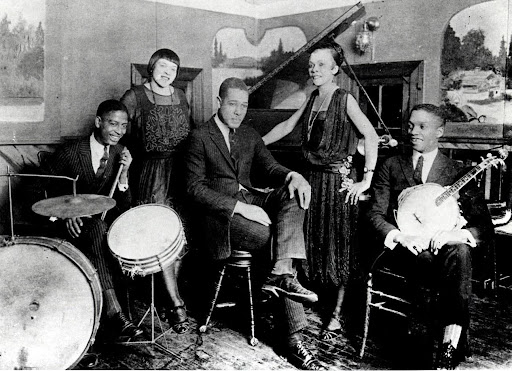
The ‘Ellington Band’, early 1920s, at Louis Thomas’ cabaret speakeasy in Washington DC
By Edward Clark
“You can say anything want on the trombone, but you gotta be careful with words” – Duke Ellington to the New Yorker, 1944
In January 1920, the United States government passed a total prohibition on the sale of alcohol. Owners of bars either repurposed them into restaurants or shops or were forced to shut them down. In response, speakeasies began to quietly open their doors all over the country. Named for the patrons’ need to ‘speak easy’ when telling doormen the pass-word, speakeasies offered an illicit environment for drinking, socialising, and enjoying performances of the vogue music genre: jazz.
Although the genre originated in New Orleans during the 19th century, racial animosity led to many jazz musicians moving elsewhere. As newspapers like The New Orleans Times-Picayune called the movement an ‘atrocity in polite society’, groundbreaking artists like Louis Armstrong, Sidney Bechet and Jelly Roll Morton moved from The Big Easy to Chicago. There, within dimly lit illicit bars serving homebrewed whiskey and gin, audiences were receptive to New Orleans style ‘ragtime’ – or what audiences were beginning to call ‘jass’.
Speakeasies were the prominent feature of American urban ‘20s social life. In Carl Van Vechten’s 1930s novel Parties: Scenes from Contemporary New York Life, the protagonist Hamish frequents the illicit bars. Van Vechten describes: ‘It was nearly time for luncheon and he had yet to enjoy his first drink. He might, in search of this, visit his club, or any one of the fifty thousand speakeasies with which central New York was honeycombed’. 50,000 may be a small exaggeration – the Mob Museum estimates that at the peak of prohibition there were 32,000 speakeasies in New York. Nevertheless, the large number of illicit bars in one city alone gave way to extreme competition. In order to set themselves apart from competing establishments, owners looked to musicians to draw customers.
Stimulated by a period of extreme social development, urban audiences had the disposable income to support the new genre; speakeasies functioned as vessels to allow jazz acts to experiment and solidify their sound. The best example was at New York’s Hollywood Club at Forty-ninth Street and Broadway. Patronage from the speakeasy’s owner provided the financial support for Duke Ellington’s legendary ‘Ellington Orchestra’ to form, as the band took on a permanent roster in 1923 and regularly played an evening for four years. These gigs were hard work. As guitarist Freddie Guy commented in a New Yorker interview: “Once you put your horn in your mouth you didn’t take it out until you quit. Until period. You started at nine and played until’.
Prohibition-era performance like this allowed some of the age’s most notable musicians to cement themselves as the genre’s staples. In Ellington’s case, he wrote some of his most popular songs: ‘Black and Tan Fantasy’, ‘Creole Love Call’, and ‘Birmingham Breakdown’, for example, were all written during his stint at the Hollywood Club. Performances in speakeasies also coincided with the inception of commercial radio, with 600 stations broadcasting by the end of the decade; jazz performances recorded within speakeasies were broadcast to audiences beyond the cityscape.
Often, speakeasies resulted in African-American musicians performing for wealthy white audiences. For example, the Cotton Club, a popular New York club in Harlem, was positioned by its owner Owney Madden as offering ‘an authentic black entertainment to a wealthy, whites-only audience’. As the aforementioned quote from Ellington displays, whilst segregated speakeasies spread jazz to a new, powerful community, popular musicians renowned for their talent were forced to perform without expressing their opinions or politics. By the latter half of the 1920s, however, the illicit nature of speakeasies promoted integration, creating multiracial – or ‘black and tan’ – clubs. Opposing government policy, speakeasies broke down cultural barriers and created an environment where Americans from all backgrounds stood side by side, watching a new jazz age flourish.