
By Alicia Mora de Rueda
War exposes the foundations of any society, both in its manifestation of power and its propensity for cruelty. Perhaps the most striking sign of this is the historical pattern of women in conflict: they are consistently the first to be attacked in specific, targeted ways and the last to be included in peace calculations.
This observation is not an attempt to diminish the experience of men, who bear the primary weight of frontline combat. Any conflict driven by the realities of the trenches, be this conscription, physical harm, or the general sacrifice of the male body when serving, is an absolute and central tragedy of the state. But recognising this does not mean the specific nature of violence aimed elsewhere should be overlooked. While male casualties are largely the result of kinetic engagements between armed forces, violence against women (particularly that of sexual and psychological nature) often functions as a purposeful, non-kinetic weapon. It is a tool used to accomplish a very specific military goal: the destruction of the internal cohesion and functionality of a community.
Rather than being a byproduct of chaos, it is a calculated instrument of force. We see this in the systematic recruitment of “comfort women” during the 1940s, or the use of mass rape as a tool of ethnic cleansing in the Balkans and Rwanda, these being just a few examples. They are a part of the long lineage of conflicts where the harm visited upon women was not a side effect of combat; it was the combat. By turning the body into a battleground, an aggressor effectively shifts the frontline from the geographical boundary to the domestic centre. It targets the primary caregivers and the links of social life, ensuring that the war’s devastation is generational rather than just infrastructure-deep, and effectively poisons the social foundation upon which any future stability must be built. The efficiency of this strategy lies in its long-term impact; even if the governmental occupation ends, the society faces a fundamental challenge in reorganising itself at its most basic level, because the “victory” was achieved by breaking the social unit from the inside out.
But this tactical utility is followed by a predictable political pivot once the kinetic phase of conflict concludes. Diplomacy, by its very nature, requires a narrowing of focus and a prioritisation of the immediate cessation of hostilities over the resolution of deeper social trauma to function.
Thus, in this context, being “the last to be considered” is typically a result of the technical limitations of the peace process, where the urgency of reaching a consensus forces negotiators to discard any variables that cannot be easily measured or traded. For those tasked with designing a new order, the specific abuses that are inflicted upon women represent “messy” data, or in other words realities that complicate the straightforward math of territory and disarmament because they cannot be settled with a signature. In this calculus, peace is treated as a technical binary (the absence of gunfire) while the restoration of the community is categorised differently. This move recontextualises the focus from the political agenda to a charitable one and allows the formal peace process to remain streamlined, even if it remains incomplete. By shifting these issues into the realm of “humanitarian” concerns, the state effectively removes them from the political table, treating them as secondary casualties of war instead of primary peace objectives. Admittedly, there have been genuine advancements in how these issues are recognised. The inclusion of gendered crimes in international legal structures and the presence of women in peace delegations represent a significant shift toward a more comprehensive record and a growing admission that a stable state cannot be constructed on top of unaddressed atrocities.
These developments are often able to provide a legal and ethical vocabulary for violations that were once entirely ignored, and are coming to signal a slow but real evolution in global standards, as well as a transition from total impunity to at least a baseline of accountability. Yet, even with these tools, the transition to stability remains a multidimensional issue. It is often simpler for an administration to focus on the visible markers of statehood (borders, banks, and the formal structures of a regime) under the assumption that once the formal structures are in place, the rest of society will naturally be able to follow suit. The official conclusion of a war is rarely a full resolution. More often, it is just a bureaucratic milestone. By treating the specific targeting of women as a secondary issue, diplomacy settles for only a very narrow and fragile definition of stability. It treats peace as a political deadline that can be met by drawing a line under the measurable aspects of war, and leaves the unmeasurable human consequences to fade into the background of both the private home and the female body. The result is a landscape that is technically at rest, where the maps are once again redrawn and records are closed, yet the fundamental work of social reconstruction continues, largely unacknowledged, in the margins.
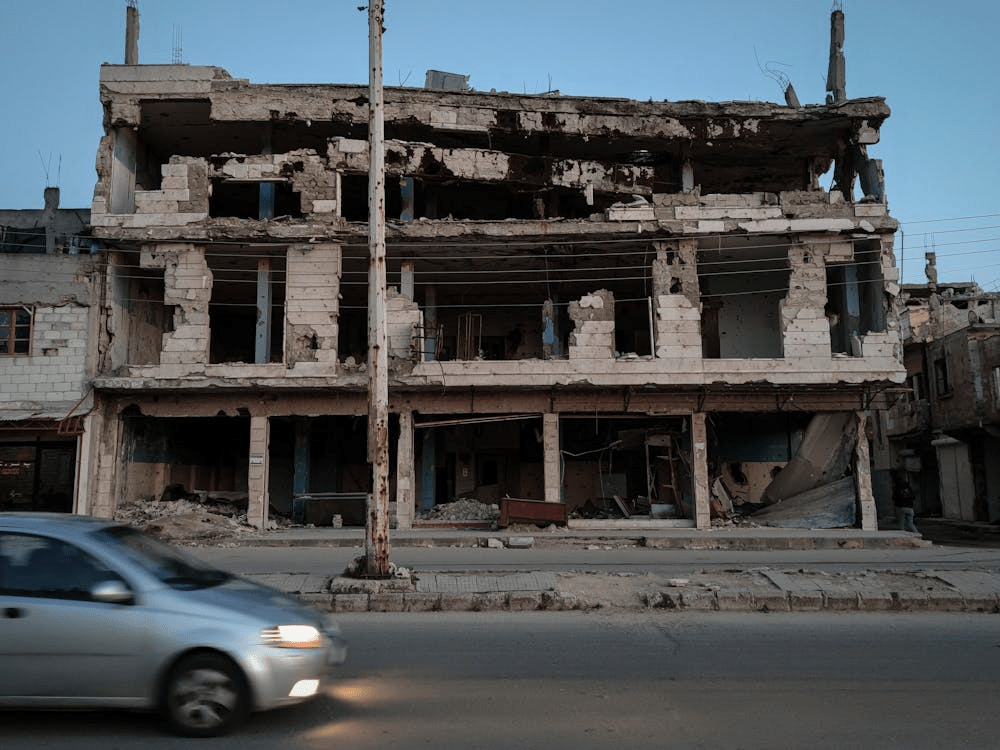
Featured Image: Ibrahim Al-Aorfali