
By Lily Whewell
“He had known that she would pass from his hands and eyes, but had thought she could live in his mind, not realising that the very fact we have loved the dead increases their unreality, and that the more passionately we invoked them the further they recede”
E.M. Forster, A Passage to India, p. 47
The first time I read this quote in A Passage to India, it shocked me profoundly. It uprooted all my beliefs and assumptions about death and memory by challenging sayings such as ‘they will be with you in your heart’, or ‘they may physically be lost, but your memories of them are not’. The thought that the more I tried to remember deceased loved ones the more they would slip away, terrified me. No one wants death to be absolute.
It is safe to say that reading this quote flung me into an existential crisis. Here, it is as if Forster is trying to suggest that being loved in life does not ensure that you – the real you – is remembered in death, but can taint the memories of you in the minds of those who knew and valued you. The greater the love, the greater the loss is a well is a commonly cited phrase. However, I always wanted to believe that this loss is only in a physical sense and not in a spiritual way.
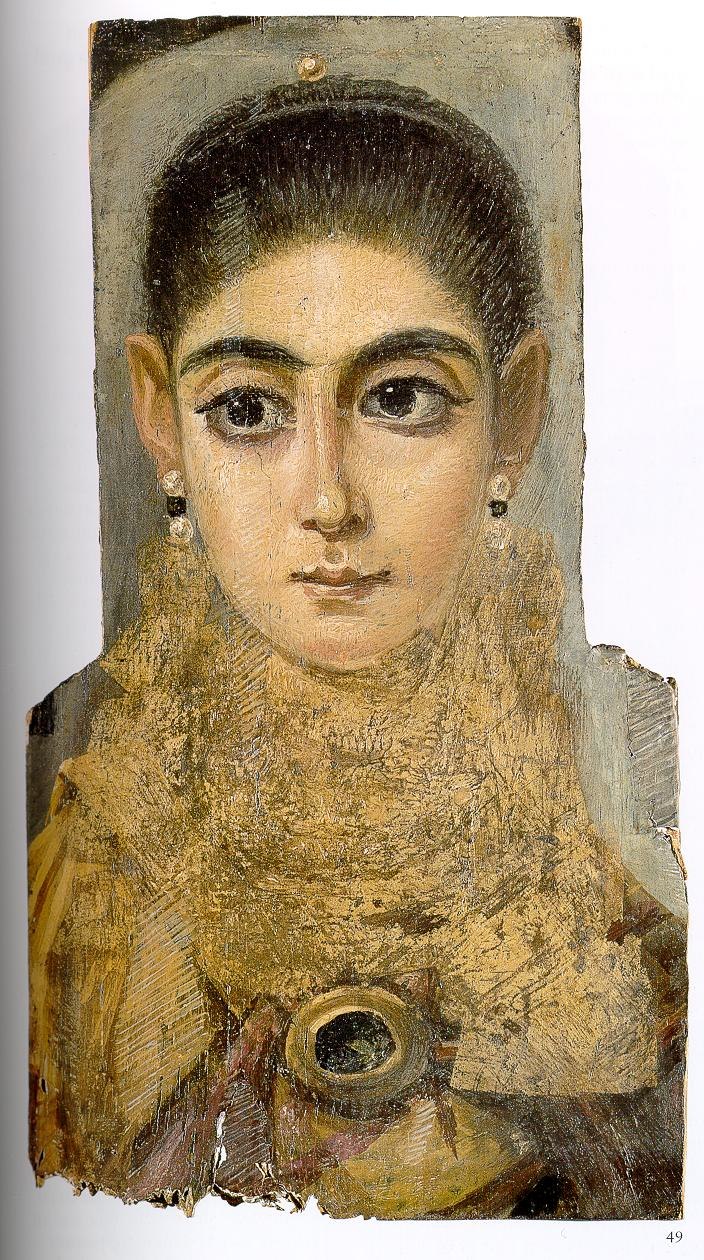
So, as Forster suggests, if being loved cannot save us from being forgotten, then what can? The Fayum Portraits offer us an interesting perspective. Painted between the 1st and 3rd centuries and mostly found in the Fayum region in Egypt, these portraits capture people with an uncanny sense of reality and vitality ‘as if they have just tentatively stepped towards us’ (John Berger, Portraits, p. 9). They were placed on top of the coffins of the dead to act as a marker of identity for their journey to the kingdom of Osiris, and to serve as a remembrance tool for the family and friends they left behind. Although it is difficult to discern how far the artists of these portraits captured the likeness or ‘mimesis’ of their subjects in the absence of photographs to compare them to, their two-pronged function as an early ‘passport photo’ (Berger, p. 8) and an aid to memorialisation suggests that an accurate representation of reality was imperative. The Fayum portraits were produced centuries before the Renaissance, when the function of portraits underwent a major evolution to no longer simply depict an individual’s physical appearance but also their ‘charisma’ and inner virtues.
In the twenty-first century, we now have the ability to take photos which can capture the likeness of an individual to an accuracy arguably unachievable by painted or drawn portraiture. However, what is remarkable about the Fayum portraits in contrast to their digital descendants is their survival. This was a point highlighted by art historian Simon Schama in discussion of the question “Why portraits still matter?”, discussed during a Sotheby’s Talk in 2023. Schama suggested that in an age where images simply disappear after twenty-four hours on Snapchat and we are reliant on ‘the cloud’ for the storage of our photos, the worry is that the images we create and collate digitally will someday be lost. It is indeed common practice to put a photograph of the deceased on the front page of printed orders of service for funerals and memorials – maybe our modern-day equivalent to the Fayum portraits? Nonetheless, surely the innate value of works of art means that we are more inclined to ensure the survival of a painted or drawn portrait over a digital one?
Unfortunately, for everyone to have a portrait painted or drawn is an unattainable reality. However, a consideration of the Fayum portraits, at least to me, acts as a prompt to move away from a reliance on the digital to capture yourself and your loved ones in an analogue form. Portraiture is one way of eternalising your physical self whereas writing, specifically private, personal writing, offers a more accessible way of ensuring that your essence does not ‘recede’. Anything from poetry to quotidian prose can become a vehicle through which the recollections of the deceased can avoid slipping into ‘unreality’.
However, the effectiveness of using personal writing as a way of eternalising the reality of a person is contingent on two factors: the writing has to be contained in a physical body to increase its chances of survival, i.e. in a notebook or in a paper folder rather than stored digitally, and the writing has to be guided by ‘how it felt to me’ or the ‘implacable “I”’, as articulated by Joan Didion in her essay On Keeping a Notebook.
‘We are not talking here about the kind of notebook that is patently for public consumption, a structural conceit for binding together a series of pensees; we are talking about something private, about bits of the mind’s string too short to use, an indiscriminate and erratic assemblage with meaning only for its maker’,
Joan Didion, On Keeping a Notebook (1968)
Just as when portraits began to be co-opted by Renaissance rulers as a visual language through which they could articulate political messages and dynastic ties when put on public display, the “I” of a notebook is lost when it is written for others. Maybe, if we all engaged in more personal, analogue modes of reflection – whether a work of art or a piece of prose – we would be more likely to win the fight against being forgotten, the essence of our person is less likely to be blurred and retold in the minds of those who outlive us.
Featured Image: Louvre Museum