
By Caroline Miholich
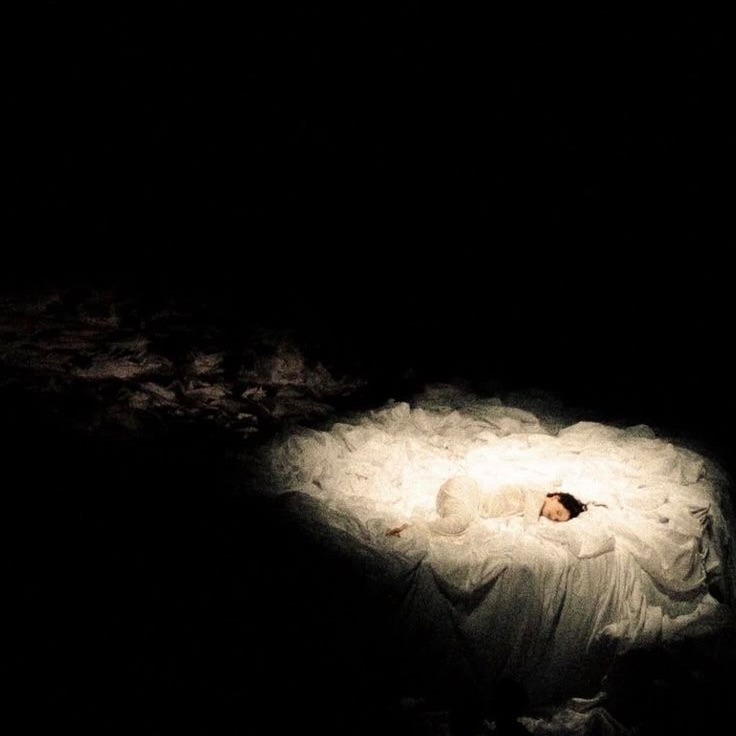
On the night of the 20th of October, thousands of Madrileños gathered in the Plaza de Callao, milling beneath the overhead screens. They were followers of an artist whose career has moved unpredictably between flamenco, reggaetón, and experimental pop, anticipating the release of her new album’s title and cover. The moment was oddly subdued; there would be no spectacle, just the pause of a crowd prepared to read meaning into an image. Rosalía, having taken a three-year hiatus since MOTOMAMI, reclaims the spotlight with her monumental fourth album, LUX. This time, she collaborates with the London Symphony Orchestra for a record meshing pop, classical, and operatic influences, while nodding to her flamenco roots. She sings in thirteen languages (Spanish, Catalan, Italian, English, Sicilian, Hebrew, Mandarin, German, Arabic, Ukrainian, Portuguese, Latin, and Japanese), and blends almost as many genres.

CatalanNews, Rosalía’s Lux: A search for meaning in the doomscrolling era / Madrid’s Callao Square with thousands of Rosalia fans during the presentation of her latest album, Lux, on October 20, 2025 / Rafa Ortiz – Sony
LUX stands out as Rosalía’s most poetically and sonically ambitious work to date, but its stylistic multiplicity is far from self-indulgent; instead, it serves a singular theme: the collective longing for the divine. Critics’ year-end lists have placed LUX at the top of 2025’s defining albums, not for its ambition so much as for its rare candour in approaching faith and interior life without irony. Even the Vatican’s Culture Minister gave his blessing – “When a creator like Rosalía speaks of spirituality, it means that she captures a profound need in contemporary culture to approach spirituality, to cultivate an inner life.”
The album arrives amid a wider cultural moment in which the music industry routinely borrows religious symbolism for popular reproduction, while neglecting its theological meaning (Terry Eagleton, Culture and the Death of God). It is a trend nowhere more visible than in pop music and its surrounding visual imagery, where narratives of the divine are handled with a flippancy rarely extended to other traditions (rock music tends at least to engage its source material with a degree of fidelity).
In practice, this produces a familiar cycle of provocation, most recognisably with Christian symbols: Madonna’s burning crosses and stigmata in the music video for Like a Prayer, Lady Gaga’s Judas released a week before Easter, or artists such as Lil Nas X masquerading as Christ on the cross, a figure whose appropriation now seems uniquely consequence-free. Most recently, Sabrina Carpenter’s Feather got a priest demoted. These popstars arrive primed for the inevitable, perhaps staged controversy, armed with a sassy clapback (“Jesus was a Carpenter”), but always sorry-not-sorry. Irony functions here as a safety net, allowing artists to touch the sacred without risking the accountability of belief or the vulnerability of transformation.
All hope is, as ever, not lost. It is into this landscape, saturated with religious imagery yet starved of its respective meaning, that Rosalía releases LUX. The album offers one of the most sustained engagements with faith in global pop since Kanye West’s Jesus Is King, a parallel underscored by common collaborator, Yeezus producer Noah Goldstein. Throughout LUX, Rosalía reclaims religious symbolism by striking visual and lyrical means.
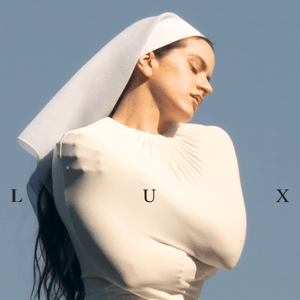
CatalanNews, Rosalía’s Lux: A search for meaning in the doomscrolling era / Album artwork for ‘Lux’, the fourth album by Rosalía / Noah Dillon – Sony
On the album cover, she dons a white nun’s veil and hugs herself in a top resembling a straitjacket. But her expression reads more as ecstasy than pain. The image holds the kind of ambivalence Rosalía, like a good theologian, seems to have mastered. Perhaps she’s communicating the idea of self-love through spiritual discipline and self-restraint. Like many of the record’s songs, it echoes an all-embracing motif: the intimacy of being seen by God.
The title, meaning “light” in Latin, is echoed in the album’s fourth song Porcelana, “ego sum lux mundi” (“I am the light of the world”), quoting Jesus’ speech to his followers at the temple in the Gospel of John (8:16). Perhaps the title is also inspired by Simone Weil, whose quote from Gravity and Grace, “Love is not consolation, it is light”, features as an epigraph on the vinyl and CD editions. This book is one of many mystical works that influenced Rosalía’s lyrics, nestled amongst biblical passages and the hagiographies of female saints and mystics, including St. Joan of Arc and St. Teresa of Ávila.
Mystics, or those who have experienced mysticism, are classified by the rare, sometimes ecstatic and always transcendent experiences of the “immediate or direct presence of God” (Bernard McGinn, The Presence of God…The Foundations of Mysticism, Vol. 1). Rosalía cites the work of Clarice Lispector as a literary touchstone, less a mystic than a modern articulator of mystical intimacy, whose prose reflects the inwardness her lyrics seek to embody. She tells The Guardian, “I’m tiring of seeing people referencing celebrities, and celebrities referencing other celebrities. I’m really much more excited about saints.”
The songs themselves draw faithful inspiration from age-old Christian theology. Relíquia (Relic) references the tradition of relics and their veneration, and Berghain’s lyrics touch on the Eucharist and the Communion of Saints. She was challenged in an interview with the New York Times, “Are you asking a lot of your audience to absorb a work like this?” Her response: “Absolutely, I am. The more we are in the era of dopamine, the more I want the opposite. That’s what I’m craving.”
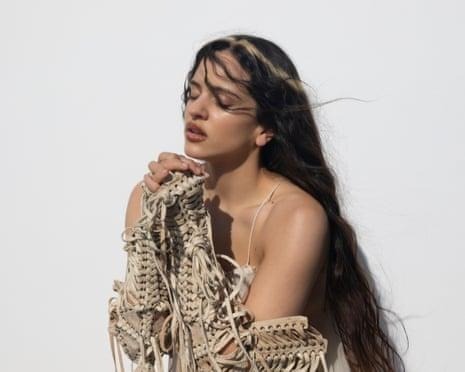
The Guardian, Rosalía: Lux review – a demanding, distinctive clash of classical and chaos that couldn’t be by anyone else / Abandon preconceptions … Rosalía

Cortona Polyptych by the Italian early Renaissance painter Fra Angelico / Diocesan Museum of the Cortona Chapter, Cortona, Italy
Rosalía’s visual language refuses to ironize religious symbols by placing discipline above indulgence. In the album’s visual rollout, she appears with a bleached ring dyed onto the crown of her head, visible in each song’s Spotify canvas and in recent interviews. It’s a mark that reads as more than a contemporary halo, and instead evokes the tonsure historically worn by Catholic monks as a sign of submission and withdrawal from self-fashioning. Here, Rosalía’s specific style recalls the Roman corona, formerly worn by St. Cuthbert and St. Bede. These shorn crowns rendered interior discipline visibly legible on the body. Paired with gloves that evoke penitential or flagellatory vestments, Rosalía’s styling resists the theatrics of costume, gesturing towards the ascetic formation of the body rather than the body as styled for consumption.
In the mystical tradition Rosalía draws from, the body is disciplined to become capable of exposure to the divine, of being seen without disguise. That logic comes into full view in Dios es un Stalker (“God is a Stalker”). The song draws on a tradition of writing that confronts the intolerable intimacy of an all-seeing God, from the theological insistence on divine proximity found in Simone Weil, to a stylistic affinity with Clarice Lispector’s prose, which exposes consciousness at its most unguarded. Rosalía boldly sings from a God’s eye view, something she admits to France Inter is “absurd – [the song] contains a sense of humour.” Through this lens, she adopts the metaphor of a stalker who follows her and knows her every move, but… in a loving way.
That divine knowledge extends even to what we would rather conceal. When Rosalía sings “Lo sé tus deseos indeseables” (“I know your undesirable desires”), she confronts the listener with a God who sees beneath the layers of moral self-presentation. She continues, “Mi aliento es el viento que te roza el pelo” (“My breath is the wind grazing your hair”), indicative of a distinctly biblical intimacy. Psalm 139 gives this knowledge its theological weight – “O Lord, you have searched me and known me… Where can I go from your Spirit?” Rosalía allows the discomfort of being fully seen to remain unresolved, placing the listener inside that exposure. The effect recalls the interior pressure found in Clarice Lispector’s The Passion According to G.H., which dismantles irony entirely and forces her narrator into a consciousness so exposed it borders on annihilation.
Rosalía modernises the concept of omniscience through technological language. The image of God with an “exploding inbox” (“Tengo un buzón explotado”) reminds me of the scene in the 2003 film Bruce Almighty, where Bruce (Jim Carrey) gains powers from God (Morgan Freeman), and has to manage just that.

YARN, What a bunch of whiners. This is gonna suck up my whole life. / https://getyarn.io/yarn-clip/b5ff545e-e029-49f7-bf10-267aea0e01ca
Rosalía attempts to communicate the impossibility of relating to divine characteristics, a notion underscored by the song’s most self-aware line, “Mi omnipresencia me tiene agotada” (“My omnipresence has me exhausted”). The exhaustion, of course, belongs to the metaphor, not to God. Yet Rosalía’s phrasing recalls the human struggle to imagine infinitude; we project our limits onto God because no other language is available. This echoes the concept of the analogia entis, in which every analogy for God’s identity both reveals and fails. Rosalía knowingly writes within this failure and continues to meditate on such contradictions throughout LUX. In fact, it forms the central motif of La Yugular: “you who are far and at the same time closer than my own jugular vein.”
The stalking metaphor’s greatest weakness lies in Rosalía’s simultaneous portrayal of divine pursuit as non-coercive. “Detrás de ti, voy” (“Behind you, I go”) is immediately tempered by “yo que siempre espero que vengan a mí” (“I who always waits for them to come to me”). This is the song’s central tenet – the paradox of God as omnipresent yet partially hidden. Were God’s presence unavoidable, human freedom would collapse into inevitability. In the Gospel of John, Jesus refuses to jump off the Temple roof and save himself miraculously to prove his divinity to surrounding crowds. Rosalía acknowledges this: “No me gusta hacer intervencion divina” (“I don’t like doing divine intervention”), conveying that love cannot force itself. Also explored in the film Bruce Almighty, Bruce can do almost everything with his divine powers except convince his girlfriend (Jennifer Aniston) to stay with him, because it’s against her free will.
Simone Weil speaks on the hiddenness of God in Gravity and Grace, insisting that He withdraws precisely to make room for human love. For Love to be real it presents a choice to accept it or to flee from it, a condition essential also to human existence: “There exists a ‘deifugal’ force. Otherwise all would be God” (Simone Weil, Gravity and Grace). In Dios es un Stalker, Rosalía does not resolve the tension of divine withdrawal but renders it as waiting, marked by a presence that watches and loves without interference.
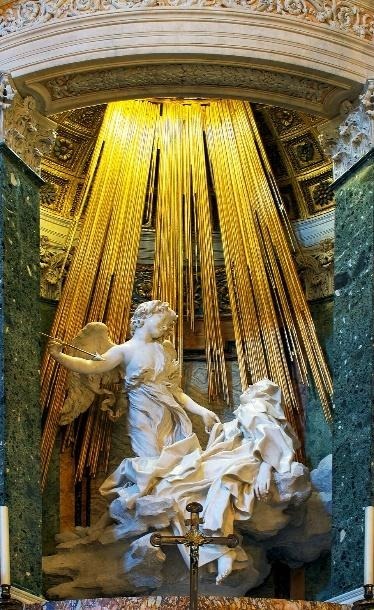
Ecstasy of Saint Teresa, by Gian Lorenzo Bernini / Santa Maria della Vittoria, Rome
Once such a divine gaze is acknowledged, Rosalía asks herself what must be relinquished. This forms the basis of Sauvignon Blanc. The song conveys how once irony is refused and intimacy faced, familiar understandings of pleasure and consumption are transformed. The song draws on the writings of St. Teresa of Ávila (1515-1582), Spanish mystic, Patron saint of Spain and chess, and first female Doctor of the Church for her advanced spiritual writings. As a Carmelite nun she renounced her wealth for the convent. She is often recognised today from Bernini’s sculpture The Ecstasy of Saint Teresa (1647-1652) in Rome, depicting a vision famously detailed in her autobiography as her Transverberation. During the vision, she experiences her heart being pierced by an angel’s spear, a moment she describes as “a sweetness so extreme that one could not possibly wish it to end.”
In Sauvignon Blanc, Rosalía rejects the idolisation of material things, perhaps, like St. Teresa and other ascetics, denying material pleasures entirely. She even sings that she’ll burn her Rolls-Royce and that she doesn’t want pearls or caviar anymore: “To my God, I’ll listen / My Jimmy Choo’s, I’ll throw them away”. As Spencer Kornhaber says in The Atlantic, “Rosalía, like many of us, is asking herself what she’d be willing to give up to save her soul… Her autonomy? Her convenience? Her Jimmy Choos?”
Rosalía’s Savvy B isn’t about “making wine cool and fun again” for Gen Z like I’ve seen suggested recently. It’s worlds apart from Drake namechecking Moscato, Jay-Z on Cristal, or Taylor Swift’s many lyrical wine references. In an interview with Apple Music, Rosalía affirms she cited inspiration for the song from St. Teresa’s work, likely The Interior Castle, in which the saint describes her experience of “divine intoxication,” or spiritual ecstasy. Teresa used the metaphor of a “wine cellar,” where God invites the soul to drink “divine love” – a Love that Rosalía sings she would leave all worldly pleasures for. Teresa herself derives the image of the wine cellar from Song of Songs 2:4, which reads“He brought me into the cellar of wine; he set in order Love in me.” Wine is also evoked as a symbol for spiritual fulfilment in Psalm 23: “my cup runneth over”, meaning “I have more than enough for my needs”.

Diana Fountain in Lerwick, Shetland, by James Hunter
Sauvignon Blanc isn’t a wine of status, but poured abundantly for the soul. One of St. Teresa’s greatest quotes, “Let nothing disturb you, let nothing frighten you, all things are passing away… Whoever has God lacks nothing; God alone suffices”, has sure influence on Rosalía’s lyrics: “Ya no tengo miedo del pasado, esta en el fondo, de mi copa de Sauvignon Blanc” (I no longer have fear / of the past / it is at the back / of my glass of Sauvignon Blanc). In a cultural economy fluent in irony, religious symbols are safe because they can often be inverted and discarded without consequence for the artist. Rosalía’s LUX reveals that mysticism offers pop culture what irony cannot… a commitment to truth, whether understood ontologically, as fidelity to the moral and metaphysical claims carried by religious source material, or artistically, as the discipline of approaching that material in a way that maintains harmony with its origins rather than merely borrowing its surface. In doing so she opens onto a reordering of desire largely absent from contemporary pop music, exploring intimacy without irony, pleasure without detachment, and faith without spectacle. Amid a popular culture saturated with symbols starved of meaning, that assertion may be the album’s most radical gesture.
Featured Image: Desirée Sara Pais