Robertha Green Gonzalez
The Original Hans Christian Andersen tales could be frightening, cruel and surprisingly uncompromising. They introduced children to punishment, loss and death without necessarily explaining them, and rather than protecting children from difficult emotions, they trusted them to encounter them. It reminded me of A Monster Calls, one of the first books I read that made me cry. What stayed with me was not simply its treatment of grief, but its refusal to suggest that emotions need to be understood before they can be expressed. Conor, the central protagonist in Patrick Ness’s A Monster Calls, does not understand what he feels, but that confusion does not lessen their reality. Instead, Ness positions this uncertainty at the heart of his portrayal of childhood: children can be unreliable narrators not only in what they say, but in what they understand about themselves. A Monster Calls turns that gap between feeling and understanding into a feature of its narrative.
Whilst A Monster Calls is a young adult novel geared towards 11–14-year-olds, its treatment of grief deliberately extends beyond a child’s understanding. Giskin Day writes that ‘The book draws on conventions of children’s literature to create a sense of familiarity that helps to balance the emotional stress of the story.’ Day’s emphasis on “familiarity” is important because Ness places Conor’s grief within a world that is immediately recognisable to a young reader: school, bullying, family conflict and the helplessness of having little control over what happens to him. The monster, its three stories and the fairy-tale structure then give these experiences a familiar fantasy framework through which difficult emotions can be explored. But familiarity does not mean simplification. Ness deals openly with anger, guilt and the frightening wish for suffering to end, trusting his younger readers to encounter emotions they may not yet have the language or experience to understand. Conor wants his mother to survive, but he also wants the uncertainty and suffering to end. The monster gives this contradiction a physical form before Conor can articulate it himself. A younger reader can accept the monster as part of Conor’s reality, whilst an older reader may interpret it as grief and emotional repression given a body. Ness therefore leaves room for both readings, and it is precisely this uncertainty that shapes the novel’s narrative perspective: just as Conor cannot fully understand what he feels, the reader is never given a completely authoritative explanation of what the monster is.
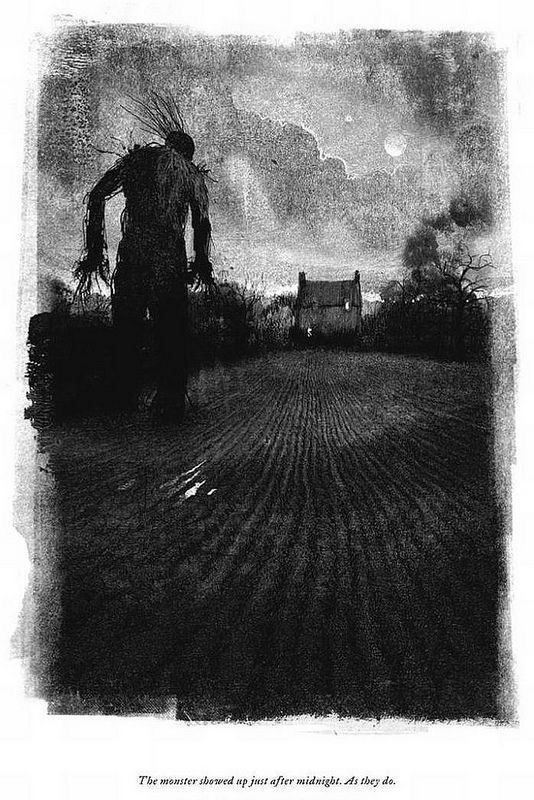
Conor O’Malley is therefore an unreliable narrator in every sense but the technical one. Although the novel is written in the third person, everything is filtered through what Conor perceives, fears and cannot say, so his limited understanding governs what the reader is allowed to know. His unreliability has nothing to do with lying. He simply does not yet have the vocabulary to name what is happening inside him, or the self-control to contain it once those feelings surface. The ancient yew tree that stands in the churchyard behind his house gives this inability a physical form: at seven minutes past midnight it transforms, walks to his window and refuses to leave until Conor tells it the truth. Later, Conor destroys his grandmother’s sitting
room, smashing the couch, bookcase and treasured clock until only the display cabinet remains. Afterwards, he stares at his own bloodied hands, unable to understand how he could have done it. Ness refuses to provide the explanation that Conor himself cannot give. When his grandmother returns to the wreckage, she does not demand an explanation or punish him; she walks straight past him and pulls down the final cabinet herself. The scene is left unresolved, just as Conor’s feelings are.
The same refusal to settle the truth surrounds the monster. Ness never definitively reduces it to a metaphor, keeping it in the same territory as a child’s imaginary friend: unprovable, but not therefore false. Its importance lies in what it allows Conor to express before he can express those feelings himself. This openness also allows an adult reader to take the more sceptical view that the monster is Conor’s grief given physical form, without forcing a younger reader towards that interpretation. Magritte makes a related point in his 1929 painting Ceci n’est pas une pipe: the painted pipe is not literally a pipe, but it still represents one. The monster may not be a monster, but it is the only visible form Conor’s feelings can take before he is able to recognise them. Even his moment of complete honesty arrives through representation. The monster tells three stories before demanding a fourth from Conor: his own. He can only tell the truth by turning it into a story. We are therefore never given Conor’s feelings directly; we encounter them through the monster, through his violence and finally through the story he struggles to tell. His unreliability comes from the gap between feeling something and understanding what that feeling means.
Day describes the novel as confronting “the psychic burden of the impending loss of a parent through cancer”, and Ness’s response is not to make that experience smaller for children, but to give it a form they can enter. The monster makes fear, anger and guilt visible without reducing them to a simple lesson, while the novel’s uncertainty allows both child and adult readers to make sense of what Conor cannot yet articulate. His unreliability is therefore not a failure of understanding, but part of what makes his grief believable. Ness trusts children to encounter difficult emotions before they have the words to explain them, leaving the reader with something more honest than a neatly resolved version of grief: sometimes a child can know what they feel long before they understand why.