Categories
Reviews

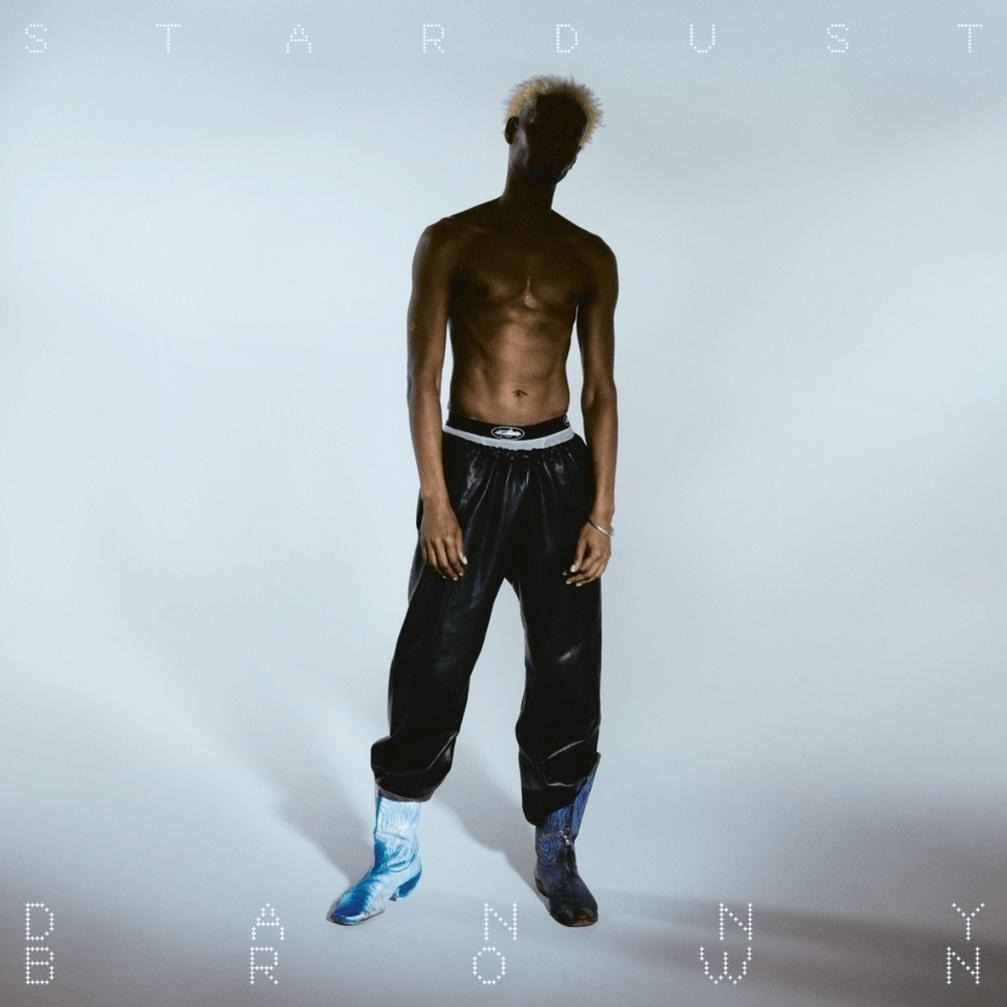
Review: Danny Brown’s Stardust Explodes with Creativity

By Edward Clark

Danny Brown is on an all-time run. For a veteran rapper with over twenty years of experience behind him, Brown shows no sign of stopping, and even less sign of becoming out of touch. Stardust is stuffed with head-turning features. Although he has worked with cult artists Jane Remover and Quadeca before, collaborations with underground artists like 8485, ta Ukrainka, and NNAMDÏ is something unparalleled by any of Brown’s hip-hop contemporaries. As his collaborators frequently express online and in interviews, ‘he’s so tapped into the scene’ (underscores to The Face magazine); Brown’s assimilation of so many up-and-coming artists makes Stardust shine.

This album is Brown’s first ever made completely sober. As he worried to the Guardian in 2023, “I’ve seen so many artists get sober and their music sucks”. His concerns were unfounded: from the album’s first single, Danny Brown showed that he was not letting sobriety hinder his out-of-the-box style. If anything, ‘Starburst’ is one of Brown’s most inventive songs to date. Over a hypnotic beat produced by Holly – a collaborator on Brown’s previous album Quaranta – Brown displays his everlasting ability to rap over seemingly anything. Still as genuinely funny as ever, Brown comes in swinging from the first, wielding ridiculously inventive and memorable one liners. “Better shape up and get them squares up out ya circle” he demands in his first moments, his delivery so potent that you’ll probably consider it. Fantastically confusing songs like ‘Starburst’ are plentiful here. ‘1999’ with JOHNNASCUS is an overstimulating cacophony of glitchy synths and punk-rap; ‘Whatever the Case’ sees Brown and ISSBROKIE take a braggadocious approach over a syncopated, bubbling beat.

However, these outlandish alt-rap bangers are accompanied in equal measure by songs that would not be out of place at a pop club night. ‘Copycats’ features a mesmerising hook by underscores, an artist leading the wave of forward-thinking pop. Her mantra of ‘Rap star, pop star, rock star / Gimme that, gimme that’ is both an earworm and a reflection of Danny Brown’s career trajectory at this point. Stardust is an absolute refusal to be bound by genre. ‘Flowers’ features 8485 singing the chorus with ease, making a welcome accompaniment to Brown’s flora-related punchlines – all over an EDM instrumental which seems to have been sent into your speakers first-class from 2009. This is not to say that Brown relies on features to achieve this new sound. ‘Lift You Up’, a solo cut which functions as the album’s centrepiece, is a head-bopping banger, Brown fitting seamlessly into a Y2K pop-rap hit. 

Whilst this blend of hyperpop and experimental rap may seem like a novelty, Stardust is far too refined to be a gimmick. Indeed, a recognition of the ‘terminally online’ nature of hyperpop is a running theme through the LP. Angel Prost, one half of pop duo Frost Children, provides narration throughout the album, which leans knowingly into online slang. “I essencemaxxed on half-severe vibe casts” she declares, merging the album’s message of self-betterment and optimism with an ironic recognition of the genre’s reputation. Building on Danny Brown’s reflections on his own career, she directly addresses him, and by proxy the listener: “To lighten the jealousy, you compare your star power to others / You jot down all the reasons you’re goated”. As the album develops, the use of internet slang blends with Brown’s actual self-doubt, suggesting that his being ‘terminally online’ is negatively affecting his sense of self. Prost’s narration functions as an embodiment of online criticism. In his sobriety, he’s forced to face his imposter syndrome head on.

Danny Brown ended his breakout album XXX on the line “Doin’ all these drugs, hope an OD ain’t next, triple X’. Thirteen years on, Stardust is an explosive meditation on his career; of all the colour on the album, his gratitude for his success and sobriety glows the brightest. ‘The End’, oddly the penultimate track, is a nearly-nine minute behemoth of a song, combining production from Rye Mann, Cynthoni (better known under her previous alias Sewerslvt), and Quadeca. Over Rye Mann’s mystical beat Brown reflects on his experience with alcohol and drug abuse: ‘Addiction had me by the throat, I couldn’t breathe, just choke’ he admits. The track is broken up by Polish indie-pop artist ta Ukrainka, who sings in Ukrainian and Polish, providing a satisfying balance to Brown’s frantic delivery; as Cynthoni’s overstimulating breakbeat production takes over, Brown is optimistic as ever. “It’s better days, my life got saved, I’m focused on the future”. Sobriety is where Brown is most stable, and as he brags on the album’s final moments, “I’ma keep goin’ ‘til my life is over’. If he keeps going at this standard, the future of experimental hip-hop is in good hands.

Featured Image: genius

Categories
Reviews

To Rest Our Minds and Bodies: My Thoughts and a Discussion With the Author

By Bel Radford

To Rest Our Minds and Bodies is an incredibly yielding book. Its contents are tender and vulnerable, falling clean off the bone and seeping hot into my palms — my fingerprints were stained for hours after, marking everything I touched. Yet there’s weight to it too, a pressure that finds old bruises I’d almost forgotten — ah yes, we’ve been here before.

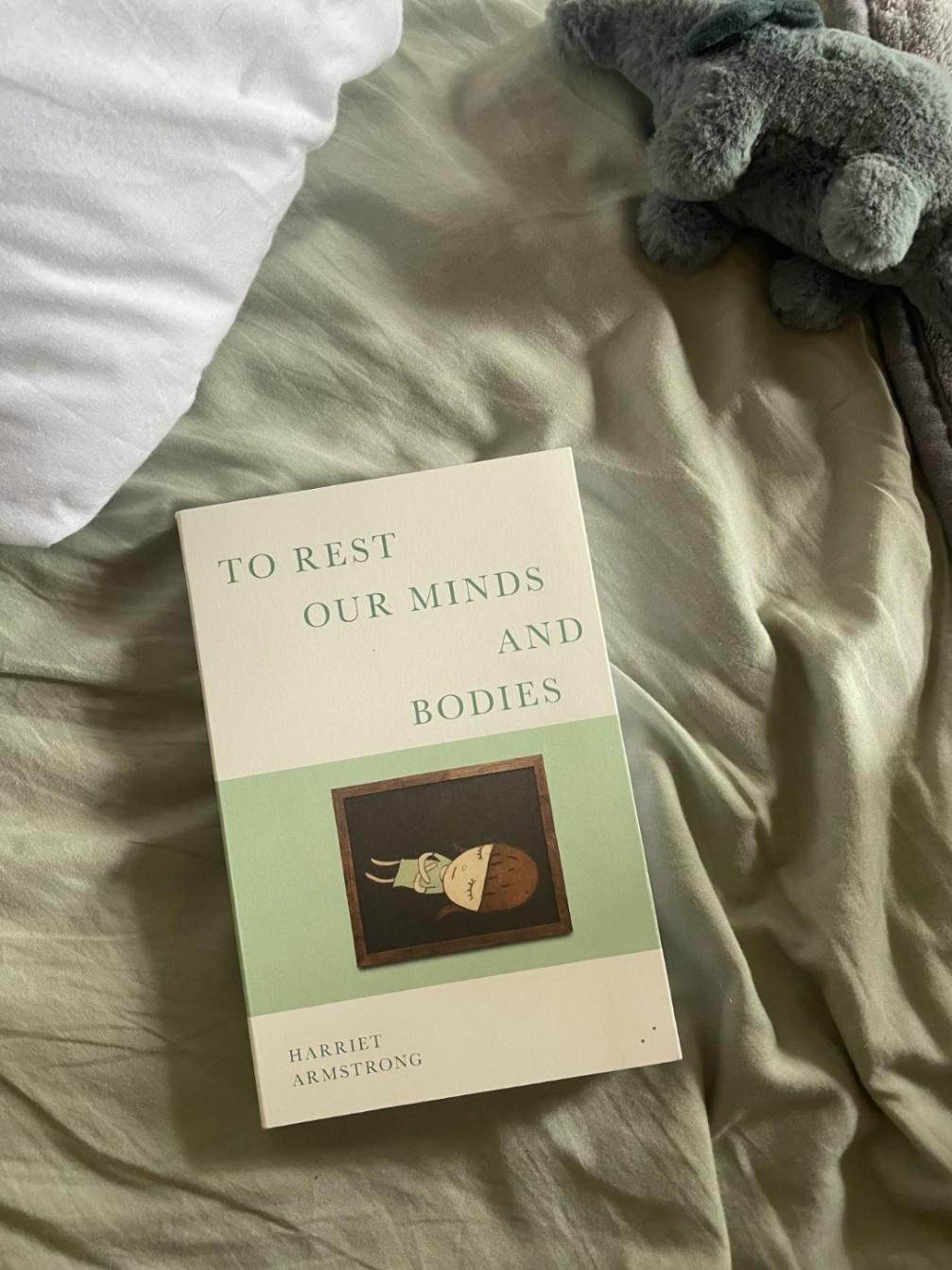
Harriet Armstrong’s book is, at its simplest, a reckoning with intense feeling: it weaves through the debris of unrequited love, the attempt to contextualise oneself within the world, self-destruction, redundancy, and mundanity. I am ashamed to admit I did entirely judge the book by its cover — it shows a Yoshimoto Nara-esque girl, pale and lying (or perhaps floating) in an oaken abyss. Her arms are crossed, the mark-making is gentle and roundish — the girl appears acutely peaceful in a way that made me envious. I recall being curled over, kneeling on the bookshop floor and finding myself enjoying the front cover — it anointed my scorched retinas, a cruel aftereffect of the pervasive LED shop lighting. I was also particularly frayed that day. Oh book so small and gentle, if you look like a lullaby, will you read like one too?!

It doesn’t exactly. It’s not necessarily a happy nor uplifting story — in fact, a great many bad things happen. It bleeds out slowly and hums along with the low timbre of humiliation thick in the everyday negotiations of awkwardly aged semi-adults. We are ripe with shame! The narrative engages with themes of redundancy and mundanity within these hangnail years; one hand turns over these old stones, the other hand holds your own — guiding you through an exacting jaunt across the minefield of your own souring youth. I found great comfort in its deep recognition; the novel really is good, compassionate company. Just a few pages in, I typed into my Notes app: “somebody appeared to be taking minutes in my brain a few years ago. they’ve since gone, gathered their findings, and returned it back to me bound in paper. harriet armstrong … who are u….”

The plot is as follows: the nameless protagonist begins her final year at university studying psychology. The book spans the entirety of the academic year. She meets her flatmate, Luke, one afternoon in the kitchen. He is a postgraduate student doing a vaguely defined degree in computer science. Luke is a kind boy, though some might categorise him as the manic-pixie-dream type — he introduces the protagonist to The Microphones, he wears guyliner, his presence is soundtracked by breathy, incomprehensible, and highly distorted music that fills the kitchen he cooks in, and he vaguely resembles Tilda Swinton. In one of their first encounters, Luke kicks a loose wooden board beneath the stove, making a soft, punctuated staccato that he remarks sounds like that of a heartbeat. He then feeds her spoonfuls of his curry.

“As he laughed he passed me a teaspoon of his curry and I couldn’t even taste the curry because I was thinking about how his fingers had touched each piece of onion, each piece of potato, some of the lentils, some of the mustard seeds — all of these things which were now inside my mouth.”

But despite his charm, irreverence, and unavailability (as we later discover), it would probably be very wrong to call Luke a manic pixie dream boy. The term is mostly used to describe a Ramona-Flowers-adjacent character, defined by Oxford Languages as “a vivacious and appealingly quirky character whose main purpose within the narrative is to inspire a greater appreciation for life in the protagonist.” These characters often exist as a mechanism or catalyst for growth, lacking real depth, and are defined more by the effect they have on others as a force for optimistic change than by their own interior lives. Luke is not vapid, and his feelings do not synchronise with the protagonist’s to produce a neat arc of self-learning. The protagonist falls in love with him, but it is fraught with resistance — unlike a classic manic pixie dream scenario: a down-and-out protagonist meets a quirky, optimistic character, a chemical reaction occurs, and the protagonist emerges enlightened. Our protagonist arguably ends the novel even more down-and-out than she began: punching trees, vomiting in a gutter, and running drunkenly into a lake.

Throughout the book, Luke and the protagonist form a seismic connection. Though the novel gestures toward friendly coffees and catchups with a handful of other friends, none possess the same intimacy nor gravitational pull as theirs. They show each other music and talk and talk and talk and cook and sit and talk. Luke and his girlfriend break up, thus galvanising the protagonist — their connection is so deep, makes so much sense — they should surely be together! It is frustrating even to us, the reader, on some level. It feels so emotionally and practically right and inevitable. The protagonist describes a kind of vaginismus, or perhaps an emotional block that has only ever been transcended when Luke is thought about. As Harriet herself puts it, love and truth collapse into one another in the book — the desire is undeniable, yet fundamentally inaccessible. This impossibility is heeded early on in the novel, when the protagonist imagines the two of them living together.. Luke insists they never could; it wouldn’t work. They’d never have time, he says, “to rest their minds and bodies.”

It is fruitless, and so the story becomes an exercise in trying to exist alongside this unresolvable attachment. From Luke’s perspective, the intensity of their bond is unsustainable — alas! The candle that burns twice as bright burns half as long! In the novel’s latter half, the protagonist spirals into a kind of blackly comic mode de la self-destruct: she seeks out sex with seedy men and runs until she shits herself or vomits, etc. etc.

It’s this specific trope I resonated with the most deeply — the pursuit of breaking through a period of murky bleakness with anything of dramatic consequence; provoking big feelings or big repercussions to bring you out of yourself and into the realm of consequence and danger. In To Rest Our Minds and Bodies, this translates for our protagonist as seeking out sexual relationships online. At one point, the protagonist meets an older comedian, Richard, on a dating app. She asks if he has any pets — he replies: “Only if you count this monster cock.” Richard is her first sexual experience, and the protagonist mentions the seediness of the encounter feeling appropriate, somewhat pleased when he reveals a gauche tattoo of some coyote on his upper arm. Her exploration of sex reads like an experiment with self-harm. I talked to Harriet about it:

BR: Does the protagonist seek out encounters with men like Richard as a craving for some kind of consequence — as if bad, awkward, degrading sex is still something to be felt? I sort of imagine she wants to get as close to the edge as possible, to provoke the universe into giving her big, intense feelings or repercussions as surrogate intense feelings that Luke gives her.

HA: That’s actually so moving to read because yes, I think that’s exactly what I wanted to get at! The protagonist is definitely seeking out intensity and extremity to try and find some kind of outlet for her intense and inexpressible feelings for Luke — and I think she’s also trying to prove to herself that she’s capable of causing intense, serious, “adult” things to happen, because she’s so unable to make anything “happen” with Luke. I honestly feel like your question puts it better than I can — she’s definitely trying to get closer to the edge and to access these extreme situations as surrogates for the intense way Luke makes her feel, I love the way you put it! I think she also perceives a kind of very binary split between Luke, who she loves, and other men, with whom she has these horrible encounters — and perhaps it feels easier, to her, to keep those two things so extremely separate. I couldn’t really imagine her having more pleasant or neutral “dating” experiences: I felt this character would be drawn to these more sort of degrading, unemotional situations because they reinstate Luke’s role as the only safe/special person. Also, I definitely remember having those sorts of sexual experiences at that age, and maybe not even seeing them as degrading or bad because I didn’t know what a more healthy, comfortable sexual experience might look like. So I think there is definitely an element of that too!

The vast difference between the tenderness she shares with Luke and the physical awkwardness, clinical detachment, and general unpleasantness of her encounters with these other men is really, truly palpable. Many might wonder where the comfort I found in reading this book really came from — it’s just good to know the self-destruct button has been as appealing to others as it has been to me.

As I’m sure is normal when reading, one tends to contextualise the story and situate it somewhere familiar within their own world. In café scenes I imagined them at Whitechurch; at the pub, under the heated lamps at the Swan. During the protagonist’s monologues, my mind surrendered to peculiar feelings; that which resonated in the book felt as if it came from some muddy dream. The closest comparison I can make is the act of trying to make out the shapes of your childhood bedroom in the dark — your carrot-lacking eyes squinting in an attempt to discern a dressing gown from some Slenderman figure at the foot of your bed. That’s how it felt. Sometimes, when the protagonist described her isolation, I imagined a waxed wooden floor — maybe a ballet studio — big mirrors in my periphery that I couldn’t quite look at, shame-bound and anchoring my gaze to my feet. It’s the same room I often find myself in when I’ve been alone too long and my feelings start to become physical sensations. Particle emotions rub against one another in my head, hot, volatile, and fast like a kettle about to boil. I feel it pressing against my temples. The protagonist’s thought process often brought me back to this room, particularly in moments when loneliness, or Luke, was discussed. When we are trapped in ourselves like this, and we feel (at last) a big feeling from something outside of ourselves — we feel as if we have found God.

The novel reaches its crescendo after a period of semi-estrangement between the protagonist and Luke, culminating in her invitation to Luke’s twentysomethingth birthday party. She arrives, knowing nobody else. When Luke quips that he “can’t spend the whole night just with her,” we see, paradoxically, both constraint and release. The protagonist then goes outside and watches the party through the great glass door. She sees Luke’s gangling limbs curl and twist around the faces and bodies of those he knows. His body fractured betwixt the rooms and people — the intimate yet dispersed birthday boy politely doing the rounds — his presence dispersed yet shared among many. How unfair: they get to be touched by him, feel him move past and through them with no consequence and in a way that’s not completely devastating. The protagonist is on her knees in Luke’s father’s vegetable patch. She proceeds to vomit in a gutter, send Luke an unelucidated unkind message, then run, drunk, into the lake they swam in just weeks before. The protagonist’s corporeal reactions are, of course, extreme; perhaps mental devastation becomes more tangible, more legible when translated into bodily experience. I also talked to Harriet about this.

BR: On the back of the book a guy called Luke B. Goebel describes the book as “the real truth about being too big for the container of the body of youth.” The protagonist’s obsession often manifests in extreme bodily acts — vomiting, running into the lake, punching trees. Do you see these gestures as the body attempting to articulate emotions or intensities that exceed the self’s capacity for containment?

HA: Yes!! Again — beautifully put!! I think the narrator is feeling such intense things emotionally, and cognitively even, but lacking a physical outlet for those things, and an understanding of how to gain that outlet. Even her sexual experiences feel so random and failed and don’t really allow her to express anything or even have a real experience — I think she finds them all so partial and unfulfilling, and totally unrelated to her real feelings and instincts. The book is quite concerned, I think, with her dis/connection from the physical world — and how, even through sex and her vaguely self-harming actions, she remains essentially insulated from the world. And I think she’s also having these feelings — like love, I guess — that feel huge and almost transcendent, but again, can’t be physically expressed or even expressed to Luke through language — and there’s definitely a claustrophobia in that, and a desire to try and break out of the self.

A final note I made whilst reading was the culturally referential breadcrumbs left along the way. When setting up her dating profile (to meet the aforementioned disappointing men), the protagonist includes a photo of herself dressed as Phoebe Bridgers from the Halloween before. She mentions listening to Mitski and “The Place Where He Inserted the Blade” by Black Country, New Road. Luke introduces her to The Microphones. Anyone familiar with these artists will immediately note their common denominator — a certain attentiveness to the emotionally fragile and generally soul-crushing. We spoke about this also.

BR: I really liked the musical references dotted along the way; it made a sort of soundtrack for the book in my head. Why was it important to include these musical references?


HA: I really liked the idea of the book feeling like an accurate depiction of life — or at least that narrator’s life — and to me that meant including lots of little daily details like music, just because those things are a big part of my day-to-day life, so it felt really natural and almost obvious to add those details into the book too. I also really liked the idea of exploring how the character is experiencing her own thoughts and feelings through music, as a way to make sense of them — I felt this fitted with her tendency to overanalyse things and try to understand their deeper “meaning.” Also, it was fun to explore the excitement of her connection with Luke — and the way it made her see herself in a new way — through her excitement about his favourite music. I wanted, also, to explore the way she uses music as a way of expressing how she feels when she speaks with Luke — I thought there was something sad and maybe interesting in the idea that she doesn’t know how to communicate her feelings to him except through other people’s art.

I think it’s particularly interesting that this impulse — to find resonance elsewhere — runs throughout the entire novel. The amorphous presence of identity is slippery and exceedingly difficult to pin down. It is hard to know who you are, what you like, what you mean, or what you give, and To Rest Our Minds and Bodies gently bears witness to this. It soothes the neurotic twenty-something heart with teeth worn down to the gum — and for that, it deserves to be held like a precious stone. Alongside its practical and emotional acuity, it is written with a compassionate beauty — a feat, considering that at the same time it kneels beside you, elbow-deep in your wretched guts, tugging out long-carried feelings that can finally be felt and made sense of.

By no means should you take my thoughts as universal truth; everyone I’ve lent my copy to has offered staunchly different emotional accounts of their experience. My mother read the second half over my shoulder on a long train ride, convinced the protagonist was chronically self-interested. My boyfriend was unsettled by her pursuit of unpleasant sexual encounters as a way to feel — a surrogate of sorts — even when he recognised it as a symptom of her desperate attempt to access her own emotions. He was particularly frustrated that the protagonist and Luke couldn’t end up together, though they inhabit the same orbit. These different responses fascinated me; it reminded me of the first time I watched 500 Days of Summer, labelling myself a passionate Tom sympathiser, then scrolling through the Letterboxd reviews of the majority. Safe to say, I learned something about myself that day. I think these varied reactions also illuminate the most profound facet of Armstrong’s writing: she accommodates the kaleidoscope of human feeling, offering complicated yet very real scenarios that each reader digests and responds to differently — a reflection of the ways we inhabit our own interior worlds. In all, To Rest Our Minds and Bodies is a truly beautiful book. Most readers will derive their own unique meanings from it, but I suspect that those in their twenties will find themselves recognising much of the prose — rehearsed, written, thought, and even cried — as their own.

Featured Image: Bel Radford

Categories
Reviews

A Chance Cultural Offering in Hamburg: Dann Passiert das Leben

By Martha Thornycroft

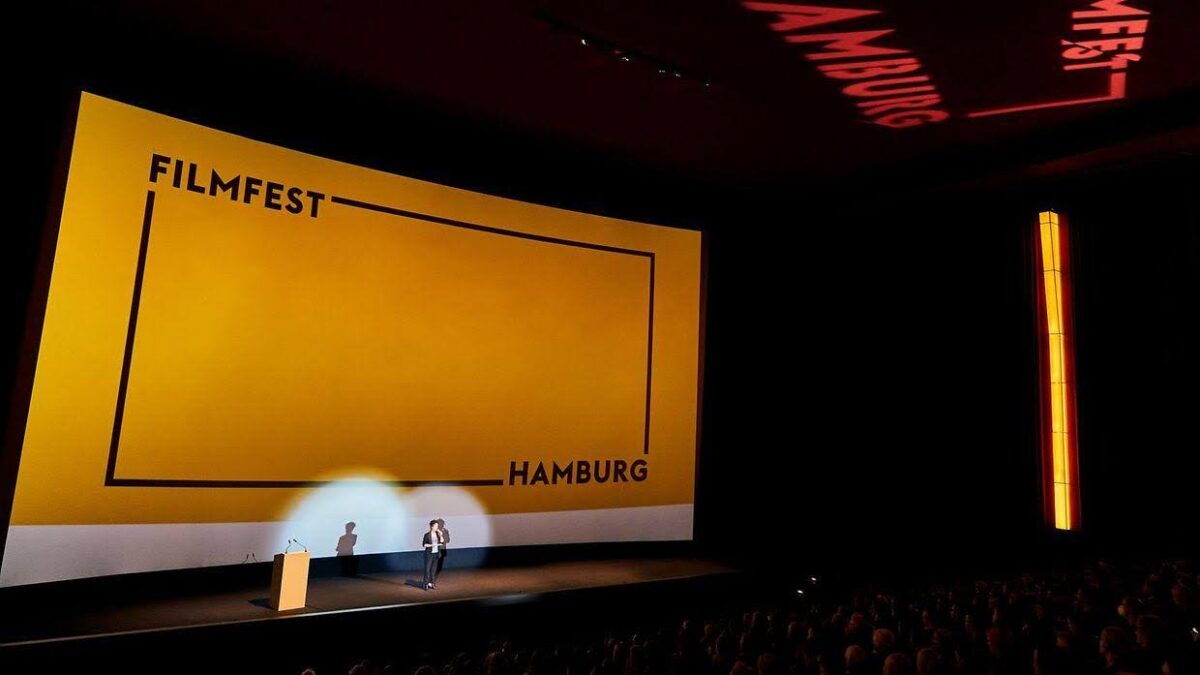
Persevering through watching often-alternative German films on a 14-inch laptop screen in the name of my degree is a far cry from experiencing German cinema in a local Kino, surrounded by its intended audience; serendipitously stumbling upon a semi-premiere of a new German film was hardly how I had imagined my first visit to a cinema in Germany would unfold. Despite repeatedly standing up for Hamburg – the location of my first year abroad placement – and having to convince family and friends that it is, really, the second-largest city in Germany, I was still uncertain about the cultural opportunities on offer in this often-overlooked, maritime city in northern Germany. Within the first month of living here, however, my ardent defence of the city was validated and rewarded when I chanced upon the Hamburg film festival (Filmfest Hamburg), which turned out to be just one of the many cultural gems this city has to offer.

Filmfest Hamburg is an annual film festival that takes place at the end of September. It is by no means akin to the Venice or Cannes Film Festival; attendees do not have the opportunity to catch glimpses of star-studded celebrities and directors. But, like many modest film festivals that steer away from the exclusivity epitomising other renowned cinematic events, this humble film festival offers a pared-back, artistically focused showcase of films from around the world for cinephiles and part-time enthusiasts alike (myself included). In this vein, the ‘Tag des freien Eintritts’ (free entry day), introduced last year to coincide with the day of German reunification (3rd October), has made this event all the more accessible. Thanks to this new feature, I was able to attend free of charge – music to any student’s ears. The film in question was Dann passiert das Leben (2025), produced and written by Neele Leana Vollmar and featuring two prominent German actors, Anke Engelke and Ulrich Tukur. Unbeknownst to me, the film’s official premiere was set for two days later at the Zürich Film Festival, with its cinema release date scheduled for just over a month after that – meaning that I was essentially witnessing its very first public screening. What’s more, the cast and main crew were even in attendance and participated in a post-screening panel. 

The film foregrounds a seemingly unassuming couple: Hans, a freshly retired headmaster, and Rita, a care home worker. Their life in Bayern is governed by a ritualistic monotony that, on the surface, appears unremarkable and inevitable, but quickly reveals a deep-seated discontent at the root of the couple’s relationship and existence. As the title – roughly translated as “Then life happens” – suggests, life gets in the way, and their quiet day-to-day is rocked by an accident that has implications for them both.

Speaking during the panel, Vollmar explained how inspiration for the film came to her unexpectedly whilst she was staying at a hotel in Berlin. At the breakfast buffet, her attention was invariably drawn to a couple in their early sixties also seated in the restaurant. Watching the couple interact, Vollmar said she was mesmerised by their mutual consideration of one another. The notion of love enduring through time – remaining constant alongside life’s milestones – began to take shape in her mind. Ironically, when she asked the pair their secret to a successful relationship, they revealed, with a laugh, that they were actually brother and sister. This moment, however, does underline an important truth: the common assumption that romantic relationships enduring into later life will naturally continue to last. It is this assumption that Vollmar grapples with in her new film, where love is no longer taken for granted but depicted as a constant, and sometimes difficult, challenge to sustain. 

Although I am evidently far from the stage of life depicted in the film – that of empty-nesterhood and retirement – Vollmar’s commitment to realism managed to immerse me in the world of this hapless couple. The damp, chilly atmosphere of the film somehow transcended the boundaries of the screen, and despite the warmth of the cinema, I had to put my jumper back on, shielding myself from the imagined cold. The film’s arguably bleak depiction of life post-middle age leaves a strong impression, with Rita’s shutters serving as a fitting visual metaphor for the routinisation and mundanity that can accompany later life. One of the cast members admitted that rewatching the film made him feel compelled to call his parents. In this sense, Dann passiert das Leben seems to depict a ubiquitous fear held by adult children: that our parents might be slipping into a static and colourless existence rather than living their life to the fullest. This is a fact the film seems to be self-aware of, as just minutes before the defining watershed moment, Hans, during an argument, refutes Rita’s claim that he barely notices her, asserting instead that she lives her life as though she doesn’t want to be seen.

The film is visceral, which is testament to Engelke and Tukur’s acting, and slowly, as love starts to be rekindled, the ambiance becomes brighter and warmer. A not-quite-happy but more contented life starts to look possible, exemplified by a spontaneous dancing scene in a schnitzel restaurant (an undoubtedly German way of signalling that all is well). That is why the film’s ending feels like a clichéd cop-out. Vollmar goes to the trouble of carefully establishing parallels only to undercut the actors’ powerful performances with an ending that feels both jarring and incoherent. It remained unclear to me what Vollmar intended to convey. As a result, the film proved more thought-provoking for the questions it raises than for its narrative substance. Still, despite its disappointing conclusion, it managed to leave a lingering impression – an outcome I certainly hadn’t anticipated as I walked to the U-Bahn from my flat, unsure of what to expect from the cinema I had discovered by chance on a Hamburg cultural events poster. With this first experience behind me, I plan to happen upon as many of these cultural opportunities as I can before I have to return to watching German language films on my laptop screen – something I know will feel all the more tedious now. 

Featured Image: Claudia Hohne

Categories
Reviews

Krapp’s Last Tape at the York Theatre Royal: Review

By Darcy McBrinn

Almost candlelit, supposedly sometime ‘in the future’, we see a den in squalor. There sit mounds of books and rubbish, intelligentsia and filth all rotted into one, whilst decrepit musical fragments of memories past echo throughout the theatre. It is in this uncanny ambiance that the audience are left in anticipation of the emergence of both an external cultural icon and an internal theatrical icon of the absurd.

Marking his grand theatrical return after thirty-seven years, York Theatre Royal’s production of Krapp’s Last Tape is both directed by and stars cinema legend Gary Oldman, in a performance equally as captivating as its source material. Written by modernist heavyweight Samuel Beckett in 1958, and presently arranged by film producer Douglas Urbanski, Krapp’s Last Tape is both a one-man and one-act play. Set entirely within his dwellings, the monodrama follows the peculiar Krapp (Gary Oldman) on his sixty-ninth birthday, enjoying an annual ritual of relistening to tape recordings of years’ past before recording that year’s own – all the while chomping through bananas, pining over spools, and working his way through half of York’s bar reserves. It is on this birthday that Krapp happens to land upon the voice of thirty-nine-year-old Krapp, immortalised within Spool 5.

Krapp’s Last Tape’s most entrancing feature is the unitary multiroling brought about by two Krapp’s atemporally occupying the stage, the physical Krapp of the present and the auditory Krapp of the past. With our contemporary Krapp largely mute beyond sparse murmured ramblings, Beckett characterises him through an intense physicality undeniably seized upon by Oldman, who manages to convey so much emotion and depth while verbally constrained. Belching, burping, gulping, coughing, spluttering, munching, wheezing, groaning, and cackling – Oldman performs an incredibly bodily and guttural display showcasing the mounting disconnect Krapp has from his mind and abstract thought. Paired with incredibly expressive facial movements, what little animation Oldman does endure about the stage is laboured and stilted, as if any separation between Krapp and his coveted spools is an ordeal. Much like the contents of what Krapp slugs on stage, the character is a concoction of debility, alcohol, and bitterness – a blend of subtlety and theatricality that Oldman mixes to perfection.

The second central character – or rather personality – of the scene is the bygone Krapp isolated to the tape recorder. A purely vocal performance, Oldman expresses the beautiful wordsmithing of Beckett with an uneasy, almost sinister eloquence. As the audial Krapp voices his self-destructive and emotionally nihilistic philosophies, Oldman begins to conceptualise him in an antagonistic role for his iteration, and as such the voice holds almost a spectral tone, eerily bereft of bodily noise – like a phantom that looms over Krapp’s memory. Oldman’s Krapp is syllabically entrancing, and this feeling is aided by the work of sound editor and engineer Gary Canale, whose crackling gramophone effect draws the ear in closer to pick up on each utterance. Weaved together, the detached pair form a natural double act with both physical theatrics and voice acting talent independently given space to flourish.

It is a marvel to see Gary Oldman transform between film roles – be he the blood-guzzling Dracula or the whiskey-guzzling Churchill – but it is something greater to see him transform before your very eyes. Capturing both the humorous scatological oddities and corroded psychological realities of Krapp’s mind, Oldman wholly embodies the tragicomedy of Krapp.

Complimenting this layered performance, set designer Simon Kenny has crafted a stage of equal symbolic, and literal, layering. With a stark dichotomy of positive and negative space, Krapp’s ‘den’ (as written by Beckett) sees heaps of forgotten waste interrupted by a narrow path Krapp can shuffle through. Ultimately this makes the stage a linear construction, as Krapp’s movements are forced along a specific path, constrained in his own home. However, as seen through his wilful untidiness and deliberate mess throughout the play, the construction of this linearity is self-imposed. Much like the tragedy of Krapp’s life and his current entrapment by misery, it is his own unchanging decisions that have led to this state. Krapp lives in a self-made prison, domestically and psychologically – confined within his own negative space, forced down the path towards his maligning tape recorder.

With light and dark imagery central to both Beckett’s characterisation of Krapp as well as the play’s overall themes, Oldman’s use of lighting – designed by Malcolm Rippeth – is structurally vital. Opening, as theatrical productions typically do, well-lit as the audience finds their seats, the lighting does not lower but rather very gradually mellows into a faint glow over several minutes. This stresses the disconnect between the bright and lively hubbub of the audience against the quiet and dark loneliness of Krapp, all the while accompanied by the nostalgic and lonesome “We Three (My Echo, My Shadow and Me)” by The Ink Spots – projecting an entrancing feel over the play’s beginning.

From there on out, the lighting casts singular warm orange hues suggestive of a faint flickering candle, like the old and weathered Krapp whose own flame is slowly dying out. This effect naturally forces the eye to strain upon the dimly lit Krapp, central and stationary at his desk. The viewer focuses and mentally blots out the surrounding disorder that engulfs Krapp, just as Krapp himself has self-sequestered from all outside of his spools. This sense of focus is reflected by the tape recorder’s lambent lighting. Almost spotlit at times, Rippeth often frames it rather than Krapp as the protagonist, with the latter relegated to a shadowy supporting role, as if Krapp has become subsumed by it, consumed by this regressive manifestation of memory and reminiscence.

Historically, this tape recorder does hold significance beyond Oldman, being the same prop used in both John Hurt and Michael Gambon’s own performances of the play. In a way, just as Krapp is, Oldman himself is recording his own theatrical spool in this Beckettian catalogue, inevitably imparting a piece of himself onto its history. Just as much of Krapp’s Last Tape is autobiographical for Beckett, these gestures to the real world in the reused prop imply a personal connection between performer and character, between Oldman and Krapp.

Having made his professional acting debut at York Theatre Royal in 1979, Oldman, just like Krapp, is here revisiting his past. In this sense Krapp and Oldman begin to intertwine, as Oldman uses Beckett’s framework to explore his own feelings of regret, nostalgia, and professional self-reflection, as well as anxieties about his life or career moving forward – Krapp’s Last Tape is set “in the future” as Beckett’s stage directions read, after all. Oldman comments on the venue directly in his short piece within the programme, Returning Home, saying of the theatre, “This ancient building still holds many charms, but has undergone some massive development […] Yet, despite all the structural upgrades, the same old challenges remain”. Much like his debut venue, Oldman is gesturing throughout the play towards his continuous journey of growth and ‘development’, and the ever-looming hardships that undercut life.

Paired with this, the production also finds itself in the heart of Oldman’s sarcastically self-styled ‘alcoholic period’, the actor having recently played a succession of alcoholics on screen – an era Krapp should feel right at home in. Himself a recovered alcoholic, the presence of alcoholism is not just significant in the play but uniquely highlighted by Oldman. Whereas Beckett’s textual Krapp routinely drinks his gallons of liquor offstage and hidden from the audience, Oldman thrusts his version’s alcoholism into the limelight, unabashedly drinking onstage throughout the play. It becomes a highlighted element, and coupled with Oldman’s own history and dramatic themes of retrospection, this Krapp’s Last Tape in part morphs into a precautionary tale of where alcoholism can lead, what an alternative Oldman could have become. Perhaps even an honest insight into the ever-present spectre of regret and danger of relapse.

While on the whole I did feel that these, among other small changes, did peel back some of the more impactful moments of Beckettian absurdism, overall through these adjustments there became a clear vision and intention to build upon the text and uplift Oldman’s personal commentary.

A deeply pensive production, it is this introspective insight that elevates Gary Oldman’s Krapp’s Last Tape beyond simply an aged Hollywood A-lister trying their hand again at theatre. Every element of the production intersects and weaves together to both uplift the themes of Beckett’s masterpiece as well as to breathe life into Oldman’s new interpretation. With an audience eternally suspended in a deathly entranced silence – barring the odd banana bite laugh – it was an incredible performance to experience, as he simply is Krapp (perhaps for the first time a review means it as a compliment). Oldman concludes his aforementioned programme piece hopeful that his production will galvanise interest in the theatrical. One can only hope then, that just like in the case of his long line of predecessors, this won’t truly be Krapp’s last tape.

Featured Image: Giselle Schmidt

Categories
Reviews

Goose on Geese

Getting Killed and Choosing Love

By Matthew Dodd

For the first forty-five seconds of Trinidad, the opening track from New York post-punk band Geese’s new album Getting Killed, there is a semblance of normality. Shuffling drums and a pedalling wah-wah guitar lick, accompanied by lead singer Cameron Winter’s plaintive cries of ‘I try so hard’, suggest a reflective, if unorthodox, serenity. Any such notion of peace and quiet is ruptured a moment later by a thunderous cacophony of sound: errant saxophones, frantic guitar and Winter’s howling refrain – ‘THERE’S A BOMB IN MY CAR!’ This contradiction, an oscillation between grooving slacker-rock and erratic noise, dogs the album. That tension, tied by Winter’s often sensitive and often bizarre lyricism to the uneasy interplay between the modern world’s mundanity and absurdity, constitutes the album’s thematic through-line. In one moment, Winter is the world-weary Sisyphus of 21st-century life, trying his hardest to no avail; in the next, he is the red-pilled doomscroller with a bomb in his car. Geese wear their influences on their sleeves, but they are nothing if not blisteringly contemporary. 

Not unlike one of their songs, Geese’s upward trajectory had, for years, been slow and rumbling before exploding, seemingly spontaneously, into the meteoric over the last summer. Since 2023’s 3D Country bought them a place in the peripheries of mainstream success, they’ve carved out a steady reputation as one of the most mercurial and exciting bands in the New York scene. A string of viral singles through the summer, bolstered by the release of Winter’s solo album Heavy Metal last year, has parachuted them into online superstardom, without any surrendering of their distinctly un-starlike style. They, like The Strokes before them, have become the ambassadors of New York’s yuppie-private-school-punk-rock-greasy-hair subculture. Cameron Winter operates in the same ambiguous space between cult leader and awkward schoolchild as Julian Casablancas did in the 2000s, appearing in both interviews and performance as much uncomfortable as he is totally in control. The band, eschewing the spotlight whilst languishing in the attention it’s won them, play to that most Gen Z affectation of self-conscious diffidence; the band are all under 25. 

Getting Killed moves with picaresque conviction through a surreal soundscape of modernity. The title track sets a discordant sea of chanting voices against pounding off-beat drums and a drudging blues riff before abruptly pulling back to reveal a gentle guitar line and Winter’s cracked, sensitive vocals. The song continues to jerk between the two sounds until both are subsumed by a wave of branching melodies and counter-melodies. Winter knows when to let the band’s musical chemistry take the spotlight, allowing his voice to become at times simply another piece of instrumental firmament. Islands of Men is carried by a grooving synthesis of guitar and drum lines, against which Winter’s vocals provide playful counterweight. The single 100 Horses is perhaps the most straightforward track on the album: an anthemic rocker, the kind of song Led Zeppelin might’ve made had they been raised on YouTube and cultural oversaturation. 

Winter’s lyricism is as bafflingly brilliant as ever. He has all the enigma of Jeff Mangum without ever venturing far from his emotional directness, evoking at times the genius of his avowed heroes Leonard Cohen and Bob Dylan. The bizarre – ‘my son is in bed / my daughters are dead / my wife’s in the shed  / my husband’s burning lead’ – is kept in delicate harmony with the simple and beautiful – ‘and if my loneliness should stay / well, some are holiest that way’. 

A certain spirituality runs through Getting Killed, a kind of sarcastic desire for a post-modern religious meaning that dares not speak its name. Winter’s solo track $0 ends with the singer’s rambling confession that ‘God is real, God is real, I’m not kidding this time God is actually real’: similar moments of religious epiphany pepper Getting Killed. On breakthrough single Taxes, Winter’s warbling baritone laments that ‘I should burn in Hell / but I don’t deserve this’ and threatens that ‘if you want me to pay my taxes / you’d better come over with a crucifix / you’re gonna have to nail me down.’ Between ‘nail me’ and ‘down’ a buoyant guitar line fulminates across a song which has hitherto been accompanied by a bottom-heavy assortment of plodding drums and droning bass. The moment has a baptismal quality, a revelatory instance of self-discovery as light dashes across a soundscape marked by darkness. Winter continues to paraphrase Luke’s Gospel – ‘Doctor, heal yourself’ before forging a new thesis: ‘I will break my own heart from now on.’ The song adopts this half-removed, self-effacing religiosity with familiar reticence but nevertheless finds an earnest truth in it: a radical freedom, a breaking away from the married scourges of sin (hell) and modernity (taxes). No wonder that Taxes has become an immediate favourite in performance, an orgiastic refutation of hyper-modern anxiety. 

Getting Killed is an intricate, freewheeling trip through modern life’s surreal minutiae, an adventure whose complexity never threatens its listenability. Though it might lack the frenetic, hard-rocking highs of Mysterious Love or 2122, it supplants them with something even more interesting, a ruminative sincerity. Change lies at the centre of the album. Standout track Au Pays du Cocaine dwells, over lilting riffs and angelic backing vocals, on the possibility of reconciling an ever-shifting world with emotional stability. ‘You can change’, Winter wails, ‘and still choose me.’ Life in the post-post-modern world is as hectic and unpredictable as a seven-minute jam track, inscrutable as a Cameron Winter lyric, but that doesn’t mean we can’t hold on to what we love. For a band as drenched in ironic internet culture as Geese, the beating heart of their latest record is as earnest as could be. 

The magic of Geese, on this album more than ever, is that theirs is a joke we as an audience aren’t in on. Here is a band of schoolfriends, content to play to each other more than any crowd. In concerts, Winter will race through lyrics to make his bandmates laugh; songs that the band enjoy will go on for double their recorded length. On one track they’re a country band, on the next they’re a Steely Dan tribute. At every step, Geese panders to no critics, no viral success, no mainstream acclaim- instead, they remain the band they themselves find most exciting. We wouldn’t want them any other way. 

One step forward, two steps back?

By Edward Clark

All eyes are on Geese. Following their critically acclaimed sophomore release 3D Country and subsequent EP 4D Country, excitement for their third album Getting Killed has been amping up. This hype was only furthered by lead singer Cameron Winter’s solo release Heavy Metal last December: a diversion from Geese’s rock roots, Winter’s work swapped 3D Country’s colourful jam-band sound for cascading piano ballads. Placing emotional lyricism and powerful vocal performances at the forefront, Winter showcased his versatility as a singer and his strength as a writer. For a band who have showcased so much creative potential, fans expected another strange departure from their previous work. Getting Killed feels like Geese playing it safe.

Having come up parallel to the post-rock scene based largely in Britain, sometimes called the ‘windmill scene’ or ‘post-Brexit’ rock (Shame, Squid, Black Midi etc.), Geese have been unafraid to place their New York identity front and centre. The band’s Spotify bio reads “NYC” and nothing else; their love for their hometown continues to glow on Getting Killed. ‘Bow Down’ wears its Strokes influence on its sleeve, Winter’s surreal religious metaphors underscored by fuzzy, driving guitar riffs and droning horns. Keeping the pace up, the song is an easy standout. After descending into a noisy instrumental section, accompanied by blaring car horns and mesmerising drum patterns, the song explodes into an awesome finale.

Where Geese achieve the same level of urgency as they do in Bow Down – emotionally or instrumentally – the album soars. Lead single Taxes is a fantastic blend of disconcerting imagery and tight accompaniment. The guitar tone is bright, blending nicely with Winter’s emotional vocalisations. Islands of Men is a more meditative cut, but still maintains a building crescendo as Winter sings about fear and ‘running away’ over a hypnotising, laidback guitar riff. Trinidad is packed with surreal panic – as the album begins at a smooth, steady pace, it is instantly offset by a frenzy of dissonant horn, bass, guitar, and sporadic drum fills. ‘There’s a bomb in my car!’, Winter shouts. Somehow, this noisy hysteria takes the form of a chorus, and somehow it works perfectly.

Despite these highlights, Getting Killed is a less creative album then their last. Less compelling tracks (Cobra, Husbands, and Half real for example) are hindered by the band’s reliance on one particular sound. The track-list merges together; each song struggles to carve out its own identity. The weirdness that the band embraced on 3D Country fails to materialise here. Winter is less silly and less melodic on Getting Killed: where Cowboy Nudes and Gravity Blues bubbled with soulful energy, Getting Killed is grittier and darker. The wide range of bizarre influences which shaped the playful sound of their previous LP are missing here; as a result, weaker songs lack the texture that made 3D and 4D country so unique. Further, Winter’s ability to create catchy, emotional ballads is not showcased here. There is no Love Takes Miles to be found on Getting Killed. The closest Geese get to striking the same emotional chord as Winter’s solo work is on Au Pays du Cocaine, a breakup song reimagined in their own New York style.

Nevertheless, the album is great. For Geese, ‘playing it safe’ is clearly an apt move. Their fanbase is growing, and they’ve recently set off on a multi-continent tour, including plenty of festival spots. As Cameron Winter admitted in an interview with GQ Magazine earlier this year, “Sometimes you’re walking down the street, and you feel like you could just make 40 albums.” The band’s love for making music shines through most of all.

Featured Image: Mark Sommerfield

Categories
Reviews

Review: Durham University Classical Theatre’s Hay Fever

By Maisie Jennings

On Monday night, I had the pleasure of watching DUCT’s production of Noël Coward’s Hay Fever, a century after its first performance in 1925. Hay Fever forms the sticky, hazardous web spun around the eccentric Bliss family, and each of their four guests who are inevitably tangled up in it. Coward’s script blends high farce, slapstick comedy, and a sharp, winking satire directed at the British upper-class – all wielded deftly by director Abby Greenhalgh and the play’s sparkling cast and crew. 

Taking my seat in the Assembly Rooms Theatre, I was struck by the cleverness of the set, effortlessly curated to emulate the jaunty untidiness of a bourgeois-bohemian family home. There are ornate lamps, a silver tea set, a piano – relics of Coward’s contemporary staging, but not anachronistic amongst more modern elements. The effect is wonderfully timeless – perhaps another convention eschewed by the Blisses. This is further emulated in the character’s costuming; a mash-up of jeans, linen shirts, slinky evening gowns, and a fabulous string of pearls allow the play some temporal movement, whilst retaining the careless, offhand nature of the Bliss’ old money fashion. When siblings Sorel (Martha Buttle) and Simon (Samuel Bentley) languidly move about the stage, foppishly draped on sofas, and waxing lyrical about vaguely artistic nonsense, their movements are organic and instinctive. Even as their spats intensify, there is very little loss of this sense of authenticity. As Sorel, Buttle is razor-sharp, energetically firing disdain towards the other characters with a bored precision. Bentley’s presence as Simon is just as lively – his snarky retorts and scornful asides are particularly funny moments scattered through the course of the play. 

It must be said that Alannah O’Hare’s portrayal of Bliss matriarch and retired actress, Judith, is a delight. She sweeps across the stage, demanding cigarettes and vigorously reenacting the stardom of her youth. Her vocal inflections are perfectly extravagant – a stunningly bad, breathy rendition of ‘Frère Jacques’ in the second act is particularly hilarious. David, her husband, played by Ben Oliver, has a more understated presence on stage. The minutiae of his gestures, body language, and vocal choices are affected, somewhat preoccupied, and more softly flamboyant. Judith and David exchange love and contempt like canapés for their guests; indeed, the guests themselves are also passed around in a strange game of sexual competition. Fun for all the family? 

The guests are also skilful actors, working with more subtle characterisation. Liv Fancourt is stellar as Jackie Coryton – airy, giggly, and startled. The painfully awkward small-talk between Jackie and Richard (Oscar Dunfield Prayero) particularly stands out. Both characters struggle under the restraint of manners, desperately trying to make polite conversation amidst the midsummer madness. Myra Arundel (Maariya Khalid) is cool, charming, and a challenge to the whims and commands of the Bliss household. She, too, has mastered the art of subtle, biting wit hidden beneath seemingly innocuous remarks. Sandy Tyrrell (Cillian Knowles) provides a grounding presence within the play’s havoc; he is endearing, naive, and hilariously steals toast from the Bliss’ breakfast tray. The breakfast tray, I must add, is carried about the stage by Cara Crofts as the Bliss’ French maid, Clara. Croft’s accent is mostly convincing, and she busies around the set breezily.  

The cast and crew of Hay Fever truly extract the very best qualities of Coward’s text and the result is wonderfully silly. I think it’s always a joy to see actors really having fun with their roles – the cast relished every line, and, meeting them with near constant laughter, so did the audience. 

Categories
Reviews

Review: Walkabout Productions’ ‘Room for Doubt’

By Edward Bayliss

Yesterday, I watched the first night of Walkabout Productions’ Room for Doubt. Watched, it seems, is the wrong word. As the UK’s largest immersive student theatre company, Walkabout have for almost three years been delivering interactive performances, wherein the audience play a part in the action. Co-founder of Walkabout Max Shanagher, funnily enough, was a Wayzgoose team member from 2023-2024.    

It’s 8:25 and the audience are sitting, standing, waiting – awkwardly – in a peculiar room in St. John’s College. We are told that the jury session will begin soon, but that we are waiting for ‘Patrick.’ Is this part of the show? I suspect so. The cast members (three of which are in the waiting room with us) attempt, painfully, to make small talk, and I don’t know whether to laugh, play along, or bury my nose in my notebook. We learn soon after, that according to the performance, we have just returned from a fifteen minute break and are back on jury duty.

There are six ‘core jurors’ (the cast) and the rest of us form the peripheral jurors; we are all given the chance to vote on three occasions as to the guilt or innocence of the defendant. At its crux, the performance is designed to cradle the euthanasia debate. The accused is a nurse, named but not seen, who has administered an overdose of morphine to her terminally ill patient. The production navigates evidence and testimonies which we, the peripheral jury, are invited to read aloud, and make our own judgement upon. The performance urges us to consider both flaws in the institution of British justice, and the flaws in jurors’ characters, both of which will provoke argument and debate.  

The immediacy of our involvement in the performance is mostly very effective. We all sit around a table as jurors might – the boundary between actor and audience is incredibly vague – initially, a fly on the wall observer would not be able to tell the difference. The cast also offer unscripted asides to their neighbours, met admittedly with mixed enthusiasm by last night’s audience, but which afford a greater sense of realism and often, humour.  

Room for Doubt’s writer, Raphael Henrion, studies deference, passivity, anger, frustration, and courage in the characters of his play. This pot of personalities boils over more than once. Alliances are formed, factions are established, and it soon becomes less about the case at hand and more about the jurors themselves. Gusts of rage from Mable (Grace Graham) swell as she bites back at her juror nemesis Alex (Noah Benson), both claiming to sit on the right side of justice in their assessment of the seemingly far off defendant, Emily Carter. The production however does not rely solely on loud confrontation and clash. Oli (Daisy Martin) gives convincing breaks as she cools the temperature of the room with her personal story of a terminally ill family member. The gravity of the situation jars bathetically against the ignorance and idiocy of juror Patrick (Matthew Lo), whose judicial laziness works as effective comedic respite. Overseeing the process is the long-suffering head juror Sasha (Orlin Todorov), who cues topics of debate, readings of evidence, and generally buttresses the performance with a sufficient sense of structure.

The show culminates in a final vote. We now realise we are voting on much more than the guilt or innocence of Emily Carter, but rather on the state of justice in general, and on the place of contextual morality within the unbending bounds of the law. Have no objections, this is quite a remarkable dramatic arrangement. So, get the chance to hear the case and cast your vote.

Performances are at 6:00pm and 8:00pm on 10th & 11th June in St. Johns’ Vasey Rooms.

Categories
Reviews

The Phoenician Scheme: I suppose I’m moved 

By Matthew Dodd

Around halfway through The Phoenician Scheme – the latest feature from Wes Anderson – Benicio Del Toro’s lead character, the existential arms dealer Zsa-Zsa Korda, takes a pin out of a hand grenade, refusing to return it until his associate Marty, played by Jeffrey Wright, agrees to cover a substantial portion of a funding deficit in the titular infrastructure project. In response to this, Marty says somewhat drolly, somewhat earnestly, ‘I suppose I’m moved by this absurd performance.’ It is a sentiment which might as well apply to the film at large: a strange and often inscrutable work which, nevertheless, leaves an indelible emotional footprint on the heart and mind of the viewer. A madcap, globetrotting adventure replete with fez-wearing nightclub owners, sardonic terrorists and semi-incestuous second cousins, The Phoenician Scheme represents Anderson at both his most eccentric and his most clear cut.

Anderson has charted a strange filmic course over the last decade. With 2014’s The Grand Budapest Hotel, it seemed that the cinematic establishment had finally accepted Wes Anderson as not simply an indie-darling, but a serious director, an auteur. Its nine Oscar nominations felt like his induction into the ranks of the great living filmmakers, regardless of the fact that Anderson himself went home empty handed. Since then, however, the director has refused to stay within the sweet spot of critical acclaim carved out by The Grand Budapest, instead moving further and further into the strange, idiosyncratic and divisive. 2024 saw Anderson win his first Oscar for the short film The Wonderful Story of Henry Sugar, the sole consideration the Academy has afforded him this decade. His last two films – The French Dispatch and Asteroid City – are marked by a deliberate complexity and emotional detachment which has left them somewhat controversial amongst his devotees. In many ways, The Phoenician Scheme is a move away from that convolution which has become staple and is, instead, a (broadly) straightforward espionage thriller about a father and a daughter. There are no meta-narratives, no plays-within-plays, no knowing winks to the camera to remind you that none of this is real. And yet, there is still an opacity about The Phoenician Scheme which can leave it feeling somewhat subdued. Whereas The French Dispatch and Asteroid City make a point out of their absurdity – the former as a sprawling ode to journalism and human life, the latter a narrative as thorny and overwrought as the melancholy of its characters – there is a sense in which this film finds no such certain footing from which to launch its hyperactive eccentricity. In short, it might seem there’s no method to the madness. 

The Phoenician Scheme tells the story of the plutocrat Zsa-Zsa Korda (Benicio Del Toro) and his attempts to curry favour from various business associates to fund his massive infrastructure project in the Levant, the eponymous scheme. He is accompanied by estranged daughter Liesl (Mia Threapleton) and tutor-cum-secretary-cum-spy Bjorn (Michael Cera). The whole affair is deliberately silly: Korda tries desperately to cover ‘the gap’ caused by a supra-national business council artificially inflating the costs of the ‘bashable rivets’ needed for construction. Along the way, the Scheme itself becomes secondary to the emotional journey Korda goes through. Constantly the subject of failed assassination attempts, Korda’s becomes a tale of a man rebirthing himself. He is dogged by strange visions of a heavenly courtroom at which God (Bill Murray) litigates the matter of his eternal soul. Liesl, his daughter, has become a nun since last seeing her father, and it is the reformation of their relationship which forms the emotional heart of The Phoenician Scheme. In a sense, the film retreads the path of Anderson’s 2001 The Royal Tenenbaums, another story about a deadbeat dad trying to make amends. In a more obvious sense, however, this is a wholly different beast. There is no moment in The Phoenician Scheme as obvious as Chas Tenenbaum breaking down and telling his father ‘I’ve had a rough year dad’ or as joyous as Royal and his grandsons riding on the back of a garbage truck to Paul Simon’s Me and Julio down by the Schoolyard.  Instead, this later Anderson builds up a world of cumulative absurdity out of which the reality of emotional connection faintly shines. 

In a heightened, exaggerated and very silly way, The Phoenician Scheme tells the story of a man who wants to move past the errors of his ways and forge a new path. Being a Wes Anderson film, this quite straightforward story has of course to be submerged under metric tonnes of pastel interiors, fast-talking bureaucrats and pristinely fitted suits. It is, to its credit, one of Anderson’s most unabashedly entertaining films. The performances – especially those of Threapleton and Cera – are ecstatically joyful, the narrative is outlandishly fun, the direction and production design is typically magnificent. And yet, moreso than others of Anderson’s work, the obfuscation of the film’s emotional centre can leave it feeling, at best, subdued and, at worst, detached. The walls of hyperreality are never quite punctured by sincerity in the way of his other films. 

Zsa-Zsa Korda is a character who ought by rights be dead and ought by rights to deserve it. The drama of the films comes from Korda’s post-death reinvention – as a father, as a Catholic, as a good man. This is a tale of male egos, pasts and presents, mutable identities and empathy. At each stop, Korda is forced to give up something in pursuit of success, whether it be an emotional confession, his own blood, his hand in marriage or, finally, all his worldly possessions. The film itself acts as a judgement of the character’s soul, sanctifying his spirit at each turn. Indeed, the film’s primary antagonist – if we can call him such – is Benedict Cumberbatch’s Uncle Nubar, a character who is set up explicitly as a monitory double for Korda himself. Nubar is described by Korda as ‘the son of my father’ and, quite possibly, the father of his daughter. They are one and the same, with Nubar representing the excess of that moral deficiency which Korda has long inhabited. Defeating him, he defeats himself. Throughout the film, various stone-faced assassins make attempts on Korda’s life, to which he dryly comments ‘I think I recognise that assassin.’ He is, quite literally, haunted by the ghosts of his pasts. Korda begins the film viewing his daughter as a business partner, a probationary heir. By the end, he accepts their connection as one beyond the mere biological, assuring her that, regardless of her real parentage, she remains his daughter. In many ways, The Phoenician Scheme constitutes Anderson’s most spiritual film. Liesl’s faith is the subject of numerous jokes throughout the film – early on, her rosary beads are replaced with a garishly bejewelled secular equivalent – but ends up central to the thematic conclusion. Owing to the influence of his daughter, Korda converts to Catholicism, a conversion cemented by an over-the-top action set piece which ends with a model dam bursting and dousing him in a tide of water. He is, in this way, baptised. He rejects riches and power for family and simplicity. The ending is a classically Christian one of humility and moral rectification. That said, where the traditionally religious narrative might land its hero in a monastery, Anderson favours an art-deco bohemian restaurant. The aesthetic and the spiritual are not, for Anderson, mutually exclusive.

The epilogue, in which the family are plunged into poverty with father and daughter reunited around a barrel playing card games, though not as punchy as Max Fischer slow-mo dancing with the woman of his dreams or Van Morrison playing out Royal Tenenbaum’s funeral, nevertheless finds a steadfast emotional footing. Out of a narrative of exaggerated absurdity, we are left with the final image of our two heroes, a father and his long-estranged daughter, enjoying the simplest of life’s pleasures. Perhaps, this is The Phoenician Scheme’s message to us, that none of the pomp and ceremony, the excess of style and riches, matters so much as family, as kindness. It is a strange, wild and often underwhelming film, but I cannot deny that I was moved. 

Who’s who – Discovering Identity in Wes Anderson’s The Phoenician Scheme

By Emilia Brookfield-Pertusini

One of the hallmarks of a classic Wes Anderson flick, almost as notorious as a symmetrically staged tableaux with a camera pan from the left, is a roll call of all your quirky looking stars. Picture the scene; it’s the start of The Royal Tenenbaums, Ravel’s ‘String Quartet in F Major’ is plucking away against a flip-book of striking scenes, each muse placed slap-bang center with action swirling around them. ‘Ahhh! I thought I recognised them’. ‘Oh yes! [insert star’s name] is great.’ The clamours of the Anderson cast list ensues. Identity is key to these quaint pictures, and in the midst of his middle-life crisis induced scriptwriting, Wes Anderson’s The Phoenician Scheme launches into an attack of identity headlong. Like with Asteroid City, the film focuses on makeup and artifice, attempting to use the precision of each piquant shot to display the loneliness and shallowness beneath. The marching towards the next tableau is merely another way to move us on to a new crisis of identity.  Charming as each curation is, The Phoenician Scheme’s self-conscious concern with its appearance leaves us with a film that is timid, with a cliche sense of adventure, departing into the realms of boring deflation. 

The promise of an Anderson feature starring the ever-awkward Richard Ayoade seemed like a manifestation long in the waiting. However, I think I could only remember 5 things he said, if that. Likewise, a silent Willam Defoe in the background of the absurdity cliche heaven segways, the forgettable apparition of Scarlett Johanssen, and the overshadowed Riz Ahmed, dissolve into the ennui of the film’s tired sighing. The Phoenician Scheme essentially follows three archetypes; the nun (Mia Threapleton), the reckless plutocrat (Benedicto del Toro), and the awkward, sniffling academic (Michael Cera). Any other person is nullified by their totemic identities, becoming one-note statues in the background. The reluctance for any sort of meaningful character breakdown within the film further cements its stagnancy. Despite her fall from grace,  Sister Liesel’s material habits and power hungry stubbornness and insistence mean she is ever the troubled nun in our eyes; these characters never really change, despite the ego death the film cries for.  The currents that cause the ripples and lapses of character are shallow and overdone, providing us with little substance outside the basic, espionage plot. The nun is really rather dissatisfied with her life, confused due to her mother’s murder, and her cloistered existence acts to stubbornly reject a world she feels detached from. The billionaire uses vanity to create intelligence. The academic is a spy, and wants more than bugs in his life. This parade of personas based on dissatisfaction ultimately makes the film itself a dissatisfaction, as each insecurity breeds into a cliched attempt of reconciliation and change.  

The instance to enshire these identities to these understood archetypes provides a catalyst for an overwhelmingly one-note performance from all. Sister Liesl provides us with an unwaveringly dead face, shrouded in unhappiness and wanting to be anywhere else, always. Zsa-Zsa speaks as if he has one eyebrow raised, always. Bjorn speaks as if preparing to be struck, with a truly Scandinavian direction, always. The compounding of their identities means even when challenged by a break, a relife never arrives. The black comedy runs stale, growing harder to digest upon each minute of the runtime. 

Maybe I have grown too old for Wes Anderson. The crisis of a plane crash, and the angsty black and white shots of heaven no longer amuse me. Perhaps my identity has moved away from the tweeness and symbolic affect of each character, leaving their identities stifling and my want for the Wes Anderson of old left unsatiated. That being said, there is still hope, with 2023s Roald Dahl adaptations solidifying Wes Anderson’s identification as the hard hitting, mature maker of twee. The Phoenician Scheme remains to be solved, and was left to discover who it was without being given a foundation of chance. 

Categories
Reviews

Sam Fender’s Long Heady Summer

By Esme Bell


I really meant to write this in February, when North-East legend Sam Fender’s most recent album, People Watching, was released. I planned a blistering review, criticising his new trajectory and the album’s general insipidness etc etc – but endless uni work and my diss meant there just wasn’t time, and the vitriol had to wait.

I should mention that Sam Fender is my longest-standing teenage obsession: his was my first gig, my next three gigs as well, and when I saw him in real life (not on stage) in Durham’s Boat Club in my first year, I nearly exploded. I was so excited for the third album – and my disappointment was therefore deep.

But my summatives were (eventually) submitted, and the album – played constantly, understandably, across Durham environs – became a general accompaniment for spring as it bled into summer; I began to think differently, and felt now might be the true time for a review.

I maintain some reservations. Lyrically, directionally, People Watching is less potent than his earlier albums, which can be characterised by real vocal and musical warmth, compassionate anger, and cutting social commentary. Songs like ‘The Borders’ and ‘The Dying Light’ demonstrate this perfectly, painting acute, personal heartbreaks, but in no way moralising or pretentious: convincing instead through their raw and open-hearted narratives; anthems in spirit as well as sound. 

People Watching is still concerned with social issues, but is also more introspective, self-regarding – at points, perhaps more fulfilling for Sam the writer than his audience – and at times it gets clunky, like the songs themselves aren’t used to this change of focus, like they miss addressing the wider world.

Case in point: in ‘Wild Long Lie’, which discusses the disconnect between fame and coming home, Fender sings  ‘And I’ve gone quiet ’cause my heart is still choking up from a love I tore apart’. This line, like a few in this song and the album, feels like it should be about someone else, not the first person: acceptable in a third-person narrative, but oddly dramatising and self-conscious when levelled by Sam about Sam.

Musically, there is also a dearth: gone are the anthemic, crowd-enrapturing, guitar-resplendent “rock” songs that we mostly expect from Fender. Anyone who has seen him live will know the magic of the final performance of ‘Hypersonic Missiles’, as the crowd joins the band to form an ecstatic, eternal-sounding choir. It is hard to imagine such a covenant being formed from this album; the whole sound is gentler, almost tinkling, much less emphatic, and in places, derivative. 

Bruce Springsteen and “Americana” has always been a self-proclaimed influence for Fender: a recent Times article discussed his label of ‘The Springsteen of the northeast’. Springsteen’s influence can be felt not just in Fender’s sound, but in their shared focus on disenfranchisement, the desire to escape, the power of place to impact a life. And while People Watching still calls on Springsteen, it is also more random: there are shades of R.E.M in ‘Nostalgia’s Lie’, shades of Oasis in ‘Rein Me In’, shades even of Fontaines D.C.’s ‘Starburster’ in ‘TV Dinner’. All, individually, are great artists and songs, and artistic appreciation/homage is obviously a major part of all music making, too – often not even deliberate. Across this album though, it comes across as a bit inconsistent: an undecided melange, as though homage were trying to plug the void of individual inspiration, and left some gaps.

But inspiration can never remain the same. Between Fender’s Hypersonic Missiles (2019) and this year’s album, he has moved away from North Shields – the anchor/kite/bone marrow of his earlier work – entered his 3rd decade, been on world tours, performed at Glastonbury, even opened for ‘The Boss’ himself. It is only fair that his music progresses, moves, fluctuates with him; as listeners, we can mourn the change, but shouldn’t ultimately resent it.

And People Watching isn’t an entire disappointment. The gentler tone is not unsuccessful; ‘Rein Me In’ has a deliciously Western, cowboy flavour, and somehow manages to rhyme ‘bliss’ and ‘tinnitus’ with complete conviction. ‘Nostalgia’s Lie’, too, is subtly affecting. Elegiac and reminiscent, it is also aware of the rose-tinted, endlessly summery way we look back on the past – particularly fitting for students, especially those of us in our final year. ‘Remember my Name’ – in touching reference to his grandparents – is a very persuasive argument for brass bands, and ‘TV Dinner’, I would argue, stands on its own: an entirely compelling listen and absolutely one of his best, from any album. 

It is startlingly different to the rest of People Watching, and definitely ‘Starburster’ – adjacent with its slippery chromaticism; it is also magnificent, kind of smoldering and metallic, with persuasive strength in the chorus and a “proper” guitar solo towards the end. Easily on a level with any of his other heavyweights like ‘Play God’ or ‘Aye’, ‘TV Dinner’ is even more poetic, more grown up, more cutting, with sophisticated lyrical layers like ‘the constant spin, the merry-go Round/house-kick into the face,’ (which sounds better if you listen to it!). It feels like a glimpse of the passion of Fender’s early sound, with the control and finesse of a third-album-artist; it feels almost like it could be the prototype sound for a fourth album.

And this is where I stand, now my rage has abated, with People Watching. As an album, it seems to signify a loss of power, of passion and outrage; but, in the quietness, there has emerged a sense of aging, growing wiser, maybe more at peace – and of greater, other, sounds still to come.

And it really does grow on you over the course of a few sunny months: the perfect soundtrack for a long, heady summer. 

Categories
Reviews

The Army, The Navy live at Colours Hoxton

By Edward Clark

The Army, The Navy shine brilliantly live. In the cozy Colours Hoxton, the American two-piece showcased their unique style, which centres the detailed vocal harmonies of singers Sasha Goldberg and Maia Ciambriello. After growing in popularity last year, with the release of projects Fruit for Flies and Sugar for Bugs, the pair cemented themselves onstage as effortlessly talented performers, the audience in the palm of their hands.

The Army, The Navy’s Spotify Bio credits the pair’s ‘consonance’ to their being ‘childhood friends who shared a singing coach’. Live, this consonance was apparent from the moment they stepped onstage. Opening song Gentle Hellraiser – the namesake of the tour itself, of which the London date was the final gig – displayed the pair’s easy harmony. Mics were turned up to amplify Goldberg and Ciambriello’s gentle vocals. Although soft, the pair had absolute control of the room. Vocal lines were not the only thing working in tandem: both lead singers underscored themselves with detailed fingerpicking patterns played alongside one another. The pair excelled in these moments of quiet control. Songs where emphasis was placed on vocal harmony, such as Bookend and Persimmon, were exceptional.

These moments, alongside almost every number in the setlist, were supported by multi-instrumentalist Jess Kallen. Kallen’s addition provided the necessary range which The Army, The Navy’s catalogue demands. Shifting seamlessly from delicate keyboard accompaniment to heavy slide-guitar and shoegazey drone, their accompaniment elevated the live performance throughout. These heavier moments did sometimes drown out Ciambriello and Goldberg’s vocal nuance, an issue more apparent with their performance of unreleased material, where lyrics and melodies were lost. Nonetheless, heavier moments were well paced in the setlist, providing moments of reprieve which kept delicate harmonies fresh and exciting. Akin to their albums, The Army, The Navy had a clear vision for the flow of their performance, balancing subdued tracks with energetic ones and maintaining energy in the room. As the set began with captivating, quieter songs, it ended with the upbeat and dynamic Wild Again, leaving the audience wanting more.

With such a concise catalogue, I walked into Colours wondering whether Goldberg and Ciambriello actually had enough music to properly fill a setlist. I once saw a newly-popular artist play at a festival where they were forced to play all of their released songs twice, and hoped the case would not be the same here. By the third song, I realised I had nothing to worry about. Hits from their two LP’s were supported by unreleased material and personable audience interaction. Fan-favourite 40% smoothly transitioned into an acutely unique cover of Destiny’s Child’s Say My Name, 40%’s catchy hook ‘Say my name, say it again’ transforming into the R&B pop banger; the result was endearing. ‘Tricked ya’’, Goldberg joked. Whether the ‘trick’ was the surprise cover itself, or a clever way to avoid having to deal with the heavy breakdown of the song’s final moments, it nonetheless entertained. Sugar for Bugs cut Rascal was transformed into an anthemic moment, as Goldberg directed the audience to sing along with the repeated vocal riffs. The pit’s quiet admiration of the pair’s harmonies seamlessly shifted into audience involvement. Goldberg and Ciambriello’s musicianship was elevated through performance.

Goldberg and Ciambriello’s performance thrives on their chemistry. As human touch in music is no longer guaranteed – the use of Artificial Intelligence in production and vocal ‘cloning’ has received endless discussion online over the past two years – The Army, The Navy offer an enchanting, human response. Moments of light choreography, laughter and connection between Ciambriello and Goldberg placed the two singers’ chemistry and consonance at centre-stage. During one unreleased song, sung a cappella with the two singers in complete unison, you could hear a pin drop in the audience. As the two friends celebrated the final moments of their sold-out first headline tour, I could only wonder as to when they will return to Europe, and doubted that it would be in a venue this intimate again. The Army, The Navy is one to watch.