
By Darcy McBrinn
Almost candlelit, supposedly sometime ‘in the future’, we see a den in squalor. There sit mounds of books and rubbish, intelligentsia and filth all rotted into one, whilst decrepit musical fragments of memories past echo throughout the theatre. It is in this uncanny ambiance that the audience are left in anticipation of the emergence of both an external cultural icon and an internal theatrical icon of the absurd.
Marking his grand theatrical return after thirty-seven years, York Theatre Royal’s production of Krapp’s Last Tape is both directed by and stars cinema legend Gary Oldman, in a performance equally as captivating as its source material. Written by modernist heavyweight Samuel Beckett in 1958, and presently arranged by film producer Douglas Urbanski, Krapp’s Last Tape is both a one-man and one-act play. Set entirely within his dwellings, the monodrama follows the peculiar Krapp (Gary Oldman) on his sixty-ninth birthday, enjoying an annual ritual of relistening to tape recordings of years’ past before recording that year’s own – all the while chomping through bananas, pining over spools, and working his way through half of York’s bar reserves. It is on this birthday that Krapp happens to land upon the voice of thirty-nine-year-old Krapp, immortalised within Spool 5.
Krapp’s Last Tape’s most entrancing feature is the unitary multiroling brought about by two Krapp’s atemporally occupying the stage, the physical Krapp of the present and the auditory Krapp of the past. With our contemporary Krapp largely mute beyond sparse murmured ramblings, Beckett characterises him through an intense physicality undeniably seized upon by Oldman, who manages to convey so much emotion and depth while verbally constrained. Belching, burping, gulping, coughing, spluttering, munching, wheezing, groaning, and cackling – Oldman performs an incredibly bodily and guttural display showcasing the mounting disconnect Krapp has from his mind and abstract thought. Paired with incredibly expressive facial movements, what little animation Oldman does endure about the stage is laboured and stilted, as if any separation between Krapp and his coveted spools is an ordeal. Much like the contents of what Krapp slugs on stage, the character is a concoction of debility, alcohol, and bitterness – a blend of subtlety and theatricality that Oldman mixes to perfection.
The second central character – or rather personality – of the scene is the bygone Krapp isolated to the tape recorder. A purely vocal performance, Oldman expresses the beautiful wordsmithing of Beckett with an uneasy, almost sinister eloquence. As the audial Krapp voices his self-destructive and emotionally nihilistic philosophies, Oldman begins to conceptualise him in an antagonistic role for his iteration, and as such the voice holds almost a spectral tone, eerily bereft of bodily noise – like a phantom that looms over Krapp’s memory. Oldman’s Krapp is syllabically entrancing, and this feeling is aided by the work of sound editor and engineer Gary Canale, whose crackling gramophone effect draws the ear in closer to pick up on each utterance. Weaved together, the detached pair form a natural double act with both physical theatrics and voice acting talent independently given space to flourish.
It is a marvel to see Gary Oldman transform between film roles – be he the blood-guzzling Dracula or the whiskey-guzzling Churchill – but it is something greater to see him transform before your very eyes. Capturing both the humorous scatological oddities and corroded psychological realities of Krapp’s mind, Oldman wholly embodies the tragicomedy of Krapp.
Complimenting this layered performance, set designer Simon Kenny has crafted a stage of equal symbolic, and literal, layering. With a stark dichotomy of positive and negative space, Krapp’s ‘den’ (as written by Beckett) sees heaps of forgotten waste interrupted by a narrow path Krapp can shuffle through. Ultimately this makes the stage a linear construction, as Krapp’s movements are forced along a specific path, constrained in his own home. However, as seen through his wilful untidiness and deliberate mess throughout the play, the construction of this linearity is self-imposed. Much like the tragedy of Krapp’s life and his current entrapment by misery, it is his own unchanging decisions that have led to this state. Krapp lives in a self-made prison, domestically and psychologically – confined within his own negative space, forced down the path towards his maligning tape recorder.
With light and dark imagery central to both Beckett’s characterisation of Krapp as well as the play’s overall themes, Oldman’s use of lighting – designed by Malcolm Rippeth – is structurally vital. Opening, as theatrical productions typically do, well-lit as the audience finds their seats, the lighting does not lower but rather very gradually mellows into a faint glow over several minutes. This stresses the disconnect between the bright and lively hubbub of the audience against the quiet and dark loneliness of Krapp, all the while accompanied by the nostalgic and lonesome “We Three (My Echo, My Shadow and Me)” by The Ink Spots – projecting an entrancing feel over the play’s beginning.
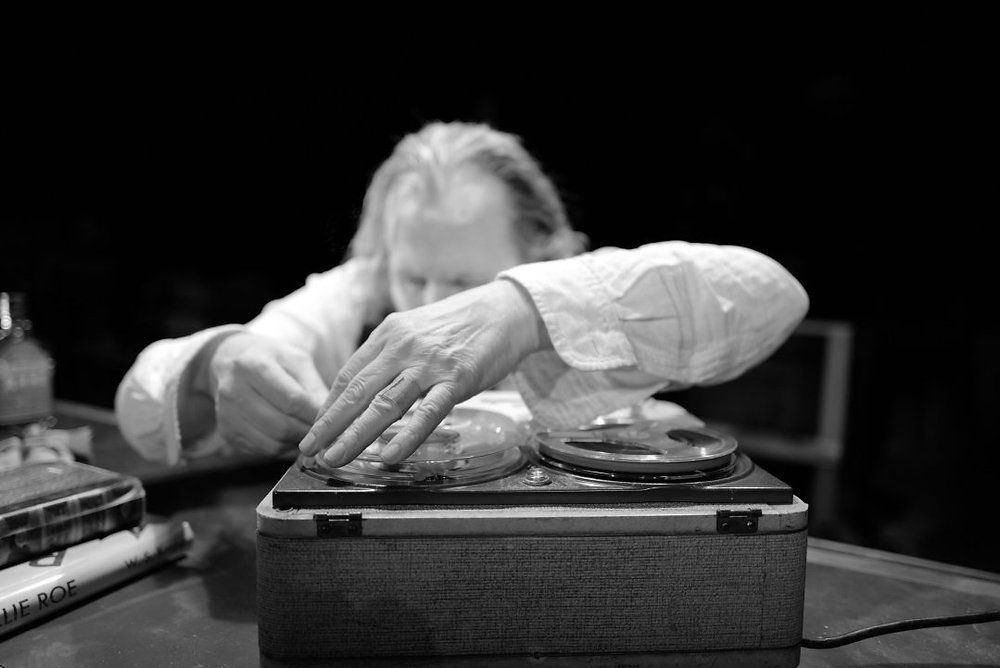
From there on out, the lighting casts singular warm orange hues suggestive of a faint flickering candle, like the old and weathered Krapp whose own flame is slowly dying out. This effect naturally forces the eye to strain upon the dimly lit Krapp, central and stationary at his desk. The viewer focuses and mentally blots out the surrounding disorder that engulfs Krapp, just as Krapp himself has self-sequestered from all outside of his spools. This sense of focus is reflected by the tape recorder’s lambent lighting. Almost spotlit at times, Rippeth often frames it rather than Krapp as the protagonist, with the latter relegated to a shadowy supporting role, as if Krapp has become subsumed by it, consumed by this regressive manifestation of memory and reminiscence.
Historically, this tape recorder does hold significance beyond Oldman, being the same prop used in both John Hurt and Michael Gambon’s own performances of the play. In a way, just as Krapp is, Oldman himself is recording his own theatrical spool in this Beckettian catalogue, inevitably imparting a piece of himself onto its history. Just as much of Krapp’s Last Tape is autobiographical for Beckett, these gestures to the real world in the reused prop imply a personal connection between performer and character, between Oldman and Krapp.
Having made his professional acting debut at York Theatre Royal in 1979, Oldman, just like Krapp, is here revisiting his past. In this sense Krapp and Oldman begin to intertwine, as Oldman uses Beckett’s framework to explore his own feelings of regret, nostalgia, and professional self-reflection, as well as anxieties about his life or career moving forward – Krapp’s Last Tape is set “in the future” as Beckett’s stage directions read, after all. Oldman comments on the venue directly in his short piece within the programme, Returning Home, saying of the theatre, “This ancient building still holds many charms, but has undergone some massive development […] Yet, despite all the structural upgrades, the same old challenges remain”. Much like his debut venue, Oldman is gesturing throughout the play towards his continuous journey of growth and ‘development’, and the ever-looming hardships that undercut life.
Paired with this, the production also finds itself in the heart of Oldman’s sarcastically self-styled ‘alcoholic period’, the actor having recently played a succession of alcoholics on screen – an era Krapp should feel right at home in. Himself a recovered alcoholic, the presence of alcoholism is not just significant in the play but uniquely highlighted by Oldman. Whereas Beckett’s textual Krapp routinely drinks his gallons of liquor offstage and hidden from the audience, Oldman thrusts his version’s alcoholism into the limelight, unabashedly drinking onstage throughout the play. It becomes a highlighted element, and coupled with Oldman’s own history and dramatic themes of retrospection, this Krapp’s Last Tape in part morphs into a precautionary tale of where alcoholism can lead, what an alternative Oldman could have become. Perhaps even an honest insight into the ever-present spectre of regret and danger of relapse.
While on the whole I did feel that these, among other small changes, did peel back some of the more impactful moments of Beckettian absurdism, overall through these adjustments there became a clear vision and intention to build upon the text and uplift Oldman’s personal commentary.
A deeply pensive production, it is this introspective insight that elevates Gary Oldman’s Krapp’s Last Tape beyond simply an aged Hollywood A-lister trying their hand again at theatre. Every element of the production intersects and weaves together to both uplift the themes of Beckett’s masterpiece as well as to breathe life into Oldman’s new interpretation. With an audience eternally suspended in a deathly entranced silence – barring the odd banana bite laugh – it was an incredible performance to experience, as he simply is Krapp (perhaps for the first time a review means it as a compliment). Oldman concludes his aforementioned programme piece hopeful that his production will galvanise interest in the theatrical. One can only hope then, that just like in the case of his long line of predecessors, this won’t truly be Krapp’s last tape.
Featured Image: Giselle Schmidt