Categories
Creative Writing

Katabasis


By Jude Kirk

Epilogue

O’ Muse, tell me how, tell me why, the strange Fates must warp my life, time and time again.

It is the fault, not merely fate, that wounds me so. My own fault, being who I am now and knowing who I was, then. But before it all, I was someone.

I used to be known by many sharp names: The Thracian bard, the father of songs. I used to be somebody, with hopes and dreams and constant, moving ideas (people become something and then nothing so quick!). I used to play gracefully. Used to sing sweet, sombre poetry; a thousand tales of a thousand men and women, a thousand lives more. But what was once a power is now a flaw, and the only flaw I know.

Now, there is only one story within me. Only story one left to tell.

O’ Aphrodite, sea-born scheming mother, I doubt you. For I believe that there is no love greater than mine. There is no love more empty, more critical, more crucial. It is what Love did to me that I must lose – and there is nothing to my love but losing.

Muse, give me the courage to tell this story, a final story, for me.
I

Three days the ceremony lasted. Three days the sky remained empty.

Hymenaeus, that dark-eyed decisive God – God to all those happily wedded – denied our calls each time. He gave no lucky omens; He brought no gifts. And in the sky, the throne where He should have been seated those days, remained vacant all along.

These were quiet days, but happy days, to me. They marked the finest days of my life. I anticipated the future in each and every way, for I felt within me such warmth. There was so little time to notice the unsettling absence of things. And my heart was too full to realise the continuous dearth of that God, and what it must have meant.

Alas, the next few days were all done in vain.

—

The first day of our wedding, we and all those in attendance had sung up, up, up into the sky, calling Him to acknowledge our holy union:

“Hymen, O Hymenaeus, Hymen, be present!”

He had not heard.

But there was always tomorrow. 

For the days were young! So young, and I was younger, happier, and looking out into the shared future before me with nothing but hope. What a joy a wedding is: to love someone in this way, and to have found this person by some grand chance. I was overwhelmed by my own luck.

In the evening time, whilst Eurydice offered her ending childhood days to lovely Hera, to swift Artemis, to Aphrodite, I poured out the libations to Hymenaeus, of thick gold honey. The air was cool and calm, and I waited for Him to come. But He remained silent to this first offering; the honey was not lapped up, nor was the incense enjoyed. And so, pouring out the libations for a lucky life, it was all fruitless.

Late that night, I imagined Eurydice in preparation: water streaming down her back and through her hair from the fine loutrophoros that had been gifted us. There and then, she had been cleansed of everything. I could imagine her, shiny and new, returning to her bed chamber to sleep alone for the last time.

Eurydice, the girl, then the woman, now nothing at all.

I thought and yearned to the point that I felt nothing within me but ironic fortune, and when Hypnos slipped his fine fingers across my eyes, I let the happy dreams come.

—

Day two was our union as husband and wife.

“Hymen, O Hymenaeus, Hymen, be present!”

And again, He did not hear! No, he was not there for Eurydice’s final moments in her father’s house, nor was He there for the splendid sacrifices made to all the Gods of Olympus. And again, I saw no reason in thinking of it too much. How could I think too much? For when I saw Eurydice, my Eurydice, with her oak-coloured eyes, and that day – that fine, beautiful day – she had flowers in her hair like Persephone, I need not think. Oh, no music, no prose of praise could preach my love for her as I do now! No love, no vivacity, felt greater than mine. It stays true, still.

So, lifting the veil to reveal her smiling face, I knew. Knew that I would never need nor want no other woman in all my life. That there would be no doubt within any ounce of my being in marrying her. That my songs may recount an element of my own longing for her, one day. And that day would be the greatest day in all my years, for in them would reveal the truth of my love.

For a striking moment, looking at her then, a sting of fear struck me universally. The knowledge of being unwatched, unprotected, passed through. There felt to be no God shielding us, and it might as well have been so.

It was a moment, in between a moment, but it seemed to linger there.

—

That night, I had a strange dream: Hymeneaus, dark-eyed, decisive, holding a torch of smoke, that would not alight pure flame.

—

Day three was the unluckiest of all.

Eurydice’s move from her father’s house to my home, her home, ours. I thought we had escaped an unhappy fate, and we were alone together at last.

New pots and perfume, jewellery and fine furniture lay across the darkening room; it was a life unlived, new and strange and exciting.

Finally, the liveliness of those days swept off our weary bones and Nyx – source of sweet repose – drew the dark curtains forth. I would have been happy to lay with Eurydice all night long, hand in human hand. If it were not for that night’s greatest woe. For when I thought it was all over, and my eyes begun to tire, to my surprise she called:

“I would much like to go out again, tonight.” She said, in a thin voice. 

I looked at her in a confused way, as if to say: How could you disturb this stillness? This final peace? 

She took my hand in between hers, hands of white and purple-veined marble.

“I want to remember this night.” she spoke. How could I deny her this?

“Shall I come with you?” I said, “A walk together, perhaps?”

She shook her head, that I could see. She did not explain why, and yet I knew: we had so much time to spend together yet. So much Time.

So, I let her go. Knowing that we were from henceforth never truly apart, or feeling it. I watched her go.

There were no stars that night.

—

I did not sleep. Could not sleep, for I finally felt a tickle of misfortune. I was right in feeling thus.

The Gods fell into their pleasing slumber, and Hymenaeus turned his back from Eurydice a final time.

To this day, I know not why, I know not how, cruel Fate twists and turns in that way it does: how it had to come then, so early in Time. For when Eurydice was walking, walking along the quiet, still plains of forest with the Naiads in her attendance, some kind of ruin slithered in.

I imagine it (with torment): for as she was speaking softly, suddenly all the flush spilled from her sweetened face, and her eyes lost their glimmer, and all the life around her begun to spin, and in doing so, gave way. In one fragile fleeting moment she fell, silenced in the dead of night by a serpent’s bite.

Muse, how am I to go on with this story?

The one that is only beginning. The one that is my end.
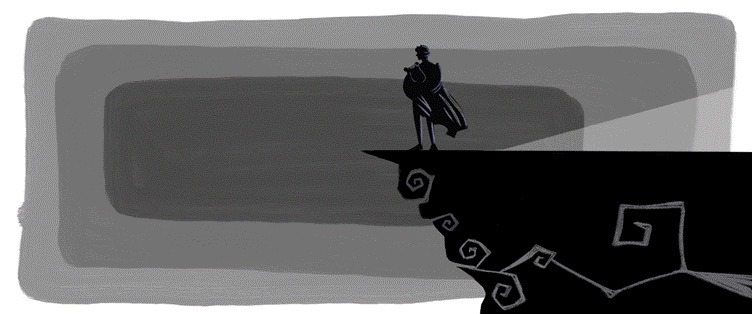
II

No words, no prose of praise can relate how I felt that night, how I have felt ever since. 

I mourned the days and nights away, mourned the outstretch of time altogether, until there was nothing to Life but Waking and Sleeping. Some days it felt that I had grieved her to completeness; I was so full of both love and loss for her. It was an emptiness that no life could fix, and everything at once became very silent. 

I was a coward, you know. Too sick with sorrow to attend her funeral, to see the truth before me. And yet I could think of nothing but Eurydice, my Eurydice, and the many years taken from her, the opportunities, the possibilities of a life full of uncertainties, joys and sorrows, for both of us.

Pots and perfume, jewellery and fine furniture, collecting dust. No lady at the loom. No one to play fine sweet music (for in losing her, I was lost too). I have lived my life, and here is the rest of it.

The night of her funeral, I went outside, where the ocean was completely still and cried:

“Hymen, O Hymenaeus, Hymen, why have you betrayed me so?”

I received no answer. That silence was the worst part. 

—

Another night, and again I had given up all hope. I felt – not just felt but knew, deep down – that I had mourned too long in that Upperworld without remedy. 

And there I found a thing to do.

Half-alive, half-thinking, then half-filled with hope, I considered a journey, lower. Would I dare? How could I dare? My stomach curdled at the thought! But with it came some strange comfort: to exchange this miserable life, the monotonous days, the come and go, the uncertainty of everything when alone. No, no, I would trade it instantly for some chance to see my wife. There was so little risk in doing so, I felt. For with my greatest fear come true, what more did I have to lose?

Rare it is for a soul to see the Underworld with living eyes. Rarer is it for a mortal to know the pure vastness of that realm. 

This is all I knew: First, to get to the Stygian world, you must enter through the gates of Taenarus, where son of Leto cannot reach you. To enter truly, escaping all six eyes of Cerberus is your only hope. Stop, anything deeper I could hardly fathom.

I knew that there was nothing else that I could do. I was nothing on my own, but with music I had a kind of power. My grief too made me ambitious, but also reckless (so, so reckless). I knew I was not a fighter. Not a hero like Hercules, nor a thinker like Theseus. All I truly had were my words, my music, so little left for me.

—

What was once a power is now a flaw, and the only flaw I know.

I found my way there.

The sky was like a smear of fire (it is the only clichéd way of describing it), and the tide was low and unending; it was unsurprising that Icarus yearned to indulge in one or the other. With me I had nothing but my love and my lyre, ready to play music again in search of half my soul.

Finding the entrance, abstracted just above the shimmering water, was the most beautiful thing I had seen in so long. For within I knew Eurydice was there, somewhere. 

Entering the cave, another kind of darkness seemed to seep in.

I walked through pure darkness, and whilst every nerve of what was both human and mortal within me begged to turn away, back to the place where the sun shined, I kept going. I don’t know how long I walked through that darkness, that silence. Through it all I felt an overwhelming melancholy, a familiarity. That space felt nostalgic to me strangely. 

Eventually, the terrain beneath felt unsubstantial, and waded back and forth, as if uncertain of itself. I found my footing.

Timeless, colourless, shapeless minutes and hours passed me by. Fatigue fell through me unhappily. But there was no time in thinking thus. For, soon enough, I heard the barking.

—

Cerberus, who was so large, so looming that I mistook it for some great cloud of shadow, I saw in front of the gates. Abandon all hope, ye who enter here. I dared not go close, too scared of the beast. How surreal it was to see the creature I had only heard of. Fear took my breath away. But Survival does what it needs.

So, to soothe the barking down I began to play my lyre, just like I had once done in life, to men and fine ladies, to children. To Eurydice, to send my darling to sleep. I played to a monster. And to my surprise it worked: those strings quieted the creature; soon enough all three heads were thudding to the floor, six inflamed eyes weighing closed unwillingly.

This victory infected me with Ego, and I was foolish enough to think it easy – for going further down, there seemed not one thing I could not dismiss with my song. 

I passed the paws of Cerberus and entered through those gates with nothing but Hope.

Time passes. Eventually, what once silence become something solid again, and I begun to hear water being poured into a cold windy cave. It sounded almost living: finally, something real, something solid against something else. It was the closest thing to certainty I had experienced.

Then I heard another sound, rising upwards and through me. Hundreds of sounds, sharp and piercing, echoing like half-formed memories. I knew not what they were until I saw: the ideas of people once before! Some wailed, some raged, some were completely silent. I saw them, barely, those insubstantial spirits of the dead.

Sifting through the absent crowd, I found the source of that fluid sound.

The Styx was a long narrow lake, looking like a plane of marble, black and unsettlingly calm, nothing like those wine-dark oceans back in Thrace. From a distance, it almost looked like peace. Before it, stood the man, the judge, who had only been a myth to me prior.

But Charon was not what I expected, for getting closer, he looked like the saddest man I had ever seen: what a thousand lifetimes of solitude and nonexistence does to you, I wonder.

“These are the souls who have not received burial.” he spoke, “feel pity on them, but do not help them. You cannot help.”

Then he looked down on me and must have realised my living soul.
  “You are still living” he said, “you don’t belong here, yet.”

His voice was slow and warbling. Here I knew not what to say, for his message was clear and simple. I tried to offer him an obol, shiny in that watery darkness, but he denied me this.

“You are still living.” the unhappy thing he repeated.

So, I had no choice but to give my lyre a second try. I played a very sad song, bringing tears to both my eyes and his. And to my pride it worked a second time; Charon offered me a seat in his tired little boat and slowly sailed me away, and did not speak nor question me.

I watched the thousand souls behind me then, crawling on the dead shore, wailing still, as they drifted from my view and into darkness again.
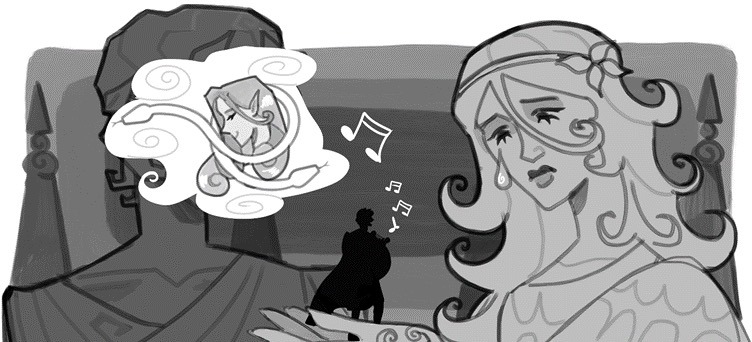
III


Looking up, I could no longer see that shining entrance which I had once entered

through. Everything above me became pure nothingness.

I landed onto solid ground, paid my obol, and with it my respects as Charon sailed away.

Here was a place I could have never quite imagined. Whilst the oceans of the earth seemed endless – but had an end – the landscape before me showed no sign. The lands went on and on, in layers before me. Each of them was filled with shades, but only a low humming sound could be heard all around, tuneless and formless.

My living body reminded me of its mortality by this time; I had been walking so long by now that I had begun to exhaust all of myself. This is how I came face-to-face with the rulers of those unlovely realms. In pure exhaustion, in pure desperation. 

Muse, how frozen I became, how powerless. For as I was wading along, I wasn’t yet aware of their presence. It was only until I looked up again and saw two exquisite thrones looming high. Soon enough shapes became recognisable, and I found myself looking into the deep, distant eyes of Hades, the gate fastener, and his wife Persephone. A God who could not yet see such a small insignificant life. No, I could hardly see their cold, still faces so high up there in the dark canopy of sky. They were eerily still. Nothing is ever how I imagine it to be.

Persephone was the first to see me; wasting her time best she could whilst stuck there. She was indeed a beautiful sight, from what I could see. It struck me so. How, oh how, could Eurydice be here, too? And how, oh how, do beautiful things leave so fast?

Eventually I caught the attention of Hades, who, in moving his head to see me, silenced every spirit with fright.

“How did a mortal make it to the land of lost souls?” 

So he spoke. And all the absence and uncertainty in that world became very clear, substantial in his voice.

There, then, I did the only thing I could do. Standing there, I began to play a final time.

“I am no hero. I have not come to see Tartarus, nor to bind the three heads of Medusa’s offspring. I cannot be who I ought to be since fate took my Eurydice away.

I have come on this journey in search of half my soul. For whilst we were together in life, a serpent snatched away her budding years, and left me here, alone. I am at my wit’s end!

Blessed king, blessed queen, believe me, I will not deny that I have tried to bear this grief. But Love has overcome me! If only you could see this grief poor mortals suffer when their lovers are turned away from them. Magnanimous Hades, may you please unravel the fates of my wife, too quickly run? All souls must return here inevitably, so why not rejoice in the death of two, after living our one good life? 

Hades, think of those cold months away from your wife, the thing you feel: though the time is mere seconds to your immortal eyes, you must feel her absence, still.

Persephone, do you miss your divine mother and her living seasons down here? Every half year the whole world knows she grieves for you. Please, give me this one hope.”

As I sang thus, playing my song in so great a melancholy, all the spirits of the Underworld cried out. The sounds blared into life in an echo. 

I saw Tantalus – yes, that most selfish fool – stop reaching for his uncertain desires, and Ixion’s turning wheel halted, wonder-struck. It is true, that Prometheus’ liver escaped the vulture in that moment, and all fifty daughters of Danaus halted from their futile labour. Sisyphus, for all eternity, forgot about the endless pushing of his boulder. Even the Erinyes stopped taking vengeance and wept, for the first time.

And for a moment – so brief a moment – I thought I saw a change in Hades, too.

He spoke nothing, for a long time. Only waited for those sounds of universal suffering to shuffle down, down into whispers again, until all was achingly still. I waited, so frozen with both love and fear, to see what they would do.

Persephone looked at her husband, her partner, a friend or a stranger. Her eyes seemed to glisten, and tears fell from her cheeks, like pearls. It was liked it begun to rain. 

Hades gave no sign of censure. Only began to kneel lower, so that his hand lay fisted before me. He opened each finger one by one, and there, in the palm of his lifeless hand I saw her.

Eurydice, my Eurydice! She who walked in steps halting, still affected by that pain which ended her.

But it was strange, for she was not fully herself: she seemed not to walk upon the ground. Her face I could hardly see, her hair drawn across it, as if caught in the wind, though there was none. She was an idea, still new, still clearer than the many shades I had witnessed.

A Eurydice half-formed. I thought: what can I do?

Before I could answer this question of mine, the divine king spoke:

“Do not look back.” Hades started, “Go forth from the valley of Avernus. You may not speak; you may not play your song. And do not turn back, for if you do before you have returned into the Upperworld, the gift before you shall all be in vain. In doing so, she will die a second time.”

The condition was clear. And so, I did the easiest thing I could do. I walked. Walked out through the darkness and the stillness, from whence I had come.

How was I to know this would be the hardest challenge yet? For whilst my other trials had one certainty in them (I knew I could play music with psychagogic charm), this was simple and vague and uncertain. How was I to know this was not some cruel trick, used to cast me out of the Underworld?

This is my worst flaw of all: Doubt. 

—

We walked. We both did, I know now. We marched up, up up that sloping path, through places of utter silence. Steep, indistinct, and dark. I imagined our wedding bells, and echo, then. Our house built for two living souls. I imagined a lady at the loom again, my darling there to sleep beside and to wake up beside. I remembered that none of it was yet real, and grieved her for the thousandth time. My eyes begun to well.

Each step away from that place felt like I was walking a lifetime away from her. The thought bit into me incessantly. Her form behind me, forced forward like a string pulled too tight. I was more scared then than I had ever been entering.

I heard no footsteps, no crunch in the rubble, no breath nor echo. I denied my temptation for clarity.

With no music to play, no quest but this, it took many hours or days until I saw that square of light again, though it felt like years. And then that light became something living. I heard sounds that I had almost forgotten. That monotonous ocean in its high tide, almost feeling the day’s warmth across my face, as if nothing had changed. I could smell the salt of my home, her home, our home. Could feel the fullness of the air lift up into my lungs and carry me away. And I knew that I could bear it no longer.

I, so afraid that she may fail me, eager for sight of her, touch of her, smell of her, turned back my longing eyes for only a moment. And in doing so, failed her. 

Oh, how beautiful she was! No longer was she a memory of herself, but a real living thing again: all the colour in her sweetened face renewed, and the glimmer of her eyes had soul behind them. I thought I heard a breath from her, a laugh from her. Felt her touch. I imagined that it would start again, our life: there was a pause, yes, but it had all returned now. We could keep on going. I, for one so foolish, was giddy with glee.

But then, I saw her face, fading how I must have that woeful night. Again, the colour faded, and the soul disconnect from her heart, and she slipped away, away from me and backwards, like a strange dream. I watched it happen this time. And I tried – Gods know I tried – to catch her, but my arms only held still air, unbreathed.

It is a sadness that wraps around you. It is a cruelty brought unto me. I have nothing to blame now for her early end, no snake to strike. It is me to blame, and me only.

Standing there, the living world behind me, I watched her go.

If you have read this far, I cannot help but thank you. No one has ever listened so long, and I have never had such a truthful song to sing.

———

THE END

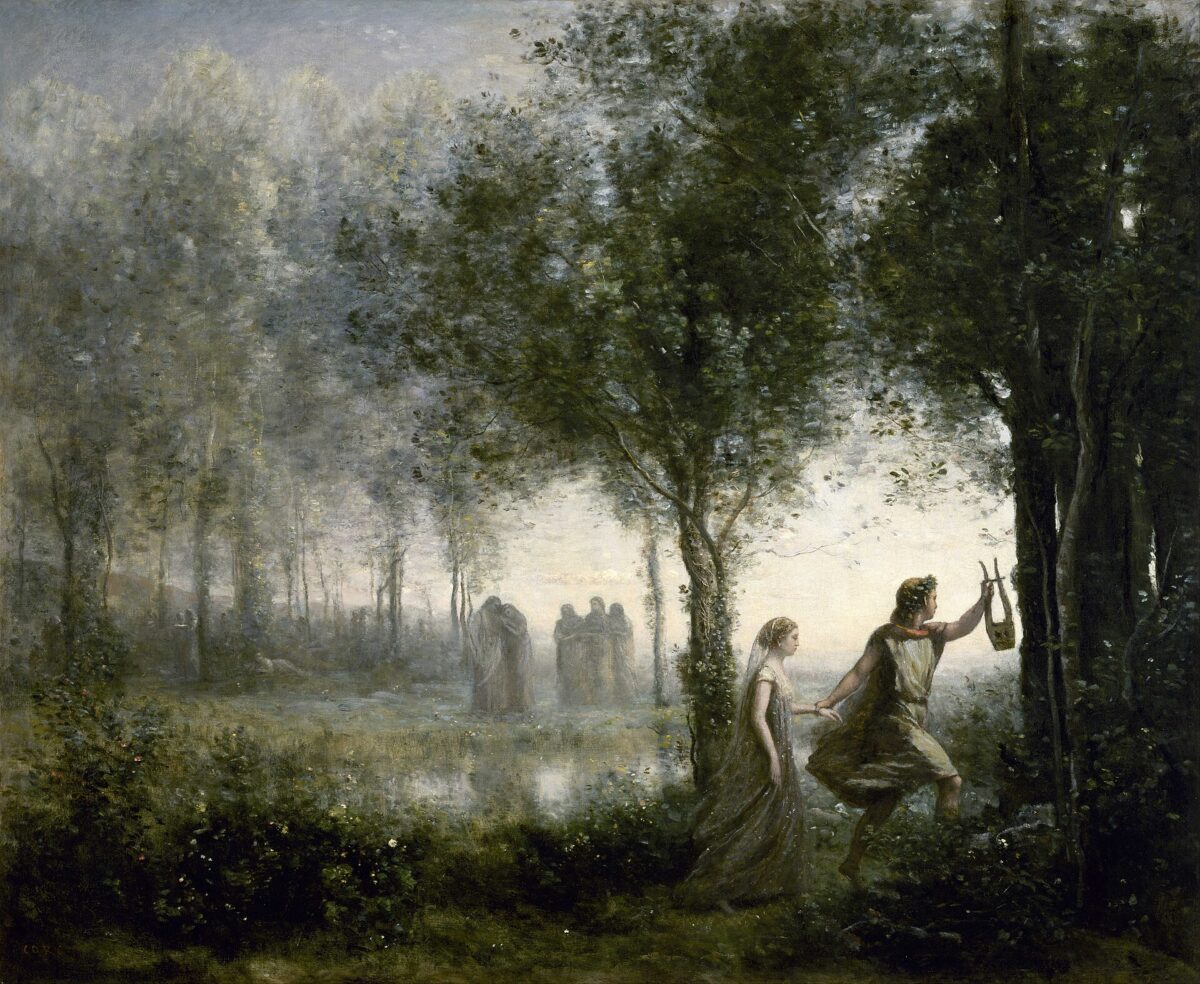
Featured Image: Jean-Baptiste-Camille Corot, Orpheus Leading Eurydice from the Underworld, 1861, Museum of Fine Arts, Houston.

Categories
Creative Writing

Growing Pains 

By Jude Kirk

Fragment of ‘Dear Benjamin’

Another letter to you, my dear. This time, let me take you back to the summer of your seventeenth. 

This was the moment I gave up my doubts. 

I was painting in the greenhouse, early August. Your favourite month, your birthday month. I had gone hiding there in a sulk, half-knowing I’d be so easy to find, to you. And to anyone who just about went looking. It was the middle of the day with the sun at its hottest and its highest; The unbearable kind that makes it hard to find the air between the heat. 

I had been sick for months by then. We still didn’t quite know what it was, but I hated it and it was horrid. It appeared to be something like pneumonia, something horrid in my lungs and closer to my heart. The bout with “pneumonia” then, had me thinking that summer may be my last. I had not been sleeping well either. When sleep did creep over to me with heavy hands, he only did so in brief snatches. Morpheus was not being kind to me. Not much was. It felt like fainting rather than sleeping. I can’t imagine how I must’ve looked!

This illness was an excuse for my silence, also. I was not usually so quiet. I could not explain to anyone what other fevers had come over me that summer. And so, it was a blessing of a sort, the horrid sort. And as the sickness eased away in that sickly sweet summer heat, so too did my mind return to me, and with it came you, again.

“You should get some air, you know.” 

I hadn’t heard you come in, and the first pitch of your voice through the stillness had my hand unsteady. The painting I had been working on was horrendous anyway, despite my heavy focus. It was never the canvas I was focused on, nor the colours nor the brush strokes, but some very distant thing I couldn’t quite reach when I awoke. 

I threw the brush down, and it hit the palette with a feeble little clatter. I wanted quite suddenly and stupidly to rub this entire painting into an even more horrendous blur, only to tell you it was your fault. But I knew that the moment I saw your saddened face I would be the sorry one. 

And then: “Sorry!” you said, quieter this time. With the way you said it, my bitterness was gone immediately. I shook my head, pulled myself from my own haziness and finally pushed myself to meet your gaze, one of the very few times that vac. 

You were hovering just by the door, as if waiting for permission to come in, as if unsure if you should disturb the apparent peace I had made. But the peace was only a distraction, and there you were to break it! You were already looking guilty, something that had become increasingly irritating for me to watch. 

I only got to see you in the summers then, and how I had missed you so throughout the long months away. But things always felt underwhelming in the end, and the anticipation might’ve been the best part. I could not tell you half the things I wanted. And I never wanted to lie to you. Being with you, especially that summer, felt like a wound. I think all these things vaguely when I see you there. I can hardly bear to look at you. 

When I looked away from you, you lingered still. I then felt your head near the crook of my shoulder, the heat of your face there. 

“What’s that meant to be?” You asked 

I huffed, and it hurt my chest. “It’s abstract. Some things aren’t meant to be understood.” 

“Well, if it was never meant to be understood then what’s the point of making it? That’s not the point of abstract art, is it? It’s… subjective, or something like that…” 

“Oh, shut up” I huffed again, despite the hurt, I liked the distraction it gave me. I threw one of my brushes at you, which you only just dodged. 

You laughed at me, your breath coming out warm and heavy near me, like a dog’s. I knew then that I had to get away from you, and I headed to the door, suddenly enthusiastic of our reluctant trip. 

But you were looking at the painting still, even as I waited by the door for you. You must’ve seen every brush stroke, every flaw and every unfinished thought. You had reached that time of summer where your face tanned and your hair was bleached in the sun, and all your freckles came back. I felt myself flush, and for a moment, I was glad for the heat. 

You brought your hand up to it, pointed at something I could hardly see, your hand arched in the air as if that explained what you were seeing or maybe even feeling. “It looks like the ocean to me.” you said it softly, so softly “And that – this grey thing back there – is like a boat.” You grinned and looked back to me “Do you see that?”

I shrugged. I had been trying not to think too deeply into all I had been doing. 

★★★★

This is one of my favourite memories. One of my favourite, worst memories. 

Summer is a rotten season. Everything rots, including myself, and everything is in flames. But I knew you loved it so. I knew that you thrived in it, unlike everything else. Your joy gave me a reason to meet you there. 

If I was going to die that summer, I wanted to at least leave a bit of my truth behind for you to find. I couldn’t imagine leaving you nothing. This was the summer a legacy came to mind, this idea of a thousand plus letters just for you. I knew it would be easier then, to be around you with a goal in mind. 

But what I also knew was that you were getting at least a little tired of me that summer. You did a good job at hiding it. But you’ve always been a distant soul, haven’t you? I know, I know, that doesn’t mean you don’t care. I think your distance – my reaction to my own solitude – said far more about me that summer than it ever did about you.

 The air was too much; Too sweet and warm, as if a whole world had moved on without me. I felt dizzying underneath it all. 

I sat on the bank near the river. The sun was too bright on the water, beaming at me in the eyes that I hardly looked up to be blinded by it. I stuck to the safety of a familiar notebook, a familiar pen and then, the unbearable horror of no ideas and an empty page. The page before me was also too bright, too empty. everything was too much. I was becoming more serious about words that summer. Silly because I was only sixteen but already felt quite old. But I was wonderfully naive, and my words proved it so. My poetry, too flowery (which is a trait that you’ll know lingers even now).

Stupidly, I could only write good poetry when away from good things. There was so much I had been feeling that the words strung themselves together before me every night and I would feverishly have to write them down, in the dark, before I had forgotten them. Reading them the next morning, hardly ever knowing what they meant. I supposed I was quite annoyed to see so much of you that summer. If I really thought about my own soul, I would realise that I was unhappy.  But I did know that then, in a very abstract way; I knew a lot of things very vaguely. I knew that thinking about the wrong things for too long was dangerous, without Passion on your side. And it was even more upsetting, because everything I wrote and everything I seemed to read, always brought me back to you. 

And how could I avoid you? It was infuriating, in a tantalizing way. You were in every word, in every space in-between. How overcome I was with my affection for you! How overwhelmed. I didn’t mind the thing blooming inside me, no: how much would it inspire. But as the feeling lingered, through the winter of last and then spring and now summer, my words became separate from me.

It started the summer of 1915, and as the year elapsed, I thought I’d come back to you and be able to shake your hand and call you merely a friend again without it feeling like a half-lie. It had only gotten worse. 

Your face changed so much over that year. You have gone from boy to man quite quickly. But I don’t want to start writing about how you look to me, not like that.

So, I have gone off into far too many tangents already, my dear. My dear, but I know you’re not mine. But I thought you were, then, or perhaps you could’ve been, one day. In a very distant way. Thought of a future was almost dangerous, because I think I knew, even then, that half my lifespan was up already, at sixteen. 

★★★★

You were shirtless in the river, with your back to me. Your muscles were strong but still soft from the ballet, which you recently confessed was starting to get tougher, and you were starting to have a hatred for all its demands. 

I wanted to join you, in the river, but I was still sick with my lungs, and I was too scared. A piece of me knew that as you stood there, looking just a little older in your years and a lot wiser, that when I stood before you, I was only aware of the pallor of my skin from so long indoors, and the ridge of each rib that would have made you worry, like you always, always do. I felt suddenly like I would dissolve in that water like paper. I felt the weakest I ever had. The discomfort is why it lingers still. I was feeling a little more defeated than I was pretty, and you were the swan instead. But I like to think that if you asked me to join you enough times and with that same smile, I would do that, maybe. Maybe I wouldn’t mind how you would worry, if it made you happy to have me there. Maybe I would come to you, and let myself sink into the cold water up to my chest, only to feel the coolness of it lapping at where it burnt to breathe. Or maybe I wouldn’t. I probably wouldn’t, would I? That would ruin all the yearning. And I’ve never liked an ending, even to painful things. 

But this: you, shirtless in the river, utterly unaware of anything but what was in the moment, with your eyes and your hair and your lips, this is the vision that accompanies me nightly! A man like this. How lucky I am, I thought. And how cursed. To know you but to never really know you.

I sat on the riverbank, and, wincing, I tried never to look at you. When I looked at you, I seemed to find a few words to write. Then I imagined what I would say or do when you – like you always do – ask to read what I’ve written so far, only to find yourself so intimately on the page. I could imagine your disgust, you know: The slight, impartial look of wide eyes, the wince you’re trying to hide to remain kind. Your lips parted – though we both know you will not find the words – the gap between your front teeth to remind me that you, like me, were just a boy still, despite what we say or do or think.

I stopped thinking and wrote this in a very sleepless daze:

August 22, 1916

You are καλος κάγαθός. You are so sweet it’s almost bitter. I almost don’t mind playing The Fool. 

To you, I give you my heart. For you, I’d do a thousand things, write a thousand horrid words. 

Though there is something comforting about being hopeless to you. I’m hapless to this thing I call Desire, this fragile thing I can never share, because the entire world hates it. I am hopeless when I imagine nothing in between us: the horrid, beautiful creature you are and the curve of your lips, the cruelty of my name on them, short and melodic. The maddening thought of you in my bed for sleep and for love (however you like it, whatever you want). The thought of your head on my pillow, and how the smell of you would linger there, further, further on. 

The thought that if only for a moment, you gave up this thing you call Morality, and let me in.

The vile notion of how I could make you move or feel, if you gave me the chance and you gave me the time. 

I think of these things in brief moments like gasps. I try not to go beyond the act of thinking, and yet you linger, still. 

I don’t mind the thought that my bed is empty without you in it, my words rendered futile if they are nothing but You. 

And I do not mind your lingering, even if you are the furthest thing from me. 

You will never know this agonising thing some try to give a name. 

You are, in more ways than one, καλός καγαθός.

After I wrote it, I read it once, then twice and then another time. On the third time I laughed, because although pretty, I could hardly understand where the words came from or what they might’ve meant. I thought that if I was going to maybe one day write a wonderful terrible novel to mark my debut, this should be an addition to it. A terrible speech marked onstage. Though I already knew I wasn’t going to read it again, after that day. I didn’t want to put it into context. I didn’t want to know what it meant. I was a living contradiction (am, still), and I both loved and hated it. All I knew was that I liked the sound of it, that was all. If it were a song then I may only recall the tune, not the words. 

Then I heard another thing I liked the sound of. Suddenly aware of your laughter, too. 

“What are you reading?” you called out. I had to wince to find the features of your face.

“Words” I said, pretending to put pen to paper if only to distract myself, to stop you from calling to me. 

“Well, that’s a bit vague.” 

I then let myself plummet back like a defeated thing. I heard you coming to me, barefooted on the grass. Blocking the sun with your silhouette.

The sigh that came from me then was pathetically sad. 

I pulled out a fig I had picked earlier (stolen, really, from a neighbour’s garden). When I split it, I found it filled with maggots. You seemed horrified, even more than I. They writhed in the pulp, what was left of it, and in between the seeds. I looked at it in a strange way, as if expecting Summer to prove itself and all its awful ways at some point.

“Don’t eat that.” you said, wide-eyed. Then you snatched it from me and threw it in the river, hearing the dull plunk that disturbed the glassy water. “Do you always have such bad luck?” you said it teasingly, but I felt the truth in each word so hard it made me tremble.

(But you’re not bad luck, I thought. Or maybe you are, if it meant I couldn’t have you). 

“I’m not blind.” I said it with sarcasm, but I always had a weakness for your affection, like a dog’s. 

You smiled at me, and went rummaging in your bag instead. I waited. Whilst I waited, I tried breathing, if only to stop my heart from beating the way it was. It thrashed so hard it almost made me nervous. And whilst you did this, I tried not to look at the smooth, cool plane of your back and the curve of your spine. I was so feverish I wanted only for a moment to feel the coolness of it from the water, soon to be dried by the sun.

Whilst you looked, so calm you seemed to me:

“What are you writing about?” 

I didn’t really know what I was writing about either. That was true for the most part. Because if I was going to lose you, to anything at all, I didn’t want to forget even the discomfort. Discomfort like this. 

So: Words, I said again. You laughed. 

 From your bag (which was filled with far more than either of us needed and mostly with things you would never use) I felt it before I saw it. You had thrown it at me, and whilst on a regular day I had reflexes “like a cat” you once said, today I was quite the opposite. As I turned it hit squarely in the face. The force of it burnt hot and red, and I clapped my hand over my nose, mostly out of embarrassment. 

“Oh my god!” you were so panicked you almost tripped over your own legs when you came to face me. “Why didn’t you catch it?” 

“Why did you throw it?” 

“I wouldn’t have thrown it if you didn’t always catch things.” 

I glared at you or at least I tried. There was no point trying to be angry at you that way. My words were muffled, and I was beginning to feel queasy in the heat. 

“My nose, I think it’s broken. I think you’ve wounded me.” I meant that last part, really, despite the melodrama. 

Before I could even think, you were shooing my hand away and pressing the smooth bridge of my nose. You were so close I could feel the heat of your face. I winced, feeling half numb and searing and tingly all at once. But the feeling of having you so close was stronger. I was shocked when I found myself wholeheartedly sad that this was the closest you would likely get to me, and the only reason why. You weren’t looking me in the eye, but God, I couldn’t look away from yours. 

“It’s not broken.” You said, then caught my eye “God, you’re clammy.”

I shooed your hand away. “I’m sick!”

You shrugged. 

“You are sick if you keep saying it. It’s all about mindset.”

“Since when were you a philosopher?” I said, though it came out a sigh. I retrieved this orange you had thrown at me, which seemed rotten and ripe too, and started to peel it. It was flat on one side from where it had hit me. I pressed down on it there where the peel was too thin. I wasn’t going to eat it. Everything was making me feel sick, even you at some point. And I knew that you were quite used to my wallowing by then, my poet’s despair, because you laughed, sweet and warm. How were you to know I was truly, deeply unhappy at that moment? Even worse, how was I to know?

“Since summer started.” you said, as if in a flourish that explained it. And it did, for you. “Summer, which comes to save us just in time.” You laid down beside me, your arm over your eyes. You smelt like skin and heat. I think that will cling to me, always. I think you will cling to me, always, whether you know it or not. 

I wanted to stay there with you forever, you and me and oranges! Even though the oranges were too soft and too sweet and the figs half-rotten, and the river too bright and the air too humid. I hated it all but didn’t seem to care.

You weren’t lying down that long before you sprung up again. 

“Can I read what you’ve written now?”

 You were so terribly excited I didn’t want to disappoint you. Didn’t want to tell you that, no, my heart is thrumming like a caged bird when I look at you, and that at any moment I could be sick. 

“Let me read it to you.” I said, shocked to find my voice shaky. I don’t know what compelled me to read instead. As if in some way I could hide some pieces of myself behind a masking voice. I covered it up with a cough, in hopes of pity, to remind you that I’m sick. I don’t know why I wanted you to feel bad. You didn’t seem to notice. You laid back down again, eyes closed whilst I fumbled, pretending to find the right page. 

I read: “You are καλός καγαθός…”

I was hoping that if I read and only focused on the shape of the words as they left me, I may forget what it felt like to write them. I tried reciting it casually, languidly, as if I were not serenading you in some way. 

When I reached the final word, the silence was sickening. I dreaded it. If you had some vile remark, I’d rather you tell me now. Do not leave me in the dark, please. Do not leave me in the silence. I couldn’t look at you, so I waited for you to try meeting my eyes instead. 

“That was beautiful.” you finally said, your voice slightly whimsy, maybe drifting between sleep and something else. “Who’s it for? What is it about?”

“You tell me.” I said it with sarcasm, but you didn’t give up. 

“What do you mean? How should I know?” You liked answering questions with even more questions. Your smile was beginning to falter, even more so when I laughed at you. 

‘It’s like what you said: all art comes from somewhere. It’s abstract, subjective, as you say. So, you tell me.’

You then looked at me sadly. Why did it seem that everything I was saying to you I was saying wrong? I didn’t know what you wanted from me. Perhaps you wanted nothing from me at all. I hardly ever felt like I took up space. But for a moment there, I did. 

I knew you didn’t like to think for yourself too often. You weren’t all that used to it. If you thought, you would have realised, by then. That I am not the kind of man who will ever have a bride.

I knew you weren’t the kind of man to go unmarried or without children. I knew you were like a dog that way, following orders or expectations. And I knew that you knew that we would never talk about girls, we would never talk about Love. But you never even mentioned such things, not once. You were so innocent as you sprung through all your years of boyhood even then that it almost sickened me. Your innocence and my curiosity of you, and my concern, strange to me in myself. 

By that age (16, only somewhat aware of life, the in-between time), I was beginning to think that Wilde’s love was the only love I would ever be able to feel. It proved itself to me in the words I wrote, and the things I saw when I looked at Art and Life together, only to see them as one in the same. The Achilleus, the Antinous, the worship and the secrecy and the sadness. I didn’t mind being proven right upon seeing you and feeling such fleeting hope. 

I supposed that you weren’t like that. And if you were (oh, if you were), I would have had you already. I would have pushed my poetry under your doorstep nightly. Maybe, I would not have to write the poetry at all, if I could just look you in the eye and say it all with the confidence that you would be happy to hear it. I might have become one of those boys who picks flowers for his sweetheart, only to leave them on your desk or at your doorstep. Maybe I would join you in the river, if I knew that you knew.

I realised only in retrospect, that I never replied to the questions you were asking me. I think we were quiet for a very long time. Everything was very still. I don’t know how long I stayed like that, chin on knees, feeling like a fragile thing, with you lying beside me, feigning sleep.

I don’t know how long we had been like this when you finally broke the silence:

“I’m going to go back in, I think,” you said, and jutted your chin to the water, still too blinding to really see. “Will you come?” Your voice became momentarily unfamiliar, as if I had been away from the world for a while.

I felt a bit like I could cry. Or laugh. I couldn’t tell how it would come out if I let it. 

I said no. I said I was feeling horrid again and that I could hardly breathe, again. You looked at me oddly sad, but only for a moment, because that look in your eye was covered quickly with something else, I couldn’t quite understand. Then you smiled, and I couldn’t tell if it was real this time. 

“Let’s get inside, then.”

We walked back, without saying much. 

★★★★

In bed that night, lying above the covers. The dull terrible ache in my lungs had caught up on me, lingering still. I could hear the rasp of it still when I breathed. 

I was no longer in my mind, but my body, and I can feel its ache. So aware of myself in terrible ways. And Time was slowing down, when I didn’t want it to. I would find momentary peace in nightly revelations, only to realise they were not real. I was tired but again I could not sleep. I couldn’t tell if my body was tired or my head. But no matter which it was, it hurt like a physical pain. Like growing pains in my heart.

There is really no reason for feeling this way. That night I thought, half-asleep finally, that this feeling too shall pass. Summer will start to fade into chilliness, the leaves will burn a different colour, and the winds will return and sweep the stillness away. This sickness will pass within me, and I will be back at it again, with the sword and the word: all the usual things in my life I hadn’t really yearned for until I could no longer have them. And this feeling for you will pass. I will return to school by the remnants of summer, and you will become a desirable distant thing, which I can never have, and thank God I can’t have. You will be so far away by then that I will forget the pain that comes with having you close, seeing you shirtless in the river, having you care for me in that way you do. 

I’m writing this to remind myself of the pain you can bring, not in a bad way, my dear. You, the real you, is not a thing I want to forget. And that too shall pass.

I know this may not be an interesting story. I know that I don’t know many things, still. The same was true the age I was here. I didn’t know it would become such a favourite memory of mine then. I didn’t enjoy it at the time. 

There I once stood, and here I stand now, 24 years old, none the wiser, and the questions I had back then remain the same. There is fear of feeling and then fear of never being able to express it. Do you think, really, that being stuck all alone with that is worse? It’s like trying to scoop the seeping tide back in. Something hot and heady and unable to hold in your hands. 

I wonder.

Darling one, can you see me now? When you read my words, can you feel me? Can you feel my affection for you, in all my irritation? Do not doubt it, do not underestimate the power of words. Writing this all up with the intention of having you one day read it feels like I’m undressing in front of you. I am giving you my heart even when it is no longer beating, so that you may love me still, and know all parts of me, always. 

To be carried by you forever is enough. 

Now, I have already said much for one memory, haven’t I? If you are still reading these, I hope my words bring you some peace, my love. Some reassurance, whatever you may need it for. In all ways.