By Isabella Tarttelin
Complaining about the weather is our national pastime, as ancestral as a hot cup of tea, but these days, ‘terribly tense’ applies equally to the afternoon forecast and the morning headlines. As an unusually hot September day blurs the line between a changing climate and a turbulent political arena, it is time to look closer at how we talk about both spheres and find that they are not as separate as we have been socialised to believe. Through literature, film, and so many of the creative arts, there is a solidified dichotomy between the greys of metropolitan and the greens of Eden. Take, for example, the rise of Romanticism; William Wordsworth wrote an almost 10,000 line poem describing the natural environment as an otherworldly place that is entered through a deep spiritual understanding. I may not have reached the same development of my prefrontal cortex at the humble age of 20, but can I not claim connection with nature without having undergone some sort of spiritual psychosis? Or is the reality far simpler, and that the boundary between the human and natural worlds is entirely artificial, and everything we do is inherently natural, because we are? In exploring this question I’ve leaned heavily on Timothy Morton’s ecocritical work, The Ecological Thought and how the boundary between contemporary and natural are explored within the fields of creative works, particularly Seamus Heaney’s Field Work and director Martin McDonagh’s film The Banshees of Inisherin.
In The Ecological Thought, Timothy Morton argues that the modern climate crisis can only be resolved if humanity awakens to the reality of the deep, inescapable way in which we are connected to other beings. This perspective stands in direct contrast to William Wordsworth’s Romantic ideal, which relies on a lofty spiritual pilgrimage to access a sentient, separate, and capitalised ‘Nature’. To truly embrace Morton’s philosophy and reject this romanticised illusion, we must turn instead to the visceral poetry of Seamus Heaney. Written against the tumultuous backdrop of the Troubles, Heaney’s work shows a landscape entirely entangled with human conflict. In his poem “Glanmore Sonnet IX”, Heaney reflects on his retreat to County Wicklow. Seeking refuge from the violent political climate swarming Belfast, Heaney relocated his family in 1972 where they stayed until 1976, under the assumption that fresh immersion in the rural world would offer a sanctuary. The speaker becomes confronted by a rat, and promptly kills, following which he is wracked by guilt and shame for doing the very thing he moved for four years to escape from. As the speaker laments on line 5: ‘Did we come to the wilderness for this?’, the unanswered question underscores his guilt. By using the word ‘wilderness’ to imply a total removal, the speaker desperately aims to draw a line between human savagery and natural peace, instead revealing the boundary already collapsed. By fleeing Belfast for County Wicklow, Heaney tries to cross an imaginary border from a political world into a natural one, treating nature as a passive, neutral sanctuary where human conflict cannot and should not exist. However, the intrusion of the rat and an immediate resurfacing of violence smashes the speaker’s illusion and reinforces how human politics and natural ecologies are completely interconnected, just as Morton argues. Through the speaker’s lament and the penultimate positioning of the sonnet, Heaney presents the escape to Glanmore Cottage as a failed one, as it proved that human politics of violence, trauma, and choices are entirely native to the natural world. Such concepts are not alien to the ‘wilderness’ but are instead interconnected, as Morton emphasises.
The idea of violence, traumas, and petty social politics being native and interwoven into rural spaces is explored further in the film Banshees of Inisherin. If Heaney proves human politics cannot be left at the boundary of the ‘wilderness’, Martin McDonagh’s 2022 film The Banshees of Inisherin completely annihilates the boundary itself. Set near the end of the Irish Civil War in 1923, the film takes place on an island off the west coast of Ireland. While the fictional remote island of Inisherin is isolated from the actual fighting, gunshots and explosions from the mainland conflict act as a backdrop to Colm and Padraic’s trivial arguments. In McDonagh’s narrative, such an ambient and violent backdrop completely infects the seemingly romanticised, spiritual sanctuary from the distant gunfire on the mainland. The isolation in fact becomes a claustrophobic stage where any artificial divide between human affairs and the natural world is completely torn down. The feud between Colm and Padraic becomes trapped within their own geography, escalating into arson and mutilation, proving that the island’s sweeping cliffs and rolling hills offer no romantic peace, but instead a catalytic cage. Passive background elements become intimate casualties of human pettiness, when Padraic’s donkey Jenny dies from choking on Colm’s mutilated finger. By showing the physical toll our ideological conflicts take on the supposedly ‘separate’ natural world, McDonagh captures the ultimate reality of our ecological existence: our politics do not happen apart from nature, but happen within it, with catastrophic consequences for the entire living ecosystem. McDonagh’s narrative therefore runs parallel with Timothy Morton’s insistence on changing our outlook on the natural world as one that enshrouds and is enshrouded by the human experience.
We return, then, to our unseasonably warm September afternoon and our polite complaints about the weather. Our instinct to separate the natural world from our political structures has always been a comforting lie, a way to pretend that the ecosystems we inhabit are merely passive backdrops to our human dramas. But as Timothy Morton’s interconnected thinking reminds us, there is no separate fortress of the realm called ‘Nature’ to escape to. We cannot leave our trauma at the threshold of Heaney’s wilderness, nor can we pretend our ideological violence does not bleed into the rolling hills of McDonagh’s Inisherin. If everything we do is inherently natural simply because we are, then ecological responsibility is not a spiritual luxury for the enlightened few, but the crux of our political reality. It is time to drop the illusion of any boundary and admit that the storm inside Westminster and the storm outside our windows are parts of the exact same sky.
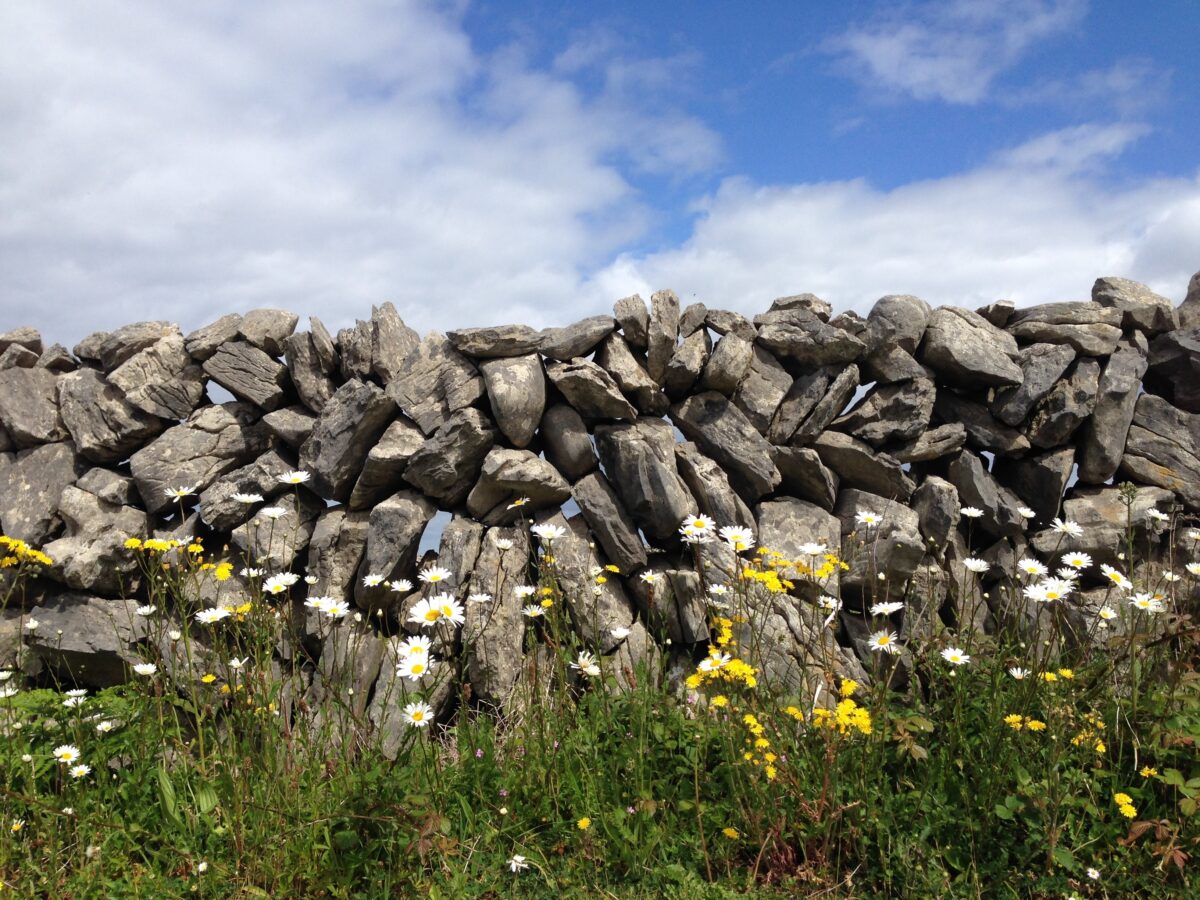
Featured Image: Cara Crofts