
By Gabe Cardy-Brown
Pitch Productions’ performance of Things I Know to Be True was an absolute triumph. I have never been to a DST show where, by the end, there was barely a dry eye in sight. This was ultimately one of the most emotional and impactful shows I’ve seen at Durham.
I’d be remiss not to mention my familiarity with the play itself; while I haven’t studied it in any real capacity aside from a couple of scenes here and there in A-level Drama, I have read it through a couple of times. While it has a solid, emotional plot, it is held back by long, drawn-out monologues and needless physicality. I am therefore very happy to report that, thanks to the amazing directorial team of Harvey Hill, Iphis Critchlow, and Beau Singleton, this version actually fixes a lot of what brought down the original, cutting parts of the long monologues and ultimately making it a much tighter experience, allowing the play to move from impactful moment to impactful moment with very little downtime.
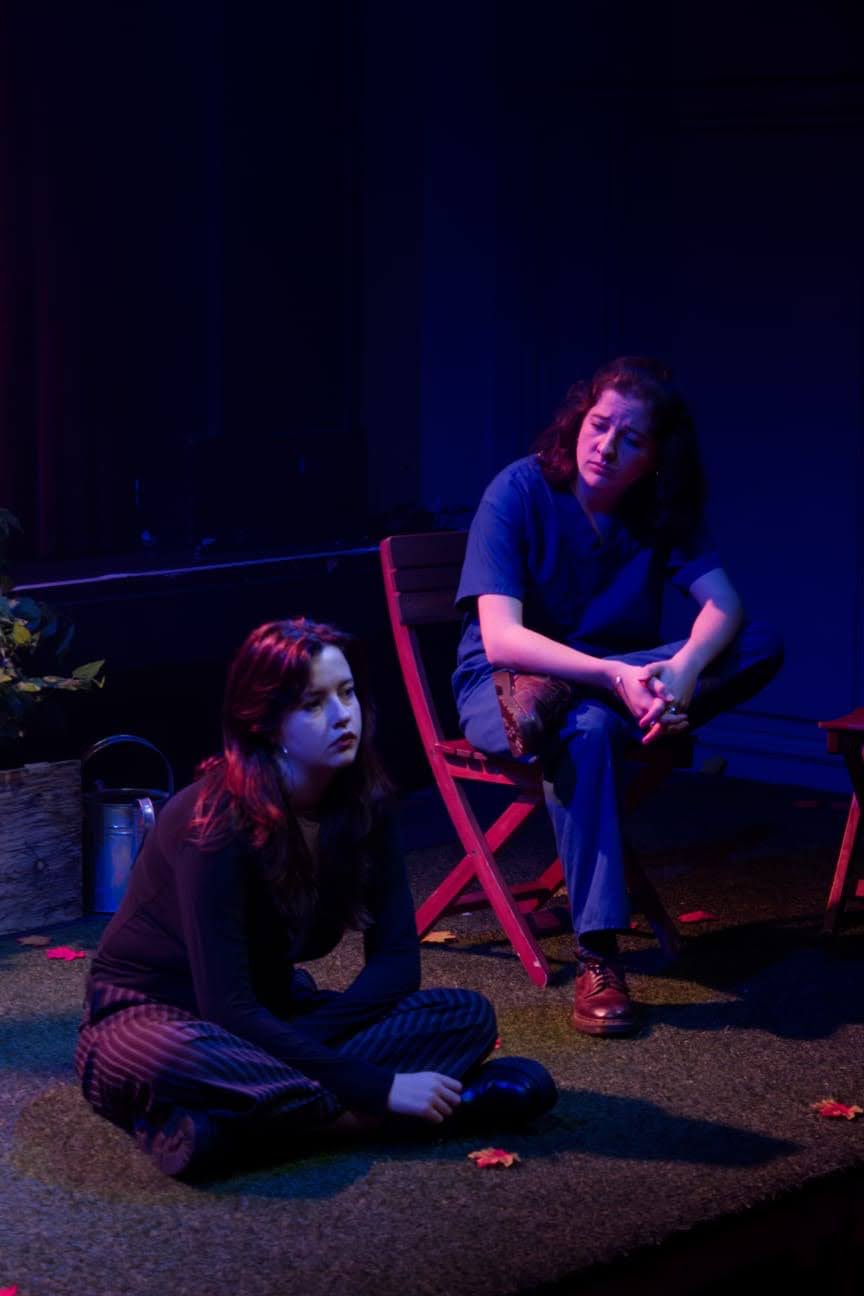
What immediately struck me when I walked into the Assembly Rooms was the family pictures on the wall by the box office, taken by producer Rhiannon Morgan. They created the perfect environment of a typical family house, setting the scene and mood of the play before it even began. This was only bolstered by the amazing set, sound and lighting design (spearheaded by Cameron Howe, Katie Madsen, and Leyla Aysan, respectively), all creating an environment akin to a typical family home. I want to draw specific attention to the “windows” at the back of the stage. This incredibly clever use of lighting and set design only further added to the immersion of the play and was expertly used to set several scenes.
On the acting front, words can’t possibly convey how impressed I was. I cannot in any way pick a standout. Sophia Jenkins as Rosie was the first proper introduction the audience had to the play with a potent monologue. In a play filled with heavy and dark emotion, Jenkins’ opening speech stood out perfectly, taking the audience on a journey and setting up what was to come later. Indeed, after that monologue, she only excelled further, providing a necessary contrast to the other members of her family with Rosie’s more upbeat personality.
Another of the Price children is Pip, as portrayed by Lottie Roddis. Frankly, I am disappointed she is not acting more because she was phenomenal. Her monologues were the first part of the play that made the audience tear up, and her fight with Cara Croft’s Fran was handled in such a realistic and heartbreaking way that, despite her specific section coming early in the play, you couldn’t help but remember it. Similarly, huge props need to be given to River Blatch’s Mark/Mia. Their section specifically needed to be handled with great care and emotion, and I believe they nailed it. If the audience didn’t cry at Pip’s amazing monologues, most of us cried here. Again, their fight with Croft’s Fran and Isaac Slater’s Bob was incredibly poignant and helped to expertly cap off Act 1.
Then we have Tristan Olesiak as Ben. While at the start, he helped provide some comic relief, the scene where he arrives at the house on drugs and gets into a fight with Bob was an incredible moment. The use of physicality, breath control, everything was just spot on. However, what truly ties the household together is the parents of these four children, Bob and Fran Price. They not only created an amazing partnership on stage that linked and held all of the scenes together but also had some of the most powerful moments of the whole show. In particular, Fran’s scenes with Pip and Mark/Mia were incredible and left the audience speechless, perfectly contrasting with her scenes with Bob, Ben and Rosie; the depth of her performance was incredible and truly made Fran a fully rounded character. Last but certainly not least, we have Slater’s Bob. While the character started as comic relief and a sort of mediator between Fran and the children, as the play goes on, we see more sides of him, and by the end, his pain at the loss of Fran was palpable; his cries as he destroys his beloved plants and the look of complete devastation were enough to make the audience collapse into tears once more. The range Slater showed off here was, quite frankly, stunning.
There were a few flaws that held this production back for me. In particular, there were a few staging decisions I found relatively strange; I understand that the AR has an unusual stage shape, to say the least – however, there were a couple of moments that dampened the emotion on display. I can point to the very end, where, after delivering another strong monologue, Jenkins’ Rosie stands downstage centre with her back towards the audience; this wouldn’t be much of a problem if it didn’t obscure the rest of the family upstage. This comes almost immediately after Bob’s breakdown, so as an audience member, I wanted to watch Bob. I wanted to see him come to terms with Fran’s death as he prepares for the funeral. But by completely obscuring him, I lost what would have otherwise been a potent moment. Similarly, there were a few times when actors were seated in the lower section of the stage; frankly, I can’t see them. This is not an overarching problem; by my count, it only happened twice, and yet, when it did happen, it made me lose focus on the emotion on display. I want to watch these talented actors’ physicality and facial expressions, not the backs of other audience members.
There were one or two other moments where the acting was partially obscured by staging or set, but ultimately, it didn’t matter. There’s enough on display here that nearly everyone in the audience cried during the performance. The directors clearly have a very strong passion for this play that is so special for DST, and, from my admittedly somewhat limited knowledge of this play, have created a better production of Things I Know to Be True than the original Frantic Assembly version. Everyone involved should be immensely proud.