
By Victoria Travers
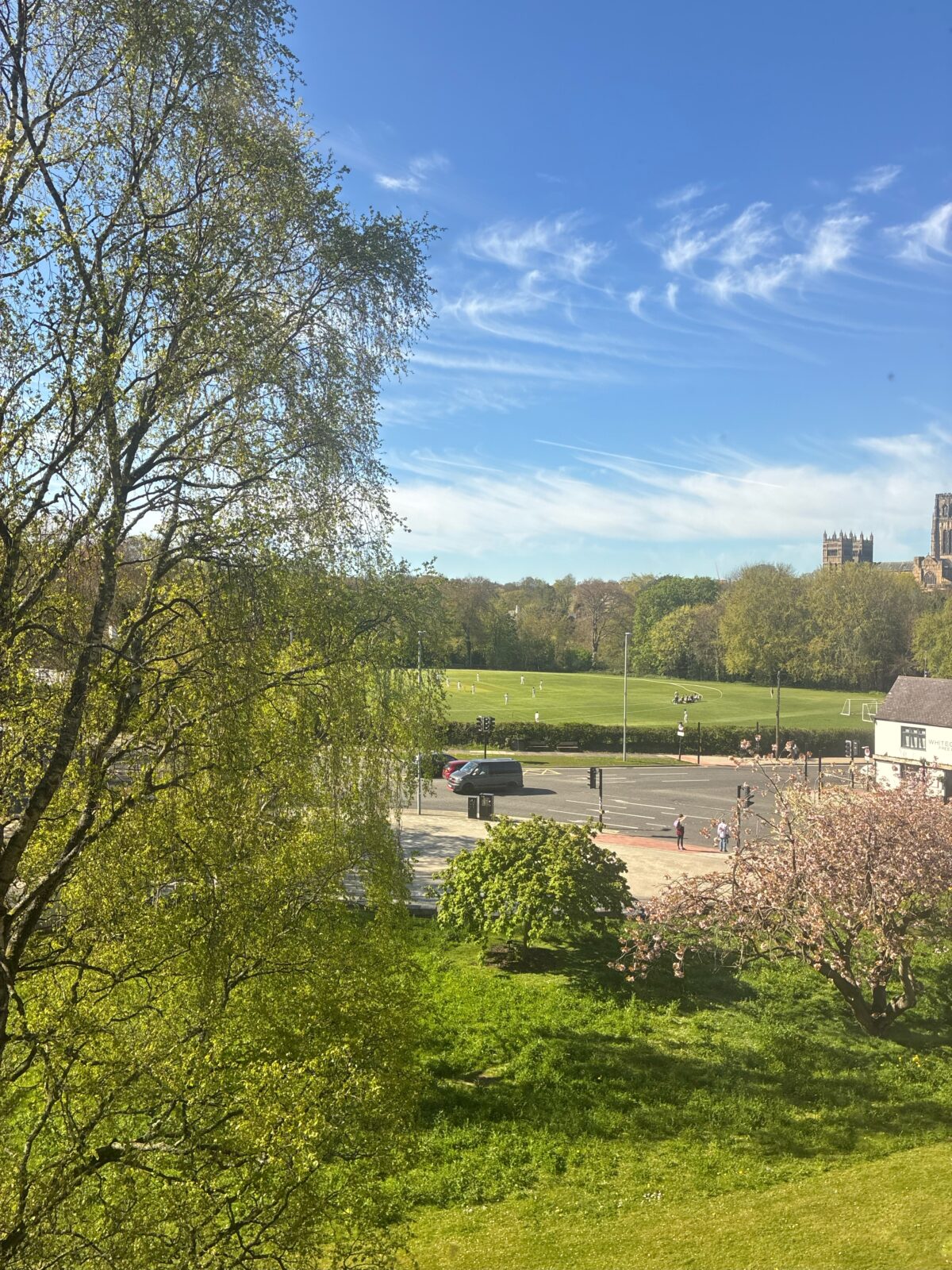
There is a spot in the library I always try to get. It faces the window, but more importantly, it faces a tree. Usually, there are birds moving through it, hopping from branch to branch, and when I’m lucky, they’ve got whatever they’ve foraged in their beaks. So, when I need to look away from the work trawling across my laptop screen, I get to see something that feels simultaneously so separate but all too similar to the ecological studies I was reading.
That morning, easing myself into work with something gentler than my usual music, I clicked on a ‘This is John Denver’ playlist. It was supposed to be background noise. Instead, it became a distraction. For anyone familiar with John Denver’s catalogue, the sheer number of songs, either explicitly or implicitly, rooted in nature is astounding. Mountains, rivers, rain, sunlight, country roads: the natural world is not just decorative, metaphorical world-building, but central. It is the emotional architecture.
And Denver was hardly alone. There used to be so many songs about the world around us at the forefront of popular music: “Green Green Grass,” “I Feel the Earth Move,” “Morning Has Broken,” and “Big Yellow Taxi”, to name but a few. Songs where fields, weather, birdsong, trees, earth and sky were not niche interests, but part of the common imaginative language. Nature could be everything you wanted it to be: romantic, spiritual, political, nostalgic, or just simply there.
What struck me was not just that these songs describe nature, but that they assume nature matters. A walk in the rain, the morning dew on the side of a mountain, the loss of trees to a parking lot: these are treated as emotionally legible experiences. The listener is expected to understand why they mean something.
So why does that now feel almost old-fashioned?
Of course, nature has not disappeared from music entirely. It would be too neat, and probably too melodramatic, to claim it has. Hozier still writes as though the forest is a place of worship and rot and desire. Bon Iver can make winter landscapes feel like a form of internal weather. Taylor Swift’s folklore and evermore are full of lakes, woods, ivy, snow, cliffs and gardens (I could also argue that these albums emerged from lockdown: an unusual period when many people’s permitted worlds narrowed to the supermarket, home, and the walk outside). But even these examples feel slightly set apart from the centre of mainstream pop. They occupy a particular aesthetic territory: indie, folk-adjacent, autumnal, cottagecore, wistful. Nature is still present, but it often arrives already stylised.
The first recent mainstream example that came to my mind was, unfortunately, Lil Dicky’s “Earth”, the 2019 celebrity charity single in which various famous people voice animals with varying degrees of dignity. This is probably unfair; the song did raise money for environmental causes. Still, I found myself slightly depressed that the most immediately available example of a nature-centred pop song was also essentially a joke.
For the sake of my own ego, I tried again. Gorillaz’s Plastic Beach came to mind: a brilliant, strange, synthetic album about pollution, consumerism and waste. But even there, nature appears largely through its destruction. The beach is plastic. The ocean is contaminated. The natural world is not encountered so much as mourned, mediated through apocalypse and irony.
This, I think, is part of the shift. Modern culture is not silent about nature. If anything, it is frequently anxious about it. We talk about climate change, extinction, pollution, ecological collapse. But the natural world increasingly enters mainstream art as crisis, not companionship. It appears as something damaged, vanishing, morally instructive. Less often is it simply allowed to be beautiful, ordinary, funny, boring, intimate, or woven into daily life.
Curious, and by this point absolutely not doing the ecological reading I had intended to do, I searched to see whether this was just nostalgia dressed up as insight. It turns out there is some evidence behind the feeling. A study by Selin Kesebir and Pelin Kesebir found a decline in nature-related words across English-language cultural products from around the 1950s onwards, including fiction, song lyrics and film storylines. References to the human-made environment did not show the same pattern, suggesting that this was not just a general change in language but a more specific cultural drift away from nature.
That does not mean everyone in the 1970s was wandering through meadows writing ballads about moss, nor that everyone now is spiritually bankrupt because they listen to synth-pop. But it does suggest something subtler and more troubling: that the shared cultural vocabulary of nature has thinned. The words are still there, but perhaps they are less central to the stories we tell about ourselves.
The same seems visible beyond music. Landscape painting no longer holds the cultural dominance it once did. Films often use nature as backdrop, threat, or spectacle, but less often as a serious emotional presence. Even adaptations of novels deeply embedded in landscape can seem oddly hesitant to let the land itself become a character. Nature is everywhere, yet strangely distanced: filmed beautifully, marketed aesthetically, invoked politically, but not always inhabited.
And yet I do not think this is only a story of loss. Recently, I have noticed small signs of return. Online, among the churn of microtrends and self-conscious identities, I keep seeing variations of the phrase: “cool girls like birdwatching.” It is easy to laugh at this, and maybe we should, a little. But beneath the trend is something sincere. There is an appeal in birdwatching precisely because it resists the pace of everything else. You cannot make the bird arrive faster. You cannot optimise the branch. You have to wait, look, and accept that most of the world is not performing for you.
Perhaps that is why nature feels newly attractive to a generation exhausted by acceleration. The appeal is not only environmental, but temporal. Nature offers a different rhythm. It does not ask to be consumed instantly, ranked, posted, monetised or improved. It can be engaged with lightly or obsessively. You can know the Latin name of every bird in the tree, or you can simply enjoy the fact that something small and alive is there.
This is what I feel in the library, looking out between paragraphs. The tree is not spectacular. It is not the Rocky Mountains. It is not a cinematic wilderness. It is just a tree outside a building, with birds in it. But it interrupts the flatness of the screen. It reminds me that the living world does not only exist as a field site, a dataset, a crisis, or a metaphor. It exists insistently, ordinarily, whether or not culture remembers how to sing about it.
Maybe we have turned our backs on what nature can give us. Maybe there is a political argument to be made there. But the great thing about nature? It will always be there. No expectation, no performance. All you have to do is just look through that window and let nature do the rest.
Featured Image: Victoria Travers