
By Bel Radford
It is a truth most unfortunate that Fashion’s Great Pervert, as we know it, has been thoroughly domesticated. You could send a rubber clad ponyboy with a ball-gag down any runway and it would fail to register as particularly transgressive, The object can no longer be abject when it’s been cannibalised by the market, as chronicled over the past half century.
Throughout the 70s and 80s, Vivienne Westwood and Malcom Mclaren freed fashion from the chains of sexual conservativism. Littering the streets of Chelsea with sexual paraphernalia, from hobble straps, crotch zips, and bum flaps, thrusting forward the fin de siècle cultural breeding ground of revolution regarding the body politic. As such, the iconography of perversion clambered up the runway and became the enfant terrible of the fashion world. Provocateurs of the fashion world began to circle the drain of vulgarity; 90’s Mugler collections found themselves peeling with latex whilst Versace ventured into the depths of the red room in their 1992 Miss S&M collection. Soon, such indulgence into perversion trickled down into the market at large for the ritual of commodification to begin. It’s now rather normal to wear leather chokers, studs, maybe a harness in a somewhat casual register – and so it’s clear we’ve flipped over the clandestine underbelly of perversion and gutted it of all substance. For instance, when Dua Lipa wore the bondage gown from Miss S&M at the 2022 Grammys, it was worn and received as a museum drag piece that celebrated the history of the pervert, but certainly not the presence of one. However, paraphilia, as per the human condition, will prevail, and as a matter of principle must remain transgressive. And so it’s wriggled its way out of the spiked collar the market walks it by, and has reinvented itself in all its slippery countenance; hang up the gimp suit, the contemporary freaks are wearing office formal.
I came to this realisation while seeking solace in Haneke’s remarkably apt film The Piano Teacher (2001). For the uninitiated, the film follows Erika Kohut, a cold, sensitive, and sexually repressed middle-aged piano teacher at a Viennese Conservatoire, who finds herself in a sadomasochistic liaison with her student, Walter Klemmer, whose sexuality is gauchely overt, and as such absolutely cannot match her freak. Perversion lies at the crux of the narrative, yet Erika clads herself in stiflingly mundane outfits, attempting to reassure herself of her similarly rigid character. She wears sensible and nondescript knitwear, stiff starch blazers layered over dainty silk blouses, drab pleats and beige monoliths, punctuated by the occasional smear of colour and the pair of gloves she wears every time she leaves the house to go to the porn shop. Erika’s wardrobe is banal and conventional, yet it carries immense ontological weight, its stiffness actualises her repression, creating a dichotomy between character and clothing whereby her outfits become vectors of calculated and powerful libido, and objects of psychosexuality.
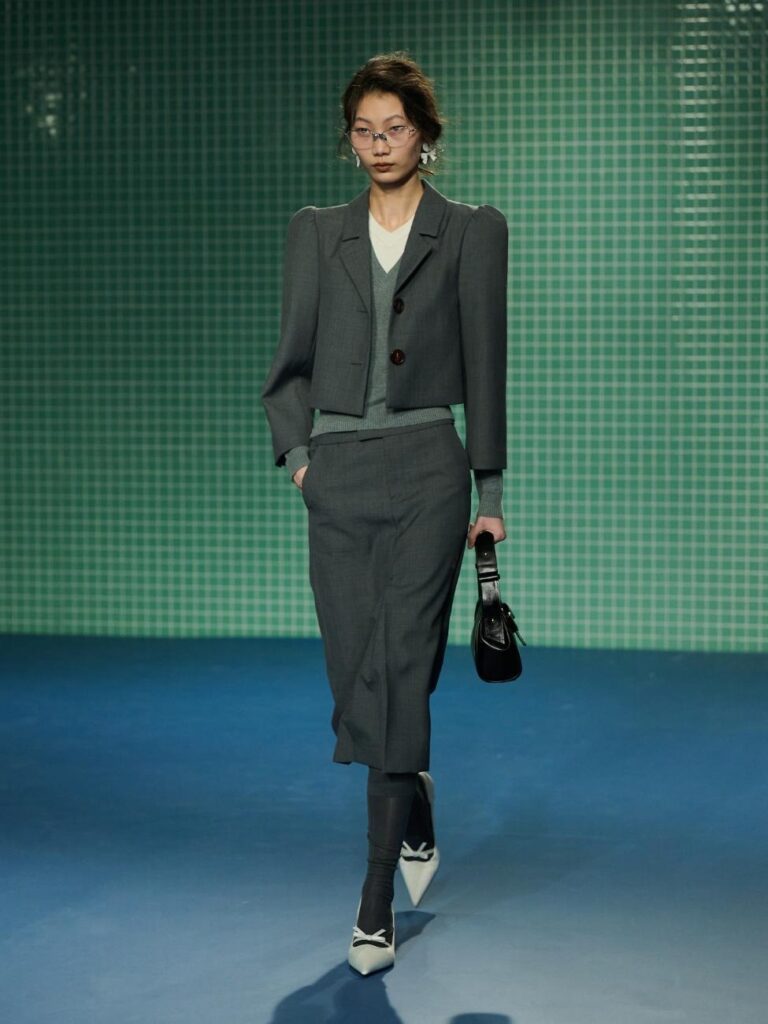
The power of her clothing has not gone unignored by the fashion zeitgeist. Erika Kohut was the muse of SHUSHU/TONG’s SS25 collection The Pleasure Of Rejection, shown at Shanghai Fashion Week. Liushu Lei (Shushu of SHUSHU/TONG) told Culted that the emotional tone of the collection was informed by restraint and introspection, noting how ‘In [Erika’s] mind, the lines between attraction and rejection seem to blur, creating a chaotic unity. This dynamic felt like a deconstruction of the binary between the two concepts, offering immense dramatic tension’, adding that ‘Erika Kohut is such a complex female character, sensitive, conflicted and even mad. Beneath her restrained and reserved exterior lies desperation and chaos, with emotions that rage like a storm’. These observations illustrate the ways in which collections like The Pleasure Of Rejection re-project a film’s psychological weight back onto the body, the ways in which desire becomes most energised through the restraint of being tightly buttoned up – a new type of bondage.
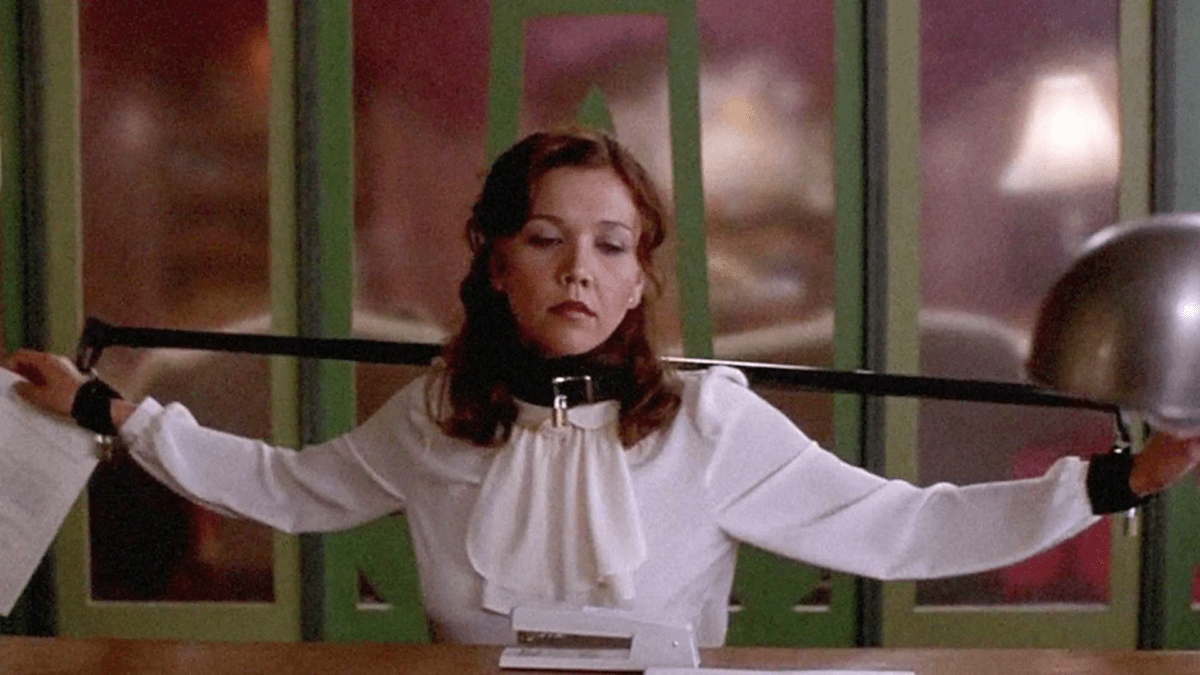
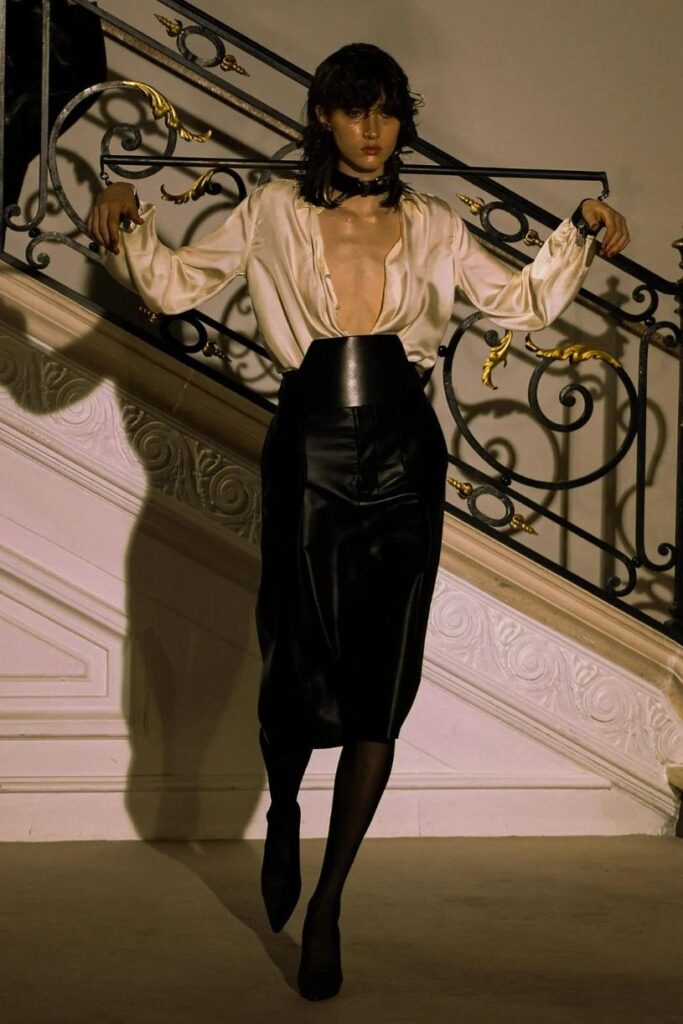
Similar comparisons can be made in Shainburg’s 2002 film The Secretary, wherein a young woman, Lee Holloway, having been recently released from a mental hospital, gets a job as a secretary to lawyer Edward Grey, who she establishes a sexually sadomasochistic relationship with. Her wardrobe is particularly striking as it evolves in tandem with her sexual and professional literacy: she begins dressing soberly – wearing silk blouses, skirts and stockings – yet her capacity for sexual expression becomes compounded. By the time she’s saddled up and crawling around Grey’s office, the erotic logic has long been present in her wardrobe as a mechanism of submission, her pencil skirt as restraint and her buttoned up collar already a collar. The Secretary has also been an object of inspiration within the fashion world, with Enfants Riches Déprimés extracting and interpreting the infamous bondage rig look onto the runway in their SS25 collection Inside Capitalism.
There is a case to be made for how both films were released in the very early 2000s, yet are only now really being celebrated and explored within fashion. The market spent the intervening decades digesting and mainstreaming the more overt face of perversion until it became palatable and gutted of ontological weight, exhausting its typical forward-facing fetish iconography in the process. Fashion now reaches backward in the cultural milieu for a sexuality undefiled by the market with a visual language communicative of perversion in its truest form, as eroticism in today’s cultural landscape offers meagre viable alternatives, clinically administering desire through legible, sexless blockbusters and hyper-sanitised cultural output. This has left a vast black hole in the place of sensuality with any real dissolute underbelly, yet office wear arguably provides a visual language exploratory of this lack. As demonstrated by Erika and Lee, the rigidity of formal wear encrypts, contains and yet compounds perversion. Perhaps this is where the contemporary appeal lies: subverted desire becomes infinite.
Featured Image: Maggie Gyllenhaal in Secretary (2002, dir. Steven Shainberg)