
By Nicole Ruf
We take women’s suffering and call it art.
I am standing in the Loggia Dei Lanzi, perhaps the most magnificent open-air gallery in the world, Florence doing what Florence does best, making you feel simultaneously small and inexplicably chosen, and I watch all the tourists congregate around Perseus, as if they have all come to the telepathic consensus that this is the piece worth noting. He is glorious, naturally, Cellini made sure of this. He stands with his arm raised, holding the severed head of Medusa aloft, his boot pressing down on what remains of her body, her breasts pointing toward the sky, with the casual confidence of a man. Her neck is open; her limbs arranged with a particular elegance only a sculptor deeply in love with female suffering might achieve. Everyone takes pictures.
A few meters away, the Sabine women are held mid-scream. They have been like this for centuries. Giambologna froze them here, arms outstretched, mouths open, bodies twisted, writhing in the grip of men who decided, one afternoon, that they were owed wives. The Rape of the Sabine Women is considered a masterpiece of Mannerist composition. There is probably a fridge magnet at the souvenir tents in the piazza.
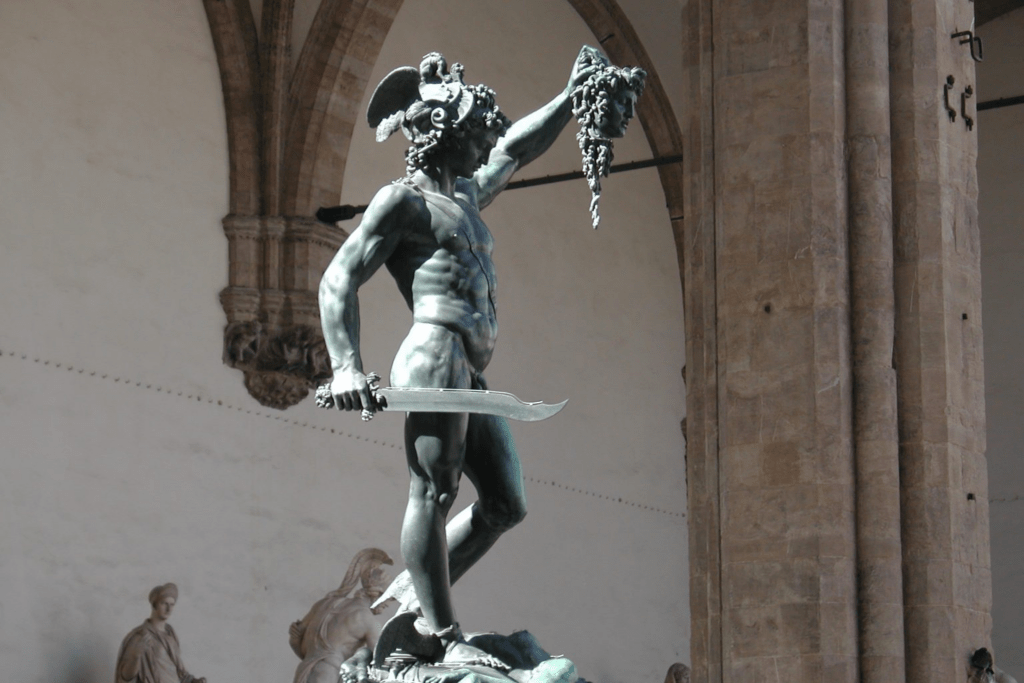
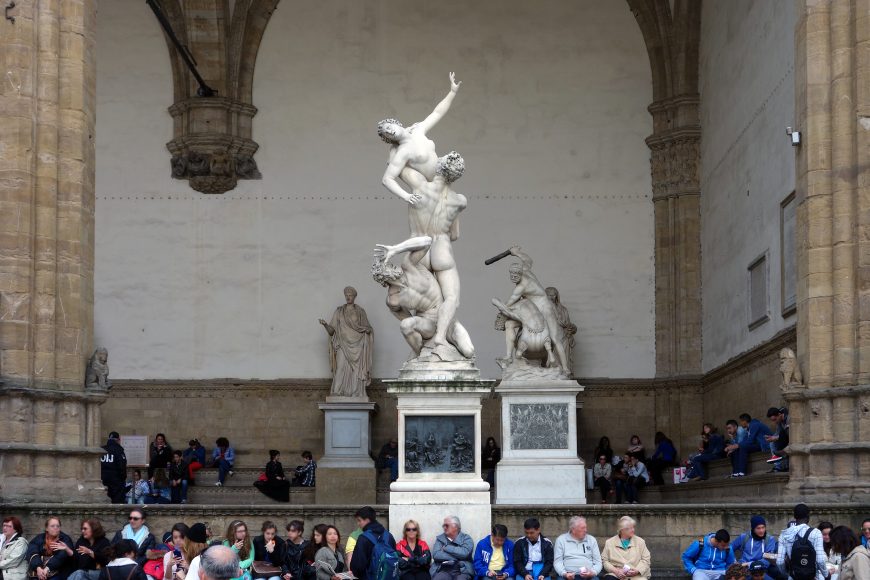
Benvenuto Cellini, Perseus with the Head of Medusa & Giambologna, Rape of the Sabine Women
Both bear the full, dizzying weight of a civilisation that built its vision of beauty atop women’s bodies. You are forced to stand there, in the open air and scorching sun, among the crowds, and obliged to appreciate the craftsmanship, the invention, the man.
The mise-en-scène changes, but the woman’s role does not. She is the body the hero stands on, the wound the story opens. I have been thinking about decapitation ever since.
—
It is appropriate, then, I think, to start with Medusa. She was, depending on who you ask, a monster, a priestess, a survivor, or simply a beautiful woman who made the catastrophic mistake of existing in a temple where a god felt entitled to help himself to her. In the oldest versions, she is mortal and ravishing. Poseidon assaults her in Athena’s temple. Athena, in a characteristically divine display of lateral thinking, punishes her; turns her hair into snakes, makes her gaze deadly, condemns her to an island at the edge of the world. Then Perseus arrives, guided and armed by the gods, cuts off her head, weaponises it and turns enemies to stone with her lifeless face. Her power, born of violation, becomes his trophy.
Taming the wild woman is the maximum expression of male victory. This thesis is repeated in marble and bronze and oil paint across every major gallery in the world. The hero does not just defeat a monster; he decapitates the unruly feminine and carries her head around as proof of his greatness.
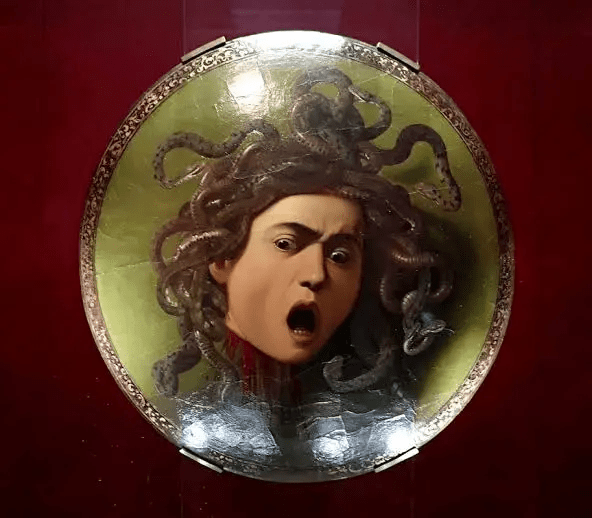
The Uffizi holds an object that makes this completely literal. Caravaggio’s Head of Medusa is not a painting in any conventional sense; it is painted on a wooden shield, commissioned as a ceremonial gift for Grand Duke Ferdinando I de Medici, intended to symbolise his courage in defeating his enemies. It stayed in the Medici armoury for over a century, a woman’s face deployed as military iconography. Mouth open, eyes wide, snakes still squirming; horrifyingly human and not monstrous at all, exchanged between powerful men as victorious symbols.
Medusa never gets to be anything other than the thing being killed.
—
Then there are other women, armed, instead, with the sword.
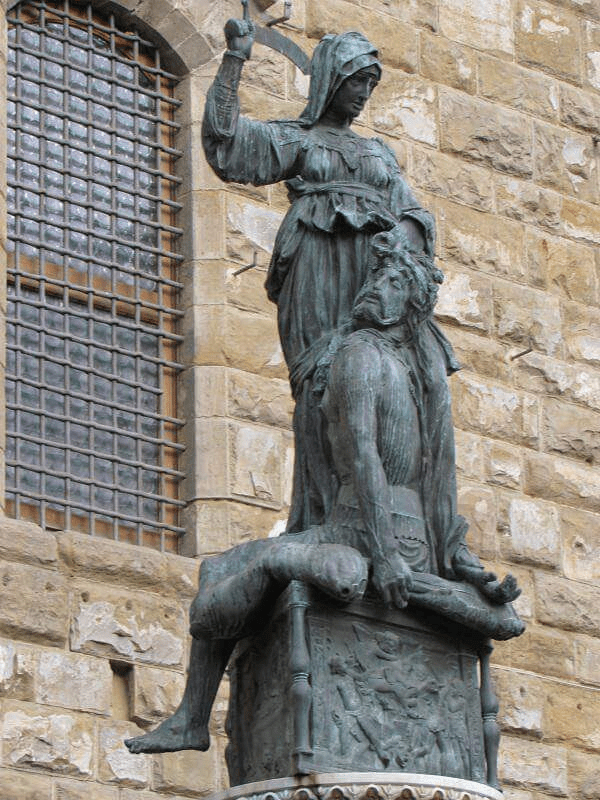
Donatello, Judith and Holofernes
Judith stands in bronze in the Piazza della Signoria, small and severe, very much out of place among all the muscular civic bravado of marble and plaster. She hangs on walls across the city, too, painted by all the greats. Always holding the same thing.
The head of Holofernes.
She did as Perseus did, is the point. She got close enough to the enemy and cut his head from his body. Her story is biblical: a widow, a commoner, who charmed the Assyrian general besieging her city, got him blind drunk, took his own sword and beheaded him with it. It is a tale of nerve and patience, of clear-eyed understanding of what men are when they think they are about to get what they want.
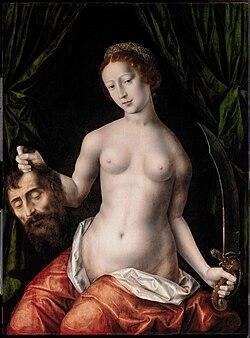
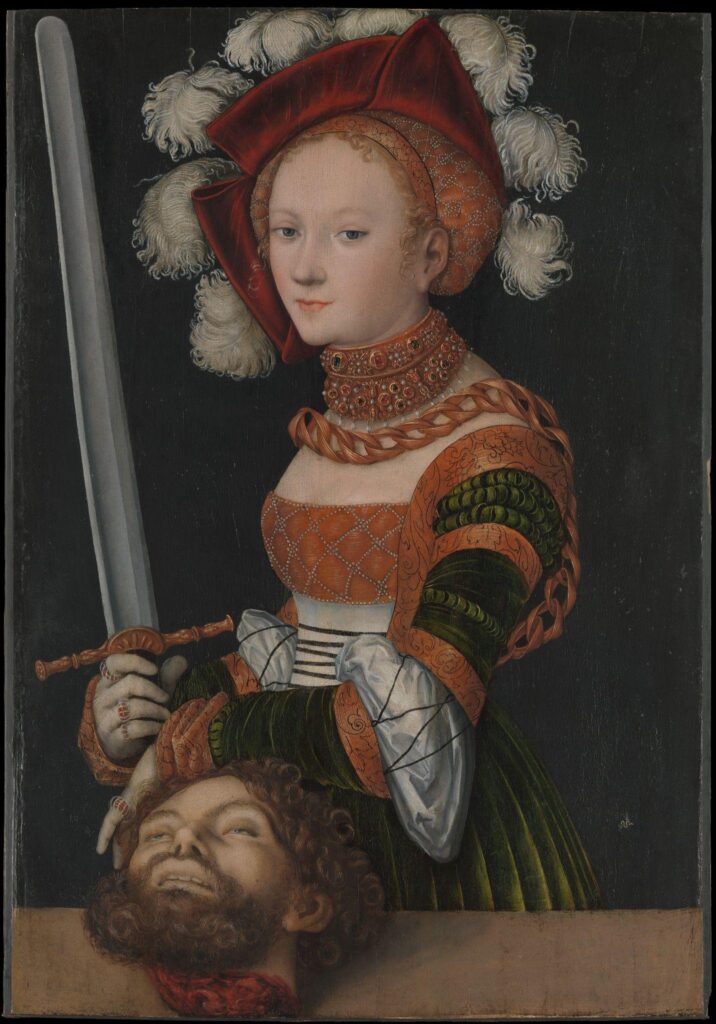
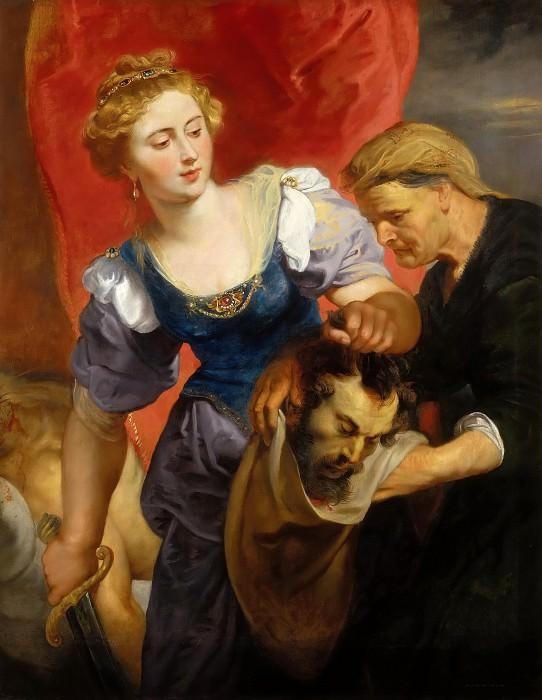
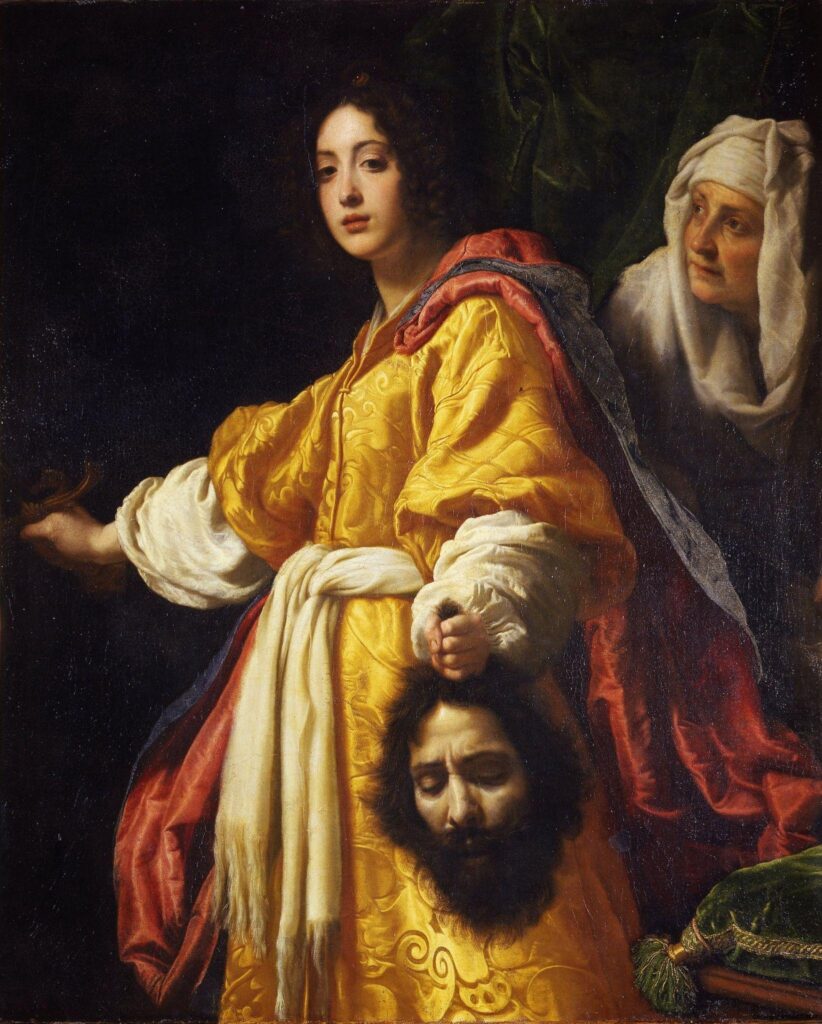
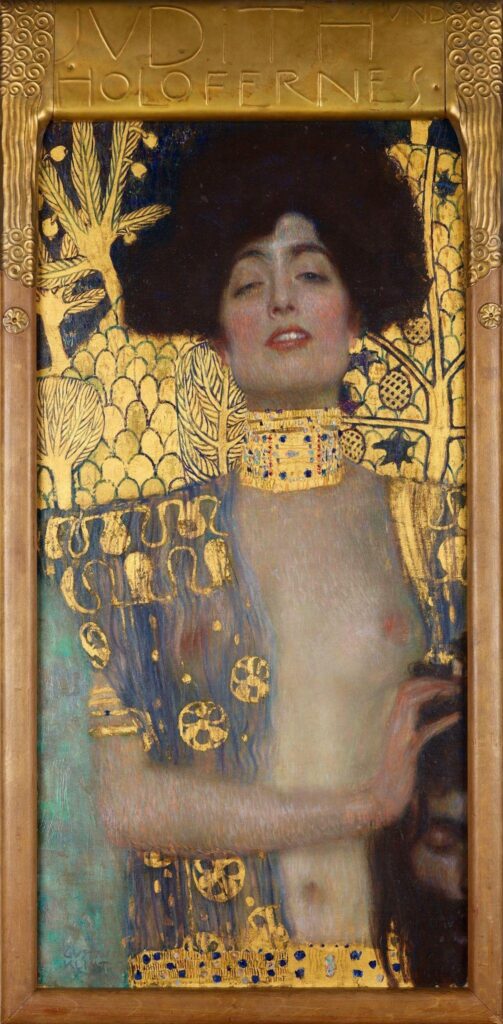
Jan Massijs, Judith with the head of Holofernes; Luchas Cranach, Judith with the Head of Holofernes; Peter Paul Rubens, Judith and Holofernes; Cristofano Allori, Judith with the Head of Holofernes; Gustav Klimt, Judith I
.jpg)
And yet.
Look at how she is painted. Massijs strips her nude, holding the head like a handbag. In Cranach’s she stands with her composed Renaissance face, rosy-cheeked and soft-lashed, the scene bathed in the warm lighting of a specifically male fantasy. In Rubens’ she is jewelled and splendid and somehow, impossibly, still glamorous. Allori painted her so beautifully that she must have been painted from life, and she was: his own lover, the model, himself as Holofernes, and this apparently romantic. Klimt painted her later too, nude and sexually satisfied, Holofernes barely present, head cropped by the frame as an afterthought. This painting is called feminist by some. I can tell you it is not. It is the male gaze recuperating even the image of female power back into erotica. Every generation gets the Judith it deserves, and most generations have deserved little.
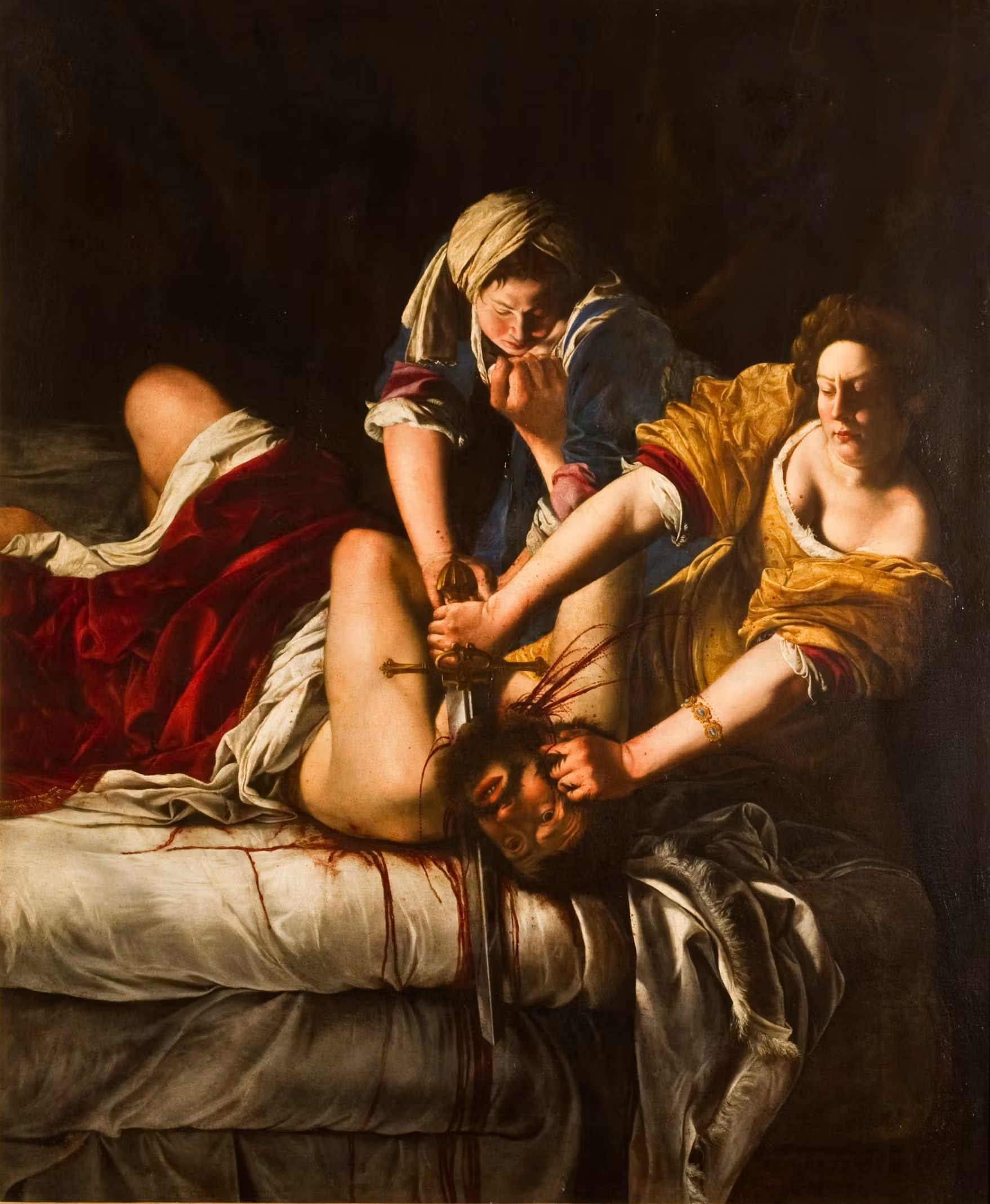
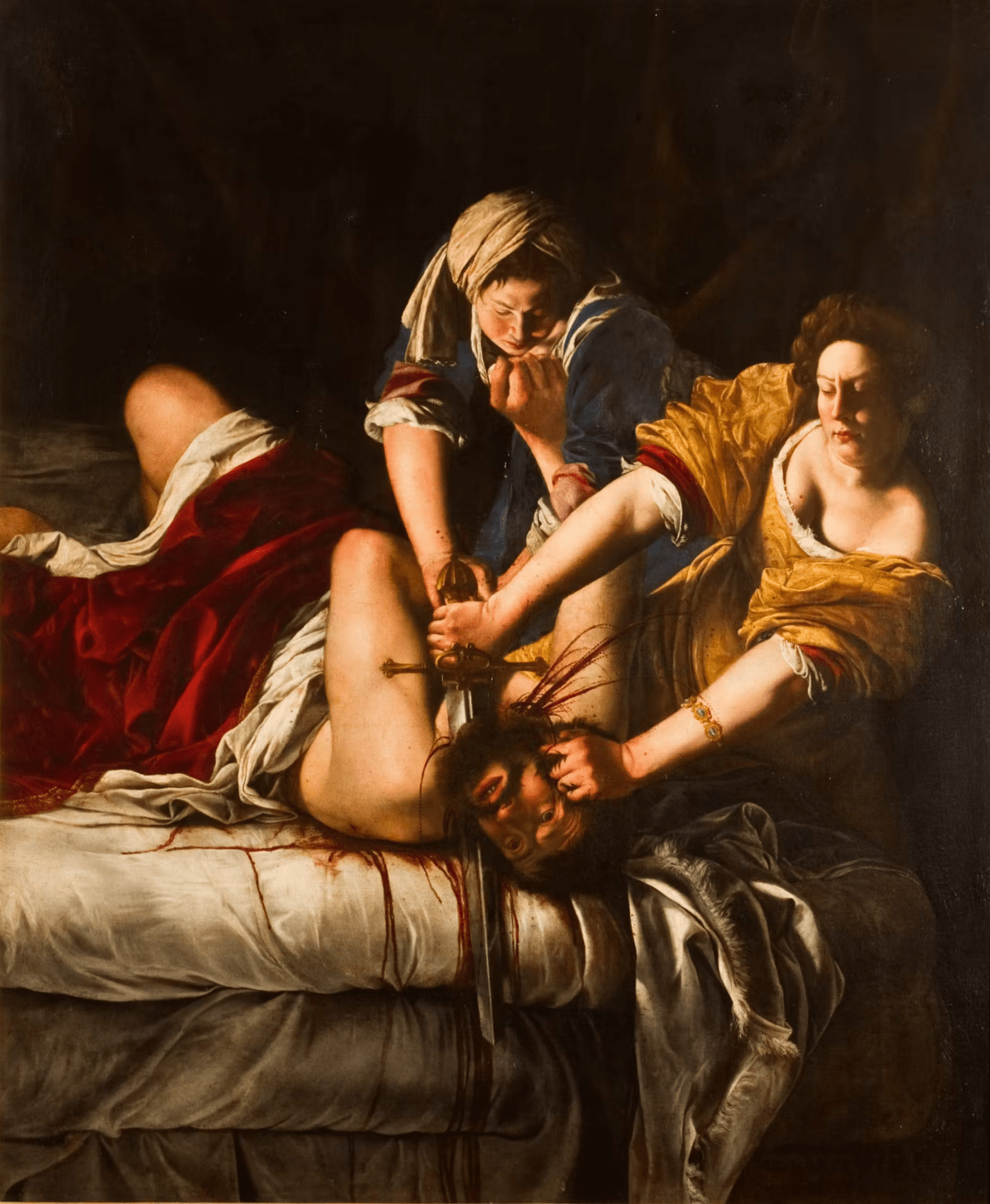
Artemisia Gentileschi, Judith Beheading Holofernes
Artemisia Gentileschi is the exception.
Only a woman could have painted Judith like this, only a woman who inhabits a real body and knows what it means for the world to take it. Artemisia was raped by her father’s associate, Agostino Tassi, at seventeen. At the trial, it was she, not Tassi, who was tortured; ropes tightened around her fingers during questioning, ropes, she noted in devastating sarcasm, like the wedding bands Tassi had promised her. Throughout it all, she remained defiant, immovable: it is true, it is true, it is true. Tassi had friends in high papal places, and so he was cleared. Artemisia went home, and painted Judith.
Her Judith is not seductive, not satisfied. She grips Holofernes by the hair with the pragmatic strength of a woman who has made a decision and will see it through. Her maidservant holds him down. Blood pools and splatters onto white sheets. It is not pretty nor erotic. It is female rage, and what it looks like, really looks like, when a woman is allowed to paint it herself; not a fantasy, not an excuse to show a beautiful body. The thing that needed doing, being done.
—
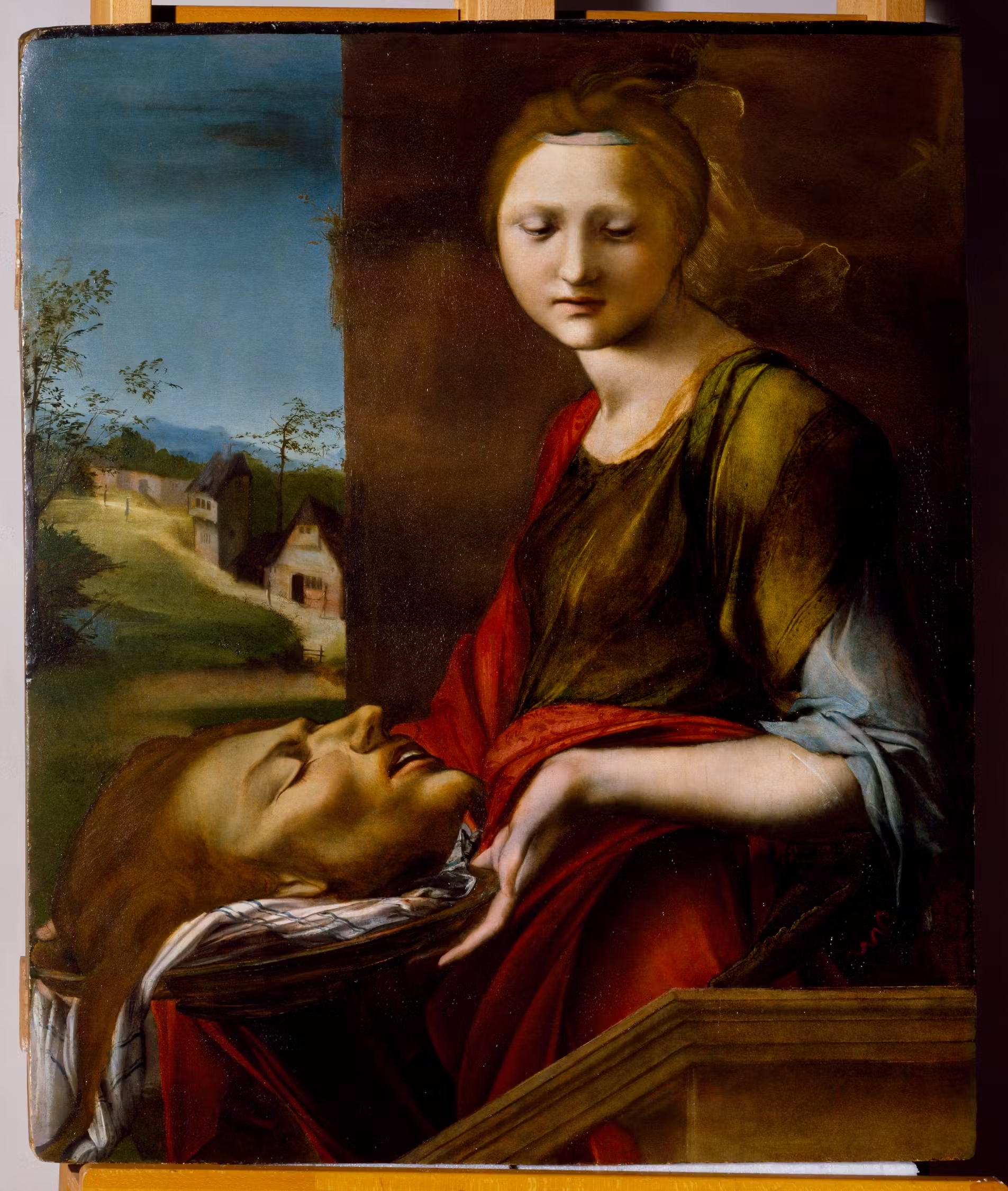
Salomé gets less credit, which is instructive. Stepdaughter of Herod Antipas, she danced at his feast and pleased him enough that he offered her anything she wanted. Prompted by her mother’s grievance, she asked for the head of John the Baptist, and received exactly that. Her motives are considered impure: personal, petty, emotional. She did not do it to save a city. As if men have ever required noble motives for their violence.
What made Salomé so threatening that centuries of painters and priests worked to contain her is that her reason is simply because: because he deserved it, because I decided, because I was owed a wish, and this is what I wished for. The femme fatale is the man’s name for the woman who acts on her own terms without offering justification he might recognise. Women are permitted rage only when it is in service of someone else.
Judith and Salomé have been manufactured by history, remade to fit the story men most want to read. The Bible is not mistranslated by a change of language but by a change of morals and truth. They are painted and repainted, sometimes heroines, sometimes monsters, often nothing more than beautiful bodies holding props.
—
There is also a different tradition, one that does not give you a sword.
Galleries contain what feels like a thousand paintings of the Virgin Mary. She is in every room, every altarpiece, every triptych; nursing, praying, receiving the news. Always beautiful, always mild, and always available; to you, to the gaze, to the narrative requirements of a tradition that needs a woman pure enough to mother God but not powerful enough to threaten him.
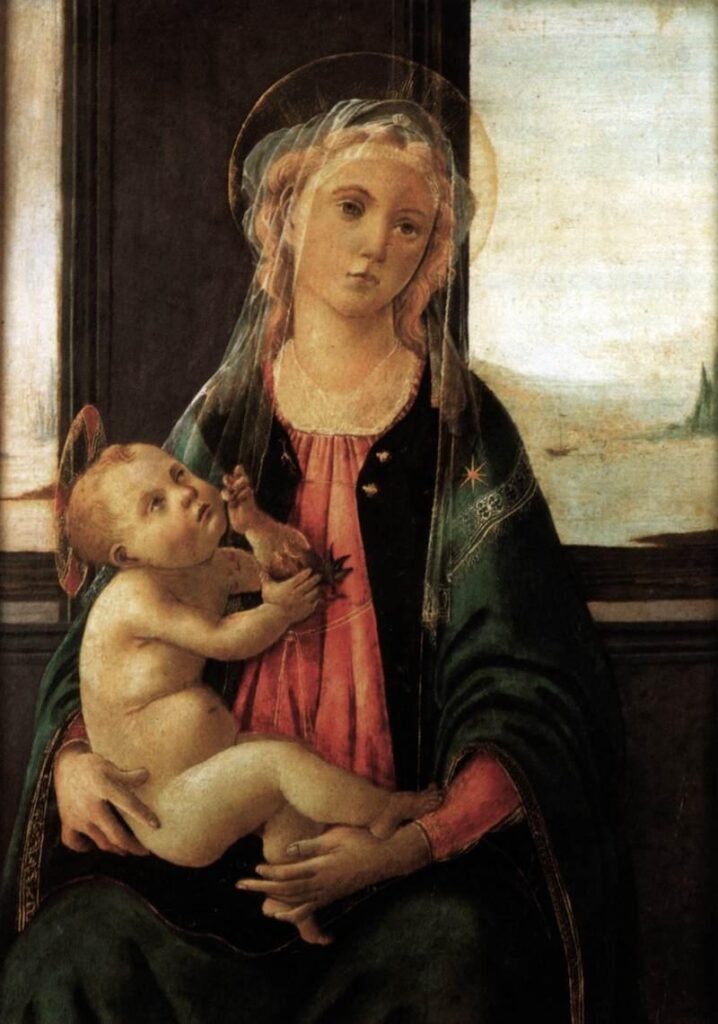
Sandro Botticelli, The Madonna of the Sea
Yet Mary is queen of the Earth. Without her body, her yes, or her body’s yes, depending on which theologians you consult, there is no redemption, no story. She is painted holding the child, and she looks elsewhere while he looks at her. For a moment, God’s entire world was a woman, this woman. The hinge on which everything turns, the architecture of Western civilisation, runs on a woman’s womb, and she gets pale blue drapery, and a lot of mild portraits people rush past, in return.
Mary Magdalene is her counterpart. She is, in the earliest texts, one of the most significant figures in the story; first witness to the resurrection. By the sixth century, she had been collapsed into a composite of unnamed sinful women and declared a prostitute. The Church did not retract this until 1969.
She is painted, overwhelmingly, weeping. Beautiful and weeping, her hair loose, loose hair being the Renaissance shorthand for sexual availability, a detail the painters understood very well. She is the cautionary tale standing next to the impossible ideal, together they construct the complete architecture of what women are permitted to be: the virgin or the whore, the mother or the magdalene, the one who never sins or the one who never stops paying for it.
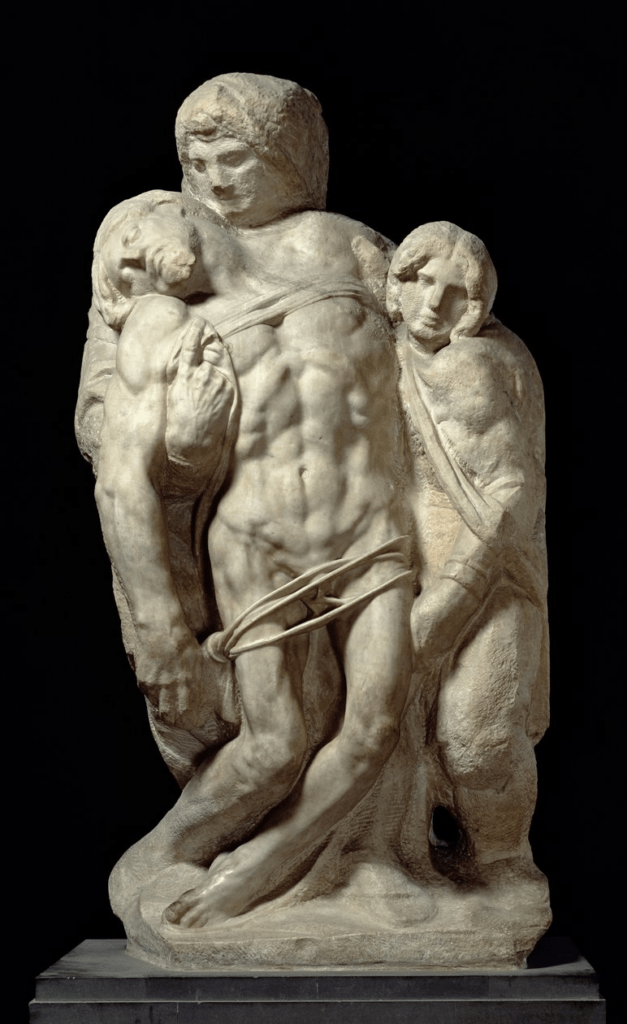
Michelangelo Buonarroti, The Palestrina Pietà
What I feel, standing in front of yet another Annunciation, is weight, not theological, but the physical kind. Mary carries Christ in her body; births him, raises him, watches him die. The pietà: mother holding her dead son, body draped across her lap, a woman absorbing the full weight of the world’s grief.
We are not given the sword; we are given the greater burden. Mary accepts, endures, loves beyond any reasonable expectation of reciprocity. The Church built a civilisation on the willingness of women to do exactly this, and called it grace, and called it virtue, and painted it ten thousand times in pale blue and gold.
—
Perseus’ arm is still raised, Medusa’s head still drips its bronze blood. The Sabine women are still mid-scream, and nobody is stopping to ask them why. I stand and I think about all the Sabines, the Virgins, the Magdalenes, the Judiths in their dozens, Salome with her platter, Artemisia’s white sheets soaked red. We built the most beautiful city in the world out of this fabric: out of women’s suffering, women’s bodies, women’s labour, women’s silence.
The snakes, the exile, the death, the head as trophy, everything came after that one moment, that one casual assumption that she was there to be taken. And the culture said: yes, and built a statue of the man who finished the job, and put it in the most beautiful square in the world, and called it civilisation.
We have been here the whole time. In the margins of the altarpieces and the backgrounds of the allegories and the corners of the loggie, holding our swords, waiting for someone to look at the right painting.
Maybe it is time to pick the sword back up.
Not in art, necessarily.
In art, of course.
Featured Image: Le Gallerie Degli Uffizi