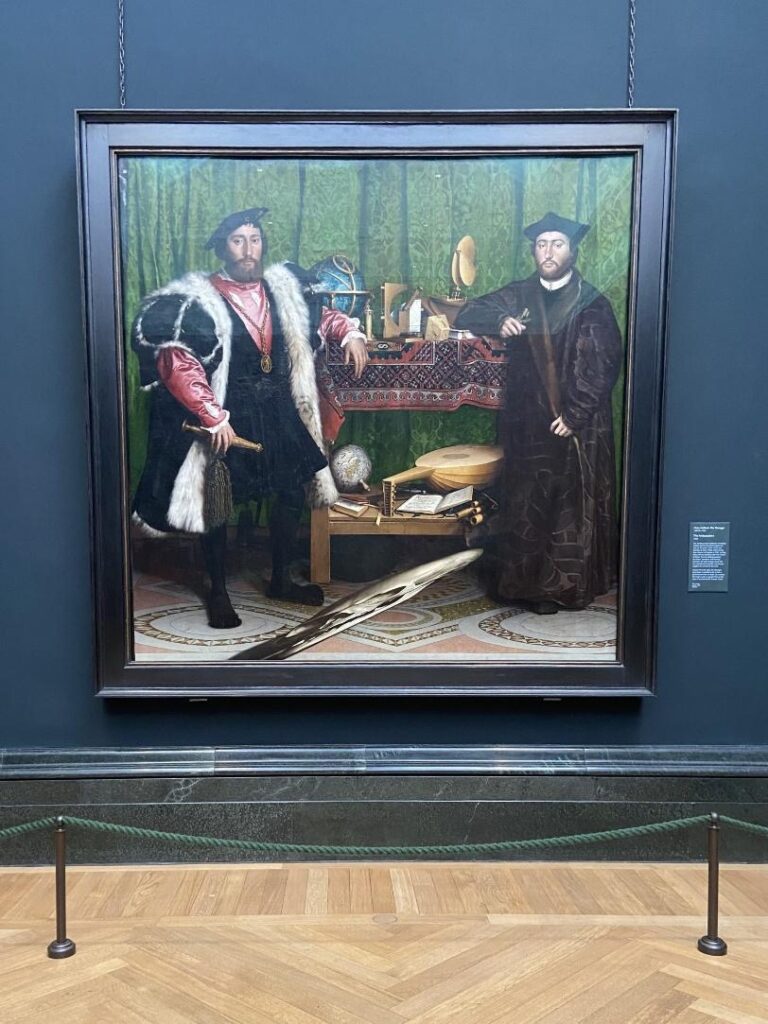
Hans Holbein the Younger, The Ambassadors, 1533, oil on wood, 207 cm by 209.5 cm, The National Gallery
By Lily Whewell
The precise meaning of The Ambassadors by Hans Holbein the Younger has been subject to scrutiny by art historians and art aficionados alike for centuries.
On the one hand, the various elements which make up the composition are straightforward enough. It depicts Jean de Dinteville, Francis I’s ambassador to England, on the left, and his friend Georges de Selve, a bishop, on the right, standing either side of a table cluttered with objects. On the top shelf are a celestial globe and astronomical instruments whilst the bottom shelf displays a Lutheran hymn book and a collection of musical instruments in disarray; close observation of the flute case reveals a missing flute, and one of the lute’s strings is broken. The upper level of the table has been interpreted by critics as representing the unity of the heavens in contrast to the disorder on earth on the lower level. Many aspects of the work supply an underlying atmosphere of unease, the most obvious being the large and distorted skull which occupies the foreground, a memento mori or reminder of the fragility of life. In reading the rich symbolism of the work, art historians have tended to interpret The Ambassadors as a manifestation of Reformation-anxiety, the fear that Catholicism would be overturned by a new Protestant world order.
Although religious instability is an undeniable aspect of the message conveyed by Holbein, Dr Bendor Grosvenor’s discussion of the work in the podcast Waldy and Bendy’s Adventures in Art supplies further understanding through his observation of one, easily overlooked detail: the floor.
Grosvenor points out that the geometric pattern of the floor is the Cosmati pavement, which was completed in 1268 on the order of Henry III and found before the High Altar at Westminster Abbey. The floor also holds Holbein’s signature and the date of the work (1533), concealed by the shadow of Jean de Dinteville. Considering these details, Grosvenor argues that Holbein is transporting us to Westminster Abbey where Anne Boleyn was crowned that year, an occasion Jean de Dinteville attended. Subsequently, he suggests that The Ambassadors specifically reflects an anxiety over Anne Boleyn’s ‘reformist sympathies’, rather than a more general fear of Protestantism. This more nuanced interpretation, derived from an observation of the floor, is compelling.
Much great art encourages the viewer to look up, but after Grosvenor’s revelation, I began to question what happens when we start looking down? How many other works of art could we further decode by simply paying attention to what is going on beneath the subject’s feet?
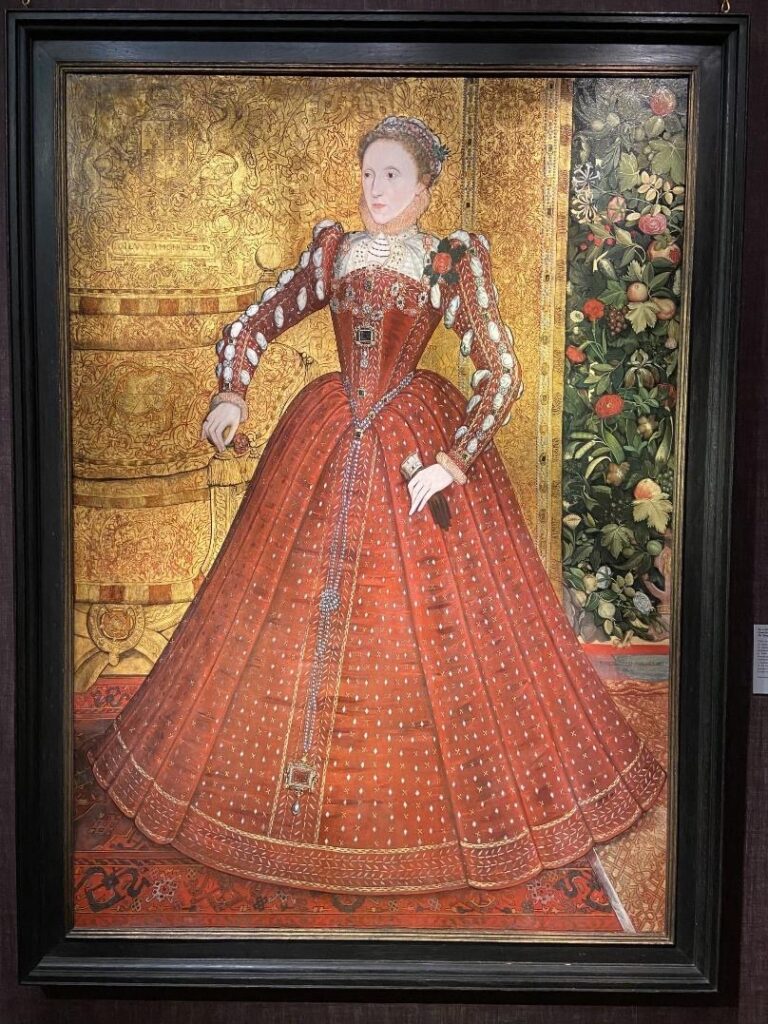
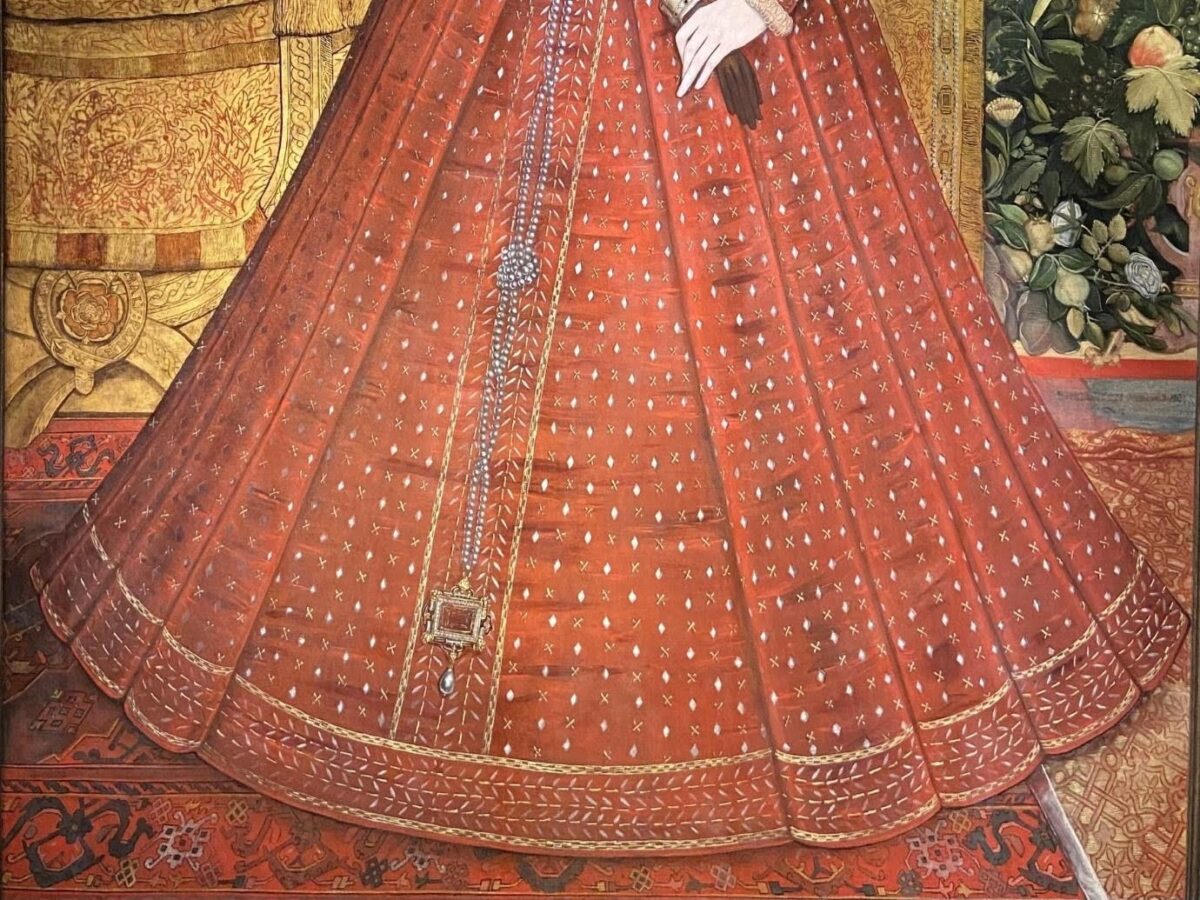
Steven van der Meulen, Portrait of Elizabeth I (The Hampden Portrait), c. 1563, oil on panel, transferred onto canvas, recently exhibited at Philip Mould & Company
The floor in early modern portraiture proves to be often enriched with symbolism. The Ditchley Portrait of Elizabeth I, painted circa 1592 by Marcus Gheeraerts the Younger, is an obvious example. In the portrait, Elizabeth stands on a globe of the world with her feet firmly planted in Oxfordshire. In this instance, the floor alludes to the patron of the work, Sir Henry Lee, who likely commissioned the work to commemorate a performance he had held in the Queen’s honour at his home in Ditchley, Oxfordshire. In another portrait of Elizabeth, the earliest surviving full-length painting of the monarch painted by Steven van der Meulen, the floor is sumptuously covered by rugs to amplify the status of the subject. Oriental rugs and carpets originating from the Islamic world were frequently depicted in European artwork from the fourteenth century onwards, initially in works of religious themes, but subsequently co-opted by elite portraiture as a means of conveying wealth and high-status.
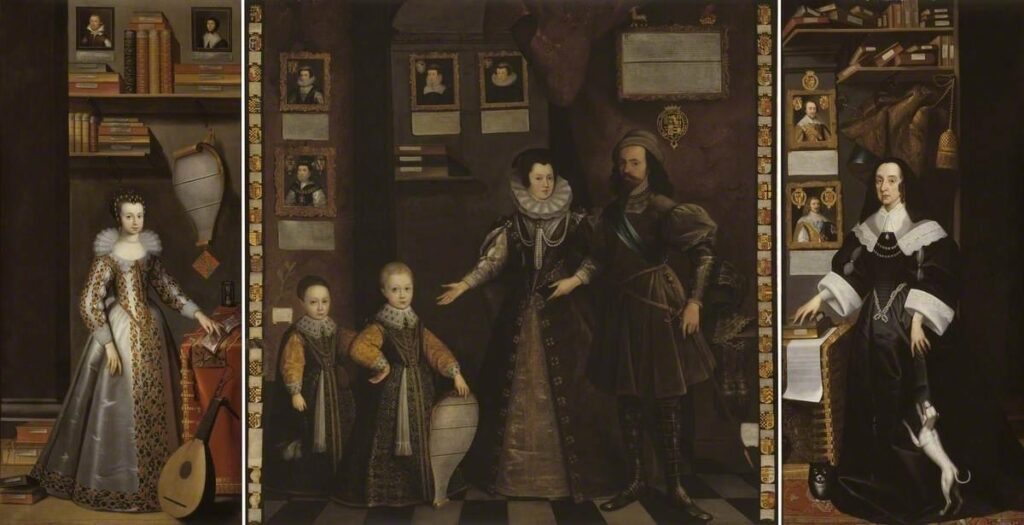
Attributed to Jan van Belcamp, The Great Picture, 1646, oil on canvas, 254 cm by 358 cm, Abbot Hall. Image credit: Lakeland Arts
A less famous example of how an artist could utilise the floor for both symbolic and practical purposes can be found in The Great Picture, attributed to the artist Jan van Belcamp. This triptych painting is a visual history of the Clifford family, commissioned by Lady Anne Clifford in 1646 to commemorate her inheritance of the family estates after a forty-year legal battle with her uncle and his heirs. The central panel depicts Anne’s parents, George Clifford, 3rd Earl of Cumberland and his wife Margaret, with their two sons before Anne was born. Upon the death of the Earl of Cumberland in 1605, Anne was set to inherit the vast Clifford estates after her two older brothers had died in their youth, but she was instead disinherited by her father who controversially named his brother as heir. The left panel presents Anne aged fifteen after she had been disinherited, whilst the right panel depicts Anne, twice married, having finally secured her rightful inheritance.
Although this is a painting rife with encoded messages, it is – unsurprisingly – the floor I wish to draw your attention to. Under the feet of the young and disinherited Anne, the floor is plain and nondescript, simply scattered with a couple of books suggestive of her learnedness. The right-hand panel presents an obvious contrast; having now repossessed her family estates, Anne stands on an oriental rug to emphasise her status as a wealthy widow. The central panel does something entirely different. Belcamp has co-opted a chequerboard floor to imbue the room with a sense of depth, a device of perspective developed by the artists of the Italian Renaissance. An especially clear example of this effect can be seen in Juan Bautista del Mazo’s depiction of Queen Mariana of Spain in mourning. Whilst looking at the floor in The Great Picture does not provide an entirely new appreciation of the message of the work as it does in The Ambassadors, it does play a fundamental role in creating perspective and enhancing the symbolism of each panel.
This article has provided just a couple of examples, largely focused on early modern English portraiture, of how our appreciation of figurative art can become more acute when we take time to look at what is going on, quite literally, under our noses. I challenge you to consider the floor, whether it holds an artist’s signature, a recognisable geometric pattern or a clever rendering of space, next time you find yourself in front of a work of art; it can be a surprisingly fruitful exercise.
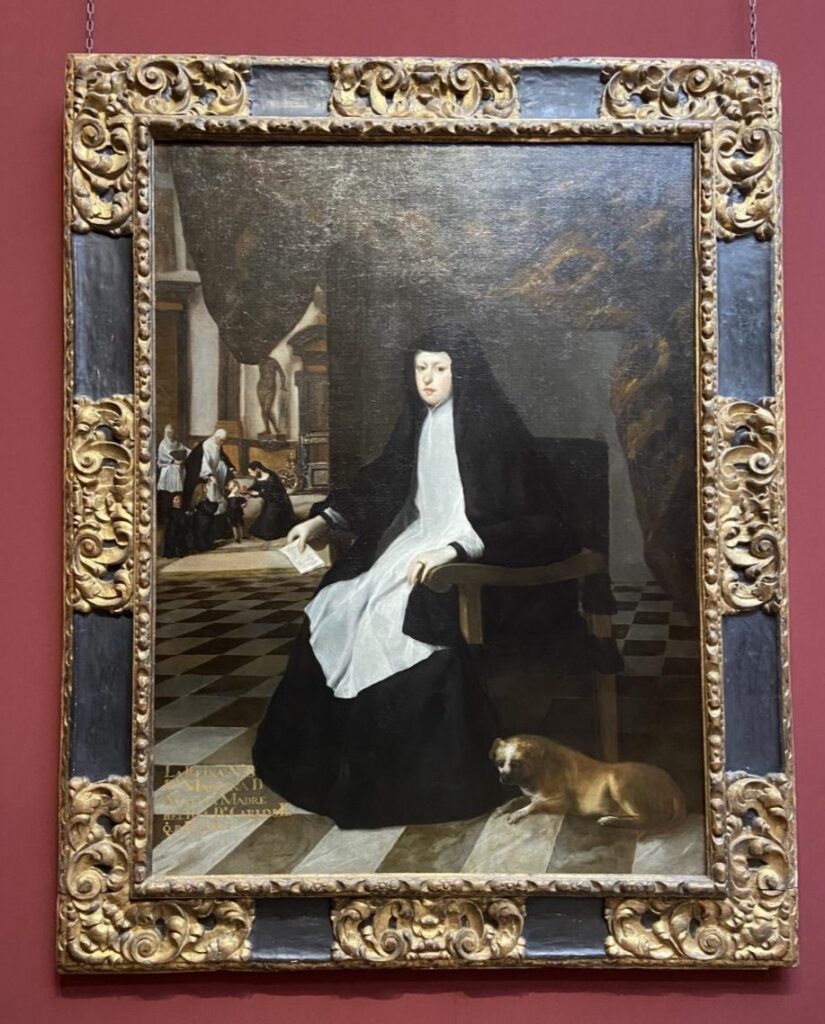
Juan Bautista Martínez del Mazo, Queen Mariana of Spain in Mourning, 1666, oil on canvas, 196.8 cm by 146 cm, The National Gallery.