By Lily Whewell
The Zurbarán exhibition at the National Gallery pays homage to the genius of one of Spain’s greatest master painters, Francisco de Zurbarán (1598-1664). Including works from private collections that have never before been brought into public view, the exhibition provides a comprehensive display of Zurbarán’s most prolific works as the first exhibition in the UK to be dedicated to the artist.
Zurbarán was born in 1598 in Fuente de Cantos, Extremadura, Spain and worked as an apprentice to Pedro Díaz de Villanueva in Seville from 1614 until 1617. After returning to his native region of Extremadura and setting up his first workshop in the town of Llerena, Zurbarán went back to Seville in the 1620s. The 1620s and 1630s subsequently saw Zurbarán at the zenith of his career. Primarily a painter of religious subjects, Zurbarán received his commissions from the Dominicans, Carthusians and Mercedarians. These religious orders had established themselves in Seville to benefit from the city’s prosperous position as a major hub of international trade, having been in possession of the royal monopoly on trade since 1503. The result was that Seville was a flourishing centre of artistic patronage of religious works of which Zurbarán was master.
Zurbarán’s genius rests in his ability to craft seemingly tangible subjects from paint. When faced with Zurbarán’s works, one cannot help but feel overcome by the paintings’ brooding power and stirred by the emotional intensity with which the artist conveys religious themes. That is not to suggest, however, that you have to be religious to appreciate the art. Throughout the exhibition you are enveloped in the sumptuous, ornately decorated and exquisitely detailed textiles donned by Zurabarán’s sitters. Zurbarán’s unrivalled capability to depict fabric is best epitomised by Saint Casilda (c.1635), one of the most popular works of his saint series. The daughter of an Arab king, Casilda converted to Christianity and supplied her father’s Christian prisoners with bread. Upon being discovered by her father, the bread Casilda had hidden in her skirt miraculously turned into roses and she was subsequently martyred in 1087.
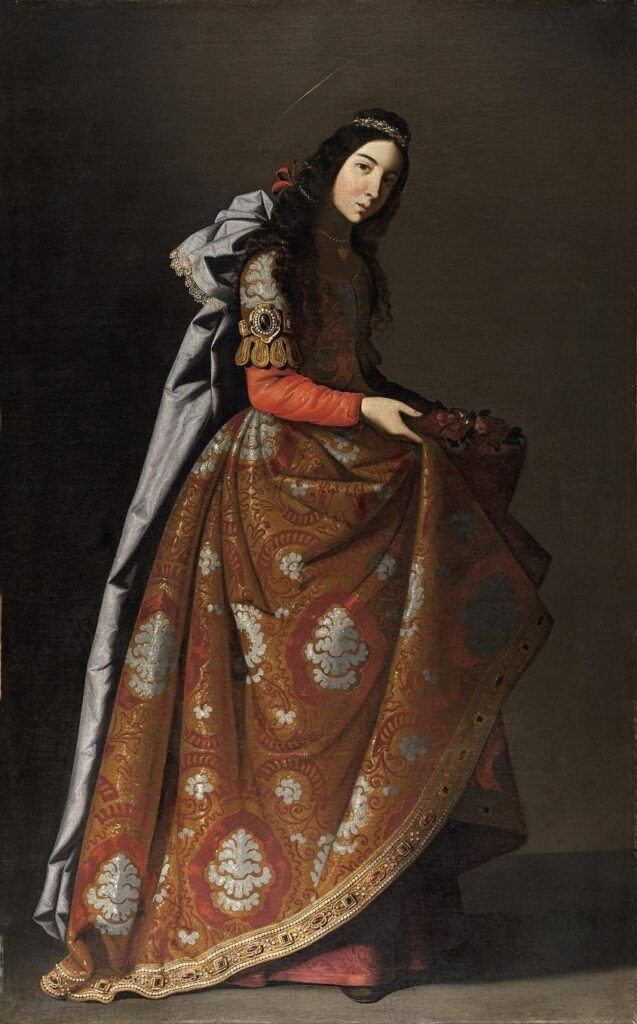
Francisco de Zurbarán, Saint Casilda, circa. 1635, Museo Nacional Thyssen-Bornemisza, Madrid
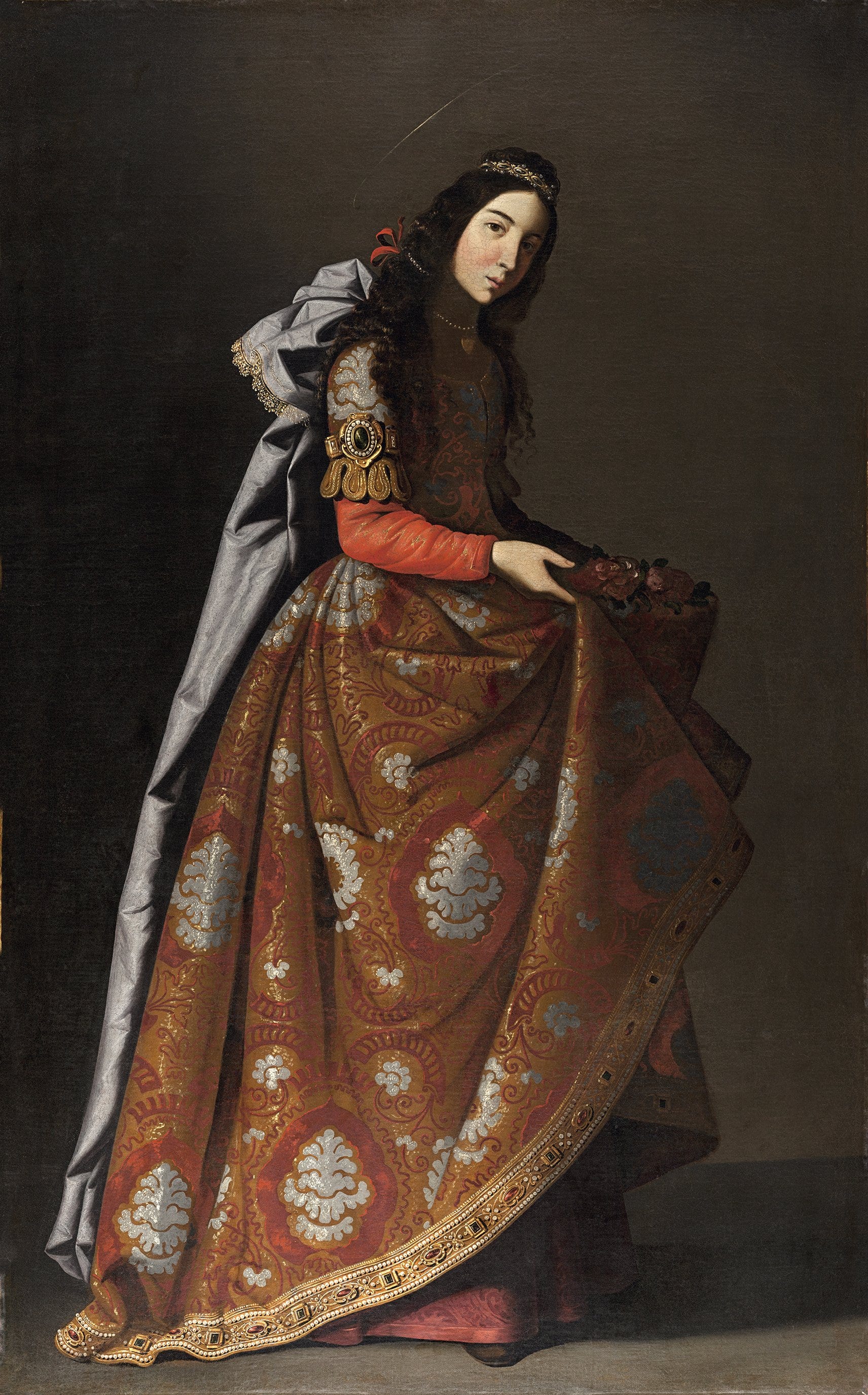
In Zurbarán’s presentation of the saint, Casilda holds her voluminous skirt, richly embroidered and trimmed with precious stones, to partially conceal the roses she is carrying. The folds in the skirt’s fabric are great and deep so that you can imagine its weight. Just in case you somehow miss it, the vivid red of her sleeve draws your eye towards her obnoxiously large armband, at the centre of which is a large, black stone – possibly an onyx symbolic of remembrance and divine strength and guidance in the bible – enclosed by a border of pearls. Nonetheless, for me the most impactful element of her attire is her cape. It appears to be constructed from stiff satin with an ornate gold trim, rendered so naturalistically you feel as if you could scrunch it up in your hands and it would hold the creases. Even in Zurbarán’s depictions of the Crucifixion, the most morbid scene of Christian iconography, Christ’s loincloth is presented as an excess of stark white fabric, with crisp folds and a haunting quality when contrasted with the black abyss of the background.
Nonetheless, the ability of Zurbarán’s paintings to exert their full power on their onlooker was hindered by the lighting of the exhibition space. Before visiting the exhibition, I anticipated the gallery space to be dimly lit to emphasise Zurbarán’s practice of chiaroscuro – the Italian term for creating three-dimensional forms through contrasting lightness and darkness. However, the exhibition space shared the same brightness and natural lighting as the rest of the gallery. Subsequently, whilst Zurbarán had meticulously and masterfully manipulated shadows and highlights to imbue his subjects with a sculptural quality, the brilliance of his execution of this technique could not be fully appreciated. Instead, I often found myself viewing the works from various angles in an attempt to escape the artificial glare.
This was apparent from the moment you entered the exhibition space when you are confronted with The Crucifixion (1627), the first of four in the exhibition and Zurbarán’s first signed and dated work. Christ is depicted with the upmost naturalism, his head hanging in a quiet but devastating solemnity. Outstretched on the cross, his elongated torso and limbs look almost as if they have been carved from marble. This sculptural quality of the work is key to understanding its power. The Crucifixion, which stands tall at 339.1cm by 212.1cm when framed, was commissioned by the Dominican Monastery of San Pablo el Real in Seville as part of a cycle of religious paintings. Of particular interest is that the work was originally placed behind a grill in the monastery so that, in the words of seventeenth-century art historian Antonio Palomino,
“Everyone who sees it, and does not know it, believes it to be sculpture”.
It therefore struck me as a bit of an oversight that the curation of the exhibition did not reflect this fundamental aspect of its original display. Why prompt people to imagine what the work would look like to contemporary observers when the effect could be very easily recreated?
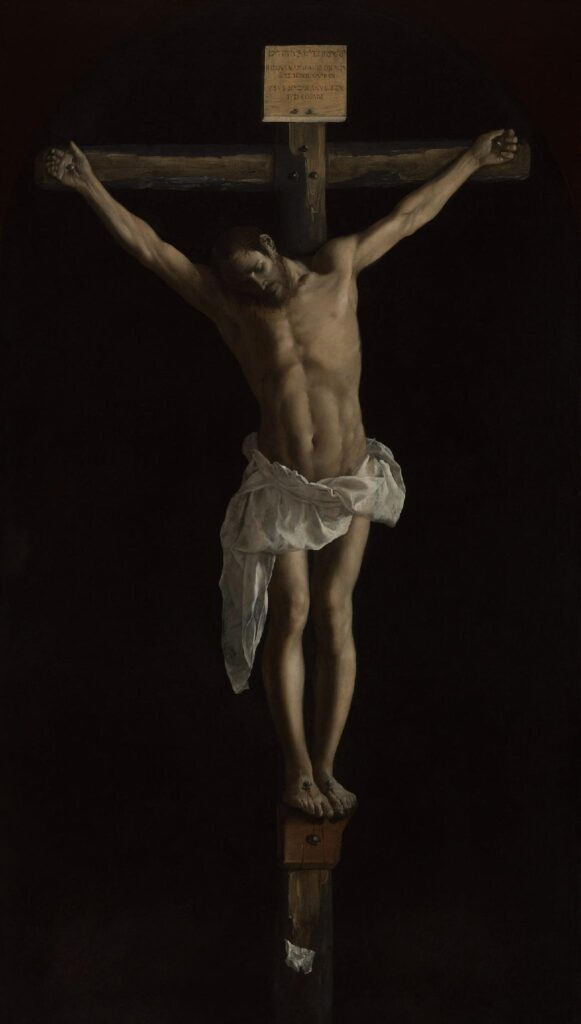
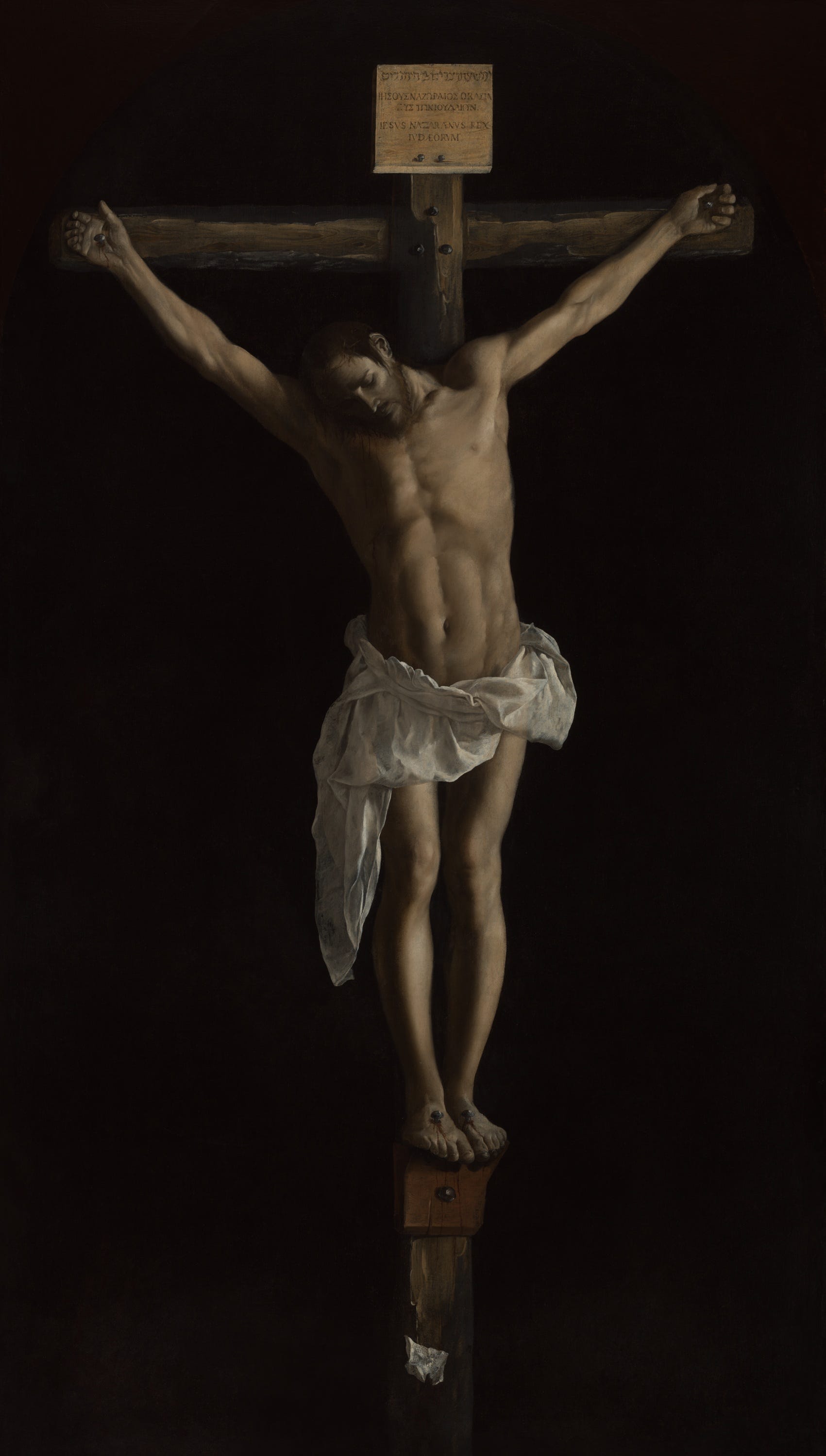
Francisco de Zurbarán, The Crucifixion, 1627, Art Institute, Chicago
In contrast, the Wallace Collection’s recent exhibition of Caravaggio’s Victorious Cupid (finished in April of this year) seized the darkness. Caravaggio’s Victorious Cupid (also known as Amor Vincit Omnia, Amor Victorious amongst other names) formed the finale of the short exhibition which showed the masterpiece along with two ancient Roman sculptures, all of which historically belonged to the collection of the Marchese Vincenzo Giustinani (1564-1637) in Rome. Painted by Caravaggio in 1601-1602, the work was backdropped by paragone “comparison”, a Renaissance debate between artists and collectors which questioned whether painting or sculpture were the superior artform. Caravaggio’s cupid, in the same manner as Zurbarán’s figures, combines both; it is a painting with a sculptural quality. Set in a near-pitch black room which echoed the work’s black background, the onlooker could easily appreciate the three-dimensionality of Caravaggio’s cheeky subject in contrast to the set-up at the National Gallery.
However, the issue with the lighting cannot ‘overshadow’ what was otherwise a wonderfully curated exhibition. From smaller commissions such as the devastating Agnus Dei and still-lifes by both Zurbarán and his son, to an appreciation of scale through the partial reconstruction of a fifteen-metre altarpiece and the giant, ominous head attributed to the artist, the exhibition provides a unique and unmissable opportunity to be fully immersed in the drama and theatricality of Zurbarán’s art.
The Zurbarán exhibition is on at the National Gallery, London, until the 23rd August, 2026.