
By Raphael Henrion
I recently had the pleasure of attending an open mic event for songwriters hosted by Durham University’s Open Mic Society (whose president is our very own Matthew Dodd!). Entering the intimate venue of the Claypath Deli late, I sat at the front near the door, which provided me with a very close view of the performers as they came up one by one. I was genuinely impressed, and at various moments also moved, by both the lyrical and melodic quality of the performances, many featuring songs never heard before in a public setting such as this one. Yet as each singer moved the microphone out of their way and unplugged their guitars from the small amp, I found myself being increasingly fascinated by the performers’ accents.
Every single singer shifted from introducing their songs in what I would consider a British accent to singing in an accent that was distinctly Americanised. Despite initially trying to brush this observation to the side, I found myself being increasingly distracted by this recurring phenomenon, prompting a few scrambled thoughts on my notes page between performances. My friend, an employee of the Claypath Deli, told me that they considered each singer’s changed accent to be more of a personal blend of accents rather than an entirely North American one. Nonetheless, this change was present and noticeable.
Since that night, I have been mulling over what causes this change, or more specifically, why the British accent is lost, whatever form of British accent that might be. While I do sing and have dabbled in writing myself, I am by no means taking away from or criticising others’ choices. After all, if I may be afforded the cliché, the beauty of music is its subjectivity. Ruminating on the why has led me to a few potential reasons why singers may choose to stray away from their natural spoken accent, subconsciously or otherwise.
The first is social and cultural, with a widespread adoption of a kind of ‘default’ pop-singing style. We have come to identify the ‘Americanised’ accent with certain popular forms of music, with linguist Andy Gibson suggesting that this shift happens automatically, calling this style of singing the “pop music accent.” Numerous famous British artists do this, including Adele, Mick Jagger, and Amy Winehouse. Even Sam Fender, from here in the North East, softens and changes his accent when singing compared with his strong spoken Geordie voice. As this style of singing has come to be expected, singers may be gravitating towards it inadvertently simply because that is the norm.
Stemming from this industry-wide homogenisation, I would put the second reason down to vulnerability, which was especially relevant in a small venue such as the one I attended. Performing original music, especially if it is inspired by difficult emotions, memories, or experiences, is inherently vulnerable and for many can be intimidating. I suggest that by shifting away from one’s own ‘natural’ voice, singers can find comfort and create a barrier, hiding behind a different accent. By creating a character that can be embodied while singing, they may be able to protect themselves from feeling exposed or nervous. Indeed, I noticed a number of singers that night who came across as shy and restrained in their spoken introductions, before seeming to gain confidence while singing in an Americanised accent.
Finally, while I am ultimately unconvinced by the strength of this argument, many people would state that the Americanised accent is linguistically caused, with intonation, vowel length, and diction all being changed by the very process of singing itself. And while this may be true, the existence of countless other accents in different singers and genres across the world must mean that this is not a strictly necessary change. Many British artists sing in their native accents, with a few names that spring to mind including Lily Allen, Alex Turner/ Arctic Monkeys, Blur/ Damon Albarn, and Kate Nash.
All in all, singers have a right to sing in whatever accent they choose. Some of the most popular and culturally significant singers of many countries including this one do adopt this Americanised pop accent. I am not in any position to tell anyone how to sound or what voice to choose, though I would suggest trying out singing in your native accent – you may like the rawer, more intimate sound that emerges when you take that wall down.
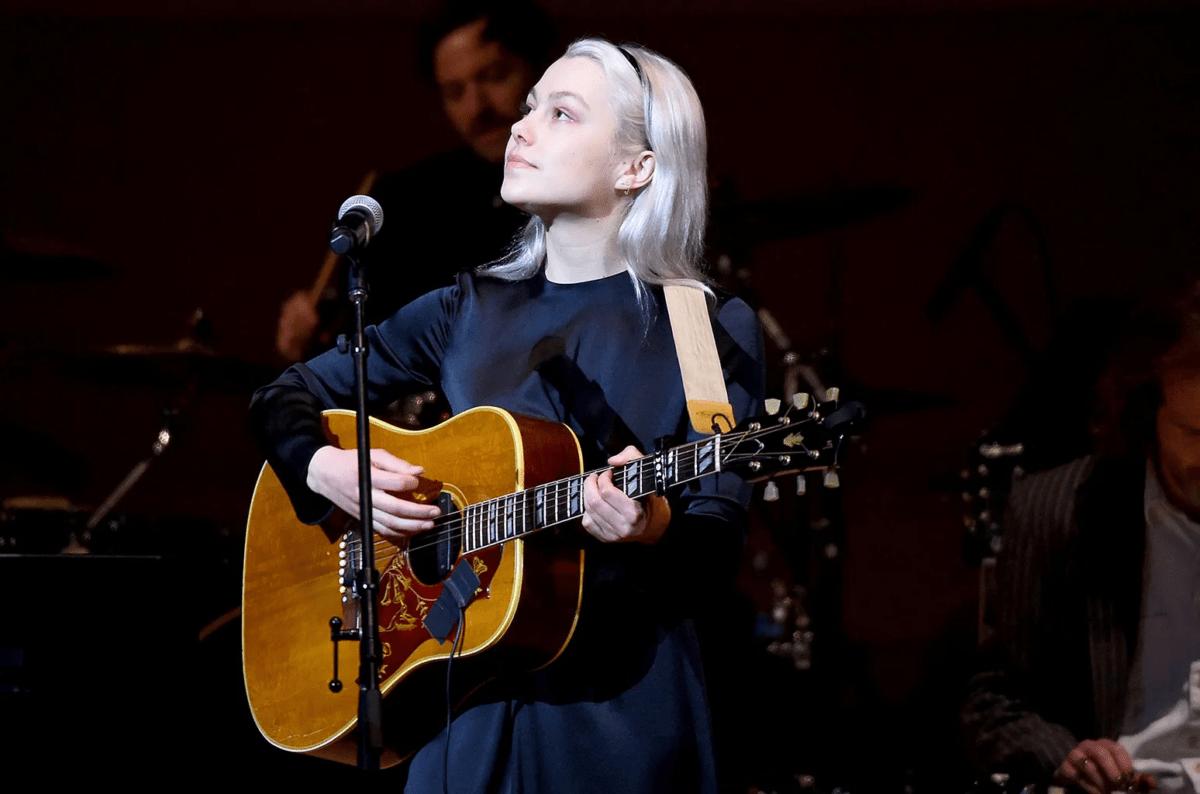
Featured Image: Phoebe Bridgers, Billboard