
Categories
Perspective

‘Why Do You Sing With an American Accent?’: A Reflection Prompted by Songwriters from Open Mic Society 

By Raphael Henrion

I recently had the pleasure of attending an open mic event for songwriters hosted by Durham University’s Open Mic Society (whose president is our very own Matthew Dodd!). Entering the intimate venue of the Claypath Deli late, I sat at the front near the door, which provided me with a very close view of the performers as they came up one by one. I was genuinely impressed, and at various moments also moved, by both the lyrical and melodic quality of the performances, many featuring songs never heard before in a public setting such as this one. Yet as each singer moved the microphone out of their way and unplugged their guitars from the small amp, I found myself being increasingly fascinated by the performers’ accents.

Every single singer shifted from introducing their songs in what I would consider a British accent to singing in an accent that was distinctly Americanised. Despite initially trying to brush this observation to the side, I found myself being increasingly distracted by this recurring phenomenon, prompting a few scrambled thoughts on my notes page between performances. My friend, an employee of the Claypath Deli, told me that they considered each singer’s changed accent to be more of a personal blend of accents rather than an entirely North American one. Nonetheless, this change was present and noticeable. 

Since that night, I have been mulling over what causes this change, or more specifically, why the British accent is lost, whatever form of British accent that might be. While I do sing and have dabbled in writing myself, I am by no means taking away from or criticising others’ choices. After all, if I may be afforded the cliché, the beauty of music is its subjectivity. Ruminating on the why has led me to a few potential reasons why singers may choose to stray away from their natural spoken accent, subconsciously or otherwise.

The first is social and cultural, with a widespread adoption of a kind of ‘default’ pop-singing style. We have come to identify the ‘Americanised’ accent with certain popular forms of music, with linguist Andy Gibson suggesting that this shift happens automatically, calling this style of singing the “pop music accent.” Numerous famous British artists do this, including Adele, Mick Jagger, and Amy Winehouse. Even Sam Fender, from here in the North East, softens and changes his accent when singing compared with his strong spoken Geordie voice. As this style of singing has come to be expected, singers may be gravitating towards it inadvertently simply because that is the norm.

Stemming from this industry-wide homogenisation, I would put the second reason down to vulnerability, which was especially relevant in a small venue such as the one I attended. Performing original music, especially if it is inspired by difficult emotions, memories, or experiences, is inherently vulnerable and for many can be intimidating. I suggest that by shifting away from one’s own ‘natural’ voice, singers can find comfort and create a barrier, hiding behind a different accent. By creating a character that can be embodied while singing, they may be able to protect themselves from feeling exposed or nervous. Indeed, I noticed a number of singers that night who came across as shy and restrained in their spoken introductions, before seeming to gain confidence while singing in an Americanised accent.

Finally, while I am ultimately unconvinced by the strength of this argument, many people would state that the Americanised accent is linguistically caused, with intonation, vowel length, and diction all being changed by the very process of singing itself. And while this may be true, the existence of countless other accents in different singers and genres across the world must mean that this is not a strictly necessary change. Many British artists sing in their native accents, with a few names that spring to mind including Lily Allen, Alex Turner/ Arctic Monkeys, Blur/ Damon Albarn, and Kate Nash. 

All in all, singers have a right to sing in whatever accent they choose. Some of the most popular and culturally significant singers of many countries including this one do adopt this Americanised pop accent. I am not in any position to tell anyone how to sound or what voice to choose, though I would suggest trying out singing in your native accent – you may like the rawer, more intimate sound that emerges when you take that wall down.

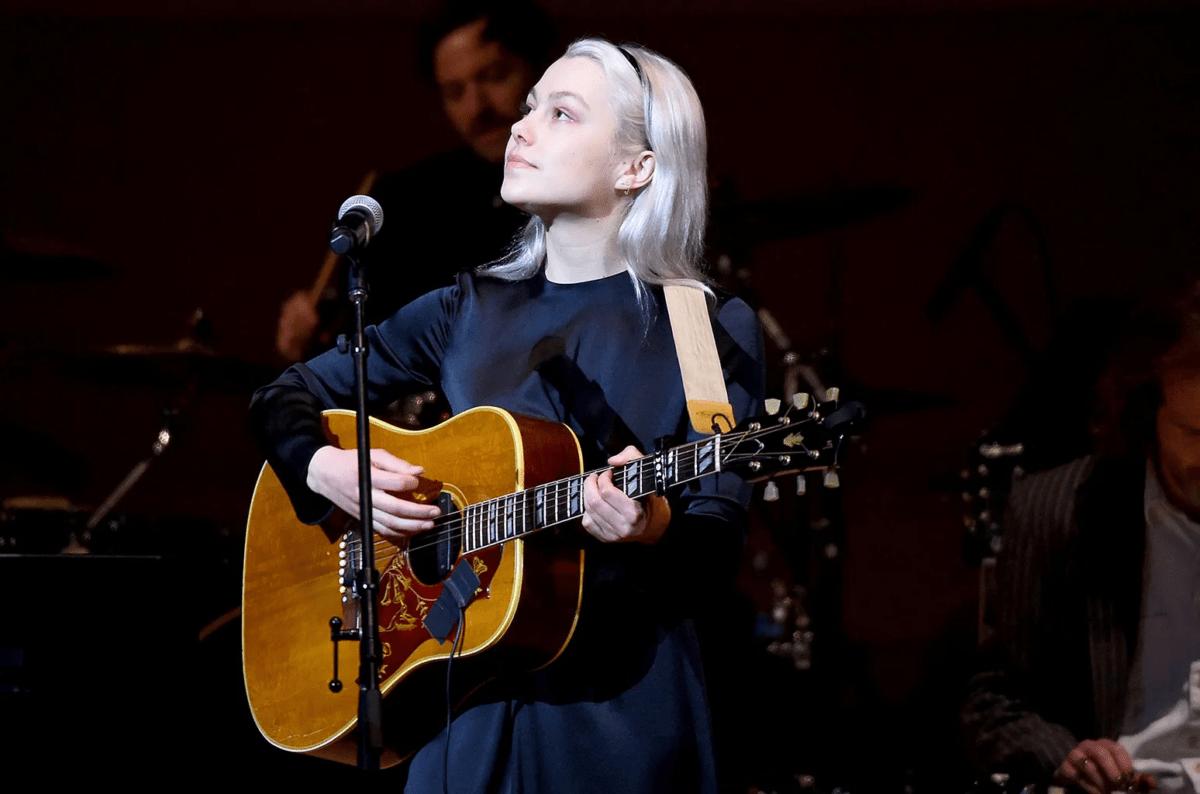
Featured Image: Phoebe Bridgers, Billboard
Categories
Reviews

DULOG’s 2025 Sweeney Todd, a Review

By Raphael Henrion

I had the privilege to watch DULOG’s production of Sweeney Todd: The Demon Barber of Fleet Street twice during their impressive run of six sold out performances. Stephen Sondheim’s musical adaptation is a classic that has been revived professionally, amateurly and somewhere in between since its opening on Broadway in 1979 and in the West End in 1980. It is no surprise that DULOG, Durham’s grandest music theatre company, took on this beloved story and musical. What I experienced in both performances was a striking, polished, and deeply impressive production with passion and energy oozing from every actor, musician and technician. Co-directors Amanda Cross-Court and Lauren Williams, assisted by Rio Patel, should be incredibly proud of creating a show with greatly deserved high praise.

The Performers

Right from his introduction, Sweeney Todd was played by Tom Carroll as a man full of confidence, purpose and power. Carroll’s ability to shift from sinister and vengeful to gracious and charming was very impressive, and was something he did especially well through his wonderfully sung lines. Todd’s partner in crime, Mrs Lovett, was played by Connie Richardson, who I must say was the standout performer both times I watched. Richardson managed to balance the extremely frantic energy in her physical and vocal performance while maintaining such clarity and strength in her singing and line delivery. Indeed, I scribbled in my notebook that Richardson ‘would not need to speak any lines’ given how much the audience gained from her facial expressions and physicality. Despite being a somewhat villainous character, I could not help but feel like I wanted to be on Richardson’s side.

Perhaps a more conventional romantic pairing, the actors for Johanna – played by Mathilda Ketterer – and Anthony – played by Joe Butler-Smith – demonstrated wonderful chemistry and embodied the hope of a more peaceful conclusion to the tale. Their voices were softer and brightly toned, helping set them apart from the other corrupted characters. A key moment of their interaction that stands out to me was that of Butler-Smith’s starstruck demeanour when he first sees Ketterer’s character. Followed by a timed spotlight, Butler-Smith was so eager to get closer that he descended the auditorium stairs quicker than the light could keep up. Intentional or not, I loved this detail.

Michael Nevin as Judge Turpin and Bede Capstick as Beadle Bamford worked very well together as the main antagonistic duo. Nevin’s highlight moment was his fantastic solo where, despite the uncomfortable motivation behind it, the audience could not help but be captivated by such a powerful performance – full of desperation, guilt and determination. As Turpin’s assistant, Beadle Bamford was embodied fantastically by Capstick, whose slimy yet charismatic portrayal made his character frustratingly likeable. 

Midun Odunaiya’s performance as Tobias was full of energy and this physicality was well suited to his character’s young age, making it far more believable. Pirelli, Tobias’s original employer and guardian (before he is ‘dealt with’ by Todd), was played by Will Simpson, who performed the faux Italian accent and flamboyant mannerisms very well and garnered many laughs from the audience. Simpson and Odunaiya appeared to have a lot of fun playing their roles, and the audience received all the benefits. Elena Pesciarelli sang excellently as the Beggar Woman, with great strength and desperation in her voice as she cries for ‘alms’, though I would have liked to see a greater sense of confusion and insanity in her characterisation.

Finally, I could not close my discussion of the acting performances without giving enormous credit to the nine members of the ensemble. This talented group of actors gave full commitment throughout the show, making a massive difference. A particularly impressive demonstration of the group’s brilliance was in the asylum scene, where each member of the ensemble played a uniquely ‘insane’ resident circling around the room – a scene that no doubt requires the crediting of Movement Directors Amelie Symmons and Jobe Hart. Their great work in choreographing this and many other moments of great synergy and synchroneity was integral.

The band, led by Musical Director Sammy Cormack-Repath, played full of character and emotion. I was impressed by the seeming shifts of motivation in their playing, their performance going beyond simply what they were playing and into how they played. In the first act, for example, the energy in their playing felt like they were on board with Mrs Lovett and Sweeney Todd’s plan, egging them on. After the interval, however, their playing felt more sinister, acting as more of a warning against rather than for Sweeney Todd. 

The Production

Production Manager George Murray and Assistant Production Manager Jonathon Wilson-Downs headed the design of a show that looked and sounded incredible. Deserving an entirely separate article reviewing their work alone, I will do my best to touch on every technical element that made Sweeney Todd so remarkable. 

The set was designed and constructed by Libby Simpson and her team. The two-tiered stage made it very easy to discern between Mrs Lovett’s pie shop downstairs and Sweeney Todd’s barber shop upstairs. Masking the height difference between the two floors were flats with painted grey brickwork. Sections of this brickwork were on hinges which could be opened to reveal different designs beneath, either red brick for symbolic emphasis, or the oven and signage of Mrs Lovett’s shop. I found this to be a very well-thought-out design that was used effectively throughout the show. The beautiful skyline drawing on the flat at the very back of the stage was gorgeously detailed yet subtle in colour, helping immerse us into Victorian London. The set and its various intricacies could not have been revealed without the excellent work of Stage Manager Evie Collins and her team (including Assistant Grace Mathews and Deputy Thea Jupe), who facilitated smooth, well-rehearsed transitions. I found that throughout these transitions, the stage crew moved with purpose, fitting into rather than clashing with the context and intensity of the play.

Co-Lighting Designers Leyla Aysan Montoya and Rory Collins delivered visuals that sincerely elevated the quality of the show. The flickering and dimming of the house lights at the beginning of the show was an effective choice I enjoyed; not even the ‘normal’ lights could provide the audience with familiarity and comfort as the show began. Additionally, the LED baton lights on the elevated platform (the upstairs) were a wonderful, dynamic choice that helped emphasise moments of violence, shifting motivations and more.

The sound for this production was some of the best I’ve experienced in Durham. Designer Carlos Davies, Isabella Broxis and Aniket Garg delivered the highest quality: very well balanced and mixed right from the beginning. All the sound effects that were used were well-timed and contributed meaningfully. Overall, I could hear and understand every line spoken or sung in this play, a feat I previously thought impossible. Indeed, one patron said to me that the amplification was potentially the best they ever heard in this venue.

Finally, I must commend the costume and makeup team, led by designer Harriet Miller, who ensured that every character was uniquely and effectively costumed to fit the bleak, Victorian context. One of my favourite details was that of changing Sweeney Todd’s waistcoat to red for the second act, matching the outfit of the Judge Turpin who he had sworn revenge upon. To reference Obi-Wan Kenobi, he had become what he swore to destroy.

Conclusion

All in all, this was a cast and crew brimming with talent and passion, making it an excellent show I am grateful I had the opportunity to enjoy (twice).

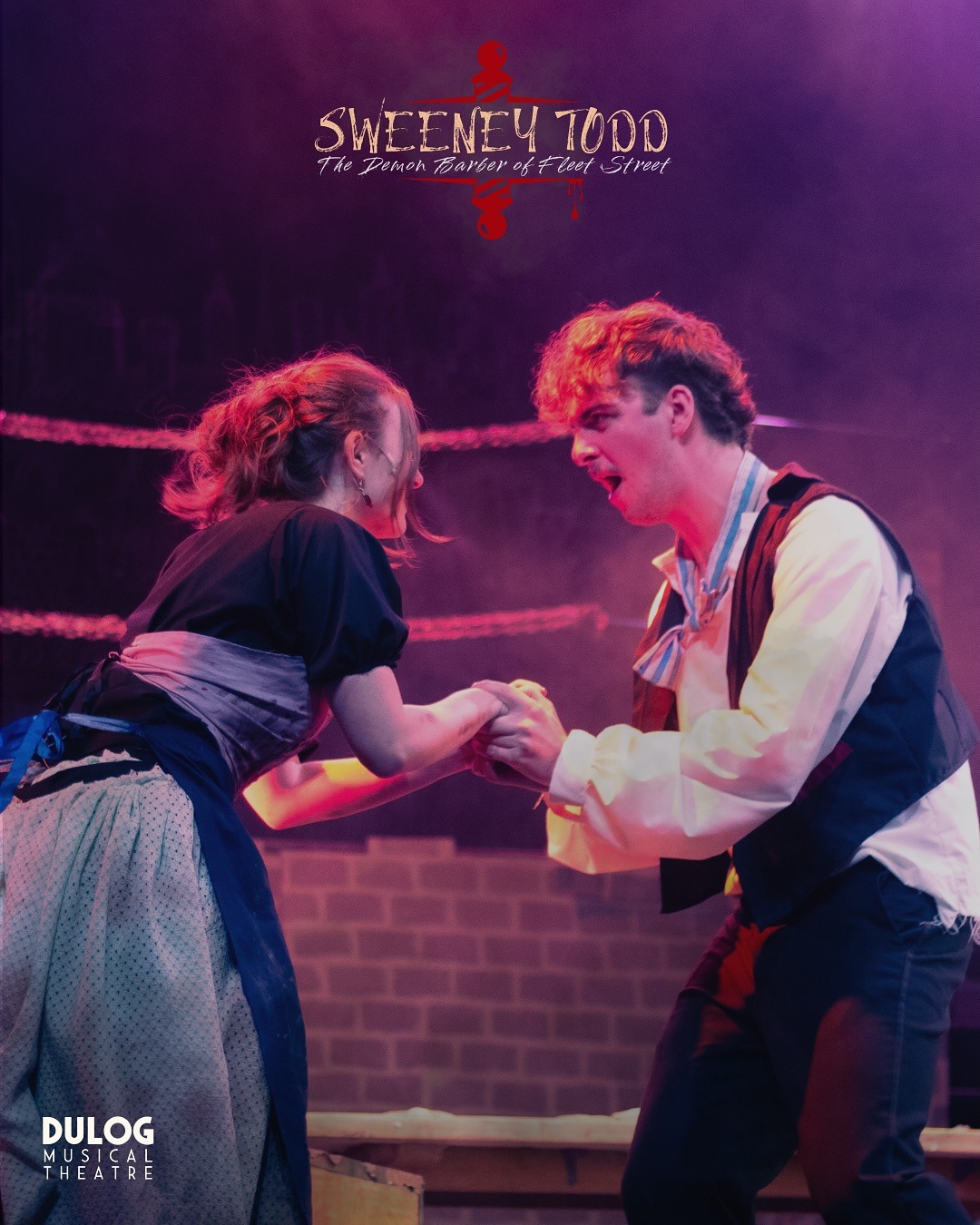
Featured Image: DULOG