
By Tashy Back
As I sat in a hopeless heap on my floor, surrounded by collapsing piles of clothes, I found myself stuck, once again, on that question which always seems far more important than it should be: what to pack? I know travelling is supposed to be about exciting new experiences and I fear that my love of roaming around strange countries may appear fraudulent, but clothing has always had a way of dictating how I move through somewhere new. More importantly though, how I feel I am perceived by the people there, with the constant risk of exposing myself immediately as a stereotypically obnoxious tourist as an ever daunting prospect.
Hong Kong, even before arriving, felt like somewhere that might read you quite quickly. The problem was that my wardrobe, unhelpfully, operates in extremes, either geared towards a nippy London winter or summers spent lounging at the beach, with very little in between. It became increasingly clear, as I tried and failed to assemble any sort of convincing outfit, that neither category would quite work. This was confirmed, with some amusement, by friends who had grown up there, who informed me that my usual Durham-coded style of baggy jeans and a half-decent top would not, in fact, cut the mustard. Indeed, nights out came with a far more specific expectation of short skirts and knee-high boots, a dress code which I hadn’t quite accounted for.
On our train ride from the airport into the city, Hong Kong presented itself to me in all its majesty, angular glass towers packed tightly together, then just behind, steep verdant green hills pushing forward, as if the city and the jungle had never quite agreed where one ends and the other begins. Moving through the island only deepened my impression of Hong Kong as a place of contrasts, as the city shifted abruptly from the compressed intensity of crowded streets where double-decker trams trundle slowly past, and people move quickly but without urgency, caught in the steady hum of city life. Then there are the isolated and deeply rural beaches on the south side of the island, where, as you gaze at the never-ending silver line of the horizon, the city seems to fall away entirely. From neon-lit crowds and late nights that drag on in heat and fervour with voices spilling out from bars onto the street, to sudden pockets of stillness that catch you off guard, a dog nosing along the tide line, a lone figure propped up against the wall smoking, the glow of his lighter briefly lifting his face from the dark, before it all slips back again.
The air in the city felt even heavier than I expected, humid, carrying with it a mix of exhaust fumes, sea salt, a faintly earthy smell, and, drifting in and out, the sharp, sweet trace of incense. At times, the city felt unexpectedly close to England, the sky turning grey, the air thick and unmoving, with a heaviness that hung low over everything. We spent that weekend after our arrival watching the rugby Sevens in a jam-packed stadium, surrounded by noise, not-so-cheap drinks, and a rowdy crowd that buzzed on the edge of disorder. Just a few hours later, I found myself walking down a side street, shutters half down, stray light pooling onto the pavement, the city suddenly smaller and more contained. Then, one night later that week, looking out over the city from the Peak, it shifted for me yet again, lights blurring into streaks of white, amber, and neon blue as the city spread out beneath me, more expansive than it had ever felt from the ground, running on without any clear edge. Within these constant shifts, I began to understand that Hong Kong is a layered island, one that operates with its own unique rhythm.
It was through my boyfriend, who calls Hong Kong home, that these layers began to take on meaning, because to walk through a place with someone who knows it intimately is to inherit a version of it that is not quite your own. We traced fragments of his childhood: half-forgotten amusement parks, familiar street corners, stories of clambering over corrugated iron fences for afternoon tea taken on silver trays by the derelict swimming pool, these places that meant everything to him and nothing to me, until suddenly they didn’t. I saw the city not just in the present, but as it had been, its past carried in his memory, which was a strangely intimate way of experiencing a new place, and one that made me constantly aware of my position somewhere between observer and participant. There is something slightly surreal about temporarily inhabiting someone else’s home like that.
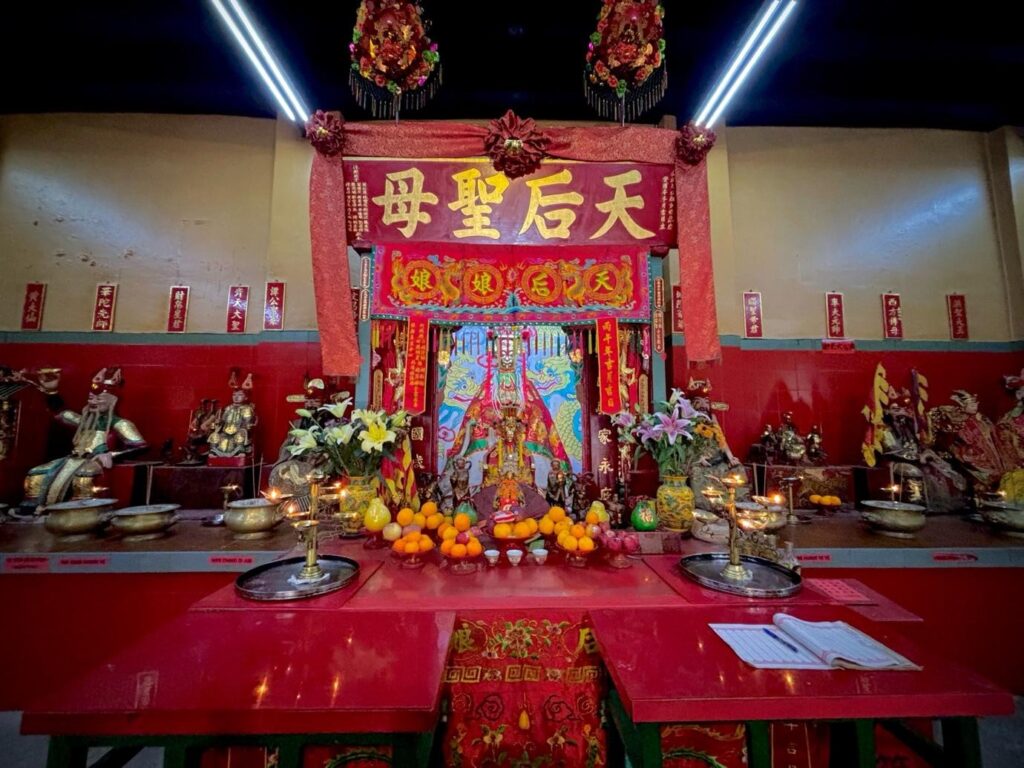
While wandering the island, we stopped at a small temple near the beach, easy to miss from the road. Inside, it was all red and gold, incense burning slowly in large bronze bowls, ash gathering in soft grey layers, and offerings of bowls of fruit arranged carefully in front of brightly painted figures. As we explored, my boyfriend told me how, as a child, he and his brothers had filmed a homemade ninja film in the square just in front of the temple. It was hard not to picture it as he spoke, a scrappy, ginger-haired boy darting between the benches and trees, sticks clutched like weapons, the whole thing playing out against the same still backdrop. For a moment it felt as though we were transported back a decade with the present still holding the faint outline of what had been.
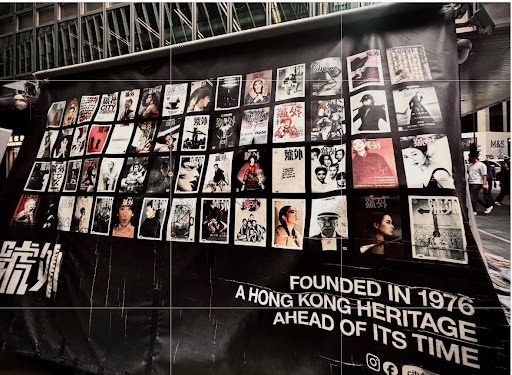
At the Hong Kong Museum of Art, I came across the work of Wu Guanzhong, who saw Hong Kong as a place where he could “see both the East and the West at the same time,” an idea reflected in his paintings, where Western scenes are rendered through traditional Chinese techniques and familiar forms shift between the two, creating a hybrid art form that links cultures. This convergence between the east and the west still lingers in Hong Kong, even after the handover to China; on one side of the street is a quintessentially British M&S, coolly lit and orderly, and opposite it, a Cantonese dim sum restaurant with plastic stools, worn menus, and steam rising from bamboo baskets. What struck me most, however, was how my friends who had grown up flitting between Hong Kong and England seemed to effortlessly embody this duality as they adjusted how they spoke and presented themselves with an instinctive ease that revealed a lived internationalism.
By the end of my time there, I had stopped thinking about the contents of my suitcase. What stayed with me instead was seeing Hong Kong through the eyes of someone who had always known it, which was, for me, the most revealing and perhaps the most meaningful way to experience it.
Images courtesy of Tashy Back