By Heather Thomson
The English language has been used consistently in the United Kingdom for over 1,500 years. When Germanic dialects were brought over by Anglo-Saxon settlers in early medieval England, what we know today as “Old English” was born. Celtic languages which dominated the country, those known collectively as “Common Brittonic”, which themselves are ancestors of modern-day Cornish and Welsh, were soon replaced by this Germanic influence. However, despite both being given the name “English”, how similar is today’s language to the Old English of the past?
The switch between Old and Middle English
A well-preserved jewel of Old English is the opening line of the famous poem “Beowulf”, which reads, “Hwæt! Wē Gār-Dena in geārdagum þēodcyninga þrym gefrūnon”. As an English speaker in the 21st century, you likely skimmed over that; it is simply illegible to you. However, it might make you wonder just what happened over the centuries to make Old English so different from the version we use today.
It is widely considered that the two are separate languages. Many factors shaped modern-day English into something unrecognisable when put next to Old English, a major one being French and Latin influences that came about after the Norman Conquest in 1066. The ruling class in 11th century England swiftly adopted Norman French due to the influence of William the Conqueror; for around 300 years, it was considered the prestigious language of law, government and the court in England. However, it was only being used by a certain elite, leaving a large majority continuing to use English. This ultimately led to a major linguistic split, serving as a catalyst for the development of Middle English, a new variation of the language which was heavily influenced by French. Due to the split, a drastic flood of French vocabulary was stirred into the midst of a developing language, creating an immense semantic shift from Old to Middle English.
How Middle English evolved into Early Modern English
Middle English’s life span is accepted to be between 1100-1500. A major differentiation between this form and its predecessor is the extreme pronunciation differences caused by the Great Vowel Shift. Taking place primarily between 1400-1600, this was the process through which vowel pronunciations in the English language underwent several significant changes. Its exact cause is debated, however many linguists believe the phenomenon could be attributed to the Black Death, natural language change or social class differences. The Black Death, for one, triggered a massive population migration to Southeast England and London. This huge shift involved mixing a range of dialects from all over England, encouraging middle-class Londoners to distinguish themselves from newcomers by changing their vowel pronunciations. In this way, Middle English slowly parted with its traditional features, evolving into what is now known as Early Modern English, commonly referred to as “Shakespeare’s English”.
The Evolution of Modern English
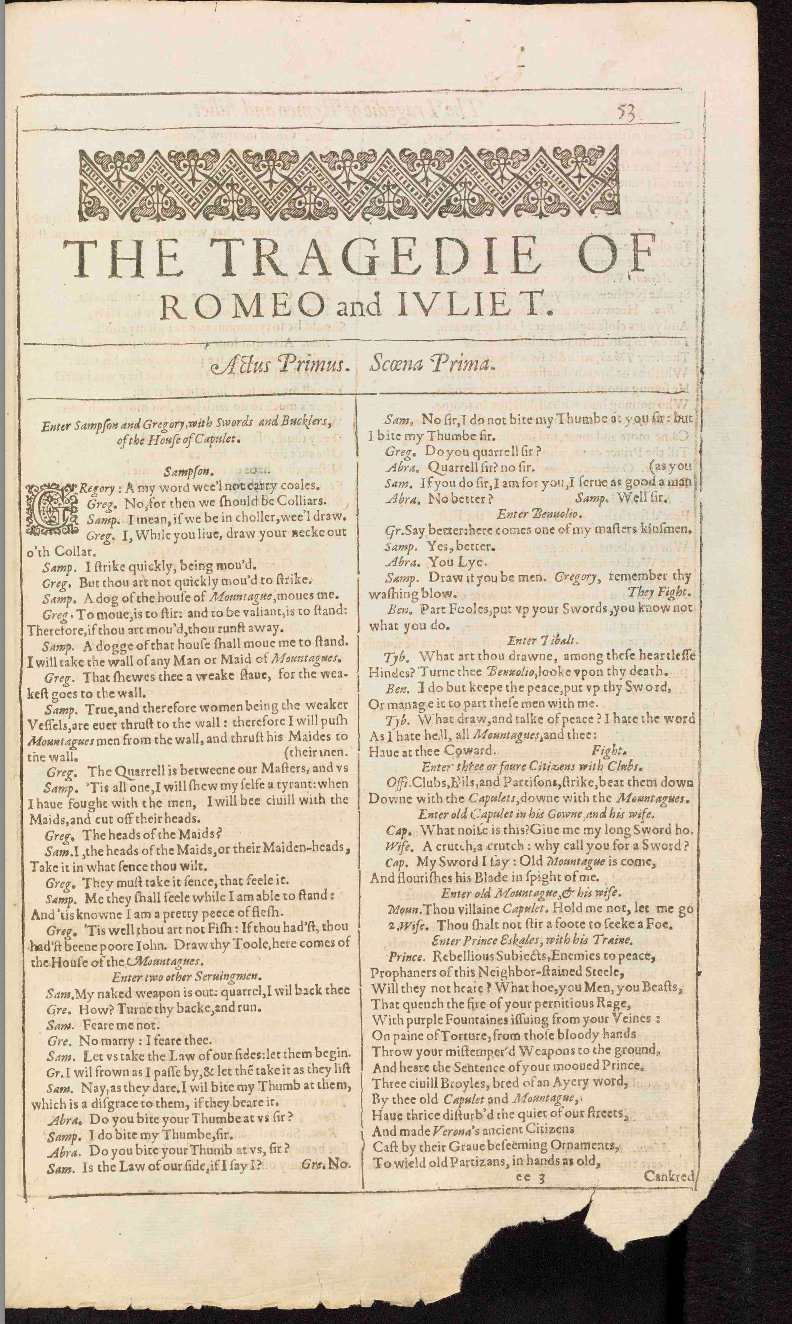
Early Modern, or Shakespearean, English is not considered a distinctly separate language from that which we use today (Late Modern English). And yet, despite this, many modern-day English speakers would much prefer studying Romeo and Juliet with a 21st-century translation running down the side. Bearing in mind that Early Modern English was a bridge between Middle and Late Modern versions, there are notable features from both variations of the English language throughout Shakespeare’s works.
If you’ve ever stepped foot in a GCSE English classroom full of students studying Romeo and Juliet, you have, without a doubt, heard several students utter that famously mistaken line: “wherefore art thou Romeo?” The present-day usage of the adverb “where” typically results in many people using context clues and guessing that Juliet is asking about Romeo’s location. However, the archaic term “wherefore” generally translates to “for what reason” or “why”, showing Juliet is asking why Romeo has to be Romeo, a child of the Montagues, her family’s generational rivals. Shakespeare also famously invented, adapted and popularised words to create meanings when he felt pre-existing words were too weak to describe the intense plots and characterisation in his work. For example, he popularised the modern-day meaning of “addiction”, which stems from the Latin word “addicere”, signifying to devote or assign.
Over time, the archaic features of Shakespearean English faded out, leaving the 19th century with a new version of English that is largely similar to that which we use today. We might think of the first lines of Charles Dickens’ A Christmas Carol – “Marley was dead: to begin with. There is no doubt whatsoever about that. The register of his burial was signed by the clergyman, the clerk, the undertaker, and the chief mourner.” This version of English is generally legible to a present-day English reader without the support of a translation.
But are we really, in the 21st century, in the same linguistic stage as that of Dickens and the Victorians? Some might argue that the digital era and the advent of other technologies have transformed the language once again. Nowadays, many individuals communicate over the internet using nothing but emoticons and emojis. Instead of “I laughed at this!” a simple “😂” can say the exact same thing with no words used. A debate that can often become heated is whether these features are “killing” the language, but if this article has shown us anything it is that English, in short, loves to change. Features of language brought in by technology are simply new and telling developments – not a threat. One of the oldest symbols of communication were cave paintings and rock art, which date as far back as 30,000 BCE. Given that, could we argue that in using emojis we are going back to our roots, reconnecting with humanity’s earliest forms of communication?
Featured Image: Bodleian Library