By Amelia Awan
Ever since I read the book, I have always hated the English translation of its name.
“The Hunchback of Notre Dame”, while being a fitting title for many adaptations of the story (including the Disney film and subsequent musical which I am about to discuss), is not at all a good descriptor of a book in which Quasimodo is arguably a supporting character at best. Needless to say, this is not the original title of the novel. In 1831, Victor Hugo published a novel simply called “Notre-Dame de Paris”, or in English, “Our Lady of Paris”. Having read the book, I think that this is a perfect title for this piece. Not only does it refer to the dozens of pages dedicated to describing the monumental cathedral, but it also refers to Esmeralda. Referring to Esmeralda as “Our Lady” not only puts her in the spotlight as the central character of the piece, but it also beautifully showcases how the narrative treats her just as a character: not as her own person, but as a MacGuffin of sorts that each of the male characters wants to gain in some way; she’s our lady.
As much as the story of the musical changed from its original source material, Esmeralda’s role in this regard is one thing that is conserved perfectly. Alan Menken is a composer who is known for his use of leitmotifs, a word which here means “a melody that is associated with a character or place in the story”. Most of the main characters have their own leitmotifs that they sing themselves throughout the musical; Quasimodo has his melody at the start of Heaven’s Light, Phoebus has Rest and Recreation (a melody that exists purely as a leitmotif without text in the original film), and Frollo gets pretty much the rest of them. When one looks at Esmeralda’s songs, there doesn’t really seem to be any common link between them; even Esmeralda’s most famous song, “God Help The Outcasts”, wasn’t used as any kind of basis for any of her other songs. The “Someday” motif, when it is sung, is mainly used to represent innocence and hope more generally rather than Esmeralda herself, hence why we see it most often sung by the choir rather than any of the cast.
However, Esmeralda does have a leitmotif, it’s just not sung by her. The Esmeralda motif is first shown in Rest and Recreation, in an otherwise forgettable section of the song where Clopin welcomes her to Paris. The relevance of this motif comes back in full stride in the finale of Act 1, which is itself titled “Esmeralda”, and this time, the melody is sung angrily by the soldiers (including Phoebus himself!) and then later by the soldiers with Frollo. At no point in her own song does Esmeralda actually sing anything. The next time it occurs, just before the finale, it is sung by Frollo, further cementing this idea of Esmeralda being ours; at this moment in time, Frollo still believes Esmeralda to be his, as a feat that he has to reckon with, and that he is better off having accomplished this “feat”. The Esmeralda motif never appears after this moment. Esmeralda is a much stronger and better written character in the musical than she is in the novel, but her role as “Our Lady” still shines through. It is worth mentioning that the Esmeralda motif is sung by every character who falls in love with her (and also Clopin), with the notable exception of Quasimodo. This is because Quasimodo’s affections for Esmeralda are deliberately painted as differently as possible from Frollo’s lust for her; there is a very good reason why Heaven’s Light and Hellfire happen in immediate succession from each other (and of course, the names of the respective songs are no coincidence). I would not say that the musical’s choice to retain some elements of the book and some elements of the film is always done as well as possible. However, the decision to have the Esmeralda motif always be sung by her suitors and never by Esmeralda herself is the perfect addition to this story. The motivic complexity of the musical, along with the precision of the choices made in this leitmotif specifically make Menken’s score a true work of art, and a perfect embodiment of Esmeralda’s role in the story.
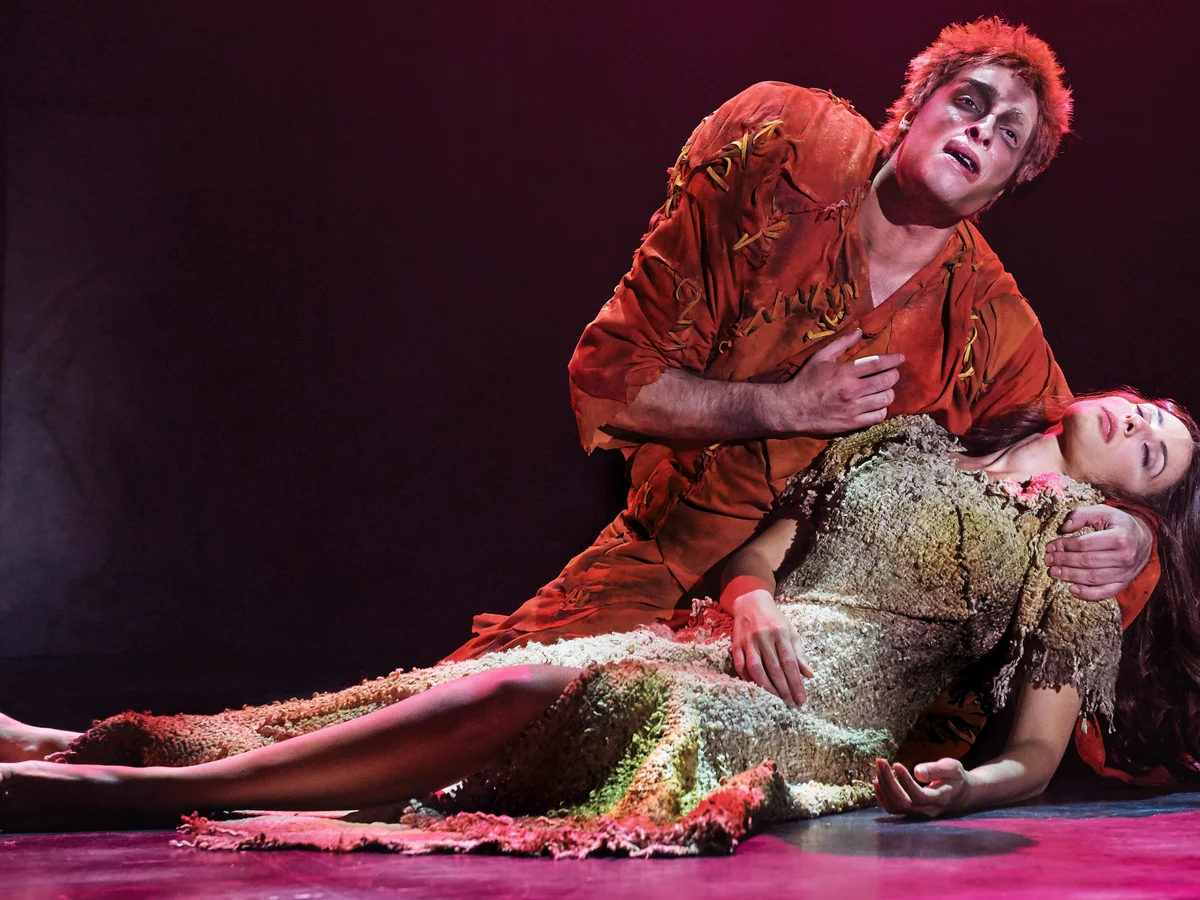
Photo Credit – Alessandro Dobici