
By Saoirse Pira
Around two-thirds of the way through Frances Ha (2012), Frances Halladay sits on the terrace at a dinner party she doesn’t quite belong to, drinking wine she can’t really afford, and delivers a monologue about what she wants from love. It’s what she wants out of a relationship, but it’s something altogether grander than that – “a secret world that no one else knows about, that exists right there in public unnoticed – sort of like how they say other dimensions exist all around us but we don’t have the ability to perceive them.” She’s drunk, but articulate, and it’s a clarity withheld from any of her romantic scenes. It’s not about romance, not really. It’s about her best friend; it’s about Sophie. It has always been about Sophie, about friendship, that foundational love. It’s recollection dressed up as longing; not wishing for some abstract love somewhere in the future, but reaching back through memory to the love that has, as of yet, defined her adult life.
Frances, played by Greta Gerwig with a sort of kinetic awkwardness, is overcome with the particular humiliations of growing up and being outgrown. It’s not that she is opposed to adulthood, she just hasn’t quite found a version of it that feels authentic to her. Over the course of the film, we watch Frances, a twenty-seven year old dancer in New York, attempt to construct a life out of a series of increasingly unconvincing arrangements. She moves between apartments, between jobs, between friendships, between versions of herself. She is not quite successful enough to be successful, not quite unsuccessful enough to admit defeat, and not quite young enough to pretend that there is no urgency about her life. She is a dancer without a company, a woman without a permanent home, without a stable romantic relationship and, for much of the film, whose idea of the future still contains her best friend, at almost every point.
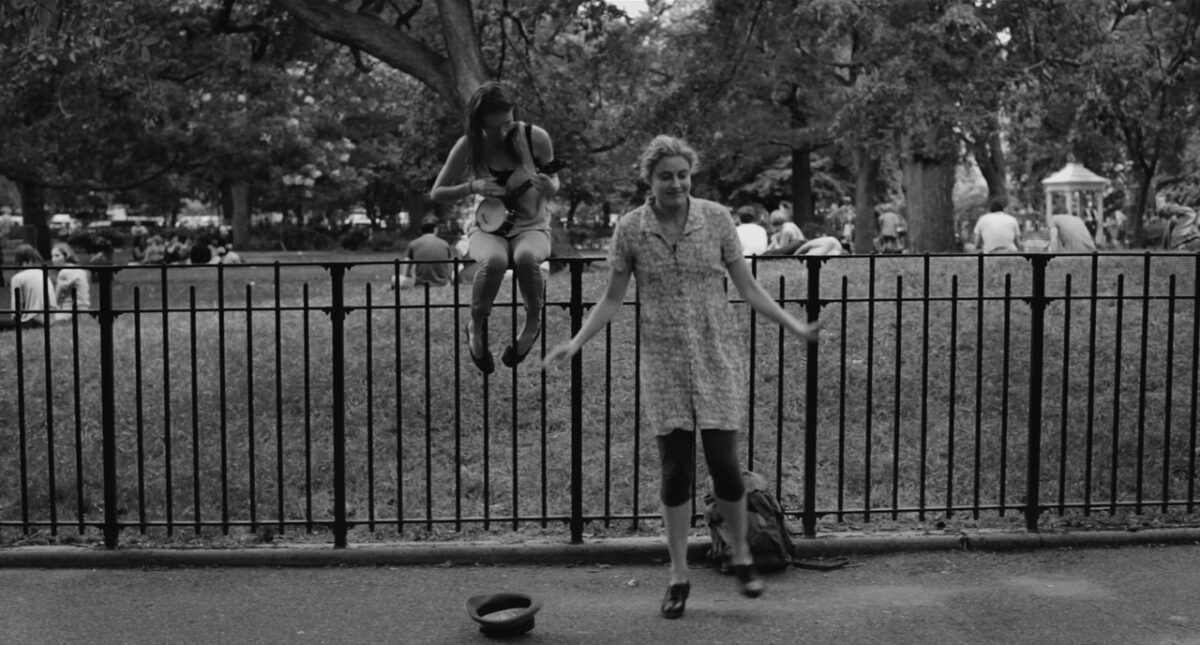
The film opens with a montage, backed by the delightfully twee “Camille” by Georges Delerue (from Le Mépris), of the two women moving through life with pure and simple joy. They play-fight in public, fall asleep, head-to-shoulder on the subway, read and knit, cook, do laundry, smoke cigarettes out of two adjacent windows in their apartment. It’s all wrapped up in love. Later, after Frances breaks up with her boyfriend unceremoniously (he wants her to move in with him, she wants to stay with Sophie), the pair find themselves back in their apartment. Frances jokes that they are like a lesbian couple that don’t have sex anymore, they laugh about Sophie’s boyfriend, lie together in Sophie’s bed. Frances asks Sophie to tell her “the story of us,” and it’s a kind of dance they do together, rehearsed and metabolised. It’s a story that is a dream of the future, in which they are together, ever-inseparable. Their friendship is the beating heart of the film, and in this vision of the future, Frances and Sophie are upheld less as separate souls, and more as each other’s other half. They’re “the same person with different hair,” only Sophie is the version who might succeed at the ordinary business of adulthood. The problem isn’t that the two women have become dangerously entangled, but that the entanglement was the best thing either of them had, and that eventually, something would have to give – someone would have to grow up.
Which is, of course, exactly what Sophie goes on to do. The centre cannot hold, and the story of us is interrupted by the ordinary attrition of adult life, in a series of small defections that accumulate into one swelling ache of abandonment. Sophie is offered a better apartment in Tribeca, one Frances can’t afford to join her in, gets serious with her boyfriend Patch, moves to Japan with him, gets engaged. There’s a title card, a new address, a new chapter in the story of them. Sophie doesn’t wrong Frances explicitly; there is no instance of her telling Frances that she is leaving her behind, because that is not, technically, what she is doing, what she means to do. Sophie is simply doing what twenty-seven year olds with functioning careers and relationships do. It’s all perfectly reasonable, and that’s precisely what makes Frances’ grief so hard to name, let alone justify to anyone else. The tragedy belongs solely to Frances, who is left to grieve a friendship that has not ended, only outpaced her, and for which there is no accepted vocabulary of loss. Nobody sends flowers when your best friend’s life goes well without you.
Baumbach and Gerwig get at something about coming-of-age here – an understanding that growing up is rarely, if ever, a single threshold deliberately crossed. Rather, more often it’s an ache inferred over time, from the fact that someone you grew up with, built your identity alongside, has started living a different kind of life that is not predicated on you.
I first watched Frances Ha at eighteen, and I’ve watched it more than ten times since – it’s my favourite film, which is not a claim I make lightly or revise often. Somewhere along the way, it also became a kind of accidental litmus test; I’ve made most everyone in my life sit through it with me, and I don’t mean for it to function as a test of character, but there is always something telling, something pointed, in the way a person responds to the film, to Frances. I should not take it as a personal attack, of course, when a friend tells me they found Frances annoying, embarrassing, pretentious – but I can’t help it, really. I can’t shake the feeling that the embarrassment is the point: it is so incredibly humiliating to be shaking off your adolescence, to be suddenly so publicly behind schedule.
Back home in Sacramento for Christmas, Frances is submerged in the bathtub at her parents’ house. It’s a close up of her face, she’s catching water in her mouth. Her mother is at the door, she wants to come in. Exasperated, she asks Frances, “How much longer?” It’s a short scene, all of fifteen seconds. There’s no grand swell of music, there’s no music at all. It’s quiet and intimate, it’s absolute urgency. She’s in the bathroom, taking up space – she’s underwater, and it’s on purpose. How much longer will she be? How much longer can she remain, submerged and arrested, grieving an abstract loss, suspended between adulthood she can’t quite claim and adolescence she can no longer justify? That’s the thing about growing up, in the end. There is no definitive moment at which somebody tells you that you have to become an adult, one at which you oblige. Eventually, you are simply expected to get out of the bath.
In “the story of us”, Frances and Sophie dreamed in tandem. They would co-own a vacation apartment in Paris, have lovers and no children, speak at college graduations, and receive honorary degrees. Then, later, on a credit card and a whim, Frances does actually go to Paris, alone, for a weekend. It is a place she had imagined as part of the shared mythology of their friendship, but it’s one she wanders through alone, jetlagged, sleeping through the day. She has flown halfway across the world to do precious little, trying to conjure a dream into reality with only half the parts. While Frances tries to bring about some sense of the future they had imagined, Sophie is doing the opposite. She has changed the score – she is living a life, building a future, and it’s not the one they had dreamed of together. It’s a life that has begun to make sense to other people.
But what becomes clear is precisely how little either woman actually gets from moving forward alone. Frances returns from Paris, having spent money she doesn’t have to visit a city that means nothing without Sophie in it. It’s not long after this that Sophie, too, spins out. Drunk and adrift in her own way, she comes to Frances in the middle of the night, needs her in a way that both recalls their old way and subverts it slightly. She tells Frances that she always felt competitive with her, and it’s an aspect of their dynamic we, nor Frances, had ever realised. There’s a sort of clarity there, an admission of fallibility, the quiet part is finally said out loud.
Sophie goes on to marry Patch, and Frances goes on, too, to build something of her own. She takes a desk job at the dance company, she makes herself useful in a way that is less glamorous, though considerably more stable than anything we had seen her hold down previously. She choreographs her own piece, her own show. It’s gorgeous and decidedly Frances. Sophie comes to the show, and it happens: across a crowded room, Frances and Sophie catch each other’s eye. They look at each other, each kind of laughing, and they’re two bodies made up purely of love. Colleen, Frances’ boss, asks her who she is making eyes at, and of course it’s Sophie, it’s her best friend. It’s the moment Frances had always wanted, the pair of them in that secret world, finally, again.
We leave Frances as she moves into an apartment of her own; it’s far from the sort of place that would have made it into her and Sophie’s story, but it’s nice, and it’s hers. She writes her name on a piece of paper to slide into her mail box. She tries it, it doesn’t quite fit – she has to fold it slightly to get it in. Once in, it simply reads: FRANCES HA. It lands somewhere between punchline and good closure. It isn’t the life she and Sophie had dreamed of together in youth, it’s not Paris and lovers and honorary degrees. It’s smaller, it’s compromised, and it fits. She has made a life that fits.
Featured Image: IFC Films