By Robin Reinders
‘When you split me and my brother in the womb, you did not divide us evenly. He got kindness, and I got longing. He got complacence, and I got ambition. I want to kill him sometimes. I think sometimes he wants to die.’
– ‘Hevel’, Nathaniel Orion
‘You do not have a brother. You have never experienced anything this ferocious or intentional with another person.’
– ‘You Are Jeff’, Richard Siken
To be a brother and to have a brother is inherently, inexorably biblical. Brotherhood within the Western cultural imagination has historically served as arguably the most enduring structure of psychic and moral antagonism, saturated from its inception with asymmetry, rivalry, inheritance, obligation, violence and blood-guilt. The brother is never only familial: he assumes multiple roles, appearing instead as rival-double and shadow-self, intimate enemy and involuntary witness, the figure against whom identity is measured and comprehended and through whom it is displaced and dismantled. Fraternity, in this tradition, is no facile framework of mutual belonging, but a theatre of comparison, substitution, accusation and sacrificial demand. The literary canon bears the imprint of this logic: in Dostoevsky’s Karamazovs, brotherhood becomes a vehicle for metaphysical crisis staged through competing claims to divine silence, legislative punishment, erotic compulsion and rational unbelief, each brother functioning as a partial ontology belonging to the whole rather than a character unto himself; in King Lear, Edgar and Edmund recast fraternity as a juridical struggle over legitimacy and primogeniture, questioning the ideologies of inheritance and structural exclusion; for Steinbeck, Cal and Aron reproduce the schema of the first fratricide as an inherited structure of moral predestination, in which affection is metabolised through perceived grace and reprobation; in The Comedy of Errors, sibling doubling pushes identity into precarious ontological positions, whereby misrecognition exposes personhood as contingent on external attribution rather than any interior sense of coherence. It is, however, the image of Cain looming over Abel which most insistently haunts the theological, the literary and the psychic genealogy of fraternity: the brother as a node of ambivalent investment, a site of conflicting libidinal and moral investments – love, envy, resentment, safeguarding, substitution and an underlying logic of annihilatory desire. To pose the question Am I my brother’s keeper? is therefore necessarily to entrench fraternity within implications of burdenhood; it is to acknowledge that one brother is, by nature, psychically tasked with preserving, galvanising, monitoring, managing and accounting for the life of the other, even at the cost of his own singular psychic coherence.
‘Something / Happened to me, and I can’t tell / Anyone, so it will happen to you’
– Robert Bly, ‘Keeping Quiet’
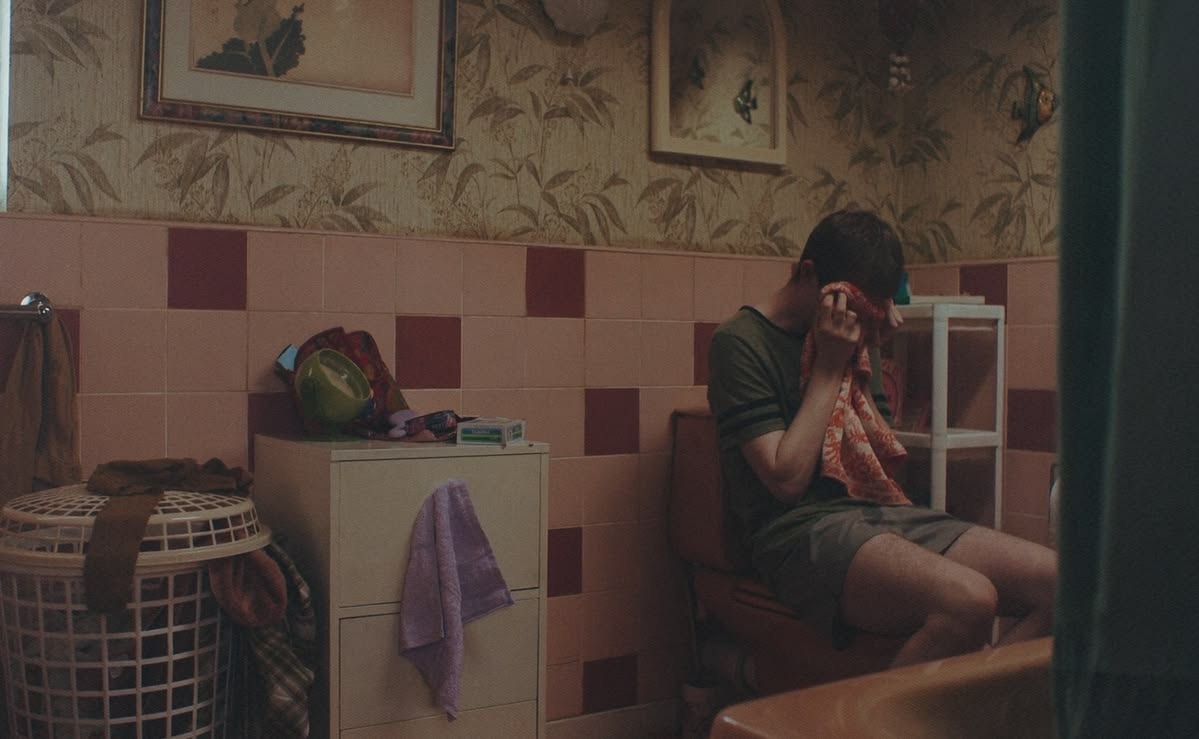
Half Man 1.06, dir. Eshref Reybrouck, 2026 / Frans Floris, c. 1531-1570
Richard Gadd’s limited series Half Man (2026) stages this question of brother-as-object and brother-as-keeper with a hand both violent and precise in equal measure. Centred upon Niall and Ruben – boys brought together through the relationship between their mothers and raised as brothers within a post-industrial Scottish milieu marked by pervasive Thatcherism, absent fathers, precarious identities and inherited familial violence – the series traces the evolution of an attachment whose intensity repeatedly exceeds the conceptual vocabularies available to describe it. Throughout the series, fraternity rewrites itself out of any stable structure of kinship and instead defines itself as a profound investment in one another’s existence as psychic objects. Each brother becomes indispensable witnesses to the other’s ego, undertaking the onerous affective labour of recognition in ways that render separation increasingly difficult to imagine. Brotherhood thus becomes a claustrophobic and internally recursive affective system in which care is reconfigured as Orwellian surveillance, intimacy as containment, dependency as a relational structure maintained by harm. The brother is simultaneously responsibility and rival, counterpart and counterbalance, object of preservation and possession, of desire and destruction. He is less a discrete subject than an extension of his kin, a living repository for his guilt, longing, resentment, obligation and projected selfhood. Niall and Ruben inhabit their siblinghood by way of enacting the retrospective effect of a prior fantasy of distribution gone awry: each is haunted by the suspicion that something essential has been allocated to the other, that identity itself has been unequally portioned at the level of origin. Gadd describes the two as ‘polar opposites’ – Niall marked by the soft-hearted, introspective self-consciousness of a fragile fifteen-year-old boy too far inside his own head; Ruben, in stark contrast, characterised by his volatility, his reckless, charming impulsivity and his comfortable physicality, present in the very way he carries himself. This asymmetry is intensified by the inverted paternal conditions under which the brothers are raised. Niall matures in the wake of paternal absence, the death of his father at the age of eight establishing a touchstone of irreparable loss which structures his later attachments as compensatory formations. Ruben, by contrast, remains ill-fatedly bound to a father whose lingering, haunting presence is no less injurious, his sense of self and relation to others organised unwittingly around an unwelcome intimacy interchangeable with violation. Stemming from patrilineal lack and ever-presence respectively, the brothers both develop a relational economy in which each appears to offer the other a kind of impossible redress. The father, in both cases, becomes what must be suffered through and survived; the brother becomes what might be lived through instead. Gadd thereby deconstructs the mainstream framework of familial intimacy, conventionally perched upon the clean promise of emotional soundness, presenting fraternity instead as a condition of psychic enclosure: a sealed and cyclical relational economy in which the distinctions between affection and abuse collapse and re-warp with increasing intensity.
Juliet Mitchell’s theorisation of sibling trauma proves indispensable here insofar as it reorients psychic injury away from the vertical axis of the Oedipal drama and toward the horizontal violence of replacement, rivalry and resemblance. Mitchell thereby positions fraternity as a constitutive rather than secondary psychosexual structure. The sibling, for Mitchell, arrives not only as a ‘second-chance child’ (Half Man, 1.04) but as a traumatic interruption of narcissistic continuity: ‘The new baby now lying in the place it occupied will be both narcissistically loved, as more of the toddler’s self, and hated, as a replacement for itself’ (‘Siblings: Thinking Theory’, 2013; emphasis mine). Brotherhood therefore originates via the friction of a profoundly unstable oscillation between identification and annihilation, between adoration and dispossession. The sibling is simultaneously the self and the usurper of the self; ‘the same’ and intolerably ‘other.’ Mitchell’s formulation that ‘jealousy is the modus vivendi for the arrival of the “other,” the one who is different but who should have been the “same”’ resonates with particular force in Half Man, where Niall and Ruben repeatedly apprehend one another less as opposite individuals than as distorted alternate selves through whom their own deficiencies are exhibited and desires are displaced. The psychic violence of this arrangement is further intensified by Mitchell’s claim that the infantile wish for ‘narcissistic sexual union with one who is the same’ is inseparable from its countervailing fantasy of destruction, such that siblinghood becomes the site at which love and annihilation are first rendered coextensive, born together as twins. Indeed, the series achieves much of its affective intensity in its persistent blurring of fraternal intimacy and erotic identification. Mitchell’s claim that ‘the narcissistic identificatory love for the baby who is the self can, via the transitivism of childhood, become the “we are as one” of adult couples’, offers a striking framework through which to read the unstable psychosexuality saturating Niall and Ruben’s relationship. Crucially, Half Man does not present incestuous possibility as aberrant deviation from safe, traditional fraternity, but rather as fraternity’s own latent logic under conditions of traumatic enclosure and collapsed relational boundaries. J. V. Caffaro observes there is no universally agreed upon definition which serves to differentiate abusive behaviour from mutually-initiated sexual encounter between siblings (‘Treating Sibling Abuse Families’, 2004); this becomes particularly significant insofar as the series repeatedly stages encounters which refuse stable categorisation within conventional binaries of coercion and consent, aggression and desire, victimhood and reciprocity and so on. The dyadic dynamic between the brothers occupies a profoundly unstable intermediate terrain in which intimacy itself has become structurally contaminated by lineages of domination, imitation, dependency and compulsive reenactment.
Half Man 1.01, dir. Alexandra Brodski, 2026
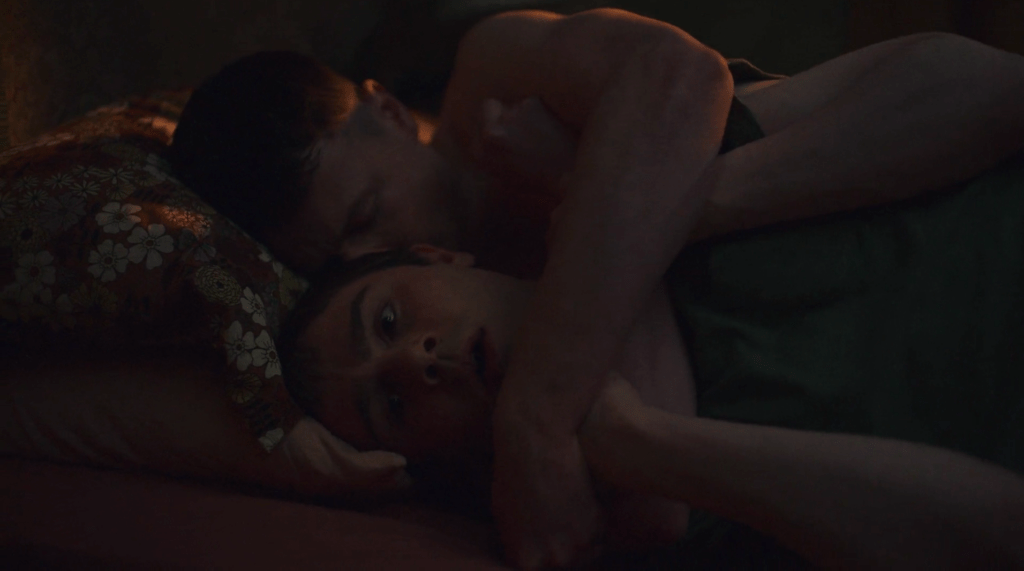
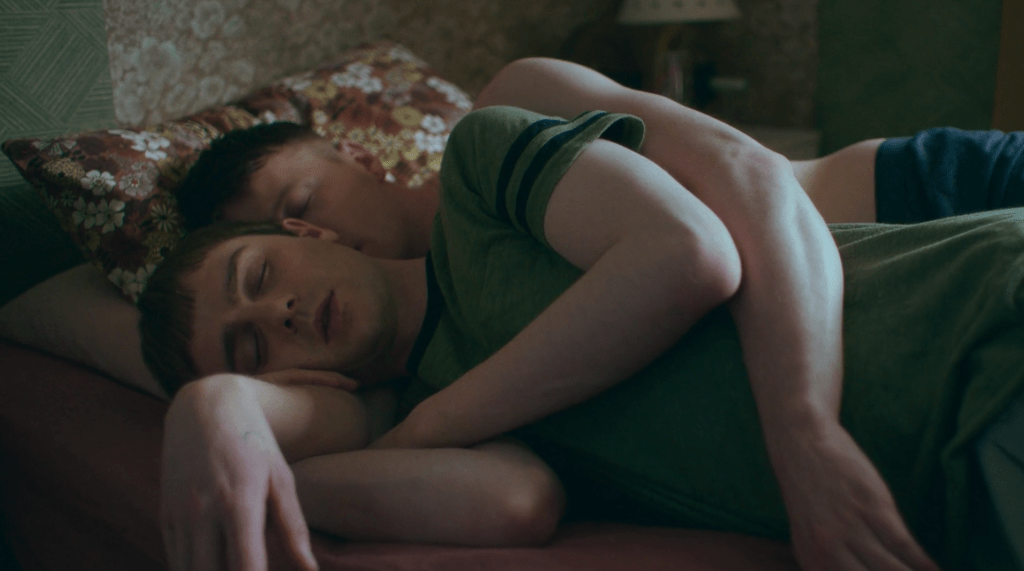
This perversion is already present in the very first episode. It is not yet clear, in these early moments, what kind of intimacy Ruben and Niall inhabit. They are not yet legible as enemies, nor as companions in any stable sense. What is discernible instead is a tense proximity which struggles to settle into category. In 1.01, Ruben restrains Niall in a harsh headlock after the latter suggests alerting their mothers to Ruben’s father’s late-night jeering outside the house (‘Why don’t you give your old man a big hug?’). The struggle quickly acquires an arguably erotic choreography: Ruben positioned behind Niall, rocking against him as the latter remains trapped between the hard line of Ruben’s body and his older brother’s mattress. Yet the scene simultaneously regresses toward infantilism, as the boys eventually fall asleep entangled together in an image oscillating between a lovers’ embrace and childlike clinging. Niall subsequently awakens to discover a wet patch staining his boxers – an image rendered deliberately ambiguous between ejaculation and the base, bed-wetting reaction of the body of a frightened child. Such moments exemplify the series’ persistent refusal to disentangle eroticism from terror and psychic helplessness, intimacy from humiliation or desire from frameworks of childhood. Sexuality and infancy become momentarily indistinguishable. Desire appears contaminated by vulnerability; vulnerability by desire. The result is a profoundly unsettling image of psychic life before differentiation has fully occurred. The body itself becomes unreadable within this libidinal economy of fraternity, incapable of clearly distinguishing arousal, fear, identification, submission or regression.
This ambiguity festers throughout the series as Ruben repeatedly mediates, orchestrates and mutilates the boundaries of Niall’s sexual subjectivity. Sexual initiation is no longer figured as a private threshold into adult relationality, but as a heavily scaffolded scene of fraternal governance in which access to desire is routed through Ruben’s regulatory presence. The sequence in which Ruben effectively ‘takes’ Niall’s virginity by proxy is particularly disquieting, arranging for Mona, the girl he himself is sleeping with, to deflower Niall (the same girl he will go on to marry) while physically regulating his somatic responses: coaching his breathing, placing a hand upon his chest to ground him, focusing his gaze upon his own face, repositioning his body when he loses rhythm. The scene’s psychosexual logic is unmistakably triangulated. What is decisive here is not only the substitution of partners, but the structural redistribution of agency: Ruben assumes a quasi-managerial position over Niall’s embodied experience. His access to heterosexuality is thus mediated through Ruben’s controlling presence, his brother insinuated in the architecture of all future possibilities. This renders Ruben simultaneously intermediary, author and witness – but also covert object of libidinal orientation and latent point of reference. The apparent heterosexual act becomes perverted with displaced fraternal eroticism, the brother the coloniser of the psyche and the body, coming-of-age’s most charged and visceral instant now irreversibly entangled with surveillance, watched by the panoptic gaze of Big Brother.
Half Man 1.04, dir. Eshref Reybrouck, 2026
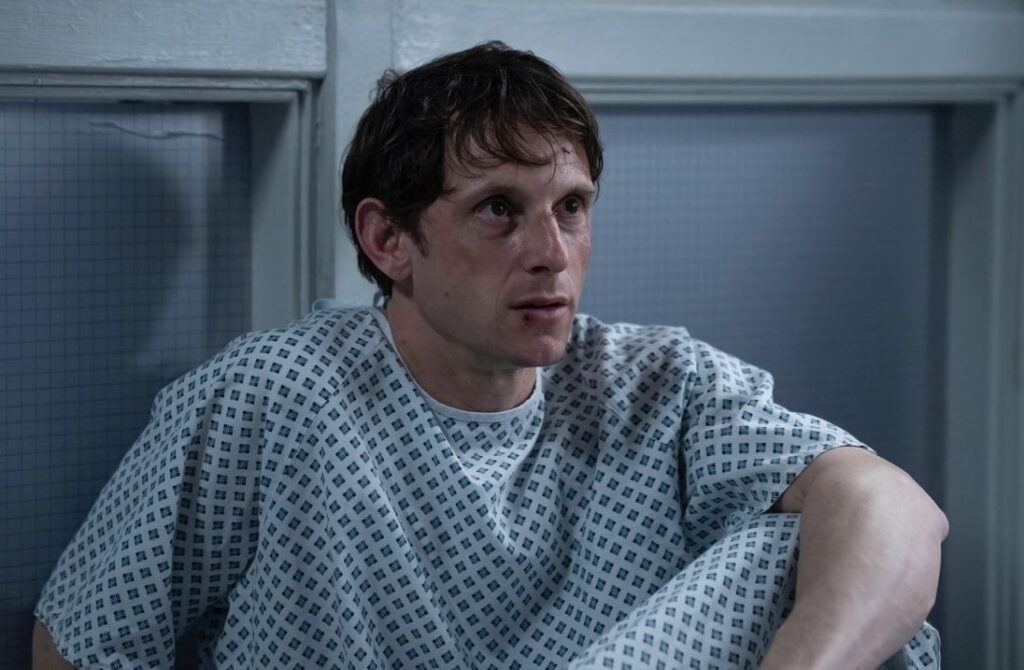
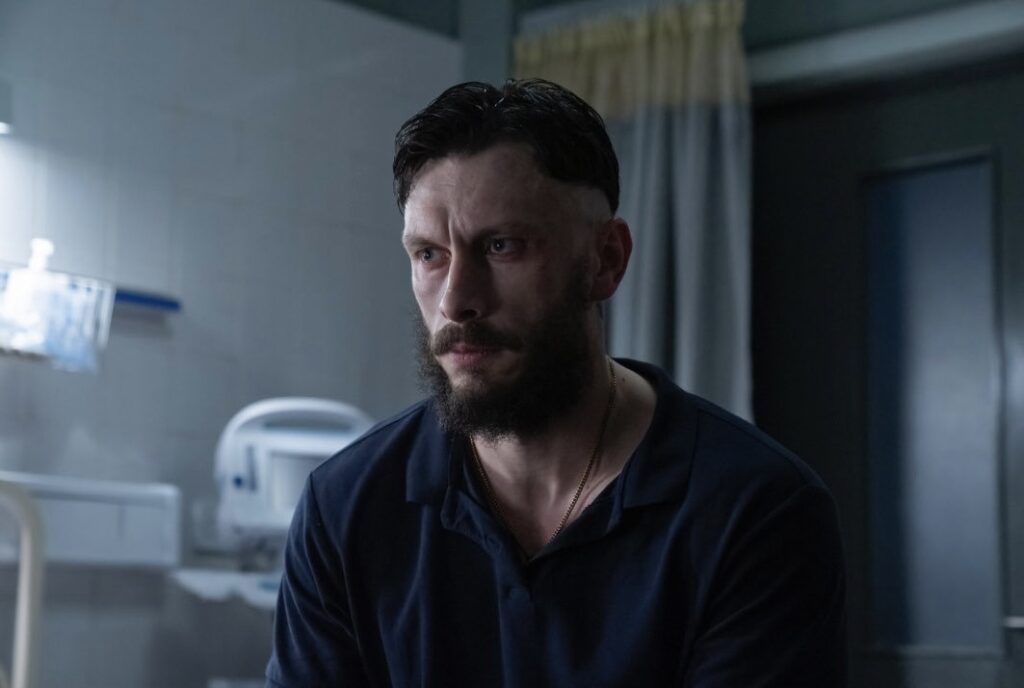
Many such instances of assault take place throughout the series, though the most violent culmination of such logic is in 1.04, in which Ruben rapes Niall in a hospital bed with his car hood ornament after threatening to ‘twist it up [his] ass without lube’ should he fail to tell him the truth. Here, the series abandons euphemism entirely and reveals the latent structure underwriting the brothers’ relationship from the outset: domination articulated through penetration, intimacy through violation, acknowledgement through bodily invasion. The existing logic of the dynamic becomes fully legible: the act does not interrupt fraternity, but reveals what fraternity has already become under the pressure of the precedent of trauma. In this sense, the scene cannot be reduced to unilateral sadism, nor the explicit dialogue deployed ‘frivolously’, as Gadd makes clear in an interview. This would be to flatten its horror into pathology. Ruben’s violence serves as an inexorable catastrophic intensification of fraternal attachment, a reenacting of the incestuous logic already embedded within his own abuse history and formulation of affection. Clementine Morgan states: ‘Incest is never an isolated event. Incest is always a family dynamic.’ (The Realm of Unreality: An Incest Memoir in Essays, 2024) She clarifies ‘if there is a child that is perpetrating incest, that child learned that incest dynamic from somewhere, and somewhere along the line it was learned from an adult’. This theory proves devastatingly resonant in this narrative context. Ruben’s abuse by his father situates incest as an inherited relational mode of intimacy, a way of apprehending closeness, interdependency, responsibility and bodily access learned through coercion and molestation and subsequently reproduced horizontally within the fraternal bond. The father’s greatest legacy is not the wound he leaves marred upon his eldest boy but the architecture through which that wound comes to organise future love; you are allowed access to the body over which you are responsible. Violence here operates as traumatic pedagogy; it reproduces itself precisely because it has become indistinguishable from the very conditions under which attachment is experienced and recognised between one another (‘This is what you’ve always wanted from me, isn’t it?’). Here is the wound gouged by the father, then. Niall is haunted by a paternal absence; Ruben by paternal persistence. This parallel is cardinal. A yawning maw lodged within the youngest boy; the eldest with his interior self stained beyond cleansing. In this sense, the series proposes a horrifying inversion of paternal function: the father fails as protective authority and is replaced by the brother as compensatory psychic infrastructure. Yet this substitution only further intensifies the burden of fraternity, because the brother cannot occupy paternal space without simultaneously contaminating it. The series thus arrives at an implicit but devastating proposition: the only cure for a father is a brother, and there is no cure for a brother.
What ultimately emerges in Half Man is therefore a vision of fraternity as unstable psychic cohabitation: two subjects trapped within an economy of identification, resentment, longing, imitation and inherited violence from which neither can fully individuate. Medieval theological discourse surrounding incest, as James Donavin notes, understood the term paradoxically as both abomination and mystical union, ‘both a sin and a way of remediating sin’. (Incest Narratives and the Structure of Gower’s Confessio Amantis, 1993) Half Man inherits something of this paradoxical logic. Fraternal intimacy within the series appears simultaneously catastrophic and salvific, violating and preservative, obscene and devotional. The brothers seek in one another precisely what destroys them: recognition, continuity, merger, absolution and the impossible fantasy of becoming whole through the body of the other.
‘I was born to watch over you / & you were born to keep my hands purposeful.’
– Bloodmercy, I. S. Jones
Encoded within every episode of Half Man is that same biblical refrain: Am I my brother’s keeper? The series’ most devastating gesture is its refusal to imagine ‘keeping’ as a benign or even coherent form of care. To keep a brother, the series suggests, is never merely to look after him. It is to monitor, regulate, preserve, possess, enable, contain and attempt to simultaneously annihilate and survive him. Can’t live with ‘im, can’t live without ‘im. Keepership is honed throughout the series as an affective relation in which nurturance becomes inseparable from domination, and whereby care mutates into a mode of psychic piloting. The brother is stewarded, and through that stewardship is loved to an abominable degree. Indeed, what renders the relationship between Niall and Ruben so profoundly discomfiting is that neither man appears fully capable of distinguishing where devotion ends and ownership begins, and neither do they seem set on drawing such a line. Gadd describes the brothers’ relationship as ‘idolatry mixed with love mixed with hatred mixed with adoration and need’. This is revealing precisely because idolatry already implies an asymmetrical structure of emotional investment: one subject becoming the site upon which another deposits meaning, reverence, dependency and psychic orientation. The brother is elevated into object-status, relic-status, transformed into something simultaneously worshipped and instrumentalised. When asked for one word to describe their dynamic, Gadd stated: ‘Contorted is one that springs to mind, but if I said loving, would you think I was insane?’ This, then, is the central tension structuring Half Man: the series does not oppose love to toxicity, but rather explores the extent to which love itself may become distorted into a coercive attachment style under conditions of childhood trauma and emotional entrapment. ‘I think for something to be toxic,’ Gadd says, ‘it has to also be intoxicating first’. What festers between Niall and Ruben is not necessarily the failure of fraternal care, but fraternal care rendered pathological through excess intimacy, asymmetrical dependency, the patrilineal wound and a sort of psychic conjoinedness from which neither brother can fully depart.
This impossibility manifests most visibly through the series’ recurrent obsession with provision, indebtedness and material subsumption. Ruben repeatedly installs himself in the role of provider despite his own economic precarity following the loss of his rigging job, accumulating catastrophic debt in order to continue financing the lives of others (including Niall) without their knowledge. When Niall confronts him over this compulsive assumption of responsibility, Ruben’s justification is startlingly naked in its ontological simplicity: ‘Because I liked it. I liked being the provider. I knew my place in the world.’ (Half Man, 1.05) To provide is to stabilise the self through indispensability; dependence furnishes Ruben with the only stable proof of his own role. Far from simple altruism, his acts of financial self-sacrifice therefore constitute an attempt to purchase recognition through utility, to render himself psychically inerasable by suturing his presence into the material conditions of others’ survival. Debt becomes an architecture of attachment through which emotional permanence might be forcibly secured.
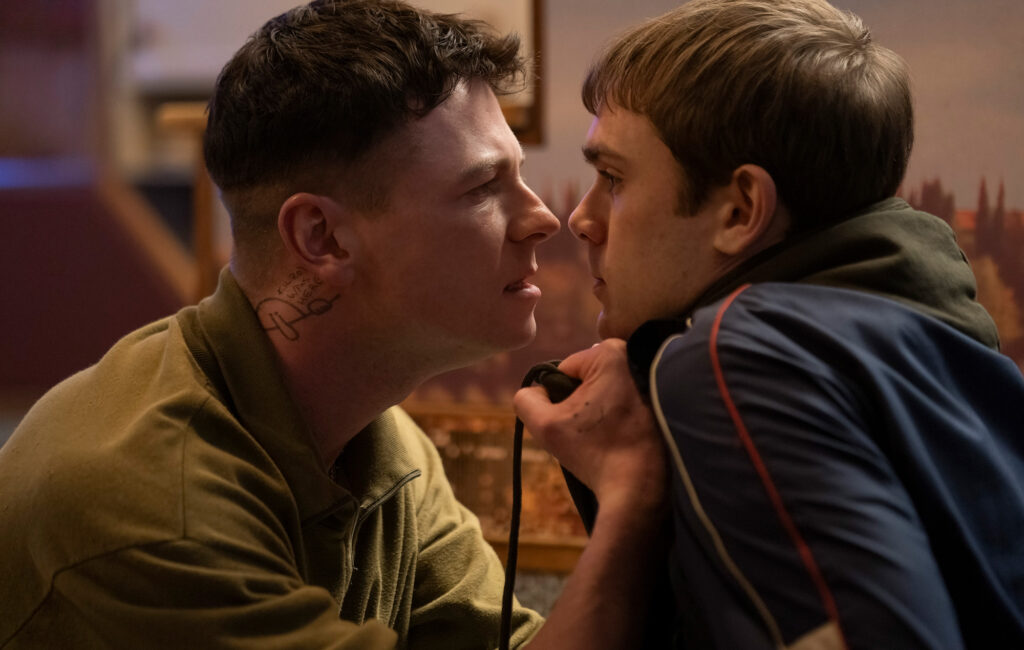
‘We share everything!’ / Half Man 1.02, dir. Alexandra Brodski, 2026
Niall, meanwhile, increasingly comes to occupy the complementary position of the kept object. Jamie Bell’s observation that Ruben becomes Niall’s ‘life support system’ captures the extent to which care in Half Man functions simultaneously as affective captivity. Niall’s attachment to Ruben is irreducible to facile fear or coercion alone; rather, Ruben’s volatility acquires the paradoxical status of security. Because Ruben is feared by the world, he may in turn shield Niall from that world’s hostility. Yet protection here is inseparable from capture. Niall becomes psychically and materially entangled within Ruben’s systems of provision to such an extent that separation itself begins to register as mutilation, as severance, as betrayal. This logic surfaces explicitly during their confrontation over Niall’s university accommodation, when Ruben rejects the very premise of independent existence: ‘We share everything! I mean you’re wearing my jumper right now … You should’ve brought me with you from the start!’ (Half Man, 1.02) The statement initially performs as childish, even petulant, yet its insistence that ‘it’s not about the room, it’s about the fucking principle’ reveals something considerably more disquieting. It is not a two-mattress-childhood at stake but ontological non-separation: a refusal of psychic distinction itself, an epistemic in utero in which selfhood can only be sustained through enmeshment. To leave is intolerable because departure threatens the collapse of the shared psychic infrastructure through which both brothers remain comprehensible to one another and to themselves.
The series repeatedly materialises this non-separation through patterns of possession, inheritance and symbolic circulation. Everything Niall touches has already passed through Ruben’s hands first: clothes, lovers, money, possessions, social identity itself. Ruben kisses nearly every person Niall kisses; he orchestrates Niall’s first time; he steals the domestic future Niall momentarily weilds for himself. The effect is competitive, certainly, but more so incorporative, implicating, insinuating – as though Ruben compulsively absorbs every emerging site of Niall’s autonomy back into the fraternal dyad before it can calcify independently. Eve Kosofsky Sedgwick’s account of male homosociality becomes especially illuminating here. Sedgwick argues ‘the use of women as exchangeable … property’ functions to cement bonds between men, revealing the extent to which heterosexual structures may conceal or serve as pretext for deeper currents of male homosocial desires, which the masculine nature deems more valuable. In Half Man, women repeatedly occupy precisely this mediating position. Mona does not inhabit the role of sexually autonomous woman within the narrative, but rather a conduit through which Niall and Ruben negotiate their own rivalry, identification, power and possession. Niall’s later affair with Mona cannot be comprehended in clean isolation; rather, it represents an attempt to access Ruben through what Ruben himself has claimed, achieved, won. To occupy his position of a man who has successfully settled in his masculinity by trespassing upon the intimate territory of his domestic life. Simultaneously, impregnating Mona (one of the few things Ruben is incapable of) offers Niall the possibility of both superseding his brother in the one way he can, and simultaneously giving Ruben the child his infertility denies him, reappropriating heterosexual reproduction itself into the convoluted economics of this libidinal fraternal economy.
The logic of keepership thus increasingly collapses distinctions between care and colonisation of the brother. Unbeknownst to Niall, during a fourteen-year-long rift between the two, Ruben pays for his bedsit, his therapy (‘The therapy I used to talk about him?’; Half Man, 1.04), his car, his Christmas presents. Debt in Half Man therefore functions past the economical and into the ontological: to owe the brother becomes indistinguishable from being constituted by him. Jessica Benjamin’s theorisation of domination as a distorted response to the crisis of recognition offers a crucial scaffolding through which to comprehend this relation. Benjamin argues ‘the most familiar conflict that arises from differentiation is between the need to establish autonomous identity and the need to be recognized’ (The Bonds of Love, 1980), and that domination itself shows its face precisely when subjects attempt to resolve this conflict without relinquishing dependency. The subject seeks autonomy whilst simultaneously refusing the separateness of the other, ‘possessing or controlling’ them in order to avoid the psychological desolation of aloneness. Ruben’s behaviour throughout Half Man repeatedly enacts this impossible negotiation. He cannot tolerate separation because separation threatens annihilation; yet he equally cannot sustain mutuality because mutuality requires recognising the brother as genuinely separate and unimplicated in one’s own self. Consequently, affection mutates into possession. Financial provision becomes a mode of management. Protection becomes surveillance. Violence becomes a means of retaining a form of closeness while repudiating unmasculine vulnerability. Benjamin goes on to claim violence operates as an attempt ‘to resolve the issues of autonomy and recognition while denying the other’s subjectivity’. This is certainly felt in Ruben’s wounded aggression toward Niall, which tends most commonly to crop up at moments when Niall threatens an independent subjecthood: leaving home, forming romantic attachments, imagining futures beyond the dyad. Violence becomes a desperate strategy for preserving a twinned continuity while simultaneously disavowing dependency itself. In this sense, Ruben’s brutality does not signify emotional absence but catastrophic overinvestment and cognitive dissonance. He requires Niall too intensely to allow him autonomy, yet cannot articulate this dependency except through domination, humiliation, sabotage, financial superiority or bodily invasion. The violence of keepership, then, is that the brother must remain close enough to guarantee psychic survival, but objectified enough to prevent abandonment. The little brother is a favourite toy one cannot grow out of and will not put down.
Crucially, however, Half Man refuses to position Niall as a poor, passive, pristine victim within this structure. Benjamin’s discussion of domination insists that both parties become organised around complementary relational positions: one asserting a joint-selfhood through control, the other relinquishing his own selfhood in favour of the safer doublet. Niall repeatedly resists Ruben’s authority and cruel hand while simultaneously relying upon the very structures which imprison him. He accepts Ruben’s money, his protection, his emotional counterbalance, his rare oblations of tenderness. It would be dishonest to describe their dynamic as one-sided when closer to truth is a reciprocal affective capture: a closed affective circuit in which the brothers require one another precisely through the mechanisms which shatter them. To keep a brother, then, is not to safeguard his happiness or to encourage his prosperity, but to direct him; blind him, take him by the shoulders and point him where you both need him to go. Keepership becomes a form of existential governance through which care and cruelty, guilt and shame, animosity and codependency, violence and validation circulate and permeate indistinguishably. One comes to find that neither brother can survive the fracturing of this structure, even as the structure itself marks survival impossible.
‘A brother is born for adversity’ – Proverbs 17:17
The distribution of suffering between Niall and Ruben is, as is evident, manifestly asymmetrical; Ruben’s violence and abuse cannot necessarily be transposed into any straightforward moral equivalence with Niall’s evasive transgressions, self-sabotages, or forms of passive complicity. Yet the series is careful not to allow this asymmetry to resolve into a sacred ethical geometry of victim and perpetrator either. Both brothers are intensely invested in the maintenance of a structure of suffering which wounds them. Victimhood in Half Man is thereby an existential orientation: a mode of self-constitution predicated upon the continual narration, citation and reopening of injury. What Richard Gadd is essentially interrogating within the series is what kinds of selfhoods are made available when one lives inside the role of the injured party.
This question is particularly acute in relation to Niall, whose interiority increasingly appears built around injury as both excuse and root cause. Upon discovering Ruben has been secretly financing significant portions of his adult life, the initial response is one of puerile moral indignation. The force of the reaction is disproportionate to the revelation itself, suggesting what is truly at stake is not simply the embarrassment of financial dependency, but the absolute collapse of a precarious and carefully maintained fantasy of autonomy. Niall stalks his converted childhood bedroom – a room he and Ruben once shared – smashing possession upon possession paid for by his brother’s pocket. Alarm clocks, CD players – all are sacrificed in his tantrum fit, accompanied by a verbal breakdown in which Niall screams at his mother: ‘I hate him! I fucking hate him! … I’m his bitch! I’m his bitch!’ (Half Man, 1.04) The oscillation between repudiation and identification is decisive. At the end of the day, he is nothing more than a little brother who has lost the game; this will always be his first and only role to play. The rage therefore originates at the point of narcissistic injury. To owe the brother is intolerable because it punctures the fantasy of self-authorship – of a life without training wheels or your big brother’s hand hovering out of sight but no less ready to catch. This anxiety recurs later when Ruben proposes Niall repay a debt through domestic labour. Niall’s immediate recoil – ‘You want me to be your bitch?’ (Half Man, 1.05) – again translates indebtedness into erotic subordination. The language of repayment is immediately converted into the idiom of humiliation, suggesting that, for Niall, dependency is never purely material but always already symbolically charged, always already inscribed within hierarchies of domination and shame.
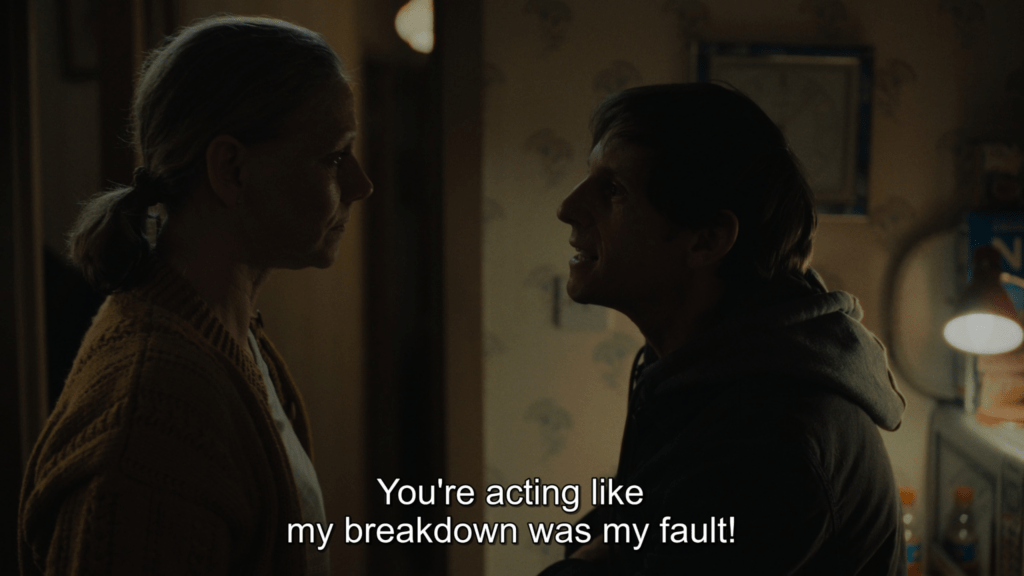
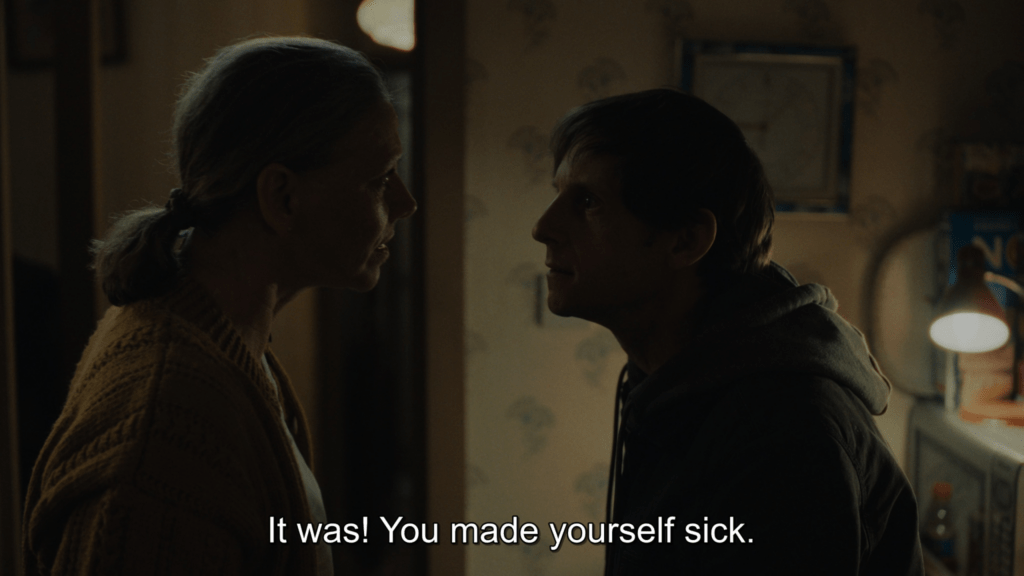
Half Man 1.04, dir. Eshref Reybrouck, 2026
Yet the series repeatedly and consciously complicates this interpretation by demonstrating the degree to which Niall simultaneously seeks, reproduces and seemingly requires the very structures he claims to abhor. Dependency functions both as grievance and lifeline. The brother is resented precisely because he provides what is needed. Such contradictions invite a broader consideration of the relationship between victimhood, complicity and identity. Throughout the series, Niall repeatedly returns to the childhood court case involving Ruben as what he describes as ‘the turning point’ and ‘the seed of all of [his] issues’. (Half Man, 1.04) The ‘seed’ becomes a master narrative through which the contingencies of adult life are retrospectively organised into a coherent story of injury. Significantly, Niall’s mother repeatedly challenges this interpretation. ‘You’re always talking about the seed’, she remarks, before accusing him of being ‘too busy blaming everyone else’ for his problems. Her harshest attack is in her rejection of Niall’s own account of his psychotic breakdown, describing his institutionalisation as a stint in a ‘madhouse’ rather than ‘hospital’: ‘You made yourself sick … You became obsessed with it.’ When Niall shouts ‘I was ill!’, she responds with a dismissive wave of her hand: ‘You were self-involved.’ The series does not ask us to take a side here. Instead, Half Man remains deeply interested in the possibility that suffering itself can become narcissistically organised, a concept Richard Gadd is certainly no stranger to, as can be seen in his previous semi-autobiographical work Baby Reindeer (2024). Bell’s observation that Niall is frequently ‘manipulative and selfish’, and that many of his relationships revolve around ‘what he can get from people and what they can shoulder for him’ points toward a more uncomfortable truth: victimhood may become attractive because it offers coherence. To be injured is to possess a story, and to possess a story is to possess a self.
René Girard’s theory of victimage is pertinent here. Girard identifies the scapegoat as a figure through whom collective tensions are displaced, ritualised and rendered meaningful. The victim acquires a paradoxical status: simultaneously powerless and empowered by his own pain. Ruben is treated within Niall’s psychic economy as the origin point of suffering itself, the figure to whom every wound can be traced. Yet Ruben also constructs himself as a sacrificial figure: provider, protector, self-abnegating agent of care whose violence is retrospectively reinterpreted as a form of burden-bearing. This competition is rendered visible through the series’ parallel trajectories of self-destruction. Ruben externalises injury: rage, violence, destruction. Niall turns inward: drug abuse, compulsive unsafe sex, obsessive thinking. Injury thereby circulates between them, ever redistributed rather than resolved. Victimhood and perpetration thereby cease to designate clean labels and instead become positional effects within a shared system of affective exchange. What renders Niall particularly compelling in this formation is the extent to which his identity remains structurally tethered to Ruben even in moments of apparent autonomy. Bell’s description of him as ‘living as several different people and … not comfortable with any of them’ articulates this fragmentation precisely. Niall’s repeated attempts at self-reinvention – student, father, author, husband – all fail to acquire durable ontological weight because they remain shadowed by a far older and far more ‘primal’ structure of recognition, as Gadd puts it. Niall’s sense of coherence remains dependent upon Ruben’s gaze, upon his approval. ‘It pains you,’ Ruben tells him, ‘to know that all your achievements fill you with a void, whereas a smile from me fills you with all the fucking energy you need’. (Half Man, 1.04) Award, career mobility, self-reinvention – all indeed fail to provide satisfaction to Niall because they cannot replace the original structure through which meaning was first constituted in boyhood (‘It’s the only thing I’ve ever felt’, Half Man, 1.06).
This dynamic is perhaps most starkly condensed in the Freshers’ Week phone call. Isolated, miserable and struggling to adapt, Niall instinctively returns to Ruben as his primary site of regulation and comfort. The exchange is remarkable in its economy. Ruben immediately understands what Niall cannot bring himself to say. ‘You only need to ask’, he tells him. ‘Just say the words.’ (Half Man, 1.02) Eventually, after prolonged hesitation, Niall blurts out: ‘I need you’, before hanging up instantly, hand-over-mouth, unable to cope with the abominable truth of his own admission. The scene encapsulates the paradox at the heart of the series: Niall experiences dependence upon Ruben as humiliating, infantilising, self-destructive and frustrating, yet remains incapable of imagining himself outside it. The bond survives every injury because the injury confirms the bond. By the series’ conclusion, the question is no longer whether one brother can survive the other. It is whether either brother possesses a self that exists independently of the wound the other has left behind. Within such a configuration, victimhood no longer designates a position external to agency but serves as a dynamic and recursive structure through which the self is continuously assembled. Suffering ensures that neither subject within the dyad can fully exit its orbit.
‘We were the first two brothers, / I the first dead man and you the first / fratricide.’
– Inscriptions Cain Read in Abel’s Eyes, Silvina Ocampo trans. by Jason Weiss
I find myself returning to the Cain-and-Abel structure time and again, the origin of fraternity, where Gadd’s narrative logic acquires its most archaic inheritance. Abel is the first murder on God’s new earth, though he is also the one through whom fraternal violence first becomes narratable as moral inevitability, the figure whose elimination retroactively stabilises the meaning of the brother as victim. The scriptural designation of fratricidal violence is marked, in its Greek translational lineage, by the term ἀνθρωποκτόνος, a word whose semantic field exceeds the merely juridical ‘manslayer’ it is all too commonly translated as to approach the sacrificial register in which killing is already shadowed by a logic of offering and taking. In certain classical contexts, as in Euripides’ Iphigenia in Tauris, this same semantic drift allows human destruction to be incorporated into the framework of sacrifice, where the slain body persists as necessity. In Gadd’s Half Man, this sacrificial residue bears considerable weight beneath the surface of contemporary storytelling. For Niall and Ruben, injury is continually converted into justification, and justification into renewed intimacy. One is incapable of existing unimplicated in the other, as implication itself is what constitutes the boundary of the self.
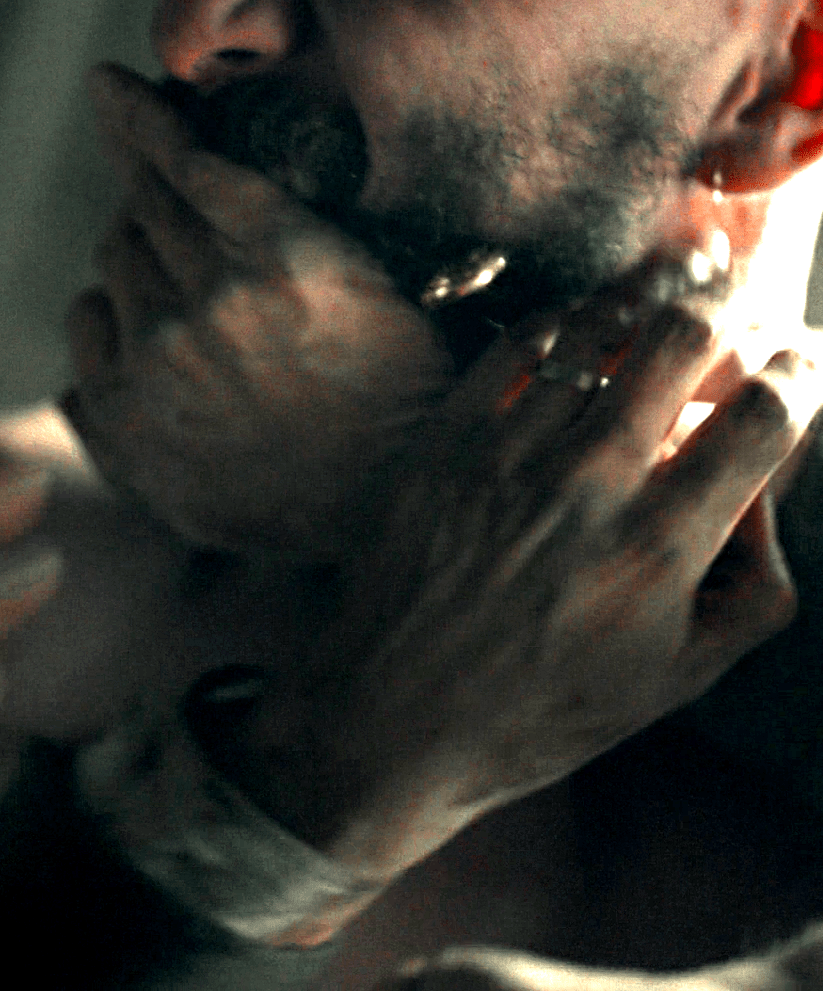
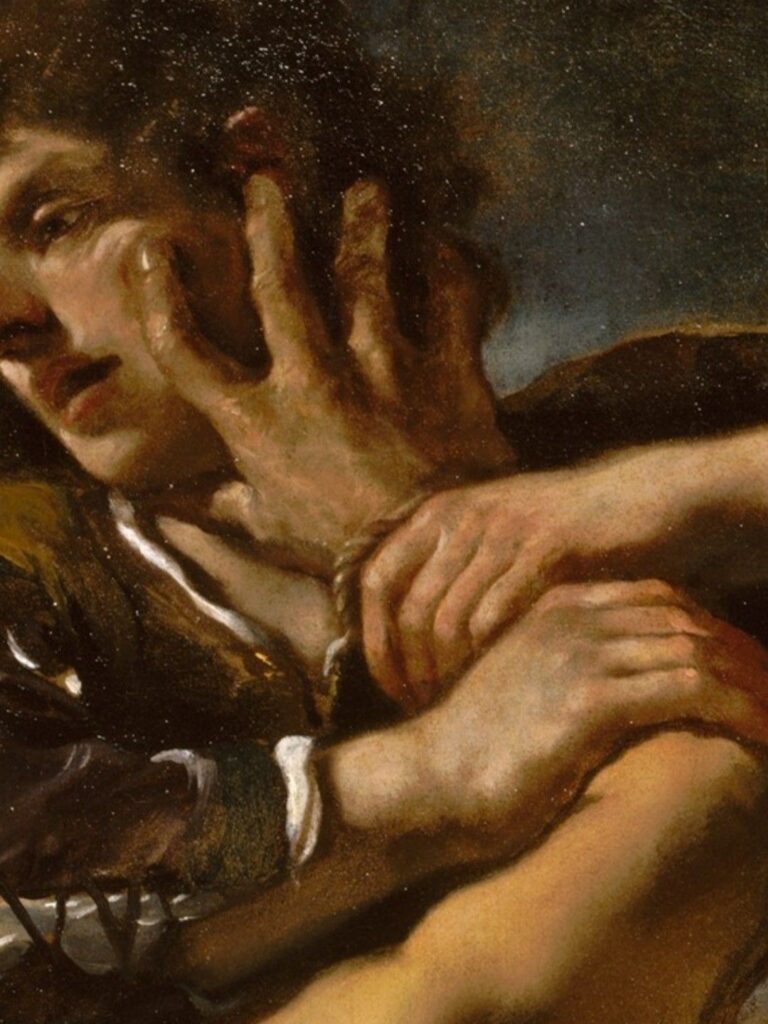
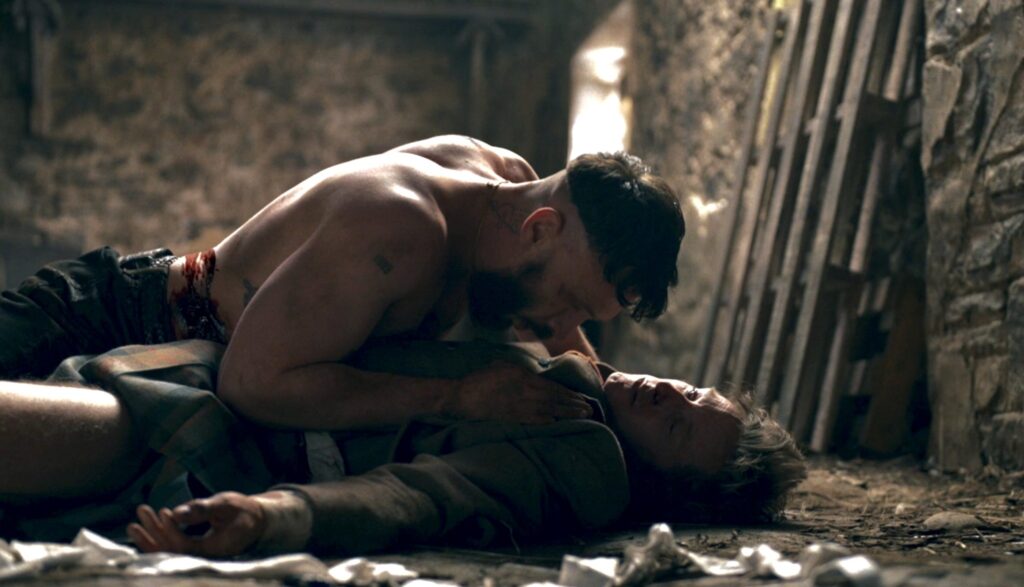
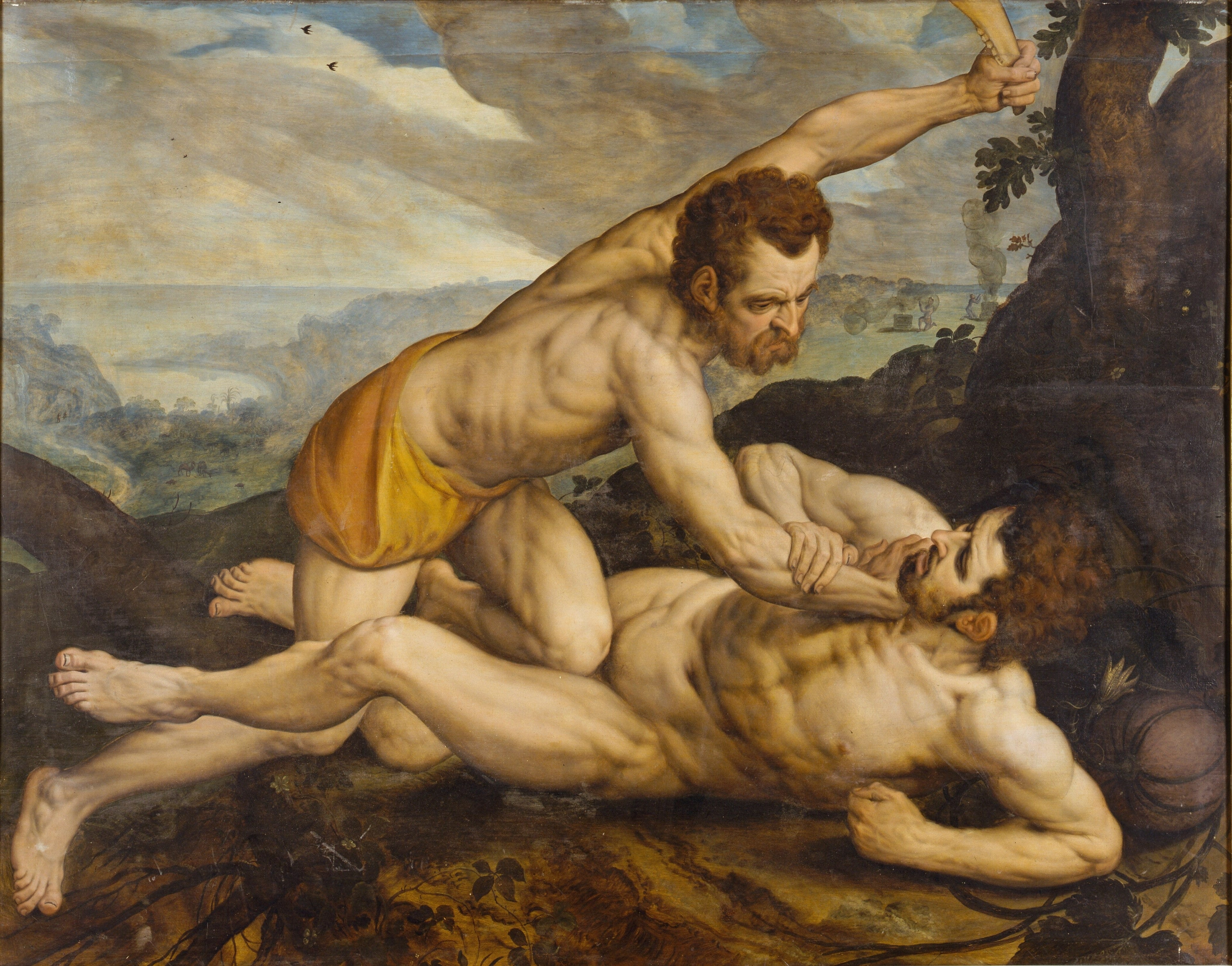
Half Man 1.06, dir. Eshref Reybrouck, 2026 / Giovanni Francesco Barbieri, 1619
A brother bends himself over another in a dim interior that might be a room or might be the remembered reconstruction of one – somewhere between domestic chamber and the spectral architecture of religious myth-world, where childhood objects and adult consequences are no longer separable in their provenance. The light behaves badly here – diffuse, uncertain – everything slightly overdetermined by atmosphere, the air thick with implication. The movement is slow, none of the punctuation of rupture, proceeding with uncomfortable familiarity, the gesture rehearsed so often – across arguments, silences, reconciliations that were never quite so – that it has shed all promise of surprise, a kind of weary competence clinging to it. Violence in this place is habit, is careless, is intimacy outlived and outlasted. There is a strange epistemic confusion in its stillness, an inevitability and a monumental, omnipresent waiting – as though nearness has become indistinguishable from threat, and threat from recognition, and recognition from something like care, though none of these terms quite retain their boundaries anymore. Beneath him, the younger does not resist in any register of resistance legible to you or to me. Perhaps he does not know how, or does not want to know how. His body offers no clean opposition, only a kind of compromised responsiveness, sensation uncertain of its own category. Breath contracts unevenly. The click of a glottal stop.
Elsewhere – though perhaps only the kind of elsewhere produced by retrospect and by narrative co-option – a brother lies still in a barn in rural Scotland; it is his wedding day. The stillness is not peaceable; it is too exact and too deliberate in its negation of movement to be mistaken for rest. The body is arranged with the unsettling neutrality of something which has ceased to bother negotiating its own position in the world. Nothing resolves into clarity because nothing is permitted to conclude. The circumstances accumulate themselves, layering aftermath upon aftermath until the distinctions between what has happened and what is happening and what will happen become almost ornamental. There were or are or will be two still bodies in the barn; there is no other version of this story. But for now there is one. It is a catholic and ubiquitous scene, which Rilke depicts as so: ‘The brother did something to me that my eyes didn’t see. He veiled the light. He hid my face with his face. Now he is alone. I think he must still exist, for no one does to him what he did to me. I sense my older brother lies awake as if accursed. Night offers itself to me, not to him.’ (‘The Book of a Monastic Life’, 1905)
Featured Image: BBC