By Robin Reinders
When you hear the word ‘Brazil’, what do you see? Racing driver Alain Prost correlates the country with a sequence of fond images. He remembers the sun, the sand. He remembers the smiles of the locals, their welcome, their character. He remembers the churrascarias and the beach and the grandeur of Rio de Janeiro. ‘And then’ – he speaks wistfully in an interview, mouth pulling askew – ‘there’s Ayrton.’
It is an invocation spoken like a prayer, a name that rests heavy at the base of Prost’s skull, brought forth and splayed bitterly across his face. It is both wound and salve. Match and mirror. ‘When you talk about Senna you speak about Prost and when you speak about Prost you talk about Senna.’ It is arguably the greatest rivalry in motorsport history; two near-divine beings rocketing through Formula One’s golden age, galvanising it with their animosity, their obsessive competitiveness, their tragic humanity. Near-divine. Near.
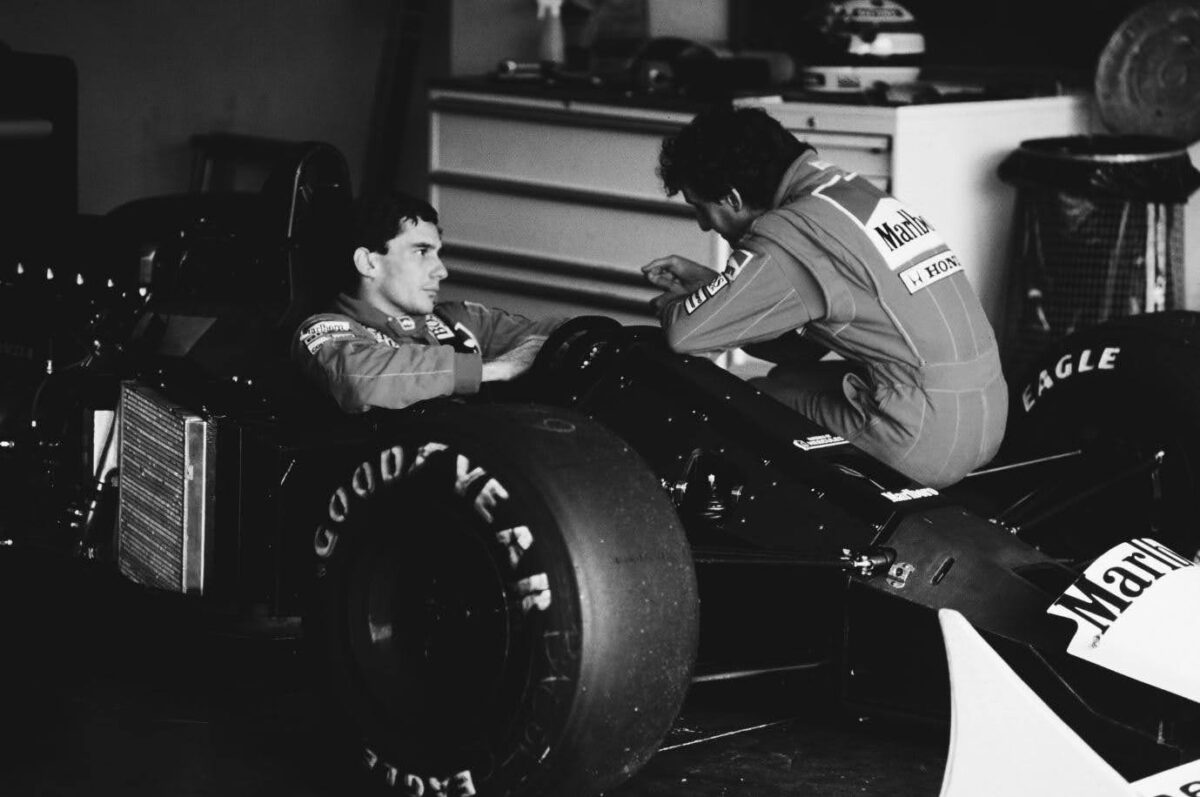
Teammates, 11 and 12 – but never partners. Theirs was a war waged in millimetres, in fractions of a second, in the mechanical exhale of a V6. Senna drove with holy devotion, God behind his ribs and beneath his palms; Prost was secular, stringent, sharp. In no world were either clean. Haniff Abdurraqib speaks on that astringent flavour of intimacy enemies share: ‘there is a tenderness in knowing what desire ties you to a person, even if you have spent your dreaming hours cutting them a casket … it is a blessing to know someone wants a funeral for you.’ Senna’s monomaniacal fixation on Prost cannot be overstated; here was a teenage karter with Renault-yellow and a charmingly crooked nose plastered on his bedroom wall, all-grown-up and starving for approval. Idolisation through a jaundiced lens: gnarled into confounded resentment, gnawing at the insatiable void of a racing driver’s volatile ego. ‘Ayrton did not think about other people’, Prost would say, ‘he just thought about me.’
Suzuka was the crucible. 1989 saw a collision on the chicane: Prost turning into Senna, sacrificing the twin McLarens on the altar of the tarmac to strategically secure his success; Senna, furious and dogged as he hauled the damaged car to the finish line – only to have his win invalidated, the championship seized. 1990 saw a reflection, a retribution: Senna hurtling into Prost, abandoning his former teammate – now driving for Ferrari – in the gravel as he snatched the championship like a malicious, mean-faced baby-brother.
When Prost retired, the fever broke: ‘We came to terms … and we stopped trying to remake each other.’ For the first time, there was laughter. Prost describes the year between 1993 and 1994 as the time he and Senna were closest. ‘Why did we put ourselves through all of that?’ he would ask. There was ease. There were breakfasts and late-night phone calls and ‘my dear friend Alain; we miss you Alain’ – spoken by Senna on the morning of the end of all things. And then Alain Prost watched Ayrton Senna die from the commentary booth at Imola. Watched as Senna torpedoed at 211 km/h into a concrete cradle. How do you cope? How do you mourn your mirror?
‘Maybe all I can say is that I was having breakfast in the morning of race day and he dropped by and sat with me. I am glad his final breakfast was with me. Even though it was short, that was still time he gave to me.’ This is how Alain speaks of his only rival, his counterpart, his almost-friend for the next thirty years, voice cloyed with saudade.
‘It was a fantastic story, don’t you think?’ he asks. His words are quiet, hopelessly reverent.
Featured Image: LaPresse