
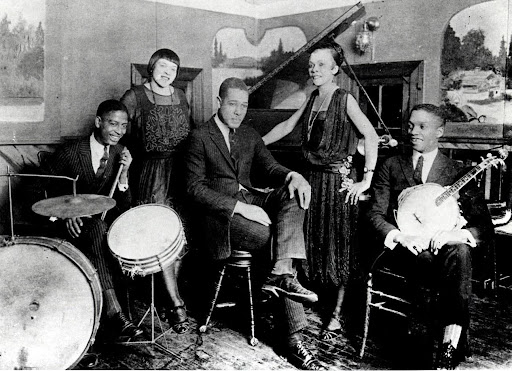
By Edward Clark
“You can say anything want on the trombone, but you gotta be careful with words” – Duke Ellington to the New Yorker, 1944
In January 1920, the United States government passed a total prohibition on the sale of alcohol. Owners of bars either repurposed them into restaurants or shops or were forced to shut them down. In response, speakeasies began to quietly open their doors all over the country. Named for the patrons’ need to ‘speak easy’ when telling doormen the pass-word, speakeasies offered an illicit environment for drinking, socialising, and enjoying performances of the vogue music genre: jazz.
Although the genre originated in New Orleans during the 19th century, racial animosity led to many jazz musicians moving elsewhere. As newspapers like The New Orleans Times-Picayune called the movement an ‘atrocity in polite society’, groundbreaking artists like Louis Armstrong, Sidney Bechet and Jelly Roll Morton moved from The Big Easy to Chicago. There, within dimly lit illicit bars serving homebrewed whiskey and gin, audiences were receptive to New Orleans style ‘ragtime’ – or what audiences were beginning to call ‘jass’.
Speakeasies were the prominent feature of American urban ‘20s social life. In Carl Van Vechten’s 1930s novel Parties: Scenes from Contemporary New York Life, the protagonist Hamish frequents the illicit bars. Van Vechten describes: ‘It was nearly time for luncheon and he had yet to enjoy his first drink. He might, in search of this, visit his club, or any one of the fifty thousand speakeasies with which central New York was honeycombed’. 50,000 may be a small exaggeration – the Mob Museum estimates that at the peak of prohibition there were 32,000 speakeasies in New York. Nevertheless, the large number of illicit bars in one city alone gave way to extreme competition. In order to set themselves apart from competing establishments, owners looked to musicians to draw customers.
Stimulated by a period of extreme social development, urban audiences had the disposable income to support the new genre; speakeasies functioned as vessels to allow jazz acts to experiment and solidify their sound. The best example was at New York’s Hollywood Club at Forty-ninth Street and Broadway. Patronage from the speakeasy’s owner provided the financial support for Duke Ellington’s legendary ‘Ellington Orchestra’ to form, as the band took on a permanent roster in 1923 and regularly played an evening for four years. These gigs were hard work. As guitarist Freddie Guy commented in a New Yorker interview: “Once you put your horn in your mouth you didn’t take it out until you quit. Until period. You started at nine and played until’.
Prohibition-era performance like this allowed some of the age’s most notable musicians to cement themselves as the genre’s staples. In Ellington’s case, he wrote some of his most popular songs: ‘Black and Tan Fantasy’, ‘Creole Love Call’, and ‘Birmingham Breakdown’, for example, were all written during his stint at the Hollywood Club. Performances in speakeasies also coincided with the inception of commercial radio, with 600 stations broadcasting by the end of the decade; jazz performances recorded within speakeasies were broadcast to audiences beyond the cityscape.
Often, speakeasies resulted in African-American musicians performing for wealthy white audiences. For example, the Cotton Club, a popular New York club in Harlem, was positioned by its owner Owney Madden as offering ‘an authentic black entertainment to a wealthy, whites-only audience’. As the aforementioned quote from Ellington displays, whilst segregated speakeasies spread jazz to a new, powerful community, popular musicians renowned for their talent were forced to perform without expressing their opinions or politics. By the latter half of the 1920s, however, the illicit nature of speakeasies promoted integration, creating multiracial – or ‘black and tan’ – clubs. Opposing government policy, speakeasies broke down cultural barriers and created an environment where Americans from all backgrounds stood side by side, watching a new jazz age flourish.
Featured Image – The Syncopated Times