By Bel Radford
To Rest Our Minds and Bodies is an incredibly yielding book. Its contents are tender and vulnerable, falling clean off the bone and seeping hot into my palms — my fingerprints were stained for hours after, marking everything I touched. Yet there’s weight to it too, a pressure that finds old bruises I’d almost forgotten — ah yes, we’ve been here before.
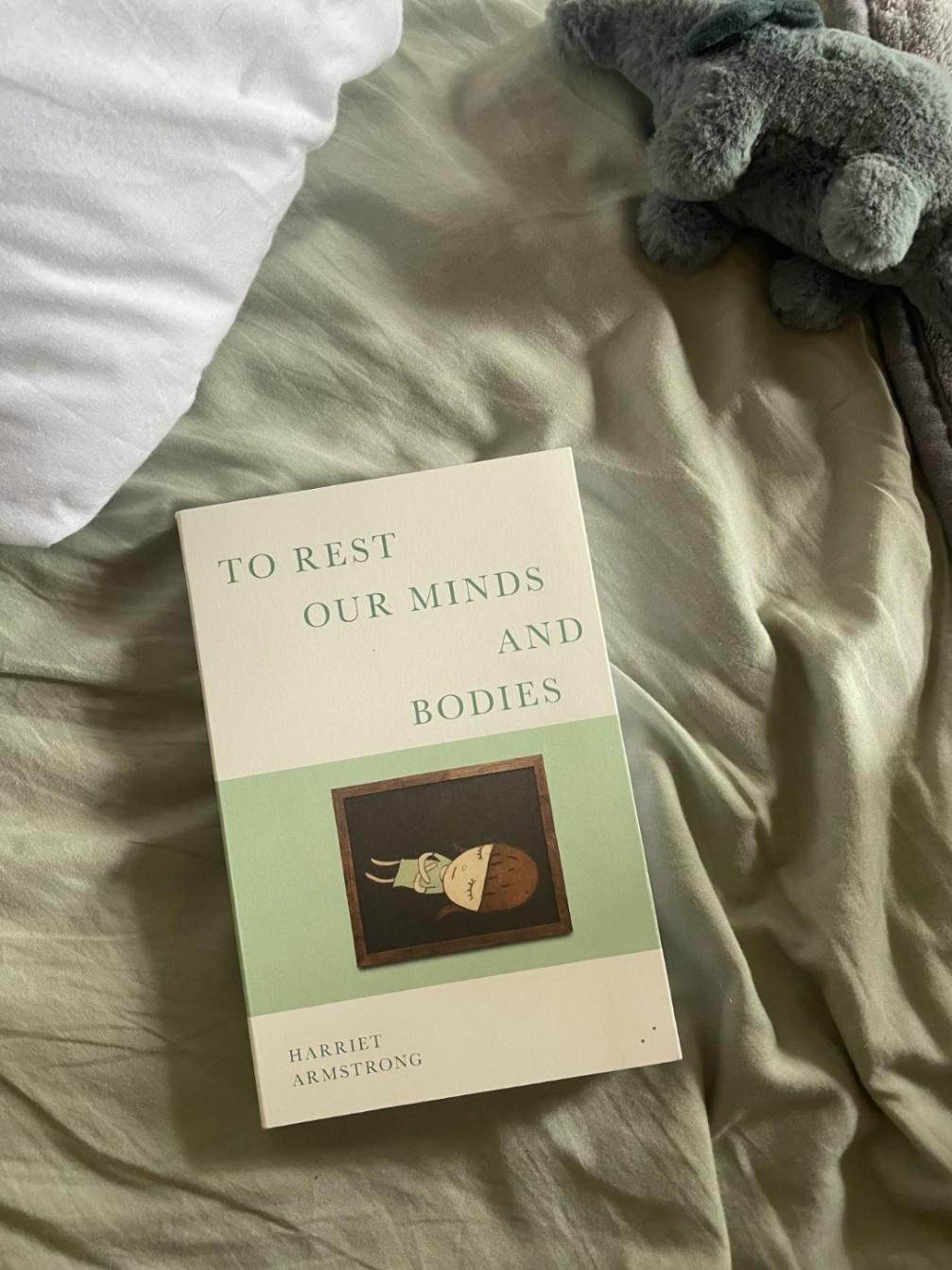
Harriet Armstrong’s book is, at its simplest, a reckoning with intense feeling: it weaves through the debris of unrequited love, the attempt to contextualise oneself within the world, self-destruction, redundancy, and mundanity. I am ashamed to admit I did entirely judge the book by its cover — it shows a Yoshimoto Nara-esque girl, pale and lying (or perhaps floating) in an oaken abyss. Her arms are crossed, the mark-making is gentle and roundish — the girl appears acutely peaceful in a way that made me envious. I recall being curled over, kneeling on the bookshop floor and finding myself enjoying the front cover — it anointed my scorched retinas, a cruel aftereffect of the pervasive LED shop lighting. I was also particularly frayed that day. Oh book so small and gentle, if you look like a lullaby, will you read like one too?!
It doesn’t exactly. It’s not necessarily a happy nor uplifting story — in fact, a great many bad things happen. It bleeds out slowly and hums along with the low timbre of humiliation thick in the everyday negotiations of awkwardly aged semi-adults. We are ripe with shame! The narrative engages with themes of redundancy and mundanity within these hangnail years; one hand turns over these old stones, the other hand holds your own — guiding you through an exacting jaunt across the minefield of your own souring youth. I found great comfort in its deep recognition; the novel really is good, compassionate company. Just a few pages in, I typed into my Notes app: “somebody appeared to be taking minutes in my brain a few years ago. they’ve since gone, gathered their findings, and returned it back to me bound in paper. harriet armstrong … who are u….”
The plot is as follows: the nameless protagonist begins her final year at university studying psychology. The book spans the entirety of the academic year. She meets her flatmate, Luke, one afternoon in the kitchen. He is a postgraduate student doing a vaguely defined degree in computer science. Luke is a kind boy, though some might categorise him as the manic-pixie-dream type — he introduces the protagonist to The Microphones, he wears guyliner, his presence is soundtracked by breathy, incomprehensible, and highly distorted music that fills the kitchen he cooks in, and he vaguely resembles Tilda Swinton. In one of their first encounters, Luke kicks a loose wooden board beneath the stove, making a soft, punctuated staccato that he remarks sounds like that of a heartbeat. He then feeds her spoonfuls of his curry.
“As he laughed he passed me a teaspoon of his curry and I couldn’t even taste the curry because I was thinking about how his fingers had touched each piece of onion, each piece of potato, some of the lentils, some of the mustard seeds — all of these things which were now inside my mouth.”
But despite his charm, irreverence, and unavailability (as we later discover), it would probably be very wrong to call Luke a manic pixie dream boy. The term is mostly used to describe a Ramona-Flowers-adjacent character, defined by Oxford Languages as “a vivacious and appealingly quirky character whose main purpose within the narrative is to inspire a greater appreciation for life in the protagonist.” These characters often exist as a mechanism or catalyst for growth, lacking real depth, and are defined more by the effect they have on others as a force for optimistic change than by their own interior lives. Luke is not vapid, and his feelings do not synchronise with the protagonist’s to produce a neat arc of self-learning. The protagonist falls in love with him, but it is fraught with resistance — unlike a classic manic pixie dream scenario: a down-and-out protagonist meets a quirky, optimistic character, a chemical reaction occurs, and the protagonist emerges enlightened. Our protagonist arguably ends the novel even more down-and-out than she began: punching trees, vomiting in a gutter, and running drunkenly into a lake.
Throughout the book, Luke and the protagonist form a seismic connection. Though the novel gestures toward friendly coffees and catchups with a handful of other friends, none possess the same intimacy nor gravitational pull as theirs. They show each other music and talk and talk and talk and cook and sit and talk. Luke and his girlfriend break up, thus galvanising the protagonist — their connection is so deep, makes so much sense — they should surely be together! It is frustrating even to us, the reader, on some level. It feels so emotionally and practically right and inevitable. The protagonist describes a kind of vaginismus, or perhaps an emotional block that has only ever been transcended when Luke is thought about. As Harriet herself puts it, love and truth collapse into one another in the book — the desire is undeniable, yet fundamentally inaccessible. This impossibility is heeded early on in the novel, when the protagonist imagines the two of them living together.. Luke insists they never could; it wouldn’t work. They’d never have time, he says, “to rest their minds and bodies.”
It is fruitless, and so the story becomes an exercise in trying to exist alongside this unresolvable attachment. From Luke’s perspective, the intensity of their bond is unsustainable — alas! The candle that burns twice as bright burns half as long! In the novel’s latter half, the protagonist spirals into a kind of blackly comic mode de la self-destruct: she seeks out sex with seedy men and runs until she shits herself or vomits, etc. etc.
It’s this specific trope I resonated with the most deeply — the pursuit of breaking through a period of murky bleakness with anything of dramatic consequence; provoking big feelings or big repercussions to bring you out of yourself and into the realm of consequence and danger. In To Rest Our Minds and Bodies, this translates for our protagonist as seeking out sexual relationships online. At one point, the protagonist meets an older comedian, Richard, on a dating app. She asks if he has any pets — he replies: “Only if you count this monster cock.” Richard is her first sexual experience, and the protagonist mentions the seediness of the encounter feeling appropriate, somewhat pleased when he reveals a gauche tattoo of some coyote on his upper arm. Her exploration of sex reads like an experiment with self-harm. I talked to Harriet about it:
BR: Does the protagonist seek out encounters with men like Richard as a craving for some kind of consequence — as if bad, awkward, degrading sex is still something to be felt? I sort of imagine she wants to get as close to the edge as possible, to provoke the universe into giving her big, intense feelings or repercussions as surrogate intense feelings that Luke gives her.
HA: That’s actually so moving to read because yes, I think that’s exactly what I wanted to get at! The protagonist is definitely seeking out intensity and extremity to try and find some kind of outlet for her intense and inexpressible feelings for Luke — and I think she’s also trying to prove to herself that she’s capable of causing intense, serious, “adult” things to happen, because she’s so unable to make anything “happen” with Luke. I honestly feel like your question puts it better than I can — she’s definitely trying to get closer to the edge and to access these extreme situations as surrogates for the intense way Luke makes her feel, I love the way you put it! I think she also perceives a kind of very binary split between Luke, who she loves, and other men, with whom she has these horrible encounters — and perhaps it feels easier, to her, to keep those two things so extremely separate. I couldn’t really imagine her having more pleasant or neutral “dating” experiences: I felt this character would be drawn to these more sort of degrading, unemotional situations because they reinstate Luke’s role as the only safe/special person. Also, I definitely remember having those sorts of sexual experiences at that age, and maybe not even seeing them as degrading or bad because I didn’t know what a more healthy, comfortable sexual experience might look like. So I think there is definitely an element of that too!
The vast difference between the tenderness she shares with Luke and the physical awkwardness, clinical detachment, and general unpleasantness of her encounters with these other men is really, truly palpable. Many might wonder where the comfort I found in reading this book really came from — it’s just good to know the self-destruct button has been as appealing to others as it has been to me.
As I’m sure is normal when reading, one tends to contextualise the story and situate it somewhere familiar within their own world. In café scenes I imagined them at Whitechurch; at the pub, under the heated lamps at the Swan. During the protagonist’s monologues, my mind surrendered to peculiar feelings; that which resonated in the book felt as if it came from some muddy dream. The closest comparison I can make is the act of trying to make out the shapes of your childhood bedroom in the dark — your carrot-lacking eyes squinting in an attempt to discern a dressing gown from some Slenderman figure at the foot of your bed. That’s how it felt. Sometimes, when the protagonist described her isolation, I imagined a waxed wooden floor — maybe a ballet studio — big mirrors in my periphery that I couldn’t quite look at, shame-bound and anchoring my gaze to my feet. It’s the same room I often find myself in when I’ve been alone too long and my feelings start to become physical sensations. Particle emotions rub against one another in my head, hot, volatile, and fast like a kettle about to boil. I feel it pressing against my temples. The protagonist’s thought process often brought me back to this room, particularly in moments when loneliness, or Luke, was discussed. When we are trapped in ourselves like this, and we feel (at last) a big feeling from something outside of ourselves — we feel as if we have found God.
The novel reaches its crescendo after a period of semi-estrangement between the protagonist and Luke, culminating in her invitation to Luke’s twentysomethingth birthday party. She arrives, knowing nobody else. When Luke quips that he “can’t spend the whole night just with her,” we see, paradoxically, both constraint and release. The protagonist then goes outside and watches the party through the great glass door. She sees Luke’s gangling limbs curl and twist around the faces and bodies of those he knows. His body fractured betwixt the rooms and people — the intimate yet dispersed birthday boy politely doing the rounds — his presence dispersed yet shared among many. How unfair: they get to be touched by him, feel him move past and through them with no consequence and in a way that’s not completely devastating. The protagonist is on her knees in Luke’s father’s vegetable patch. She proceeds to vomit in a gutter, send Luke an unelucidated unkind message, then run, drunk, into the lake they swam in just weeks before. The protagonist’s corporeal reactions are, of course, extreme; perhaps mental devastation becomes more tangible, more legible when translated into bodily experience. I also talked to Harriet about this.
BR: On the back of the book a guy called Luke B. Goebel describes the book as “the real truth about being too big for the container of the body of youth.” The protagonist’s obsession often manifests in extreme bodily acts — vomiting, running into the lake, punching trees. Do you see these gestures as the body attempting to articulate emotions or intensities that exceed the self’s capacity for containment?
HA: Yes!! Again — beautifully put!! I think the narrator is feeling such intense things emotionally, and cognitively even, but lacking a physical outlet for those things, and an understanding of how to gain that outlet. Even her sexual experiences feel so random and failed and don’t really allow her to express anything or even have a real experience — I think she finds them all so partial and unfulfilling, and totally unrelated to her real feelings and instincts. The book is quite concerned, I think, with her dis/connection from the physical world — and how, even through sex and her vaguely self-harming actions, she remains essentially insulated from the world. And I think she’s also having these feelings — like love, I guess — that feel huge and almost transcendent, but again, can’t be physically expressed or even expressed to Luke through language — and there’s definitely a claustrophobia in that, and a desire to try and break out of the self.
A final note I made whilst reading was the culturally referential breadcrumbs left along the way. When setting up her dating profile (to meet the aforementioned disappointing men), the protagonist includes a photo of herself dressed as Phoebe Bridgers from the Halloween before. She mentions listening to Mitski and “The Place Where He Inserted the Blade” by Black Country, New Road. Luke introduces her to The Microphones. Anyone familiar with these artists will immediately note their common denominator — a certain attentiveness to the emotionally fragile and generally soul-crushing. We spoke about this also.
BR: I really liked the musical references dotted along the way; it made a sort of soundtrack for the book in my head. Why was it important to include these musical references?
HA: I really liked the idea of the book feeling like an accurate depiction of life — or at least that narrator’s life — and to me that meant including lots of little daily details like music, just because those things are a big part of my day-to-day life, so it felt really natural and almost obvious to add those details into the book too. I also really liked the idea of exploring how the character is experiencing her own thoughts and feelings through music, as a way to make sense of them — I felt this fitted with her tendency to overanalyse things and try to understand their deeper “meaning.” Also, it was fun to explore the excitement of her connection with Luke — and the way it made her see herself in a new way — through her excitement about his favourite music. I wanted, also, to explore the way she uses music as a way of expressing how she feels when she speaks with Luke — I thought there was something sad and maybe interesting in the idea that she doesn’t know how to communicate her feelings to him except through other people’s art.
I think it’s particularly interesting that this impulse — to find resonance elsewhere — runs throughout the entire novel. The amorphous presence of identity is slippery and exceedingly difficult to pin down. It is hard to know who you are, what you like, what you mean, or what you give, and To Rest Our Minds and Bodies gently bears witness to this. It soothes the neurotic twenty-something heart with teeth worn down to the gum — and for that, it deserves to be held like a precious stone. Alongside its practical and emotional acuity, it is written with a compassionate beauty — a feat, considering that at the same time it kneels beside you, elbow-deep in your wretched guts, tugging out long-carried feelings that can finally be felt and made sense of.
By no means should you take my thoughts as universal truth; everyone I’ve lent my copy to has offered staunchly different emotional accounts of their experience. My mother read the second half over my shoulder on a long train ride, convinced the protagonist was chronically self-interested. My boyfriend was unsettled by her pursuit of unpleasant sexual encounters as a way to feel — a surrogate of sorts — even when he recognised it as a symptom of her desperate attempt to access her own emotions. He was particularly frustrated that the protagonist and Luke couldn’t end up together, though they inhabit the same orbit. These different responses fascinated me; it reminded me of the first time I watched 500 Days of Summer, labelling myself a passionate Tom sympathiser, then scrolling through the Letterboxd reviews of the majority. Safe to say, I learned something about myself that day. I think these varied reactions also illuminate the most profound facet of Armstrong’s writing: she accommodates the kaleidoscope of human feeling, offering complicated yet very real scenarios that each reader digests and responds to differently — a reflection of the ways we inhabit our own interior worlds. In all, To Rest Our Minds and Bodies is a truly beautiful book. Most readers will derive their own unique meanings from it, but I suspect that those in their twenties will find themselves recognising much of the prose — rehearsed, written, thought, and even cried — as their own.
Featured Image: Bel Radford