“There’s not an hour that goes by that I’m not wishing that I was eating some sort of fried chicken.”
It was bitterly cold in London. I was nursing a Guinness, alone, at 7pm on a Friday evening in January. Fear not, I was waiting for a friend who was running late, but I thought I could use the time to be productive. I drafted what turned out to be a somewhat long and shmoozy message to an instagram chef. Slightly tipsy, I began the message with ‘Dear Mr Whyte’. I begged him to agree to an interview and sent the message before I could think twice. Little did I think he would reply, let alone see it. But a few hours later, and a few pints deeper (thankfully no longer alone), his response flashed up on my screen: ‘Sign me up mate’ and ‘You could have just said hi mate’. Safe to say I overdid it with the speech, but when it comes to an idol you’ve got to give it your best shot, right?
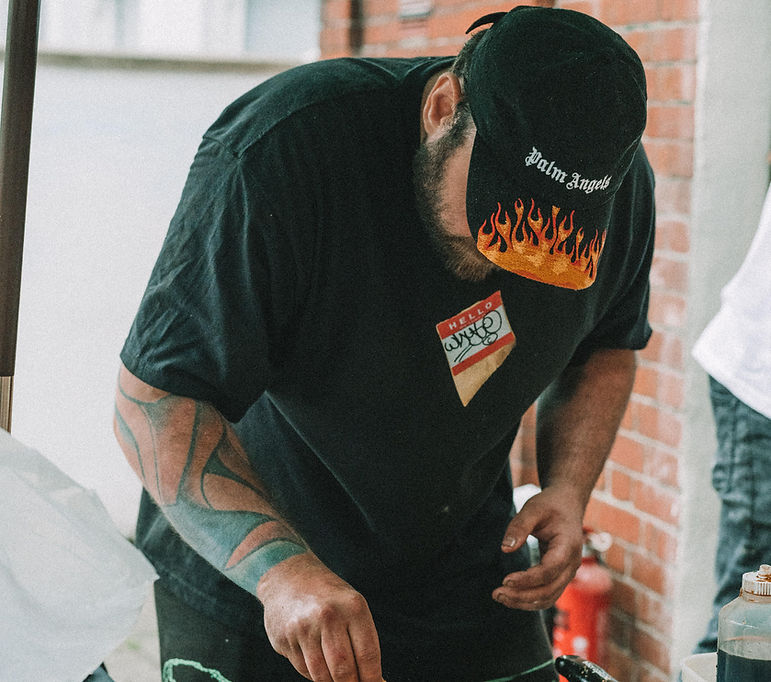
I’ve been following Whyte Rushen on instagram since the first lockdown, and have oohed and aahed at his mesmerising photos of food along with 20,000 other followers. I managed to get myself to one of his pop-up’s in September 2021. Guzzling down a chicken shawarma calzone in Dalston roof park, I thought that I’d died and gone to heaven. That was before I’d even tried the ‘poysters’ (pizza oysters) that were the secret item of the pop-up, access to which requires whispering a code word in his ear. After months of only seeing his signature icon, a ‘Whyte Rushen’ scrawled onto a ‘Hello, my name is’ sticker, I was taken aback by his bubbly demeanour. Face to face with the man himself, I was thrilled to find him to be so friendly and happy to chat. I found myself at another pop up a couple of weeks later, this one staged outside a chicken shop. Let me just tell you, the tamarind caramel wings with rainbow tobiko mayo are on my death row meal.
Back to January. I text Jojo, and before I know it there’s an interview in the diary. For those of you who don’t know, just a few minutes scrolling through this man’s instagram will give you an idea of his vibe. Blending comfort food with high cuisine, his flavours and combinations are consistently unique, creative, and delicious. To give you an example, the most recent pop up item was braised octopus takoyaki confit garlic dough balls with seaweed salt, katsuobushi, kewpie, bulldog sauce and shrimp floss (decipher how you will). He’s also an artist, selling his paintings for up to £300 through instagram, and a brilliant writer. His captions are curated so that they are fascinating yet readable, and his personality, although always elusive (we still don’t know his name – and yes, we tried to get it), always shines through as down to earth and familiar. This is exactly what it was like to interview him. It was a pleasure for both of us and the fact that he gave a small time student magazine an hour of his evening is another testament to his character. He clearly, despite having gone viral for selling smash-patties outside his council estate to hundreds of people, including Lily Allen herself, has stayed true to his aesthetic and his roots. He just wants people to have a good time and enjoy his food, and when I find myself tat his next pop up, I know that’s exactly what I’ll get.
Wayzgoose: How are you?
Whyte Rushen: Yeah not too bad, busy but it’s good to be busy innit.
WZG: I just wanted to start by asking for those readers who don’t know you, would you like to briefly introduce yourself, explain who you are and what you do?
WR: I’m Whyte Rushen, for the past 10 years I’ve been working in Michelin star kitchens, so I got my foot through the door a long time ago. So I was a builder originally, hated that, forever, like hated it, as soon as I got into it to the day that I left. I dunno what it was but one day like, yeah I just decided enough is enough, I’m going into the chef game, so yeah, first and foremost I guess I’m a chef. I seem to have gotten a bit of clout on the old instagram over the last year, putting stickers up on the wall, posting pop-ups and various collabs. So that’s me I guess in a nutshell.
I’m from Hays, West London, I’m originally from the wild west, as west as west can get really. Close to Heathrow airport, quite a dingy little place, the armpit of the west. I guess it’s really only known for passing through when you’re going to the airport, or drugs I guess.
(Chuckles to himself)
WZG: How did you come up with the name Whyte Rushen?
WR: I just really like the cocktails, and like where I’m from we always done graffiti innit, so I guess I’m from a bit of a graffiti background, we just always kinda spelt things a bit weird, you know, you’d replace the I’s with the y’s, might put a fuckin E on the end of something, so you like swap the letters about a bit. But that was what my Instagram was called like even when it was just like my personal instagram, there was never no big decision to make it like a brand name or anything like that. I think my real name, I think that one got like hacked or something like fucking years ago, so it just stems from that really. If you scroll back far enough I think there’s just photos of me on holiday, just doing weird shit.
WZG: You don’t seem to disclose your real name, is that a conscious choice or just how it has played out?
WR: Dunno, I dunno, (Deep breath) It weren’t a conscious choice to begin with yeah, cos like when everyone starts calling you it you just go along with it innit, so there was like so many people addressing me as Whyte and I was like ah that’s not my name, and they were like ‘I didn’t even think to ask your real name’. I was getting it in emails and stuff where people were just addressing me as Whyte Rushen, and yeah, it’s just become easier to go with it. I guess it’s becoming like a stage name innit. So yeah I just kind of adopted it in that sense, and then I was like fuck it then, let’s go all the way and yeah just take my real name a little but out of the public eye I guess.
If anyone come to the early pop-ups where I just took the payment via paypal, everyone would just know my name innit. It’s all just quite fluid and like there weren’t really, like I never really made clear-cut decisions it just sort of always seems to have fallen in place, even with the logo and stuff you know.
WZG: yeah it seems like it’s all true to who you’ve always been which is cool
WR: Yeah, like with the logo, the logo was just a picture of me, and like (Sighs to himself) when I started getting a bit of a following and that I was just like I should get a logo innit, or some sort of art work or summing, so I had this big fucking thing in place like I was talking to this artist and he had all loads of stuff, he’d drawn out a few concepts and I was ready to splash quite a bit of money on it, but then I just had this fuckin sticker and I just wrote my fuckin thing on it and then that seemed to one that got some sort of clout, so I decided not to go with the fancy shmancy art work and just adopted this sticker.
WZG: With the role of Instagram in your work, do you think in general the roles of chefs might change? Thea and I were calling it ‘Instagram Personality Chefs’, do you think this is the new thing?
WR: everythings the new thing till it’s the old thing innit, like tik toks already taken over, it feels like at the minute, if you’re not on it, like instagram and stuff, I guess you’re kind of getting forgotten or left behind a little bit you know what I mean? All the chefs that I’m kind of, well I’m mates with a lot of them anyway, but the people I’m exposed to, and all the dishes they’re putting out, sort of what’s going on in their restaurants, and all that, I’m exposed to that via instagram. So, I guess in that sense yeah definitely. And it’s a big thing for business innit, I do 100% of my fucking business through instagram. So yeah, I think it’s here to stay definitely, even just as a tool to push your business and promote yourself.
It feels like chefs are getting sort of more air time as a personal thing rather than the restaurant that they are attached to, which I feel like is a positive thing.
“I think my real name, I think that one got like hacked or something like fucking years ago, so it just stems from that really.”
WZG: The nice thing I guess is your pop ups also make your Instagram content into a reality too
WR: yeah that is something i’m proud of, making it a physical thing, you know kind of dragging it out of the digital world and actually being able to offer something tangible, that’s something people have taken to that feels nice man.
WZG: How much work would you say goes into each pop up?
WR: I think at the moment, cos they are mostly just one day events, like one day one night, we set aside two days prior and the day for the actual event, but that’s just from like a physical work stand point, so you know, you’re doing your two days prep, you’re getting the venue ready and doing the pop up. In terms of all the back and forth like getting the artwork sorted out, designing the menu, it starts a month before, and it kind of doesn’t stop until you’ve done it. Like, at some point, everyday from its conception you’re doing a little bit of work on it, whether it’s just talking to somebody, hiring something, there’s a lot that goes into it behind the scenes man.
WZG: We always say it’s so good that the prices of your pop ups are affordable, like as students we’ve still been able to come to loads!
WR: Yeah yeah, don’t get me wrong, that sometimes kicks my arse, I’d just feel so dirty just jacking it all up do you know what I mean? It’s not what I’m about man. Like I like the crowd that I’ve sort of attracted so why alienate people that have already shown a bit of loyalty I guess, and shown a bit of passion for it.
WZG: So how many people do you have working on your team at the moment?
WR: I’ve got Mike, you know Mokes, he’s my sous-chef so he’s on every single pop up with me, and will be forever. It chops and changes, there are like 5 people who help, but it all just runs on mates and favours surprisingly. I haven’t really got a payroll or a full team at the moment but obviously the venues as well tend to put on a few people you know. I guess for a big event I’ll roll down there with 5 people.
WZG: Do you work on your menus with your team? I find the way you combine flavours insane, for instance the octopus in your last pop up! How do you come up with these dishes, where do you get your inspiration from?
WR: Yeah I guess it is 99% me really. I cook based on memory and yeah I think about a time in my life rather than an ingredient. A prime example is the octopus thing, the takoyaki balls was one of my favourite things in Japan, so i’ve always wanted to do a take on that, and then I dunno…it’s just the way my brain works.
So for me if I’m working with a pizzeria, like the pop up that was a collab with Gordo’s, why not take those balls, turn them into garlic dough balls, but still riff off the original flavours so that’s how that one came about. But yeah I just really try to take in my surroundings and stuff like that. Like the one at the Hoxton was a collab with Camden brewery so I made sure that there was beer in every single element of every single dish, you’ll see one that’s gonna be a good example which will be the one in Camden, so I’m gonna base the menu on all the like takeaway food that you can get in Camden market so all the Chinese takeaways and stuff that you pay a fiver for and get a ratchet box of stuff on like a silver tray.
It’s just about having fun as well innit, just cooking stuff I wanna cook and you know I guess what people haven’t seen too much of before.
WZG: Are they any childhood influences/dishes that have inspired your food?
WR: The older I get the more I feel like I’m tryna go back to like, like I dunno I was infatuated with Japanese food, Chinese food and food from all over the world. But, I think the older I get the stuff that interests me is just these tiny little snippet memories. Shit that my dad used to cook and stuff. I guess I’m trying to chase that backwards and sort of re-live those memories.
I think English food in London and shit is underrepresented at the moment man. If it is represented its just a massive lie, like when chefs are like this is English food and its like venison and fuckin pigeon and shit like that and I’m like where the fuck did you grow up?
(Laughing) Like who the fuck was eating that? Like yeah, you got that ingredient in England, but its not English food, English food to me, we was eating from chicken shops everyday, like my mum and dad would, I mean we weren’t rich so it’s just like most of the time its just frozen shit you get in Iceland, and Sainsburys and shit like that. But I find it fun to kind of like take that food and elevate it I guess, and make it in a way that kind of shows the skills that I’ve learnt over the last ten years breaking my back.
So it is fun to do like some chicken nuggets and baked beans and just make ‘em nice you know what I mean? It’s relatable as well and I think that might kind of be why people do sort of gravitate to the pop ups. As mad as it all is there’s always an element of relatability I guess.
WZG: So that relatability is important to you? I guess in your insta captions it’s all kept quite colloquial.
WR: I’m just trying to share my story, do you know what I mean? It is nice that people can relate, you feel in touch with people, rather than it being empty likes and stuff. Because the writing is quite personal sometimes. It took me a while, but like the pictures of food on instagram like everyone is doing that and that’s fine. But I felt like there was a turning point where I was brave enough to write about the things that are going around in my head, it felt quite personal. But yeah it’s nice that people relate to it and like, it’s nice to just be heard.
WZG: What’s your plan then? You’re super busy with pop ups over the next few months but will you try and set up your own restaurant?
WR: I mean I don’t think I could set up a restaurant even if I wanted to at this point, this year, cos I’ve already boxed so much stuff off that I’ve already sort of said yes to. I would love a restaurant, don’t get me wrong, and I firmly believe it will happen if I make the right moves but I think that might be next year. But, urm, in terms of this year, I think it’s just gonna look a lot like last year but just I think you know, bigger names involved in the collabs, crazier venues, like I’m really excited about pushing the art direction of things as well.
“When chefs are like this is English food and its like venison and fuckin’ pigeon and shit like that and I’m like where the fuck did you grow up?”
WZG: Yeah! You’ve suddenly started selling art, have you always been into it?
WR: Yeah its fucking wild innit! (Laughing) I’ve suddenly started selling art, that’s basically what it is mate yeah. Fuck knows, if you can explain it please let me know, its wild man. I dunno, I guess in a weird roundabout way I was an artist before I was a chef, sort of going back to the whole graffiti thing, you can see in my artworks like I’m not drawing the Mona Lisa, it’s kind of more obviously graffiti based kinda art. I guess it sort of works from the standpoint of having that logo there, that’s become a bit of a like, I don’t wanna say ‘icon’, that’s so dirty but, you know, it’s becoming recognisable, somewhat, in a few circles…
I guess the art just works as an extension of that and you know the merch is doing kinda well with the tees and stuff every now and again. It’s all art innit, everything’s art, the foods art, the music is art, the art is art.
I never price them, I just kind of invite people to pay what they will I guess, some of them have gone for like £300 quid and shit which is wild. I just enjoy doing it man, the first few were so bad but people were like oh can I buy that and I was like fuck yeah you can. It’s a bit of a de-stress for me. I really enjoy doing it.
WZG: It’s so nice you can have fun in your career that now involves two creative things that you enjoy.
WR: Yeah it’s mad luck, I feel so fortunate that way do you know what I mean, cos I feel like everyone’s got something you know, everyone’s got like some sort of special shit that they can do and they’re really good at yeah, but I think that the saddening thing is not everyone has the chance to have like an audience to show it right? So you can go through life without ever getting a chance to put your talents in front of a massive audience which I’ve been fortunate enough to kind of get. Yeah man, getting all a bit philosophical innit.
WZG: Did you have a favourite pop-up last year? Or a highlight of the year?
WR: Favourite pop up that’s mad, yeah man you know we done 32? Ended with the one in Scotland which was a nice way to round it off, I know it’s only Scotland but we did sort of count it as like going to a different country.
WZG: it looked so good that one, is that the one where the oven broke? Or you had no power?
WR: Haha the oven broke?! Mate the whole thing was plunged into darkness. There was a massive storm followed by a massive national power cut, so the whole week we had no internet, no hot water, no phones, no power – no nothing. Me and Mikey ended up just fucking, (Laughs) putting a pizza dough together, sort of re-imagined all the ingredients we had got together to do this sit down meal, and used them as pizza toppings effectively, and just fucking cooked them over like coals man. You got a lot of people there you don’t wanna let them down you know.
“It’s all art innit, everything’s art, the foods art, the music is art, the art is art.”
When I went to Mortimer house, that was the first one that sort of came away from the street food theme and was like a sit down multicourse meal, that felt like it was something massive. So I guess that will always be a cornerstone, that we managed to take it away from one sort of street food item and sort of harness it into effectively a restaurant meal. Obviously having Scream dj at that one aswell – was just like what the fuck is goin’ on, I loved that one. Not only was it having Scream there, who was someone that I looked up to, and genuinely listened to the geeza’s music and I have done since I was early teens, and suddenly he’s there as one of the biggest dj’s in the world and fucking doing an event for me – it was a bewildering moment. So that was one of my favourites.
The ones at my flats are always ones that I love. Just the OG’s one doing the burgers. Let me think. The one from the off license was sick. We just done cheesecake literally from my local offy. The chicken shop one was bangin’ tho yeah cos that one had the air of the art direction to it. We had some art on display, we had all the spray painted t-shirts. I think you’ve got them ain’t ya, unless you’ve binned it because how much did they smell of paint (Laughs).
WZG (Jojo): Yeah we’ve got them!
WZG (Thea): Definitely not binned.
WR: Wild man yeah they had a smell to em
WZG: It’s cool that the pop-ups are an all-rounded experience, obviously the food is the centre-piece, but the art and the music is a big part of it as well
WR: Yeah, I guess I’m just trying to make them events now innit instead of just food. It feels like, on instagram as well like people are buying into more than just the food, like investing in someone as a person I guess or I dunno the beginning of a brand. I guess just trying to make it more like an event, more of a rounded thing people can do and just come chill for like a whole day. It’s just nice for everyone involved to come and have this really sort of all-round event, instead of a one-dimensional experience where you just collect food off someone, like every food truck wherever can do that.
“Everyone’s got something you know, everyone’s got like some sort of special shit that they can do and they’re really good at.”
WZG: What would your death row meal be?
WR: I have come to the decision that I would have a Chinese takeaway, but no fancy stuff, just my local Chinese takeaway, sweet and sour sauce everywhere. I love the crispy seaweed, it’s one of the best things in the world yeah. But yeah real trashy, and then, I just love fried chicken so bad mate, it’s a problem. There’s not an hour that goes by that I’m not wishing that I was eating some sort of fried chicken. Then I dunno, I’d probably have a real, sticky sort of naughty desert like, a sticky toffee pudding, or a treacle tart or something. Something insane- if you’re gonna die just go out having something that feels like it’s gonna kill you anyway, like even if the chair doesn’t work I’m going out.
WZG: What’s a food or dish that you tried recently that surprised you? And what’s one that you haven’t tried but would like to
WR: I tell you what surprised me yeah, you know in my last couple posts, that refreshing black fungus, its like woodear mushrooms in a bit of black vinegar, coriander, bit of chilli bit of ginger. It’s one of them things you would glance over like I’m not getting a plate of weird mushrooms, but its so fucking banging like no wonder they call it refreshing. The texture is banging – it’s like you’re eating it and you’re having a lemonade at the same time. So that was the one that surprised me cos it was such a sly little banger, I was like here we go this is gonna be very average, and then it was just the sickest.
I wanna try real tacos in Mexico. I’m going there in April, I think I’ve looked forward to that for my entire life. Yeah I wanna eat tacos el pastor at like 2 am in a car park somewhere in the middle of Mexico city.
WZG: Do you have a go-to comfort meal?
WR: Just having a moody Chinese always reminds me of being at mum and dads, it was my favourite thing when I was a child and that. I think fried chicken by nature just seems to be like a cuddle. I tell you what I always sit there mad content after and it’s not very often, but you know just a proper well-made shepherd’s pie. You just sit there on the sofa… when you live in London or England you always wanna move somewhere else but when you have a shepherd’s pie you’re like I know why I’m here actually, like I am in the right place in the world.
WZG: Do you have 3 ideal dinner party guests?
WR: Tell you what, who would I have, I don’t think I would have any chefs. I tell you what I’d have David Attenborough, and I’d have Stephen Fry, cos that’s banging like you know that the conversations are always gonna be mad. I’d have Amy Winehouse too I reckon.
WZG: Go-to offy snack?
WR: Ah mate, urm, I guess I like obscure ones you might not have heard of. You know what I love yeah they come in a little roll, they’re like waffles yeah but they’re tubes and they’ve got like a cream filling, they’re Polish and Russian or something. You can get hazelnut ones or coconut ones, they’re banging yeah. I think the sugar content is so high in them yeah, like if youre fucked and you just eat a whole box of them yeah real quick you’re just fine, so that’s a little survival tip for anybody. We all need that.
I love ribbons saucy Nick Naks, best crisps in the world. You gotta get the purple ones. Other than that if I’m in the offy I just get a can of gin and tonic, always the diet ones as I’m tryna watch my figure.
From chicken wings and spray-paint tee’s, a sat down beer inspired tasting menu, pincho in an underground (previous brothel) venue, and finally Caribbean style snacks in the Prince of Peckham. It seems that collectively, Thea and I have attended (and eaten) most of Whyte’s creations. The Whyte Men can’t Jerk event did not disappoint. After a few tinnies on the bus, the Prince of Peckham in all its glory greeted my eyes. The anticipation for the source of the aroma that had been hugging my nostrils for a good hour was made easier by the happy hour cocktails. Safe to say, the curry chicken chips along with the curried goat burger, caramelised pumpkin patty and roasted breadfruit, were all shovelled ever so gracefully into a greedy mouth. Amidst smoked-oysters with banana chips and a boogie accompanied by salt-fish doughnuts, I bumped into the man himself, asking him to describe the night in three words: ‘utter controlled chaos’. I know you’re tempted, maybe your mouth is already drooling- stop dilly-dallying and get yourself to a pop up.