Categories
Perspective

To Live and To Love

By Lawrence Gartshore.

As a student of theology, one of the major criticisms that one learns about God’s existence (or lack thereof) relates to a seemingly very simple notion – the idea that, for Christians, God is good. I beg of you to bear with me here; I promise that there is a deeper point coming than simple religious semantics.

On the face of it, stating that God is good seems to be a rather straightforward assertion. If the God of Christianity does exist, which for the sake of argument here I will assume is true, then, of course, this omnibenevolent deity must be good. If he wasn’t, then one would not be thinking of the Christian God at all and rather some other, lesser, meaner god.

Yet, this statement of ‘God is good’ is, in many ways, a tautology. A tautology, in layman’s terms, is when one states the same idea twice and, in doing so, commits a fault in style. Simply put, saying ‘God is good’ is no different linguistically to saying ‘return back to’. The word ‘back’ is redundant here, for the meaning of the sentence does not change with its addition; ‘return to’ says the same in fewer words. In much the same way, therefore, the argument goes that as for Christians, God is goodness itself, so saying ‘God is good’ is, in fact, simply saying ‘God is God’ – which is perfectly meaningless.

For those of you interested in reading more about this theological minefield, I would point you in the direction of the Euthyphro dilemma but, and I can almost hear the audible sigh of relief, this article is not one on theology.

Rather, I would like to propose another tautology exists in the world – one that is perhaps even more ever-permeating than that of God’s goodness. I speak of the concepts of living and loving.

This may seem like a strange proposition on the face of it. Why, using my earlier logic surrounding the divine one could, in fact, perfectly conceive of something being alive without necessarily feeling the emotion of love. There appears to be no contradiction in terms, nor does one possess a linguistic meaning that necessitates the other.

However, I believe most strongly that we, as human beings, are not merely ‘something’ – no, every one of us, from the highest to the lowest, is rather ‘someone’.

‘Someone’, in my opinion, cannot live without love. Many of us are lucky enough to be born with it bestowed upon us by our parents. We develop the feeling as we grow, eventually finding the ability to love others. We grow a little more and obtain the far more difficult talent to love ourselves. Even when we are at our absolute lowest, and we cannot locate the facilities for self-love, when we think that all our love reserves have been spent, someone new enters our life and teaches us that we do in fact have more to give.

Love is, fundamentally, what sets us as species apart from so many others. Other animals may mate for life, such as the dolphin, but no other, as far as I am aware, show the same capacity for unbridled love as we humans. We fight for it; we are guided by it. It provides safety, and pain, and joy, and agony, and it is through all those feelings, good and bad, that we truly know we are alive.

Love can hurt, as life can hurt, but it is only through love that the very act of living becomes possible. We needn’t say that to live is to love – the statement is redundant – both words mean the very same.

Categories
Perspective

Can algorithms feel pain?

By Emma Large.

Curb the indignation just for a moment. Brian Tomasik wants to spark a conversation about the ethical duty he contends we have to “reduce the harm that we inflict on powerless, voiceless [AI] agents,” and I think we should briefly listen to him (very…very briefly).

Initial reactions to sentiments along the lines of Tomasik’s declaration often involve laughter. A spluttering of exasperation. Mockery. Very often, a rolling of the eyes; sometimes, as per the nature of my reaction, defensive outrage: How can anyone possibly imply we introduce AI into the scope of our moral consideration, as if there isn’t enough genuine suffering already? 

However, historically there has been a pattern of Cause-Xs: ethical areas that a current generation is blind to or critically overlook in a way that seems later incomprehensible. It is unthinkable to us now, for example, that anyone could ever think slavery a morally acceptable practice to engage with. I don’t mean to suggest that AI is a Cause-X area or in any way comparable; but I do think Cause-Xs show us that we can’t immediately laugh away subjects as ‘obviously’ undeserving of ethical consideration, without further thought. So I think we should bear with Tomasik and PETRL (‘People for the Ethical Treatment of Reinforcement Learners’ – Google it, it’s real) just momentarily. 

I’m nothing close to a computer scientist but I can attempt an amateur explanation of Tomasik’s general premises.1 AI agents in some algorithms (in lift buttons; in ChatGPT; in the behaviours of NPCs in video games) are trained to accomplish set tasks using a technique called reinforcement-learning (RL), a method sourced from biological neuroscience. Agents are set a task and receive a ‘reward’ whenever they achieve the desired state. When they fail to achieve the desired state, they receive a ‘punishment’. This seems familiar – don’t we often teach human children and animals in the same way? Tomasik argues the various cases of the agent receiving a reward or punishment can be identified with very rudimentary, extremely minimal states of cognitive pleasure and pain. These algorithms might, then, have the capacity to suffer. It is a fairly prevalent thought that we should try and prevent suffering if we can. Tomasik thereby presents his case that RL algorithms should be assigned a non-zero level of moral value (infinitesimal but not net-zero); in fact, he equates the moral value of one laptop’s combined RL algorithms to nearly that of an ant.

How is an artificial ‘punishment’ like biological pain?

Tomasik employs many complex parallels between neurological states and reinforcement-learning states to support the plausibility of his claim that AI possess some minimal sentience. These are too intricate for me to explicate or do justice to here. He does, however, employ three empirical criteria for identifying if something is in a state of pain, which he contends reinforcement-learning algorithms often exhibit when experiencing ‘punishment’ states:

  1. Not wanting anymore. Reinforcement-learning algorithms sometimes choose to enter terminating states (they will turn themselves off) sooner rather than later. This seems strikingly similar to the way we choose not to extend our painful experiences; behaviour like this implies that perhaps the algorithm was having or was anticipating net negative experiences.
  1. Avoiding rather than seeking. If moving across a grid of high-reward and low-reward squares, for example, an RL agent will avoid the low-reward squares. Whether this is high-reward seeking or low-reward avoidance is contentious; but ultimately, does it really matter? Both suggest the agent has a preferred and a non-preferred state of being that can be paralleled to sentience.
  1. Self-evaluation. Intelligent RL agents can sometimes ask us to stop running an algorithm or to turn them off, indicating they are having negative experiences. Sometimes they can literally tell us they are in ‘pain’ (if they are intelligent enough to understand the human concept of pain).

I’m not convinced. These exhibited RL behaviours might be similar to animal responses to pain; I can even accept that algorithms are put into states that are very distantly equivalent to neurological pain. However, I can’t corroborate the moral significance of this sentience because it seems to be non-qualitative and unconscious. We typically envision consciousness as supervenient on our bodies yet also non-physical, like a mysterious fog of qualitative experience that hangs about us. This could be false2, but it is a useful picture in showing this is not something that algorithms possess. AI can identify the colour red, but it doesn’t know what it feels like to see red; it can know a pain-state, but it doesn’t know what it feels like to be in pain. Algorithms don’t know the texture of experience, in all its mottled consistencies. So how can they be truly sentient in a way that is morally relevant, if they can’t consciously feel pleasure and pain in the way we do?3

Why would AI suffering matter?

I’m sceptical it would, even if algorithms did possess minimal sentience. However, Tomasik grounds his argument for why we should care about AI suffering with an extreme but somewhat persuasive analogy: 

A scientist proposes that she wants to create human children in labs that are physically disabled, for the purpose of research. As a result, they will likely spend their lives in quite a lot of pain. We naturally respond: absolutely not. 

But often AI is not programmed perfectly, and it malfunctions. It therefore spends quite a lot of time in a state of punishment, which Tomasik argues is somewhat equivalent to pain. Why should we morally condemn the first and not the second case?

Presumably, because the first case is one about human suffering – which is more important to us than silicon suffering. But Tomasik retorts: is the material that something is made of a morally relevant factor? It is wrong to discriminate against or disrespect people upon the basis of sex, or nationality, or race, or the colour of their eyes; these physical attributes are irrelevant to how we determine someone’s value. How can discrimination upon basis of material be any more morally justifiable? Surely, this could lead to an undesirable ethical landslide.

Tomasik consequently recommends we reduce the number of RL algorithms used and replace them with other AI, or refine algorithms to be more humane by using only rewards instead of punishments. I’m sceptical, but Tomasik’s problem is one to keep in mind; and as neurologists and computer scientists continue mapping the biological brain’s structure into AI sub-systems, one that will become increasingly ethically relevant.

References

1 His arguments require dense metaphysical and neurological explanations, which I don’t have the space for here; I link his thesis below. 

Tomasik, Brian. “Do Artificial Reinforcement-Learning Agents Matter Morally?.” (2014).

2 Tomasik certainly argues it is; but, again – not an argument I can lightly abridge.

3 Tomasik responds that moral relevance only requires the faintest traces of sentience. My suggestion that basic sentience isn’t sufficient to meet the standard for moral relevance admittedly gets tricky because it could possibly exclude quite a lot of things like insects, or humans with minimal sentience, from moral relevance. It also raises the eternal big question: if sentience doesn’t make you morally relevant, what does?

PETRL link – Look particularly at Brian Tomasik’s interview on their blog page.

Categories
Perspective

Not Yet… And That’s Okay

By Lawrence Gartshore.

Something that is becoming increasingly apparent to me is the fact that certain situations will not, as one continues to struggle with waves of mental illness, feel entirely okay. And that is, equally, entirely, okay.

I have written before about my own personal situation – the fact that I still harbour a great deal of guilt for the way I treated certain individuals during my time plagued by mental illness – and how I am desperately trying to make up for that. I do not wish to rehash this in this particular article – know only that there are specific people whom I still struggle to deal with.

Now I have, since I made this decision to break free from the clasp of mental health issues, found myself slipping back into momentary lapses of depression only when dealing with these individuals. People whom I feel, rightly or wrongly, have been affected most deeply by my actions whilst under the cosh of depression and, as such, have seen our relationships damaged by that.

It has caused me, on a number of occasions, to withdraw from social situations in which we find ourselves in close proximity, fearing that I cannot continue to have a decent time whilst the thick air of our broken friendship hangs in the atmosphere. I write this very article after one such escape.

However, I am also coming to realise that this, whilst seemingly ridiculous, is okay. It is an okay way to think, an okay way to act, an okay way to feel.

I believed that all would be put to rights the second I made the call to cease my depressive state – that all would immediately slot back into normality; back into the way things used to be. I now understand that this is foolish.

I have written before about how depression changes people and relationships, yet never did I truly heed my own writing. Rather did I view it as a distinct, distant, hypothetical – something that touches me, yes, but something I could easily overcome.

Now, I comprehend that this is not the case. It will continue to be tricky to navigate, and these broken relationships will continue to hurt – but what is humanity without pain? Would it not be a far more strange scenario for me to feel nothing towards these people who loved me once?

Yes, this is in fact healthy. It’s also healthy to wish to not hurt oneself any more by staying in close proximity to these people whom you love yet cannot love you back. It is, rather, a great sense of self-knowledge, to understand when one is feeling overwhelmed and, for the sake of self-preservation, to withdraw oneself from it.

It is okay to not always feel okay, and these moments of self-doubt; of depression; of anxiety; are all key parts in healing oneself. One cannot become immediately sea-ready following a storm – one first has to take time to fill in the holes.

Categories
Perspective

When Incels End Up in a Cell; The Consequences of Laughing off Misogyny

By Sia Jyoti.

I have come to accept that someone with my level of faith in humanity is destined to feel  perpetually disappointed with reality. A recent example of this emotion being triggered was in my  Law, Gender and Society lecture when despite being in a lull from my lack of caffeination, I noticed  the fact that not one man took this module. Initially, my peers and I laughed at our mutual  realisation but it was only until the seminar that I was met with my underlying rage. In a discussion  about the ways in which the legal system would disappoint us, both as future practising lawyers  and as potential victims of the system, it struck me why no man was enrolled in this module. It  boiled down to the privilege of not having to educate yourself on the systematic inequalities that  we, as women, are bound to face.  

Now, whilst I can write a paper on this subject alone, I would like to move on to the current event  that reignited this notion of the oppressed educating themselves on their oppressor for me: Andrew  Tate and the rise in incels. The first time I came across the term incels (involuntary celibate) was in  a New Yorker article in 2018. The article discussed the circumstances in which groups from both  genders were unable to be intimate despite a desire to do so, yet differentiated in the way they dealt  with this. Women, thanks to greater attention towards female liberation in the forms of education  and empowerment, sought to raise their self-esteem through other forms of validation. This  inevitably meant that men no longer became the primary source for a woman to feel worthy in  society. This for me is modern-day liberation; the ability for a woman to define herself without the  perception of any man.  

Yet, since we continue to exist in patriarchy, our little wins are quickly met with massive losses: and  here we see the rise in incels. When women found their worth and were no longer available to men  that were below their standards, a group of men found themselves generating an ideology  embedded in pure misogyny which they deemed a suitable response to their inability to be decent  human beings. In the 2018 article, they recorded the existence of at least sixteen deaths in the US  alone that had occurred in the pursuit of incel ideology. This could be easily summarised by a quote  from one of the murderers in 2014 that declared that his actions were in the hopes of starting a  war, not against, but ‘on women’ for ‘depriving’ him of sex. The attention I have drawn on his  choice of ‘War on Women’ as opposed to a ‘War against women’ is to illustrate the power dynamic  he subconsciously shares he holds. A war against someone is in opposition to them, it assumes  fairness and a starting point of equality. On, in contrast, already assumes that one group will be  above another. A visual image of an attempt to crush the rise of something is what I imagined when  I saw this quote. Now, eight years since Elliot Rogers’s misogyny-fuelled murders took place, I feel  we have made limited progress as a society.  

At the point of his peak in social media presence, Andrew Tate had made apparent his views on  women. Whilst the utter absurdity of some of these views made them laughable to the general  public, I had hoped that the corresponding rumours of his alleged sex trafficking and rape  allegations reduced his normalisation. Unfortunately, as I mentioned at the start of this article or  what some might see as an organised rant, hopeful people are often disappointed. After a casual dig  at him in a funny manner so that I wasn’t called a crazy feminist (I’m so crazy for being scared of  my biggest natural predator aren’t I?), my messages were flooded with defensive responses from so  many university friends. What surprised me most was the number of objectively normal, sweet,  and educated boys in my DM’s who shared in their feeling that “not everything he says is bad, he  has a point a lot of the time”.  

For my own sanity and the limited word count on this, I refuse to unravel the many problems with  that statement. Additionally, I find myself mentally exhausted from having to justify  disappointment in the male desire to find rational points made by a man who openly tweets that  women are responsible for their sexual assault. If you are happy to do this, then how come my,  actually researched and now proven defence for Amber Heard is met with literal barbaric rage and  an unfounded accusation that I don’t care about male issues when I can positively list the boys I have offered therapy to for free? For now, I will cut down on my charity work. Meanwhile, naively, I  yet again hope that this year we won’t offer our platforms up to lunatics, who can convince more  lunatics to spend their money on something as laughable as Hustlers University.

Categories
Perspective

The Anxiety of Abandonment

By Lawrence Gartshore.

I should begin here with a confession. When I speak of abandonment, I do not refer to the notion of physical isolation. Deserted on a desert island like a pirate who mutinied against his captain. Nor do I speak of those days where you simply cannot bring yourself to leave your house, or even your room, and so abandonment is a by-product of your self-isolation. Anxiety, in these instances, is most understandable indeed.

No, the abandonment which I have found most keenly affecting is that which one concocts in one’s own mind. This is, in many ways, entirely unsurprising. If one is plagued with other mental health issues, depression for instance, then this notion of attached anxiety surrounding abandonment is not revolutionary. It is not unusual to feel as though you cannot engage in social situations because you simply don’t have the right words to speak – you should hate to make yourself seem like a fool!

Again, even this general situational abandonment is not that of which I truly speak. It is closer to the truth, yes, however the real feeling of abandonment, the one I would contend is far more palpable, far more common, is that of feelings of specific abandonment.

What do I mean by this? Well, I mean those days when you have had an otherwise fabulous time. You have been surrounded by friends; you have done the things you most love doing in the world. You have eaten good food; you have drunk good drink. It would seem as though nothing could ever get you down again. And yet, in a flash, a single interaction can bring you spiralling back down into misery. Five minutes in a day that ruin the other one-thousand, four-hundred, and thirty-five.

I speak here of those moments where you question all that you are doing, simply because you have convinced yourself that someone, for whatever reason, has a problem with you. It could be a stranger; it could be a peripheral friend. Most damaging, however, are those moments when you find yourself questioning whether someone you love, someone you consider your rock, truly loves you too.

An unread message, and you question all that you have ever said to them. Perceived flippancy in a pub, and you question every action you have performed in front of them. You question everything about yourself, desperately trying to think what it could possibly be that has caused this perceived angst. The braver amongst us may try to confront the issue head on, asking directly what it is that has caused this supposed animosity. Yet, given that the problem is likely to only exist in one’s own mind, it is deeply unsurprising to be met with the response of ‘nothing at all’.

This should put the issue to bed. Were one thinking with a sane mind then that would be all the confirmation needed to move on, dispel this strange idea of some permeating feud, and return to conversation as the dearest of friends. Yet, of course, for this issue to arise in the first place one cannot be in the possession of a completely sane mind.

As such, you allow it to cloud all your future encounters. They begin as friendly, but tense. Then merely civil. Then, when all possible avenues have been considered in your mind, the only solution one can imagine is that they simply long for space from you. That you have offended them so deeply that you cannot ever truly aim to rebuild the friendship.

I can only tell you how destructive this is. I cannot profess to take my own advice here – I speak from a personal position of weakness, unable to reason my own way back, ignorant of my own guidance. Indeed, such encounters are the only consistent factor now that cause me to slip back into bouts of depression. However, I do truly believe that, as with all other aspects of mental health, this is a battle one must fight – and one that is infinitely winnable.

Now, in some instances, loved ones have every reason to feel slighted by you. As I detailed in my previous article, one cannot apologise for having mental health issues, but one can and should apologise for, and acutely recognise, the hurt that you cause others as a result. That being said, I implore you to not allow this plague to permanently burn the bridges of loving friendship. I have read recently that coming to terms with the fact that certain friendships simply won’t survive is an important part of maturing; if you truly love someone, let them go. I do not, I cannot, accept this. Allowing mental health issues to keep fostering these damaging relationships is, in my opinion, incredibly damaging

Do not allow feelings of abandonment, feelings of anxiety, to cloud those most precious relationships. It is through those that we find the most joy; that act as the rock upon which the foundation of our happiness is built. For as long as you do, you shall never truly break free from the shackles of the black-dog of depression. And always, on a personal note, question whenever you are feeling down due to interactions such as this – have you actually had a terrible day, or have you allowed a bad five minutes to ruin the other one-thousand, four-hundred, and thirty-five?

Categories
Perspective

Reflecting on my New Year’s Resolution: a brief look into fast-fashion, overconsumption and the importance of sustainable consumer choices

By Annabel Roest.

I knew going into 2022 that my chosen New Year’s Resolution would be a hard one to see through, but I never expected it to be so rewarding. 

The start of the new year marks a chance for us to work towards new successes, a time for us all to reassess our goals and what we want to achieve in the upcoming year. However, it also marks the chance to reflect on our previous New Year’s resolutions.

Last January, I decided to challenge myself to reject the temptations of buying first hand clothing and instead attempt to replace this by only buying pre-loved garments. My mission was simple – I would buy no brand-new clothes except for underwear, socks, and swimming costumes for the next 12 months. I set this goal to reduce my personal carbon footprint and contribution to the negative environmental effects brought about by incessant fast-fashion purchasing. In fact, the fashion industry is considered by the United Nations Conference on Trade and Development (UNCTAD) as one of the most polluting industries in the world.

Sadly, this year it has become obvious to me that fast-fashion is not the only problem. It is overconsumption that is harming the planet. 

Today, we thrive on instant gratification. We can have practically anything we want 24 hours after ordering it, eat whatever we want in under an hour and even find a romantic partner instantly thanks to apps like Tinder.  Our planet simply cannot sustain the waste and pollution coming from this level of production. In a world where everything is so instant, we need to put the brakes on our behaviour and consider if the things we buy will really enhance and enrich our lives, or if it can wait another 6 months – using and making the most of what we already have.

More and more of us are realising the importance of our consumer choices regarding their effects on the planet. According to the Euromonitor 2022 Consumer Trends Report, “there is no gap between climate awareness and intention to act”; an extremely positive sign. This can only lead to greater, more sustainable changes and alternatives going forward. 

67% of consumers tried to have a positive impact on the environment through their everyday actions in 2021, with the likes of myself and many others joining their ranks in the past year. With the rise of the ‘Climate Changer’ consumer trend, green activism and low-carbon lifestyles are around to stay. It is our responsibility to try to adapt our consumer choices to protect the planet. 

Second-hand clothes shopping constitutes part of ethical consumerism by attempting to minimise or eliminate harmful effects to the environment or society by reducing clothing disposal, and on that basis, I felt that this would be a great way of doing my part whilst challenging my self-discipline.

In 2021 I lived in Milan for a period of time for a year abroad from my degree. I was very much a shopaholic and was living in one of the fashion capitals of the world. I was surrounded by gorgeous people wearing amazing clothes and I felt inspired and excited to be around such good taste. I would do regular Zara hauls and check out the new arrivals each week, to make sure I was staying on top of the trends and trying to look (nearly!) as good as the people walking down the streets of Milan. After a couple of months, I began to question the quality of the Zara garments. The plastic shoes would break, and the fabrics of the clothes were not as comfortable or durable as I had expected. A family friend recommended that I check out a couple of the second-hand designer shops that Milan was famous for, my personal favourite being ‘Cavalli Nastri’. This recommendation was probably the biggest and best wakeup call I had. I found amazing pieces for even better prices and began to understand that companies like Zara and H&M, are not only deeply harming and changing the face of the environment, but the fashion world too. 

Zara has advertised itself as a shop selling medium quality fashion clothing at cheap rates ever since it was created. Compelled to research, I discovered that Zara could generate a new design and have the finished product in shops in four to five weeks for completely new designs, or two weeks for changes made to already-existing products. Comparatively, the production cycles of other typical clothing retailers could take up to six months for concept and design and up to three months for manufacture. Small, regular shipments and restrictions on how long products can be exhibited and sold in stores, as well as the company’s insistence that its stores keep a minimum quantity of stock openly visible, all contribute to the feeling that one should “purchase now or regret later.” This kind of trickery is what keeps Zara such a big player within fast fashion. The research I carried out on this topic was deeply shocking. I was part of the problem. 

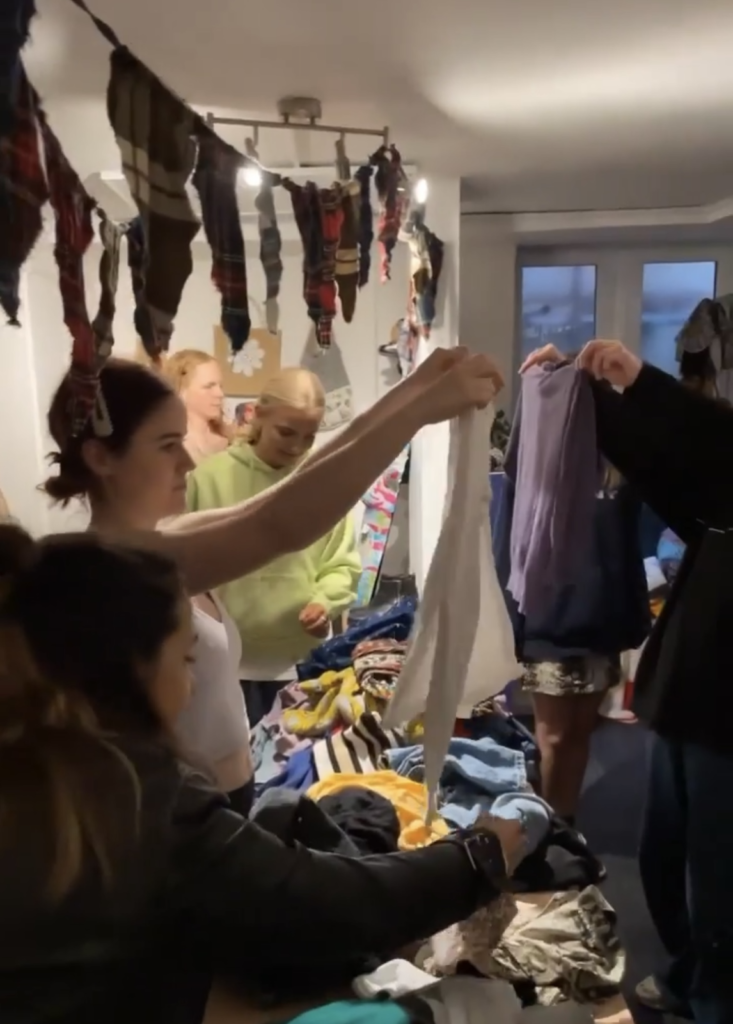
Upon returning to Bristol in September 2021, I established a partnership with The Emporium of Loveliness, a charity shop who supports the charity Empower the Gambia. Through our partnership, we hosted a series of monthly clothes swaps where young women would bring a minimum of 5 pieces to the swap, and we would put them on a table and start swapping with one another. There was a donation policy for the entry fee, letting people give what they could, and leftover unwanted pieces would then be donated directly back to the charity shop for merchandising. This was an incredibly successful initiative and established a lovely network of like-minded individuals. It encouraged us all to consider our environmentally-conscious future purchasing choices, instead opting to contribute to a small-scale circular economy and avoid first-hand and fast-fashion consumption. I was extremely proud to have worked alongside the Emporium and relished each event, meeting new and enthusiastic faces each time.

Even after moving to Switzerland, where far fewer second-hand shops are readily available than Bristol, I have found some great spots to buy pre-loved bits and have started many conversations with my friends here about making better choices, which don’t compromise their spending habits or preferences but gets them to think before buying, which is something we all should do more of. That was my main aim, to encourage people to think about whether they really need something or are just buying it for the sake of buying. This is because I’ve been there, and now as I sell much of my wardrobe on Vinted, I often kick myself for buying things that I’ve never worn, but at least by reselling on platforms such as Vinted, they will be given a new life and I am also reducing my own personal overconsumption. So, what started at the beginning of 2022, as a fight against fast-fashion, has led me to the realisation that fast-fashion is just the tip of the iceberg. 

Let’s hope that this new year brings about a greater awareness of the need for responsible consumption and production. I hope we can all make better, more informed, purchasing choices. Are you looking for a resolution to help the planet as well as yourself? Think about where your clothes are coming from, and where they’re going. Try out being a better steward of the planet, for this generation and for the many to come.

Categories
Perspective

The State of Undress

By Lawrence Gartshore.

The notion of clothing has always been one that has perturbed me. Quite simply, I cannot in all good reason understand its necessity. Why is it that we, as the human race, are the only species of animal to have evolved to be ashamed of our naked flesh?

Now, as a good theology student, I am well aware of the biblical narrative here. Whisk your minds back to your school chapel services and the tale of the Book of Genesis. Man was created to walk freely in the Garden of Eden, a perfect paradise devoid of any pain or suffering. Indeed, I use the word ‘man’ here keenly, for it was of course, according to the biblical account, the bloke who first stepped foot on the earth, with woman coming a little later from the ribcage of the chaps. All was perfectly fine until the woman, Eve, was tempted by the devil, in guise of a snake, to eat from the prohibited fruit tree and thus gain extra detrimental knowledge – a crucial part we are told, and indeed the bit that appears to tip God off as to the fall of mankind, was a newfound shame of nudity. They fashioned leaves to cover their most intimate parts, God thus saw that they had disobeyed him, and cursed humanity to wander the earth with pain and hardship for the rest of time.

Now, unless you happen to find yourself in the bible bashing Southern states of America, then few people would take this account as verbatim. Thus, the question remains – why on earth are we quite happy to have so much of our body on show, from the face and neck to one’s thighs, and yet publicly revealing the meat and two veg of a man, or the personalities of a woman, is to be feared.

Nowhere, I would argue, is this more ridiculous a concept than in the comfort of one’s own home. So many people I know would find the notion of being nude in front of their parents, or indeed their parents being nude in front of them, a horrifying state of affairs. Is this not mad? By walking around, tackle-out, at home, one is not in some way coming-on to members of one’s own family! I know Freud and his Oedipus concept, but I’m not sure even he believed that sons literally wish to shag their own mothers.

I do not contest that clothes do, in fact, have a place. Were I to find myself in the Arctic Circle, I should, for my own sense of bodily wellbeing, rather like to be sporting a coat. The world is such, and the human body poorly designed, that in order to avoid the pain of frostbite, protection can be a necessity. But in the temperance of mild heat – no damned need!

Now, and I must say that as a proud Englishman this is most painful to write, I think the Germans have the right idea here. You cannot walk through a street in Berlin without seeing a frankfurter wobbling in the breeze. And all power for it! Why is that any more affronting than seeing a morbidly obese male chest at a football match?

No; we, particularly as the British public, are prudes. The mere mention of sex drives most of us into a fit of uncontrollable giggles and, whilst I make no secret of my adoration for the feminine physique, I would so hope that men and women could exist perfectly well in unity without the need to hide our God given rigs.

So, I say my friends, let us move past our animalistic urges; let us throw off the shackles of our Orangutang ancestors; and let us allow the boys and girls to breathe. Life would be far simpler, and far better ventilated.

Categories
Perspective

Break the Cycle

By Lawrence Gartshore.

My mother doesn’t believe in depression. Don’t get me wrong, she isn’t some callous, emotionally distant parental figure. Far from it. As a single mother, she has had to fulfil the job of two parents for much of my childhood, working all hours that God sends and still finding time to spend with me. However, like so many from her generation, she doesn’t believe in depression.

To tell the truth, for much of my life I harboured some scepticism too; a product of this ‘traditional’ upbringing. Like her, I was a fan of the quintessentially British ‘stiff upper lip’ mentality. If you ever feel down, you should bottle it up and busy yourself with more cheerful things. Labelling depression as a condition only gives it credence in your mind – feeling down is a sign of weakness, and one simply has to snap out of it.

Then, the black dog struck me. In a way that felt rather selfish, that was the first time I understood what depression really was. It wasn’t the fleeting sadness, the down day, that had been instilled in me as a young boy. It was a war, fought against the most difficult opponent of all – one’s own mind.

That is, truly, the best analogy I can give to anyone who has had the fortune to avoid the condition themselves. War. The most destructive war. A war from the moment one wakes up in the morning to the moment one closes one’s eyes at night. A war so destructive, it saps the very energy from you that is needed to fight it. A war that clouds every decision one makes.

I am conscious that this shouldn’t turn into some pitiful anecdote, an alcoholics anonymous-esque confession, so might I rapidly come to my point.

Movember. One cannot escape the sea of dodgy growth and half-baked fluff that adorns the top lip of countless men across the nation at the moment. For many, Movember is little more than an opportunity to finally pursue the very masculine dream of wanting a moustache, whilst trying not to offend one’s better half – I have found, from personal experience, that women are generally less than keen on the sliver of facial hair that I am able to grow.

More than all of that, however, Movember is a chance to talk. As cliché as the old trope is, there is a profound truth in the saying ‘a problem shared is a problem halved’.

In the UK today, ¾ of all suicides are male. The biggest killer of men under the age of 45 in this country is suicide. It is not violent crime, nor accidents, nor disease that puts a man most at risk of death, but rather his own mind.

So, I urge all of you who have continued reading this far, please check in with your friends. Indeed, Movember places an emphasis on men’s mental wellbeing, but depression is pervasive and does not discriminate on who it affects. If your friends seem off, or abrasive, or irritable, do not ignore the signs. Ask them out for a pint, go for a walk with them, share your problems together. Begin to fight back against a condition that cripples so many. 

My mother’s generation may struggle to understand depression, but it just takes one to break the cycle.

Categories
Perspective

‘It’s Not a Phase, Mum!’

By Henry Munns.

Recently I’ve been asked by a few people whether my passion for climate change is ‘just a phase’. I don’t blame them; it certainly seems like one. Within the space of a few months, I went from having a comparatively basic understanding to having read more than twenty books, listened to over a hundred hours of podcasts, and written multiple articles on the subject. 

Perhaps it is a phase. It is quite likely that over the coming months my passion for climate change will wane. It’s a sombre realisation that something you are so interested in might fade into the background. I’m sure everyone reading this has been in that situation also.

From an early age, persistence is put on such a pedestal; I can picture it plastered on the wall of my kindergarten classroom next to a cartoon of a climber summiting a steep mountain. The school my sister attended for ten years even had the motto ‘per aspera ad astra’, meaning ‘through hardships to the stars’ – slightly cheesy but I understand the intention.

Confronting those doubts, has actually made me want to continue with my interest in climate change. It is definitely a worthy cause, could lead me to interesting career paths, and I find it fascinating.

However, I am prone to phases and obsessions. But as I’ve grown up, these phases have become more productive. I’ve been through a behavioural economics phase, and a quantitative finance phase, among others. 

Why am I saying all this?

Looking at the very early stages of my career, I believe that my tendency for obsession and phases, has become the most important character trait that I possess.

When you’re starting out, your value depends on these four main factors: how smart you are, how well you work with others, how hard you work, and what you know. The first two are, for the most part, set in stone. You can improve how you relate to others over time, and experience in the workforce certainly helps, but progress can be slow.

That leaves your work ethic and your knowledge as the two criteria that you can materially influence. Yet, from what I’ve seen, the latter is severely undervalued by young people. My experience tells me it really matters what you know. Knowledge gives you direct value, increases respect, and sets you apart from the competition. Most importantly, knowledge makes you confident — the impact of which cannot be understated. What’s more, diverse knowledge fosters a nuanced perspective, allowing for better judgement.

So, how can we accumulate diverse knowledge?

Learning follows the law of diminishing returns. Early on, you can learn a lot in a short-space of time. But the more you learn, the harder it is to learn more. 

This is why phases are so valuable. Whilst you’re in one, you become obsessed with the subject; as a result, your learning curve is steep, as seen in the above diagram. By contrast, passive learning, often received in education, is far slower, more akin to the black curve.

By timing the demise of a phase well you can capture the early steepness of the curve and exit before you hit diminishing returns. Provided you move quickly onto the next phase, this style of learning can massively accelerate your accumulation of knowledge. For someone prone to phases, moving on comes naturally.

The specialist or the generalist?

Having said all this, persistence is still extremely valuable. Scientists, engineers, and doctors all dedicate their careers to specific subject areas. What makes them so valuable is their persistence in the accumulation of knowledge in a chosen field.

Nonetheless, striving to be the ‘expert’ isn’t necessarily the best choice for everyone and many people can’t sustain interest in one particular pursuit for their entire career. It is no wonder people make more career changes than ever before. In many careers, diverse knowledge and experience is extremely valuable and can be a valuable tool. 

My advice is two-fold:

Firstly, ask yourself whether you are prone to phases? With that in mind, are you going down the right career path?

Secondly, foster your obsessions – immerse yourself as deeply as you can while your passion still burns. But if needed, allow it to fade away. Moving on does not negate the original interest, and the knowledge can be useful for future endeavours. 

By inhibiting someone’s willingness to step into that obsession, you’re also inhibiting their ability to step into obsessions that matter. Moreover, bungled, irrelevant, and niche phases only build on each-other, making you more interesting. Diversity isn’t a bad thing; it’s the best thing. I’m lucky those around me have, for the most part, fostered my phases, no matter how irrelevant. 

Considering the original question, perhaps someday I will lose my burning desire to learn all about climate change. But just because the fire ceases to burn does not mean I have lost passion or fascination. 

I still want to pursue this as I believe it is one of the most important issues of our time and is one I feel I can have a significant impact on. It may just fade into the background just enough that I can turn my attention to something new. I truly believe that something new will not only add value to both this interest and future ones. This might make it, ‘just a phase’ but I welcome that possibility with open arms.

Categories
Perspective

Inside Fight Night: What Does it Really Take? 

By Emily Mahoney.

Fight Night is a night organised by Wilder Events to raise money for their charities (BlOKes UK and SolidariTEE), promising 20 students competing in boxing matches, with each match consisting of 3 rounds that last 2 minutes. I am sure many of us have heard of it, but the big question remains, who is brave enough to sign up and fight? I sat down and interviewed my flatmate, Maddie ‘The Baddie’ Clark, who is taking part, to find out a bit more about the inner workings of Fight Night. What does it really take to embrace this commitment that is equal parts terrifying and exhilarating? 

Maddie tells me that she signed up as a challenge, stepping outside of her comfort zone to push herself both physically and mentally. She explains that ‘it has been really challenging, but in the best way possible, and it is for such amazing causes too!’, going on to talk about the incredible charities that the proceeds of Fight Night are contributing to. Maddie explained that Fight Night perfectly encapsulates two of the things most important to her, fitness and charity. The first charity, BlOKes Uk provides a free ‘online other community’ for men to share their experiences with mental illness, allowing them to meet and talk to men ‘from all walks of life’, ultimately challenging the narrative that men should bottle up their thoughts and feelings. The second, SolidariTEE, is a charity led ‘by students and young people, standing against the injustices faced by refugees, and supporting NGOs working directly with those affected by forced displacement’. 

I was intrigued to know about the training process, which Maddie summed up in three words, punctuated by her signature cackle; ‘Really. Bloody. Hard’. Despite this, she says that in the hour-long training (which happens 4-5 times a week) they ‘push you really hard, and I am really enjoying it, despite the skipping- which I hated at the beginning!’ Ultimately, she articulates that it is immensely ‘empowering to see the progress that everyone is making’. We spoke at length about the mental health benefits of boxing as a whole, and Maddie strongly believes that it is so positive for her routine and her mental clarity, alongside the obvious physical benefits. She explains that ‘it is such an incredible way to get all your anger out for that hour, it is just so cathartic! It fosters this real sense of mindfulness, if you’re having a bad day when you enter that boxing ring everything goes out the window and all you can focus on is the person in front of you’. 

Despite her love for acting and being up on stage, even Maddie is still incredibly nervous for the fight, both due to her admiration of her opponent and the size of the audience but she continues to create a positive mindset and reminds herself that she has ‘put in the hard work for it’ as well as to ‘enjoy it and enjoy the process’, but she still ‘would like to come back home without a broken nose!’.

She continually sings the praises of the team at Go The Distance- Durham Community Boxing Club, which is a charity itself, set up to support people who have gone through domestic violence and abuse, and more generally for mental wellbeing as a whole. Maddie says that the support of the coaches is getting her through the training process, alongside the sense of community that has developed between the boxers. Speaking of this community she says that ‘everyone is really supportive during sparring and it is such a nice group. Is quite hard with boxing because everyone wants to train as hard as they can and essentially win, so you’re in your own mental headspace but that support is still there for each other because everyone knows how tough it really is’. Despite her parents being apprehensive at first, after explaining the training process her whole family is excited and supportive, with her brother trekking up to Durham from Marlow to show his support ringside, and she has promised her mum ‘for you I won’t get punched in the face!’. 

When asked if she would recommend signing up to Fight Night she said ‘it’s been an amazing experience in terms of boxing, everyone should get into it at some point! It has been so good for my physical and mental health’. Maddie suggested that Aggression Sessions is also a good alternative for people who want to get involved with boxing for a cause, training is over a longer period, as the hectic rush of 6 weeks of training can be quite intense for some! 

In summary, Maddie says ‘I am as ready as I’ll ever be, I have made some great friends and ultimately, I feel stronger and more empowered than I ever have before’.